
Microsoft’s September 2026 Patch Tuesday introduced an unusually important vulnerability for organizations running Windows-based DNS infrastructure: CVE-2026-69730, a critical remote code execution vulnerability in Windows DNS Server.
The vulnerability carries a CVSS 3.1 base score of 9.8 out of 10 and is classified as a use-after-free, or CWE-416. According to the available Microsoft vulnerability data, an unauthorized attacker can potentially exploit the vulnerable Windows DNS implementation over a network. The CVSS vector is particularly concerning: network-accessible, low attack complexity, no privileges required, and no user interaction required. (SecAlerts)
Microsoft has also assessed CVE-2026-69730 as “Exploitation More Likely.” That designation does not mean exploitation has already been detected. Rather, it means Microsoft considers the vulnerability more likely than many other newly patched flaws to attract working exploits. Tenable highlighted CVE-2026-69730 as the most serious member of a large cluster of Windows DNS vulnerabilities fixed in September 2026. (Tenable)
For enterprise defenders, the combination matters more than the raw number:
DNS Server + unauthenticated remote attack + low complexity + no user interaction + memory corruption + potential RCE.
And in a Windows enterprise network, compromising a DNS server may carry consequences far beyond manipulating name resolution.
What Is CVE-2026-69730?
CVE-2026-69730 is a Windows DNS Server Remote Code Execution Vulnerability published as part of Microsoft’s September 8, 2026 security updates.
Its core weakness is described as a use-after-free condition in Windows DNS. Successful exploitation could allow an unauthorized remote attacker to execute code on an affected machine. Cisco Talos independently lists the vulnerability as a Windows DNS Server RCE associated with use-after-free and a CVSS base score of 9.8. (Cisco Talos Blog)
The most important characteristics are:
| Property | CVE-2026-69730 |
|---|---|
| CVE | CVE-2026-69730 |
| Component | Windows DNS Server |
| Vulnerability type | Use-after-free |
| CWE | CWE-416 |
| Severity | Critical |
| CVSS 3.1 | 9.8 |
| Attack vector | Network |
| Attack complexity | Low |
| Privileges required | None |
| User interaction | None |
| Confidentiality impact | High |
| Integrity impact | High |
| Availability impact | High |
| Microsoft exploitability assessment | Exploitation More Likely |
| Confirmed exploited in the wild | No public confirmation as of September 9, 2026 |
The CVSS base vector is:
CVSS:3.1/AV:N/AC:L/PR:N/UI:N/S:U/C:H/I:H/A:HThat vector is close to the worst possible profile for a remotely reachable enterprise service. An attacker does not need an existing Windows account, does not need a victim to open a document, and does not need local access to the server. (SecAlerts)
Why CVE-2026-69730 Is More Dangerous Than an Ordinary DNS Bug
Not every DNS vulnerability deserves emergency treatment.
Some DNS vulnerabilities merely disclose information. Others can crash a resolver or authoritative server. Some require authenticated access, unusual configurations, or complex race conditions.
CVE-2026-69730 has a considerably more dangerous combination of properties.
The vulnerable component accepts network traffic by design. Microsoft describes an unauthorized attacker as potentially reaching the vulnerable code through a specially crafted packet. Tenable similarly reports that an unauthenticated remote attacker could send a crafted packet to exploit the Windows DNS use-after-free condition and achieve remote code execution. (Tenable)
That distinction is fundamental.
A vulnerable application that requires a malicious document still depends on delivery and user interaction. A local privilege escalation vulnerability requires the attacker to establish an initial foothold first.
A vulnerable DNS service, by contrast, may already be listening for traffic continuously.
The security boundary therefore moves from:
Attacker
   ↓
Phishing / Initial Access
   ↓
User Interaction
   ↓
Local Execution
toward a potentially much shorter path:
Attacker-controlled network traffic
                ↓
        Windows DNS Server
                ↓
        Memory corruption
                ↓
     Remote code execution
The second scenario removes multiple prerequisites that normally slow an attacker down.
How the Use-After-Free Weakness Works
Microsoft has not publicly released the low-level exploit mechanics necessary to build a working exploit for CVE-2026-69730, so it would be inaccurate to claim that a particular DNS record type, message field, opcode, transport, or parsing function is definitively responsible.
What Microsoft has disclosed is the weakness class: use-after-free.
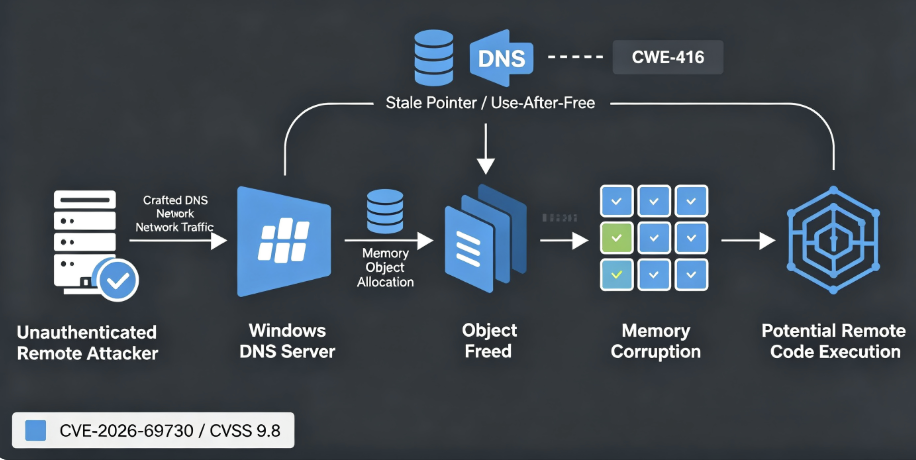
A use-after-free occurs when software continues using a memory object after that object has already been released.
Conceptually, consider a simplified program:
object = allocate();

process(object);

free(object);

/* object should no longer be used */

access(object);
Once free(object) executes, the memory may be reused for something else. If the program later assumes that the old pointer still refers to a valid object, behavior becomes unpredictable.
The result may be a crash.
But under exploitable conditions, an attacker may attempt to influence what data occupies the freed memory before the stale pointer is used again.
The conceptual sequence becomes:
1. DNS Server allocates an internal object
2. Processing changes the object's lifecycle
3. The object is freed
4. A stale reference remains
5. Attacker-controlled processing influences memory reuse
6. Windows DNS references the stale object
7. Memory corruption occurs
8. Control flow may become attacker-influenced
9. Arbitrary code execution becomes possible
This is why CWE-416 vulnerabilities can range from relatively simple denial-of-service conditions to severe remote code execution vulnerabilities.
Microsoft’s CVSS assessment for CVE-2026-69730 indicates that the company believes the consequences can reach complete confidentiality, integrity, and availability impact rather than being limited to a DNS service crash. (SecAlerts)
Why the CVSS 9.8 Rating Matters
The 9.8 score is not simply a marketing severity label.
Every part of the CVSS vector contributes to the risk.
AV:N means the vulnerable functionality can be attacked through a network.
AC:L means exploitation is not assessed as depending on highly specialized environmental conditions.
PR:N means attackers do not require an authenticated account.
UI:N means no administrator, employee, or other victim needs to interact with malicious content.
Finally:
C:H
I:H
A:H
means a successful compromise may cause high impact to confidentiality, integrity, and availability.
Together, those characteristics explain why organizations should treat CVE-2026-69730 differently from many of the hundreds of vulnerabilities included in the September Patch Tuesday release.
The Active Directory Problem
The vulnerability becomes particularly important when Windows DNS is part of an Active Directory environment.
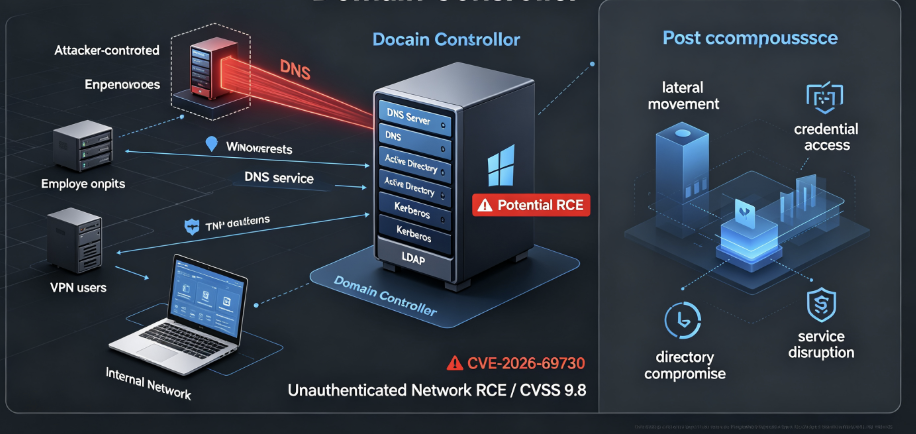
DNS is deeply integrated into Active Directory. Domain-joined machines use DNS to discover services including domain controllers, Kerberos endpoints, LDAP services, and Global Catalog servers.
More importantly, Windows DNS is frequently deployed directly on domain controllers.
CrowdStrike specifically highlighted this architectural issue when discussing CVE-2026-69730, noting that DNS commonly runs on domain controllers in Active Directory environments. As a result, successful exploitation of an AD-integrated DNS server could potentially translate into code execution on infrastructure that also performs domain-controller functions. (CrowdStrike.com)
That dramatically changes the risk calculation.
Consider an environment containing:
Employee endpoints
      │
      ├── DNS queries
      │
      ▼
Domain Controller
 ├── DNS Server
 ├── Kerberos
 ├── LDAP
 ├── Active Directory
 └── Authentication services
A company may think of DNS as ordinary infrastructure.
An attacker may see the same host as an authentication control plane.
If the DNS service is compromised on a domain controller, the security concern is therefore not restricted to poisoned DNS responses.
The attacker may have reached one of the most trusted systems in the Windows environment.
CVE-2026-69730 Is Not Currently an Active Zero-Day
This distinction is important because several September 2026 Microsoft vulnerabilities really were already being exploited.
Microsoft’s September security release included two confirmed exploited vulnerabilities, including CVE-2026-81963 in Windows Update Stack and CVE-2026-85880 in Windows ALPC. Security researchers and CISA treated those separately because exploitation had actually been observed. (Qualys)
CVE-2026-69730 does not currently fall into that category.
Microsoft’s exploitability assessment is:
Exploitation More Likely
not:
Exploitation Detected
That difference should be preserved in technical reporting.
As of September 9, 2026, there is no publicly confirmed evidence in the sources reviewed here that CVE-2026-69730 has been exploited in the wild. (Verinestory)
A headline such as:
CVE-2026-69730 Windows DNS Zero-Day Under Active Exploitation
would therefore currently be misleading.
A more accurate description is:
Critical unauthenticated Windows DNS Server RCE assessed as more likely to be exploited.
That is already severe enough without overstating the available evidence.
Affected Windows Versions
Microsoft’s vulnerability data covers multiple generations of Windows Server infrastructure.
Available CVE data shows affected systems including Windows Server 2012, Windows Server 2012 R2, Windows Server 2016, Windows Server 2019, Windows Server 2022, and Windows Server 2025, including relevant Server Core installations. Windows 10 versions 1607 and 1809 are also represented in the affected-product data. (Vulners)
Reported corrected build levels include:
Windows Server 2012:
6.2.9200.26349

Windows Server 2012 R2:
6.3.9600.23397

Windows Server 2016 / Windows 10 1607:
10.0.14393.9512

Windows Server 2019 / Windows 10 1809:
10.0.17763.9245

Windows Server 2022:
10.0.20348.5622

Windows Server 2025:
10.0.26100.33438
The corresponding security updates vary by operating-system branch. For example, vulnerability aggregation based on Microsoft’s published data maps Server 2022 to KB5122882, Server 2019 to KB5122876, and Server 2025 to KB5122871. Administrators should ultimately confirm deployment against the Microsoft Security Update Guide and their exact servicing branch rather than relying exclusively on version-family assumptions. (SecAlerts)
First Question for Defenders: Is the DNS Server Role Installed?
Not every Windows machine is exposed to the vulnerable server functionality.
The first task is therefore identifying systems running the Windows DNS Server role.
On Windows Server, administrators can query installed roles with PowerShell:
Get-WindowsFeature DNSA broader inventory command can be used:
Get-WindowsFeature |
    Where-Object {$_.Installed -eq $true}
To verify whether the DNS Server service exists and is running:
Get-Service DNSAdministrators can also inspect listening network services:
Get-NetTCPConnection -LocalPort 53 -ErrorAction SilentlyContinueand:
Get-NetUDPEndpoint -LocalPort 53 -ErrorAction SilentlyContinueThese commands do not test exploitation. They simply help establish whether a host is actually functioning as a DNS server and therefore deserves vulnerability-specific investigation.
Identifying the Installed Windows Build
The next step is determining whether the host has received Microsoft’s September security update.
Useful commands include:
winveror:
Get-ComputerInfo |
    Select-Object WindowsProductName, WindowsVersion, OsBuildNumber
Administrators can also inspect installed hotfixes:
Get-HotFix |
    Sort-Object InstalledOn -Descending |
    Select-Object -First 20
For enterprise environments, querying servers individually is not sufficient. Vulnerability management should correlate three datasets:
Operating system version
        +
DNS Server role
        +
September 2026 patch status
That produces a much more useful exposure map than simply searching for every Windows host affected by the underlying OS release.
Internet Exposure Should Be Treated Separately
A Windows DNS server accessible only from tightly controlled internal networks represents a different risk profile from one accepting arbitrary DNS requests from the public Internet.
That does not make internal servers safe.
An attacker who compromises a workstation, VPN account, branch-office system, Wi-Fi network, or other internal foothold may still gain network access to the DNS server.
But prioritization should begin with the shortest attack paths.
A practical risk model is:
Internet-facing vulnerable DNS
              ↓
        Highest urgency

Reachable from user networks
              ↓
        Very high urgency

Reachable from server networks
              ↓
        High urgency

Strongly segmented DNS infrastructure
              ↓
        Still patch urgently
The fundamental remediation remains Microsoft’s update.
Network isolation reduces reachable attack surface but does not correct the vulnerable memory-management logic.
What Could Successful Exploitation Mean?
The CVSS vector rates confidentiality, integrity, and availability impact as high. (SecAlerts)
That means defenders should model the vulnerability as potential system compromise rather than simply DNS interruption.
On a standalone DNS server, successful code execution could theoretically allow an attacker to establish persistence, access data available to the compromised service or host, interfere with DNS resolution, use the server as an internal pivot, or launch additional attacks against neighboring infrastructure.
On a DNS-enabled domain controller, the stakes may be considerably higher because the compromised machine participates directly in Active Directory.
The precise privileges or execution context achieved by a real exploit have not been publicly documented in sufficient technical detail to justify more specific claims.
This distinction matters.
Security analysis should not automatically jump from:
Remote Code Executionto:
Guaranteed Domain AdminThose are not equivalent statements.
What can reasonably be said is that obtaining arbitrary code execution on a domain controller-class system represents a severe security event and should be treated accordingly.
Could CVE-2026-69730 Become Wormable?
It is tempting to call every unauthenticated network RCE “wormable.”
That would be premature here.
CVE-2026-69730 has several attributes that can enable rapid exploitation: network reachability, no authentication, low complexity, no user interaction, and a widely deployed infrastructure service.
But actual wormability depends on substantially more than CVSS.
A reliable self-propagating exploit would require attackers to understand the precise vulnerable message path, develop stable memory corruption primitives across relevant Windows versions, survive modern exploit mitigations, obtain reliable code execution, and automatically identify and infect subsequent vulnerable systems.
None of that is established merely by a 9.8 score.
The correct conclusion is therefore that CVE-2026-69730 has an unusually attractive attack profile for exploit developers, not that a worm already exists.
Why Microsoft’s “Exploitation More Likely” Rating Matters
Microsoft’s exploitability assessment deserves special attention.
September 2026 contained an extraordinary number of vulnerabilities. Depending on counting methodology, security vendors reported roughly 966 to 974 Microsoft issues, with more than one hundred classified as Critical. Qualys counted 974 vulnerabilities and 113 Critical issues, while BleepingComputer’s Patch Tuesday-specific methodology counted 966 flaws. (Qualys)
Organizations cannot realistically treat nearly a thousand vulnerabilities as equally urgent.
Exploitability becomes an important sorting mechanism.
Tenable notes that CVE-2026-69730 was one of several Windows DNS Server RCE vulnerabilities patched that month, but it stands out because Microsoft rated it Exploitation More Likely, while most of the other DNS flaws received “Less Likely” or “Unlikely” assessments. (Tenable)
That is precisely why CVE-2026-69730 deserves a higher patching priority than simply scanning the September bulletin for every CVSS 8.x issue.
September 2026 Included a Cluster of Windows DNS Vulnerabilities
CVE-2026-69730 did not appear alone.
Microsoft fixed numerous Windows DNS vulnerabilities in the same Patch Tuesday, including multiple remote code execution issues.
Tenable highlighted additional DNS Server RCEs including CVE-2026-69551, CVE-2026-69813, CVE-2026-69858, CVE-2026-77505, CVE-2026-69782, CVE-2026-69827, CVE-2026-69989, and CVE-2026-72928. (Tenable)
Qualys likewise identified several Critical Windows DNS Server RCE vulnerabilities and reported that multiple vulnerabilities were associated with use-after-free conditions. (Qualys)
This clustering matters operationally.
Organizations should not patch only CVE-2026-69730 and assume their Windows DNS exposure is finished.
The September cumulative security update addresses a broader attack surface.
For defenders, that reinforces a simple strategy:
deploy the applicable Microsoft security update rather than attempting to create a one-CVE workaround.
Detecting Possible Exploitation Attempts
At the moment, defenders face an important limitation: there is no widely published, authoritative packet signature for CVE-2026-69730 that can reliably distinguish exploitation from ordinary DNS traffic.
That is not unusual immediately after Patch Tuesday.
The vulnerability description tells defenders the affected component and weakness type but does not disclose enough packet-level detail to safely construct a precise exploit signature.
Security teams should therefore avoid creating extremely broad IDS rules such as:
alert on every unusual DNS packetSuch rules quickly become noisy and provide little operational value.
Instead, defenders should combine network and endpoint telemetry.
Look for abnormal DNS Server behavior immediately followed by unexpected process execution, unusual outbound connections, service termination, memory-access exceptions, system instability, or activity inconsistent with the server’s normal role.
One especially useful conceptual detection chain is:
Unusual inbound DNS traffic
          ↓
dns.exe abnormal behavior
          ↓
Crash / memory fault / process anomaly
          ↓
Unexpected child process
          ↓
Outbound connection
          ↓
Credential or lateral movement activity
No single step proves CVE-2026-69730 exploitation.
The value comes from correlation.
Why Monitoring dns.exe Matters
On Microsoft DNS Server systems, defenders should establish a behavioral baseline for the DNS service rather than monitoring port 53 alone.
A DNS server normally receives large volumes of network traffic, so network volume by itself may not indicate compromise.
Endpoint telemetry can provide additional context.
Security teams should pay particular attention to unexpected executable launches associated with the DNS service, suspicious memory-access failures, abnormal service restarts, and outbound communication from infrastructure servers that normally have tightly constrained network behavior.
An attacker obtaining code execution through a network service typically needs to transition from initial execution toward persistence, command and control, discovery, credential access, or lateral movement.
Those post-exploitation actions may be more visible than the memory-corruption event itself.
DNS Infrastructure Should Not Have Unlimited Network Freedom
CVE-2026-69730 is also a reminder that infrastructure servers should not automatically receive unrestricted outbound connectivity.
A DNS server needs to perform specific network functions.
That does not necessarily mean it should initiate arbitrary SMB, RDP, PowerShell remoting, HTTP, or other connections toward every endpoint in the company.
If infrastructure segmentation is properly designed, compromise of one service becomes harder to turn into total network compromise.
Consider the difference between:
DNS Server
   ↓
Can connect anywhere
and:
DNS Server
   ↓
Only approved DNS upstreams
Only required management systems
Restricted server segments
Blocked unnecessary outbound access
The second architecture does not prevent CVE-2026-69730 itself.
It reduces the attacker’s options after exploitation.
Domain Controllers Deserve the Highest Priority
Organizations running Microsoft Active Directory should identify whether the affected DNS service resides on domain controllers.
If it does, CVE-2026-69730 should be included in the organization’s highest-priority server patching queue.
A reasonable prioritization model is:
Vulnerable DNS + Domain Controller + broad network exposure
                           ↓
                    Emergency priority

Vulnerable DNS + Domain Controller + segmented exposure
                           ↓
                    Critical priority

Vulnerable standalone DNS
                           ↓
                    Critical priority
The distinction is about patch sequencing, not whether the patch is necessary.
Every affected deployment should ultimately receive Microsoft’s fix.
Safe Validation for Security Teams
Organizations performing authorized security validation should separate exposure verification from exploit reproduction.
Exposure verification can often establish most of what defenders need without executing malicious payloads.
A safe validation workflow is:
Identify Windows DNS servers
        ↓
Determine OS release
        ↓
Determine build number
        ↓
Confirm September security update
        ↓
Map reachable network paths
        ↓
Determine whether DNS is on a DC
        ↓
Assign remediation priority
For many organizations, that is enough.
If a vulnerable Windows Server 2022 host is running DNS, reachable from untrusted network segments, and remains below Microsoft’s corrected build, security teams do not need to crash or compromise the production server to prove that patching is required.
This is especially important for DNS and Active Directory infrastructure where aggressive exploit testing can disrupt critical business services.
Example PowerShell Exposure Check
Administrators can combine several checks into a simple defensive inventory script:
$dnsFeature = Get-WindowsFeature DNS -ErrorAction SilentlyContinue
$dnsService = Get-Service DNS -ErrorAction SilentlyContinue
$os = Get-ComputerInfo

Write-Host "Windows Product:" $os.WindowsProductName
Write-Host "Windows Version:" $os.WindowsVersion
Write-Host "OS Build:" $os.OsBuildNumber

if ($dnsFeature -and $dnsFeature.Installed) {
    Write-Host "DNS Server Role: INSTALLED"
} else {
    Write-Host "DNS Server Role: NOT DETECTED"
}

if ($dnsService) {
    Write-Host "DNS Service Status:" $dnsService.Status
}
The script does not determine vulnerability automatically because applicability depends on the precise servicing state.
Its purpose is inventory.
The returned build information should be compared with Microsoft’s updated versions for the affected operating system.
Patching Is the Primary Remediation
Because the vulnerability exists in the Windows DNS Server implementation itself, Microsoft’s September 2026 security update is the principal remediation.
Organizations should prioritize servers according to exposure and business criticality, but should avoid delaying DNS infrastructure simply because CVE-2026-69730 has not yet been confirmed as exploited.
“Exploitation More Likely” exists specifically to help defenders act before exploitation becomes widespread. (Tenable)
In practice, defenders should identify vulnerable DNS servers, determine which ones are domain controllers, patch Internet- or user-network-reachable systems first, verify corrected Windows builds after reboot, and continue monitoring those hosts for abnormal behavior.
What If You Cannot Patch Immediately?
Some environments cannot deploy cumulative updates immediately because of application certification, operational dependencies, maintenance windows, or high-availability requirements.
In that situation, network controls become temporary risk-reduction mechanisms.
Restrict who can send DNS requests to the affected server.
Remove unnecessary Internet exposure.
Prevent guest, IoT, workstation, or untrusted VLANs from directly accessing domain-controller DNS unless required.
Use internal recursive resolvers or forwarding architectures where appropriate.
Restrict management access to dedicated administrative networks.
Limit unnecessary outbound communication from DNS infrastructure.
These actions may reduce reachable attack paths.
They should not be interpreted as equivalent to installing Microsoft’s security update.
The underlying vulnerable code remains present until patched.
CVE-2026-69730 and External DNS Exposure
Organizations should also distinguish between authoritative public DNS and internal Active Directory DNS.
Many enterprises use cloud or third-party authoritative DNS services for public domains while keeping Microsoft DNS strictly internal.
That architecture may mean CVE-2026-69730 is not directly Internet exposed.
However, internal reachability still matters.
Assume an attacker compromises an employee endpoint through phishing.
The attack graph may then look like:
Compromised workstation
          ↓
Internal network
          ↓
Windows DNS / Domain Controller
          ↓
CVE-2026-69730
          ↓
Potential server compromise
Security teams should therefore not conclude:
“Our domain controller isn’t publicly accessible, so this vulnerability doesn’t matter.”
Internal lateral attack surfaces are critical because many modern intrusions begin with a relatively low-value endpoint and then target authentication infrastructure.
Why DNS Is an Attractive Post-Compromise Target
DNS occupies an unusually powerful position in enterprise networks.
Almost every system depends on it.
Attackers compromise infrastructure systems not only because of the permissions available on the machine but because of their central position in the network.
A compromised DNS infrastructure server may offer attackers opportunities to observe internal naming patterns, identify services, disrupt availability, interfere with network resolution, and use a trusted server as a staging point for further attacks.
When DNS also runs on a domain controller, its strategic value increases further.
This is why defenders should evaluate CVE-2026-69730 according to asset criticality, not merely CVSS.
CVSS Alone Is Not Enough
Two organizations can both have CVE-2026-69730 and face very different risks.
Organization A might run an isolated Windows DNS test server accessible from one laboratory VLAN.
Organization B might run vulnerable Windows DNS on domain controllers serving thousands of employees and dozens of network segments.
The CVSS score remains 9.8 in both cases.
The actual organizational risk does not.
A better model is:
CVE severity
      ×
Network reachability
      ×
Asset privilege
      ×
Business criticality
      ×
Existing segmentation
      ×
Patch status
For CVE-2026-69730, the worst-case combination is clearly an unpatched, broadly reachable DNS service running on a domain controller.
Incident Response Considerations
If defenders believe an affected DNS server may already have been targeted, simply installing the patch should not automatically close the investigation.
Patching prevents future exploitation of the corrected vulnerability.
It does not remove persistence that may already have been established.
Security teams should review endpoint detection data, process creation events, service modifications, scheduled tasks, unusual PowerShell activity, new accounts, outbound connections, authentication activity, and lateral movement originating from the DNS server.
For domain controllers, suspicious activity deserves an especially conservative response because credentials and directory integrity may be involved.
Again, no public CVE-specific IOC currently proves that an event represents exploitation of CVE-2026-69730.
Investigation therefore needs to focus on behavioral evidence.
Why CVE-2026-69730 Should Be Patched Before Many Higher-Profile Bugs
Patch Tuesday creates a difficult problem for security teams.
There may be hundreds of vulnerabilities but only a limited maintenance window.
A useful prioritization strategy begins with actively exploited vulnerabilities, followed closely by remotely exploitable vulnerabilities affecting high-value infrastructure.
That puts CVE-2026-69730 near the top of the September 2026 queue.
The fact that it has not yet been confirmed exploited should not make it low priority.
The vulnerability provides exactly the conditions attackers typically value:
Remote reachability
No authentication
No user interaction
Low attack complexity
High-value server component
Potential RCE
Microsoft "More Likely" assessment
The vulnerability’s location inside Windows DNS makes those properties more consequential than they would be in many ordinary desktop applications.
Frequently Asked Questions About CVE-2026-69730
Is CVE-2026-69730 critical?
Yes. It has a CVSS 3.1 base score of 9.8 and Microsoft’s severity classification is Critical. (SecAlerts)
Is CVE-2026-69730 remotely exploitable?
Yes. The CVSS vector specifies AV:N, meaning network attack vector, and Microsoft’s description indicates that an unauthorized attacker may execute code over a network. (Vulners)
Does exploitation require authentication?
No. The CVSS vector specifies PR:N, or no privileges required.
Does a user need to click anything?
No. The CVSS vector specifies UI:N, meaning no user interaction is required.
What type of vulnerability is CVE-2026-69730?
It is a use-after-free vulnerability, classified as CWE-416. (Cisco Talos Blog)
Is CVE-2026-69730 being actively exploited?
There was no publicly confirmed active exploitation as of September 9, 2026 in the sources reviewed for this article. Microsoft instead classifies exploitation as More Likely. The two confirmed exploited Microsoft vulnerabilities in the September release are separate issues. (Verinestory)
Is CVE-2026-69730 a zero-day?
It should not currently be described as an actively exploited zero-day. Microsoft’s patch was released on September 8, 2026, and public sources do not show exploitation predating the fix.
Does it affect Windows DNS Server?
Yes. The affected component is explicitly Windows DNS Server.
Are domain controllers at risk?
A domain controller running an affected Windows DNS Server role may be exposed. CrowdStrike has specifically highlighted the importance of DNS and domain-controller co-location when assessing this vulnerability. (CrowdStrike.com)
Does Windows Server 2025 have a fix?
Yes. Published vulnerability data shows Windows Server 2025 builds below 10.0.26100.33438 as affected, with the corrected build at 10.0.26100.33438. (SecAlerts)
Does patching require disabling DNS?
No general requirement to permanently disable Windows DNS has been published. Applying Microsoft’s applicable security update is the preferred remediation.
Final Assessment
CVE-2026-69730 is one of the most important server-side vulnerabilities in Microsoft’s September 2026 security release.
It combines a CVSS 9.8 score, network-based attack vector, low attack complexity, no authentication, no user interaction, a use-after-free memory corruption condition, and potential remote code execution inside Windows DNS Server. Microsoft has additionally rated exploitation More Likely. (Tenable)
It is equally important not to exaggerate the current threat intelligence. Unlike CVE-2026-81963 and CVE-2026-85880, there is currently no public evidence that CVE-2026-69730 was already being exploited when Microsoft issued its September 8 updates. (Krebs on Security)
But defenders should not wait for that status to change.
For organizations using Active Directory, the most urgent systems to inspect are Windows DNS servers running on domain controllers or reachable from broad internal or external network segments. Those machines combine a highly attractive exploitation profile with unusually valuable infrastructure placement.
The operational response is straightforward: identify servers running the DNS role, compare their Windows build and September update status against Microsoft’s fixes, patch vulnerable systems rapidly, reduce unnecessary DNS exposure, and monitor high-value DNS infrastructure for abnormal service and post-exploitation behavior.
CVE-2026-69730 is not yet a story about confirmed mass exploitation.
It is a warning that defenders have been given a patch before that story necessarily begins.


 English
  German
  French
  Spanish
  Portuguese
  Japanese
  Korean
  Hindi
Hindi  Arabic
  Turkish
  Hebrew