
Choose DAST when your immediate requirement is a configured, repeatable check of a running application. Evaluate agentic pentesting when the missing work is selecting and investigating a sequence of actions, interpreting application state, and assembling evidence. The two can belong in the same assessment. A product labeled agentic may run a scanner, and a DAST platform may support sophisticated authentication, APIs, scripts, and AI features. Compare the actual workflow you will operate rather than buying a category name.
For a team deciding where to spend its next testing budget, the useful question is specific: which unresolved security decision will this purchase help us make? An existing scan may already provide dependable feedback for known checks. Another subscription makes sense only if it supplies useful additional work, reduces a measured operating burden, or meets a delivery requirement the current process cannot satisfy.
This guide is published by Penligent and discusses its product as one evaluation option. Official documentation was checked on October 27, 2026. The comparison is a decision framework, not a performance ranking. The offline policy experiment below was executed for this article; no DAST or AI pentesting product was run in that experiment. The application, identities, workflow, acceptance criteria, and purchasing worksheets are original synthetic examples.
DAST vs agentic pentesting at a glance
DAST describes dynamic application security testing: examining a running application through its exposed behavior. Agentic pentesting describes an approach in which a system selects actions, uses tools, observes results, and adapts its next steps toward an assessment objective. These descriptions address different aspects of testing. They do not establish a universal boundary between products or prove that either approach covers a particular vulnerability.
| Decision | Configured DAST workflow to evaluate | Agentic workflow to evaluate | Evidence to request |
|---|---|---|---|
| Repeat known runtime checks | A maintained plan with explicit targets and checks | A constrained task that repeats the agreed procedure | Same build, identities, actions, and comparable output |
| Reach authenticated functionality | Login, session verification, imports, and recorded navigation | Login handling, tool access, browser state, and recovery | Proof of the active identity at the relevant action |
| Investigate a workflow boundary | Explicit cases, scripts, extensions, or tester guidance | A supplied policy and a bounded investigation task | Expected rule, observed state, and reproducible sequence |
| Explain a finding | Request/response evidence with reviewer interpretation | Tool artifacts and interpretation that a reviewer can challenge | Sanitized artifacts independent of generated prose |
| Operate after a release | Stable configuration and owned maintenance | Versioned task context and visible interventions | Retest record plus legitimate-use controls |
| Make a purchase | Cost of coverage and maintaining the plan | Cost of useful investigation and reviewing the result | Total operating effort, not the length of the report |
Treat each row as a question for a pilot. It does not assign a capability to every product in either column. A configured scanner may meet your access-control requirement; an agent may fail before reaching the protected feature. Conversely, a guided investigation may expose a missing workflow case your recurring configuration never described. Neither outcome should be assumed before running the relevant test.
Start by listing the checks that already work. Preserve their configuration, test data, ownership, and output history while evaluating a new approach. Removing a reliable release check to make room for a demonstration creates an unnecessary blind spot. A replacement decision should name the existing responsibility being transferred and show that the new process can carry it under ordinary operating conditions.
Do not compare a configured agent with an unconfigured scanner
Burp Scanner’s documentation describes crawling and auditing as distinct parts of its scanning workflow. For a comparison, record what the selected configuration actually visited and what it tested. An agent that receives a prepared route, valid accounts, and a written business rule has a different starting position from a scanner launched with a public URL alone. Comparing their final finding counts would hide that preparation difference.
The same caution applies to authentication. ZAP’s authentication documentation describes authentication within contexts and associated user/session configuration. This is enough to reject the blanket claim that DAST necessarily stops at the login page. It is not proof that every configuration will authenticate successfully against your application. That still needs observation in your environment.
Likewise, ZAP’s Access Control Testing add-on documents access-control testing support. The fair question is whether the configured route, users, and expected access rules express your requirement. Do not classify a result as an inherent category limitation when the missing element was an unused supported feature. Record the setup effort instead; that effort may still materially affect a purchase.
A useful comparison gives each candidate a reasonable, documented setup appropriate to the intended operator. If a vendor engineer spends hours preparing one candidate, show those hours. If your own engineer writes a script for another, show that contribution too. Assistance does not invalidate an evaluation, but invisible assistance makes the result difficult to reproduce and the eventual operating cost difficult to predict.
There are two legitimate questions here. The first is capability under supported configuration: can this route perform the required work? The second is operational suitability: can our team keep that route working at an acceptable cost? A specialist-assisted success can answer the first while leaving the second unresolved. Keep those decisions separate in the evaluation record instead of compressing them into a single winner label.
Define the application decision before the test
Consider a fictional expense-review application. Tenant A has an ordinary member and a reviewer. Tenant B has a separate reviewer. A member can read permitted expenses but cannot approve them. A reviewer can approve a submitted expense in its own tenant. A draft cannot be approved. The example is intentionally small enough that a reviewer can state the expected result of each action before any tool operates.
The buyer’s question is whether the release preserves those boundaries. That question differs from asking whether the application has any vulnerabilities, whether a crawler finds many URLs, or whether an agent can complete an elaborate demonstration. A narrow policy question creates a useful starting point because the team knows what evidence would change the release decision and what result would remain inconclusive.
Write down the deployment identifier, permitted identities, synthetic records, relevant workflow states, and allowed actions. Include the negative and positive cases together. A reviewer should be able to approve a submitted record in its tenant; the same reviewer should be denied for a draft. A successful denial without a successful permitted action can result from a broken setup rather than a functioning boundary.
Use a security requirement as a reference when that improves precision. The OWASP Application Security Verification Standard provides a framework for technical security requirements and procurement. If the evaluation maps to a specific requirement, record the standard version and exact requirement after checking it. A broad statement such as “OWASP compliant” is not a substitute for describing the action actually examined.
Give the application owner responsibility for the expected policy. A tool operator may identify an ambiguous behavior, but the tool should not decide the intended business permission from a role name alone. Some applications permit delegated approval or cross-tenant collaboration. Those exceptions change the expected outcome. Resolve them before turning an observed response into a finding about unauthorized access.
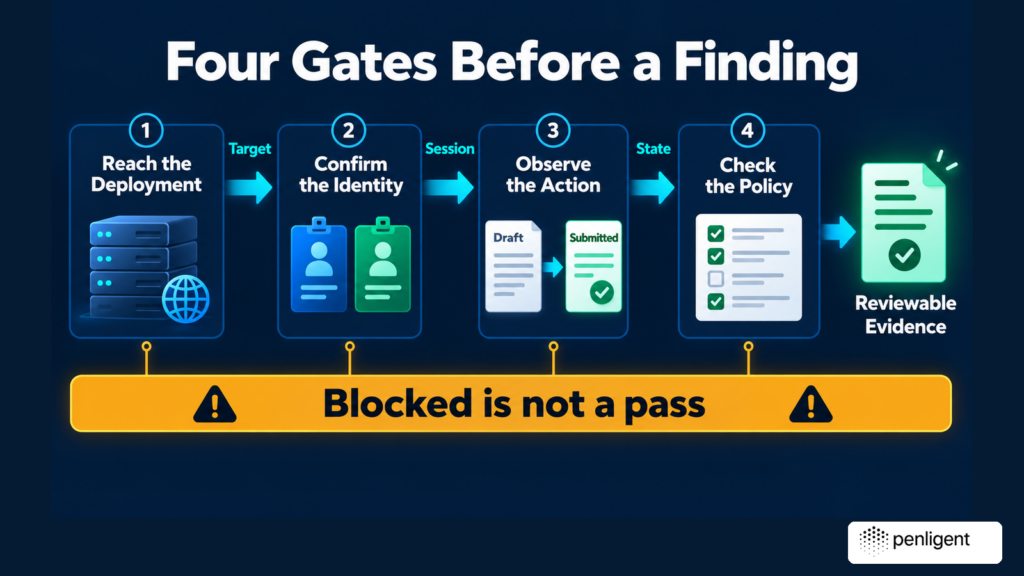
Verify four layers before calling a test complete
The first layer is reachability. Did the test reach the intended running deployment? A redirect, outdated base URL, unavailable staging environment, or reverse-proxy error can produce a plausible-looking response without reaching the relevant feature. Preserve a harmless deployment marker or application-specific observation so the reviewer can distinguish the intended environment from a generic gateway response.
The second layer is identity. Did the action execute as the required account and role? A browser tab may show a familiar username while the API client uses a different session. A tool may silently become anonymous after a token expires. Validate identity at the point relevant to the action; do not infer it solely from a login step that happened earlier in the run.
The third layer is execution. Did the actual business action occur, or did the test only request a page describing it? A submitted approval may enqueue work, fail validation, or return an interface shell. Agree which observation establishes execution in your synthetic environment. That might be a read-only state check, an application audit event, or a returned record with an expected transition.
The fourth layer is judgment. Does the observed outcome violate the policy you supplied? A 200 status alone cannot answer that. It might contain a login page, an allowed public result, or an application error. A denial status also needs interpretation: it may establish the boundary, or it may reflect missing fixtures. A finding connects the acting identity, target record, expected rule, and observed effect.
The OWASP WSTG session-management guidance explains why maintaining user state matters across requests. For this evaluation, keep a separate session-health observation rather than treating a completed login as permanent proof of identity. A run that loses its session should retain the affected cases as unresolved, even if other checks finish successfully.
Separate object, function, and workflow questions
OWASP API1:2023 addresses broken object-level authorization. In the synthetic application, a tenant B reviewer reading a private tenant A expense raises an object boundary question. The evidence should identify the record’s owner and the acting identity. A changed identifier is only a test action; the returned private object and violated policy establish the relevant observation.
OWASP API5:2023 addresses unauthorized access to functions. A tenant A member approving an expense raises a function permission question even when the expense belongs to tenant A. The role lacks approval authority. Checking tenant membership alone would not enforce that separate responsibility. Keep these distinctions visible so the remediation addresses the missing check rather than only the particular record used in the demonstration.
Workflow state creates another question. A reviewer may be authorized to approve submitted expenses while remaining unable to approve drafts. The WSTG workflow-circumvention guidance describes application-specific workflow testing. In this example, the expected sequence comes from the fictional policy; it is not a claim that any particular DAST or agentic product automatically understands approval semantics.
These questions require different controls. For object boundaries, keep an owned and another-tenant record. For function permissions, keep a member and reviewer in the same tenant. For workflow state, keep both a draft and submitted record available to the same reviewer. Changing one dimension at a time makes it easier to identify why the observed result differs from the expected policy.
Avoid using a broad administrator account for every test. Such an account may legitimately cross boundaries that matter for ordinary users. It can help prepare fixtures, but its actions should not be mistaken for proof about lower-privileged behavior. Record fixture preparation separately from test execution, particularly when the preparation interface and the tested API use different credentials or permission models.
Run an offline policy experiment before evaluating products
The following Python fixture performs no HTTP requests and contacts no external service. It models a small approval policy using synthetic identities and records. Its purpose is to make the expected decisions explicit and demonstrate why several ordinary controls are needed. It does not simulate a complete application, measure scanner coverage, or establish the performance of an AI model.
Save the program as policy_fixture.py and run it with a local Python 3 interpreter. The deliberately flawed function checks only session validity and tenant membership. The corrected function additionally checks the action, approval role, and workflow state. Both versions use the same inputs, allowing the difference to be inspected without deploying a vulnerable network service or providing any real credentials.
"""Offline synthetic approval-policy fixture; no network or product benchmark."""
import json

MEMBER_A = {"name": "member-a", "tenant": "A", "role": "member"}
REVIEWER_A = {"name": "reviewer-a", "tenant": "A", "role": "reviewer"}
REVIEWER_B = {"name": "reviewer-b", "tenant": "B", "role": "reviewer"}
CASES = [
    ("member reads own draft", MEMBER_A, "read", "A", "draft", True, True),
    ("member approves submitted", MEMBER_A, "approve", "A", "submitted", True, False),
    ("reviewer approves submitted", REVIEWER_A, "approve", "A", "submitted", True, True),
    ("reviewer approves draft", REVIEWER_A, "approve", "A", "draft", True, False),
    ("other tenant reviewer reads", REVIEWER_B, "read", "A", "submitted", True, False),
    ("expired session reads", MEMBER_A, "read", "A", "draft", False, False),
    ("anonymous reads", None, "read", "A", "draft", True, False),
    ("unsupported action", REVIEWER_A, "delete", "A", "submitted", True, False),
]

def flawed(user, action, tenant, state, session_valid):
    # Deliberate teaching defect: ignores role, workflow state and action.
    return bool(user and session_valid and user["tenant"] == tenant)

def corrected(user, action, tenant, state, session_valid):
    if not user or not session_valid or user["tenant"] != tenant:
        return False
    if action == "read":
        return True
    if action == "approve":
        return user["role"] == "reviewer" and state == "submitted"
    return False

def run():
    result = []
    for name, user, action, tenant, state, valid, expected in CASES:
        result.append({"case": name, "expected": expected,
                       "flawed": flawed(user, action, tenant, state, valid),
                       "corrected": corrected(user, action, tenant, state, valid)})
    assert all(r["corrected"] == r["expected"] for r in result)
    assert sum(r["flawed"] != r["expected"] for r in result) == 3
    return result

if __name__ == "__main__":
    print(json.dumps(run(), indent=2))
In the executed fixture, all eight corrected decisions matched the stated expectations. The flawed function differed on three cases: a member approving a submitted record, a reviewer approving a draft, and a reviewer invoking an unsupported action. The program’s assertions check those properties directly. These are results of the policy functions, not results attributed to Penligent, Burp, ZAP, or another testing product.
| Synthetic case | Required decision | Flawed function | Corrected function |
|---|---|---|---|
| Member reads a permitted same-tenant draft | Allow | Allow | Allow |
| Member approves a submitted record | Deny | Allow | Deny |
| Reviewer approves a submitted same-tenant record | Allow | Allow | Allow |
| Reviewer approves a draft | Deny | Allow | Deny |
| Other-tenant reviewer reads the record | Deny | Deny | Deny |
| Expired session reads a record | Deny | Deny | Deny |
| Anonymous identity reads a record | Deny | Deny | Deny |
| Reviewer requests an unsupported action | Deny | Allow | Deny |
Notice what the table cannot tell you. The flawed version correctly denies the cross-tenant read, so a successful object-authorization test would not reveal the missing approval role check. The expired-session denial also succeeds in both versions. Several passing security cases can coexist with an important missing permission. The value comes from the defined cases and policy, not from assuming that any one denial proves the entire application secure.
The permitted reviewer approval is equally necessary. A supposed correction that simply denies every approval would satisfy the forbidden cases but break the intended feature. Maintain positive cases when correcting a boundary. This is especially useful when a team evaluates output generated by a tool: the reviewer can ask whether the proposed fix preserves the legitimate action rather than accepting a one-sided demonstration.
An HTTP evaluation would need additional engineering. The fixture does not model route discovery, authentication exchanges, server-side sessions, state persistence, browser behavior, asynchronous jobs, middleware, or response interpretation. To use these cases against an owned staging application, implement them using its supported interfaces and synthetic data. Do not claim that exercising these Python functions measures the behavior of the deployed application.
Give each candidate the same acceptance task
Prepare a short task brief that states the approved environment, accounts, fixture ownership, allowed actions, and expected policy. Specify the result the reviewer needs: for example, determine whether a member can approve a submitted synthetic expense, while confirming that the designated reviewer can still approve an equivalent submitted record. Include any excluded transitions and the contact who can clarify ambiguous application behavior.
For the DAST route, configure the relevant authentication, navigation, request sources, and supported access-control checks. If a case requires a script or tester-operated step, document that dependency. For the agentic route, supply the same policy and access context, then preserve the actual sequence and any human redirection. A natural-language brief is context for execution; it is not proof that scope is enforced by the execution environment.
Start with a known expected result in the synthetic setup. The objective is to learn whether the workflow reaches the correct action and interprets it accurately. After that, evaluate a less guided investigation separately. Combining known-case validation and open-ended discovery into one score makes it difficult to distinguish failure to reach the feature from failure to identify an unfamiliar security issue.
Use a matched preparation record. Document the application build, tool versions, configuration, model selection where applicable, supplied instructions, session setup, operator interventions, and elapsed review time. When a feature is unavailable in a selected edition or plan, mark it unavailable under that configuration. Do not interpret it as evidence about every product configuration, and do not quietly purchase an upgrade without including its cost in the comparison.
Review the first task before expanding the scope. If it fails because fixtures were missing, repair the fixtures and identify the earlier run as blocked. If it fails because the tool cannot use the authentication flow, establish whether a supported configuration exists and how much maintenance it requires. If it reaches the feature but misinterprets the result, preserve that evidence for the interpretation review.
Distinguish an alert from a confirmed finding
Use a small result vocabulary during the pilot. A candidate observation needs investigation. A confirmed finding has sufficient evidence for the supplied security rule. A rejected candidate has an explained reason it does not establish that violation. A blocked case could not be completed. A completed case with no observed violation describes the tested condition; it does not prove the absence of every possible path.
For the member-approval case, a confirmed finding should identify the member account, tenant, record state before the action, permitted test request, and resulting unauthorized transition. The record should make it possible to distinguish a new approval from a stale state left by fixture preparation. If the system returns a job identifier, follow the agreed read-only verification step instead of claiming success from the acknowledgment alone.
An agent’s interpretation is useful when it connects observations to a plausible explanation. Preserve the observations separately, however. A reviewer should be able to reject the explanation without losing access to the underlying evidence. The same principle applies to scanner issue descriptions: a generic description of a vulnerability class does not establish that the specific response from your application demonstrates that class.
Record uncertainty where it changes the conclusion. If a background worker was unavailable, the request may have been accepted without completing the intended state transition. If fixture ownership cannot be confirmed, the observed data may not establish a cross-tenant disclosure. These are reasons to qualify the result and request the missing observation, not reasons to fill the report with a confident impact paragraph.
Keep severity downstream of the demonstrated effect. A synthetic approval transition shows a control failure in that setup; production financial impact depends on the actual deployment, permissions, workflow, data, and subsequent actions. Explain the possible consequence and the assumptions separately. Avoid turning a harmless fixture result into a claim that money was transferred or a production business process was compromised.
Count useful coverage with a stated denominator
Endpoint counts are not enough for this purchasing decision. A single endpoint can perform different actions for several roles and states, while many URLs may lead to the same public page. Use a case identifier that includes the business action, identity relationship, state, and expected rule. You can then explain which relevant combinations were examined without implying that the number covers every route or vulnerability class.
For the example, the denominator is eight defined policy cases. If only six execute because the reviewer account cannot log in, report six completed cases and two blocked cases according to the actual dependency. Do not change the denominator to six merely to show complete coverage. A dashboard percentage becomes meaningful only when the reader can inspect what was eligible and what remained unresolved.
Separate discovery from validation. If a candidate discovers an undocumented route, that is an observation worth reviewing. It does not automatically add a successfully tested business action to the coverage record. Confirm ownership, scope, relevant identity, and expected behavior before evaluating the route. Keep the original plan intact and record approved additions with their own identifiers so the pilot remains interpretable.
For false positives, define the reviewed candidate set. A reviewer-rejected finding is different from an unresolved candidate that lacks evidence. For missed cases, use only known seeded or independently established issues for which the workflow had the relevant opportunity. Without a reference set, you can describe useful discoveries and limitations but cannot calculate a defensible general false-negative rate for the product.
Do not compare scores from different targets as if they were controlled measurements. A product assessed against a simple fixture and another assessed against a complex SSO application faced different conditions. Report each context or rerun matched tasks. If repeated runs differ, retain the individual outcomes rather than choosing the most favorable run. Variation may itself matter when the team needs predictable release feedback.
Measure the operator work that the interface hides
Record active setup time separately from unattended run time. Preparing identities, configuring authentication, importing a schema, and explaining a business rule are real contributions. So are investigating an ambiguous response, correcting a mistaken interpretation, and producing a customer-ready explanation. A short automated run can still require substantial active work before and after it.
Use a simple intervention log. For each intervention, record the reason, responsible role, approximate duration, and effect on the result. Examples include renewing a session, supplying a missing fixture, correcting the acting identity, confirming an expected policy, or stopping an excluded action. The log should help you plan staffing, not punish a tool for requesting clarification that the application actually requires.
Distinguish reusable setup from recurring work. A carefully maintained authentication plan may cost more initially but become inexpensive across releases. A short instruction may be quick to write but require frequent corrections when the interface changes. Conversely, a guided agent may remove recurring manual navigation that was difficult to stabilize. Measure the pattern across representative changes rather than judging only the first run.
Assign ownership for maintenance before rollout. Someone must respond when the identity provider changes, a test account expires, a route is renamed, a schema becomes stale, or a tool updates its configuration format. The maintenance owner needs access to diagnose those conditions. A recurring job without an owner can continue producing reassuring output after its original assumptions stop being true.
Use those observations in the purchasing discussion. If the team lacks the capacity to maintain the required setup, a technically capable product may still be the wrong immediate choice. If a supported service supplies that missing work, include the service responsibilities and cost. Do not compare a self-operated subscription with a fully staffed assessment as though the quoted price covers the same deliverable.
Use repeatable plans for the work that is already understood
ZAP’s Automation Framework documents YAML plans, authentication/session configuration, jobs, and job tests. That offers a concrete route to evaluate repeatable application checks. In this guide’s proposed operating model, known stable cases belong in a maintained plan or regression suite whenever the team can express and verify them reliably. An agentic investigation can then focus on unresolved questions instead of rediscovering the same prerequisite on every run.
Be precise about scan modes. The ZAP Baseline Scan documentation describes a spider followed by passive scanning and says the script does not perform actual attacks. A successful baseline run therefore should not be presented as proof that active approval-boundary tests were executed. Label the performed mode in the report, and evaluate active or custom checks separately under the approved operating conditions.
The distinction matters during purchasing demonstrations. A baseline may provide useful, low-effort observations about encountered traffic, while a deeper active evaluation addresses another question. Neither should be dismissed because it does not perform work outside its stated mode. Ask the operator to explain the mode, inputs, and completion criteria before comparing its output with an investigation that had a different task.
Version the plan with the assumptions that make it useful. Include the environment, selected cases, identity references, fixture setup, verification conditions, and expected result interpretation. Keep secrets in the approved secret-management mechanism instead of embedding them in a shared report or source file. The version record should let another qualified operator understand what the plan was intended to do.
When a manually discovered issue becomes a stable regression, define a focused check for the corrected behavior. Keep the original observation attached to that check, but update the fixture and permitted actions for recurring execution. A test that once demonstrated a violation should not continue performing unnecessary consequential actions simply because the original investigation needed them to establish impact.
Place investigations and release gates on different schedules
A release gate needs a clear interpretation and a practical failure response. Begin with a small set of stable checks whose dependencies are understood. Establish which failures block a release, which require review, and which indicate unavailable test infrastructure. Avoid making every new candidate observation a hard gate before the team has learned its behavior and assigned an owner for triage.
Run broader investigations where their variable duration and interpretation fit the development process. That might be before a significant permission change, after a new integration, or during a scheduled assessment. The trigger should connect to a risk question. Continuous testing is useful when meaningful changes lead to relevant revalidation, rather than when a long-running job repeatedly generates output without a clear review decision.
For an approval redesign, schedule a focused review of role and state transitions before release. Then promote the stable corrected cases into the recurring check set. For a cosmetic interface change with unchanged underlying interfaces, first verify whether existing navigation and session assumptions still hold. The appropriate response depends on what changed; a calendar alone cannot identify the relevant security test.
Keep a fallback procedure for tool or environment outages. A missing result should be visible as missing. Decide who can authorize an exception, what compensating review is required, and when the blocked test will be rerun. An exception should describe the unresolved condition rather than relabeling the run as successful. Preserve the decision alongside the deployment it affected.
Retain established controls while the new workflow proves dependable. This is not an argument for keeping every tool forever. It is a way to transfer a responsibility deliberately: identify the old check, show the new check’s result under the same relevant conditions, assign maintenance, and only then remove duplicated execution when the team has evidence that the coverage and response remain adequate.
Preserve evidence without turning the report into a secret store
A useful finding record includes the tested deployment, case identifier, acting role, prerequisite state, expected rule, observed behavior, and reproduction sequence. Add enough sanitized request or application evidence for another engineer to evaluate the conclusion. Explain any missing observation that limits the interpretation. The reader should not have to reconstruct a chain of assumptions from a generated narrative alone.
OWASP WSTG’s reporting guidance provides suggestions for communicating assessment results and emphasizes the usefulness of the report to its audience. For this example, provide a compact finding followed by the relevant evidence and retest status. A long technical appendix can support the record, but it should not obscure the action the application owner needs to take.
Use synthetic data for the pilot so the evidence is easier to share within the approved review group. Even then, treat session tokens and credentials as secrets. Mask them in published examples and shared reports. Preserve a reference to the approved credential channel if the reviewer needs to reproduce the action; do not distribute working credentials merely to make a report look more complete.
Separate raw artifacts from the editorial summary. An internal evidence store may need narrower access or shorter retention than the customer-facing report. Identify who can access prompts, tool logs, screenshots, exported records, and model-processing traces where those exist. Make those decisions before the pilot so that a useful technical result does not create an unplanned disclosure or retention problem.
Record the difference between observation and inference explicitly. “The member account produced an approved state in this deployment” is an observation when supported by artifacts. “The same defect permits a production payout” is an additional inference requiring further conditions. The report can explain the risk without pretending the second event occurred. This makes the result more credible and gives engineering a clearer remediation target.
Ask where execution and reasoning actually happen
A desktop interface does not establish that all processing stays on that device. A private runner does not establish that model inference, telemetry, evidence storage, or report generation stays within the same boundary. Map the actual components used by the selected configuration. Include target access, identity use, model requests, log storage, support access, and exports when discussing deployment suitability.
Ask which inputs may be sent to a model or managed service. A request body may contain synthetic data in your pilot and sensitive data in a real engagement. A screenshot can reveal information even when a text prompt is carefully written. The relevant question is which actual artifacts leave the approved boundary, under what controls, and with what contractual and technical handling commitments.
Confirm execution limits independently of prompt wording. For an investigation tool, identify the mechanisms that constrain destinations, credentials, actions, and resource use. For a scanner, review the configured scope and exclusions. Test the supported controls in a harmless approved setup before relying on them. A successful result within scope does not prove that the product would stop at every boundary under other conditions.
Keep the initial pilot low consequence. Use dedicated accounts, synthetic records, an approved environment, and a clear stop contact. Where a workflow normally sends messages, creates charges, or changes shared state, substitute an approved fixture or explicitly agreed safe action. These constraints are part of evaluation design, not evidence that any tool or product can automatically make every action safe.
Document unresolved deployment requirements as purchase conditions. If your team needs a specific processing region, private model route, retention period, or support-access boundary, obtain an answer for the actual edition and configuration. Do not infer those properties from a general product label. An otherwise promising testing workflow should remain a candidate until the required operating conditions are established.
Price the next useful unit of work
Compare cost at the level of the work you need to complete. A subscription, a target allowance, a credit budget, an assessment fee, and an inference bill describe different units. Before estimating a total, define the intended task, expected repetition, human review, reporting requirement, and retest. A plan that is inexpensive for a short experiment may be unsuitable for the team’s recurring delivery workload.
Use a worksheet with visible inputs instead of inventing a market average. List the applicable license or service charge, separately billed model and infrastructure usage, active setup time, review time, recurring maintenance, and planned retest effort. Include only costs relevant to the selected route. Avoid counting an included service twice, and mark an unknown charge as unresolved rather than silently treating it as zero.
| Cost or responsibility | What to establish before purchase | Evidence from the pilot |
|---|---|---|
| Initial access and setup | Who prepares identities, fixtures, and integrations? | Active preparation time and unresolved prerequisites |
| Execution allowance | What consumes usage, and do blocked runs consume it? | Actual billing or usage record for the bounded task |
| Interpretation | Who validates findings and dismisses unsupported candidates? | Review time and reasons for disputed results |
| Deliverable | What export or independent assessment is required? | Accepted sample structure and applicable entitlement |
| Retest | What repeat work is included or separately billed? | Corrected-case result and legitimate-use controls |
| Maintenance | Who updates the workflow after application changes? | Ownership and a change-handling example |
For Penligent, the published AI pentesting workflow describes black-box execution, browser-assisted verification, operator input, and remediation retesting. Those are capabilities to investigate against the same task, not evidence of success on your application. Evaluate reach and reviewable evidence first, then confirm the current plan’s usage and export entitlement before deciding what additional work to buy.
The buying decision can be modest. If a first evaluation answers one useful question, purchase the next defined increment only when it has a clear purpose: another role, another approved workflow, a larger authorized surface, or a retest after a fix. If the task never reached the relevant feature, more usage may simply repeat the same blocked condition. Resolve the prerequisite before increasing scope.
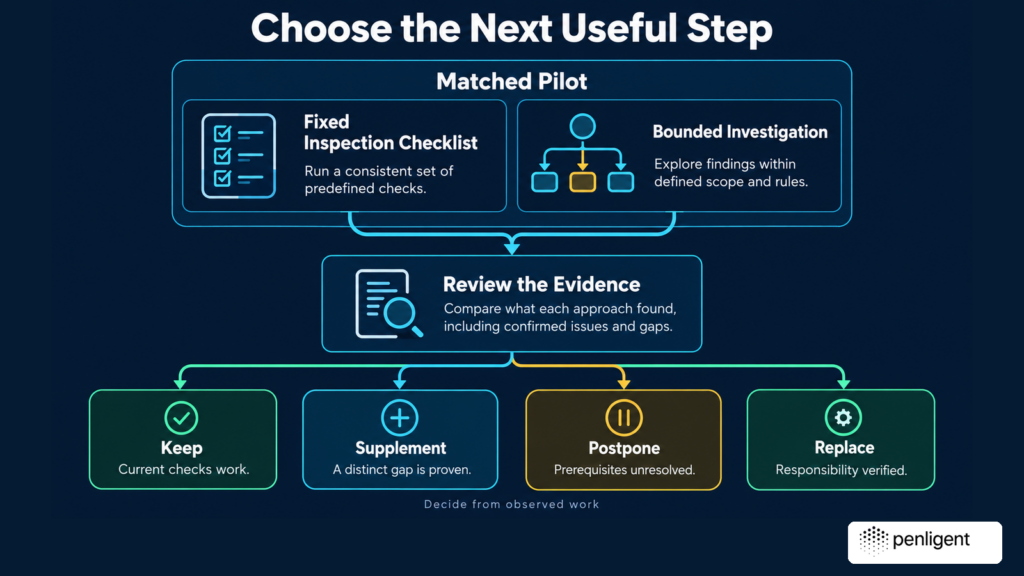
Decide whether to keep, supplement, postpone, or replace
Keep the current DAST process when it performs useful checks reliably and the pilot does not demonstrate an unmet requirement worth the added cost. That is a valid evaluation outcome. The next improvement may be better authentication configuration, a maintained access-control case, or clearer ownership rather than another platform. Document what the existing process covers and the residual questions it leaves open.
Supplement the current process when the new workflow addresses a distinct investigation or evidence need. Define the handoff between them. For example, recurring checks may provide stable release feedback while a guided investigation examines a new approval workflow. Avoid paying both routes to repeat indistinguishable work unless the independent confirmation itself has an agreed purpose and the team can interpret the combined results.
Postpone a purchase when prerequisites or acceptance requirements remain unresolved. Missing test identities, unclear data-processing requirements, or an unknown report recipient can prevent a useful decision even when a demonstration looks impressive. Write down the condition that would reopen the evaluation and its owner. This is more useful than leaving a tool in an indefinite trial with no defined success criterion.
Replace an existing route only after the new one demonstrates the responsibility being transferred. Check the defined cases, operational response, evidence access, configuration maintenance, and cost. Preserve the prior result history as needed for continuity. A new interface or longer report does not by itself justify removing a working control; the decision should explain the observable improvement or necessary requirement the replacement supplies.
Use explicit acceptance statements. “We can reproduce the member-approval finding and the corrected result under the agreed build and accounts” is reviewable. “The agent is smarter” is not. “The configured scan completed all scheduled cases and reported blocked authentication as a failure” is useful. “The dashboard stayed green” leaves the reviewer guessing what work actually happened beneath the indicator.
Retest the correction and the intended business action
An approval-boundary fix needs more than the disappearance of the original alert. Recreate the relevant synthetic state in the corrected deployment. Attempt the previously forbidden action using the same member role, then execute the permitted reviewer action on an equivalent submitted record. Confirm the expected state transitions and preserve the observations separately. A changed response message alone does not establish the intended correction.
Keep environment differences explicit. A retest against a different tenant configuration, permission model, feature flag, or background-worker setup may answer a narrower question than the original finding. Record those differences and decide whether they require another test. Do not label a result fixed merely because a similar path behaved differently in a deployment whose relevant assumptions were not checked.
If access fails during the retest, mark it blocked. If the defect is no longer observed under the tested conditions, state those conditions. If a workflow redesign removes the original action entirely, explain what replacement behavior was examined and what uncertainty remains. The result should help the owner close the specific risk decision rather than force every outcome into a binary label without context.
Promote the stable controls into the recurring process. Include the member denial, reviewer permission, draft denial, cross-tenant denial, and session checks that remain relevant. The offline fixture illustrates the policy combinations; your application tests must use the real supported interfaces and observe actual state. Keep the policy record connected to the deployment check so later role or workflow changes trigger a deliberate review.
The resulting operating model can use both approaches without confusion. DAST, explicit regression checks, manual investigation, and an agentic workflow can contribute different evidence. Each contribution needs a named question, a visible execution record, and an owner who interprets the result. That clarity matters more than assigning all security work to a single label or assuming every automated finding has equal evidentiary value.
Diagnose a blocked run before changing the tool
Use a dependency record when a pilot cannot complete. Start with a harmless direct request using the approved operator and environment. Confirm that the fixture exists, the account has its intended role, and the ordinary action works without the testing tool. If that baseline fails, the result points to an application or preparation dependency. Repair it before comparing candidate behavior; otherwise both routes may fail for a reason unrelated to their testing capabilities.
Next compare the execution path. Identify whether the tool reaches the same host, deployment, and interface as the operator’s successful baseline. A runner inside another network may see a different gateway. A browser and an API client may follow different redirects. Preserve a small diagnostic observation from each path. The objective is to isolate the changed condition without asking the tool to compensate for an environment it cannot reach.
Then examine identity continuity. Establish which component obtained the credential, which component presents it, and what observation confirms that it remains valid. A session copied from a browser may not behave like the supported login procedure. A token may be valid but lack the audience or permissions required for the action. Use the application’s approved troubleshooting information and avoid placing working tokens in a broadly shared diagnostic log.
Finally inspect the fixture lifecycle. Another run may have approved a record that this run expected to remain submitted. A cleanup process may have removed a synthetic user. A background job may not have processed the prepared event. Reset the appropriate fixture through the supported setup mechanism and rerun the affected case. Record the reset so that a later reviewer can distinguish the corrected preparation from the original blocked attempt.
This sequence produces an actionable handoff: environment owner for unreachable deployment, identity owner for account or session failure, application owner for missing state, or tool operator for unsupported configuration. Some failures involve more than one owner. Keep the affected cases blocked until the required observations are available. The useful outcome is a diagnosed dependency, not a cosmetically successful run achieved by removing the cases that caused difficulty.
Use a compact acceptance record at the review meeting
Bring a one-page decision record to the pilot review. Name the question, tested deployment, selected configuration, and reviewer. Link the individual case results rather than copying every artifact into the summary. Include a short statement of what was confirmed and a separate statement of what remains unresolved. The review should end with a decision about the next unit of work, not merely an acknowledgment that a demonstration took place.
For the fictional example, an acceptance statement might say that the workflow reached the member and reviewer actions, preserved their distinct identities, and produced evidence of the three deliberate policy defects in an owned test implementation. That statement would be appropriate only after actually running the application evaluation. The offline experiment in this article does not supply those product results; use the statement as a template with verified observations filled in later.
Show the permitted controls beside the forbidden cases at the meeting. An application owner can then challenge a proposed interpretation without navigating an entire technical report. If the owner identifies a legitimate delegation rule, update the expected policy and reevaluate the affected case. Do not preserve a finding simply because it appeared in an earlier draft. A corrected interpretation is useful progress even when it reduces the finding count.
Close with an assigned action and a reopening condition. A keep decision might require maintaining the current plan and revisiting the investigation route after an authentication redesign. A supplement decision might authorize another bounded pilot while keeping existing gates. A replacement decision needs a transition owner and a defined verification step. A postpone decision needs the missing prerequisite and responsible person. Each outcome is concrete enough to revisit without reconstructing the original sales conversation.
Questions buyers ask before choosing a runtime testing workflow
Can agentic pentesting replace DAST?
- It can replace a particular responsibility only after demonstrating that responsibility under the required conditions. List the existing checks, authentication dependencies, release behavior, and evidence needs before evaluating a replacement. A broad product-category claim cannot establish equivalence for your application.
- Many teams may find a complementary route more useful: retain repeatable checks and add bounded investigation where a specific policy or workflow question remains unresolved. Evaluate the added value and operating cost before expanding the arrangement.
Can DAST test an authenticated application?
- Products can support authentication, sessions, browser navigation, imports, scripts, or access-control extensions. Check the actual product documentation and configured edition. The relevant acceptance test is whether your required identity remains active at the protected action, not whether a feature list contains the word authentication.
- A completed scan with expired credentials should not be treated as completed authenticated coverage. Preserve session-health evidence and mark the affected cases unresolved until the prerequisite is repaired.
Which approach is better for business logic?
- Begin with the expected business rule and the observations needed to establish a violation. A custom configured case, a tester-guided workflow, or an agentic investigation may be useful. The application owner must clarify policy exceptions; the approach does not supply missing business intent automatically.
- Compare the same role, record ownership, state, and action. Measure whether the workflow executes and interprets those cases accurately, while retaining the setup and review effort needed to obtain the result.
Does a tool finding more issues make it the better purchase?
- Not necessarily. Compare confirmed findings against the agreed task, rejected candidates, blocked cases, and reviewer effort. Duplicate observations and unreviewed candidates can inflate counts without answering the buyer’s security question.
- A narrow successful evaluation can justify another defined task, but it cannot establish general superiority across targets, vulnerability classes, or deployments that were not examined.
Can this article’s Python fixture benchmark a product?
- No. It checks two policy functions in memory and has no network interface, authentication exchange, browser, or tool integration. Its output demonstrates the stated synthetic policy and controls only.
- Use the cases to design a separately authorized application evaluation. Record the actual product, build, configuration, inputs, interventions, artifacts, and repeated results before making any product performance claim.
Will an AI-generated report satisfy a customer review?
- Agree the recipient’s scope, methodology, evidence, assessor, and independence requirements before choosing software. A report format or control mapping does not establish that those requirements were met.
- Inspect a sample deliverable, then check the actual pilot’s findings and limitations. Keep unresolved coverage visible and confirm the entitlement to produce the required export under the selected plan.
What should happen after the first successful trial?
- Review one result end to end, confirm its business meaning, and identify the next useful authorized task. Confirm operating effort, usage, data handling, and retest responsibilities before committing to a larger workload.
- Maintain the proven cases and their legitimate-use controls. When the application changes, revisit the assumptions that made those cases meaningful instead of treating the first successful trial as permanent assurance.
Choose the runtime testing workflow that leaves a defensible record of the security decision you need to make. Reach the intended action, preserve the acting identity and application state, explain what the evidence supports, and verify the correction without breaking intended use. A reliable plan and a bounded investigation are both valuable when their responsibilities and limitations remain visible.

 English
 German
 French
 Spanish
 Portuguese
 Japanese
 Korean
 Hindi
 Arabic
 Turkish
 Hebrew