
Drupal Commerce operators should treat CVE-2026-118539 as an urgent patch-and-review issue. The Drupal security team says the flaw is being actively exploited in the wild, identifies affected Commerce Core release lines, and specifically advises affected sites to audit orders for inconsistencies. That combination changes the response from “apply the next routine update” to “patch, verify, and investigate whether business records were altered.” Official advisory.
The Drupal advisory is deliberately concise. It describes insufficient protection of certain routes and entity fields, resulting in an access bypass that may financially affect a vendor. It does not name the vulnerable routes or fields. A technical analysis by the reporting research team, based on the fixed release and its tests, adds implementation detail; this article labels that evidence separately rather than attributing it to Drupal’s short notice. Administrators do not need to reproduce an attack to respond: confirm the Commerce package version, install the fixed release for its branch, and compare sensitive order and payment records against independent records.
What the advisory confirms
The Drupal contribution security advisory SA-CONTRIB-2026-254 assigns the issue a highly critical rating and says active exploitation has been observed. The vulnerable project is Commerce Core, machine name commerce, rather than Drupal core itself.
The affected versions are:
| Installed branch | Affected range | Fixed release named by Drupal |
|---|---|---|
| 2.x | Earlier than 8.x-2.41 | 8.x-2.41 or later in the supported branch |
| 3.x | 3.0.0 through releases before 3.3.13 | 3.3.13 or later in the supported branch |
Use the advisory and the release pages for the exact branch when planning an upgrade: Commerce 3.3.13 and Commerce 8.x-2.41. A Drupal core version alone does not tell you whether the contributed Commerce package is fixed. Conversely, the fact that a site uses Drupal Commerce does not prove it is vulnerable; the installed package version and deployment state decide that.
This distinction matters operationally. Drupal sites often have separate core and contributed-module update cycles, Composer lock files, custom patches, and more than one runtime environment. The running package can differ from the repository branch or the developer workstation. Inventory the deployed artifact, not just the source repository.
What the fixed code reveals
Ostorlab’s technical analysis of the patch and functional tests describes a missing field-level authorization layer. Entity-level permissions could allow a user to edit an entity they owned, while reference or state fields on that entity were not separately protected. A user with permission to update one object could therefore attempt to modify fields that link it to another vendor’s object. The Drupal advisory confirms the broad route/entity-field access bypass; the detailed field list below is attributed to the independent diff analysis, not to the advisory text.
The report identifies several classes of affected relationships: a product variation’s product reference, a coupon’s promotion reference, a promotion’s coupon list, and a store’s default-store flag. It also describes order, order-item, and payment-method fields that carry ownership, state, amount, payment, or referenced-entity information. The patch introduces restricted-field checks in access handlers, adds permission checks to affected administration routes, limits coupon autocomplete visibility, and narrows deletion behavior so a cross-reference does not remove an entity owned by another promotion or product.
The practical prerequisites are narrower than “anyone on the Internet can take over a store.” The research analysis says the demonstrated write paths required an account and the relevant limited Commerce permission, plus API access through JSON:API or REST for the described operations. A customer with permission to update their own cart did not need broader Commerce administration rights to attempt changes to restricted fields on that cart. Product/variation and promotion/coupon takeovers required other limited Commerce permissions. This distinction matters when prioritizing identity review: test customer cart boundaries and staff/vendor permissions separately.
The same analysis describes read-side issues: some API collection queries could reveal that an otherwise hidden variation existed, and a coupon autocomplete route could expose coupon codes to callers who could reach it without the required promotion-management permission. A deletion side effect could remove referenced coupons from unrelated promotions before the fix. These are distinct from changing an order total; a site review should consider data integrity, confidentiality, and deletion effects, not only order totals.
The analysis does not identify reusable public exploit code. Its explanation draws on the patch diff and functional tests, which show expected failures after the fix. Do not turn those test observations into a production attack recipe. They are useful for mapping defensive tests in a staging environment: cross-owner references should be denied, restricted fields should not be editable by ordinary customers, autocomplete should not list unauthorized coupons, and deletion should not affect unrelated entities.
A permission matrix for the reported paths
The following matrix summarizes the role boundaries described in the independent patch analysis. It is not a statement that every Commerce site has identical permissions. Local configuration, custom modules, API enablement, and role assignments determine the actual exposure.
| Principal | Relevant capability described by research | Defensive question |
|---|---|---|
| Anonymous visitor | No authenticated account in the described state-changing paths | Are public routes exposing data that should require authentication? Do not infer anonymous write access from this CVE. |
| Customer | Can update their own cart/order under the site’s normal customer permissions | Can API writes change restricted cart fields such as ownership, state, totals, or referenced data? |
| Product or variation editor | Has limited product-management permission | Can the editor change a variation’s product reference across ownership boundaries? |
| Promotion/coupon manager | Can manage only some promotions or coupons | Can a coupon be linked to an unauthorized promotion, or can autocomplete disclose codes outside the intended permission? |
| Store administrator | Has broad administration capability | Are route permissions still enforced when UI controls are bypassed and requests go directly to API routes? |
The purpose of this matrix is to separate principal types, not to provide a privilege-escalation recipe. It lets an administrator find the smallest set of accounts and API surfaces that deserve attention. A customer account may be lower privilege than a store manager while still having write access to its own cart. A limited staff role can have access to a product-editing function but should not necessarily have authority over every product or promotion. Role names are not guarantees; inspect the assigned permissions and object-level rules.
Separate API reachability from API authorization
An endpoint being enabled is not, by itself, a vulnerability. Likewise, disabling one API surface may reduce exposure while leaving another route or server-rendered workflow available. The relevant question is whether the authenticated principal can perform a disallowed operation through the exact interfaces that the deployed site exposes.
Inventory the site modules and integrations that expose entity APIs. Record whether JSON:API, REST, custom controllers, commerce storefront integrations, or partner applications are enabled. Identify which roles can create, update, view, or delete each entity type. Map those permissions to the affected entity-field relationships described by the patch analysis. Do not send guessed mutation requests to production. Use a staging copy and supported client or documented application code so the test remains reproducible and safe.
For a decoupled storefront, examine both the public storefront and the API service. A user interface may omit a field while the API serializer still accepts it. Conversely, an API module can reject an operation even when a role has a general entity-edit permission. Validate the end-to-end path: actor authentication, route access, entity access, field access, reference ownership, and side effects. A test that checks only an HTTP response code may miss an unauthorized side effect; inspect the synthetic database state after each test.
For coupon autocomplete, treat discoverability separately from redemption. A code being exposed can increase abuse or reveal a promotion, while the ability to apply that code depends on other business rules. Review whether the autocomplete endpoint is reachable by the relevant role and whether the result set is constrained to the current user’s permissions. Do not classify every returned coupon as a financial loss without evidence that it was valid, used, and outside its intended audience.
Entity references and cross-owner boundaries
Commerce systems often model relationships as entity-reference fields. A variation may reference a product; a coupon may reference a promotion; a promotion may reference multiple coupons; an order item may reference a purchased variation; a payment method may belong to an account. The security expectation is not just “the user can edit the record,” but “the user can edit this record and this relationship in a way that is allowed for both entities and the transaction’s current state.”
This is why object-level permission and field-level permission should be tested together. A user may be authorized to update a title but not the owner reference. A promotion manager may be permitted to edit its own promotion but not add a coupon owned by another manager. A customer may see and update their cart quantity but not set payment status or change the order’s total. A store configuration administrator may set one store flag but not make a different store the default. The exact policy should be derived from the site’s business rules, then checked against the fixed code and its tests.
In staging, build two synthetic tenants or vendors with separate products, variations, promotions, coupons, orders, and payment methods. For each relationship, test an authorized same-owner reference and a denied cross-owner reference. Verify the state after the request, including whether unrelated entities were deleted or detached. These tests help catch both direct writes and secondary effects. Keep all test identifiers synthetic; do not reuse production entity IDs to make a request easier to formulate.
A structured response for the first day
First hour
Identify the Commerce branch and deployed version from production artifacts. Preserve the deployment metadata and relevant logs. Determine whether the site accepts customer or staff access through JSON:API or REST and whether any limited roles can edit carts, products, coupons, or promotions. Assign an incident lead and an application owner. If the affected version is running, schedule the fixed update promptly; do not wait for a definitive exploitation indicator before patching.
Avoid quick changes that destroy context: do not delete coupon records, mass-cancel orders, disable all customer accounts, or rotate unrelated credentials before identifying a need. If a particular account or integration shows credible abuse, temporarily restrict the smallest relevant identity or capability and retain the evidence that informed that choice.
Same business day
Deploy the correct fixed version for the site’s branch, confirm all runtimes have it, and exercise checkout, cart, payment, refund, and fulfillment workflows in a controlled manner. Review access behavior for customer and limited staff roles. Start an order and entity-reference audit over the affected deployment window. Make sure Finance, Commerce Operations, and Security are using a common timeline and a shared definition of a confirmed anomaly.
If a production anomaly is found, preserve the original record and compare it with payment gateway, fulfillment, and support records. Triage each anomaly without assuming it is malicious. Escalate confirmed unauthorized access or financial changes through the incident-response process. Consider customer or regulatory communication only after the appropriate owners assess evidence and obligations.
Following days
Complete the look-back review, track unresolved discrepancies, and monitor for delayed events such as refunds, queue retries, and certificate-like expirations of payment authorizations or shipping labels. Confirm that no old runtime or rollback image can reintroduce the affected package. Add regression tests for cross-owner references and restricted fields to CI. Document which data sources were searched, which were unavailable, and who accepted residual uncertainty.
Designing the post-patch test suite
A useful regression suite protects behavior, not a single demonstration request. Include tests for:
- A customer reading and updating fields permitted on that customer’s own cart.
- The same customer attempting fields reserved for payment, order state, ownership, or system-managed totals.
- A second customer attempting to view the first customer’s cart or order.
- A product editor updating an owned product and attempting a cross-owner variation reference.
- A promotion editor changing its own promotion and attempting to attach an unrelated coupon.
- An unauthorized account querying coupon autocomplete or hidden variations.
- A deletion operation that should not remove an entity still associated with another product or promotion.
- A permitted administrator performing the intended operation through the supported interface.
Tests should record the actor, entity owner, role/permission set, field or relationship, action, expected result, observed status, and resulting database state. The goal is to show both that the intended action still works and that the restricted action fails without changing data. This guards against a patch that blocks too much as well as one that blocks too little.
For sites with custom access handlers, plugins, or API serializers, run the same cases through the custom integration. The upstream fix cannot automatically prove that custom code uses the corrected access checks. Review overrides, event subscribers, and code that changes Commerce entity serialization. If a custom extension intentionally permits a broader operation, document the business reason and test its guardrails separately.
Why an access bypass matters to a store
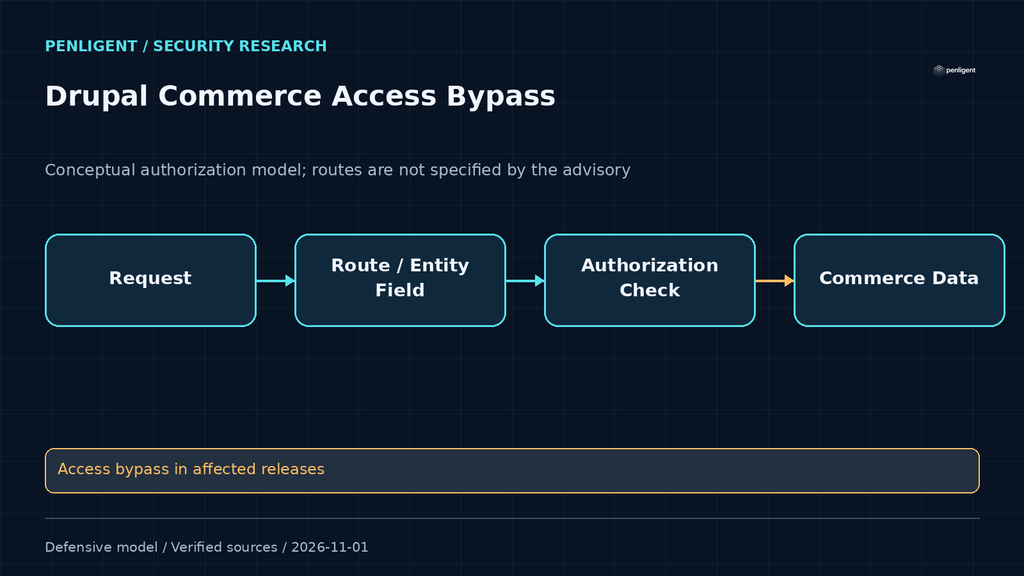
An authorization check answers whether a particular actor may perform a particular action on a particular object under the current conditions. A route can be reachable while an entity field remains protected, or an entity may be visible to one role but not editable by it. An access-control defect occurs when a request crosses a boundary that the application intends to enforce.
In a commerce application, those boundaries protect more than page visibility. Orders can carry customer identity, line items, quantities, prices, discounts, fulfillment state, payment references, billing and shipping details, and administrative notes. The Drupal advisory states that the weakness affects certain routes and entity fields and may financially impact the vendor; it does not specify which of these data classes are exposed in a particular deployment. Treat them as review targets, not as a claim that every field is exploitable.
The OWASP Broken Access Control overview and its authorization testing guidance describe the general engineering problem: permission decisions must be enforced server-side for each operation, resource, and field, not inferred from a hidden button or a user-interface route. These references explain general authorization practice; the Drupal advisory and the cited patch analysis support the CVE-specific details.
For a store, the practical impact assessment should ask which user classes could access which records and fields, and whether any sensitive values changed unexpectedly. A customer should be restricted to intended operations on their own cart; a vendor or staff account with permission to update its own product or promotion should not be able to change cross-owner references; a fulfillment role may need to change shipping state but not payment details. A support role may need limited customer context without permission to alter totals. The exact role design differs by site, so compare observed behavior with the site’s intended policy.
Patch first, then confirm the running build
The direct corrective action is to upgrade Commerce Core to the fixed release for the installed branch, or a later supported release. Before changing production, record the currently deployed package version, take a restorable backup, and test the update against a staging copy with representative checkout and order workflows. This is normal deployment hygiene, not a reason to delay an urgent security update indefinitely.
For Composer-managed projects, verify the lock file and the deployed container or artifact after the update. A command such as composer show drupal/commerce can help inspect a local project, but it is not by itself proof that every web node runs that artifact. Check the release pipeline, image digest, active pods or hosts, and rollback plan. Where multiple regions or environments exist, make sure staging, production, workers, scheduled tasks, and administrative instances converge on the fixed package.
After deployment, confirm the actual Commerce Core version from the running environment and exercise ordinary business workflows: create a test order, view it as the owning customer, verify that another test customer cannot view it, and check that staff roles retain only their intended actions. Use synthetic accounts and test data. Do not use a production customer’s order as a penetration-test target. If the site exposes JSON:API or REST, verify that tests exercise the same API surface used by the store, but keep all cross-owner and restricted-field tests in staging.
The Drupal security team maintains general guidance on security advisories and updates. Follow the project-specific advisory for the exact fix; broad update guidance cannot replace the branch-specific version requirement.
Investigate order integrity without inventing an exploit signature
The advisory’s explicit instruction to audit orders is important because a successful access bypass may affect business state, not only confidentiality. It does not provide a known malicious request signature or say that every affected site has been attacked. A useful review therefore relies on records and invariants rather than one assumed log pattern.
Start with a time window that includes the period the site ran an affected Commerce version and the first verified deployment of the fix. Preserve relevant application, web server, identity-provider, payment gateway, queue, and database audit logs before retention or rotation removes them. Record the site timezone and clock offsets. Do not edit evidence in place.
Where the site’s schema and audit retention permit it, include ownership/reference changes as well as money and state fields. The technical patch analysis points to variation-to-product references, coupon-to-promotion references, promotion coupon relationships, and selected store flags as areas to review. For orders and order items, compare owner, store, state, items, totals, adjustments, unit prices, purchased entities, coupon use, checkout path, payment gateway, and payment-method references against the site’s normal transaction history. For payment methods, review ownership and gateway associations without exporting card data into the audit dataset.
For each resource, identify whether the application provides a revision, audit-log, or database change history. If only the current state exists, do not claim that a changed field proves when or by whom it was changed. Use web/API logs and independent payment/fulfillment records to establish a timeline. If the site’s logs do not contain request bodies, do not enable verbose production logging that captures customer information solely to compensate; preserve existing evidence and design a privacy-reviewed audit control for future activity.
Compare high-impact order fields with independent systems of record where available: payment processor authorization and capture records, refund events, shipping or fulfillment updates, customer support history, inventory changes, and immutable exports. Look for unexplained changes to totals, discounts, quantities, payment status, order ownership, addresses, workflow state, or refunds. These are investigation questions, not indicators unique to this CVE. A legitimate promotion, administrative correction, retry, or asynchronous update can also produce a change.
Correlate a suspected change with the actor identity, session, source address, time, application route if available, and neighboring events. Confirm whether the actor was authorized for that object and action at that time. Preserve the original and current values, and distinguish a confirmed unauthorized change from an unexplained discrepancy still under investigation. Do not reset all customer orders or cancel transactions based only on an anomaly count; that could create a second incident.
If evidence suggests unauthorized access or financial changes, use the organization’s incident process. Restrict the affected account or integration when warranted, contact the payment provider through established channels, and assess notification obligations with the appropriate legal and privacy teams. Rotate credentials only when they may have been exposed or misused; indiscriminate rotation can disrupt processing without improving the investigation.
Safe authorization validation
The goal of a post-patch validation is to prove that intended policies hold, not to recreate the undisclosed exploit. In a staging environment containing synthetic data, create two customer accounts and representative staff roles. Build a small expected-access matrix:
| Actor | Own order read | Other customer’s order read | Price or payment-field write | Intended result |
|---|---|---|---|---|
| Customer A | Yes | No | No | Allowed only for own permitted operations |
| Customer B | Yes | No | No | Same boundary as Customer A |
| Fulfillment role | Limited | No by default | No | Only explicitly granted fulfillment actions |
| Commerce administrator | Yes | Yes | Policy-dependent | Restricted to approved administrative users |
Run the matrix through documented application workflows or a controlled test harness against the staging site. Add cases for a customer editing their own cart through approved interfaces, an ordinary customer attempting restricted order fields, a limited vendor account working with its own product, a vendor attempting to reference another vendor’s variation, promotion management and coupon visibility, and deletion behavior for linked objects. The expected result must come from the store’s intended policy and the fixed release’s documented behavior. The harness should use test identities, expected status codes or rendered access outcomes, and synthetic object identifiers. It should not enumerate production orders, bypass rate limits, or send guessed exploit requests. Record the package version and test results with the deployment evidence.
The OWASP ASVS provides a broader framework for verifying application security controls. For API-backed or decoupled commerce deployments, OWASP’s Broken Object Level Authorization guidance is also relevant to the general risk of failing to bind object access to the requesting identity. Neither should be treated as a CVE-specific exploit description.
A response sequence for operators
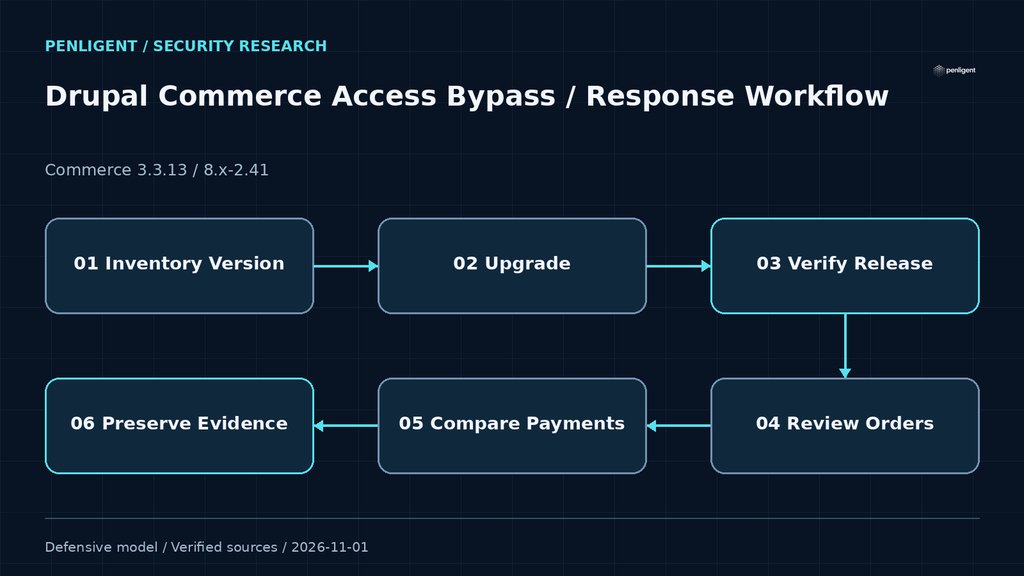
- Identify every deployed Commerce Core version, branch, fork, and custom patch.
- Preserve a pre-update inventory and relevant logs; record affected time windows.
- Upgrade the deployed 2.x line to 8.x-2.41 or the 3.x line to 3.3.13, as applicable, or later supported fixed releases.
- Verify the fixed package is running across web nodes, workers, scheduled jobs, and deployment regions.
- Run synthetic role-based access tests and ordinary checkout/order regression checks.
- Audit order integrity against payment and fulfillment records; triage discrepancies before making corrective edits.
- Document confirmed findings, unresolved anomalies, remediation owners, and monitoring duration.
Automated testing can help validate authorization paths when it is constrained to an authorized staging target and produces reproducible evidence. Penligent’s AI pentest workflow is relevant only as a controlled validation step after an owner defines the scope and test identities; it does not replace the Drupal security advisory, application-owner decisions, or a financial-record investigation.
Common mistakes
- Checking only Drupal core: Commerce Core is a contributed project with its own package version and fixed release.
- Assuming a version string from a repository equals production state: verify the artifact running on every relevant node.
- Treating Drupal’s advisory as a full exploit disclosure: the notice itself does not identify exact routes or fields; independent patch-diff analysis provides additional detail and should be attributed to that research.
- Assuming every path is anonymous: the technical analysis describes authenticated customer or limited-permission accounts for the demonstrated paths; verify the site’s exposed API and role model.
- Assuming active exploitation means the site is compromised: the notice establishes exploitation in the wild, not the status of any individual site.
- Patching without reviewing order integrity: Drupal explicitly recommends an order audit for affected sites.
- Changing financial records before preserving evidence: retain original records and correlate with payment-provider data first.
- Testing against real customers: use staging, synthetic identities, and synthetic orders.
A practical commerce authorization model
An order is not one indivisible permission. A store may have different rules for reading a customer’s profile, reading an order, changing an address, applying a promotion, marking fulfillment complete, issuing a refund, or exporting reports. A site can also have routes that expose different views of the same entity. For that reason, a role matrix should list operations and data classes separately instead of asking only whether a role “has access to Commerce.”
Begin with the site’s documented business rules. Typical roles may include anonymous visitor, authenticated customer, customer-support agent, fulfillment worker, finance operator, store manager, and site administrator. These are examples, not assumptions about Drupal’s defaults or about the vulnerable implementation. For each role, note which order states it can see, which fields it can read, and which state transitions it can initiate. A permission should be justified by a job function and limited to the minimum necessary information.
Then identify the operations that change business state. Examples include changing quantity, recalculating totals, applying a discount, changing ownership, confirming payment, initiating a refund, and updating shipping state. An authorization test should assert both positive behavior and negative behavior. If a finance operator is expected to see a payment reference but not modify a delivery address, test both. If customers are permitted to cancel only before fulfillment, include tests at both sides of that state transition. These tests validate the intended policy; they do not claim that any one of these operations is the vulnerable route in CVE-2026-118539.
Where a system is decoupled, a mobile app or storefront may call APIs that are separate from the server-rendered administration UI. Test the server-side API boundary directly through documented application functions in staging. A hidden button or a client-side role check is not a security control if the same action is accepted by a server endpoint. For GraphQL, REST, or custom endpoints, include the operation, resource identifier, actor, and expected result in the test record. Avoid guessed CVE-specific requests because the public notice does not name them.
An order-integrity audit that preserves evidence
Order review should be scoped to the period in which an affected package was deployed. If version history is incomplete, start with the earliest date the affected range could have been introduced and narrow the window with deployment records. Record the time zone used by each system. Web logs may use UTC while support tickets and payment dashboards use local time; mismatched clocks can make a legitimate event appear unrelated.
Choose review dimensions that align with the store’s actual data model. For each sampled or flagged order, capture the order ID, creation and modification times, account owner, state history, line items, quantities, unit price, tax, discount, shipping, total, payment references, refund history, and fulfillment events. Do not assume every Commerce installation stores these values in the same entity or field. Use approved exports and audit facilities, and involve the application owner who understands custom modules.
Independent records improve confidence. A payment processor can confirm authorizations, captures, voids, and refunds. A warehouse or carrier integration can confirm fulfillment. Inventory systems can reveal quantities that no longer reconcile. Customer support correspondence can establish whether an address change was requested. These sources are not automatically authoritative for every field: reconcile semantics, retries, currencies, partial captures, and asynchronous updates before declaring a discrepancy.
Create a triage classification for findings. For example: confirmed authorized change; expected automation; explainable data migration; unexplained difference; likely unauthorized change; confirmed unauthorized change. Keep the classification and evidence separate. Record who reviewed each case, which independent sources were consulted, and what remains unknown. An anomaly score or detection rule may prioritize work, but it should not automatically reverse an order, issue a refund, or notify a customer without a human decision.
If a record is changed during remediation, preserve the pre-change value and reason. Prefer a documented corrective transaction over overwriting history. A financial adjustment should be linked to the original order and processor activity so accounting can understand why the ledger changed. Coordinate with finance and payment operations before bulk actions; a technically correct response can still create chargebacks or duplicate refunds if it ignores settlement timing.
Deployment details for Composer-managed sites
Many Drupal sites manage contributed packages through Composer, but a successful local dependency update is only one stage of the deployment. Confirm which Composer project root is deployed, whether the site uses a multisite layout, and whether each environment has its own lock file. A monorepo may contain multiple applications, and a package can be pinned in one deployment while updated in another. Store the output of the dependency inventory with the build artifact rather than relying on a developer’s terminal history.
Check whether the project has a patch file or fork that changes Commerce code. An upstream version number can coexist with a local patch that reintroduces old behavior or conflicts with the vendor’s fix. Review patch application output during the build and compare the resulting package to the official fixed release. If the site uses a private mirror, verify that the mirror has synchronized the fixed package and that the build was not served a stale archive.
The production rollout should include web servers and any long-running workers that load Commerce code. Queue consumers, scheduled tasks, command-line jobs, and administrative tools may run from a separate image or release directory. If they continue using the vulnerable package after the storefront is updated, the installation is not fully remediated. Record the rollout time of each component. Confirm old pods, containers, or hosts have drained and cannot be reintroduced by an autoscaling group or rollback policy.
Cache invalidation and configuration deployment should follow the site’s normal release process. Do not delete user or order data as a security workaround. If a custom module overrides access behavior, test it against the fixed release, and review whether the override was intentionally preserving an unsafe assumption. A hotfix that changes a permission check without coordinated testing can block legitimate commerce operations or fail to close all relevant paths.
Prepare a rollback that preserves the security fix where possible. If a release must be rolled back for availability, an older vulnerable binary should not silently return to service without a documented risk decision and compensating controls. A safer rollback may revert an unrelated application change while retaining the patched Commerce package. If that is not technically possible, restrict the affected exposure and set a short, owned deadline for restoring the fixed build.
Monitoring after remediation
For a period defined by the incident owner, monitor authorization failures and unusual order changes using the site’s existing telemetry. Establish a baseline from prior legitimate operations so a sales event or fulfillment batch does not generate a false incident. Monitor the behavior that matters to the business: changes by unexpected identities, unusual state transitions, repeated access denials, and a mismatch between Commerce orders and payment or shipment records. The advisory does not provide a CVE-specific network signature; do not present generic request rates as proof of exploitation.
Keep the detection logic in observation mode until false positives are understood. A new alert should include enough context to support investigation without dumping personal data or payment details into a broadly accessible channel. Use order IDs or protected references and require authorized access to retrieve the underlying record. Apply retention and privacy controls to exports used for analysis.
Track remediation as an auditable state: affected package inventory completed; fixed version deployed; runtime verification completed; access matrix tests passed; order review completed or still in progress; suspected incidents escalated; monitoring owner and end date assigned. This is more meaningful than a ticket marked “patched” when no one has confirmed the running package or reviewed financial state.
For multi-tenant commerce platforms, determine whether one deployment serves several independent stores. A shared code fix may remediate all tenants while the data review must remain tenant-scoped. Access to order exports should be limited to the tenant’s authorized operators. Preserve tenant boundaries in incident communications and avoid exposing one merchant’s records while helping another investigate.
Communicating findings without overstating them
Security teams often need to tell store owners, customer support, finance, and payment partners what is known before the investigation is finished. Use a short status statement that separates four things: the affected software version, the vendor’s exploitation statement, the actions completed, and the status of the site-specific review. For example, “The site ran an affected Commerce Core version; Drupal reports in-the-wild exploitation; the fixed release is deployed; order reconciliation is ongoing” is more precise than “the store was hacked” or “the patch fixed everything.”
Do not send a broad customer notification solely because the site had a vulnerable version. At the same time, do not wait for a perfect forensic reconstruction if evidence indicates that customer data or financial records were affected. Legal, privacy, payment operations, and communications owners can decide what notice is required based on the evidence and applicable rules. Keep statements tied to verified facts and update them as confidence changes.
When sharing technical detail with administrators, include the exact package version, deployment artifact, affected time window, role/API surfaces reviewed, and specific tests performed. Avoid sharing full customer records, payment data, or raw credential-like tokens in email or tickets. Provide a controlled reference to the evidence store and record who has access. If a merchant operates multiple independent stores, communicate only about the affected tenant and the data that tenant is authorized to see.
Operational acceptance criteria
An incident ticket should not close because the deployment pipeline finished. Define completion criteria before the review begins. A reasonable set is:
| Control | Evidence to retain | What it proves |
|---|---|---|
| Package remediation | Lock file, artifact digest, deployed runtime inventory | Fixed package is running across identified components |
| Access regression | Staging test matrix with synthetic accounts and post-request state | Intended access boundaries pass through used API/UI surfaces |
| Order review | Reconciliation method, period, reviewed volume, exceptions, independent data sources | The specified review was completed, not that exploitation is impossible |
| Credential review | Value-free secret inventory and rotation/revocation records where needed | Relevant credentials were assessed without exposing values in evidence |
| Exposure closure | API/role inventory and configuration record | The reviewed access paths are documented and unnecessary paths reduced |
| Residual risk | Unavailable data sources and open anomalies with owners | Uncertainty is visible and has an accountable next step |
Each item should include an owner and completion time. If the organization cannot review every order, document the sampling method, risk-based filters, and residual limitation. Do not turn “no anomaly found in a sample” into “no exploitation occurred.” The purpose of the record is to make the decision reproducible for a later auditor or incident responder.
Making the review repeatable
For a multi-environment site, create one record per environment and identify the commit, lock-file hash, deployment artifact, Commerce package version, and verification time. A label such as “production” is not enough if the organization has multiple regions, blue-green pools, or customer-specific deployments. Include background workers and scheduled jobs that can read or change commerce entities. If a service can modify an order after checkout, it belongs in the inventory even if it does not serve HTTP requests.
Keep the test dataset small but representative. Include an order in each relevant state, a customer with a cart, a product with more than one variation, a promotion with an attached coupon, and a payment method represented by synthetic data. The scenario is not meant to simulate every production rule; it is meant to exercise the relationships identified in the patch analysis and the site’s intended permissions. Use unique fake identifiers that cannot accidentally resolve to a production record.
Separate authorization checks from business validations. A request can be authorized but invalid because the order is already complete. A request can be syntactically valid but unauthorized because the actor does not own the referenced entity. Record the expected outcome for each layer so an HTTP 400, 403, or a validation error is interpreted correctly. Where the application deliberately returns a generic error to avoid revealing resource existence, test that behavior without assuming the status code alone explains the control.
After every negative test, inspect the resulting state. Confirm that the target field did not change, no related entity was detached or deleted, no queue event was emitted, and no payment or fulfillment integration was triggered. A handler can reject a response after a side effect has already occurred; the test must examine downstream state, not only the client response. Use test gateways and sinks so a regression test cannot charge a real payment method or create a real shipment.
Retain evidence in a way that another engineer can rerun the scenario. Record the application build, the test account role, the synthetic object ownership, the tested operation, expected and actual outcomes, and test harness revision. Avoid storing passwords, session cookies, production identifiers, or customer data. If the test fails, preserve the failure output after redacting sensitive values and open a remediation ticket that points to the owning code or configuration.
For production monitoring, use a bounded period and an explicit stop condition. Define which alert types trigger renewed review, such as an unexplained cross-owner reference, an unexpected coupon association, or a state transition inconsistent with the business process. Route the alert to an owner that can distinguish automation from misuse. Close the heightened monitoring only after the owner reviews the agreed window and records any residual limitations. This avoids both indefinite alert fatigue and an undocumented return to normal monitoring.
The most useful outcome is a clear chain of assurance: the fixed code is deployed; the running application enforces the intended roles; historical records have been reviewed against independent evidence; and remaining uncertainty has an owner. None of these steps alone proves that the site was never accessed. Together, they give a defensible basis for deciding whether to restore ordinary operations or continue incident response.
Conclusion
Security teams can identify a package version and preserve logs, but they may not know whether an adjustment, partial capture, or promotion was valid for a particular merchant. Commerce Operations and Finance understand those workflows; they may not have access to deployment evidence. Pair the disciplines rather than asking one group to make both judgments. Give reviewers a controlled queue of order references and the minimum context needed to assess each one, then let Security correlate confirmed discrepancies with identity and runtime data.
Agree on escalation thresholds before the review becomes large. A single unexpected field may be a support correction; a pattern involving unrelated customer accounts, repeated cross-owner references, and matching unauthorized sessions is stronger evidence. Define who can freeze an account, stop a promotion, pause a payment integration, or contact a processor. Make those actions reversible where possible and log the decision, approver, and time. Avoid giving the investigation team direct write access to order records unless a corrective action is approved.
If multiple organizations use a shared Commerce platform, establish tenant-specific contacts and evidence boundaries. The platform operator may have broad technical access, but individual merchants own their commerce records and customer relationships. Share findings through the platform’s incident channel, preserve the minimum tenant data necessary, and coordinate any cross-tenant action with the authorized service owner. A technical response that leaks another tenant’s order details would compound the original security risk.
After closure, feed the results into development and operations. Add denied-access cases to automated tests, document role changes, improve deployment inventory, and update the order-reconciliation playbook. Do not publish internal exploit paths or customer data in a public postmortem. A sanitized account of the control failure, affected release, remediation, and defensive validation is usually enough for future maintainers to learn without creating a new exposure.
The response should remain evidence-led from start to finish. The vendor notice establishes the affected Commerce Core versions, the access-bypass category, the reported in-the-wild exploitation, and the need to audit orders. The patch comparison analysis adds concrete field and permission areas that can guide defensive tests, but it does not establish that every deployment is exposed in the same way. The operator must connect those facts to the site’s actual roles, enabled APIs, data model, and runtime package.
That distinction prevents two opposite mistakes. Underreaction treats the issue as an ordinary dependency update and ignores the exploitation notice and order-audit recommendation. Overreaction assumes every store has been taken over, exposes customer records to unnecessary review, or reverses transactions without evidence. A disciplined sequence avoids both: deploy the fixed version, verify the artifact, test with synthetic roles, preserve records, compare commerce state with independent sources, and escalate only what the evidence supports.
The patch is the starting point, not the end of the work. A secure release closes the known software defect; an order review addresses possible historical impact; a role and API review reduces the chance that adjacent customizations reintroduce similar authorization mistakes. Keep those workstreams distinct, assign owners, and record what each one proves. This produces a response that is actionable for merchants and technically honest about what remains unknown.
FAQ
- Is CVE-2026-118539 a Drupal core vulnerability? No. Drupal’s notice identifies Commerce Core, the contributed
commerceproject. - Which versions are affected? Releases before 8.x-2.41 in the 2.x line and releases from 3.0.0 to before 3.3.13 in the 3.x line, according to the official advisory.
- Does the notice confirm active exploitation? Yes. It says the vulnerability is being actively exploited in the wild. That does not prove compromise of a specific site.
- What should a patched site do next? Verify the running package, test authorization boundaries, and audit order records for inconsistencies as Drupal recommends.
- Does Drupal publish a route or exploit payload? Drupal’s notice is concise. Ostorlab’s technical analysis of the fixed diff and tests describes affected field and route classes, but does not provide reusable exploit code. Attribute those details to the research analysis, and do not rely on invented indicators.
- Can an ordinary customer be in scope? The research analysis says a customer with access to their own cart could modify restricted fields on that cart in the affected version. Product and promotion takeover paths require other limited Commerce permissions; the analysis does not describe anonymous product takeover.
- Is a changed order proof of exploitation? No. Treat it as an anomaly to correlate with payment, fulfillment, identity, and application records.
- Can I test production access controls? Use a pre-approved test plan and synthetic accounts; default to a staging environment, particularly for financial state.
References
- Drupal SA-CONTRIB-2026-254
- Drupal Commerce 3.3.13 release
- Drupal Commerce 8.x-2.41 release
- CVE Record
- NVD record
- Drupal security advisories
- Drupal Commerce project
- Ostorlab technical analysis of CVE-2026-118539
- Commerce 3.3.12 to 3.3.13 patch comparison
- OWASP Broken Access Control
- OWASP Web Security Testing Guide authorization testing
- OWASP ASVS
- OWASP API Security: Broken Object Level Authorization
- Penligent AI pentest
 English
 German
 French
 Spanish
 Portuguese
 Japanese
 Korean
 Hindi
 Arabic
 Turkish
 Hebrew