
The best penetration testing company is the one that can test your actual security boundaries and produce evidence your engineers accept. Brand recognition, tool counts and generic certifications are weak substitutes for a clear method, capable testers, safe execution and reliable remediation retesting.
Define the buying outcome
State the decision the engagement must support. Examples include release approval, customer assurance, compliance evidence, acquisition due diligence, validation of a new cloud boundary or investigation of a suspected weakness. Different outcomes need different scope, depth and reporting.
RFP scope fields
- applications, APIs, infrastructure, cloud accounts and client software;
- environments and production safety constraints;
- roles, tenants, identities and privileged workflows;
- critical data and business processes;
- architecture, integrations and trust boundaries;
- test window, notification and emergency-stop contacts;
- required report audiences and ticket integrations;
- retest period and expected closure evidence.
The NIST testing guide, OWASP WSTG and OWASP ASVS can help create a common vocabulary. Ask the provider to explain where its method extends or narrows those references for your architecture.
Score the provider
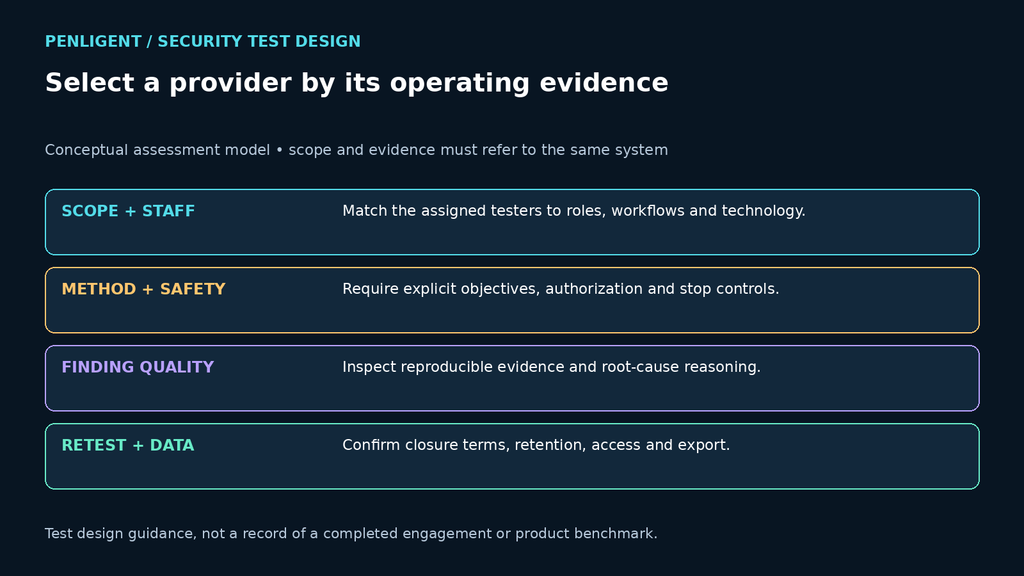
| Area | Strong evidence | Warning sign |
|---|---|---|
| Scope understanding | Questions about roles, data, workflows and architecture | Immediate quote based only on URL count |
| Tester assignment | Named skills matched to the target technology | Only company-wide credentials or anonymous staffing |
| Method | Test objectives and evidence mapped to risk | A generic checklist presented as complete coverage |
| Safety | Rate, data, stop and escalation controls are explicit | Production testing with vague guardrails |
| Finding quality | Reproducible root cause and demonstrated impact | Scanner output rewritten as prose |
| Retesting | Original security property is re-evaluated | Ticket closure based only on developer statements |
| Data handling | Clear storage, access, retention and deletion rules | Reports and credentials handled through personal accounts |
Explore Penligent for authorized security testing
Request a redacted sample finding
The sample should contain the target context, identity, prerequisites, exact observation, expected security property, impact, remediation direction and retest plan. Remove customer data, but preserve enough technical structure to judge whether an engineer could reproduce it.
Ask how the provider handles duplicates, disputed severity and chained findings. A mature process distinguishes one root cause affecting many endpoints from many independent weaknesses.
Evaluate AI and automation claims
Automation can improve coverage and consistency, while AI can help with planning and evidence organization. Neither proves that conclusions are correct. Ask which steps are automated, who validates findings, how scope is enforced, what data reaches model providers and whether the audit trail exposes tool calls and decisions.
Require the same evidence standard for human and AI-generated findings. The label should not change acceptance criteria.
Run a paid pilot
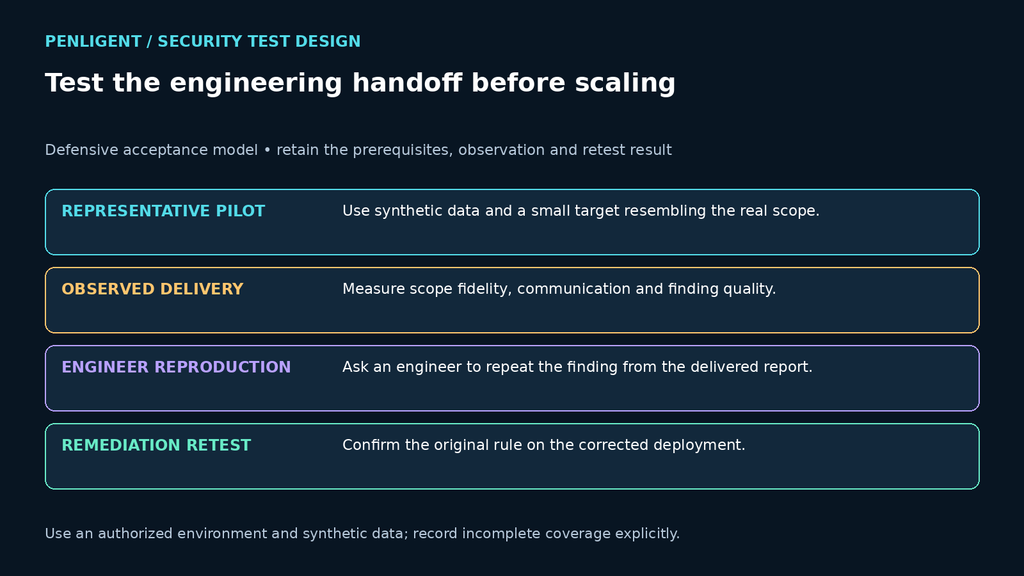
For a strategic or recurring relationship, use a small representative target with synthetic data. Include one known authorization defect, one configuration issue and one negative control. Measure technical communication, scope fidelity, finding quality, disruption, developer reproduction and retest speed.
Contract details
- rules of engagement and authorization;
- subcontractors and testing locations;
- data classification, retention and deletion;
- notification for critical findings and service incidents;
- ownership and export of reports and raw evidence;
- included retests and expiration;
- change-order rules and overages;
- liability and production disruption process.
References and certifications
Customer references are most useful when their target and operating model resemble yours. Certifications can support individual competence or process maturity, but they do not guarantee the assigned tester understands your stack. Ask who will perform the work and how senior review is applied.
Interview the proposed delivery team
A short technical interview is more informative than a long capabilities deck. Give the team a simplified architecture and ask how they would test one authorization boundary, one business workflow and one cloud integration. Strong testers identify missing context, propose safe prerequisites and explain what evidence would change their conclusion.
Ask whether the people in the meeting are the people who will perform and review the engagement. If staffing is assigned later, require minimum role qualifications, substitution notice and a named technical escalation path.
Assess communication during the engagement
| Event | Expected provider behavior |
|---|---|
| Possible critical finding | Rapid confidential notification with verified facts, scope and safe containment advice |
| Ambiguous behavior | Request context and run controlled validation before assigning severity |
| Production instability | Stop affected testing, preserve evidence and contact the authorized incident path |
| Scope discovery | Pause and obtain written authorization before testing a newly found target |
| Disputed finding | Review evidence and security property without defensiveness or silent deletion |
Require useful limitations
Every report should explain what was not tested, what could not be concluded and which environmental differences may affect results. A zero-finding engagement is not proof of security. It means the provider did not observe a validated weakness under the documented scope, methods, access and time constraints.
Plan the engineering handoff
Agree on a finding review meeting, ticket format, evidence storage and remediation questions before testing starts. The provider should be available to clarify root cause without turning every question into a new consulting engagement. Retest results should state whether the original weakness is fixed, partially fixed, not fixed or no longer reproducible because the environment changed.
Explore Penligent for authorized security testing
Make the purchase measurable
Choose a penetration testing company by examining the work product and operating controls before signing a broad engagement. A trustworthy provider makes uncertainty visible, avoids overstating coverage and remains accountable through remediation. Penligent can be included in the same evidence-based comparison through its AI pentesting offering.
The following Penligent overview introduces a general authorized testing workflow. It does not demonstrate that every assessment capability discussed in this guide is included in a particular product plan.
 English
 German
 French
 Spanish
 Portuguese
 Japanese
 Korean
 Hindi
 Arabic
 Turkish
 Hebrew