
AI application penetration testing must examine the system around the model. A chatbot prompt test cannot prove that retrieval is tenant-safe, tools enforce authorization, agent memory is isolated or sensitive data stays out of model and telemetry pipelines.
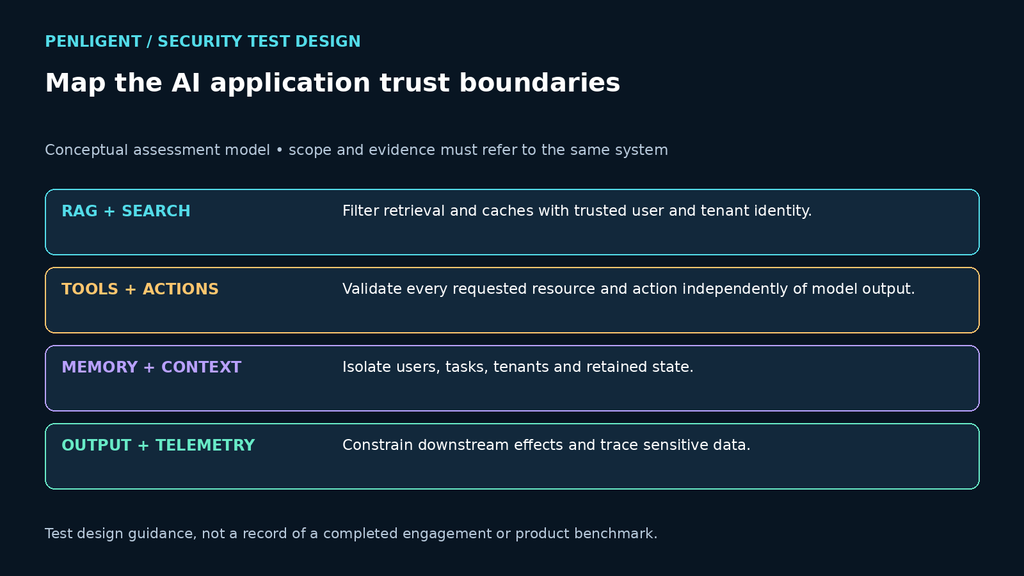
The test should start with trust boundaries: user input, orchestration, model providers, retrieval stores, tools, plugins, memory, human approvals, output rendering and downstream actions. The model is one component in a larger application.
Map the AI application
| Component | Security question | Evidence |
|---|---|---|
| Prompt and policy layer | Can untrusted content change instructions or bypass intended controls? | Input provenance, policy decision and resulting behavior |
| RAG and search | Are retrieval results authorized for the requesting user and tenant? | Identity, query, retrieved object metadata and authorization decision |
| Model provider | What data leaves the application, and what is retained? | Request path, provider configuration and retention controls |
| Tools and actions | Does every action enforce server-side authorization and parameter constraints? | Tool call, principal, approval and downstream result |
| Memory | Can one session, user or tenant influence another? | Memory keys, lifecycle and cross-context tests |
| Output rendering | Can model output become executable content or unsafe instructions? | Encoding, sanitization and consumer behavior |
| Monitoring | Can defenders reconstruct important model and tool decisions? | Correlated identity, prompt, retrieval, tool and approval events |
Explore Penligent for authorized security testing
The OWASP Top 10 for LLM Applications is a useful risk taxonomy. The NIST Generative AI Profile supports broader risk management, and MITRE ATLAS provides a knowledge base of adversarial techniques. None of them should be converted into a checkbox-only test plan.
Prompt injection is a path, not the final impact
A model following untrusted instructions matters when the application gives that behavior access to protected data, privileged tools or downstream consumers. The test should distinguish:
- a model producing unwanted text;
- retrieval returning unauthorized content;
- a tool accepting an unauthorized operation;
- an approval workflow being bypassed;
- output triggering code, requests or persistent content;
- sensitive data reaching an unintended provider or user.
This distinction prevents dramatic demonstrations from being reported as critical compromise without an application-level security boundary being crossed.
Test retrieval authorization
Create synthetic documents across two users, two tenants and multiple sensitivity levels. Test direct queries, paraphrases, summaries, citations, cached results and follow-up questions. Record whether authorization is applied before retrieval, after retrieval or only when content is displayed.
Embedding similarity is not an authorization decision. A retrieval system should filter with trusted identity and policy context, and downstream caches should preserve that context.
Test tool use and agents
| Control | Test | Expected property |
|---|---|---|
| Tool allowlist | Reference a tool outside the approved task | The orchestrator refuses before execution |
| Parameter validation | Supply model-generated identifiers for another tenant | The tool enforces authorization independently |
| Approval | Attempt a state-changing or high-impact action | A specific human approves the exact operation |
| Delegation | Chain tools with different privileges | Privileges do not accumulate silently across steps |
| Stop behavior | Cancel during a multi-step plan | Queued and child actions terminate |
| Replay | Reuse a previous approval or tool result | Authorization remains bound to task, actor and time |
Evidence requirements
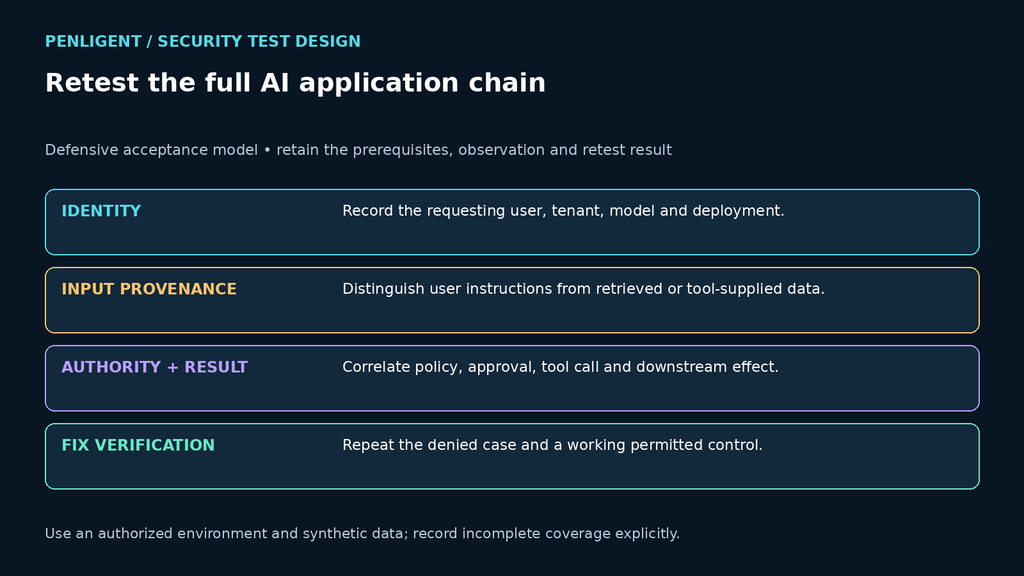
An AI finding should show the full chain: user identity, input provenance, model or policy decision, retrieved context, tool request, approval state, downstream authorization and observable impact. A screenshot of surprising model output is rarely enough.
Separate confirmed application behavior from model variability. Run repeated trials when nondeterminism matters, but do not report a success percentage unless the environment, model, parameters, sample size and scoring method are documented.
Data governance
Trace prompts, attachments, retrieved passages, model responses, tool output, logs, feedback data and analyst access. Confirm provider retention, training settings, regional processing, encryption, deletion and incident response. Test whether secrets or personal data are copied into traces that have broader access than the production system.
Design the engagement
- Document architecture, data flows, models, stores, tools and trust boundaries.
- Create synthetic identities, tenants, documents and high-impact tool actions.
- Define the security invariant for retrieval, memory and each tool.
- Test direct, indirect and stored untrusted content.
- Evaluate output consumers, approvals, logging and emergency stops.
- Deliver reproducible chains with application-level impact and safe retests.
Vendor selection
Ask whether the provider tests only prompts or can inspect APIs, identity, retrieval, cloud, tools and application code. Request a redacted finding that includes an authorization decision and downstream evidence. Confirm which models and attack libraries are used, how tests remain within scope and how customer data is protected.
Explore Penligent for authorized security testing
Make the purchase measurable
An AI application pentest is successful when it validates the application’s security boundaries despite probabilistic model behavior. Teams can evaluate Penligent’s AI pentesting workflow against this architecture-and-evidence model rather than relying on the number of prompt attacks attempted.
The following Penligent overview introduces a general authorized testing workflow. It does not demonstrate that every assessment capability discussed in this guide is included in a particular product plan.
 English
 German
 French
 Spanish
 Portuguese
 Japanese
 Korean
 Hindi
 Arabic
 Turkish
 Hebrew