
CVE-2026-123039 is a local privilege escalation vulnerability in Check Point Gaia’s DynamicCLI service. Its urgency comes from the way it has been used after an internet-facing gateway was already breached: a lower-privileged foothold became root access. Check Point rates the flaw High at 7.8 and recommends the November Jumbo Hotfix. Its November 12 security advisory confirms exploitation alongside PHP2Shell.
A completed package installation leaves two further decisions: historical exposure and appliance trust. An administrator needs to establish whether the affected software is present, whether an attacker could have reached an initial entry point, and whether the appliance still deserves trust. Those questions require different evidence. A gateway can be updated while its exposure history remains unresolved; an investigation can find no known indicators while lacking the logs needed to exclude an intrusion.
This analysis separates the published vulnerability facts from a proposed response and verification method. It does not claim to reproduce the real exploit or to inspect any customer gateway. The practical aim is to make a defensible decision about containment, the correct vendor update, service recovery, and the systems reachable from an appliance that may have been compromised.
What CVE-2026-123039 does and does not establish
A local privilege escalation classification describes the access required for that individual defect. It does not mean the device can only be attacked by someone physically present. An earlier remote vulnerability, a stolen account, or another foothold can change the starting position. When reviewing this case, keep the initial-access question separate from the question of which privileges the DynamicCLI boundary should enforce.
Check Point’s November 13 CheckMates notice lists Management, Multi-Domain, Log Server, and Security Gateway deployments across R80.30 through R82.20. That is broader than the release summary in the previous day’s blog. Treat these as differently scoped summaries, then use the product advisory sk1000362 and support guidance to resolve your exact role, release, and required hotfix Take. No universal Take number is asserted here.
| سؤال | Evidence to use | Decision it supports |
|---|---|---|
| Is this the DynamicCLI issue? | The exact CVE and corresponding vendor advisory | Avoid confusing local escalation with the remote entry flaw |
| Does this asset require an update? | Role, Gaia release, installed Take, and release-specific vendor mapping | Select the correct supported package |
| Was a remote entry path exposed? | Historical configuration and ingress records | Set the investigation scope |
| Is the running asset remediated? | Post-change version and component evidence from each member | Close the software finding |
| Was trust restored after intrusion? | Incident findings, recovery actions, and downstream review | Close the incident on its own evidence |
A common reporting error is to assign every capability in an observed intrusion to one CVE. That loses the distinction between access, escalation, persistence, and movement to another host. It can also mislead an engineer into checking the wrong control. A network rule protecting an administrative portal and authorization inside a local privileged service address different boundaries; neither should be credited with fixing the other.
Use explicit labels in tickets: software exposure, entry-path exposure, suspicious activity, and confirmed compromise. Reserve confirmed compromise for evidence that meets the organization’s incident criteria. Use unresolved when the necessary inventory or historical telemetry is missing. This vocabulary allows the response to move quickly without converting incomplete information into a clean bill of health.
Read the reported attack as a sequence of trust boundaries
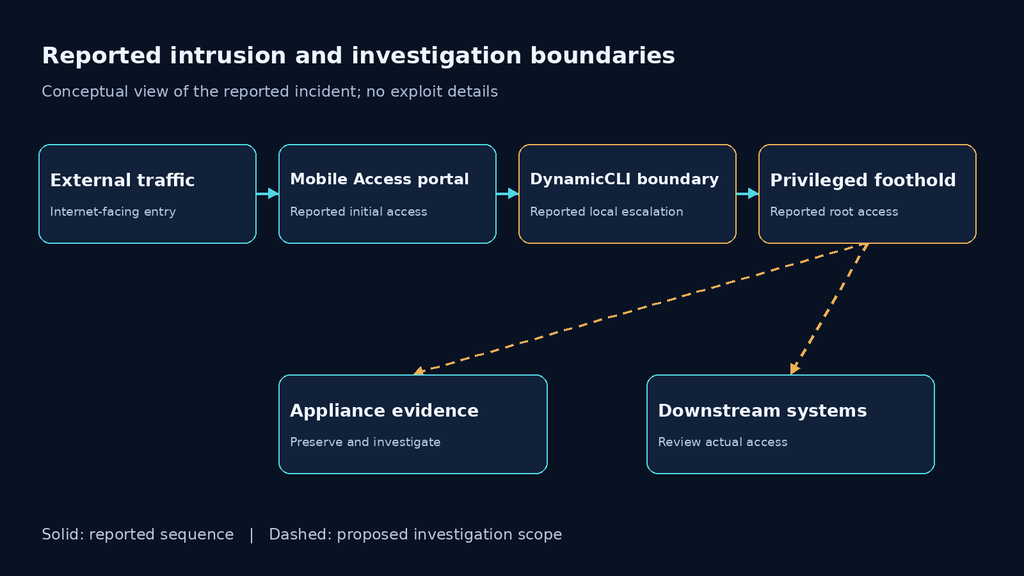
في Check Point Research’s incident analysis, PHP2Shell provided entry through the Mobile Access portal, followed by DynamicCLI privilege escalation. The researchers describe later webshells, a backdoor with proxy functionality, and movement to an ESXi host in an investigated intrusion. The sequence matters because a gateway-only software update cannot, by itself, establish what happened beyond that first system.
For defensive analysis, draw the environment as a set of boundaries rather than a line of product names. An external user reaches a published service. That service operates under an execution identity. A privileged local component accepts some requests from local callers. The appliance has network routes and may hold credentials or session material useful elsewhere. Each transition needs its own access condition and its own observable outcome.
This model avoids an unjustified assumption that the firewall’s role as a security device makes everything behind it equally reachable. Actual routing, segmentation, allowed protocols, account privileges, and stored secrets determine the next opportunities. A diagram should show these as investigation questions, not as a guaranteed attack chain across every deployment. Validate each connection against the customer’s configuration before expanding the incident perimeter.
It also explains why administrative network isolation remains valuable even when it does not repair a local defect. Limiting access can reduce available paths into management services and reduce some follow-on opportunities. The scope of that benefit depends on the affected interface. Record the particular route that was restricted, the systems that still need access, and the route used to verify the restriction. A generic statement that the appliance is internal is insufficient.
When a lower-privileged service is part of the incident, ask what it could read before escalation and what additional authority root would add in that environment. That exercise helps identify evidence sources and recovery dependencies. It does not require sending an exploit request. The right starting point is an authorized inventory of service identities, trust relationships, and relevant access policy, with the owner involved in interpreting appliance-specific behavior.
The conceptual diagram below distinguishes the sequence reported by the researcher from downstream investigation work. Its investigation branch is a response model, not a claim that every affected gateway leads to every adjacent asset.
Use the incident timeline without overstating attribution
The research report places the first wave on October 30, 2026, and a broader scanning wave on November 2. It distinguishes destructive activity in some initial targets from the later wave. The researchers also state that the available evidence does not support high-confidence attribution. Those limits belong beside the incident facts, rather than disappearing when the story is condensed into a vulnerability alert. See the published investigation and attribution assessment.
For an individual organization, the relevant timeline starts with its own assets. Establish when each appliance entered service, when its portal or management path became reachable, what software it ran during that period, and when the applicable correction took effect. A public report’s first observed date is useful context; it is not a reliable earliest-possible exposure date for every customer.
Represent time as intervals with confidence. A configuration backup may show that an interface was exposed on one date without proving it was continuously exposed until the next backup. A change request may document intent without establishing implementation. A load-balancer record can help resolve the interval, while a missing record leaves uncertainty. Keep the supporting artifact attached to the interval instead of flattening these signals into one precise but unsupported timestamp.
Normalize clocks before joining events. Preserve the original timestamp and time zone, then add the normalized value used for analysis. Record clock drift when it can be established. A gateway crash, a connection from the appliance, and a hypervisor login may appear unrelated if collected from systems using different clocks. Correct correlation depends on understanding those differences, not merely sorting exported strings.
Attribution should not delay containment. An organization can determine that an appliance has an unauthorized modification without knowing who made it. Conversely, a politically themed filename is insufficient to identify an operator. Separate the confidence in observed behavior from confidence in actor identity, motivation, and campaign membership. Operational decisions should rest on the access and consequences supported by the evidence.
Preserve alternative explanations when they remain plausible. A process restart may be a maintenance action, a software failure, or an attack effect. Ask which additional records could distinguish them. This practice produces a stronger investigation than selecting the most dramatic explanation early and forcing later evidence to match it.
Build an asset record that survives a cluster rollout
Begin with individual appliances and members. A service name, shared address, or cluster label is useful for business ownership, but it is an inadequate unit for patch verification. Record every member that can become active, including standby systems, management components, log servers, and disaster-recovery instances included in the vendor’s affected scope. An offline member remains a tracked exception until someone verifies its state.
For each asset, retain its role, release, installed hotfix Take, administrative owner, maintenance owner, external services, management ingress, and relevant cluster membership. Link to evidence rather than copying every configuration detail into the ticket. This keeps sensitive material within the approved evidence location while making the decision reviewable by responders who do not have direct appliance access.
Check Point’s Gaia role documentation identifies show version all as a way to show product, build, and kernel information. Treat the output as one inventory input. A release name alone does not establish which security correction is installed, and an output captured before maintenance does not describe the post-change running system.
| Asset field | Useful evidence | Frequent blind spot |
|---|---|---|
| Individual member identity | Owner-confirmed asset record | Only recording the shared service address |
| Release and Take | Time-stamped local or supported management output | Relying on a scanner banner |
| Exposure interval | Ingress history and service configuration | Assuming today’s rule describes last month |
| Operational role | Actual deployment and management inventory | Ignoring management and log components |
| Exception status | Named owner and next check | Counting unreachable systems as complete |
Resolve identity collisions before scheduling work. Cloned names, reused addresses, and stale management records can cause evidence from one appliance to be attached to another. Prefer a stable asset identifier plus environment and member role. When an address has changed, retain the historical relationship so that an incident search does not exclude traffic that belonged to the device before its move.
Measure progress against the complete population. A rollout report that says all reachable members were updated may be technically correct while concealing the remaining risk. Report both the verified fraction and the unresolved count, with the reason for each exception. This prevents a maintenance window from becoming an accidental decision to accept exposure on unobserved assets.
Have the service owner confirm the dependency map. A security team can identify the software concern while the network team knows which member handles a critical remote-access workflow. Bringing those facts together early makes it possible to sequence maintenance and evidence collection without improvising during a failover.
Check the activation conditions for an offline spare as well. A member that is disconnected during collection may later return through an automated recovery process or an operator’s emergency action. The exception record should tell that operator what must be verified before activation. Otherwise, a corrected service can quietly return to an unverified member during the next unrelated outage.
Choose containment before changing the evidence
Containment has two jobs: reduce the opportunity for further access and preserve enough information to understand the incident. These goals can conflict when a live appliance is unstable or business-critical. The response lead should make the tradeoff explicit, document the reason, and coordinate with the owner and vendor support. There is no universal sequence of shell commands that safely resolves every gateway incident.
For a suspected active intrusion, decide whether traffic must be isolated, failed over, or otherwise restricted before routine maintenance begins. Keep an approved administrative route available to responders. Record which business functions depend on the affected path and who can authorize a temporary service loss. A technically effective restriction that also removes the team’s recovery access can extend an outage.
إن vendor’s current notice describes stopping DynamicCLI and preventing its restart as a temporary option when losing that functionality is acceptable, referring customers to sk1000362. Follow that release-specific procedure rather than inventing a command sequence. Before using it, determine which operations depend on the service and how the temporary state will be verified and tracked.
Preserve the evidence that would be changed by a reboot, update, or recovery action when doing so is feasible and consistent with the incident plan. Document what was collected, by whom, when, and from which member. If a business decision requires immediate isolation or a restart before collection, record that limitation. An honest evidence gap is preferable to an unsupported claim that an investigation was comprehensive.
NIST SP 800-61 Revision 3 places incident response within broader cybersecurity risk management. The response method proposed here applies that separation to an appliance incident: technical remediation, operational recovery, and business acceptance each have accountable owners. The publication does not supply a Check Point-specific exploit test or hotfix mapping.
Keep containment changes in a controlled record. Include the original policy reference, the temporary restriction, the validation performed, and the condition for removal. Avoid restoring access automatically at the end of a change window if the investigation remains open. Temporary controls need an expiry review, but an expiry date is not evidence that the underlying incident has been resolved.
Turn indicators into an investigation rather than a verdict
Check Point’s published indicator list includes a PHP session marker, suspicious component-like process names, temporary-directory tooling, a themed note, and unexplained traffic-log gaps. The vendor explicitly warns that absence of a match does not exclude compromise. Use the full vendor list and its updates in the investigation; no single string is presented here as a universal detection rule.
Start with the observation, then test its meaning. Record the artifact, its collection source, its timestamp, and the reason it is unusual for that asset. Compare it with an appropriate trusted baseline and authorized changes. A file name resembling a reported indicator deserves investigation, but a name can be reused by unrelated activity. A matching hash is more specific to a sample but still needs context about whether the file was merely stored, executed, or blocked.
Build a timeline across independent sources where available. Appliance telemetry can be compared with upstream access logs, network records, administrative changes, identity logs, and activity on potentially reached systems. Sources outside the appliance are especially useful when the integrity of its own records is uncertain. Do not assume that all organizations retain the same data or that a missing feed can be reconstructed retrospectively.
Define the coverage of every negative result. A search over seven days of retained proxy logs answers a narrower question than a search over the full suspected exposure interval. A process snapshot describes a moment, not the entire history of the host. A file-integrity comparison answers only for the files and baseline included. Put these limits in the result field so that an empty search cannot silently become an assertion about the whole incident.
Keep collection and interpretation separate. An evidence custodian can preserve the original artifact while an analyst creates a working copy and records hypotheses. This reduces accidental modification and allows a reviewer to retrace the conclusion. When vendor support provides a collection procedure, prefer that supported workflow over broad exploratory commands that may affect performance or overwrite useful artifacts.
Escalate when the evidence crosses a boundary. An unexplained privileged change should trigger more than another version check. A connection from the gateway to an administrative service should bring the receiving system into scope. The response remains proportional: add the assets and questions supported by the evidence, then collect what is needed to test them.
A harmless model of privileged-service authorization
The following exercise illustrates a general authorization mistake: confusing a caller’s ability to reach a local service with permission to request a privileged action. It is not Check Point source code, a reconstruction of DynamicCLI, or an exploit for CVE-2026-123039. Everything happens in memory. The program opens no network listener, contacts no appliance, changes no privileges, and executes no operating-system command.
In the model, the caller and action are already established by a hypothetical trusted transport. A real service would also need to authenticate the peer and protect its communication channel. The example intentionally focuses on the later authorization decision. Its purpose is to show why reachability and authorization must be checked separately, without reproducing a real privileged interface.
from dataclasses import dataclass

@dataclass(frozen=True)
class Caller:
    identity: str
    local: bool
    permissions: frozenset

def weak_decision(caller, action):
    # Toy mistake: local reachability becomes authority.
    return caller.local

def explicit_decision(caller, action):
    # Demonstration only, not a production security library.
    allowed = {
        "read_status": "status.read",
        "change_policy": "policy.write",
    }
    required = allowed.get(action)
    return required is not None and required in caller.permissions

portal = Caller("portal-demo", True, frozenset({"status.read"}))
operator = Caller("operator-demo", True, frozenset({"policy.write"}))

assert weak_decision(portal, "change_policy") is True
assert explicit_decision(portal, "change_policy") is False
assert explicit_decision(portal, "read_status") is True
assert explicit_decision(operator, "change_policy") is True
assert explicit_decision(operator, "unknown_action") is False
print("Toy authorization boundaries checked; no action executed.")
The exercise succeeds when it rejects the unauthorized action. The weak function accepts a privileged request because the caller is local; the explicit function requires permission for the requested operation and rejects unknown operations. A team reviewing its own administrative service can translate that distinction into design questions: how is the peer identified, where are privileges assigned, and which layer enforces the operation-specific rule?
Do not mistake this model for proof that a vendor implemented the same mistake internally. Public incident reporting supports the affected boundary and observed escalation, but not every detail of a particular service’s authorization logic. A toy exercise is valuable only while that distinction remains visible. It should help a reader reason about controls without making unsupported claims about undocumented code.
For a real validation engagement, agree on the evidence needed before selecting a test. A configuration review, a supported version check, and vendor-provided validation may answer the immediate exposure question with less disruption than active exploitation. If deeper testing is justified, isolate it in an approved lab and define stop conditions, recovery, and acceptable outcomes in advance.
Select the correct Jumbo Hotfix without guessing a Take
The release string is the beginning of the update decision. Obtain the current vendor mapping for the appliance’s release and role, confirm the appropriate package, and check its prerequisites. Do not copy a Take number from an unrelated branch or a third-party discussion merely because its publication date is recent. A package identifier and a statement that it addresses the particular issue should be linked in the change record.
Check Point’s CPUSE installation guide describes package verification and warns that cluster and scalable-platform installations require the relevant administration guide. It also cautions against restoring old manually changed files over updated versions. Those details matter because a successful package transaction and a safe deployment across the actual topology are different tasks.
Prepare an explicit change plan for the deployment type. Identify the member order, the expected traffic effect, the administrative access path, and the checkpoints that allow the next step to begin. For a cluster, verify the state of the member being changed and the state of the member expected to carry service. For a management system, account for the teams and workflows that depend on it during the window.
Use vendor-supported package verification before installation. Record the result and any warnings, then resolve them with the owner or support rather than treating them as cosmetic. A compatibility warning can be operationally significant even when the security update is urgent. Documenting the tradeoff lets the response lead distinguish a supported emergency rollout from an improvised one.
إن R82 Jumbo Hotfix procedure includes package verification and an automatic reboot. That page is an example for its named release, not a substitute for the matching guide on every appliance. Plan for the documented behavior of the actual package and topology, including the evidence that must be collected before a disruptive step.
After maintenance, obtain fresh evidence from the running member. Link the installed state to the selected vendor correction and record any required restart or follow-up action. Reuse of a pre-change screenshot is not validation. If the supported management interface reports an aggregate status, confirm that the report includes all relevant members and does not hide failures or deferred tasks.
Make rollback a security decision as well as an availability decision. Reverting to a previous software state can restore service while reopening the exposure being addressed. Define which compensating restrictions remain during a rollback and who accepts the temporary condition. When a system is suspected of compromise, restoring an old disk image also requires confidence in the image’s age and integrity; successful boot alone is not sufficient.
Separate software closure from operational recovery
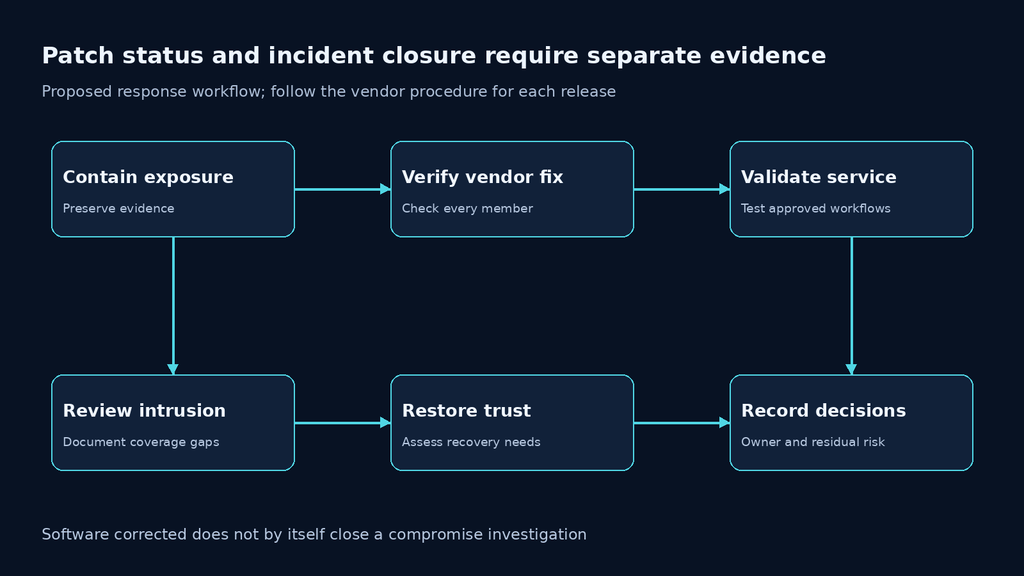
Use three acceptance outcomes, each with an assigned reviewer. Software closure establishes that the correct fix is running. Operational recovery establishes that the expected service works after the change. Incident closure establishes the result of the compromise investigation and recovery work. Marking all three complete because a device returned to the network collapses the evidence that the response is supposed to produce.
Software closure should identify the asset, release, installed Take, supporting vendor reference, collection time, and validation owner. It should also identify exceptions such as unreachable members or unsupported versions. When the exact mapping cannot be confirmed, keep the software finding open and involve vendor support. A high-confidence record of uncertainty is more useful than an unreviewable green status.
Operational recovery should follow the critical workflows the owner identified before maintenance. Test representative allowed traffic, remote-access behavior where applicable, logging delivery, management access, and expected failover behavior using the approved procedure. These are functional checks, not exploit tests. Keep their results separate so a service failure is not misclassified as evidence that the security fix failed.
Incident closure requires a statement about the investigation’s scope and limitations. If a suspicious artifact was found, document how it was handled and which additional systems were reviewed. If no evidence was found, name the sources searched and the period covered. If a portion of the period was unobservable, state that directly. The final judgment should explain what the evidence supports, not just list the tools used.
| النتيجة | Acceptance evidence | What does not establish it |
|---|---|---|
| Software corrected | Matching vendor update and post-change member state | Download completed or maintenance scheduled |
| Service restored | Approved business and infrastructure checks pass | A login page loads |
| Investigation completed | Evidence scope, findings, blind spots, and accountable decision | No match for one indicator |
| Trust restored | Recovery method and dependencies accepted by incident owner | Reboot or patch installation alone |
Use a response workflow that makes these branches visible. Evidence collection and containment can proceed alongside patch planning, but they should not disappear into the same task. The diagram below is a proposed operational method, not a vendor certification process or a claim that every incident requires the same recovery action.
Decide whether the appliance can remain trusted
When an investigation establishes unauthorized privileged access, an in-place update does not explain every modification made before that update. The response owner must decide whether supported forensic assessment and targeted remediation are sufficient or whether a rebuild from trusted media is required. That decision depends on evidence, the appliance’s role, vendor guidance, and the organization’s tolerance for unresolved changes.
Document the trust argument explicitly. Identify the material that is trusted, why it is trusted, and what it will restore. A clean software image can provide a stronger starting point than an unknown running filesystem, but importing an unreviewed configuration or restoring a compromised secret can recreate part of the risk. Recovery should consider software, configuration, credentials, and surrounding access paths together.
Do not erase the only available evidence simply to make the appliance look clean. Coordinate preservation with containment and restoration. If business needs require rapid replacement, record the disposition of the original device or image and retain the information needed for later analysis under the incident plan. This allows service recovery to proceed without pretending that every investigative question has already been answered.
Review the source of backups. A backup made after an intrusion may faithfully preserve an unauthorized change. A much older backup may omit legitimate configuration required for current service. Compare candidates against change history and known-good references, then validate the chosen recovery configuration in the appropriate environment. Neither the newest timestamp nor successful import establishes trust by itself.
Include monitoring readiness in the return-to-service decision. Verify that relevant external collection is receiving events and that responders can distinguish the new baseline from the pre-recovery state. Preserve the last trusted observation before the change and the first verified observation afterward. Without those markers, a later alert may trigger an unnecessary repeat investigation or conceal a recurrence.
State residual risk in terms the business owner can evaluate. An unresolved exposure interval, missing historical telemetry, or an unreachable recovery dependency has a concrete consequence. Name the next action and the owner who can resolve it. Avoid a broad statement that the organization is safe; the response should close defined findings and document the remaining uncertainty.
Follow credentials and network access beyond the gateway
The next investigation boundary is determined by what the appliance could access and what the evidence indicates it did access. Start with legitimate administrative relationships, automation credentials, service accounts, certificate material, and reachable management systems. This is a review of possible exposure, not an assertion that every secret on an affected product has been stolen.
For each credential, identify its authority, storage location, authorized users, dependent services, and revocation method. Rotation should happen through a trusted administrative path. Changing a secret while an attacker still controls the system that stores its replacement may not establish a durable recovery. Coordinate credential changes with containment and the restoration of the affected trust boundary.
Give receiving systems their own timeline. If a gateway initiated an unusual administrative session to another asset, review that destination using its native records and owner context. An authorized maintenance session and an unauthorized session can look similar at a network level. Correlation with account activity, change records, and process or management telemetry can resolve the difference where the data exists.
Keep the scope proportional. Do not reset every credential in an organization without understanding dependencies, but do not restrict the review to the firewall because that was the original alert. Rank credentials by evidence of access, privilege, reuse, and the consequence of continued misuse. Record each rotation decision and the validation that its dependent service still works.
Review shared administrative paths separately from ordinary application traffic. A gateway may be correctly segmented for user workloads while retaining a privileged management route. The response should examine the actual exception rather than infer access from a diagram drawn for another purpose. Include temporary troubleshooting rules and emergency access arrangements that may have outlived their original maintenance window.
When another organization manages a dependency, exchange a scoped evidence request. Specify the relevant asset, interval, identity, and behavior under review. Avoid sending an entire configuration export when a smaller record can answer the question. The objective is to establish whether the boundary was crossed while protecting unrelated customer and administrative information.
Handle MSP and multi-tenant response boundaries deliberately
An MSP may operate similar gateways for many customers, but similar software does not mean identical exposure. Build the response population from actual customer environments and assigned roles. Separate the common update requirement from the environment-specific investigation. Shared maintenance automation can accelerate delivery while each customer’s evidence and incident status remain distinct.
Use a customer-specific scope record that identifies the assets, authorized administrative paths, response owner, and communication channel. Shared infrastructure should appear as an explicit dependency rather than be copied into every customer’s evidence bundle. If an administrative system serves multiple tenants, assess its influence on the other environments according to the evidence and access model.
Be precise about remote evidence collection. A central platform may show the last observed version rather than the current version of an offline appliance. A management account may lack permission to inspect a particular member. These are collection limitations, not proof that the member is safe or unsafe. Report them as unresolved work with an owner and an expected verification time.
Separate service restoration promises from incident conclusions. A customer can be told that the supported update was installed and tested while an exposure review is still underway. Conversely, a customer with no identified attack evidence may still need the software correction. This distinction avoids withholding useful operational information until every investigation is finished.
For an authorized assessment performed with Penligent or another testing workflow, agree on deliverables that can be reviewed: asset coverage, source-backed version decisions, configuration evidence, limitations, and retest results. Device-specific incident handling, privileged recovery, and vendor support remain explicitly assigned tasks. Do not assume that a general web-testing product automatically inventories Gaia internals or removes a backdoor.
A reusable acceptance template is useful; a reusable conclusion is not. Carry the same evidence standards across customers while allowing each result to reflect the actual environment. A tenant with a missing history and a tenant with complete external logs may require different residual-risk decisions even after the same update is installed.
Work through a hypothetical two-member gateway incident
Consider a fictional organization with two gateway members, a separate management server, and a remote-access service published through an upstream address. The management dashboard reports a recent release, but the on-call engineer has not yet collected each member’s installed Take. An analyst also finds an unexpected restart during the period the portal was exposed. These facts justify urgent investigation and update verification; they do not yet establish a successful intrusion.
The first useful step is to identify which member handled traffic at the relevant time. Current active status is insufficient if a failover occurred. The network owner supplies the available member-state history and upstream routing records. The analyst preserves the restart observation with its original timestamp and checks whether it aligns with an approved change. The response lead records what remains unknown instead of interpreting the unexplained restart as a confirmed exploit.
Next, the software owner compares the actual release and Take on each member with the current vendor advisory. Suppose the first member is verified corrected, while the second is unreachable through the normal management path. The cluster is not marked fully remediated. The second member receives a named exception owner, and the service owner decides how to prevent it from returning to service before verification. That is a concrete operational control, not a statistical adjustment to the rollout percentage.
The investigation then compares external records with the telemetry available from the appliance. Imagine that upstream logs cover the relevant interval but appliance logs have a gap around the restart. The report should preserve that difference. It may say that no listed indicator was found in the retained external records, while appliance-level visibility is incomplete. It should not say that the gap proves tampering or that the external negative result excludes local persistence.
If later evidence establishes unauthorized privileged modification, the recovery decision changes. The team can stop treating the event as a software-only exposure and invoke the supported incident process. It reviews restoration material and the gateway’s administrative dependencies, then decides how to replace or recover the affected member. The already corrected member still needs the exposure review appropriate to its own history; the status of one member does not automatically describe the other.
Finally, the service owner validates the planned remote-access and routing workflows on the recovered topology. The response lead records the remaining evidence limits and assigns any downstream review. The outcome is several reviewable statements: which software state was corrected, which business function was tested, which intrusion evidence was established, and which uncertainty remains. This fictional example illustrates decision structure only and is not an account of a Check Point customer incident.
Design the evidence record before collecting large exports
A compact evidence schema can make an incident easier to review without centralizing every sensitive appliance artifact. Use a finding identifier, asset identifier, observation time, collection method, evidence location, analyst interpretation, and limitation. Add a reference to the source advisory when the observation supports a software decision. The schema is a proposed working format; it is not a vendor-required form or a compliance certification.
{
  "finding": "gaia-update-review-demo",
  "asset": "gateway-member-example",
  "observation": "post-change software state recorded",
  "evidence_location": "approved incident evidence store",
  "supports": ["software-state review"],
  "does_not_establish": ["absence of earlier compromise"],
  "reviewer": "assigned response owner",
  "limitations": ["historical appliance logs incomplete"]
}
The limitation field prevents later readers from extending the observation beyond its scope. It prevents a later reader from stretching a version result into an incident conclusion. It also helps the next analyst choose a complementary source. If software state is known but historical access is not, another version scan will add little; an ingress-history review may resolve the remaining question.
Keep raw exports in the approved evidence location and reference them from the working record. Restrict access according to the incident’s needs. Configuration and diagnostic bundles may contain details that should not appear in a general ticket or a public testing report. A reviewer usually needs the relevant finding and a controlled way to inspect supporting material, not a copied archive attached to every status update.
Retain the original and the normalized interpretation separately. A screenshot can provide immediate context, while structured output can support comparison across members. Neither format is universally sufficient. Choose the smallest set that preserves the decision and allows another qualified person to reproduce the interpretation. When a collection step fails, retain the failure reason so it does not disappear from the final coverage count.
Evidence aging also needs an owner. A valid post-change observation may become stale after another rollout, failover, or recovery operation. Link the observation to the change that produced it and define when a new observation is required. This is especially helpful during a multi-day response in which several teams are making legitimate changes to related systems.
Prioritize the remaining fleet using access and consequence
After urgent exposed systems are assigned, prioritize the rest of the affected fleet using actual access conditions and business consequence. An appliance serving a published portal, an internally reachable management server, and an offline spare are different operational situations. They may still share a software correction requirement, but the investigation and scheduling decisions should reflect their particular paths and dependencies.
Use a small decision matrix rather than a single severity number. Record external reachability, privileged relationships, confidence in version information, available telemetry, and the consequence of an outage. A higher-confidence inventory can make a safe maintenance plan faster. An unknown inventory should create an early discovery task, not automatically move the asset to the end of the queue.
Be careful with controls that existed only after the alert. If a portal was restricted today, that change can reduce current exposure while leaving a previous interval to investigate. Similarly, moving a device to a trusted network does not explain modifications made before the move. Keep the mitigation effective time distinct from the start of the asset’s history.
For unsupported or unusually old releases, engage the vendor and service owner on a supported migration path. Do not infer safety because the public summary emphasizes current branches. The practical question is which correction or replacement is supported for the actual deployment, including the availability and recovery requirements that constrain the change.
Report priority as a decision with a reason. For example, an internally reachable management component may be scheduled early because it has broad administrative influence, even if it has no published portal. A spare may require isolation and verification before activation rather than an emergency production change. These are environment-specific judgments, and the supporting evidence should make them reviewable.
Define an authorized validation scope that avoids accidental disruption
A validation request should name the assets, interfaces, accounts, allowed methods, time window, and stop conditions. Include the expected evidence and the operations that require a separate incident or maintenance owner. This is particularly important when a tester can reach both public services and privileged management interfaces. Reachability is not a substitute for the customer’s authorization to interact with every service.
Start with the least disruptive method that can answer the question. Supported inventory and configuration review can establish many remediation conditions. A controlled functional test can establish that service remains available. These results should be labeled accurately. An ordinary successful request does not reproduce a memory corruption exploit or prove that a local authorization boundary is fixed.
If a lab exercise is needed, define a success condition that measures the control rather than the attacker’s ultimate capability. For an authorization boundary, the meaningful question may be whether an unprivileged caller is denied the operation under test. A failure to obtain a shell is ambiguous if the test never reached the boundary or used an unsuitable environment. Record prerequisites and denied access as part of the result.
Keep validation traffic distinguishable from suspicious activity. Tell the relevant monitoring owner the approved source, interval, and case identifier through the normal engagement process. Preserve the test record so an analyst can later correlate it. This coordination does not require reducing monitoring or disabling protection; it provides context for interpreting the observations.
A strong handoff states the tested condition, the observed result, the evidence, and the limits. For example, it can establish that an approved external path is restricted after the change while explicitly leaving historical compromise outside that test’s scope. That precision makes the report more useful to the incident team and more credible to the person accepting the remediation.
Diagnose a rollout that reports success but still fails acceptance
Suppose the deployment console reports success while a member still presents an unexpected software state. First resolve whether the console and the local observation refer to the same asset and time. A cached inventory, a reused management name, or a change made after collection can produce contradictory-looking results without establishing that the installer failed. Preserve both observations until their identity and timing are reconciled.
Next, distinguish the installation record from the running state required by the package. Review the supported procedure and the recorded change outcome with the platform owner. A maintenance task may have completed one phase while a later required action remains pending. Avoid forcing the status to complete simply because the scheduled window has ended. The acceptance condition should remain the one agreed before deployment.
If traffic behaves differently after an update, compare the failed workflow with the pre-change test definition. Identify the client, destination, member, protocol, and time rather than describing the problem as a general network outage. This gives the service team a reproducible symptom and helps distinguish a routing or failover issue from a management-only problem. Preserve the failing observation before making additional changes.
When logging delivery fails, inspect the collection path with its owner. A device can produce events while an intermediate collector, forwarding rule, or storage destination prevents responders from seeing them. Test the approved collection workflow and retain a known event as an anchor. Do not treat an empty dashboard as evidence that no security activity occurred on the appliance.
A rollback can change which evidence remains relevant. If the system returns to an older state, the post-update version observation no longer establishes its current correction status. Record the rollback time, the resulting software state, and the restrictions retained while the permanent solution is reconsidered. A recovered business service and an open software exposure can coexist, and the status report should show both.
Assign contradictions to a person who can resolve them. An incident queue often accumulates screenshots from several teams without a shared interpretation. Ask the assigned owner to state which assertion each artifact supports and what observation would settle the disagreement. This is more productive than rerunning every scanner or collecting another broad diagnostic bundle without a specific question.
Before handing the system back to routine operations, confirm that temporary workarounds have a documented disposition. Some may remain necessary while an exception is open; others may interfere with normal administration after the supported correction is installed. Their removal should follow an approved change and a defined validation, rather than an assumption that all emergency controls can be discarded together.
Questions administrators are asking about CVE-2026-123039
Is CVE-2026-123039 an unauthenticated remote code execution vulnerability?
- The CVE concerns local privilege escalation in DynamicCLI. The reported intrusion used a separate entry weakness first. Do not describe the individual local flaw as if it independently provides the full remote chain.
- For your environment, review both the applicable software state and the initial-access paths. A correction for one boundary does not automatically establish the state of another.
Which Check Point versions and roles should I check?
- Use the exact role, release, and hotfix state against the current product advisory. The official summaries reviewed have different levels of scope detail, as discussed above.
- Include relevant management, log, and cluster members rather than limiting the inventory to the active traffic address. Obtain support clarification where the release-to-fix mapping is unclear.
Does installing the November Jumbo Hotfix finish incident response?
- It can address the software requirement when the correct update is verified on the running asset. Historical compromise is a separate question.
- When unauthorized access is suspected or confirmed, retain the investigation and recovery tasks, including the review of dependencies indicated by the evidence.
Can I use an internet scan to prove the appliance is safe?
- A remote observation can help identify a reachable service. It does not necessarily identify the installed Take, every cluster member, or the integrity of the appliance.
- Use supported asset evidence and the vendor mapping for the software decision. Document the scope of any external test and keep it within the customer’s authorization.
What if none of the published indicators match?
- State which sources and time interval were searched. An empty result is meaningful only within that coverage.
- Missing logs, unavailable members, and an unknown baseline remain limitations. They should be visible in the acceptance decision instead of being converted into evidence of absence.
Should I disable DynamicCLI immediately?
- The vendor describes a temporary option subject to the loss of that functionality. Use the supported release-specific procedure and have the owner assess the operational consequence.
- Track the temporary restriction, verify its effective state, and continue the permanent update work. This article does not provide an improvised service-control command.
Should I rebuild an appliance after confirmed root access?
- Decide through the incident process and vendor support using the evidence, recovery options, and remaining uncertainty. An update alone does not account for every earlier modification.
- Review recovery media, configuration, and credentials together. Preserve the original evidence as required before destructive recovery actions.
What should an external assessment deliver?
- A scoped asset list, source-backed software decisions, relevant configuration evidence, test results, exceptions, and a clear retest outcome.
- Require an explicit distinction between patch validation, functional testing, and incident investigation. A tool name or completion percentage does not replace those deliverables.
The accompanying Penligent product video demonstrates a general authorized testing workflow. It is not a demonstration of CVE-2026-123039 exploitation, a substitute for Check Point incident support, or evidence that a particular appliance has been tested.
For the response owner, the decision to close this case should be traceable to the affected assets and the questions actually answered. Verify the vendor correction, validate the service, and make the compromise assessment on its own evidence. Where a boundary remains unknown, retain that uncertainty with a responsible owner and a concrete next action.

 Arabic
 English
 German
 French
 Spanish
 Portuguese
 Japanese
 Korean
 Hindi
 Turkish
 Hebrew