
Java4Shell, tracked as CVE-2026-114938, is a memory-corruption flaw in the accelerated Base64 decoder used by affected Java runtimes on specific x86-64 processors. Oracle and OpenJDK published security updates on November 17, 2026. The practical question on November 18 is which running workloads use that code path, and whether a completed maintenance ticket actually changed those workloads. Start with the OpenJDK advisory and your runtime vendor’s release record.
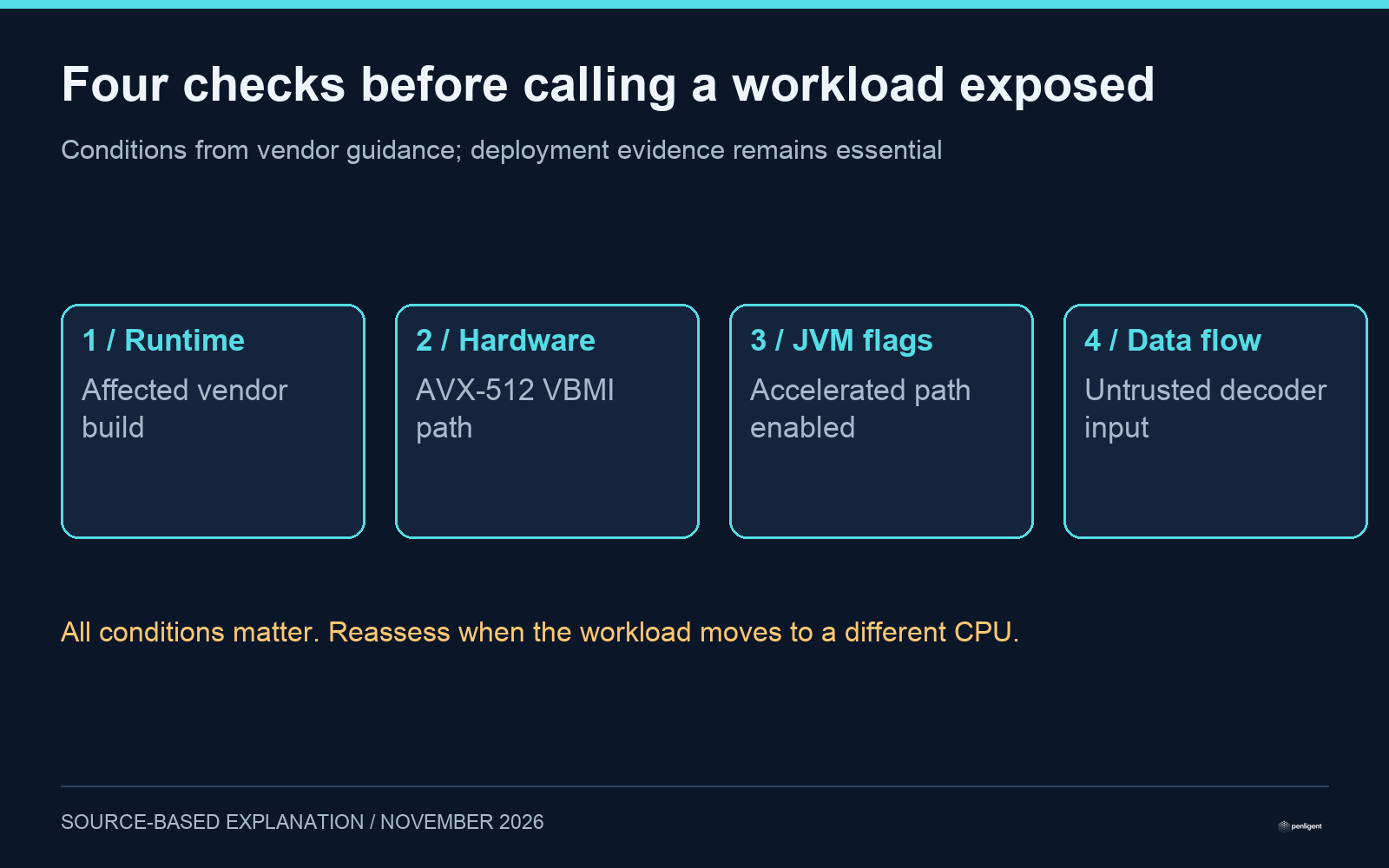
Four conditions determine the decoder exposure
Red Hat’s technical bulletin identifies affected OpenJDK 17.0.6 and later branches, x86-64 hardware with AVX-512 VBMI, an enabled accelerated path, and attacker-controlled Base64 reaching Java’s standard decoder. Authentication headers and encoded tokens can reach decoding before authentication completes. A product name alone cannot establish all four conditions.
| سؤال | Evidence to collect | Decision |
|---|---|---|
| Which JVM runs the service? | Vendor, full build and executable inside the deployed workload | Compare with that vendor’s affected and fixed builds |
| Which CPU features does that process see? | Guest-visible x86-64 flags, including AVX-512 VBMI | Evaluate the current host; repeat after placement changes |
| Is the accelerated path enabled? | Effective service startup flags after restart | A saved configuration file alone proves little about a live process |
| Can untrusted input reach the decoder? | Application and protocol data flow | Prioritize exposed authentication and token-processing paths |
Standard Java 8 and Java 11 do not contain this vulnerable path according to Red Hat. Oracle separately identifies its Java 8 Performance Pack build 8u511b33-perf as affected. Preserve that exception when creating inventory rules; do not turn “standard Java 8” into a blanket statement about every Java 8 distribution. The Oracle advisory also covers specified GraalVM builds.
Use release evidence from the correct vendor
The following are Oracle JDK security releases, each supported by its own release notes. They are reference targets for those Oracle branches, not universal build numbers for every OpenJDK vendor.
| Oracle JDK branch | November security release | Direct evidence |
|---|---|---|
| 17 | 17.0.21.1 | JDK 17 notes |
| 21 | 21.0.13.1 | JDK 21 notes |
| 25 | 25.0.5.1 | JDK 25 notes |
| 27 | 27.0.1.1 | JDK 27 notes |
The Corretto 17 changelog independently records the security update in 17.0.21.1.2. Check Corretto’s changelog for that distribution. At our November 18 check, Red Hat’s bulletin still described expedited fixes and directed customers to apply errata when available. That is a time-bounded status, not evidence that an Oracle release can be substituted into a supported Red Hat product.
Apply a temporary mitigation to the process that matters
Red Hat recommends -XX:-UseBASE64Intrinsics as the preferred interim option because it disables the accelerated Base64 implementation while preserving other AVX-512 optimizations. Its broader alternative, -XX:UseAVX=2, is for x86-64 deployments; the bulletin warns that ARM64 JVMs do not recognize that flag and can fail to start. Validate changes through the application’s supported service configuration and a controlled restart.
In a mixed fleet, record the workload’s image digest, runtime vendor and CPU architecture together. A flag set in an interactive shell may never reach a service manager, a container entrypoint or an embedded runtime. Conversely, changing a shared environment variable can affect many unrelated Java processes. Review the actual startup path and retain a functional smoke test after the change.
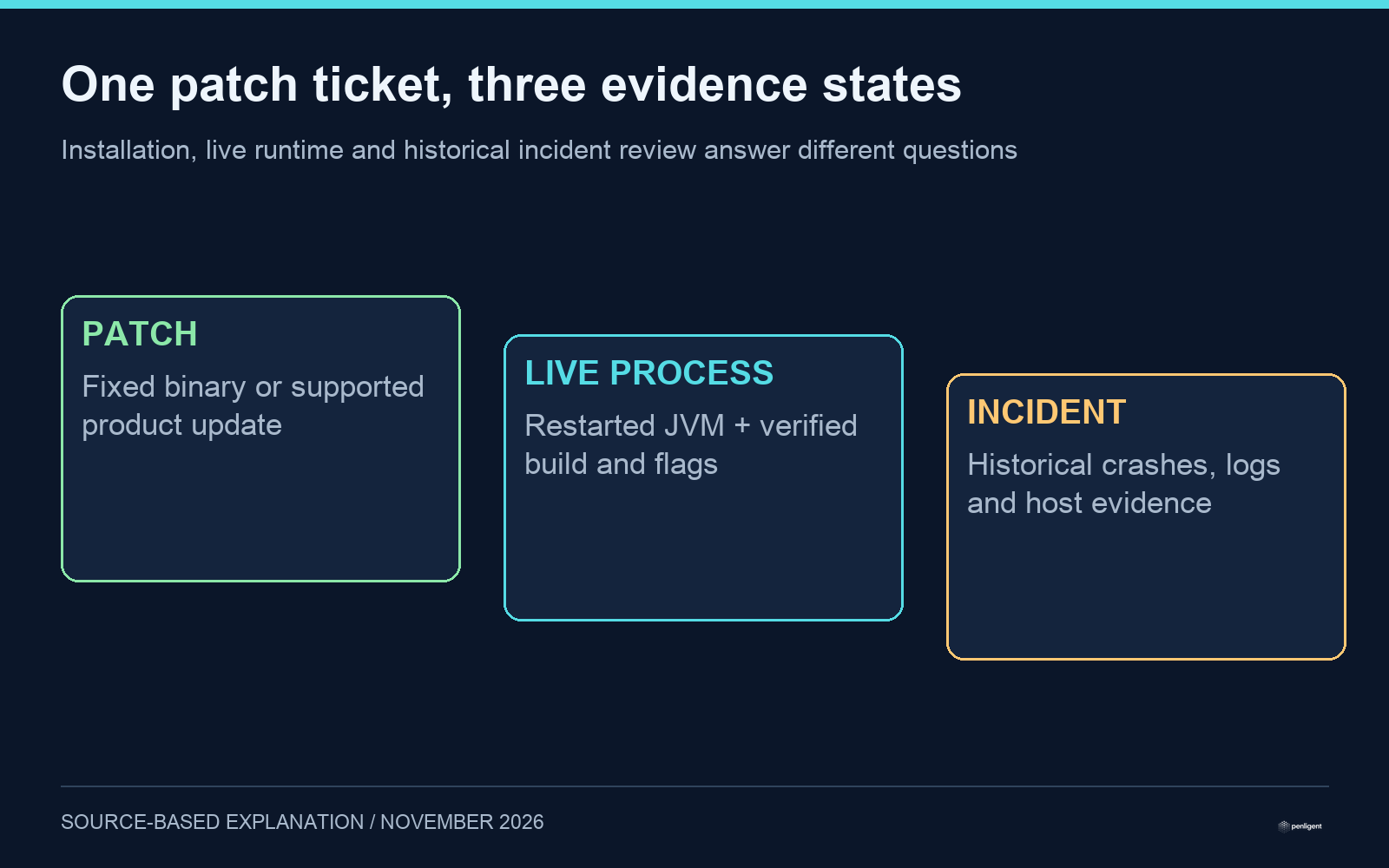
Close three separate questions after deployment
- Patch state: confirm the vendor-fixed binary or supported product update is deployed. Rebuild images that still contain the old runtime.
- Runtime state: restart or recreate the workload, then verify the live build and effective flags. An old process can survive a package replacement.
- Incident state: investigate relevant historical crash and application evidence separately. Patching does not answer whether a service was previously attacked.
Calif’s original research reports application-specific remote-code-execution demonstrations and emphasizes that no universal exploit works across products. Upwind’s independent lab report supports memory-corruption and mitigation observations within its stated test environment. Those are third-party results. We did not reproduce an exploit, and a severity score or a public demonstration is not evidence of exploitation in your environment.
For an authorized assessment, keep version evidence, service configuration, input-path review and retest results in the same record. بنليجنت can be considered as part of that assessment workflow; tool output should still be checked against the deployed runtime and the vendor advisory.
Method: source and release-note review checked November 18, 2026, with AI-assisted drafting and agent editorial validation. The exposure and closure framework is our analysis; no first-hand Java exploitation is claimed. The following Penligent 3.0 video is a general product workflow demonstration.
 Arabic
 English
 German
 French
 Spanish
 Portuguese
 Japanese
 Korean
 Hindi
 Turkish
 Hebrew