
CVE-2021-23017 is a one-byte memory overwrite in NGINX’s resolver. The original advisory gives two important exposure conditions: the affected NGINX configuration uses the resolver directive, and an attacker can forge UDP packets that appear to come from that DNS server. The issue can crash a worker process and may have other impact. Do not classify every NGINX server as equally exposed based only on its version.
The upstream affected range is NGINX 0.6.18 through 1.20.0; fixed releases were 1.20.1 and 1.21.0. Those are historical upstream thresholds from the 2021 advisory. For a distribution package, check the security status for that exact operating-system release because vendors may backport the repair without changing the upstream-looking version in the way an inventory tool expects.
Sources: the NGINX security advisory, the original May 25, 2021 announcementو CVE record.
Evaluate the two exposure conditions
First, determine whether the deployed configuration uses resolver. The directive enables NGINX’s DNS resolver for name resolution in relevant runtime paths; it is not automatically present merely because the server handles HTTP requests. Check the effective configuration and included files, not only a guessed default path. An authorized local search across known NGINX configuration roots can locate candidate directives:
rg -n --glob '*.conf' '^\s*resolver\s+' /etc/nginx /usr/local/etc/nginxThis search is an inventory hint, not proof of the complete active configuration. Validate the include tree and the running instance’s configuration path with the service owner. Avoid dumping the full effective configuration into a shared ticket because deployments sometimes place sensitive values there.
Second, assess whether an attacker can forge UDP traffic from the configured DNS resolver. The vendor announcement makes this a prerequisite. Review the resolver address, network segmentation, packet-filtering controls, and the DNS path from the NGINX worker. A public HTTP listener alone does not prove that this condition holds; a trusted DNS label alone does not prove that spoofing is impossible.
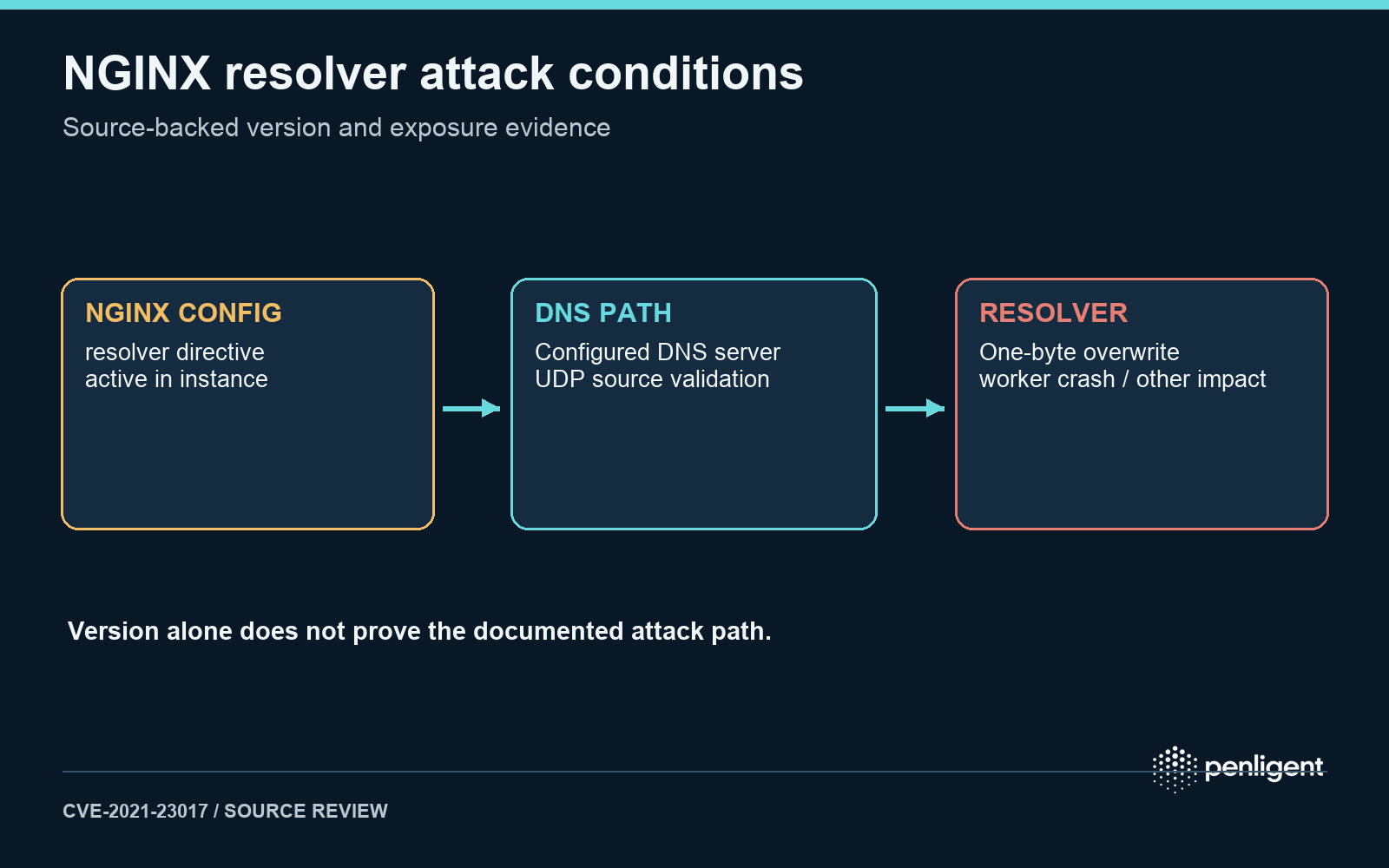
Map upstream and vendor patch evidence
NGINX’s May 2021 announcement lists 1.20.1 and 1.21.0 as fixed. The security page lists 1.21.0+ and 1.20.1+ as not vulnerable, and 0.6.18–1.20.0 as vulnerable. Use these as upstream release boundaries. If the executable comes from an operating-system repository, container base image, appliance or managed platform, use that supplier’s advisory and the complete package revision instead of comparing only the upstream version string.
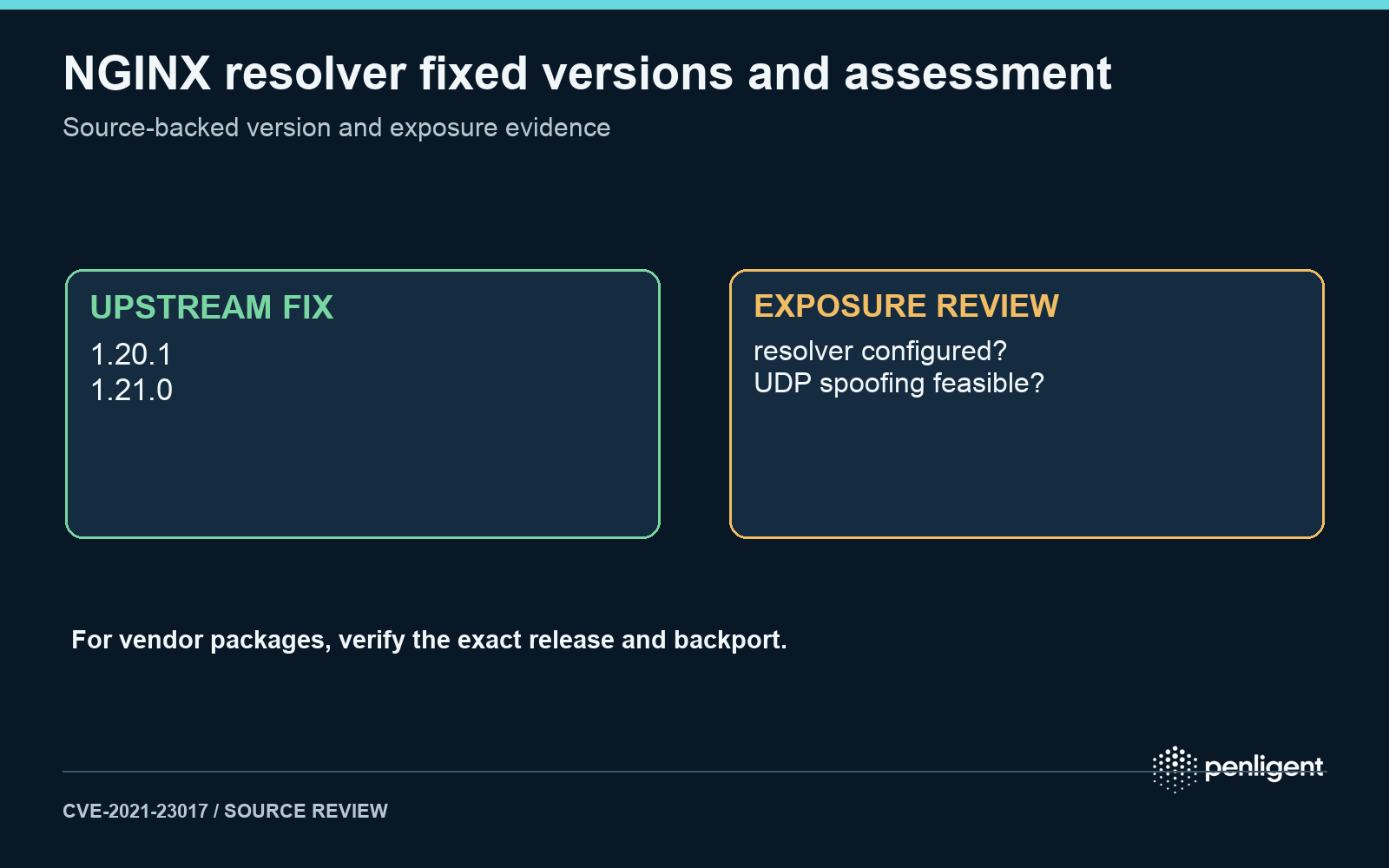
| Assessment finding | Interpretation | Next action |
|---|---|---|
| Fixed upstream release or supplier-confirmed backport | Patch evidence supports remediation | Verify the running worker uses that build and restart/redeploy as required |
| Potentially affected version, no resolver directive in effective configuration | The documented configuration condition was not found | Preserve the configuration path and version evidence; still update to a supported release |
| Resolver configured and UDP source spoofing not assessed | Exposure is unresolved | Review the DNS network path and anti-spoofing controls |
| Old vendor package with unclear backport status | Version comparison is inconclusive | Consult the supplier tracker for the exact release and package revision |
The configuration condition can help prioritize an inventory, but it is not a reason to leave an unsupported NGINX release in service. Configurations change, includes may be missed, and package provenance may be uncertain. Patch to a currently supported vendor release and retain evidence that the actual worker was replaced.
Close with runtime evidence
- Record the NGINX binary or package source, full version and supplier revision.
- Record the effective configuration file path and whether an active
resolverdirective applies to the instance. - Document the configured DNS resolver and the network controls relevant to forged UDP packets.
- Apply the supported fixed update and restart or redeploy the NGINX worker as required.
- Confirm the running process uses the updated package, then retain the evidence and validation time.
A successful configuration test or DNS lookup only checks normal behavior; it does not test the vulnerable memory condition. No exploit or crafted response is needed for this exposure review. NGINX did not describe this issue in the cited announcement as a general remote crash from any HTTP client. Penligent did not reproduce the vulnerability or test a customer deployment. This article extracts the vendor’s two stated conditions into an operational triage method.
The video below is a general Penligent workflow demonstration. It does not demonstrate or validate CVE-2021-23017.
 Arabic
 English
 German
 French
 Spanish
 Portuguese
 Japanese
 Korean
 Hindi
 Turkish
 Hebrew