
MONAI Label 0.8.6 fixes CVE-2026-133968, but it is no longer the release to use as the end of a security upgrade. The project published 0.8.7 and 0.8.8 on November 25, 2026, with additional security corrections. As verified on November 26, 0.8.8 is the latest official release. A vulnerability ticket can therefore be correct about the original path-traversal fix while still pointing an operator to an outdated deployment target. Sources: 0.8.6, 0.8.7و 0.8.8 release notes.
CVE-2026-133968 affects the monailabel package before 0.8.6. The CVE record assigns CVSS 3.1 9.8 and reports exploitation beginning in September 2026. CISA added it to KEV on November 23, 2026. These records establish urgency, but they do not establish whether a particular server was compromised. That requires evidence about its running code, reachability, permissions, and historical changes.
Use two version questions in the change ticket
The first question is whether the original datastore-write correction is present. The second is which release incorporates the later corrections relevant to the deployed server and its clients. Keep those answers separate when interpreting a scanner finding or approving a change. The following matrix reconciles the official release sequence.
| Installed release | CVE-2026-133968 status | Additional decision as of November 26, 2026 |
|---|---|---|
| 0.8.5 and earlier | Affected; original fixed release is 0.8.6 | Restrict untrusted access and plan an upgrade to 0.8.8 after compatibility checks. |
| 0.8.6 | Original datastore path issue fixed | Still within the affected range of the client-controlled bundle-path issue fixed in 0.8.7. |
| 0.8.7 | Original datastore path issue fixed | Still affected by request-value code execution and maintainer-review issues fixed in 0.8.8. |
| 0.8.8 | Includes the original correction and subsequent release fixes | Verify the deployed runtime, update relevant clients, and review earlier exposure. This version does not establish a clean incident history. |
إن bundle-path advisory covers 0.6.0 through 0.8.6. The bundle request-value advisory covers 0.7.0 through 0.8.7, and the maintainer-review advisory covers versions through 0.8.7. Those are separate issues with their own prerequisites. They should not be relabeled as CVE-2026-133968 or used to claim that the 0.8.6 datastore fix failed.
The 0.8.8 release asks all server deployments to update, along with Python-client and 3D Slicer plugin users. Client updates matter because that release also constrains how server-supplied result filenames become local paths. Record client ownership in the same rollout plan rather than assuming a server update replaces workstation components. Source: 0.8.8 security and compatibility notes.
The datastore fix checks the resolved destination
إن original advisory identifies two write paths: image upload and label saving. A caller-controlled image identifier contributed to a destination filename; label saving also incorporated a label tag. The vulnerable implementation could write beyond the intended datastore directories, within the permissions available to the server process. The advisory identifies code execution and denial of service as possible consequences. File-write access is the mechanism; code execution depends on what writable files can influence later execution.
The source change in pull request 1915 is more specific than stripping a traversal string. A helper resolves the requested destination and the allowed base with os.path.realpath(), then compares their os.path.commonpath() result with the allowed base. A destination outside that base is rejected. Paths on different Windows drives also fail the containment decision. This is source inspection, not an exploit test.
For images, the final destination must remain inside the image directory. Labels need two checks: the selected label directory must remain inside the labels root, and the final file must remain inside that selected directory. Checking only the final filename against an already redirected label directory would miss the first boundary. The endpoint additionally normalizes an explicitly supplied image identifier to its basename and rejects empty or dot-prefixed values. These layers are visible in the same official patch.
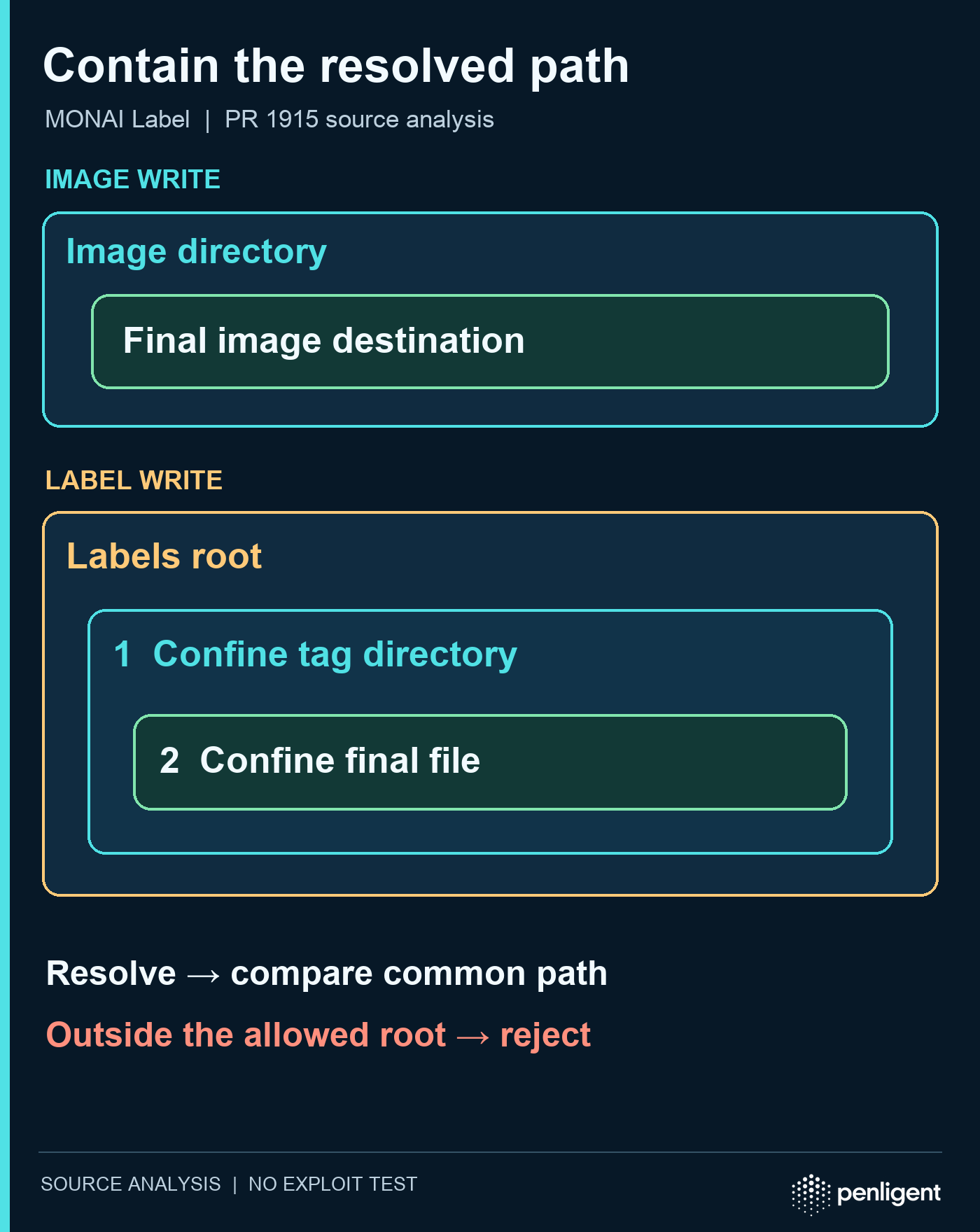
The upstream regression tests exercise rejected image identifiers, rejected label tags, rejected label image identifiers, and ordinary accepted inputs. For teams reviewing a vendor backport, the useful acceptance criteria are both rejection of destinations outside the allowed root and preservation of legitimate datastore writes. A filename filter alone is weaker evidence than confirming all of the patched containment points. Penligent inspected these tests but did not execute them.
Verify the environment that actually runs the service
A package version from a developer shell may describe a different virtual environment from the live server. Run a metadata-only check inside the server’s intended Python environment, or inside the running container through the organization’s approved administration path. This command prints the interpreter and installed distribution version without importing the MONAI Label application:
python -c "import sys; from importlib.metadata import version; print(sys.executable); print(version('monailabel'))"Then correlate that interpreter with the service command, virtual environment, or container image actually serving requests. For source builds, preserve the deployed revision and evidence that the relevant correction is included. A successful metadata query establishes package identity in that environment; it does not by itself prove that the active worker uses it. This is a read-only verification method, not a vulnerability probe.
Compatibility checks belong before the change window. The 0.8.6 release moves the minimum Python version to 3.11 and changes the Docker base to Ubuntu 24.04 with Python 3.12. The 0.8.8 release also tightens accepted image identifiers, image extensions, request values, and several authorization checks. Use representative approved images, label saves, inference, and training jobs in staging to check the workflows the deployment actually uses. An application error after an upgrade may be a newly enforced input rule; do not weaken that rule before comparing the request with the release notes.
Map reachability, role, and writable storage separately
Authentication is disabled by default through MONAI_LABEL_AUTH_ENABLE=False. Under that configuration, the advisory says a network client that can reach the service can use the vulnerable write path. Enabling authentication reduces access, but an authenticated ANNOTATOR is sufficient for this issue. The vendor workaround therefore combines trusted roles, restricted network exposure, and an unprivileged service account with narrowly scoped write access.
| Boundary | Evidence to collect | What it tells the reviewer |
|---|---|---|
| Network access | Server listeners, proxy routes, firewall rules, and who could reach them during the exposure period | Which clients could access the vulnerable service; a private hostname alone is insufficient evidence. |
| Application role | Effective authentication setting, identity-provider integration, and annotator assignments | Whether unauthenticated clients or less-trusted annotators could reach the write operation. |
| Filesystem access | Service identity, directory ownership, writable mounts, and application or configuration paths | The writable scope of the server process; this determines the potential reach of the arbitrary write. |
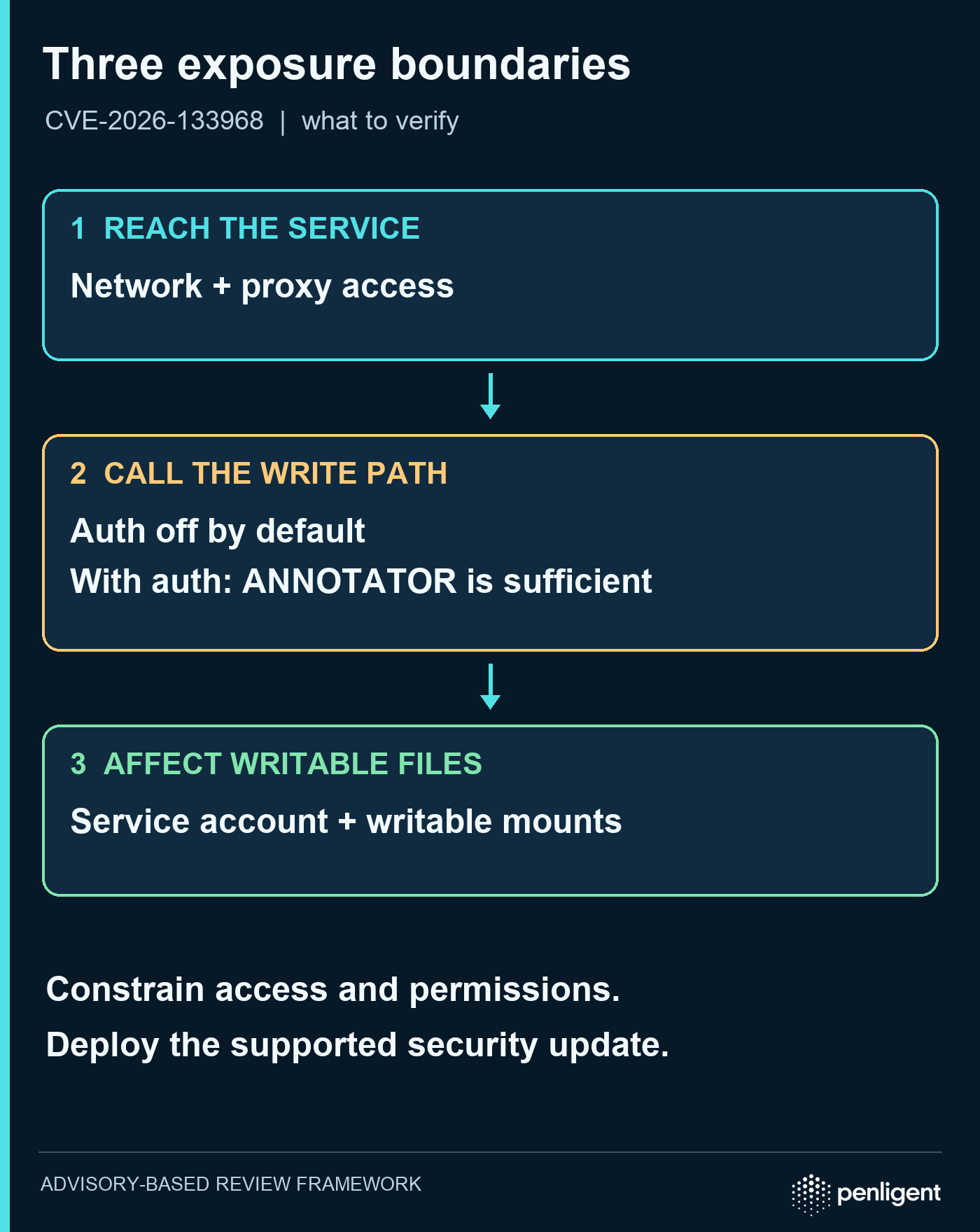
These boundaries constrain different parts of the failure. Authentication does not make an older build contain paths, and a container name does not describe its writable host mounts. Inspect the effective runtime configuration and mount permissions. The table is an assessment framework derived from the advisory’s access conditions and file-write impact; it is not a claim that a particular deployment exposed all three boundaries.
Review the exposed period before returning the server to service
إن 0.8.6 release notes explicitly tell operators to review unexpected file changes when a server on 0.8.5 or earlier was reachable from an untrusted network. Build that review around the permissions and storage identified above. Compare application files, relevant configuration, and writable mounted locations with known-good deployment records. Correlate unexplained changes with available service, proxy, and host activity records.
Preserve the distinction between an unexpected change and a confirmed malicious change. Upgrades, model updates, and routine jobs can also change files. Conversely, a lack of retained logs or a missing baseline limits the conclusion that can be reached. Record the affected time window, the evidence available, and any unresolved gaps. Installing corrected code cannot establish what happened before it was installed.
Close the change with the deployed version and revision, the checked client components, working application flows, and the verified access boundaries. Keep the historical investigation status visible alongside that deployment record. For teams documenting authorized security validation, the following بنليجنت video illustrates a general product workflow. It does not reproduce this vulnerability or certify a MONAI Label installation.
Method and scope: Prepared with AI assistance from official MONAI Label advisories, releases, pull request 1915, the CVE record, and CISA KEV, checked November 26, 2026. The technical analysis compares published source changes and deployment requirements. No exploit, production probe, MONAI installation, or upstream test execution was performed for this article.
 Arabic
 English
 German
 French
 Spanish
 Portuguese
 Japanese
 Korean
 Hindi
 Turkish
 Hebrew