
CVE-2026-93479 is a buffer overflow in NGINX’s evaluation of string expressions containing variables. The useful question for an operator is not whether a server uses JavaScript. It is whether the deployed NGINX build falls within the affected range, whether its effective configuration reaches the relevant expression processing, and whether the corrected executable is actually serving traffic.
إن NGINX security advisory index rates the issue medium and lists upstream versions 1.31.2–1.31.6 and 1.30.0–1.30.5 as vulnerable. It lists 1.31.7+ and 1.30.6+ as not vulnerable. The October 14 release notes identify document-root calculation and request logging in HTTP and stream modules as affected uses of variable expressions. Those details make this an infrastructure configuration and runtime-verification problem, rather than a reason to run an unexplained exploit against a public endpoint.
This assessment was prepared on October 19, 2026. It separates the upstream scope from deployment-specific judgments and does not claim that the author reproduced the vulnerability in NGINX. The local demonstration below illustrates a general sizing invariant without sending network traffic or corrupting memory.
What the vendor has confirmed
Start with the product’s own language. In the current security index, the finding is named “Buffer overflow in script evaluation.” The associated release entry explains that the overflow can occur in a worker process when evaluating string expressions with variables. The entry names document-root calculation and request logging in both HTTP and stream processing. It credits Matt Suiche of Tolmo Inc.
The word “script” is easy to overinterpret. The description concerns internal expression evaluation. It does not establish that a site must install njs, execute user-supplied JavaScript, enable CGI, or run an application scripting language. An inventory that searches only for JavaScript modules can therefore answer the wrong question. Conversely, the presence of any variable in an arbitrary configuration is not proof that a request can trigger the disclosed overflow.
The distinction matters when assigning work. The platform owner can establish the executable and deployment provenance. The configuration owner can identify relevant expression use. An application developer may help test routing and logging after maintenance, but the application repository alone cannot settle the status of a reverse proxy maintained by another team.
| Evidence item | What it establishes | What it does not establish |
|---|---|---|
| Upstream security index | Upstream version ranges and vendor severity | Status of every downstream package |
| Release notes | The disclosed processing areas | A complete trigger or exploit chain |
| Local package record | Installed package identity | Identity of an already-running process |
| Effective configuration | Expression use in the inspected configuration | Reliable exploitability of every expression |
| Successful ordinary request | A tested function remains available | Absence of the memory-safety defect |
For an individual deployment, the first deliverable should be a short evidence record that joins these facts. Keep the CVE, host or workload identity, package source, build, effective configuration, serving process, and maintenance result together. This prevents one team’s package update from being mistaken for another team’s completed rollout.
Keep CVE-2026-93479 separate from the map-and-regex issue
NGINX’s recent release history contains several memory-safety fixes. Similar vocabulary does not make their prerequisites interchangeable. The July 15 entry for CVE-2026-42533 discusses a map using regex matching and capture-related string expressions, with an additional non-cacheable-variable case. The October entry for CVE-2026-93479 describes a separate expression-evaluation overflow affecting root calculation and logging.
That is a practical reason to reject a copied description that assigns the older map-and-regex wording to the newer identifier without supporting evidence. A remediation ticket can point to both records when relevant, but its tests and closure conditions should say which finding each observation addresses. Otherwise, a team may remove a map, find that a page still works, and conclude that a different memory-safety issue has been resolved.
Likewise, the October release notes include CVE-2026-15176 involving alias and rewrite, CVE-2026-95101 involving HTTP/3 request bodies, CVE-2026-97629 involving session-ticket keys, and CVE-2026-97205 involving SSI and asynchronous file I/O. They share a release vehicle, not one universal trigger. Upgrading can address several issues together; an article or incident report should still preserve their identities.
For operators, choose the supported fixed package, then build regression tests around the features actually used. Do not enable HTTP/3 to test a logging-related finding, or disable a document-root feature because an unrelated session-ticket advisory mentions the same fixed release. Configuration changes should follow a verified relationship to the intended risk.
Read the upstream version boundary correctly
إن official affected ranges identify two upstream branches. For the stable branch, the listed vulnerable interval ends at 1.30.5 and the corrected boundary is 1.30.6. For mainline, the listed interval ends at 1.31.6 and the corrected boundary is 1.31.7. A newer supported corrected release is also a reasonable target; the original fixed boundary is not an instruction to downgrade.
| Upstream branch | Listed affected versions | Listed corrected boundary |
|---|---|---|
| Stable 1.30 | 1.30.0–1.30.5 | 1.30.6 |
| Mainline 1.31 | 1.31.2–1.31.6 | 1.31.7 |
| Other upstream versions | Outside these listed intervals | Check the exact advisory and support status |
| Distribution or appliance build | Cannot be decided from this table alone | Use that supplier’s package advisory |
The final row is not a loophole. A downstream supplier may carry fixes in its own package revision, and a packaged version string is not necessarily a complete upstream patch history. Require the supplier’s explicit disposition for this CVE and the exact package revision. Without that evidence, leave status unresolved rather than declaring either vulnerability or remediation from a truncated banner.
Do not interpret “outside the listed interval” as a statement that an obsolete installation is generally secure. This table answers one CVE. Other advisories, unsupported components, and deployment weaknesses require separate assessment. Keeping those conclusions separate gives an upgrade proposal more credibility than treating every old version as vulnerable to every new identifier.
A useful asset row might read: “edge-a, vendor package revision recorded, CVE disposition linked, serving image digest recorded, configuration revision recorded, verification pending.” That is more actionable than “NGINX old.” It identifies the missing observation and the person who can supply it.
The configuration is part of the exposure question
NGINX can derive values at request-processing time from variables. The HTTP core documentation describes the root directive and its support for variables, subject to documented exclusions. The HTTP logging reference also documents variable-containing log paths. These features explain why root calculation and logging deserve inspection after the release notes name those areas.
That connection is an investigation model, not a reproduced trigger. The public description reviewed here does not justify a statement that every dynamic root, every access log, or every request containing a long value will overflow. The actual result depends on code, configuration, evaluated values, and the conditions described by the complete vendor guidance.
Review the effective configuration, including generated files and includes, rather than a single repository template. The file checked into source control may not be the file read by the master process. A deployment tool can add includes, substitute variables, or select another prefix. An operator who inspects the default path while the service uses an alternative configuration has collected valid evidence about the wrong object.
Use a configuration search as navigation. It can identify candidate directives and expressions for human review. It cannot infer complete control flow, capture semantics, runtime values, or reachability. Record the enclosing context and the configuration source before deciding what a match means.
The most useful review notes connect four things: where a value originates, where an expression consumes it, which request or session path reaches that consumer, and which serving build performs the work. Each connection can be established or left unknown. A clear unknown is safer operationally than a confident claim based on one matching line.
A defensive model of expression evaluation
At a conceptual level, expression construction has to keep the amount of storage reserved consistent with the bytes eventually written. A memory-safe implementation may detect or prevent a mismatch. In native code, violating that invariant can become a memory-safety defect. This is a general explanation of the engineering problem; it is not a claim about the exact patch or instruction sequence for CVE-2026-93479.
Variable evaluation makes the invariant more interesting than copying a constant string. An expression may combine a constant prefix with one or more values obtained during processing. If the implementation estimates space under one set of assumptions and later writes under another, the estimate needs a mechanism that preserves consistency. Reviewing such a system requires attention to value lifetime and evaluation semantics, not merely the presence of a length check somewhere in the source.
For defensive review, think in terms of producers, transformations, and consumers. A producer makes a value available. A transformation can change its representation or the context in which it is interpreted. A consumer constructs a path or another output. The release notes tell operators which consumer areas to examine; they do not provide enough evidence to fill in an attacker-controlled chain for every site.
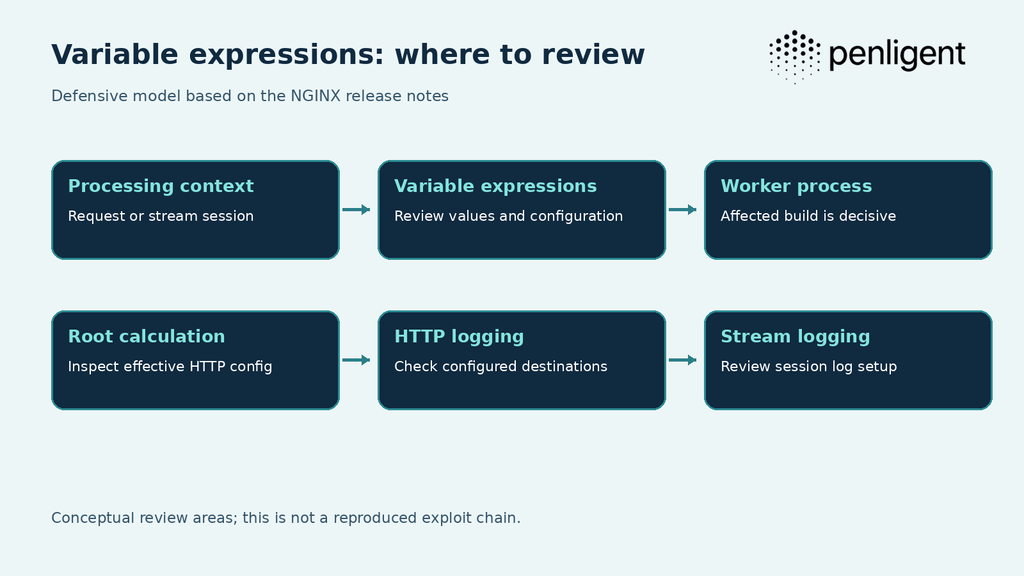
An accurate diagram therefore labels the path as conceptual. It can show a request or session context, variable expression evaluation, document-root calculation or logging, and a worker-process boundary. It should not invent an endpoint, payload, authentication prerequisite, or guaranteed code-execution outcome. A diagram becomes misleading when its visual certainty exceeds its source.
For a security team, this model is useful even without a production exploit. It tells the reviewer what questions a scanner cannot settle from a banner, and what evidence a configuration owner can contribute. It also explains why removing a visible scripting module is not automatically a mitigation for an internal expression evaluator.
Inventory the executable without confusing disk and memory
إن NGINX command-line reference documents version output, build information, configuration testing, and configuration dumping. The following examples are local administrative inspection commands. Run them in the intended host or container context with approved access; they do not contact a remote target.
nginx -v
nginx -V
nginx -t
# Inspect locally; the output may contain sensitive configuration.
nginx -T
Read each command result according to its purpose. Version and build output describe the executable being invoked. Testing checks the selected configuration’s syntax and referenced files. Dumping exposes the configuration used by that invocation. None of those observations alone proves that the already-running service has adopted a new executable.
On hosts with multiple installations, the shell’s command lookup may select a different binary from the one configured in the service manager. In containers, running the command on the node can inspect the host installation instead of the workload. In a build pipeline, checking a newly built image says nothing about whether all serving replicas have moved to it.
Resolve those ambiguities before interpreting the version. Record the executable path used by the service, the invocation’s configuration path, the workload identity, and the package or image provenance. Use the platform’s supported process and deployment inspection tools to join the running instance to that record. There is no one command that reliably expresses this relationship across every operating system and orchestrator.
Treat configuration dumps as internal evidence. They can contain hostnames, private addresses, routing details, and other operational information. Store them with appropriate access controls and give external reviewers a redacted extract when sufficient. Redaction should preserve the directive relationships relevant to the finding; removing all context can make the artifact impossible to assess.
Why a configuration reload is not a binary upgrade
NGINX distinguishes configuration changes from executable replacement. Its process-control documentation describes HUP as a configuration reload and USR2 as part of an executable-upgrade procedure. Reloading starts workers for a new configuration while gracefully retiring older workers; upgrading the executable is a separate lifecycle operation.
The operational lesson is to verify the rollout mechanism chosen by the package or platform. Do not assume that replacing a file and sending a reload signal proves that workers now execute the corrected code. A supported package installation may coordinate service actions, but the evidence needs to show what happened in that deployment.
For a container workload, replacement normally means bringing up instances from the approved image and retiring the old ones through the orchestration workflow. For a managed service, it means obtaining the provider’s deployment-specific patch statement. For a custom binary installation, it means using a documented executable-upgrade or restart procedure with a tested recovery plan.
Avoid copying raw signal sequences into a maintenance ticket without understanding the existing service manager. Two controllers attempting to manage the same master process can complicate recovery. The official live-upgrade instructions explain a specific process model; they are not a universal substitute for a distribution’s supported update procedure.
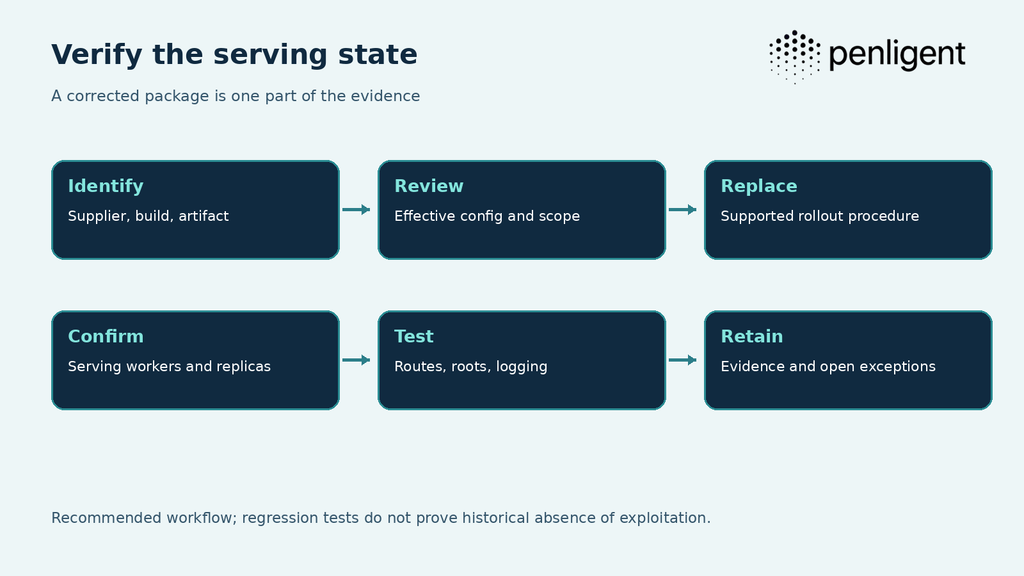
Close this stage only after the serving process or workload generation is tied to the approved build. A package transaction, a reload message, and a successful page request are useful pieces of evidence. The deployment relationship is what makes them a remediation record.
Build a maintenance plan that preserves service behavior
Security maintenance should specify both the risk being corrected and the behavior that must survive. For a reverse proxy, “homepage returns 200” is often too weak. A site may continue serving a cached landing page while an authenticated route, a static asset path, a tenant-specific root, or a stream listener fails.
Choose representative tests from the actual configuration. Include an ordinary route, a route affected by root selection when relevant, a denied or missing resource, and the logging destination expected for each. If stream proxying is part of the installation, give it an appropriate protocol-level smoke test rather than treating an HTTP check as coverage for it.
The test data should be synthetic and low impact. The purpose is to establish that the corrected deployment handles normal supported behavior, not to rediscover an overflow in production. Use owned test endpoints or a staging environment and constrain request volume. When a path requires authenticated testing, use a dedicated account whose permissions and expected result are documented.
Before the change, save the previous package identity, configuration revision, deployment definition, and a recoverable artifact. After the change, compare the same functional observations. If a test fails, this comparison helps distinguish a package regression from a preexisting error or an unrelated backend outage.
Set explicit stop conditions. These can include unexpected worker exits, a sustained error increase, loss of required logs, or a failed essential route. A stop condition should lead to a named decision owner and an approved response, not an improvised downgrade that silently restores the original exposure.
A localhost demonstration of a sizing invariant
The Python example below is deliberately not an NGINX exploit. It uses fabricated byte strings to show how measuring one value and later writing a different value can invalidate a storage assumption. Python safely represents the values; the program reports the mismatch rather than writing outside allocated native memory. It uses no network, NGINX process, shell execution, or external dependency.
from dataclasses import dataclass

@dataclass
class Evaluation:
    reserved: int
    produced: int
    fits: bool

def inspect_two_values(measured: bytes, written: bytes) -> Evaluation:
    prefix = b"/demo/"
    reserved = len(prefix) + len(measured)
    result = prefix + written
    return Evaluation(reserved, len(result), len(result) <= reserved)

def inspect_snapshot(value: bytes) -> Evaluation:
    snapshot = bytes(value)
    return inspect_two_values(snapshot, snapshot)

cases = [
    (b"alpha", b"alpha"),
    (b"a", b"longer-example"),
]
for measured, written in cases:
    print("two values:", inspect_two_values(measured, written))
    print("snapshot:", inspect_snapshot(written))
The first case retains the same value across the two observations. The second changes it. The snapshot example keeps the bytes used for measuring and constructing consistent. That is one general design strategy for a toy program, not a claim that the NGINX patch uses this exact strategy or that changing a configuration to resemble the toy will mitigate the CVE.
Run this example as a local file with a supported Python 3 interpreter. Its output should show a false fit result for the changed-value case and true results for the snapshots. There is no meaningful “success” condition involving a crashed service. The lesson is the relationship between a measurement and the data that measurement is supposed to bound.
This distinction is useful when reviewing public proofs of concept. A toy can explain an invariant while providing no evidence of a particular product defect. A real reproducer would need the identified build, exact configuration, controlled input, observed failure, and a credible connection to the corrected code. Do not promote an illustrative program into evidence that a deployed service is exploitable.
Logging needs its own post-update test
Because the release notes name request logging, check that maintenance preserves the logs your investigation depends on. The HTTP logging documentation explains that requests are logged in the location where processing ends, which can differ from the original location after an internal redirect. The stream logging documentation describes session logging separately. These are reasons to design checks around the deployment’s actual processing paths.
A useful smoke test makes an ordinary synthetic request and looks for its expected record at the intended destination. Confirm the timestamp, route or service context, and final status. If the site uses a collector, check both local production and collector receipt. A missing record can arise at either stage, and the corrective action differs.
Do not log credentials or request bodies merely to make this test convenient. A short synthetic identifier on an approved test request can provide correlation without introducing sensitive content. Choose a representation that fits the site’s existing logging policy; do not insert a new variable expression into a vulnerable production configuration as an improvised security experiment.
Avoid declaring logging healthy because one file’s modification time changed. Another request may have updated it, or the request under test may have followed a different location. The expected record provides a stronger connection between the test and its outcome. Preserve enough context for another administrator to repeat the check.
If maintenance changes log paths, retention, or collection, document that change explicitly. An incident query that spans the rollout may otherwise search only the old location and mistake a collection gap for absence of activity. Functionality and observability belong in the same release acceptance decision.
Use crash telemetry as a lead, not a verdict
Unexpected worker termination deserves investigation, but a crash is not a unique identifier for CVE-2026-93479. The same NGINX release history documents other crash fixes and memory-safety issues. A worker exit can also have causes outside this CVE. Attribute it only when the collected evidence supports the relationship.
A practical triage record aligns the process exit with the executable build, deployment event, configuration revision, workload, and available request or session observations. If a core dump or diagnostic artifact exists, handle it as sensitive material because process memory can contain application data or secrets. Use the organization’s incident procedure rather than attaching it to an unrestricted issue.
Look for repeated patterns that help select the next investigation step: similar failures on the same configuration revision, failures clustered on old replicas, or failures beginning after a particular rollout. Those patterns can prioritize analysis without proving an attack. A restart loop on one node is not automatically a campaign, and an absence of crashes is not proof that every relevant path is safe.
When presenting a finding, distinguish “worker exited unexpectedly,” “failure reproduced in an isolated environment,” “failure linked to this code defect,” and “unauthorized activity established.” Each statement requires additional evidence. Collapsing them into “exploited” makes an incident report harder to defend and can send responders toward the wrong problem.
Remediation and historical investigation can proceed together. The platform team can replace an affected build while responders preserve relevant artifacts and review earlier events. Updating the executable answers the forward-looking exposure question; it does not retrospectively establish what every earlier request did.
What a scanner can and cannot verify
A remote fingerprint can identify a candidate service. It may reveal a server header or a recognizable response, but that observation is not an authenticated inventory of the serving build. A proxy can alter a header, a downstream package can use its own revision, and a load balancer can distribute requests across different generations.
For this finding, an assessment should distinguish discovery from confirmation. Discovery finds NGINX-like services within authorized scope. Confirmation joins a service to its actual build and configuration. Verification after maintenance checks that the corrected deployment has replaced the affected one and that required behavior still works.
An automated workflow should preserve this distinction in its output. Label a banner-only observation “candidate” rather than “confirmed exploitable.” Label a package-based result with the package source and advisory used. Label a test’s success condition explicitly. “No error returned” is not a memory-safety oracle.
In an authorized assessment, a platform such as Penligent can help organize the evidence and retest workflow. The report should still identify which facts came from remote observations, which came from administrator-supplied inventory, and which were independently checked. Automation cannot replace missing configuration access with certainty.
The two most useful questions for a tool evaluation are simple: can another reviewer reproduce the status decision from the retained evidence, and does the system retain unresolved assumptions instead of converting them into a green badge? A detailed explanation of uncertainty is often more valuable than a dramatic vulnerability label.
Containers, replicas, and packaged applications
An image build and a serving rollout are different milestones. A pipeline can produce a corrected image while some replicas continue using the earlier digest. A mutable tag can hide that difference if the evidence records only the tag name. Retain the artifact identity that the platform actually deployed and the workload generation that adopted it.
Check auxiliary locations as well as the obvious public ingress. An application bundle may include an NGINX instance for static files, an internal reverse proxy, or a separate stream service. This is an inventory recommendation, not a statement that every such instance is affected. The same build-and-configuration analysis decides its status.
For appliances and managed integrations, ask the supplier for a statement about the exact product release and this CVE. A generic announcement that “NGINX has been updated” may omit which component, which image, or which customer deployment is covered. Preserve the reply with the asset record and identify anything it leaves unresolved.
In fleets, sample checks are useful for validating a rollout mechanism, but they do not establish complete coverage by themselves. Combine representative functional tests with an inventory that enumerates every serving generation. If some nodes cannot be inspected, report the coverage boundary and assign follow-up rather than extrapolating from one healthy instance.
Retirement matters too. A corrected service can coexist with an old deployment still reachable through a forgotten hostname or internal route. Closure should account for intended active instances and obsolete instances that need removal. A rollout is not complete merely because the primary URL reaches the new pool.
A patch record that survives handoff
Use the following structure as an internal template. The values are placeholders, not observations about a real environment.
Finding: CVE-2026-93479
Asset: edge-example / owned workload identifier
Supplier: package or image publisher
Before: package revision and serving artifact identity
Configuration: reviewed revision and effective include set
Decision source: supplier advisory for the exact build
Change: approved deployment or executable replacement
After: corrected package and serving artifact identity
Regression: named route, root behavior, logging, stream checks
Coverage: all intended replicas or explicit exceptions
Incident review: separate ticket if historical activity is suspected
Owner: accountable platform team
The record is strongest when its conclusions are narrow and testable. “Supplier identifies package revision X as corrected, and all intended replicas now run image Y” is better than “latest version installed.” The former can be checked later even after the repository’s latest version has changed.
Keep exceptions visible. A node awaiting a maintenance window, a vendor appliance awaiting a package, and a workload whose configuration has not been supplied are different states. They require different owners and deadlines. An exception should include the compensating action and the evidence needed to close it.
Do not let a rollback silently erase the security decision. If availability requires restoring an older artifact, reopen the exposure status and record temporary controls. The operational decision may be justified, but the evidence should describe the resulting state rather than retain a successful-update badge from an earlier moment.
Turn a configuration match into an exposure decision
Consider an illustrative multi-tenant service whose operator finds a variable in a root expression. The match should open a review, not close it. The reviewer first identifies the enclosing server and location, then establishes how traffic enters that configuration. A matching line in a disabled template has a different operational meaning from the same line in a generated file read by a serving instance.
Next, identify the value’s source. Does the deployment choose it from a controlled set, derive it from request context, or obtain it through another configured transformation? Document the answer without assuming it reproduces the CVE. This information helps the vendor or an internal specialist assess relevance, and it tells the application team which legitimate routes deserve regression testing after maintenance.
Then resolve the executable. An affected upstream build supports an update requirement. A supplier statement that a particular package is corrected can change the package decision, provided it matches the installed revision and product. An unknown binary should remain an inventory problem until its origin is established. A configuration match does not make an unverifiable build trustworthy.
Finally, record the scope of the conclusion. “This serving deployment uses a build within the upstream affected interval and contains variable-based root configuration” is a supportable inventory statement when both facts were observed. “This request yields remote code execution” requires different evidence. The first statement can justify maintenance without inventing the second.
The best review artifacts make this progression visible. A finding should say what was observed, how the observations are connected, what decision follows, and which questions remain. This is particularly useful when a vendor case passes between teams: the next engineer can continue from a precise boundary rather than repeat the entire investigation.
Handle downstream-package disagreements explicitly
Suppose a scanner flags the upstream version embedded in a distribution package, while the operating-system team says the issue is fixed. Neither a red scanner badge nor a verbal assurance should settle the disagreement. Ask for the supplier’s advisory, the complete installed package revision, and the evidence connecting that revision to the running service.
Compare the statements at the same level. An upstream interval describes upstream releases. A distribution advisory describes packages maintained by that distributor. A container publisher’s note describes an image lineage. A statement about one cannot automatically be applied to a locally compiled binary or an image rebuilt from a different repository.
If the supplier explicitly lists the installed revision as corrected, retain that evidence and explain why a banner-based finding is being reclassified. Do not simply suppress the scanner identifier across the fleet. Other nodes may have a different revision, use another supplier, or run an old executable despite the corrected package being present on disk.
If the supplier has not assessed the issue, “under investigation” is a meaningful status. Give it an owner, a next review time, and any temporary exposure reduction that the team actually applies. A pending assessment should not become an indefinite exception whose evidence is never revisited.
Where support teams disagree, reduce the question to a reproducible claim: “Does package revision X for product release Y contain the correction for CVE-2026-93479?” Attach the package provenance and service identity. This is more likely to produce a useful answer than asking whether “our NGINX is safe,” which combines several independent questions.
The resulting disposition should distinguish corrected, affected, not applicable to the identified product, and unresolved. These categories carry different meanings. “Not applicable” needs a scope explanation; “corrected” needs a patch relationship; “unresolved” needs follow-up. Keeping the distinctions prevents an exception from turning into an undocumented assertion.
A blue-green rollout needs two kinds of acceptance
In an illustrative blue-green deployment, the new pool can pass an ordinary health check before it receives real application traffic. That establishes a limited readiness condition. It does not establish that the pool uses the intended image or that configuration-dependent behavior remains equivalent to the old environment.
Give artifact acceptance and functional acceptance separate observations. Artifact acceptance records the approved image or package, build provenance, and configuration revision. Functional acceptance exercises representative behavior with synthetic data. The deployment is ready only when the two observations refer to the same pool and generation.
Before switching traffic, compare the configuration inputs. A corrected binary with an accidentally omitted tenant include can produce healthy responses for the default server while failing specific customers. A new image that reads a mounted old configuration can also differ from the configuration reviewed in the build pipeline. Establish what the serving process actually reads.
During the switch, track which pool handles the test requests. A load balancer that still sends part of the traffic to the old pool can make repeated tests look inconsistent. Preserve a deployment-level correlation method that does not expose internal details publicly. The purpose is to tie the observation to a workload generation, not to add permanent diagnostic headers for everyone.
After the switch, verify retirement of the old pool according to the maintenance plan. Long-lived connections or an overlooked listener can extend the period of coexistence. NGINX’s process-control documentation describes old and new processes coexisting during graceful lifecycle transitions; operators should account for their own platform’s equivalent behavior.
Acceptance should state both the traffic transition and the remaining exceptions. “New pool serves the primary route” is weaker than “all intended entry points use the approved generation, with the named legacy endpoint isolated pending retirement.” The latter makes unfinished work visible without understating the completed change.
Design a regression matrix around decisions
A regression matrix should be small enough to execute and specific enough to catch a meaningful failure. For this update, derive its rows from the configuration and business functions. Do not generate hundreds of arbitrary paths simply because a vulnerability tool can send them.
| Test family | Example observation | Decision supported |
|---|---|---|
| Default HTTP route | Expected status and synthetic response | Basic routing survived deployment |
| Tenant-specific content | Expected tenant receives its intended content | Root or location selection remains correct |
| Missing resource | Documented error behavior | Failure routing did not expose unintended content |
| Authentication boundary | Dedicated test identity receives expected access | Application access behavior remains intact |
| HTTP logging | Correlated synthetic record reaches collector | Required observability is retained |
| Stream service | Approved protocol exchange succeeds | That listener remains functional |
| Replica coverage | Serving generations match approved artifact | Rollout coverage is established |
Use expected results that are meaningful for the application. A 200 response can be wrong if it contains another tenant’s content or an error template. A 404 can be correct for a missing resource. A denied request can be a successful test of an access boundary. Treat status codes as observations to interpret, not universal pass or fail labels.
Keep the test account and data deliberately limited. A synthetic object created for maintenance can verify access and routing without touching customer records. If the test writes data, provide an ordinary recovery or cleanup plan. Read-only checks may still expose confidential content if the chosen route is inappropriate, so select the test fixture before the maintenance window.
Retain failures as well as successes. A test that timed out because a dependency was unavailable should not disappear from the report when another test later passed. Record the retry, its cause when known, and whether the final result covers the original requirement. This gives the release owner a truthful basis for acceptance.
Separate observability loss from attack evidence
Imagine that an investigator sees a gap in access logs around a worker restart. There are several possible explanations, including collection delay, a destination change, buffering, a failed write, or missing source coverage. The gap is itself an observation; it does not identify its cause.
Build a timeline with explicit layers. One layer records configuration and deployment changes. Another records worker lifecycle events. Another records local log production and collector receipt. A fourth records the application or upstream service behavior. The layers help identify whether an apparent attack pattern is actually a maintenance transition or whether maintenance obscured a period that needs further investigation.
Do not fill a missing interval by assuming adjacent behavior continued unchanged. If a collector received records until a particular time and resumed later, report the interval as incomplete unless another source covers it. A workload that serves no matching requests and a workload whose logs were not collected can produce the same empty search result.
Use correlation fields already supported by the environment where possible. Timestamps should include the relevant time zone or a normalized reference. Host and workload identities should remain stable across renaming. A deployment identifier can connect the new pool to its logs without relying on a human-readable label that was reused.
When the evidence supports only a bounded conclusion, write it that way. “No matching events were found in collector A for interval B” is honest. “No exploitation occurred” is a stronger historical claim that an empty query cannot establish by itself. This precision also protects the maintenance team from being asked to prove something its tests were never designed to observe.
The same principle applies after patching. Successful logging checks demonstrate current observability for the tested paths. They do not repair an earlier gap or certify that every request class was retained. Preserve the distinction between today’s verified state and the limits of yesterday’s records.
Evaluate public exploit claims before using them
A repository named after a CVE is not a substitute for evidence. Before running unfamiliar code, identify its author, stated environment, dependencies, and claimed success condition. Read what the program actually does. An executable downloaded under an exploit label can create a separate supply-chain risk without teaching anything about the target vulnerability.
For a credible reproducer, ask whether the author identifies the exact NGINX release, relevant configuration, build assumptions, test conditions, and observed outcome. Check whether the outcome changes on the corrected build under the same conditions. A generic HTTP error, a connection close, or an unrelated process failure does not establish the claimed vulnerability.
Keep reproduction separate from production validation. Even a legitimate crash reproducer can disrupt a shared service. An isolated environment needs clear ownership, bounded resources, synthetic data, and a recovery path. Do not run a proof of concept against an Internet address because the banner appears old or because a search result describes it as vulnerable.
Examine whether the code’s actions exceed its stated purpose. Package installation, outbound connections, credential access, and opaque binaries require their own justification. A defensive review should prefer a transparent minimal demonstration over a large script whose side effects are unclear. If provenance or behavior cannot be established, the appropriate result is to decline execution and continue with supported patch verification.
An article should be equally disciplined. If the author has not reproduced the defect, it should not claim a laboratory result. If a toy explains a principle, label it as a toy. If a researcher claims exploitation, attribute the claim and describe the evidence boundary. Readers can use an accurately bounded assessment more reliably than an unsupported assertion of certainty.
Preserve an incident boundary around patch work
An affected build warrants remediation according to the organization’s risk decision, but it does not automatically mean the host has been compromised. Conversely, replacing the build does not resolve an incident when there is independent evidence of unauthorized activity. Give these two workflows separate closure criteria.
The patch owner establishes current software state and functional acceptance. The incident owner establishes what can be determined about earlier activity, the scope of any access, and the recovery actions required by the findings. They can share artifacts without turning one ticket into a proxy for the other.
If suspicious worker behavior exists, preserve relevant records before routine cleanup removes them. Coordinate collection with service restoration so evidence handling does not become an uncontrolled outage. The appropriate balance depends on actual incident severity, available redundancy, and organizational procedure; this article cannot infer it from the CVE identifier alone.
Avoid rotating secrets blindly while a potentially compromised process remains in control of their destination. When incident evidence warrants credential recovery, sequence containment, trusted restoration, and credential replacement according to the response plan. This is a general recovery principle, not a claim that this NGINX finding exposed any specific credential.
At handoff, state which workflow is complete. “Corrected build deployed; historical crash investigation remains open” is a coherent result. So is “no compromise established from available evidence; patch deployment still pending.” Neither should be compressed into “resolved” if the other decision remains unfinished.
This separation improves prioritization. The platform team can move quickly on a supported update, while responders concentrate scarce forensic effort where evidence justifies it. It also prevents a routine vulnerability ticket from making unsupported assurances to customers about historical access.
Measure completion across the fleet
For a fleet rollout, define the denominator before reporting a completion percentage. Does the inventory include only public gateways, all NGINX containers, embedded instances, disaster-recovery environments, or vendor appliances? A percentage without an asset definition can look precise while excluding the systems most likely to be forgotten.
Use an evidence timestamp with the inventory. Ephemeral workloads can disappear and reappear from an old deployment definition. A clean snapshot is useful, but the build source also needs correction so the next scheduled job or scale-out event does not recreate the affected artifact. Treat runtime inventory and deployment-source remediation as complementary checks.
Classify exceptions by cause. Unsupported supplier package, unknown ownership, unavailable maintenance window, failed regression, and incomplete process verification are different blockers. Each should have an accountable owner and a next concrete action. A generic “accepted risk” bucket conceals the work required to reduce exposure.
Sample testing still has value. A representative smoke test can establish that the rollout procedure produces a functional corrected instance. Inventory establishes where that procedure was applied. Neither replaces the other: exhaustive version enumeration does not prove application compatibility, and one successful application test does not prove fleet coverage.
Make recurrence prevention part of closure. Update the base image or package definition, retire the obsolete artifact according to policy, and retain the corrected configuration in the supported deployment path. Otherwise, a recovery exercise or a newly provisioned node can undo the maintenance without anyone deliberately reverting the security fix.
The final fleet report should therefore contain an explicit scope, observed serving generations, accepted functional checks, exceptions, and a reproducible source for future deployments. Those fields turn a one-time CVE response into a maintainable software state.
Explain severity without substituting it for exposure
The vendor severity label is one input to a maintenance decision. It does not describe the business importance of every service running the affected software. A medium-rated issue on a shared gateway may deserve earlier attention than the same package on an isolated laboratory workload, depending on reachability, configuration, redundancy, and the consequences of interruption. That is a local prioritization judgment, not a new vendor score.
Keep the technical and business statements separate in the ticket. Record the upstream rating as published, then explain the deployment-specific reason for the chosen maintenance window. If the service supports an essential workflow, identify the tested failover or alternative before replacement. If exposure is limited by network placement, name the control and verify that it applies to the actual listener.
Do not inflate the impact to make the upgrade easier to approve. The reviewed release description does not by itself demonstrate an attacker-controlled code-execution chain for this deployment. A justified update can rest on an affected supported build and a feasible maintenance path. Claiming more than the evidence supports creates unnecessary dispute when a reviewer asks for reproduction details.
The same restraint applies to reassurance. Low observed traffic, a quiet dashboard, or a medium rating cannot replace the build assessment. Document the decision, the evidence available when it was made, and the condition that would trigger escalation. New supplier guidance, a reproducible failure in a controlled environment, or a relevant incident observation can change priority without requiring the earlier record to be rewritten as though the new information had always been known.
Questions operators are asking
Is CVE-2026-93479 an NGINX JavaScript vulnerability?
The reviewed upstream description concerns string-expression evaluation with variables inside NGINX. It does not establish a requirement to use JavaScript or njs. Base scope decisions on the vendor’s identified code areas, build, and effective configuration.
Which upstream releases contain the fix?
إن NGINX security index lists 1.30.6+ and 1.31.7+ as not vulnerable. For distribution packages, appliances, and managed services, obtain the supplier’s disposition for the exact build rather than applying an upstream string comparison mechanically.
Does nginx -t prove that the overflow is fixed?
No. The documented configuration test checks syntax and attempts to open referenced files. It does not certify the absence of a runtime memory-safety defect. Use it as one configuration acceptance check alongside build and serving-process verification.
Is a reload sufficient after replacing the package?
Verify the supported deployment procedure. NGINX documents configuration reload and executable upgrade separately. The closure evidence must connect the running service to the corrected executable or image, rather than infer adoption from a reload message.
Should we disable logging as a workaround?
The reviewed sources do not establish blanket logging disablement as a validated mitigation for this finding. It can also remove evidence needed for response. Prefer a supported corrected build and obtain vendor guidance before making configuration changes intended as a workaround.
Does an unaffected version mean the server is generally secure?
No. It resolves only this advisory’s version question, subject to package provenance. Other CVEs, configuration risks, application defects, and unsupported dependencies remain separate assessment topics.
Can the local Python example detect a vulnerable server?
No. It explains a general sizing invariant using fabricated bytes and no network activity. It neither reproduces CVE-2026-93479 nor supplies a remote detection method.
Close on the serving state
For CVE-2026-93479, useful remediation evidence connects the advisory to an exact build, that build to the serving workload, and the rollout to representative functional and logging tests. Configuration review explains where the issue could matter; it should not be promoted into a fabricated exploitability claim.
The final operational question is concrete: can a second administrator identify what is serving now, why that build is considered corrected, and what was checked after replacement? If those answers are retained together, the team has a defensible patch result rather than a version string and an assumption.

 Arabic
 English
 German
 French
 Spanish
 Portuguese
 Japanese
 Korean
 Hindi
 Turkish
 Hebrew