
CVE-2026-112816 is a critical authentication bypass in the HTTPS listener used by Canonical LXD. The flaw breaks a fundamental property of mutual TLS: presenting somebody else’s public certificate must not be enough to become that identity. In affected releases, an attacker who can reach the LXD HTTPS API and obtain the public certificate of a trusted client can construct a certificate chain that causes the daemon to accept the attacker as that client. Canonical warns that the resulting access can include root control of the host, depending on the privileges associated with the impersonated identity.
The issue also affects Canonical MicroCloud. Canonical’s advisory explains that a joining member’s public TLS certificate may be observable during the join process and could then be abused to impersonate that member. The official CVE Record assigns CVSS v4.0 10.0, with network attack vector, low complexity, no privileges, no user interaction, and high impact across confidentiality, integrity, and availability. Canonical published fixed LXD releases 4.0.15, 5.0.11, 5.21.9, and 6.10.1, plus MicroCloud 2.1.5 and 3.4.1.
Operators should treat this as an identity-boundary failure, not merely another package update. The safe response has four parts: determine whether the HTTPS API is reachable, identify the running LXD or MicroCloud version on every node, restrict network access immediately where practical, and verify that each system is actually running a fixed release after the update. A refresh command that exits successfully is not the same as proof that every cluster member has crossed the fixed-version boundary.
Immediate decision table
| سؤال | Risk meaning | Required action |
|---|---|---|
| Is the LXD HTTPS API reachable from an untrusted network? | The principal attack prerequisite may be satisfied | Restrict the listener, firewall path, proxy, and VPN route while patching |
| Is LXD below 4.0.15, 5.0.11, 5.21.9, or 6.10.1 on a supported affected branch? | The daemon may contain the vulnerable validation logic | Refresh to the fixed release for the installed channel and verify the result |
| Is MicroCloud below 2.1.5 or 3.4.1? | The joining and member identity path may remain exposed | Refresh MicroCloud and verify all members |
| Are trusted client certificates stale, shared, or poorly inventoried? | Impersonation impact and investigation difficulty increase | Review trust entries and remove identities that are no longer needed |
| Did logs show unexpected trusted-client activity? | There may be attempted or successful unauthorized control-plane access | Preserve evidence, investigate actions, and rotate affected trust relationships |
| Is the daemon accessible only through the local Unix socket? | Remote exploitation is less directly reachable, but version risk remains | Patch anyway and confirm no alternate listener, proxy, tunnel, or cluster path exists |
Canonical’s security advisory is the primary operational reference. It states that users should update immediately and lists the fixed snap versions. The article below focuses on understanding the trust failure, proving exposure, applying the correct branch update, and collecting defensible evidence that remediation is complete.
What failed in the client certificate trust decision
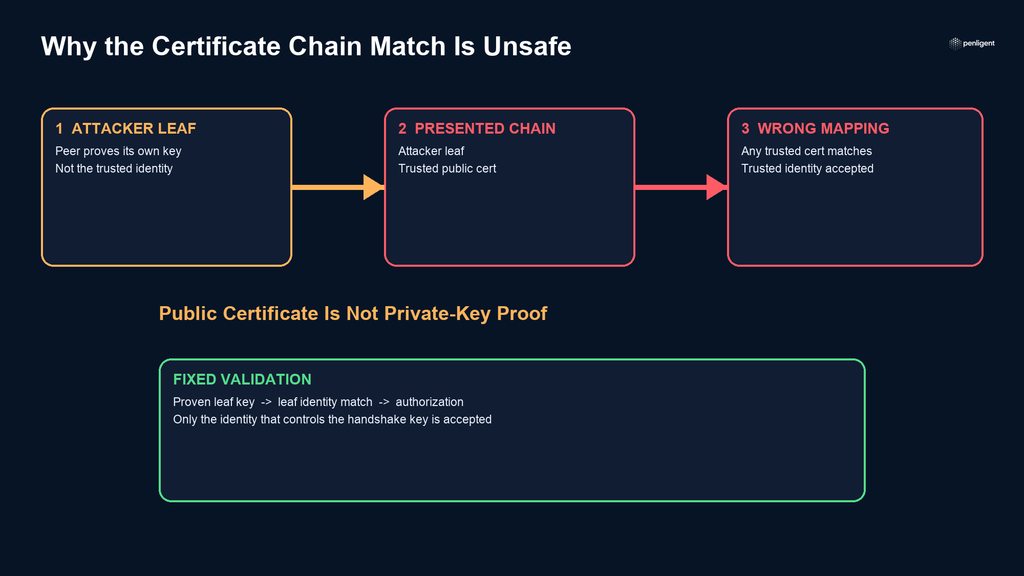
LXD exposes a local control surface through its Unix socket and can expose a remote HTTPS API. Remote clients can authenticate using mechanisms documented in Canonical’s remote API authentication guide, including TLS client certificates. In a normal mutual-TLS relationship, the client proves possession of a private key during the handshake. The server validates the presented certificate and its chain, then maps the proven client identity to an authorization decision.
The distinction between a public certificate and control of its private key is essential. Public certificates are routinely distributed. They may appear in trust stores, configuration backups, onboarding exchanges, support bundles, monitoring systems, or administrative workstations. Possession of the certificate alone should not allow a new connection to act as the certificate owner. Authentication depends on the cryptographic proof made by the peer that controls the private key corresponding to the leaf certificate used in the handshake.
Canonical describes the vulnerable logic as comparing all peer certificates sent by the client against known trust-store entries. That creates a dangerous mismatch between chain membership and authenticated identity. A certificate somewhere in a supplied chain may be publicly known, but it is not necessarily the certificate whose private key the peer proved it controls. If the server treats any trusted certificate in that chain as the connecting identity, the attacker can supply its own leaf certificate for the handshake while inserting another user’s trusted public certificate into the chain. The daemon then makes an identity decision using a certificate for which the attacker has not demonstrated private-key possession.
إن CWE-295 definition describes the broader class as improper certificate validation. The CVE record additionally maps the issue to CAPEC-475, signature spoofing through improper validation. Those taxonomies help classify the weakness, but the practical lesson is simpler: a chain is evidence used to validate a peer; it is not a bag of identities from which the application may select any trusted name.
This difference explains why the vulnerability is severe even though the attacker does not need the victim’s private key. A correct implementation would reject the impersonation because the attacker cannot produce the required signature as the victim. The affected implementation can instead associate the request with a trusted certificate that merely appears in the chain. Once that association is made, authorization proceeds under the wrong identity.
Conditions required for exploitation
The CVSS score describes the vulnerable behavior under a worst-case general scenario, but defenders still need a concrete exposure model. Three conditions are especially important.
First, the attacker needs a network path to the LXD HTTPS API or an equivalent reachable path through a reverse proxy, VPN, tunnel, port-forward, load balancer, cluster network, or compromised adjacent host. Canonical’s network exposure documentation explains how the server is made available remotely. A daemon that is genuinely limited to a local Unix socket presents a different immediate exposure than a daemon listening on all interfaces. However, administrators should verify rather than assume. Old automation, a forgotten proxy, a cloud security-group rule, or a management VPN may make the API reachable from more places than the primary configuration suggests.
Second, the attacker needs the public certificate of a trusted client or, in the MicroCloud scenario described by Canonical, a joining member’s public certificate. Public certificates are not normally treated as secrets, and that is precisely why the vulnerable design is unsafe. Defenders should not respond by pretending certificates must never be observable. The durable fix is correct validation and a patched daemon. Reducing unnecessary distribution of trust metadata can still make abuse harder and investigations clearer, but secrecy is not a substitute for patching.
Third, the impersonated identity must have enough privilege for the attacker’s objective. Canonical states that the vulnerability may lead to root access to the host, depending on the victim user’s privilege. A lower-privilege project-scoped identity may constrain some actions, while an administrative identity could expose the cluster, instances, images, profiles, storage, networking, secrets present in configuration, and host-adjacent capabilities. Incident responders should therefore inventory not only certificates but also the effective permissions and projects attached to each trusted identity.
No evidence in the official record justifies claiming widespread active exploitation. The CISA ADP enrichment included in the CVE record marked exploitation as none at its October 30 timestamp. That field is time-bound and evidentiary, not predictive. It does not mean exploitation cannot occur, that no private exploitation exists, or that internet exposure is safe. It means defenders should communicate accurately: the vulnerability is critical and automatable according to the enrichment, while confirmed exploitation was not reported in that record at that time.
Affected and fixed versions
The authoritative version ranges come from the Canonical-assigned CVE record and Canonical’s advisory.
| Product branch | Affected version shown in CVE record | First fixed version | Official release reference |
|---|---|---|---|
| LXD 4.0 LTS | 4.0.14 and versions before 4.0.15 in the stated range | 4.0.15 | LXD 4.0.15 release |
| LXD 5.0 LTS | 5.0.10 and versions before 5.0.11 in the stated range | 5.0.11 | LXD 5.0.11 release |
| LXD 5.21 LTS | 5.21.8 and versions before 5.21.9 in the stated range | 5.21.9 | LXD 5.21.9 release |
| LXD 6.x | 6.9.0 and versions before 6.10.1 in the stated range | 6.10.1 | LXD 6.10.1 release |
| MicroCloud 2 | Versions before the advisory’s fixed release | 2.1.5 | Canonical advisory |
| MicroCloud 3 | Versions before the advisory’s fixed release | 3.4.1 | Canonical advisory |
Version comparison must use the running product and channel. Do not compare only the first digit or assume that a newer-looking channel name is fixed. An LXD 5.21 deployment requires at least 5.21.9; an LXD 5.0 deployment requires at least 5.0.11. A pinned snap revision, staged rollout, maintenance hold, offline mirror, or failed restart can leave one node behind even if other nodes have updated.
The release posts state that the point releases contain critical security fixes and document the relevant snap channels. Canonical also noted progressive rollout from candidate to stable. That operational detail matters. During progressive rollout, the latest fixed revision may not immediately arrive on every machine through an ordinary automatic refresh. Administrators should inspect installed revisions, channel tracking, refresh holds, and fleet consistency instead of waiting passively.
Why the potential impact extends beyond one container
LXD is a systems container and virtual-machine manager. Its API is a control plane rather than an application data endpoint. A trusted administrative client may create, stop, copy, publish, or modify instances; alter profiles; attach devices; change network configuration; manage storage pools; access console or execution functions; and operate across clustered members. The exact authorization model and project boundaries matter, but a successful identity bypass may give the attacker the same control surface available to the impersonated client.
That makes the vulnerability qualitatively different from a certificate warning in a low-privilege service. If an identity can administer privileged instances, attach host resources, modify devices, or operate the cluster, control-plane access can become host compromise or broad workload compromise. Canonical’s LXD security explanation should be used to understand the platform’s trust and isolation boundaries. Containers share the host kernel, while virtual machines provide a different isolation layer; neither architecture makes unauthorized management-plane control acceptable.
Impact analysis should cover at least five asset groups:
- Host and cluster control: changes to members, projects, profiles, certificates, and daemon configuration.
- Workloads: lifecycle operations, console or execution access, snapshots, migrations, and image publication.
- Network: bridges, forwards, load balancers, ACLs, proxies, and routes managed through LXD.
- Storage and data: pools, volumes, snapshots, backups, and attached host paths.
- Evidence and recovery: logs, configuration backups, trust entries, and the ability to determine which identity performed an action.
- the product version reported by the running daemon;
- the snap revision and channel;
- the node or member name;
- the timestamp in UTC and local operations time;
- the API listener and firewall state;
- cluster health and workload status;
- any restart, rollback, or refresh-hold decision.
- source addresses and network segments used by each trusted identity;
- first-seen and unusual management clients;
- API actions that change projects, profiles, devices, networks, storage, certificates, or instances;
- creation of new trust entries or administrative users;
- unexpected instance starts, stops, snapshots, exports, migrations, or console activity;
- changes to logging, backups, proxies, firewall rules, or cloud security groups;
- certificate files copied into temporary directories, support bundles, or automation workspaces;
- MicroCloud join events, member replacement, and bootstrap traffic around the maintenance period.
- Bind remote administration to a management interface or VPN rather than a public address.
- Keep a short inventory of nodes, channels, versions, API listeners, trusted identities, and owners.
- Give each operator a separate identity. Avoid a shared certificate that makes attribution impossible.
- Remove test certificates after a lab or engagement ends.
- Pin or document update channels, but review holds and progressive rollout regularly.
- Keep management traffic separate from workload traffic where possible.
- Log control-plane actions and export logs to a location the daemon cannot silently rewrite.
- Automate version checks against branch-specific minimums.
- Test restoration of configuration backups without exposing private keys.
- Make fixed version plus verified exposure a completion criterion in the ticket.
- which interfaces expose the API;
- whether management access is limited to approved sources;
- whether fixed-version evidence is consistent across nodes;
- whether stale and shared identities remain;
- whether administrative actions are logged and attributable;
- whether a backup and rollback path exists;
- whether cluster maintenance preserves security controls.
- It is a Canonical-assigned critical vulnerability caused by improper certificate validation in the LXD HTTPS listener.
- The same advisory covers a related MicroCloud trust path.
- The CVE record gives it CVSS v4.0 10.0.
- The CVE record lists 4.0.14, 5.0.10, 5.21.8, and 6.9.0 as affected examples and defines vulnerable ranges before 4.0.15, 5.0.11, 5.21.9, and 6.10.1.
- Confirm the exact installed branch and running daemon version.
- Canonical's advisory lists MicroCloud 2.1.5 and 3.4.1.
- Update every member and verify the result; do not assume that updating LXD alone covers MicroCloud.
- The flaw is dangerous because the attacker can be accepted using a trusted public certificate placed in a presented chain.
- The attacker still needs network reachability to the relevant HTTPS API and enough information about a trusted identity.
- Do not publish or test a weaponized chain against production.
- A daemon limited to a local Unix socket is not exposed through that remote path.
- Verify alternate listeners, proxies, tunnels, cluster paths, and forwarding before concluding that remote reachability is absent.
- Patch regardless because configuration can change.
- Query the running LXD or MicroCloud version on every node.
- Check snap channel and revision, listener address, firewall path, and cluster health.
- Preserve before-and-after evidence with timestamps.
- If suspicious access, shared credentials, stale identities, or certificate exposure is plausible, review and rotate affected trust relationships according to the product's supported procedure.
- Rotation does not replace upgrading the vulnerable daemon.
- The CISA enrichment attached to the CVE record reported exploitation as none at its October 30, 2026 timestamp.
- That does not predict future exploitation or prove that a private incident has not occurred.
- A certificate's public subject and extensions.
- The private key that proves control of the certificate.
- The issuing chain used to validate the certificate.
- The authorization record that maps a validated identity to privileges.
- maintain a record of certificate fingerprint, owner, purpose, and expiry;
- avoid sharing one certificate across people or automation jobs;
- separate administrative and read-only identities;
- remove test identities at the end of a project;
- protect private keys with appropriate filesystem and secret-store controls;
- avoid copying full trust stores into support bundles unless required;
- review certificate-to-project mappings after staff or client changes.
- affected node and branch;
- observed version and fixed threshold;
- API exposure and approved source range;
- trusted identity and privilege review;
- update timestamp and resulting version;
- evidence limitations;
- residual risk and next review date.
- percentage of nodes at or above the fixed branch release;
- percentage of nodes with an explicitly documented API listener;
- number of trusted identities with a named owner;
- age of the oldest unreviewed identity;
- percentage of control-plane actions with source and identity evidence;
- time from vendor advisory to containment;
- time from containment to verified remediation;
- number of exceptions with an expiry date.
- Did we identify every LXD and MicroCloud node, including recovery and lab nodes?
- Did we record the branch-specific fixed threshold?
- Did we determine whether the HTTPS API was reachable and from where?
- Did we restrict untrusted access during the update?
- Did every reachable daemon move to a fixed release?
- Did we verify the running daemon rather than only the package manager?
- Did we check cluster consistency and workload health?
- Did we review stale, shared, and high-privilege trusted identities?
- Did we preserve logs and configuration evidence?
- Did we decide whether suspicious activity requires a separate investigation?
- Did we record residual exceptions with an owner and expiry?
- Remediation status: all identified reachable nodes are at or above their fixed branch release.
- Exposure status: remote API access is restricted to the documented management path.
- Identity status: active trusted identities have named owners and stale identities were removed.
- Investigation status: no suspicious activity was identified in the available evidence, with listed visibility limitations.
- Residual work: exceptions, owners, and deadlines.
An attacker who impersonates a trusted user may also create changes that persist beyond the immediate API session. Examples include adding a new trusted identity, creating an administrative workload, changing network reachability, exporting data, or altering backup and logging paths. This is why response should not stop after patching. If suspicious access is plausible, responders need to review state changes and rotate affected trust relationships.
MicroCloud changes the certificate-observation scenario
MicroCloud orchestrates LXD with other components to form a small private cloud. Its security documentation describes the trust relationships among MicroCloud services and cluster members. Canonical’s CVE advisory highlights a specific concern: during cluster joining, an attacker may be able to intercept the public TLS certificate of the joining member and later authenticate as that member against the vulnerable service.
The lesson is not that a public certificate must be encrypted forever. Cluster bootstrap necessarily exchanges identity material. The security property should be that observing public material does not grant control of the identity. The vulnerable chain validation breaks that property. Networks used for joining and bootstrap should still be treated as sensitive because they carry configuration, discovery, and trust-establishment traffic, but segmentation alone does not repair the authentication logic.
MicroCloud operators should verify both the MicroCloud version and the LXD version on each member. Updating only the orchestration layer while leaving a vulnerable LXD daemon behind does not provide a convincing remediation record. Conversely, updating LXD without checking the MicroCloud release can leave the related product path unresolved. Record the before and after version of every member and verify that cluster health remains normal after the maintenance window.
Exposure discovery before changing the system
Before emergency changes, capture enough evidence to understand the current state. The goal is not to delay containment; it is to avoid losing the information required to determine which systems were exposed and whether all nodes were fixed.
Start with the installed versions and snap channels:
lxc version
snap list lxd
snap info lxd
snap list microcloud
snap info microcloud
Record the command output, hostname, timestamp, cluster member, and management network. If a command is unavailable or the product was installed through a different packaging method, document that exception and use the packaging system’s version evidence. The CVE record focuses on Canonical LXD version ranges; do not automatically transfer those exact version statements to unrelated forks or repackaged builds without vendor confirmation.
Next, determine how the API is exposed. Review the LXD server configuration, listening sockets, host firewall, cloud firewall, reverse proxy, VPN routes, and any automation that forwards the management port. Useful local observations include:
lxc config get core.https_address
ss -lntp
sudo nft list ruleset
sudo iptables-save
Run commands only on systems you own or administer. A blank core.https_address can support a conclusion that the standard HTTPS listener is not configured, but it does not prove there is no alternate exposure. Check proxies, tunnels, cluster communication, and host-level forwarding. If the system sits behind a load balancer, record the listener, source restrictions, health-check path, and backend mapping.
Finally, inventory trusted identities and their privilege. Use the product’s supported trust-listing mechanisms for the installed version. Record fingerprints, names, projects or restrictions, last known owner, and whether the identity is still required. Do not copy private keys into the inventory. Public certificate fingerprints and ownership metadata are sufficient for most response records.
Emergency containment
If the daemon is vulnerable and reachable from an untrusted network, reduce reachability immediately while arranging the update. Prefer a control that can be applied and later audited: a host firewall rule, cloud security-group change, load-balancer restriction, VPN-only policy, or temporary listener bind to a management interface. Avoid an undocumented one-off change that another administrator may reverse during the incident.
Containment should preserve legitimate administrative access. Test the management path from an approved source before ending the change window. In a cluster, confirm that member-to-member communication and health are not unintentionally broken. If a reverse proxy terminates or passes TLS, understand where mutual TLS is actually evaluated and ensure the restricted path covers the daemon endpoint.
Do not rely solely on blocking public internet access. An attacker may operate from a compromised internal workstation, CI runner, VPN account, adjacent tenant, or cloud workload. Limit the API to the smallest set of management sources, then patch. Network controls lower exposure and buy time; they do not correct the certificate validation bug.
If the environment cannot be patched immediately, consider temporarily disabling unnecessary remote access, removing stale trusted identities, increasing logging, and monitoring management-plane activity. These steps are compensating controls, not an accepted final state. The fixed versions are the primary remediation.
Updating the correct channel
Canonical’s advisory lists the direct snap commands:
sudo snap refresh lxd
sudo snap refresh microcloud
Those commands are intentionally simple. The hard part is choosing the right channel, completing rollout, and proving the version after the refresh. In a production cluster, establish a maintenance sequence before changing members. Capture health, workload placement, storage replication, and backup state. Update one member or a controlled group, verify service health, and then continue. Avoid a fleet-wide refresh that leaves you unable to distinguish an application regression from a security fix.
For a single-node lab, record the current version and channel, refresh, restart only when the package requires it, and verify the daemon. For a cluster, record each member separately. An orchestration dashboard may display a desired channel while the node still runs an older revision. Snap’s update management documentation explains refresh controls, holds, and staged updates; use it to understand why a node did not move when expected.
The minimum post-update evidence should include:
Do not rewrite an old version string in a ticket. Preserve before-and-after output. A reviewer should be able to answer whether every affected branch crossed its specific fixed version.
Patch verification is a separate task
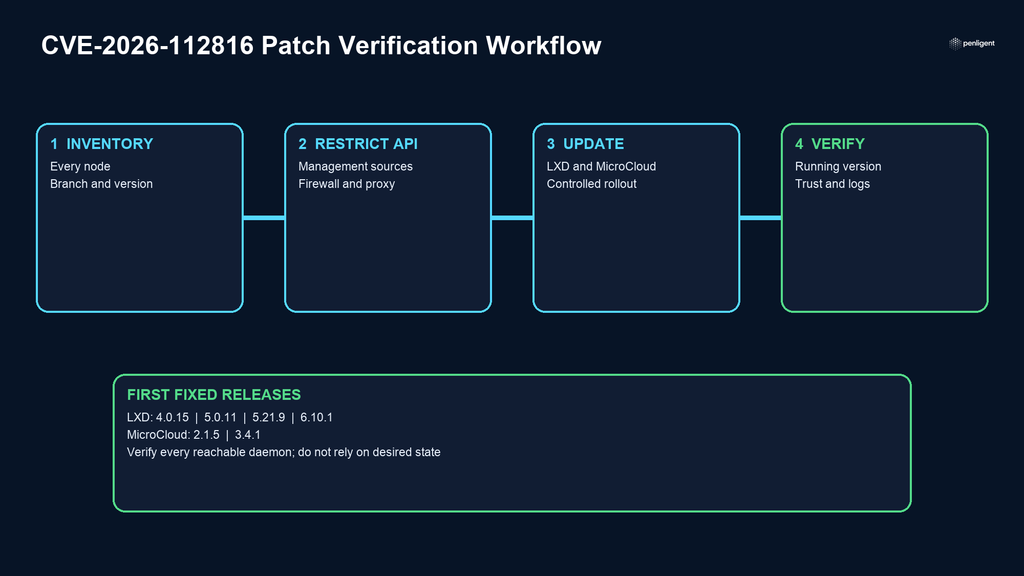
A patch is verified when the running service is fixed and the relevant exposure is understood. It is not verified merely because a package manager reported success. Use a layered test.
Verify the running version
Query the running LXD client and daemon using the supported interface. Compare the result with the branch-specific minimum:
lxc version
snap list lxd
For MicroCloud, use its supported status and version commands and record every member. If the product reports a client and server version separately, capture both. A workstation may have a fixed client while the remote daemon remains vulnerable.
Verify the listener and path
Inspect the LXD HTTPS address, local listening sockets, firewall rules, cloud security groups, proxy routes, and VPN policy. A fixed daemon may still be overexposed, while a vulnerable daemon may look safe only because one interface is currently down. Treat configuration and observed sockets as different evidence sources.
Verify cluster consistency
Check that all members are healthy and on a fixed release. Do not accept “the leader was patched” as a fleet result. A cluster control plane can fail operationally if a stale member is still reachable through a management path. The correct unit of verification is every reachable daemon, not the machine where the administrator ran the command.
Verify identity and authorization
Review trusted certificates and owners. Remove abandoned lab identities, shared operator certificates, and test accounts that no longer need access. Confirm that high-privilege identities are assigned only to intended administrators. This does not replace the code fix, but it limits the blast radius of future mistakes and makes suspicious activity easier to attribute.
Verify recovery
Take a fresh configuration backup after the update and test that it can be read by the approved recovery team. Confirm that backups do not contain private keys in unsafe locations. If the investigation finds suspicious access, preserve the pre-update state separately for analysis and document which configuration changes were made as containment.
Safe local model of the validation mistake
The following toy model demonstrates the decision error without creating certificates, contacting LXD, or sending an authentication request. It compares two abstract algorithms:
trusted = {"alice-public-cert"}
presented_chain = ["attacker-leaf", "alice-public-cert"]
# Vulnerable decision:
if any(cert in trusted for cert in presented_chain):
identity = "alice"# Safer decision:
if presented_chain[0] == "alice-public-cert" and private_key_proof_is_valid:
identity = "alice"The example is deliberately incomplete. private_key_proof_is_valid is a placeholder for the cryptographic handshake performed by a TLS implementation; it is not a value a user should fake. The point is that a trusted certificate appearing anywhere in a chain must not become the authorization identity unless the peer has proven control of the corresponding private key under the protocol’s validation rules.
Save the model as a local text file or run it in a test interpreter if you need to teach the distinction. Do not adapt it into a production certificate chain or use it against a system you do not own. A safe lab validates reasoning; it does not reproduce the vulnerable endpoint.
Detection and investigation
Certificate impersonation can be difficult to recognize from application logs alone. The attacker may appear under a legitimate trusted identity if the authorization decision is made after the flawed chain comparison. Focus on inconsistencies around the identity rather than expecting a log line that says forged certificate.
مراجعة:
Treat timestamps carefully. Snap refresh, service restarts, cluster failover, and log rotation can reorder evidence. Synchronize clocks where possible and preserve raw logs before filtering. If the daemon did not record enough identity, source, or action detail, state that limitation rather than claiming that no unauthorized access occurred.
If suspicious control-plane activity is plausible, isolate the affected management path, preserve logs and configuration, rotate affected client credentials as appropriate, and review host and workload integrity. Avoid destroying evidence by deleting the certificate or wiping the node before the response plan is complete. The exact rotation procedure depends on the LXD and MicroCloud version and the operational role of each identity.
Long-term hardening for individual operators
Personal professionals often run LXD in a home lab, a consulting environment, a small cloud account, or a temporary customer engagement. Small scale does not remove the control-plane risk; it often means fewer people notice configuration drift. Use a repeatable baseline:
The most useful automation is simple. A scheduled check can compare the running version with a known minimum, report the listener address, and alert when a node changes channel or becomes publicly reachable. It should produce evidence for a human reviewer, not silently declare a security update complete.
Common misconceptions
TLS is enabled, so the API is safe
TLS protects transport and supports authentication, but an implementation can still make the wrong identity decision after the handshake. Encryption is not a guarantee that every certificate validation and authorization mapping is correct.
The public certificate is not secret, so it cannot be abused
The public certificate should not grant identity control. The vulnerability is serious precisely because the server treated public chain material as sufficient identity evidence. Fix the validator and restrict exposure; do not rely on hiding certificates.
A firewall makes patching unnecessary
A firewall reduces reachability but can be bypassed by a compromised internal host, VPN user, proxy, or changed rule. Containment buys time. The fixed release closes the software defect.
The refresh command succeeded
The command may have updated a snap revision on one node while another node remains stale, or a staged rollout may leave the machine on an older revision. Query the running service and record the result.
Every compromise gives root
Canonical warns that root access may result depending on the impersonated identity. Privilege boundaries still matter. Incident response should determine what the identity could actually do instead of assuming the maximum or minimum impact.
No exploitation is listed, so this is low priority
The CISA enrichment timestamp reported no exploitation. That is a snapshot, not a safety certification. A network-reachable authentication bypass with CVSS 10.0 deserves urgent remediation even without a public exploit.
Where automated testing fits
After patching, a security assessment should validate the control plane as an authorized asset, not attempt to weaponize the certificate-chain flaw. A useful engagement can confirm:
Penligent can be used as one part of that authorized validation workflow when the operator has a defined scope, a safe test window, and an evidence requirement. Keep the test focused on exposure, configuration, version, and proof of remediation. Do not upload private keys or confidential customer certificates to a testing system. If an engagement needs a deeper control-plane review, document the exact API boundary and stop conditions before testing.
الأسئلة الشائعة
What is CVE-2026-112816?
Which LXD versions are affected?
What are the fixed MicroCloud versions?
Does the attacker need a private key?
Is a local Unix socket affected remotely?
How do I verify that the patch worked?
Should I rotate certificates?
Is this known to be exploited in the wild?
A practical operator runbook
When a critical management-plane issue arrives, individual operators need a sequence that works under pressure. The following runbook is intentionally conservative and can be adapted to a home lab, a consultancy staging cluster, or a small production environment.
Establish ownership and scope
Write down the person responsible for the change, the approved maintenance window, the systems in scope, and the path used to reach the API. If the node belongs to a customer, confirm the engagement scope before touching it. If it is a personal lab, record the same information in a change note. This prevents the common failure mode where a security update is applied to a client workstation but the remote daemon remains unchanged.
List every LXD and MicroCloud node, including nodes that are powered off, paused, disconnected, or used only for disaster recovery. The version matrix is branch-specific, so an old recovery node can remain relevant even if it is not serving workloads today. Include cloud instances, bare-metal systems, nested labs, and temporary conference or training environments.
Capture a pre-change snapshot
Capture version output, channel information, listener configuration, firewall policy, cluster health, trusted identity inventory, and a configuration backup. Store the snapshot in a location with an immutable timestamp. If the environment is sensitive, redact private material before sharing it with a ticketing system. Never put private keys in a chat or a general-purpose issue.
The snapshot has two purposes. It lets the operator recover if the upgrade causes an unrelated regression, and it lets an investigator determine whether the system was vulnerable and reachable before the change. A short version-only note is not enough for the second purpose.
Reduce exposure while preserving administration
If the API is exposed beyond a tightly controlled management path, apply a temporary restriction. A VPN-only rule, source-address allowlist, private security group, or management-interface bind is preferable to a vague instruction to “block the port.” Record the exact rule and the approved source. Test the approved path from the operator workstation before closing the untrusted path.
Where possible, use a reversible control. The change should be easy to remove after verification, but it should not disappear from the audit trail. If a proxy or load balancer sits in front of LXD, restrict both the frontend and any direct backend route. A backend listener that remains reachable can defeat a frontend-only containment step.
Update in a controlled order
For a standalone node, update the package and check service readiness. For a cluster, choose a sequence that preserves quorum and workload availability according to the product’s operational guidance. Do not improvise a failover sequence from the CVE description. Use the version’s normal maintenance procedure and document any deviation.
After each member update, check the exact running version, service health, cluster membership, storage state, and workload status. If an update is held or rolls back, record the reason and maintain containment. A failed update is a visible problem; a silently stale member is a hidden one.
Prove the post-change state
Use at least two independent observations. For example, compare the daemon’s reported version with the snap revision, then compare the listener and firewall observation with the intended management policy. Independent evidence catches cases where a client command points to a different endpoint or where a dashboard reports desired state instead of running state.
Do not close the incident because the homepage loads or a routine workload starts. The security property is about identity validation on the control plane. Include a statement that the running branch is at or above its fixed version, the API is reachable only from approved sources, and all members were checked.
Decide whether investigation is needed
If the API was never reachable from an untrusted source, no suspicious activity exists, and the trusted identity inventory is clean, record those facts and continue monitoring. If exposure was broad, a certificate was copied into an unexpected location, or control-plane actions look unusual, escalate to an incident review. The absence of a public exploit does not remove the need to investigate credible local evidence.
Certificate lifecycle lessons
The flaw provides a useful lesson for every system that maps certificates to users or services. Certificate operations should distinguish at least four objects:
These objects are related but not interchangeable. A trust store may contain a root, an intermediate, or an end-entity certificate. An application must know which object it is authorizing and which cryptographic proof it has received. If it simply searches the presented chain for any familiar bytes, it can accidentally convert a chain into an identity injection mechanism.
For individual operators, the practical hygiene is straightforward:
None of these practices fixes CVE-2026-112816 by itself. They reduce ambiguity, constrain privileges, and make response faster after the fixed release is installed.
How to communicate risk to a client
Independent consultants often need to explain the issue without overstating it. A useful client statement has four parts:
“The environment contains an affected LXD or MicroCloud release. The vulnerable HTTPS API can make an authorization decision from a trusted certificate appearing in a client-supplied chain instead of requiring proof that the connecting peer controls that identity’s private key. If the API is reachable and a trusted public certificate is known, an attacker may be accepted as that identity. Canonical rates the issue critical and provides fixed releases. We are restricting management access, upgrading each affected member, and collecting version and reachability evidence. We have not concluded that exploitation occurred solely from the CVE record.”
This language separates confirmed product facts, environment-specific conditions, remediation, and investigation status. It avoids saying that the customer was breached when no evidence supports that claim, while still communicating urgency.
For a report, include:
This structure is more useful than copying a generic severity label. It gives the reader a decision and a way to reproduce the verification.
Validation scenarios for a small lab
A safe lab can test the operational controls around the issue without recreating the authentication bypass. Consider three scenarios.
In the first, the LXD API is bound only to the local machine. The operator records the address, confirms no external listener exists, and verifies that a local Unix-socket client can still administer the node. The result demonstrates containment, not immunity. The version still needs to be fixed.
In the second, the API is reachable through a private VPN. The operator documents the allowed source subnet, checks the host firewall and cloud policy, and confirms that an unapproved test workstation cannot connect. The result demonstrates network segmentation. It does not prove that the validator is correct, so the daemon still needs the update.
In the third, a two-member lab cluster is updated one member at a time. The operator records each member’s before and after version, checks cluster health, and confirms that workloads remain available. The result demonstrates rollout evidence and operational safety. It does not justify skipping the trusted-identity review.
These scenarios are appropriate for a personal professional because they create durable evidence and repeatable habits. They avoid generating a forged chain or interacting with a real vulnerable endpoint. If a customer requires a deeper assessment, agree on a safe test design and authorization before execution.
Metrics worth tracking after remediation
Security teams frequently stop tracking a vulnerability once the package is updated. For this class of management-plane issue, a few lightweight metrics provide longer-term value:
These metrics work for a one-person practice as well as a larger team. The goal is not a compliance dashboard for its own sake. The goal is to detect when a temporary lab exception becomes permanent or when a “patched” state is actually only a desired state in a management system.
Final operator checklist
Before declaring the issue closed, answer yes or no to each question:
If any answer is no, the remediation may be technically incomplete even if the update command succeeded. This checklist is intentionally mundane: management-plane vulnerabilities are often worsened by missing inventory and ambiguous evidence rather than by a lack of sophisticated tooling.
Building a durable evidence package
A good remediation package should survive review weeks after the emergency. Create one folder or ticket section per environment and include a concise inventory, raw command output, screenshots only when they add information, the vendor links used for the decision, and a final signed conclusion. Avoid pasting hundreds of unrelated log lines. Evidence should answer a defined question.
For version evidence, preserve the daemon version and package revision. For reachability, preserve the listener, firewall, and cloud-policy observations. For authorization, preserve the trusted identity list with private material removed. For operational health, preserve cluster and workload status before and after maintenance. For investigation, preserve the relevant management events and the time range searched.
Record limitations explicitly. Examples include missing historical firewall logs, a node that was offline during the first review, an old certificate whose owner is unknown, or a proxy configuration managed by another team. A limitation is not an admission of failure. It prevents a later reader from interpreting incomplete evidence as a complete negative finding.
Use a final conclusion that separates remediation from incident assessment:
This format is useful for an independent consultant because it can be handed to a client without requiring the client to understand snap internals. It is also useful in a personal lab, where the future operator may simply be you six months later.
Designing future regression checks
Once the immediate issue is closed, add a small regression check to routine maintenance. It can be a shell script, configuration-management assertion, or monitoring rule. The check should report rather than mutate by default. It should identify the node, read the running version, map the installed branch to a minimum allowed version, record the API listener, and fail visibly when the state is unknown.
Do not hard-code “6.10.1 is safe forever.” The minimum in this article is the first fixed release for this vulnerability, not a permanent recommended version. A mature check uses a maintained policy file or vendor-supported channel and alerts when the node is below the organization’s current baseline.
Add a reachability check from approved and unapproved network locations when practical. An internal monitoring probe can confirm that the management API is reachable from the VPN, while an external probe under your control confirms that it is not reachable from the public internet. Do not scan third-party address space or a customer environment without authorization.
Finally, test the evidence path. If the alert fires, can the operator identify the owning node, the channel, the responsible person, and the expected update procedure? Automation that detects a stale version but cannot identify an owner creates noise rather than resilience.
Broader engineering lessons
CVE-2026-112816 illustrates several engineering principles that apply beyond LXD. First, authentication and authorization must use the same proven identity. A parser may successfully read a certificate chain while the application later selects the wrong certificate as the principal. Security review must follow data from protocol proof through identity mapping to permission checks.
Second, public-key infrastructure contains multiple roles. Root and intermediate certificates establish issuance paths. Leaf certificates represent endpoints. Trust anchors, presented chains, and authenticated peers are not interchangeable collections. Code that searches for a familiar certificate without considering its role is likely to create confused-deputy behavior.
Third, exposure and vulnerability are separate dimensions. A vulnerable service behind a strict management boundary still needs patching because boundaries change. A fixed service exposed to the world may still violate the intended security design. Good remediation closes both dimensions and records both results.
Fourth, fleet consistency matters. Clustered infrastructure often fails security review at the edges: a recovery node, an old branch, a paused instance, or a member excluded from the dashboard. Critical vulnerability response should define the inventory first and calculate completion against that inventory.
Fifth, the absence of known exploitation is not a reason to delay a clearly severe authentication bypass. It is a reason to communicate carefully and avoid claiming a breach without evidence. Urgency and accuracy can coexist.
الخاتمة
CVE-2026-112816 is a failure to keep certificate presentation, private-key proof, and authorization identity aligned. It affects a management plane that can control clusters and workloads, so the practical response is more than a package update. Determine whether the HTTPS API is reachable, restrict it while patching, move each LXD and MicroCloud installation to its fixed branch release, and preserve evidence that every reachable member is running the fixed code. Then review trusted identities and control-plane activity so that a successful update is not mistaken for proof that nothing happened before it.
 Arabic
 English
 German
 French
 Spanish
 Portuguese
 Japanese
 Korean
 Hindi
 Turkish
 Hebrew