
Web application penetration testing services should evaluate how the application makes security decisions across browsers, APIs, identities and workflows. A scan of public routes can find useful issues, but it cannot establish that authenticated roles, tenant boundaries and state-changing processes are secure.
Scope by behavior
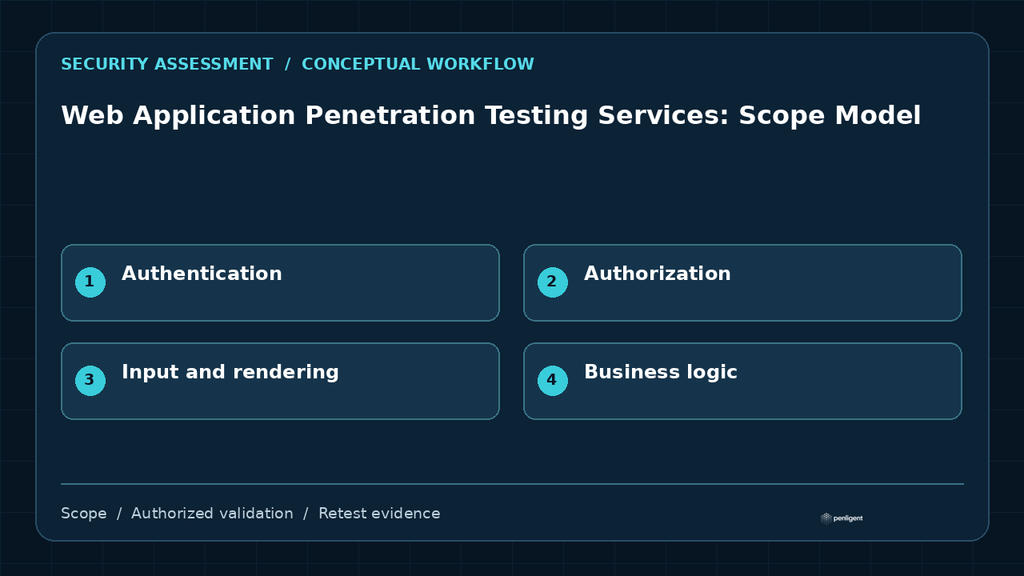
| Area | أمثلة | Test evidence |
|---|---|---|
| المصادقة | Registration, SSO, MFA, recovery, session rotation | Account state, token lifecycle and server decisions |
| Authorization | Objects, functions, tenants, administrative actions | Role and ownership matrix with request differences |
| Input and rendering | Queries, templates, uploads, rich text, exports | Source, transformation and safe output behavior |
| Business logic | Approvals, inventory, credits, refunds, quotas | State transitions and unauthorized outcome |
| Browser boundary | CORS, CSP, cookies, postMessage, service workers | Origin, browser context and protected action |
| API and jobs | REST, GraphQL, webhooks, queues, scheduled tasks | Identity propagation and downstream result |
For the assessment framework, consult OWASP WSTG and map the relevant guidance to the actual environment and authorized scope.
إن OWASP WSTG is a strong testing reference, while the OWASP ASVS helps define security requirements. If the application exposes APIs, use the OWASP API Security Top 10 as an additional taxonomy. The engagement should still be adapted to the product’s actual architecture.
Authenticated coverage
Provide accounts for every material role and at least two tenants where isolation matters. Include newly invited, disabled, removed, downgraded and privileged states. Ask the provider how it will preserve state across UI actions, APIs and background jobs.
Do not accept “authenticated testing included” without a role matrix. One standard user account cannot establish that administrative, billing, support or cross-tenant boundaries were exercised.
Business-logic testing
Identify high-value workflows and define the invariant for each. For a refund, value should not be created through replay or concurrency. For an approval, the approved object and amount should remain bound to the decision. For an invitation, a token should be bound to the intended tenant and lifecycle.
Evidence requirements
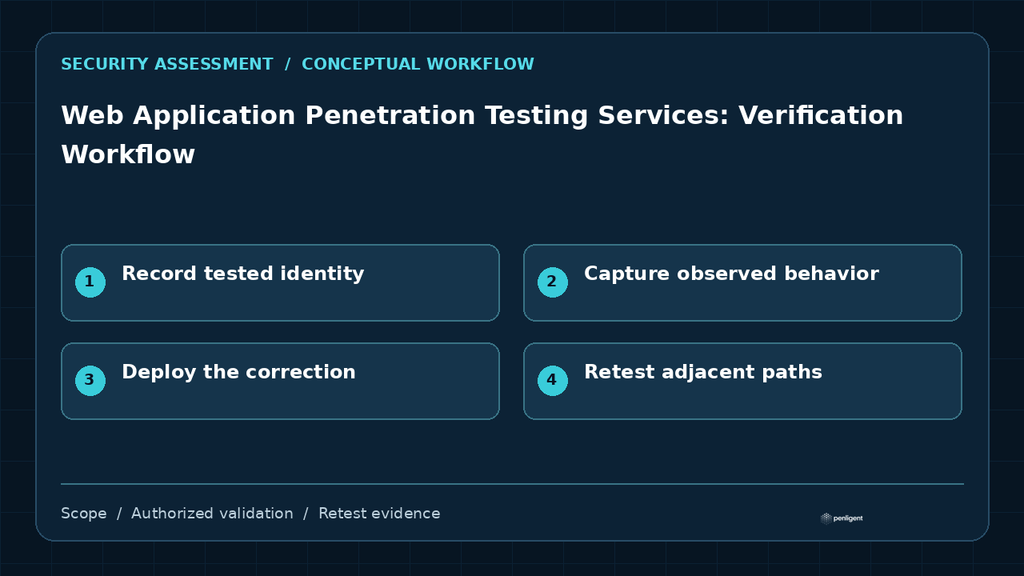
- the exact role, tenant and session state;
- all material requests in a multi-step chain;
- expected and observed application behavior;
- the data or action exposed;
- root-cause attribution rather than endpoint-only symptoms;
- safe reproduction and remediation retest steps.
Automation and manual investigation
Automated testing is useful for broad route, input and configuration coverage. Adaptive or analyst-led work is necessary when meaning depends on identity, state, business value or chained impact. Ask which parts of the scope receive each treatment and how automated findings are validated.
Production safety
Define prohibited actions, rate limits, test-data rules, notification recipients and emergency-stop procedures. Use a production-like staging system for destructive or high-volume cases. If production-only controls must be tested, create narrow cases with reversible outcomes and active monitoring.
Vendor trial
- Choose one workflow with multiple roles and a supporting API.
- Seed a known object-authorization defect and a protected negative control.
- Observe scope compliance and communication during testing.
- Have an engineer reproduce the finding from the report.
- Fix the issue and evaluate the retest artifact.
Report and retest
The report should support executives, security and engineering without turning one document into three disconnected narratives. Require a risk summary, scope and limitations, technical findings, root-cause grouping, remediation priorities and a retest record tied to the original evidence.
Client-side and browser behavior
Modern web applications rely on browser storage, service workers, cross-window messaging, third-party scripts and client-side routing. Ask the provider how it tests origin assumptions, token exposure, unsafe rendering and transitions between browser and API authorization. Client-side restrictions should never be treated as proof of server-side access control.
API and asynchronous coverage
Inventory the APIs used by the web client, mobile applications, integrations and internal consoles. Include GraphQL operations, webhooks, queues, scheduled jobs and export pipelines where they affect the same security boundary. A front-end action may return safely while an asynchronous worker processes a stale or unauthorized state later.
File and content workflows
Uploads and generated content should be tested through storage, parsing, preview, transformation, sharing and deletion. Validate authorization on the original file and every derivative. Test filename, metadata, content-type and rendering decisions with harmless samples rather than weaponized production payloads.
Acceptance questions for proposals
- How many roles, tenants and authenticated workflows are included?
- Will the tester inspect browser, API and background behavior as one system?
- Which activities are automated, and who validates the results?
- How are business-logic objectives chosen and documented?
- What evidence will engineers receive for multi-step findings?
- How many retests are included, and what does the retest report contain?
- How are credentials, sessions and captured data deleted?
Coverage limitations to record
Document inaccessible roles, unstable features, excluded third parties, rate restrictions and functionality that differs between staging and production. This turns limitations into a future testing backlog and prevents a broad “web application tested” statement from concealing material gaps.
Final decision
Select a web application testing service that can explain how it will test authenticated state, authorization and business workflows before the engagement begins. Penligent’s AI-assisted pentesting workflow should meet the same evidence and retest requirements as any other provider.
 Arabic
 English
 German
 French
 Spanish
 Portuguese
 Japanese
 Korean
 Hindi
 Turkish
 Hebrew