
CISA added CVE-2026-115731, a Puppet Enterprise report-deserialization vulnerability, to its Known Exploited Vulnerabilities catalog on November 17, 2026. That changes prioritization: this is an exploitation-backed remediation task, not simply a high severity score. The catalog’s December 1 due date belongs to its directive context; organizations should apply their own applicable obligations and risk process. Confirm the entry in CISA’s live KEV feed.
A trusted agent certificate is the important boundary
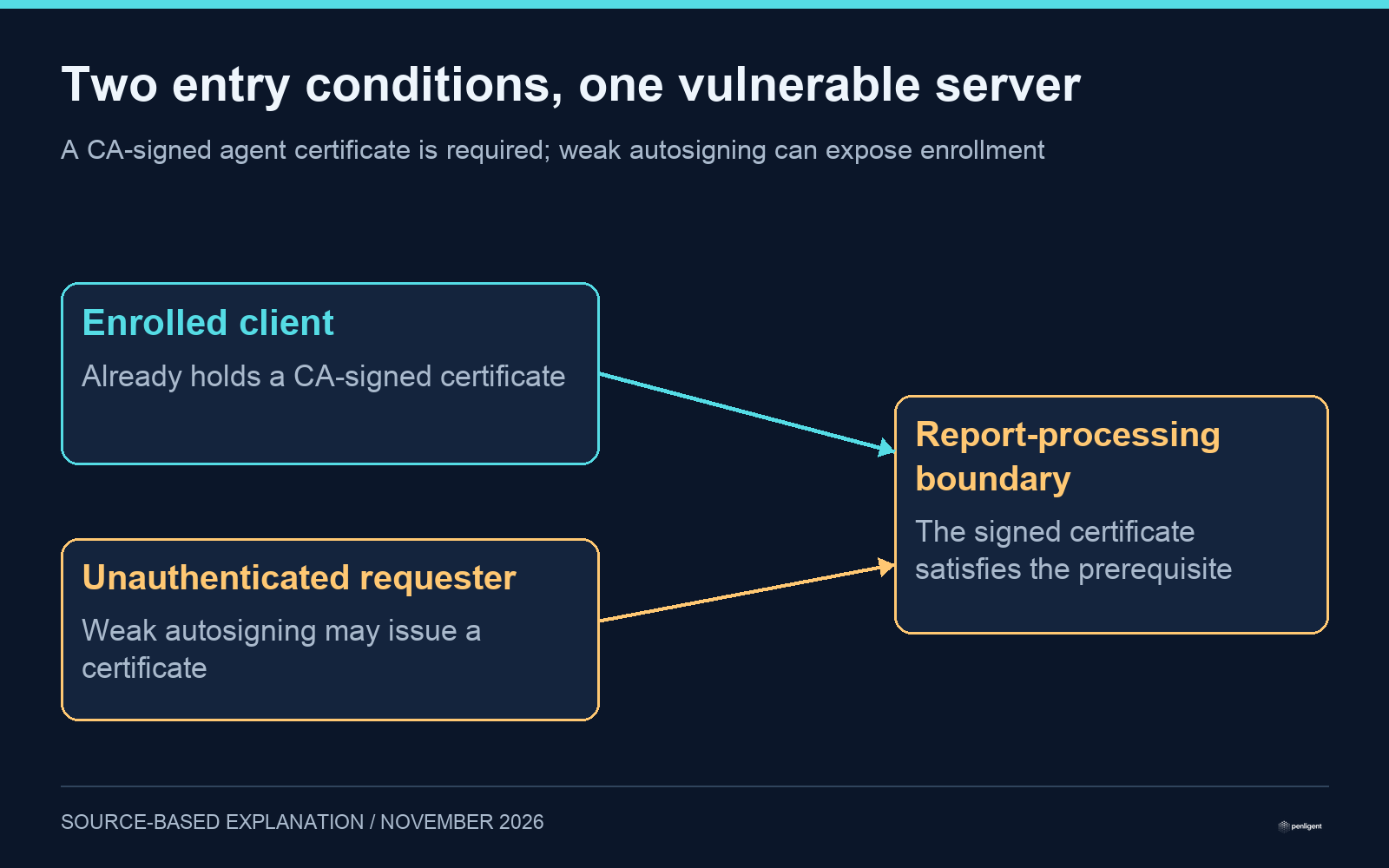
إن Perforce-authored CVE record describes unsafe rich-data deserialization in report processing. A client holding any CA-signed agent certificate can cause code execution on Puppet Server as the service user. This is not a statement that every remote Internet client is automatically authenticated, nor that the resulting process necessarily runs as root.
There is a second branch: if the certificate authority autosigns enrollment requests without strong verification, an unauthenticated network attacker may obtain the required certificate. Review certificate issuance and report processing together. A closed public management interface does not answer whether a less-trusted agent already has an accepted certificate.
| Observed state | Operational implication | Evidence needed |
|---|---|---|
| Affected server accepts reports from enrolled agents | Agent credentials are security-significant for this issue | Which certificates can submit reports and who controls them |
| Autosigning has weak or unverified enrollment controls | The prerequisite can become reachable to an unauthenticated requester | Actual signing policy and recent issuance records |
| Fixed server code is installed but the process has not restarted | The active service may still use the old code | Runtime restart and deployment evidence |
| Patch completed after a period of exposure | Remediation does not settle historical compromise | Preserved report, certificate and host evidence |
Match the Enterprise branch to the published fix
The CVE record identifies the following Enterprise ranges and fixed releases. It states that the fix is delivered with a release bundling puppet-agent 8.22.2 or 9.1.3 and requires a Puppet Server restart so the fixed code is loaded. Use the vendor remediation entry and your supported product procedure when planning the change.
| Enterprise branch range listed as affected | Fixed Enterprise release |
|---|---|
| 2023.8.0 to before 2023.8.13 | 2023.8.13 |
| 2025.0.0 to before 2025.12.1 | 2025.12.1 |
| 2026.0.0 to before 2026.0.1 | 2026.0.1 |
Do not generalize those rows into a complete inventory rule for arbitrary historical or unsupported products. The record’s default status is affected. An unlisted deployment needs explicit vendor-supported assessment rather than an automatic unaffected label.
Keep patch, enrollment and incident closure separate
For patch closure, retain the product release, bundled agent evidence, server restart time and a successful normal report-processing check. A package-manager success message alone is incomplete. Apply the supported change to every relevant server instance, including any separate environment that shares the agent trust domain.
For enrollment review, document the current CA-signing policy, authorized enrollment owners and certificates that no longer correspond to an approved agent. Handle revocation or rotation through your incident and operations process; a hurried change can disconnect legitimate managed nodes. The review should answer whether an unauthorized certificate could have been issued, not merely whether autosign is currently enabled.
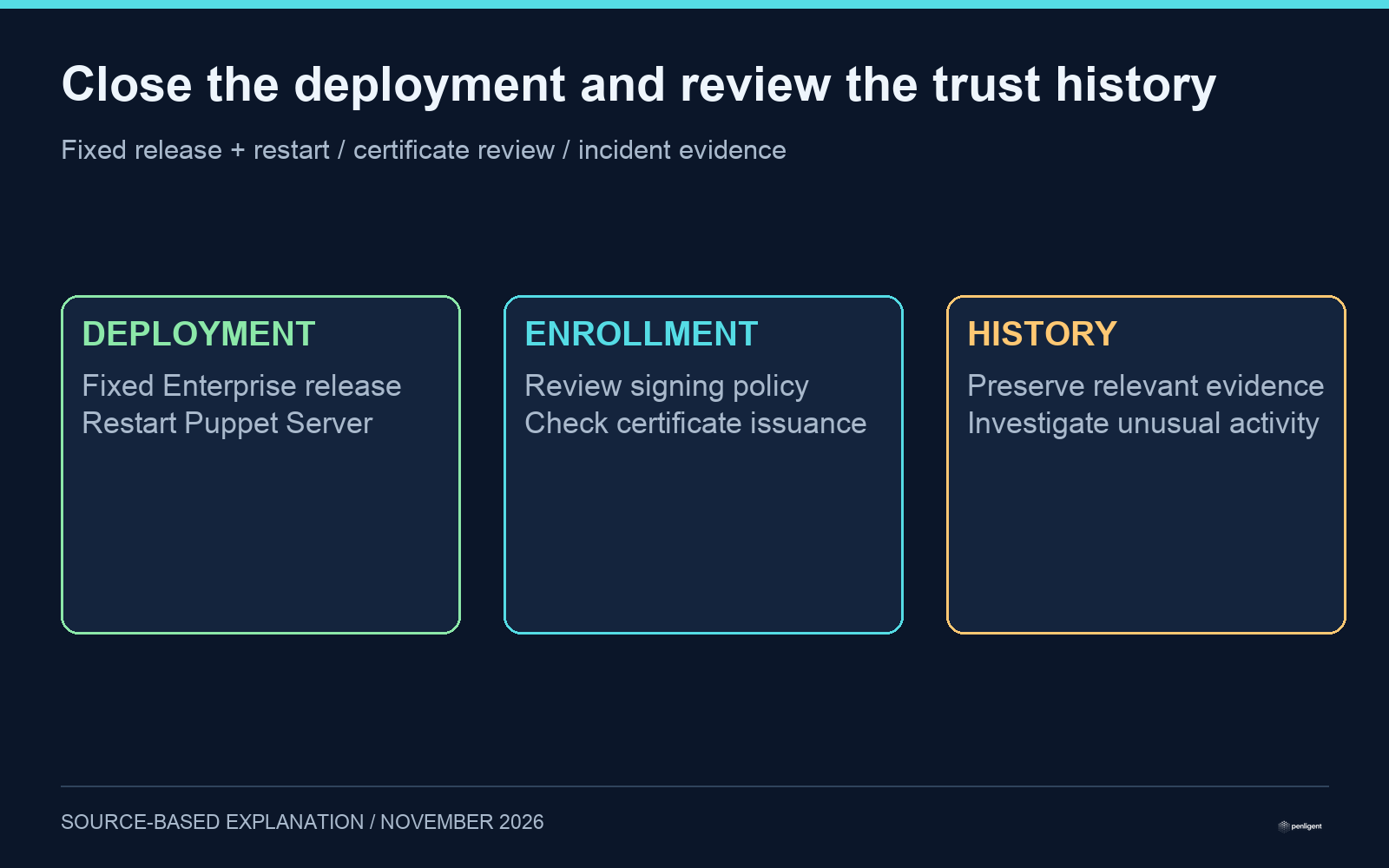
For incident review, preserve the evidence available under your retention policy before routine cleanup. Correlate unusual certificate issuance, unexpected report activity and host behavior around the affected service identity. These are investigation categories derived from the trust model, not vendor-published indicators or proof that a specific artifact is malicious.
CISA’s KEV listing supports known exploitation of the vulnerability. It does not identify your affected instances, prove compromise in your organization, or establish ransomware use. The catalog’s ransomware field was “Unknown” at this review. Avoid converting an unknown field into either reassurance or a claimed campaign.
Method: CISA catalog and Perforce-authored CVE record checked November 18, 2026. The vendor portal’s static response did not expose the full advisory during our check, so the version matrix and restart requirement are grounded in the vendor-authored CVE record. AI-assisted writing received agent factual validation; no exploit was run. The following Penligent 3.0 video is a general product workflow demonstration.
 Arabic
 English
 German
 French
 Spanish
 Portuguese
 Japanese
 Korean
 Hindi
 Turkish
 Hebrew