
CVE-2026-129239 is an authorization gap in Directus share updates. A non-administrator with the necessary share-update permission can change fields that determine the share’s effective permissions and target. The important review question is whether authorization applies only to the share before a change, or also to the security-relevant state that will be stored.
إن maintainer advisory describes a confidentiality impact. It does not establish issuance of an administrator token, arbitrary writes or an availability impact. The documented correction is Directus 12.3.1. This article examines the patch and derives a bounded permission-review method; no live share exploitation is claimed.
Resolve the affected-range discrepancy without guessing
The repository advisory’s affected-version field says <12.2.0, while the GitHub global advisory record says <12.3.1. Both identify 12.3.1 as patched. These records do not justify silently declaring the intervening versions unaffected.
إن 12.3.1 release was published on August 25, 2026 and includes the share-permission change. The global advisory was published on November 16. Treat November 17 as the date of this review, not as the patch’s release date. For a deployment below 12.3.1, use the documented corrected release or a supported later release containing the correction, and obtain maintainer clarification if a historical per-version finding must be resolved.
| Record checked | Affected field | Fixed version |
|---|---|---|
| Repository security advisory | Before 12.2.0 | 12.3.1 |
| Global advisory | Before 12.3.1 | 12.3.1 |
| Release and associated patch | Does not resolve the range disagreement | Documents the correction in 12.3.1 |
Start with the actual permission prerequisites
The report requires an authenticated non-admin account with update permission on directus_shares, an item it may share, and knowledge of administrator user and role identifiers. Baseline app access gives read-only access to the user’s shares; the broader update grant is part of the recommended defaults template that an instance may apply. Therefore, “has a Directus account” is not a sufficient exposure conclusion.
Review the effective permission for each relevant role or policy, including the row filter and allowed fields. A filter that limits updates to rows owned by the current user can authorize the original row without constraining a new owner value. The advisory also states that the schema’s read-only marker for the creator is a Data Studio interface hint, not an API-write restriction.
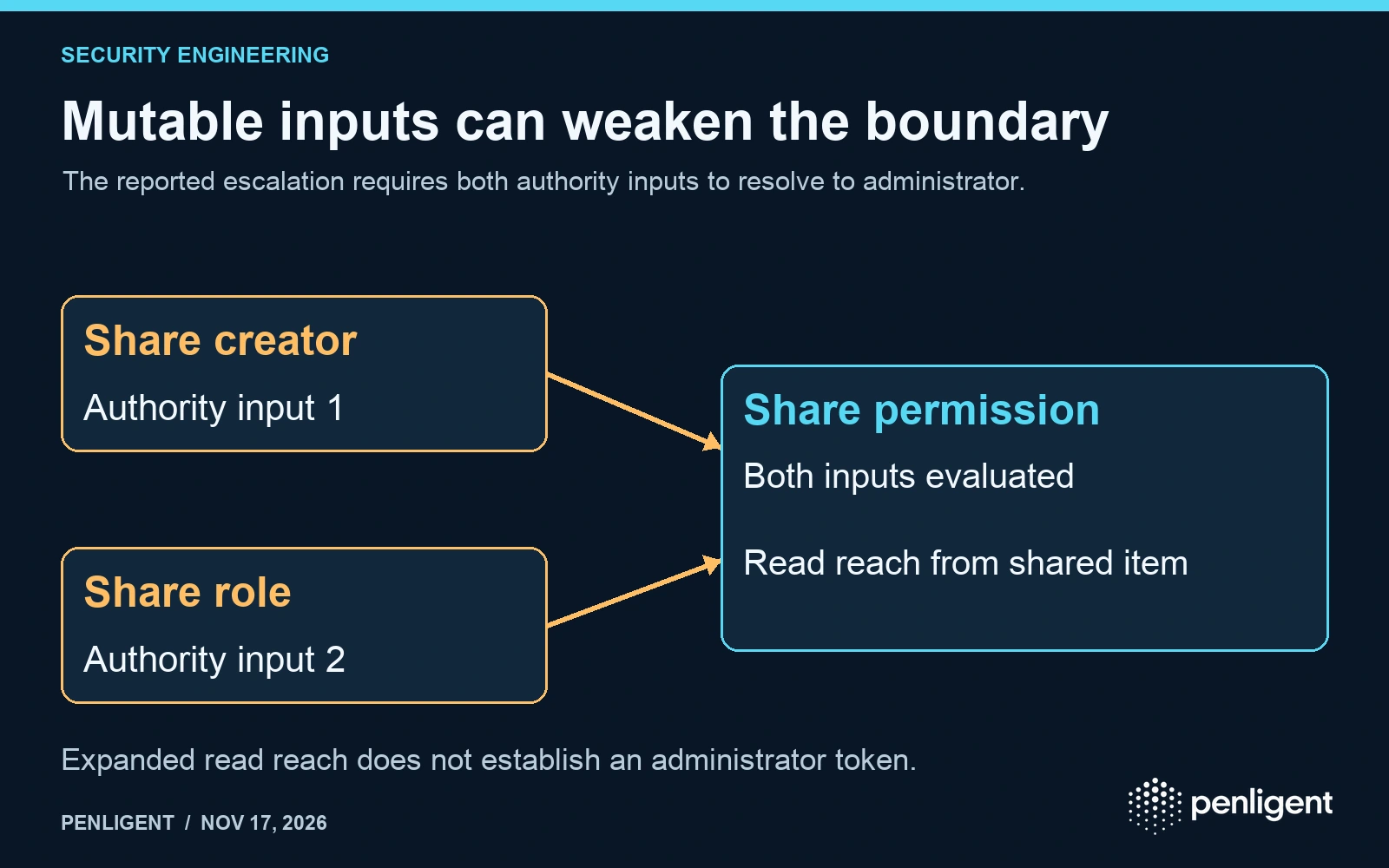
The reported escalation depends on both the share creator and selected role resolving to administrator authority when a guest authenticates through the share. Changing those inputs undermines the permission intersection introduced for the earlier CVE-2025-24353 surface. The result is expanded read reach from the shared item, subject to the relationships described in the advisory, rather than a general administrator credential.
The patch adds a service guard and target revalidation
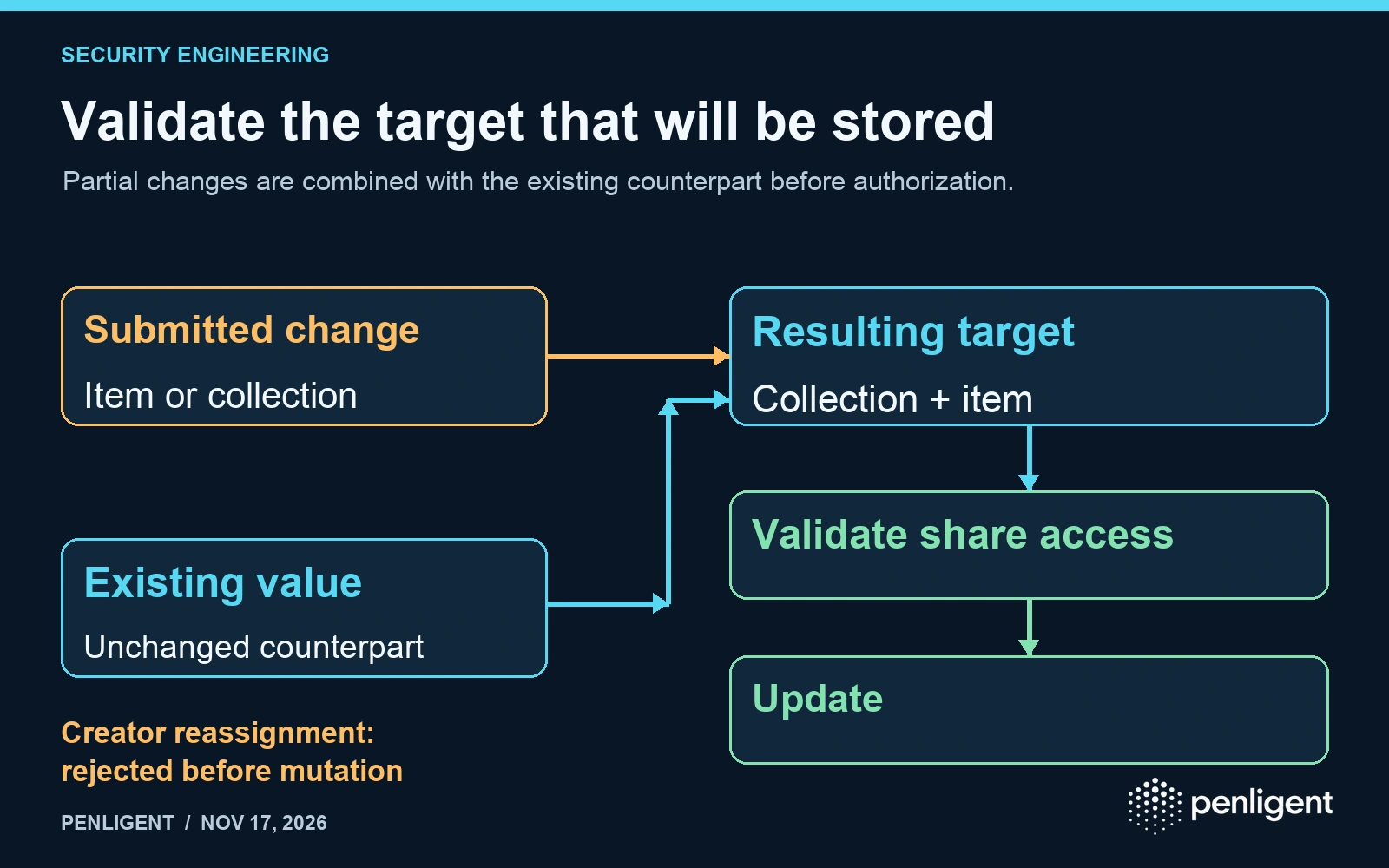
Commit 5869c06 makes three relevant changes. First, the share service rejects an update containing user_created before calling the underlying update operation. Second, when an accountable caller changes item أو collection, it validates share access against the resulting target. Third, the recommended update field list becomes explicit and excludes creator and creation-date fields.
The target-validation detail is useful for code review. If both item and collection are supplied, the patch validates that proposed pair. If only one changes, it reads the existing counterpart and constructs the resulting pair for each share. It groups targets by collection before validating access. A partial update therefore cannot be assessed using only the submitted field in isolation.
The explicit field list still contains الدور. Do not summarize this patch as making every security-related share field immutable. Its controls instead protect the creator boundary and revalidate the proposed target while retaining permitted share-management functions. The upstream tests assert rejection before mutation, validation of full and partial target changes, and permission-cache clearing after a successful update. Those are maintainer test assertions in the patch; they were not rerun for this article.
| Patch element | Security property | Review implication |
|---|---|---|
| Reject creator reassignment in the service | Creator identity cannot be manually replaced through that update path | Do not rely only on the UI field state |
| Validate the merged item/collection pair | Share permission is checked for the proposed target | Include partial-field and batch updates in regression coverage |
| Explicit recommended update fields | Template no longer grants unrestricted field writes | Inspect deployed custom policies; do not assume template edits describe every instance |
Use synthetic shares to verify the intended behavior
In a disposable staging environment with synthetic content, establish a non-admin test identity that mirrors the relevant production policy. Give it a deliberately shareable fixture and a separate fixture it cannot share. Record the intended permission boundary before running the normal share workflow.
- Verify that an ordinary allowed share update still succeeds and that its creator remains unchanged.
- Verify that an attempted creator-field update is rejected before mutation. Use synthetic identities; the test does not need a production administrator identifier.
- Check item-only, collection-only and combined target updates against the permitted and denied fixtures. Confirm the stored target and the access decision agree.
- If the application uses batch share administration, verify that each resulting collection/item combination is covered rather than checking only one representative row.
- Record the installed Directus build, artifact identity, effective policy and actual results. Keep an unexecuted case marked pending.
These are proposed acceptance cases derived from the patch, not a production-ready exploit or proof that a deployment has passed. A purely cosmetic edit is useful as a compatibility check, but it cannot establish that target revalidation is functioning. Conversely, disabling all sharing may contain a workflow while concealing whether the supported correction was deployed.
Separate current remediation from historical share review
After the supported upgrade, review existing shares using the organization’s administrative and audit records. Compare creator, role and target changes with the expected workflow. Preserve available history and the scope of retention. A current row with no unusual values does not reconstruct prior reads, and an unusual row does not by itself identify who accessed data.
The patch’s recommended-permission change is not evidence that every custom policy was automatically rewritten. Inspect the effective deployed policy and the active service version. If evidence suggests an unauthorized share, use the established incident process to restrict or revoke it, assess reachable data and investigate recorded access.
The practical closure record has two parts: the running service contains the correction and passes the selected synthetic permission cases; the review of earlier shares has a stated result and visibility limits. Keeping those decisions explicit prevents a successful upgrade job from being mistaken for a conclusion about historical disclosure.
Source review: November 17, 2026. Prepared with AI assistance using the maintainer advisory, global record, release notes and patch. Patch behavior was inspected in source; no Directus instance or customer share was tested. The affected-range disagreement remains documented.
The official Penligent 3.0 video below is a general product workflow demonstration. It does not demonstrate exploitation or certify remediation of CVE-2026-129239.
 Arabic
 English
 German
 French
 Spanish
 Portuguese
 Japanese
 Korean
 Hindi
 Turkish
 Hebrew