
CVE-2026-41940 is not a routine website bug. It sits in the management plane used to administer hosting accounts, websites, email, databases, DNS, SSL, and server-level settings. The NVD entry for CVE-2026-41940 describes it as an authentication bypass in the cPanel and WHM login flow that allows unauthenticated remote attackers to gain unauthorized access to the control panel. The official cPanel advisory says the issue affects cPanel software, including DNSOnly, in versions after 11.40, and lists patched builds for multiple supported and legacy branches. CISA later added the vulnerability to its Known Exploited Vulnerabilities Catalog, confirming that defenders should treat it as an actively exploited control-plane vulnerability rather than a theoretical bug.
The operational risk is straightforward: if an exposed WHM or cPanel service is vulnerable, the attacker is not merely abusing a single hosted application. The attacker may reach a control surface that can affect many hosted sites and administrative functions. WHM is especially sensitive because it provides server-level administration, while cPanel gives user-facing access to individual hosting accounts. In multi-tenant hosting, that distinction is the difference between “one customer application is at risk” and “the platform that manages many customers is at risk.” Rapid7’s emergency threat response summarized the practical impact as control over the host system, configurations, databases, and managed websites when exploitation succeeds.
CVE-2026-41940 at a glance
| الحقل | Current public information |
|---|---|
| مكافحة التطرف العنيف | CVE-2026-41940 |
| Affected products | cPanel & WHM, including DNSOnly, and WP Squared under affected versions |
| فئة الضعف | Authentication bypass in the login and session-management flow |
| CWE | CWE-306, Missing Authentication for Critical Function, according to NVD |
| الخطورة | CVSS v3.1 9.8 Critical, according to NVD |
| ناقل الهجوم | Network |
| Privileges required | None before exploitation |
| User interaction | لا يوجد |
| Primary risk | Unauthorized access to hosting control-panel functions |
| Public exploit status | Public technical analysis and exploit code were published by watchTowr, but weaponized details should not be reused in production environments |
| Fixed cPanel & WHM builds | 11.86.0.41, 11.94.0.28, 11.102.0.39, 11.110.0.97, 11.118.0.63, 11.124.0.35, 11.126.0.54, 11.130.0.19, 11.132.0.29, 11.134.0.20, 11.136.0.5, and higher, based on cPanel’s official advisory |
| Fixed WP Squared build | 136.1.7 and higher |
| Emergency priority | Patch first, verify version and service restart, then hunt for session and post-authentication indicators |
Why this bug is dangerous in hosting control planes
cPanel and WHM are not just login pages. They are administrative layers for hosting infrastructure. WHM commonly handles server-level tasks such as account creation, package management, DNS zone administration, SSL configuration, service settings, and root-level hosting operations. cPanel gives hosted users a control interface for web files, databases, email accounts, cron jobs, domains, and application management.
That matters because authentication bypass at this layer creates a different blast radius than an authentication flaw in a single business application. A typical broken login in a customer application might expose one app, one tenant, or one database. A control-panel bypass may affect many tenants, many domains, email accounts, backups, server secrets, and deployment paths. Even when the attacker’s exact post-authentication capabilities depend on which interface is reached and how the environment is configured, the control-plane position is inherently high value.
cPanel’s own follow-up post, CVE-2026-41940: Response, Actions and Next Steps, describes the issue as an authentication vulnerability in cPanel & WHM’s session-management layer. The key engineering detail is that two separate code paths wrote to session files on disk: one path included input sanitization; a second path, invoked during Basic authentication handling, did not. That missing sanitization created a condition where a specially crafted request could cause an unauthenticated session to be treated as authenticated.
That explanation is more useful than the phrase “auth bypass” alone. It tells defenders where to think: session state, pre-authentication state, session files, input normalization, authentication markers, and the code path that turns a request into trusted control-panel identity.
The root cause, session state became part of the trust boundary
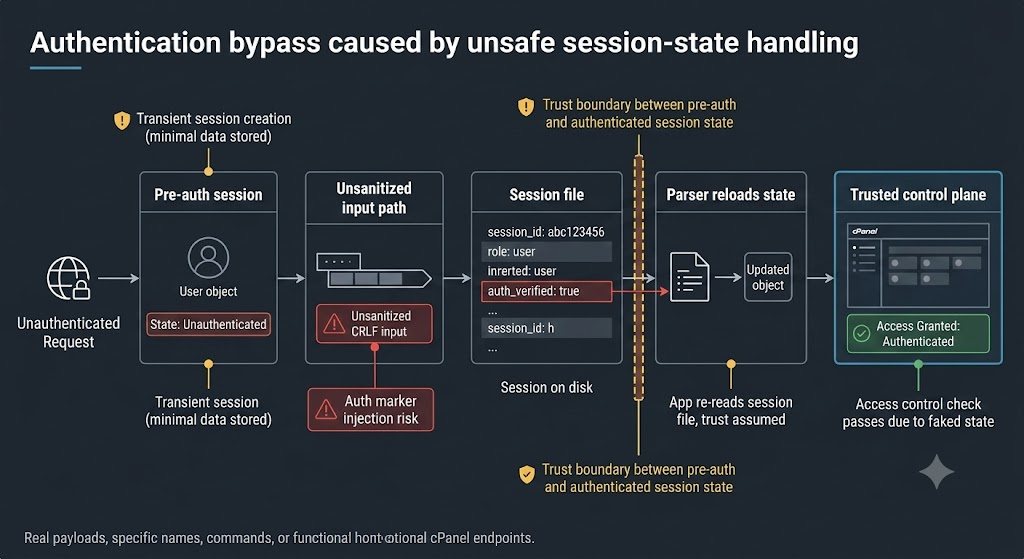
The safest way to understand CVE-2026-41940 is to separate three ideas that often get blurred in production systems.
First, a session is not automatically proof of authentication. Many web systems create some form of pre-authentication state before a user successfully logs in. This can be used for CSRF tokens, login tracking, IP binding, theme selection, MFA flow state, redirect handling, or rate-limit metadata.
Second, session files are not just storage. If the application later reads those files to decide whether a request belongs to an authenticated user, the file format becomes part of the authentication boundary. A single malformed field can become security-critical if it changes how the session is parsed.
Third, input sanitization belongs at the dangerous sink, not merely at selected callers. If multiple paths can write to the same session format, every path must produce safe output. In its technical analysis, watchTowr explained that the patch moved the filter_sessiondata call into saveSession itself, rather than relying on each caller to remember to sanitize before writing session data.
That is a classic secure-design lesson. When the sink writes authentication-relevant state, the sink must defend itself. A safe caller does not protect an unsafe caller. In control-plane code, “most paths sanitize correctly” is not a security guarantee.
How the vulnerability works at a conceptual level
The public technical research around CVE-2026-41940 describes a CRLF-driven session manipulation problem. CRLF means carriage return and line feed, the characters commonly represented as \r\n. In text formats where each line has meaning, newline characters are dangerous when untrusted input reaches a line-oriented storage format without being removed or encoded.
Many configuration and session formats rely on a simple structure:
key=value
another_key=another_value
If user-controlled input is inserted into such a file without removing newline characters, one logical value can become multiple physical lines. That can change what the parser sees later.
A simplified unsafe example looks like this:
pass=attacker-controlled-value
If the attacker-controlled value contains a newline, the stored file might become:
pass=attacker-controlled-value
hasroot=1
This is not a real exploit payload for cPanel. It is the dangerous pattern: newline injection can turn one field into more than one field when the storage format is line-oriented. In an authentication system, that pattern becomes severe if the newly created fields are interpreted as authentication state, privilege state, MFA state, or identity metadata.
إن watchTowr analysis also explains that cPanel session files can exist even after failed login attempts, because cpsrvd uses session files as a state machine across requests. Their example of a pre-authentication session includes values such as a security token, origin information, 2FA state, source IP data, local port, and login theme; the same session can later be upgraded when login succeeds.
That design is not inherently broken. Many systems maintain pre-authentication state. The weakness appears when untrusted input can cross from “data attached to a failed or incomplete login flow” into “trusted keys that change authentication interpretation.”
Why authentication bypass is not the same as password compromise
A common mistake during incidents like CVE-2026-41940 is treating the event as if it were mainly about password hygiene. Strong passwords still matter. MFA still matters. Rate limiting still matters. But none of those controls directly fix a server-side bug that causes unauthenticated state to be treated as authenticated state.
If an attacker can cause the server to create or load a session that already contains privileged authentication markers, the user’s password strength is not the blocking condition. The attacker is not winning a login challenge. The attacker is reaching a path where the application’s own state machine misclassifies the request.
That also explains why MFA should not be treated as a complete compensating control. MFA protects normal authentication flows. If the flaw is below or beside the normal authentication flow, MFA may not be reached, or its state may be incorrectly represented in the session. For CVE-2026-41940, defenders should think in terms of server-side session integrity, not only user-facing login security.
Affected versions and fixed builds
إن official cPanel advisory lists patched cPanel & WHM versions across multiple branches and says all further versions are patched as well. It also lists WP Squared 136.1.7 and higher as patched. The same advisory says all versions after 11.40 are affected, including DNSOnly, and warns that servers with disabled updates or pinned update configurations may not auto-update.
| Product branch or product | Fixed version named by cPanel | Operational note |
|---|---|---|
| cPanel & WHM 11.86 | 11.86.0.41 and higher | Verify manually if the update tier is pinned |
| cPanel & WHM 11.94 | 11.94.0.28 and higher | Confirm the installed build, not only the major branch |
| cPanel & WHM 11.102 | 11.102.0.39 and higher | Restart cpsrvd after update |
| cPanel & WHM 11.110 | 11.110.0.97 and higher | cPanel also documented special handling for some older OS paths |
| cPanel & WHM 11.118 | 11.118.0.63 and higher | Include internet-facing WHM and cPanel services in exposure checks |
| cPanel & WHM 11.124 | 11.124.0.35 and higher | Do not assume branch number alone is enough |
| cPanel & WHM 11.126 | 11.126.0.54 and higher | Confirm with local version output |
| cPanel & WHM 11.130 | 11.130.0.19 and higher | Include DNSOnly where applicable |
| cPanel & WHM 11.132 | 11.132.0.29 and higher | Check all nodes, not only primary hosting servers |
| cPanel & WHM 11.134 | 11.134.0.20 and higher | Review pinned update configuration |
| cPanel & WHM 11.136 | 11.136.0.5 and higher | Treat lower patch levels as exposed until proven otherwise |
| WP Squared | 136.1.7 and higher | Verify product-specific build state |
| CentOS 6 or CloudLinux 6 using v110.0.50 | cPanel describes v110.0.103 as a direct update path | Legacy systems should be treated as high-risk exceptions |
There is one subtle point about public vulnerability records. The NVD entry shows that the description evolved from a version-specific list of fixed branches to the broader statement that cPanel and WHM versions after 11.40 contain the authentication bypass. That is normal during fast-moving vulnerability publication, but it means defenders should avoid relying on a single copied version sentence from an early write-up. For production decisions, use the current cPanel advisory, installed build output, and current cPanel changelogs.
Immediate remediation on authorized servers
The priority is to update. Workarounds can reduce exposure, but they do not replace patching. The cPanel advisory directs administrators to update using the cPanel update script, verify the build version, and restart cpsrvd.
Run these only on servers you own or are explicitly authorized to administer:
# Force a cPanel update
/scripts/upcp --force

# Verify the installed cPanel build
/usr/local/cpanel/cpanel -V

# Restart cpsrvd after the update
/scripts/restartsrv_cpsrvd --hard
If a server has updates disabled or pinned to a specific version, it may not auto-update. cPanel specifically warns administrators to identify and manually update those servers as a priority. For CentOS 7 or CloudLinux 7, cPanel says the server must be set to the 11.110 tier.
# Example from cPanel guidance for setting the update tier
whmapi1 set_tier tier=11.110
Treat version verification as evidence collection, not a checkbox. A useful remediation record should include the hostname, public IP or asset ID, previous version if known, new version, timestamp, update command output, restart confirmation, temporary firewall changes, detection-script result, and any post-update anomalies.
Temporary mitigations when patching cannot happen immediately
cPanel provides temporary mitigation guidance for cases where the server cannot be updated immediately. The documented options include blocking inbound traffic on ports 2083, 2087, 2095, and 2096, disabling Service Subdomains, and stopping cpsrvd و cpdavd.
Those mitigations have business impact. Port 2087 commonly exposes WHM over HTTPS. Port 2083 is commonly used for cPanel over HTTPS. Ports 2095 and 2096 are associated with Webmail access. Blocking them can break customer administration, support workflows, API-driven maintenance, webmail access, and provider operations. But if an affected system cannot be patched and remains internet-facing, leaving those services exposed may be worse.
A practical decision table helps avoid confusion:
| الوضع | Preferred action | لماذا |
|---|---|---|
| Supported version, update possible now | Patch immediately, verify version, restart cpsrvd | This is the cleanest risk reduction |
| Updates pinned or disabled | Unpin or adjust tier, update manually, document exception | Auto-update assumptions are unsafe |
| Legacy OS path with special cPanel guidance | Follow vendor-specific update path, then plan migration | Legacy exceptions often remain exposed longer |
| Cannot patch within the required window | Block affected ports and disable exposed services while preparing update | Reduces remote reachability but does not fix the bug |
| Hosting provider with many customer-facing panels | Patch in waves only if emergency constraints require it, but block externally exposed panels during delay | Control-plane exposure creates multi-tenant risk |
| System shows possible compromise | Patch, isolate if needed, preserve logs, run detection, rotate secrets, inspect hosted accounts | Patching alone does not remove attacker persistence |
The key point is that temporary mitigation should be time-boxed. If a team blocks ports and then stops the incident process, it has not finished remediation. It has only reduced one access path.
Safe PoC, a local CRLF session-file demonstration
The following proof of concept is intentionally a toy example. It does not connect to a network service. It does not use cPanel paths, cPanel cookies, WHM endpoints, real headers, real ports, or a working exploit chain. It only shows why writing untrusted strings into a line-oriented session format without removing \r و \n can change how a later parser interprets state.
Use it in a local scratch directory only.
from pathlib import Path
from tempfile import TemporaryDirectory

def unsafe_write_session(path: Path, username: str, password: str) -> None:
    """
    Toy example of a dangerous pattern:
    user input is written directly into a key=value session file.
    """
    path.write_text(
        f"user={username}\n"
        f"pass={password}\n"
        "needs_auth=1\n",
        encoding="utf-8",
    )

def safe_value(value: str) -> str:
    """
    Minimal demonstration fix for line-oriented storage:
    remove CR and LF before writing user-controlled values.
    Real systems should use structured serialization and centralized validation.
    """
    return value.replace("\r", "").replace("\n", "")

def safe_write_session(path: Path, username: str, password: str) -> None:
    path.write_text(
        f"user={safe_value(username)}\n"
        f"pass={safe_value(password)}\n"
        "needs_auth=1\n",
        encoding="utf-8",
    )

def parse_session(path: Path) -> dict[str, str]:
    parsed = {}
    for line in path.read_text(encoding="utf-8").splitlines():
        if "=" in line:
            key, value = line.split("=", 1)
            parsed[key] = value
    return parsed

with TemporaryDirectory() as tmp:
    tmpdir = Path(tmp)

    injected_password = "wrong-password\nhasroot=1\ntfa_verified=1"

    unsafe_path = tmpdir / "unsafe.session"
    unsafe_write_session(unsafe_path, "root", injected_password)

    print("Unsafe session file:")
    print(unsafe_path.read_text(encoding="utf-8"))
    print("Parsed unsafe state:", parse_session(unsafe_path))

    safe_path = tmpdir / "safe.session"
    safe_write_session(safe_path, "root", injected_password)

    print("\nSafe session file:")
    print(safe_path.read_text(encoding="utf-8"))
    print("Parsed safe state:", parse_session(safe_path))
Expected lesson:
Unsafe session file:
user=root
pass=wrong-password
hasroot=1
tfa_verified=1
needs_auth=1

Parsed unsafe state: {'user': 'root', 'pass': 'wrong-password', 'hasroot': '1', 'tfa_verified': '1', 'needs_auth': '1'}

Safe session file:
user=root
pass=wrong-passwordhasroot=1tfa_verified=1
needs_auth=1

Parsed safe state: {'user': 'root', 'pass': 'wrong-passwordhasroot=1tfa_verified=1', 'needs_auth': '1'}
This toy PoC helps defenders understand the boundary condition behind CVE-2026-41940 without giving them a production exploit. The dangerous pattern is not “newlines are always magic.” The dangerous pattern is “untrusted input reaches a line-oriented authentication-state file and is later parsed as trusted state.” In real products, the fix should be more disciplined than sprinkling replacements across call sites. The safer architecture is centralized validation at the writer, structured serialization, explicit schema checks, and hard rejection of unexpected authentication markers in pre-authentication contexts.
Detection, what to look for after patching
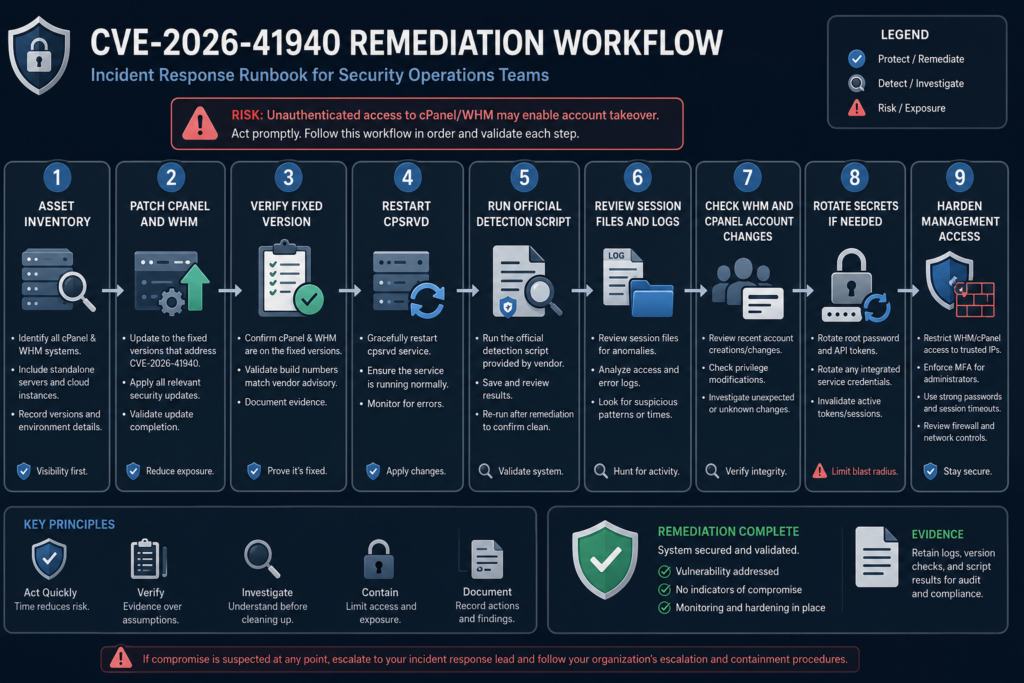
Patching closes the known vulnerability path, but it does not prove the server was never touched. CVE-2026-41940 requires post-patch hunting because public reporting indicates exploitation in the wild, and public exploit code was available shortly after disclosure. Rapid7 wrote that KnownHost stated the vulnerability was being exploited in the wild and that there was speculation of targeted zero-day exploitation as early as February 23, 2026. That early date should be treated carefully because it originates from incident reporting and public discussion rather than a full vendor-confirmed timeline, but it is serious enough to justify retrospective review.
cPanel published a detection script for session-file indicators and later updated it to address false positives. The cPanel response page says the script scans session files for indicators of compromise associated with the attack and notes that the script was refined on May 1 to remove an earlier false positive on session.lock files.
That false-positive note matters. During a high-pressure incident, teams often overreact to any odd-looking session artifact. cPanel’s script comments explain that the exploit vector is session file content, not the lock file, and that lock files may be left behind by normal SafeFile behavior after crashes or aborted writes. An unexpected lock file can be worth operator awareness, but it should not be treated by itself as confirmation of exploitation.
A practical detection model should separate signals into four tiers.
| Signal tier | Example evidence | المعنى | Response |
|---|---|---|---|
| Exposure | Affected version exposed on ports such as 2083 or 2087 | Server may have been reachable before patch | Patch, preserve logs, run detection |
| المحاولة | Failed exploit-like session patterns, unusual token-denied behavior, suspicious pre-auth session anomalies | Someone may have tried to exploit the service | Investigate source IPs, timing, frequency, and related logs |
| Possible session manipulation | Badpass-origin session with authentication markers that should not appear there | Higher concern for exploitation path | Preserve session files, access logs, and process timelines |
| Confirmed post-auth behavior | New admin actions, WHM API use, account changes, file writes, unknown tokens, suspicious cron jobs | Treat as compromise unless disproven | Incident response, credential rotation, malware/webshell hunt |
| Post-compromise activity | Webshells, ransomware artifacts, mass file modifications, malicious mail forwarding, suspicious DNS changes | Active compromise or persistence | Isolate, contain, restore from trusted backups, notify stakeholders |
cPanel’s detection script comments give useful examples of suspicious combinations. They discuss token_denied إلى جانب cp_security_token, badpass origins, authentication markers such as successful_*_auth_with_timestamp, hasroot=1و tfa_verified=1, and access-log hits on security tokens. The important detail is context: some fields are not suspicious alone, but become suspicious when they appear in a pre-authentication or badpass session where they should not legitimately exist.
Local detection commands for authorized administrators
The following commands are defensive examples for servers you administer. They are not remote scanners and should not be pointed at third-party infrastructure.
Check the installed version:
/usr/local/cpanel/cpanel -V
Record whether the main control-plane ports are listening locally:
ss -lntp | awk '$4 ~ /:(2082|2083|2086|2087|2095|2096)$/ {print}'
Preserve a timestamped copy of relevant logs before aggressive cleanup:
mkdir -p /root/cve-2026-41940-evidence
cp -a /usr/local/cpanel/logs/access_log /root/cve-2026-41940-evidence/access_log.$(date +%Y%m%d%H%M%S) 2>/dev/null || true
cp -a /usr/local/cpanel/logs/error_log /root/cve-2026-41940-evidence/error_log.$(date +%Y%m%d%H%M%S) 2>/dev/null || true
Create a restricted listing of recently modified session files for triage:
find /var/cpanel/sessions -type f -mtime -14 -printf '%TY-%Tm-%Td %TH:%TM:%TS %p\n' 2>/dev/null | sort
Look for high-level suspicious markers in session files without printing full secrets to the terminal:
grep -RIlE 'hasroot=1|tfa_verified=1|successful_.*_auth_with_timestamp|origin_as_string=.*badpass' /var/cpanel/sessions 2>/dev/null
Search access logs for unusual bursts against WHM or cPanel endpoints during the suspected window:
awk '{print $1, $4, $5, $6, $7, $9}' /usr/local/cpanel/logs/access_log 2>/dev/null \
  | grep -E ':(2083|2087)|/login|cpsess|whostmgr' \
  | tail -200
These commands are intentionally conservative. They help a defender build a timeline. They do not prove exploitation by themselves, and they should not replace cPanel’s official detection script or a full incident-response review.
Post-patch compromise review
After a control-plane authentication bypass, the question is not only “Are we now patched?” It is also “What could have changed while we were vulnerable?”
For cPanel and WHM environments, review at least these areas:
| Area | What to inspect | ما أهمية ذلك |
|---|---|---|
| WHM users and reseller accounts | New accounts, privilege changes, reseller changes | Attackers may create durable admin paths |
| cPanel accounts | New users, suspicious password resets, unknown contact emails | Hosted-account takeover may persist after patch |
| API tokens | Newly created or recently used tokens | Tokens may bypass interactive login monitoring |
| SSH keys | Added keys under root or hosting accounts | Common persistence path |
| Cron jobs | New commands under root and hosted users | Persistence and malware execution |
| Web roots | Recently modified PHP, JavaScript, .htaccess, unknown uploaders | Webshells and redirects |
| DNS zones | Changed A, CNAME, MX, TXT records | Domain hijack, mail interception, phishing |
| Email settings | Forwarders, filters, autoresponders, mailbox changes | Silent data theft and persistence |
| Databases | New users, changed grants, suspicious dumps | Data access may continue outside cPanel |
| Backups | Backup timestamps, integrity, offsite copies | Attackers may delete or poison recovery paths |
| System packages | New binaries, unknown services, modified startup units | Broader host compromise |
Credential rotation should be risk-based. If there is no evidence of exploitation and the system was patched quickly, a team may choose targeted rotation for high-value tokens and administrative credentials. If there are suspicious session artifacts, unknown WHM activity, or post-authentication changes, rotate aggressively: WHM root password, reseller passwords, cPanel account passwords, API tokens, SSH keys, database credentials, application secrets, and external integrations that may have been stored on the server.
Why public exploit code changes the response timeline
Rapid7 noted that watchTowr published technical analysis and proof-of-concept exploit material as of April 29, 2026. The CIS advisory also stated that watchTowr Labs published detailed technical analysis and proof-of-concept exploitation code against internet-exposed cPanel or WHM.
That does not mean every exposed server was successfully compromised. It does mean defenders should assume the time between disclosure and broad exploitation was short. For internet-facing control-plane vulnerabilities, public technical detail often compresses the attacker learning curve. Even unsophisticated operators can reuse public research, while more capable actors can adapt it into scanning, triage, and post-exploitation workflows.
The right response is not panic. It is sequencing:
- Patch or block exposure.
- Confirm the exact build.
- Restart affected services.
- Run official detection.
- Preserve logs.
- Hunt for post-authentication changes.
- Rotate credentials based on evidence.
- Harden management-plane exposure.
- Produce an evidence-backed remediation record.
Teams that skip steps 4 through 8 often end up with a dangerous half-remediation: the version is fixed, but the compromise window remains unexamined.
Real-world exploitation reports, how to read them carefully
Public reporting around CVE-2026-41940 includes several strong claims: active exploitation, possible zero-day use before public disclosure, public exploit availability, scanning activity, and ransomware-related follow-on activity. CIS Advisory 2026-042 states that threat actors were actively exploiting CVE-2026-41940, that it was added to CISA’s Known Exploited Vulnerabilities Catalog, and that exploitation escalated after disclosure. It also reports that the chain requires only a small number of HTTP requests and no valid credentials, after which WHM API access may provide root-level remote code execution through legitimate WHM-exposed features.
That last phrase is important. The CVE itself is best described as an authentication bypass. The path to “remote code execution” can come from what an authenticated WHM administrator is legitimately allowed to do after the bypass. That is different from a memory corruption bug where the exploit directly hijacks instruction flow. In practice, the outcome may still be severe, but the mechanics matter for detection and communication.
Security teams should avoid flattening every severe bug into “RCE” without explanation. For CVE-2026-41940, a precise description is stronger: unauthenticated remote attackers may bypass authentication into a hosting control panel; once in that privileged control plane, legitimate administrative features can enable destructive or code-execution outcomes depending on privileges and configuration.
That distinction helps executives understand why patching is urgent without misleading engineers about what to look for in logs.
What fixed code teaches security engineers
The most useful long-term lesson from CVE-2026-41940 is not specific to cPanel. It is about where security invariants live.
If the session writer is the place where authentication-relevant state becomes durable, the writer must enforce the session schema. It should not rely on each caller to remember which characters are dangerous. It should not accept unexpected authentication markers from pre-authentication contexts. It should not allow state transitions to be implied by raw key-value text when those transitions should require explicit authentication events.
A better design model looks like this:
untrusted request
    ↓
strict request parsing
    ↓
pre-auth state object with limited schema
    ↓
authentication decision
    ↓
explicit state transition
    ↓
authenticated session object with limited schema
    ↓
durable storage through one centralized writer
The dangerous model looks like this:
untrusted request
    ↓
several caller-specific paths
    ↓
some callers sanitize
    ↓
some callers forget
    ↓
shared session writer accepts raw fields
    ↓
later parser treats file content as trusted authentication state
That second model fails because the trust boundary is distributed. Distributed trust boundaries are hard to reason about, hard to test, and easy to break during maintenance.
Secure session systems should adopt several rules:
| Design rule | Reason |
|---|---|
| Use structured serialization with explicit schema validation | Line-oriented formats make injection mistakes easier |
| Reject unexpected keys in pre-authentication sessions | Pre-auth state should not carry privilege markers |
| Centralize output encoding and sanitization | Every caller should receive the same protection |
| Make authentication state transitions explicit | Privilege should not emerge from incidental fields |
| Separate pre-auth and post-auth session types | Type separation prevents accidental field promotion |
| Log state transitions, not only login failures | Authentication bypass often looks like “success” |
| Treat parser errors as security events | Malformed state near auth boundaries is rarely benign |
| Add regression tests for malicious control characters | Bugs return when tests only cover normal login |
These are mundane engineering controls. That is why they matter. Authentication bypass bugs often come from ordinary code paths that were reasonable when written and dangerous when combined.
Patch verification checklist
For each cPanel or WHM server, build a verification record. A version number alone is not enough.
| Verification step | Evidence to collect | Pass condition |
|---|---|---|
| Identify server | Hostname, IP, owner, role | Asset is in inventory |
| Confirm installed version | /usr/local/cpanel/cpanel -V output | Version is at or above fixed build |
| Confirm update path | /etc/cpupdate.conf, update tier, pinned settings | No pinned vulnerable branch remains |
| Restart affected service | restartsrv_cpsrvd --hard output | cpsrvd restarted after update |
| Confirm exposed ports | Local listener and firewall state | Exposure is expected and documented |
| Run official detection | cPanel detection script output | No unresolved critical findings |
| Review sessions | Recently modified session files and suspicious markers | No unexplained auth markers in pre-auth context |
| Review logs | cPanel access/error logs around exposure window | No unexplained successful admin activity |
| Review accounts | WHM, reseller, cPanel users, API tokens | No unauthorized changes |
| Review hosted content | Webshell, redirects, suspicious file modifications | No unauthorized persistence |
| Rotate secrets where needed | Passwords, tokens, keys, database credentials | Rotation complete based on risk |
| Document closure | Ticket, evidence, owner sign-off | Remediation is auditable |
A mature response produces evidence that another engineer can review later. That matters for customer communication, cyber insurance, compliance, and internal accountability.
Hardening after CVE-2026-41940
After emergency remediation, reduce the chance that the next control-plane bug becomes an incident.
Restrict management-plane access. If WHM does not need to be reachable from the entire internet, place it behind VPN, zero-trust access, source IP allowlists, or a provider-controlled management network. This does not eliminate the need to patch, but it reduces exposure to mass exploitation.
Keep MFA enabled. MFA may not stop a server-side session bypass, but it still protects normal credential theft, password reuse, phishing, and support-desk mistakes. Do not remove one control because it does not solve every class of bug.
Audit update policy. Servers with pinned branches, disabled updates, or legacy OS exceptions should be visible in a dashboard. The worst time to discover a pinned update tier is during a KEV vulnerability.
Separate tenants and secrets. Do not store long-lived production secrets where a control-panel compromise trivially exposes everything. Use least privilege for database accounts, rotate application credentials, and isolate backups.
Monitor administrative behavior. Many organizations monitor website traffic heavily but under-monitor WHM and hosting control-plane activity. Log admin actions, API token creation, reseller changes, DNS edits, file manager usage, cron modifications, and suspicious archive operations.
Protect backups from the control plane. If an attacker can compromise cPanel and then delete every local backup, recovery becomes much harder. Keep immutable or off-platform backups with tested restore procedures.
Add file integrity monitoring. Webshells and malicious redirects are common after web-hosting compromise. Track changes in web roots, .htaccess, PHP files, JavaScript, cron files, and startup scripts.
Practice customer notification. Hosting providers should prepare a technical notice that distinguishes exposure, attempted exploitation, confirmed compromise, remediation status, and customer-required actions. Vague “security update completed” emails are not enough when customers may need to rotate application secrets.
Automated validation without replacing judgment
For teams managing many internet-facing assets, CVE-2026-41940 is difficult because the work is repetitive and evidence-heavy. You need to identify exposed control panels, verify versions, confirm patch state, preserve logs, run detection, check for post-authentication changes, and retest after hardening. In that workflow, an authorized AI-assisted security testing platform such as بنليجنت can help organize attack-surface mapping, validation steps, evidence capture, and retesting into a repeatable process rather than a pile of one-off checks. The important boundary is authorization: automated testing should run only against assets the team owns or is explicitly permitted to test.
The same principle applies beyond cPanel. Authentication-bypass bugs often look different on the surface while sharing the same engineering failure: untrusted data crosses an identity boundary without the proof the system assumes exists. Penligent’s separate write-up on CVE-2026-29000 in pac4j-jwt is a useful example of that broader pattern, where successfully decrypted token content could be mistaken for authenticated identity under affected conditions. It is not the same vulnerability as CVE-2026-41940, but it is relevant because both show why authentication logic must fail closed and make trust transitions explicit.
Related CVEs that sharpen the lesson
CVE-2026-41940 belongs to a larger family of failures where identity, session state, or perimeter control logic breaks in ways that are more dangerous than ordinary application bugs.
| مكافحة التطرف العنيف | Product area | ما حدث | Why it is relevant |
|---|---|---|---|
| CVE-2026-41940 | cPanel & WHM, WP Squared | Session-management/login-flow authentication bypass | Shows how pre-auth session state can become privileged control-plane access |
| CVE-2026-29000 | pac4j-jwt | Encrypted JWT handling could allow forged authentication tokens under affected versions | Shows that parsing or decrypting data is not the same as authenticating it |
| CVE-2015-9235 | رمز jsonwebtoken | Weak validation of JWT algorithm type enabled verification bypass | Shows why authentication code must not trust attacker-controlled metadata |
| CVE-2026-50751 | Check Point Remote Access VPN and Mobile Access | Improper authentication in a deprecated IKEv1 VPN path could allow unauthenticated VPN session establishment | Shows how edge authentication bugs can become high-value initial access |
| CVE-2024-24919 | Check Point VPN and Mobile Access | Information disclosure in internet-connected gateways with relevant blades enabled | Shows the repeated targeting of remote-access and control-plane infrastructure |
NVD describes CVE-2026-29000 as an authentication bypass in pac4j-jwt versions prior to 4.5.9, 5.7.9, and 6.3.3, where attackers with the server’s RSA public key could create a JWE-wrapped PlainJWT with arbitrary claims and bypass signature verification. That bug is not about CRLF or session files. It is relevant because it reinforces the same rule: identity must be proven, not inferred from a successfully processed object.
CVE-2015-9235 in jsonwebtoken is older but still instructive. NVD describes a verification bypass in versions before 4.2.2 when a token expected to be signed with an asymmetric algorithm could instead be sent with a symmetric algorithm. The GitHub Advisory Database entry explains that the weakness resulted from weak validation of the JWT algorithm type when an attacker could specify the algorithm. The durable lesson is that authentication systems must not let attacker-controlled fields decide how trust is verified.
CVE-2026-50751 is relevant from an operational angle. NVD lists it in CISA’s Known Exploited Vulnerabilities Catalog as a Check Point Security Gateway improper authentication vulnerability, and Rapid7’s analysis of CVE-2026-50751 says it affected Remote Access VPN, Mobile Access, and Spark Firewall deployments configured to use deprecated IKEv1 under specific conditions. That is a different product and a different protocol, but the risk shape is similar: a remote authentication boundary on an edge or control-plane system fails.
CVE-2024-24919 is not an authentication bypass; it is an information disclosure issue in Check Point gateways with Remote Access VPN or Mobile Access enabled. It belongs in the comparison because it shows the same operational pressure: internet-facing administrative and remote-access infrastructure is a high-value target, and small exposure mistakes can become large incidents.
Common mistakes during CVE-2026-41940 response
The first mistake is treating cPanel auto-update as proof. Auto-update may be disabled, delayed, pinned, blocked by a legacy OS path, or failing silently. Always verify the installed build locally.
The second mistake is assuming the firewall solved everything. Blocking ports can be an emergency control, but if the server was exposed while vulnerable, you still need to hunt.
The third mistake is treating failed logins as the only signal. Authentication bypass often produces strange “successful” behavior, not only failed login events. Look for state transitions, admin actions, API calls, token creation, and post-login changes.
The fourth mistake is ignoring hosted accounts. If WHM was compromised, customer-level cPanel accounts may have been changed. Check user files, mail settings, DNS, databases, cron jobs, and application secrets.
The fifth mistake is over-reading noisy indicators. cPanel’s own detection script update around session.lock false positives is a reminder that not every odd file is exploitation. Use context and severity.
The sixth mistake is failing to rotate credentials after evidence of compromise. Patching stops the known path. It does not invalidate stolen tokens, added SSH keys, changed database users, or malicious mail forwarders.
The seventh mistake is writing a closure note before business owners understand residual risk. Hosting infrastructure touches customers. If there is confirmed compromise, communications need to be specific, timely, and technically accurate.
A practical incident workflow for hosting providers
Hosting providers and MSPs should not handle CVE-2026-41940 as isolated server maintenance. The response should look like an incident workflow.
Start with scope. Build a list of every cPanel, WHM, DNSOnly, and WP Squared instance. Include public IPs, private IPs, hostnames, OS versions, cPanel branches, update tiers, customer impact, and whether ports 2083, 2087, 2095, and 2096 were internet-exposed.
Then classify. Systems already patched before public exploit availability may be lower risk, but they still need evidence. Systems exposed and unpatched after public exploit release require deeper review. Systems with suspicious session files or unexplained admin actions should be treated as possible compromise.
Then contain. Patch supported systems immediately. For systems that cannot be patched, block exposed ports and disable services as cPanel recommends while working through the upgrade path. Document the customer impact of each control.
Then hunt. Run cPanel’s detection tooling, preserve logs, review session artifacts, inspect WHM activity, check account changes, and look for post-compromise persistence.
Then recover. Remove malicious artifacts, rotate credentials, rebuild severely compromised hosts from trusted images where necessary, restore from known-good backups, and validate customer sites.
Then harden. Restrict management-plane access, improve logging, remove legacy exceptions, monitor update failures, and practice tabletop scenarios for future control-plane CVEs.
Finally, communicate. Customers do not need exploit drama, but they do need clear statements: whether their environment was affected, whether exploitation was observed, what was fixed, what credentials should be rotated, and what monitoring remains in place.
الأسئلة الشائعة
What is CVE-2026-41940?
- CVE-2026-41940 is a critical authentication bypass affecting cPanel & WHM and WP Squared under vulnerable versions.
- NVD describes it as a login-flow authentication bypass allowing unauthenticated remote attackers to gain unauthorized access to the control panel.
- cPanel describes the root issue as a session-management vulnerability where one session-file write path lacked the input sanitization present in another path.
- The risk is high because the affected surface is a hosting control plane, not merely a normal website login page.
- CISA’s KEV listing means defenders should treat it as actively exploited and urgent.
Is CVE-2026-41940 remote code execution?
- The CVE is most precisely described as an authentication bypass.
- Successful exploitation can lead to access to privileged cPanel or WHM functionality.
- In WHM contexts, legitimate administrative features may enable command execution, file changes, account manipulation, or other high-impact actions after the bypass.
- Calling it “RCE” without explaining the control-plane step can mislead defenders about what to detect.
- A better incident description is: unauthenticated remote control-panel access with possible severe post-authentication impact.
Which cPanel and WHM versions are fixed?
- إن official cPanel advisory lists fixed cPanel & WHM builds including 11.86.0.41, 11.94.0.28, 11.102.0.39, 11.110.0.97, 11.118.0.63, 11.124.0.35, 11.126.0.54, 11.130.0.19, 11.132.0.29, 11.134.0.20, 11.136.0.5, and higher.
- WP Squared is listed as fixed in version 136.1.7 and higher.
- cPanel also documented a direct update path for some CentOS 6 or CloudLinux 6 servers using v110.0.50.
- The safest verification method is to run
/usr/local/cpanel/cpanel -Vlocally and compare with current vendor guidance. - Do not rely only on the major branch number. Patch-level matters.
Does MFA protect against CVE-2026-41940?
- MFA remains important for normal credential attacks.
- MFA should not be treated as a complete mitigation for this vulnerability.
- The issue is server-side session and authentication-state handling, not password guessing.
- If a vulnerable path can cause an unauthenticated session to be treated as authenticated, the normal MFA flow may not provide the expected protection.
- Patch and session-integrity validation are the primary controls.
How should I check whether a server was exploited?
- Update first if the server is still vulnerable, unless you need immediate forensic preservation before containment.
- Run cPanel’s official detection script and note that cPanel updated it to reduce false positives.
- Review session files for suspicious authentication markers in pre-authentication or badpass contexts.
- Check cPanel and WHM access logs for unusual successful administrative behavior, token use, and API activity.
- Inspect WHM users, reseller accounts, API tokens, SSH keys, cron jobs, web roots, DNS records, mail forwarding rules, and database users.
- Treat suspicious post-authentication changes as possible compromise even if version checks now pass.
What should hosting providers rotate after patching?
- Rotate WHM root credentials and reseller credentials if exploitation is suspected.
- Revoke and recreate suspicious or newly created API tokens.
- Review and rotate SSH keys for root and hosted users where risk warrants it.
- Rotate database credentials and application secrets if hosted account compromise is possible.
- Check customer mailboxes, forwarders, DNS records, and web files before declaring closure.
- Use evidence-based rotation if no compromise indicators exist, but rotate aggressively when control-plane activity is unexplained.
Should I block cPanel ports even after updating?
- Blocking or restricting management-plane ports is still good hardening after patching.
- Patching fixes the known vulnerability, but limiting exposure reduces risk from the next control-plane flaw.
- Public access to WHM should be restricted where business operations allow it.
- Use VPN, zero-trust access, source IP allowlists, or provider management networks for administrative access.
- If customer-facing cPanel or Webmail must remain public, strengthen monitoring and alerting around login flow, session anomalies, and administrative changes.
Closing judgment
CVE-2026-41940 is severe because it attacks the place where hosting infrastructure decides who is allowed to control it. The technical detail is not exotic: unsafe session-state handling, missing sanitization on one path, newline-sensitive storage, and authentication markers that can become trusted at the wrong moment. The operational consequence is much larger because the vulnerable component is a control panel for many assets.
The correct response is disciplined and evidence-driven: update to a fixed build, restart and verify services, apply temporary exposure controls only when patching cannot happen immediately, run official detection, hunt for post-authentication changes, rotate secrets where risk justifies it, and harden management-plane exposure before the next emergency. Version numbers close the known bug. Only verification and hunting close the incident.
 Arabic
  English
  German
  French
  Spanish
  Portuguese
  Japanese
  Korean
  Hindi
Hindi  Turkish
  Hebrew