
CVE-2026-43503 is a Linux kernel local privilege escalation issue in the skbuff networking path. Public research refers to the exploit variant as DirtyClone. The vulnerability sits in the same broader family as DirtyFrag and Fragnesia: page-cache-backed memory is accidentally treated as writable packet data after Linux networking code loses the marker that says a fragment is shared. JFrog Security Research reported the issue to Linux kernel maintainers on May 19, 2026, said the variants were patched and merged into mainline on May 21 in v7.1-rc5, and published a detailed DirtyClone analysis on June 25, 2026. (research.jfrog.com)
A CVE-2026-43503 PoC matters because it proves that the bug can become root under the right local conditions. It should not be treated as a safe production test. The practical defender question is not “can I run a public exploit and get root?” The better question is “can a low-privileged user or workload on this host reach the affected Linux networking and XFRM/IPsec paths, and is the running kernel fixed?” NVD describes the core bug as a failure to propagate SKBFL_SHARED_FRAG في skb_shinfo()->flags through frag-transfer helpers, specifically __pskb_copy_fclone() و skb_shift(), when fragments move from a source skb to a destination skb. (nvd.nist.gov)
A safe response starts with patch verification, exposure mapping, namespace and capability review, and evidence collection. Running an untrusted exploit on a production server can corrupt page-cache state, create misleading forensic evidence, crash workloads, or hand an attacker a root-level primitive during a test that was supposed to be diagnostic.
What matters first
| البند | Current practical meaning |
|---|---|
| مكافحة التطرف العنيف | CVE-2026-43503 |
| Common name | DirtyClone, used by JFrog for its exploit analysis of this DirtyFrag variant. (research.jfrog.com) |
| فئة الضعف | Linux kernel local privilege escalation through page-cache-backed memory corruption. |
| Affected area | Linux sk_buff fragment handling, including paths in net/core/gro.c, net/core/skbuff.cو net/ipv4/tcp_output.c listed in NVD’s kernel.org data. (nvd.nist.gov) |
| السبب الجذري | Shared-frag metadata can be lost when skb fragments are transferred, leaving the destination skb with externally owned or page-cache-backed pages while reporting skb_has_shared_frag() as false. (nvd.nist.gov) |
| Exploit condition | Local code execution plus access to the relevant network namespace, XFRM/IPsec, and packet-processing surface. JFrog notes that configuring the environment requires CAP_NET_ADMIN, which can be reachable inside user and network namespaces on some systems. (research.jfrog.com) |
| الخطورة | Ubuntu lists CVSS 3 score 8.8 High while assigning Ubuntu priority Medium. (Ubuntu) SUSE also lists CVSS v3.1 8.8 for CVE-2026-43503 in one of its kernel live patch advisories. (suse.com) |
| Fix | Install the vendor kernel update that includes the CVE-2026-43503 fix, then reboot or verify livepatch status. Debian lists fixed versions across several supported branches in its tracker. (security-tracker.debian.org) |
| Highest-priority systems | CI runners, shared Linux hosts, Kubernetes worker nodes, container platforms, sandbox services, developer jump boxes, and any host where untrusted or semi-trusted local code runs. |
| Unsafe shortcut | Running a public CVE-2026-43503 PoC on production as a “test.” |
| Safer verification | Check kernel package status, booted kernel version, vendor advisory state, namespace policy, relevant module exposure, and detection coverage without triggering the write primitive. |
Why a local kernel bug still deserves urgent attention
Many teams instinctively downgrade local privilege escalation because the attacker already needs a foothold. That habit is dangerous in modern infrastructure. Local code execution is not rare. It is the default operating model of CI runners, container workers, notebook services, plugin systems, build farms, browser sandboxes, AI agent runners, shared hosting, student lab machines, and developer workstations that execute third-party scripts.
CVE-2026-43503 is not a remote unauthenticated network bug by itself. It does not mean a random internet user can root every Linux server simply because the server is online. The risk begins after an attacker or untrusted workload can run code as a low-privileged user. At that point, a kernel local privilege escalation becomes the difference between contained compromise and host takeover.
DirtyClone is especially important because it sits near a recent cluster of Linux page-cache and shared-fragment issues. Wiz described Fragnesia, CVE-2026-46300, as a DirtyFrag-family Linux local privilege escalation in the XFRM ESP-in-TCP subsystem that lets unprivileged local attackers modify read-only file contents in the kernel page cache and achieve root. (ويز.io) Huntress explains the broader pattern across CopyFail, DirtyFrag, Fragnesia, and Dirty Pipe: optimized kernel paths place references to file-backed memory into packet or crypto processing paths, and in-place writes can corrupt page-cache content that later readers trust. (الصيادة)
The risk profile changes sharply based on environment. A single-user laptop that rarely executes untrusted code has a different exposure profile from a shared CI host running pull requests from forks. A Kubernetes node running only tightly restricted internal workloads has a different exposure profile from a multi-tenant cluster that allows privileged pods, relaxed seccomp profiles, or broad namespace creation. The same CVE number can carry different operational urgency depending on whether local execution is exceptional or routine.
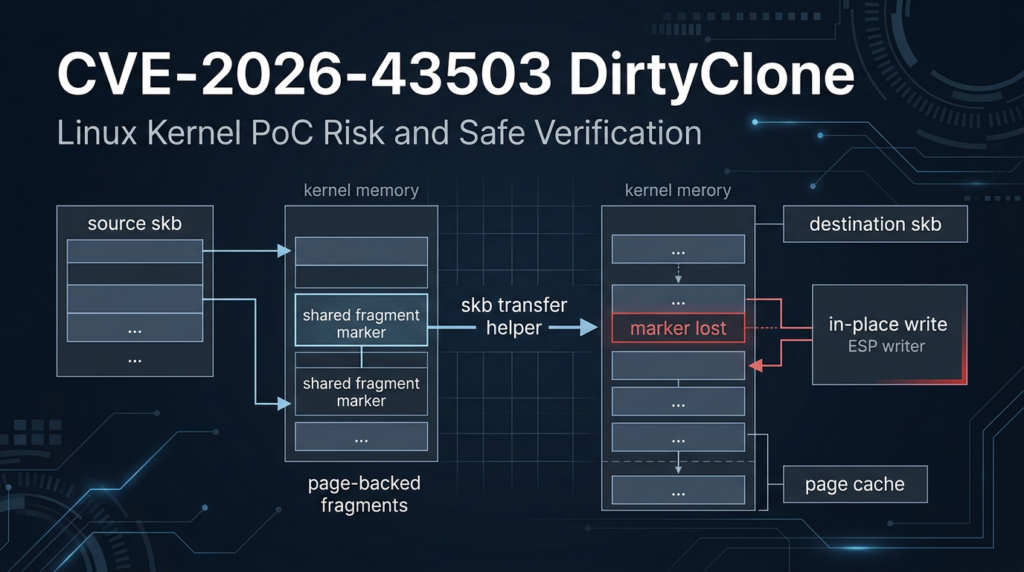
What actually breaks in the kernel
Linux networking uses sk_buff, commonly shortened to skb, to represent packets. Packet bytes do not always live in one flat buffer. For performance, Linux often stores packet data in paged fragments. Those fragments may point to memory that was not freshly allocated as ordinary writable packet memory. In the dangerous case, a fragment can refer to externally owned or page-cache-backed memory.
The kernel tracks that risk with metadata. SKBFL_SHARED_FRAG tells later code that the skb contains shared fragments. If a later subsystem wants to write into packet data, that subsystem needs to know whether the data is safely writable or whether it must first detour through copy-on-write handling.
CVE-2026-43503 is a metadata propagation failure. NVD’s kernel.org record says __pskb_copy_fclone() و skb_shift() fail to propagate the SKBFL_SHARED_FRAG bit when moving fragments from one skb to another. The destination skb can keep a reference to externally owned or page-cache-backed pages while reporting that skb_has_shared_frag() is false. (nvd.nist.gov)
That is a small bookkeeping error with a large security effect. Later in-place writers rely on skb_has_shared_frag() to decide whether they can safely write over skb data. NVD’s change record specifically points to ESP input in esp4.c و esp6.c as one such writer, and notes that an nft dup to <local> rule or another nf_dup_ipv4() أو xt_TEE caller can land a copied skb in ESP input after the marker has been stripped. (nvd.nist.gov)
The bug is not best understood as a normal buffer overflow. The kernel has a reference to memory. The reference is valid. The packet path is real. The failure is that the destination skb no longer carries the correct memory provenance. The kernel later writes into memory because it believes the fragment is ordinary writable packet data. In reality, that fragment may still point into page-cache-backed memory associated with a root-owned read-only file.
DirtyClone in one packet-flow model
A defender-friendly model of DirtyClone looks like this:
| المرحلة | What happens | ما أهمية ذلك |
|---|---|---|
| File-backed memory enters a zero-copy or fragment path | A page associated with a file can become referenced by packet-related data structures. | The memory still has file-backed meaning even though it is being processed through networking code. |
| skb fragment metadata should mark the fragment as shared | SKBFL_SHARED_FRAG should preserve the warning that the fragment is not ordinary private packet memory. | Later writers need this marker to decide whether to copy first. |
| Fragment transfer moves descriptors to another skb | Helpers such as __pskb_copy_fclone() أو skb_shift() move fragment descriptors. | Moving descriptors without moving the safety marker breaks the ownership model. |
| Destination skb loses the shared-frag marker | The destination skb still references externally owned or page-cache-backed memory but reports no shared fragment. | Later code sees a false sense of safety. |
| ESP or another in-place writer operates on the skb | The writer consults skb_has_shared_frag() and may skip copy-on-write handling. | Packet processing can become a write into page-cache-backed data. |
| Runtime state changes without a normal disk write | A read-only file can appear modified in memory while the on-disk file remains unchanged. | Disk-only file integrity monitoring can miss the meaningful impact. |
The exploit value comes from turning this confusion into a controlled write. JFrog’s public analysis says the DirtyClone variant demonstrates a broader exploitation pattern across multiple skb processing paths, rather than a one-off bug in a single path. (research.jfrog.com) That is why defenders should think in terms of page-cache corruption and shared-frag invariants, not only one PoC implementation.
Why the page cache makes this class uncomfortable
The Linux page cache is normally a performance feature. If a process reads or executes a file, Linux may keep those file pages in memory so future reads are fast. That cached copy should reflect the file’s legitimate content. If a file is read-only for a low-privileged user, that user should not be able to change the cached page that other processes later read.
Page-cache corruption breaks that assumption. The attacker does not write the file through the filesystem API. The attacker uses a kernel path that accidentally treats a file-backed page as mutable processing memory. The file on disk may remain unchanged. The cached page in memory may be different. Any later process reading or executing that file can consume the corrupted bytes.
That is why this bug class is so hard to reason about with ordinary integrity checks. A package manager may report that /usr/bin/su or another binary still matches the vendor package. A disk hash may remain clean. A file monitor may not record a normal write. Yet the memory page used by execution may have been modified. Wiz’s Fragnesia write-up makes the same point for that related vulnerability: the modification exists only in page cache memory and does not alter the on-disk binary. (ويز.io)
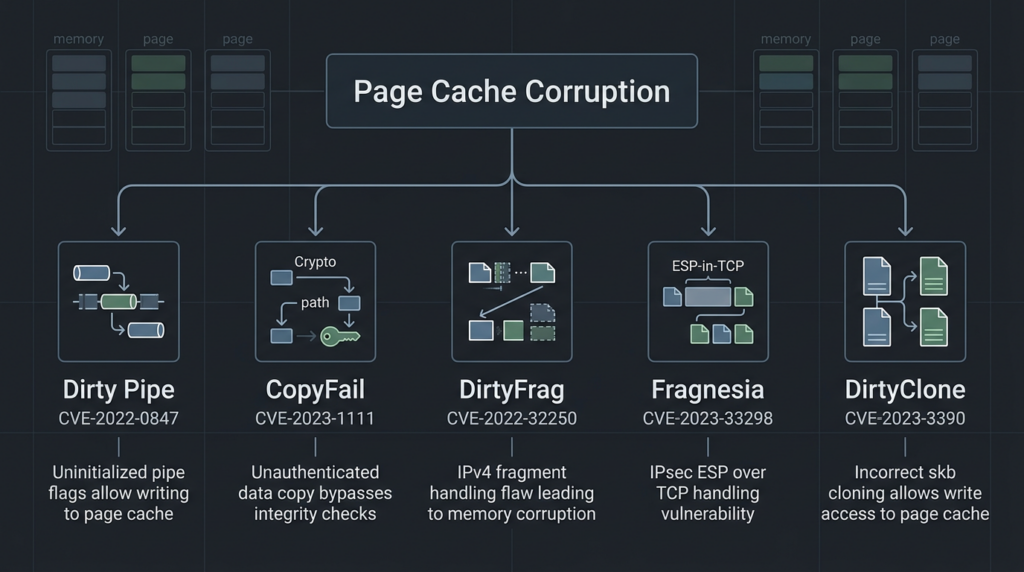
Dirty Pipe, CVE-2022-0847, made this style of risk widely understood. CopyFail and DirtyFrag moved the concern into other Linux subsystems. Fragnesia pushed it through XFRM ESP-in-TCP. CVE-2026-43503 DirtyClone extends the lesson again: optimized packet processing paths must preserve memory provenance exactly, because a missing marker can turn a performance path into a privilege boundary failure.
DirtyClone, DirtyFrag, Fragnesia and Dirty Pipe
| Issue | مكافحة التطرف العنيف | Surface | Shared lesson |
|---|---|---|---|
| الأنابيب القذرة | CVE-2022-0847 | Pipe buffer and page-cache behavior | Kernel bookkeeping mistakes can let unprivileged users alter file-backed cached pages. |
| CopyFail | CVE-2026-31431 | Linux crypto and splice-related paths | A small page-cache write primitive can become host compromise when aimed at trusted files. |
| DirtyFrag | CVE-2026-43284 and related entries | XFRM ESP and RxRPC-related surfaces | Zero-copy packet paths can carry page-cache-backed fragments into in-place crypto processing. |
| Fragnesia | CVE-2026-46300 | XFRM ESP-in-TCP | Wiz describes it as improper handling of shared page fragments during skb coalescing, causing page-cache corruption through AES-GCM processing. (ويز.io) |
| DirtyClone | CVE-2026-43503 | skb frag-transfer helpers, packet duplication, ESP input | NVD describes loss of SKBFL_SHARED_FRAG through __pskb_copy_fclone() و skb_shift(), allowing page-cache-backed fragments to be misclassified as safe for in-place processing. (nvd.nist.gov) |
The common weakness is not one specific Linux feature. It is the combination of zero-copy performance, shared memory references, and later in-place writers. Zero-copy systems are efficient because they avoid copying bytes. That also means they move references. Once a reference crosses subsystems, every subsystem must know whether the referenced memory is private, shared, file-backed, externally owned, or safe to modify. CVE-2026-43503 is what happens when that knowledge is lost.
CVE-2026-43503 PoC is not a production validation method
A PoC is useful evidence. It is not a safe operations procedure. Public CVE-2026-43503 PoC material is tied to local privilege escalation. Its purpose is to prove impact. Running it on a production kernel can cause the same class of state change defenders are trying to prevent.
A safe validation process should avoid all of the following on production systems:
| Unsafe action | Why it is unsafe |
|---|---|
| Running a public DirtyClone exploit to “see if root happens” | It can intentionally trigger page-cache corruption and root-level side effects. |
Testing against /usr/bin/su, /etc/passwd, or other sensitive files | These are high-impact runtime targets; corrupting their cached pages can change authentication or execution behavior. |
| Assuming a failed exploit means the host is safe | Defense-in-depth controls may block one PoC path while the kernel remains vulnerable. Red Hat’s Fragnesia testing showed that a vulnerable kernel can still resist a specific exploit chain when SELinux blocks UID mapping needed for namespace-root privileges. (redhat.com) |
| Trusting only disk hashes after a suspected attempt | Page-cache corruption may not change on-disk bytes. |
| Treating containers as patched because the image was rebuilt | Containers share the host kernel; image updates do not fix the node kernel. |
The right output of a CVE-2026-43503 validation is not a root shell. It is a defensible answer to three questions: whether the running kernel is fixed, whether untrusted local code can reach the relevant attack surface, and whether telemetry exists for exploit-like behavior.
A safe verification workflow
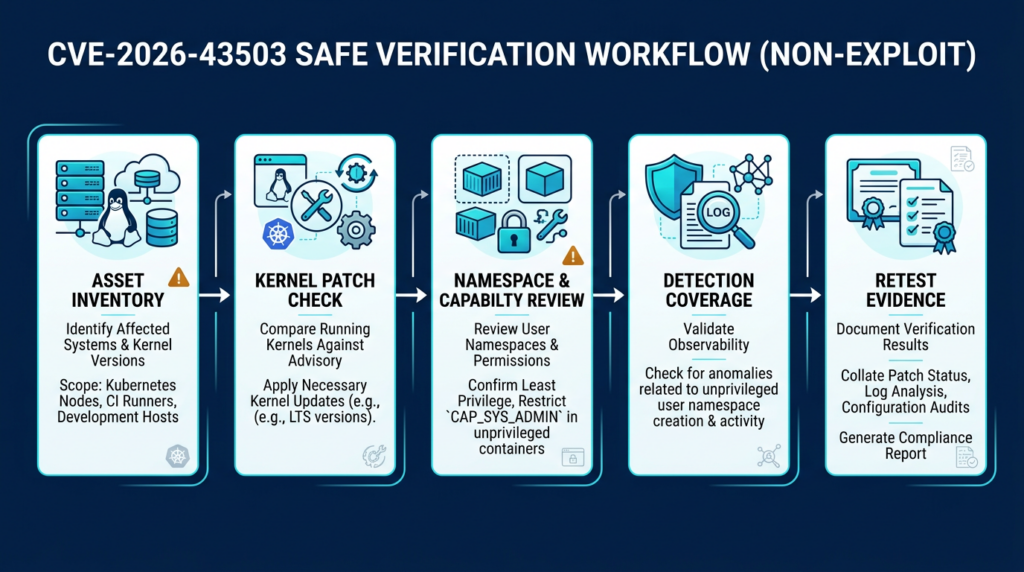
The following workflow gives defenders evidence without triggering the vulnerability.
| الخطوة | الهدف | الأدلة |
|---|---|---|
| Identify Linux hosts | Find servers, CI runners, Kubernetes nodes, sandboxes, jump boxes, and developer systems. | Host inventory with OS, kernel, and role. |
| Check the running kernel | Confirm the kernel that is actually booted. | Uname -r, boot time, livepatch status. |
| Check vendor package status | Match installed kernel packages against vendor fixed versions or errata. | Package manager output and advisory reference. |
| Review local-code exposure | Decide whether low-privileged users or workloads can run code. | CI policy, shell access list, Kubernetes workload model. |
| Review namespace and capability exposure | Check user namespaces, network namespaces, privileged containers, and CAP_NET_ADMIN. | sysctl output, container security context, pod specs. |
| Review affected feature reachability | Look for ESP, XFRM, RxRPC, packet duplication, and related module exposure. | module status, kernel config, ip xfrm output. |
| Add detection | Monitor namespace creation, XFRM manipulation, module loading, and suspicious privilege transitions. | auditd rules, EDR/SIEM detections, test events. |
| Retest after remediation | Prove the host is running the fixed kernel and exposure was reduced. | Before-and-after evidence bundle. |
Start with read-only inventory:
#!/usr/bin/env bash
set -euo pipefail

echo "== Host identity =="
hostnamectl 2>/dev/null || true
echo

echo "== Running kernel =="
uname -a
echo

echo "== OS release =="
cat /etc/os-release 2>/dev/null || true
echo

echo "== Boot time =="
who -b 2>/dev/null || uptime -s 2>/dev/null || true
echo

echo "== Debian or Ubuntu kernel packages =="
if command -v dpkg >/dev/null 2>&1; then
  dpkg -l 'linux-image*' 2>/dev/null | awk '/^ii/ {print $2, $3}' || true
  apt-cache policy linux-image-generic 2>/dev/null || true
fi
echo

echo "== RPM kernel packages =="
if command -v rpm >/dev/null 2>&1; then
  rpm -qa | grep -E '^kernel|^kernel-core' | sort || true
  rpm -q --changelog kernel-core 2>/dev/null \
    | grep -Ei 'CVE-2026-43503|SKBFL_SHARED_FRAG|skbuff|shared-frag|dirty.frag' \
    | head -40 || true
fi
echo

echo "== Relevant modules currently loaded =="
for mod in esp4 esp6 rxrpc; do
  if lsmod 2>/dev/null | awk '{print $1}' | grep -qx "$mod"; then
    echo "$mod loaded"
  else
    echo "$mod not loaded"
  fi
done
echo

echo "== Namespace-related sysctls =="
sysctl kernel.unprivileged_userns_clone 2>/dev/null || true
sysctl user.max_user_namespaces 2>/dev/null || true
sysctl kernel.apparmor_restrict_unprivileged_userns 2>/dev/null || true
echo

echo "== XFRM state and policy, read-only =="
if command -v ip >/dev/null 2>&1; then
  ip xfrm state 2>/dev/null || true
  ip xfrm policy 2>/dev/null || true
fi
This script does not prove exploitability. It is not supposed to. It gives the security team enough context to compare the host against vendor advisories and platform policy. The most common mistake is to treat Uname -r as the only source of truth. Enterprise distributions frequently backport security fixes without changing the apparent upstream kernel version in a simple way. A system can also have a fixed kernel package installed but still be running the old vulnerable kernel because it has not rebooted.
For Debian and Ubuntu, use package state plus advisory state. Ubuntu’s CVE page lists publication on May 23, 2026, last update on June 25, 2026, Ubuntu priority Medium, and CVSS 3 score 8.8 High. Its description matches the kernel.org explanation of the lost shared-frag marker in __pskb_copy_fclone() و skb_shift(). (Ubuntu) Debian’s tracker describes the same frag-transfer bug and includes the important detail that the mismatch can let an unprivileged user write into the page cache of a root-owned read-only file through ESP input after packet duplication. (security-tracker.debian.org)
Useful Debian and Ubuntu checks:
uname -r

dpkg -l 'linux-image*' | awk '/^ii/ {print $2, $3}'

apt list --installed 2>/dev/null \
  | grep -E '^linux-image|^linux-generic|^linux-headers' || true

grep -R "CVE-2026-43503" /usr/share/doc/linux-image-*/changelog* 2>/dev/null || true
For SUSE systems, SUSE’s live patch advisory SUSE-SU-2026:2494-1 lists CVE-2026-43503 as “final dirty.frag related fixes” and gives CVSS v3.1 8.8 for the issue. (suse.com) That kind of vendor wording is important because it shows the fix may arrive as part of a larger kernel update, not as a package named after the CVE.
For RPM-based systems:
uname -r

rpm -qa | grep -E '^kernel|^kernel-core' | sort

rpm -q --changelog kernel-core 2>/dev/null \
  | grep -Ei 'CVE-2026-43503|SKBFL_SHARED_FRAG|skbuff|shared-frag|dirty.frag' \
  | head -40 || true

rpm -q --changelog kernel 2>/dev/null \
  | grep -Ei 'CVE-2026-43503|SKBFL_SHARED_FRAG|skbuff|shared-frag|dirty.frag' \
  | head -40 || true
For Kubernetes, check the node kernel, not only workload images:
kubectl get nodes -o wide

kubectl get nodes -o jsonpath='{range .items[*]}{.metadata.name}{"\t"}{.status.nodeInfo.kernelVersion}{"\t"}{.status.nodeInfo.osImage}{"\n"}{end}'
This output still needs vendor interpretation. It tells you which nodes need review. It does not prove fixed status by itself.
User namespaces and CAP_NET_ADMIN are central to exposure
DirtyClone is local, but local does not mean simple. The exploitability question often turns on namespace and capability policy. JFrog notes that DirtyClone exploitation requires CAP_NET_ADMIN to configure the necessary network and IPsec environment, and that unprivileged user namespaces can let an attacker obtain that capability inside a new namespace on some systems. (research.jfrog.com)
That does not mean user namespaces should always be disabled everywhere. They are used by browsers, rootless containers, sandboxing tools, and developer workflows. The right question is whether the host runs untrusted code and whether those users or workloads can create namespaces and gain enough network administration capability to reach the vulnerable kernel path.
A read-only exposure review can begin here:
echo "== User namespace policy =="
sysctl kernel.unprivileged_userns_clone 2>/dev/null || true
sysctl user.max_user_namespaces 2>/dev/null || true
sysctl kernel.apparmor_restrict_unprivileged_userns 2>/dev/null || true

echo "== Process namespace clues =="
lsns -t user,net 2>/dev/null | head -50 || true

echo "== Docker security options =="
docker info 2>/dev/null | grep -Ei 'rootless|userns|security options' -A8 || true

echo "== Podman rootless and security context =="
podman info 2>/dev/null | grep -Ei 'rootless|security|namespace' -A8 || true
For Kubernetes, privileged workloads and added NET_ADMIN are high-value review targets:
echo "== Privileged pods =="
kubectl get pods -A -o json 2>/dev/null \
  | jq -r '
    .items[]
    | select(any(.spec.containers[]?; .securityContext.privileged == true))
    | [.metadata.namespace, .metadata.name] | @tsv
  '

echo "== Pods with NET_ADMIN =="
kubectl get pods -A -o json 2>/dev/null \
  | jq -r '
    .items[]
    | select(any(.spec.containers[]?; any(.securityContext.capabilities.add[]?; . == "NET_ADMIN")))
    | [.metadata.namespace, .metadata.name] | @tsv
  '
Red Hat’s Fragnesia testing is a useful warning against simplistic exploitability claims. In one OpenShift scenario, the kernel remained vulnerable, but SELinux blocked writes to /proc/self/uid_map, preventing successful UID mapping, namespace-root privileges, XFRM/ESP access, and page-cache corruption. (redhat.com) That does not make the kernel safe. It means layered controls can break a specific exploit chain even when the underlying bug exists.
For CVE-2026-43503, that distinction matters. A failed public PoC may mean the host is patched. It may also mean AppArmor, SELinux, seccomp, container policy, namespace restrictions, missing modules, or runtime configuration blocked one path. Security teams should record both findings separately: kernel fixed status and exploit path reachability.
Module and feature exposure
JFrog recommends patching first and lists temporary workarounds such as disabling unprivileged user namespaces and blacklisting esp4, esp6و rxrpc when immediate patching is not possible. (research.jfrog.com) Wiz gave similar temporary recommendations for the related Fragnesia and DirtyFrag class, including disabling vulnerable modules when they are not required and restricting unprivileged user namespaces where feasible. (ويز.io)
A temporary mitigation can be useful, but it has operational tradeoffs. esp4 و esp6 are used for IPsec ESP processing. Disabling them can break IPsec tunnels, VPN infrastructure, host-to-host encryption, or network security products. rxrpc is less common in typical web workloads, but it may matter for AFS-related environments. A module blacklist also does not help if the functionality is built directly into the kernel rather than loadable as a module.
Check current module state:
lsmod | grep -E '^(esp4|esp6|rxrpc)\b' || true

modinfo esp4 2>/dev/null | head -20 || true
modinfo esp6 2>/dev/null | head -20 || true
modinfo rxrpc 2>/dev/null | head -20 || true
Check whether IPsec state is present:
ip xfrm state 2>/dev/null || true
ip xfrm policy 2>/dev/null || true
Check nftables and iptables rule surfaces that could indicate packet duplication behavior:
nft list ruleset 2>/dev/null | grep -Ei 'dup|tee|xfrm|esp' -C2 || true

iptables-save 2>/dev/null | grep -Ei 'TEE|mangle|xfrm|esp' -C2 || true
These commands are not exploit steps. They help defenders understand whether the host is using related networking features and whether unusual packet duplication or XFRM configuration exists. In incident response, the same commands can provide context for suspicious activity.
Patch prioritization by environment
CVE-2026-43503 should not be prioritized only by CVSS. Use CVSS as a severity signal, then layer in local-code exposure and host value.
| البيئة | الأولوية | Reason |
|---|---|---|
| Shared CI runners that execute untrusted pull requests | الحرجة | Local code execution is normal, and host compromise can expose source code, signing keys, package tokens, and cloud credentials. |
| Kubernetes worker nodes with privileged pods or broad namespace access | الحرجة | A pod compromise can become a host kernel attack path if controls allow the needed capability chain. |
| Multi-tenant shell servers | الحرجة | Many users already have local execution on the same kernel. |
| Sandbox and notebook platforms | الحرجة | The business model often depends on executing user-provided code safely. |
| Developer workstations running third-party build scripts | عالية | Local code execution through dependencies, package scripts, and test harnesses is common. |
| Single-user servers with strict access and no untrusted workloads | Medium to High | Patch promptly, but emergency sequencing may depend on service exposure and access model. |
| Systems with IPsec or XFRM heavily used | عالية | Temporary module blacklisting may be disruptive, making patch scheduling more urgent. |
| Appliances or OT-style Linux systems with limited reboot windows | Context-dependent | Vendor patch availability, livepatch support, and compensating controls matter. |
The highest-risk environments are the places where “local only” is not a meaningful comfort. A build server running untrusted code is already past the first prerequisite. A malicious package post-install script, compromised test dependency, or attacker-controlled CI job can provide the local execution step. A kernel local privilege escalation then becomes a path to secrets and lateral movement.
Detection strategy
Detection should focus on behavior clusters rather than one file name, one GitHub repository, or one command string. A CVE-2026-43503 PoC can be renamed, recompiled, split into stages, or adapted from the public implementation. The better signals are namespace creation, unusual network namespace administration, XFRM manipulation, module loading, packet duplication rules, and suspicious privilege transitions after those events.
| الإشارة | ما أهمية ذلك | Possible telemetry |
|---|---|---|
unshare, clone, clone3أو setns from unusual users | Exploit paths may create user and network namespaces. | auditd, EDR process events, shell history, container runtime events. |
| XFRM state or policy changes by unexpected processes | DirtyClone reaches IPsec-related processing. | ip xfrm execution, netlink telemetry where available, process lineage. |
Loading esp4, esp6أو rxrpc unexpectedly | Related bug classes use ESP or RxRPC-related kernel paths. | kernel logs, auditd module syscalls, EDR module telemetry. |
| nftables or iptables packet duplication rules | NVD describes paths involving nft dup to <local>, nf_dup_ipv4()و xt_TEE callers. (nvd.nist.gov) | nftables ruleset snapshots, iptables-save, configuration management drift. |
| Execution of setuid binaries after namespace setup | Many LPE chains trigger a privileged binary after staging runtime corruption. | process lineage, audit logs, EDR detections. |
| Low-privileged process becomes root unexpectedly | End-state signal of successful local privilege escalation. | session logs, auditd, EDR identity transition events. |
Example auditd rules for generic namespace and module activity:
# Namespace creation and joining
auditctl -a always,exit -F arch=b64 -S unshare,setns,clone,clone3 -k namespace_activity
auditctl -a always,exit -F arch=b32 -S unshare,setns,clone -k namespace_activity

# Kernel module operations
auditctl -a always,exit -F arch=b64 -S init_module,finit_module,delete_module -k kernel_module_activity
auditctl -a always,exit -F arch=b32 -S init_module,delete_module -k kernel_module_activity

# Common network configuration tools
auditctl -w /usr/sbin/ip -p x -k ip_tool_execution
auditctl -w /usr/sbin/iptables -p x -k netfilter_tool_execution
auditctl -w /usr/sbin/nft -p x -k nft_tool_execution
Query recent activity:
ausearch -k namespace_activity -ts recent
ausearch -k kernel_module_activity -ts recent
ausearch -k ip_tool_execution -ts recent
ausearch -k netfilter_tool_execution -ts recent
ausearch -k nft_tool_execution -ts recent
Kernel and systemd log review:
journalctl -k --since "24 hours ago" \
  | grep -Ei 'esp4|esp6|rxrpc|xfrm|skbuff|skb|netfilter|nft|audit' || true

journalctl --since "24 hours ago" \
  | grep -Ei 'unshare|clone3|setns|ip xfrm|iptables|nft|CAP_NET_ADMIN' || true
These rules can be noisy on container-heavy systems. Tune them by host role. CI workers, Kubernetes nodes, and sandbox hosts will naturally create namespaces more often than traditional servers. The goal is not to alert every time a namespace appears. The goal is to detect unusual combinations: untrusted job context, namespace creation, XFRM manipulation, module loading, packet duplication, and then privileged execution.
Why file integrity monitoring can miss the impact
File integrity monitoring is still valuable, but it is not enough for this vulnerability class. Page-cache corruption can change what the kernel serves from memory without a conventional write to the file on disk. Huntress describes this broader page-cache issue across CopyFail, DirtyFrag, Fragnesia, and Dirty Pipe: the file read from disk can remain unchanged while the in-memory copy is corrupted and later reads see the modified copy. (الصيادة)
After suspected exploitation, defenders should avoid overconfidence from clean package verification alone. A cleaner response is:
- Preserve volatile evidence where feasible.
- Record process lineage, namespace events, loaded modules, XFRM state, and suspicious privilege transitions.
- Patch or isolate the host.
- Reboot into a fixed kernel or verify livepatch coverage.
- Rotate secrets that could have been exposed after root compromise.
- Rebuild high-risk hosts when the integrity of runtime state cannot be trusted.
Dropping caches may clear runtime page-cache corruption, but it does not undo what a root-level attacker may have already done. Rebooting into a patched kernel is a remediation step, not a complete incident closure by itself.
Mitigation plan
The durable mitigation is a fixed kernel. JFrog states that the variants were patched and merged into mainline on May 21, 2026. (research.jfrog.com) Distribution users should rely on their vendor’s security packages rather than compiling random patches into production kernels unless they already operate a mature custom kernel process.
A practical mitigation plan:
| المرحلة | الإجراء | الملاحظات |
|---|---|---|
| Immediate triage | Identify hosts where untrusted local code runs. | CI, Kubernetes, sandboxes, shared shell, developer build hosts first. |
| Vendor status | Check Ubuntu, Debian, SUSE, Red Hat, cloud image, or appliance vendor status. | NVD is useful, but vendor backports decide real package state. |
| Patch | Install fixed kernel packages or livepatch where supported. | Keep package and advisory evidence. |
| Activate | Reboot, drain Kubernetes nodes, or verify livepatch is active. | A fixed package is not enough if the old kernel is still running. |
| Reduce reachability | Restrict user namespaces and CAP_NET_ADMIN where compatible. | Test application impact before broad changes. |
| Disable unused modules | Denylist esp4, esp6و rxrpc only if the host does not need them. | Do not break IPsec-dependent systems blindly. |
| Detect | Add behavioral monitoring around namespaces, modules, XFRM, and privilege transitions. | Tune per role to avoid alert fatigue. |
| Review secrets | Treat suspected successful exploitation as root compromise. | Rotate credentials and rebuild where necessary. |
Temporary module denylisting may look like this on systems where ESP and RxRPC are not required:
sudo sh -c "cat > /etc/modprobe.d/dirtyclone-hardening.conf <<'EOF'
install esp4 /bin/false
install esp6 /bin/false
install rxrpc /bin/false
EOF"

sudo rmmod esp4 esp6 rxrpc 2>/dev/null || true
Do not apply that blindly. If the host terminates or depends on IPsec, disabling ESP modules can cause outages. If the module is built into the kernel, the denylist may not have the intended effect. Treat this as a temporary exposure reduction, not a substitute for patching.
User namespace restriction is also workload-sensitive:
# Example only. Test workload impact before deployment.
sudo sysctl -w kernel.unprivileged_userns_clone=0

# Persist only after compatibility testing.
echo 'kernel.unprivileged_userns_clone=0' | sudo tee /etc/sysctl.d/99-restrict-userns.conf
Some distributions do not use the same sysctl, and some workloads require unprivileged user namespaces. A safer enterprise approach may be role-based: restrict them on server classes that do not need them, use AppArmor or SELinux confinement where available, and isolate workloads that require rootless containers or sandbox behavior.
Kubernetes and container response
For Kubernetes, the host kernel is the asset. Patching the base image of a container does not fix CVE-2026-43503 on the node. The worker node kernel must be updated, rebooted, livepatched, or replaced.
Node response should include:
kubectl get nodes -o wide

kubectl get nodes -o jsonpath='{range .items[*]}{.metadata.name}{"\t"}{.status.nodeInfo.kernelVersion}{"\t"}{.status.nodeInfo.osImage}{"\n"}{end}'
Review risky workload permissions:
echo "== Privileged pods =="
kubectl get pods -A -o json \
  | jq -r '
    .items[]
    | select(any(.spec.containers[]?; .securityContext.privileged == true))
    | [.metadata.namespace, .metadata.name] | @tsv
  '

echo "== Pods adding NET_ADMIN =="
kubectl get pods -A -o json \
  | jq -r '
    .items[]
    | select(any(.spec.containers[]?; any(.securityContext.capabilities.add[]?; . == "NET_ADMIN")))
    | [.metadata.namespace, .metadata.name] | @tsv
  '

echo "== Host namespace sharing =="
kubectl get pods -A -o json \
  | jq -r '
    .items[]
    | select(.spec.hostNetwork == true or .spec.hostPID == true or .spec.hostIPC == true)
    | [.metadata.namespace, .metadata.name, (.spec.hostNetwork|tostring), (.spec.hostPID|tostring), (.spec.hostIPC|tostring)] | @tsv
  '
A strong Kubernetes response is not just “patch nodes.” It should include node pool segregation. Untrusted CI jobs, build workers, browser automation, student workloads, and AI agent execution should not share kernels with high-value internal services. Short-lived nodes also reduce dwell time. If a runner pool executes untrusted code, rebuilding nodes after patching may be more reliable than trying to prove no exploit attempt ever touched runtime state.
CI runner response
CI systems are one of the highest-priority environments for CVE-2026-43503 because local code execution is the product feature. Build scripts run. Test commands run. Package manager lifecycle hooks run. Pull requests from forks may run in constrained modes, but the kernel still sees code execution on a host.
A CI response should include:
| التحكم | ما أهمية ذلك |
|---|---|
| Patch runner host kernels quickly | The runner host is the privilege boundary, not the job container alone. |
| Use ephemeral runners for untrusted jobs | Destroying the host after a job reduces persistence and cross-job exposure. |
| Avoid mixing trusted and untrusted jobs on the same runner pool | A local kernel exploit on one job can expose secrets from another. |
Minimize CAP_NET_ADMIN and privileged Docker | These settings can increase reachability of kernel networking attack surfaces. |
| Disable unnecessary user namespaces on runner classes that do not need them | Reduces one path to namespace-scoped capabilities. |
| Separate signing and deployment jobs | A successful LPE on a test runner should not immediately expose signing keys. |
| Monitor namespace and XFRM behavior | Normal builds rarely need to manipulate IPsec state. |
The most dangerous CI pattern is a long-lived shared runner that executes untrusted code and stores sensitive credentials. CVE-2026-43503 should push teams to re-check that model even after patching.
Incident response when exploitation is suspected
Treat suspected successful exploitation as host compromise. The write primitive targets kernel-managed runtime state, but successful LPE can lead to ordinary attacker actions afterward: credential theft, backdoors, kernel module loading, tampering, lateral movement, and cloud token abuse.
A practical response sequence:
- Isolate the host from the network where operationally possible.
- Preserve volatile evidence before rebooting if incident response requirements allow.
- Collect process trees, login sessions, namespace events, loaded modules, XFRM state, netfilter rules, and recent command execution.
- Capture relevant CI job metadata, container metadata, or user session context.
- Rotate secrets that the host could access.
- Patch and reboot into a fixed kernel or rebuild from a trusted image.
- Revalidate kernel state and namespace policy.
- Review whether detection should have caught the behavior earlier.
Useful collection commands:
date -Is
uname -a
uptime
who
last -a | head -50

ps auxwwf
lsmod
ip xfrm state 2>/dev/null || true
ip xfrm policy 2>/dev/null || true
nft list ruleset 2>/dev/null || true
iptables-save 2>/dev/null || true

lsns
journalctl -k --since "48 hours ago" > kernel-48h.log
journalctl --since "48 hours ago" > system-48h.log
Do not assume a reboot alone solves the incident. A reboot may remove page-cache corruption, but it also destroys volatile evidence. If the attacker gained root before the reboot, they may have changed persistent files, added accounts, planted cron jobs, modified systemd units, stolen credentials, or moved laterally.
Using automation without turning validation into exploitation
Large fleets need repeatability. The safe automation target is not “run the DirtyClone exploit everywhere.” The safe automation target is inventory, exposure classification, vendor-status matching, remediation evidence, and controlled retest.
Penligent’s public site describes an agentic security workflow for vulnerability verification, evidence-first results, controlled agentic workflows, and reports aligned with SOC 2 and ISO 27001. (بنليجنت) In a CVE-2026-43503 response, that kind of workflow is best used to organize authorized checks, collect proof of patch state, preserve command output, and turn remediation into an auditable report. It should not replace change control, kernel vendor guidance, or human approval around exploit execution.
The connection to earlier Linux page-cache issues is direct. Penligent’s Fragnesia analysis frames CVE-2026-46300 as a Linux kernel local privilege escalation where low-privileged local execution can become root through page-cache corruption associated with read-only files. (بنليجنت) CVE-2026-43503 belongs in the same operational playbook: map local-code execution, verify kernel fixes, reduce namespace and capability reachability, and keep evidence that the host boundary was actually restored.
Common mistakes
| Mistake | Better approach |
|---|---|
| Treating “local” as low risk | Ask whether local code execution is normal on the host. CI, containers, sandboxes, and shared systems make local execution routine. |
| Running a public CVE-2026-43503 PoC in production | Use non-destructive verification and vendor patch checks. Reproduce only in a lab you can rebuild. |
Checking only Uname -r | Combine running kernel, installed package, vendor advisory, changelog, reboot state, and livepatch status. |
| Updating container images but not worker nodes | Patch the host kernel. Containers share it. |
| Assuming clean disk hashes mean no issue | Page-cache corruption can be runtime-only. |
| Applying module blacklists blindly | Confirm the host does not require IPsec or RxRPC functionality. |
| Ignoring namespace policy | User and network namespaces can change whether low-privileged users reach the relevant capabilities. |
| Assuming a failed exploit means fixed | Defense-in-depth may block one exploit chain while the kernel remains vulnerable. |
| Forgetting reboot evidence | A fixed package installed on disk does not help if the old kernel is still running. |
الأسئلة الشائعة
Is CVE-2026-43503 remotely exploitable by itself?
- Public technical sources describe CVE-2026-43503 as a Linux kernel local privilege escalation, not a standalone unauthenticated remote exploit.
- The attacker needs local code execution first.
- The risk is still serious on systems where local code execution is normal, such as CI runners, Kubernetes worker nodes, shared hosts, sandboxes, and developer build machines.
- A prior remote code execution bug in an application can make CVE-2026-43503 much more dangerous because the kernel bug can become the second stage.
What does the CVE-2026-43503 PoC prove?
- It proves that the shared-frag marker bug can be turned into meaningful local privilege escalation under the right conditions.
- It does not prove that every Linux host with a matching version string is exploitable in the same way.
- Exploitability depends on kernel patch state, namespace policy, capabilities, loaded or reachable modules, XFRM/IPsec access, and defense-in-depth controls.
- Production validation should focus on patch and exposure evidence, not on obtaining a root shell.
How do I check whether my system is affected safely?
- Check the running kernel with
Uname -r. - Check installed kernel package versions with your package manager.
- Compare against your distribution’s advisory, not only upstream version ranges.
- Confirm whether the fixed kernel is actually booted after patching.
- Review unprivileged user namespace policy,
CAP_NET_ADMIN, privileged containers, ESP modules, RxRPC, and XFRM state. - Avoid running public exploit code on production hosts.
Are Docker and Kubernetes environments affected?
- They can be affected because containers share the host kernel.
- Rebuilding a container image does not patch the worker-node kernel.
- Privileged containers,
NET_ADMIN, host networking, host PID sharing, and broad namespace permissions can increase exposure. - Kubernetes teams should patch or replace worker nodes, review workload security contexts, and separate untrusted runner workloads from sensitive services.
Is disabling unprivileged user namespaces enough?
- It can reduce exposure on some systems.
- It is not a complete fix for CVE-2026-43503.
- It can break rootless containers, browsers, sandboxing tools, and some developer workflows.
- It should be treated as a compensating control while patching is scheduled, not as a substitute for a fixed kernel.
- Role-based restriction is often safer than a blind fleetwide change.
Why can disk integrity tools miss DirtyClone-style impact?
- The bug class can corrupt page-cache-backed memory without a normal write to the file on disk.
- Package verification can report clean files while the runtime cached copy was modified earlier.
- Clean disk hashes do not prove that no local privilege escalation occurred.
- After suspected exploitation, treat the host as potentially compromised and investigate process activity, credentials, persistence, and lateral movement.
What should I do after installing a fixed kernel?
- Reboot into the fixed kernel or verify livepatch activation.
- Confirm the running kernel, not just the installed package.
- Re-run non-destructive exposure checks.
- Remove temporary mitigations only after confirming they are no longer needed.
- Keep evidence for change management: package versions, advisory references, reboot time, node inventory, and retest output.
- Review whether CI, container, and namespace policies should be tightened permanently.
What systems should be patched first?
- Patch shared CI runners first, especially those running untrusted pull requests or third-party build scripts.
- Patch Kubernetes nodes that run privileged or semi-trusted workloads.
- Patch shared shell, notebook, sandbox, and agent execution hosts.
- Patch internet-facing servers where a low-privileged service account could become an attacker foothold after an application compromise.
- Patch lower-exposure single-user systems afterward, but do not ignore them.
Closing judgment
CVE-2026-43503 is not dangerous because of its name. It is dangerous because a tiny metadata mistake crosses a hard trust boundary: page-cache-backed memory is carried through high-performance networking paths, loses its shared-frag warning, and can later be written by code that thinks it is handling ordinary packet data. DirtyClone is another reminder that kernel memory provenance is a security boundary.
The correct response is disciplined and boring: identify exposed Linux hosts, patch the kernel, reboot or verify livepatch status, restrict namespace and capability reachability where possible, monitor the exploit primitives, and preserve evidence that remediation actually worked. A public CVE-2026-43503 PoC raises urgency, but production security should not depend on running someone else’s root exploit to learn what a vendor advisory, kernel package state, and careful exposure review can prove more safely.

 Arabic
  English
  German
  French
  Spanish
  Portuguese
  Japanese
  Korean
  Hindi
Hindi  Turkish
  Hebrew