
CVE-2026-99288, also called NoisyTCP, is a Linux kernel TCP lookup race with a demonstrated remote denial-of-service outcome. An attacker who can reach a vulnerable TCP listener may be able to crash its host before application authentication. The practical triage question is therefore whether the running kernel contains the fix and whether the network receive path permits concurrent processing—not whether Nginx, Apache, or SSH has a current application release. The researcher’s disclosure describes tests against those services, and the Linux CNA record documents the kernel crash and fixed branches.
As of November 17, 2026, the CVE record identifies affected upstream code beginning with Linux 4.4. It was published on November 10; the detailed disclosure followed on November 15 UTC, dated November 16 in the sender’s time zone. This is a recently expanded technical disclosure, rather than a vulnerability first discovered today.
What changes between a matching socket and a safe socket
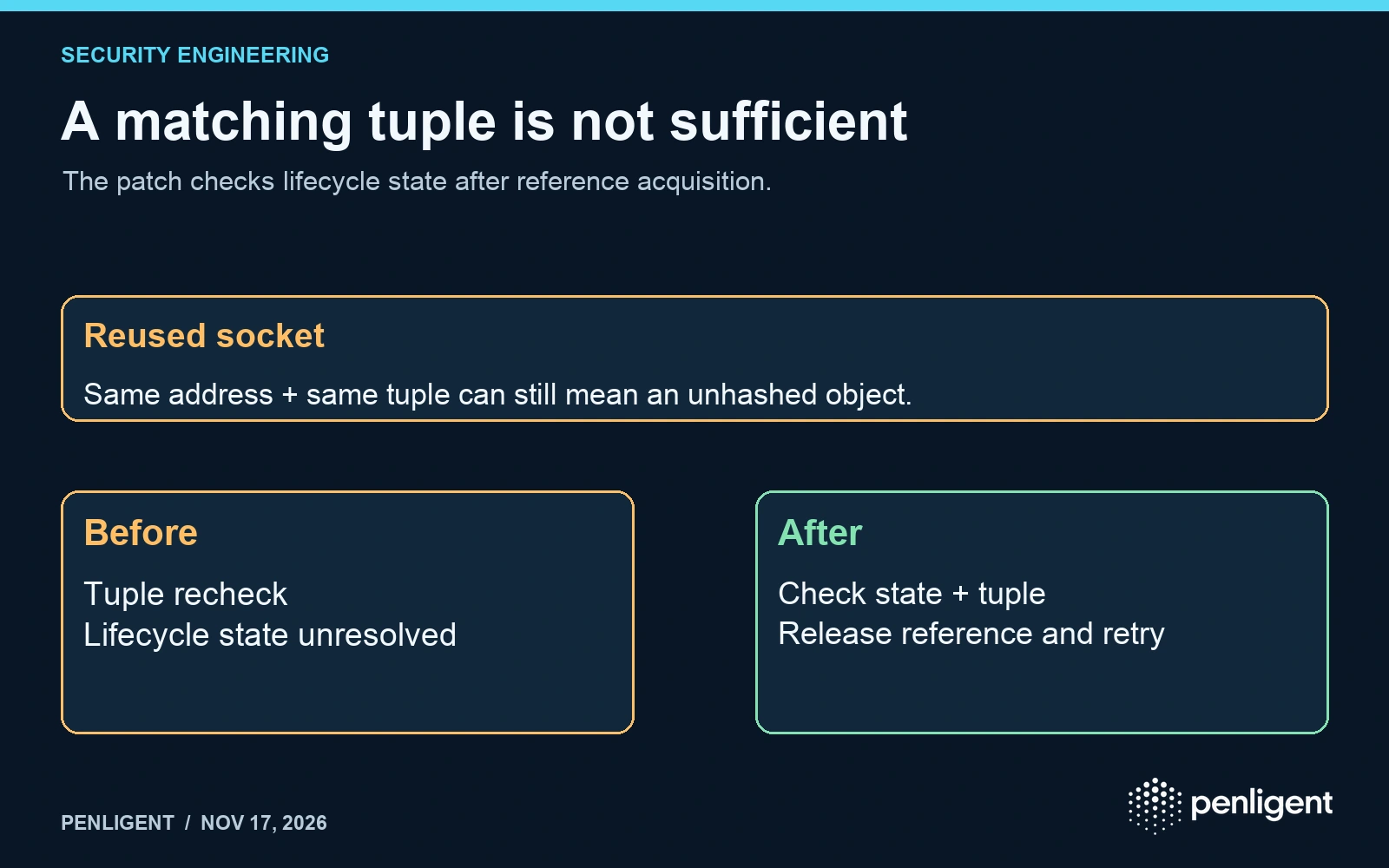
The established-connection lookup is lockless. Its socket caches permit memory to be reused while an RCU reader still retains an old address. Before the fix, a lookup checked the connection tuple, acquired a reference, and checked the tuple again. That sequence did not establish that the newly referenced socket was still linked into the hash table. A replacement object at the same address could have the same tuple while being in the wrong lifecycle state.
إن upstream patch adds an unhashed-state check after reference acquisition in both the IPv4 and IPv6 established-lookup paths. A failed state or tuple check releases the reference and restarts the lookup. It also changes reference release in SYN-cookie, Fast Open, and request-migration failure paths, because an object that was never inserted into the table can still have a live reference. Checking only for an extra tuple comparison in a downstream patch is consequently insufficient evidence that the complete fix is present.
In the demonstrated request-socket path, reuse through a SYN cookie produces an object without a listener. Returning that object allows the receive path to dereference the missing listener and panic. The disclosure also describes a more complicated full-child-socket race with a use-after-free outcome. The verified operational outcome in the advisory is host denial of service; these sources do not establish reliable remote code execution or an active exploitation campaign.
Separate kernel exposure from application exposure
The researcher’s trigger relies on different receive contexts progressing concurrently. The disclosure identifies two or more RX queues, or receive packet steering across multiple CPUs, as conditions that can enable the race. It also uses differences in the receive hashing of IPv4 fragments and ordinary TCP packets. These details matter when deciding which systems need the earliest maintenance window.
| Observation | What it supports | What still needs proof |
|---|---|---|
| Externally reachable TCP listener on an affected kernel | A relevant attack surface exists before application login. | Receive parallelism and the actual packet path. |
| Multiple RX queues or RPS across CPUs | The disclosed concurrency prerequisite may be satisfied. | The kernel’s exact patch state. |
| A service runs inside a container | The host kernel remains the remediation target for ordinary shared-kernel containers. | Which host and network namespace receive the traffic. |
| A short test produces no crash | Only that this test did not trigger the race. | Whether the fix is installed and running. |
| A reverse proxy or load balancer is present | The packet path may differ from direct exposure. | Where TCP terminates; whether forwarding still exposes a vulnerable host. |
The last row is a deployment inference, not a claim that every proxy is protective. Record the TCP termination boundary for the public listener and each backend hop. A routing or forwarding device and a separately patched TCP terminator have different implications. The disclosure does not validate every cloud or load-balancer topology.
Race timing also makes a negative test weak closure evidence. The researcher reported approximately five seconds to two minutes on tested virtual machines, but about fourteen hours on a quiet bare-metal Nginx server with eight RX queues, even with a tuned proof of concept. Those are the researcher’s observations, not universal timing guarantees or Penligent measurements.
Fixed upstream branches and distribution backports
The following fixed-version entries come from the CVE record. Treat each row as a branch-specific boundary, rather than applying one version threshold to every Linux distribution.
| Upstream branch | First fixed version listed |
|---|---|
| 6.12 | 6.12.117 |
| 6.18 | 6.18.63 |
| 7.3 | 7.3.4 |
| Mainline | 7.4-rc2 |
For a distribution kernel, use the vendor’s security advisory and package build as the authoritative mapping. A backported fix can retain an older upstream version string. Conversely, installing a newer kernel package does not prove that the host has booted it. Do not switch production systems to a release candidate merely because the mainline row names one; choose the supported fixed package for the deployed branch.
A read-only evidence collection pass
The following local checks collect the running release, listeners, SYN-cookie setting, and interface receive configuration. Replace eth0 with the actual ingress interface. They send no attack traffic and make no configuration changes. Their output supports a triage record; it is not an automated vulnerable-or-safe verdict.
uname -r
ss -lnt
sysctl net.ipv4.tcp_syncookies
ethtool -l eth0
for q in /sys/class/net/eth0/queues/rx-*; do
  printf '%s\n' "$q"
  cat "$q/rps_cpus" "$q/rps_flow_cnt" 2>/dev/null
done
sysctl net.core.rps_sock_flow_entries
Interface drivers can expose different queue controls, and some environments do not provide all of these files or commands. Record missing evidence explicitly. Repeat the relevant inspection in each applicable network namespace when namespace-specific settings matter. For managed infrastructure, ask the provider for the running kernel build and its CVE remediation evidence instead of inferring host status from a container image scan.
Temporary mitigation has an availability cost
إن disclosure proposes two temporary measures when patching cannot be completed immediately: disabling SYN cookies, or serializing ingress onto a single RX queue while disabling RPS and RFS. These are alternatives to evaluate with the network and platform owners; they are not a complete substitute for the kernel fix.
Disabling SYN cookies blocks the disclosed request-socket reconstruction path but reduces protection against SYN floods. The setting is per network namespace, so changing only the host’s setting may leave separate container namespaces unchanged. Do not apply it as a fleet-wide convenience switch without a compensating availability plan.
Single-queue operation changes the receive concurrency prerequisite and may reduce throughput. Merely changing a hardware queue count while leaving software steering active does not match the researcher’s stated mitigation. Capture the resulting queue and steering state, observe latency and packet-drop behavior, and retain an explicit rollback plan. Whether either measure is suitable depends on the service’s traffic and operational constraints.
Close the incident with a running-kernel evidence chain
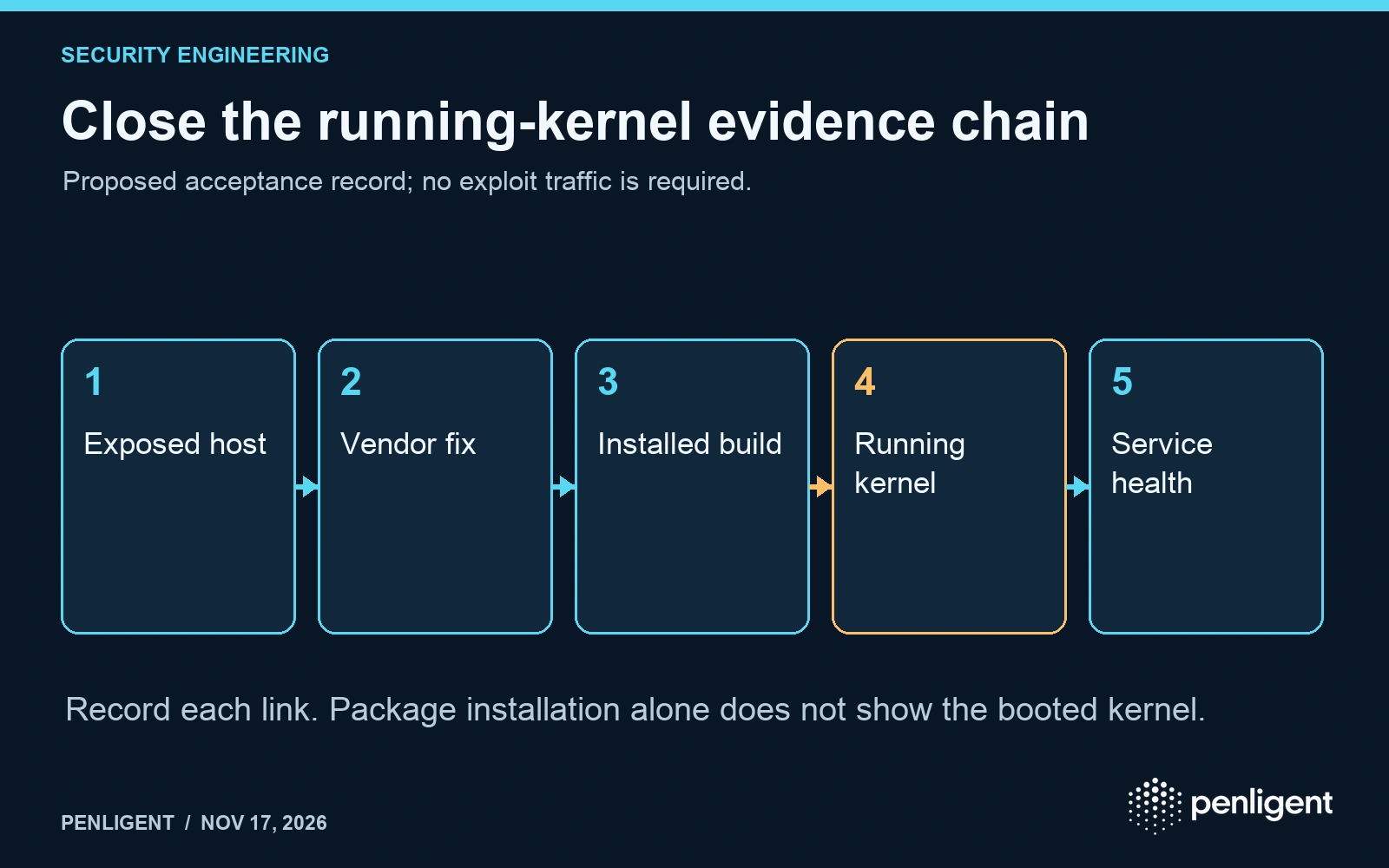
A useful remediation record links five items: the exposed listener and host, the vendor’s fixed package or verified backport, the installed build, the running build after the maintenance action, and a service-health check. The closure decision should follow that chain. It should not rely on a green application scanner result, an updated container image, or a failed attempt to trigger the race.
If temporary controls were introduced, remove them only after the fixed kernel is running and the original network configuration has been reviewed. Restore and validate normal receive capacity as a separate change. This keeps the emergency availability tradeoff from becoming an undocumented permanent setting.
Teams using بنليجنت for authorized security validation can keep this kernel remediation evidence alongside application findings. The supporting artifact for this issue is the host’s verified patch state and exposure record; application-level testing alone cannot establish that the kernel race is fixed.
The following official Penligent video demonstrates the general product workflow. It does not demonstrate exploitation or remediation of CVE-2026-99288.
Method: This analysis was prepared with AI assistance and checked against the Linux CNA record, the original disclosure, and the upstream patch on November 17, 2026. No exploit was run and no independent crash reproduction is claimed. The exposure matrix and closure workflow are Penligent’s operational analysis of those sources.
 Arabic
 English
 German
 French
 Spanish
 Portuguese
 Japanese
 Korean
 Hindi
 Turkish
 Hebrew