
Hacker AI, HackerAI and the hosted PentestGPT.ai service: HackerAI’s official migration instructions describe moving an active subscription from PentestGPT.ai to HackerAI.co; chat history and files are not included. This brand relationship does not make the separate GreyDGL/PentestGPT open-source project another name for HackerAI. The comparison below uses “PentestGPT” for that open-source project unless the .ai domain is specified. Brand relationship checked November 8, 2026.
HackerAI vs PentestGPT comes down to the workflow you want to operate. Evaluate HackerAI when you want its hosted assistant and local or cloud Agent routes. Evaluate the GreyDGL PentestGPT project when you want to own and inspect a framework, choose its supported backend, and maintain its execution environment. If you want a packaged desktop workflow for an authorized Web assessment, include Penligent in the same first-task evaluation.
The useful comparison is setup, total operating cost, control of execution, and usable findings. Both HackerAI and current PentestGPT can drive actions; comparing an active product with an imaginary chat-only version of its competitor would answer the wrong question.
Reviewed November 7, 2026. Published by Penligent. This comparison uses current official documentation and an original offline evidence exercise. We did not run or rank the candidate products against a target.
Jump to: comparison - pricing - execution and data - first task - offline exercise - detailed workbook - الأسئلة الشائعة
HackerAI vs PentestGPT at a glance
| Decision | HackerAI | PentestGPT | بنليجنت |
|---|---|---|---|
| Starting point | Hosted application, with local and cloud execution choices. | Source-accessible framework with autonomous and interactive modes. | Desktop project and assessment workflow for authorized Web testing. |
| What you operate | The selected hosted/local workflow, or a separately maintained repository deployment. | The chosen revision, runner, backend authentication and saved session. | A supported client, its configured runtime, task activity and findings. |
| Free means | Limited responses and a local Agent route in the published Free plan. | MIT-licensed code; model access, compute and operator time remain separate. | One Free test task; report export and task retesting are paid-plan considerations. |
| Best first check | Can the chosen execution route reach the authorized app and retain useful evidence? | Can you reproduce the selected mode and inspect the actual session artifacts? | Can you complete one bounded task and explain a finding from the available evidence? |
| Reason to choose | You prefer the offered assistant and execution model after reviewing its limits and data flows. | You want framework ownership and can support the environment. | You prefer evaluating the packaged project, supervision and handoff workflow. |
The distinctions above follow the HackerAI plan descriptionsفإن maintained PentestGPT project, and Penligent’s public product material. They describe operating choices, not measured differences in vulnerability discovery.
Pricing and the cost of a usable assessment
HackerAI’s published monthly individual plans are Free, Pro at $29, Pro+ at $60, and Ultra at $200. Team is listed at $40 per seat per month. The official pricing page distinguishes usage allowances, file uploads, model access and cloud agents. Extra Usage is a separately enabled prepaid balance. Do not treat a subscription price as an unlimited assessment allowance.
PentestGPT’s source license is not a hosted model subscription. Budget for whichever supported backend and environment you actually use. A team that already maintains those dependencies may have a different marginal cost from a new user building the environment for the first time.
| Cost layer | What to write down | Common comparison mistake |
|---|---|---|
| Product or source access | Billing period, seats, task allowance and renewal. | Comparing free code with a complete hosted service. |
| Execution and models | Backend usage, sandbox or machine cost, tool charges and retries. | Assuming local commands imply free or local inference. |
| Operator work | Installation, authentication repair, supervision and review time. | Ignoring the engineer who turns a run into a deliverable. |
| Handoff and retest | Export rights, evidence access, repeat-run allowance and support. | Pricing only the first run when the customer needs a verified fix. |
For the Penligent option, current public pricing lists one Free task and a $99.90 monthly Pro option with 13,000 credits. Report export and task retesting appear in Pro. The $19.90 top-up adds 2,000 credits to an existing trial task; it does not create another task or unlock Pro features. Confirm billing mode and allowance before purchase.
Local execution, hosted use and repository deployment are different
A local agent can run commands on your machine while still sending prompts and selected tool output to a remote model. A hosted interface can coordinate a local execution worker. A public repository can still depend on hosted storage, authentication and background processing. Identify each boundary separately.
HackerAI’s Security & Trust page states that its cloud actions use an E2B sandbox and its local mode executes with the user’s privileges without isolation. It also describes model-provider processing. Those details matter more than a generic “local” label when deciding which test machine and synthetic data to use.
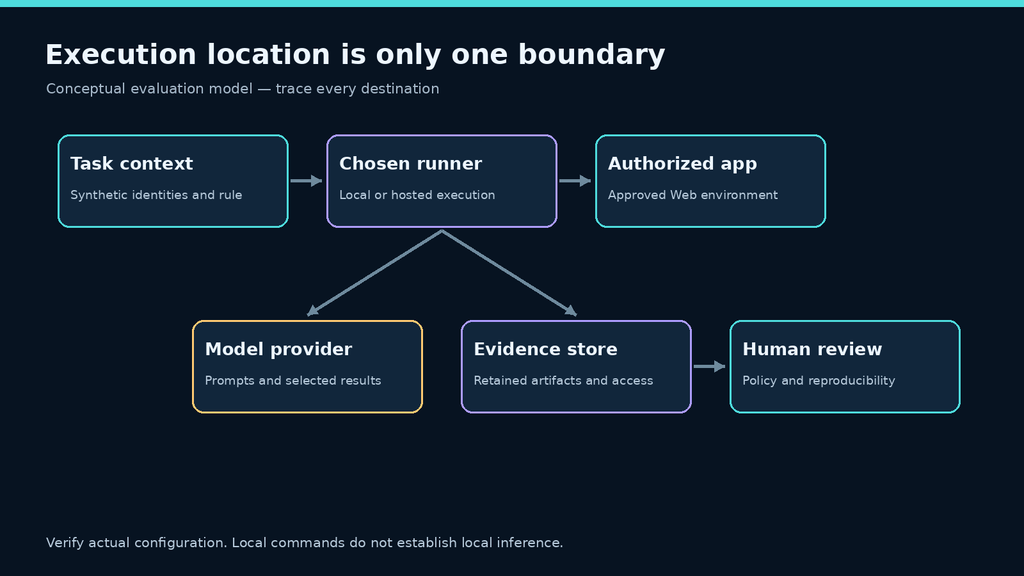
For repository deployment, the HackerAI README lists model services, E2B, Convex, S3, WorkOS and Trigger.dev among required dependencies. That is a deployment ownership question, not a prerequisite list for every hosted customer. Check the exact repository license for your proposed use; its README explicitly flags commercial restrictions.
PentestGPT documents a current autonomous pipeline and a separate modernized legacy interactive workflow. The selected mode affects model integration and operator interaction. Its README advertises a Docker route, while the checked current Makefile marks the maintained agent’s docker-run wiring as pending. Verify the revision before treating that advertised command as an installation recipe.
Give the products one useful first task
Choose an authorized staging Web application with two dedicated test accounts and synthetic records. Start with a read-only ownership rule: each account can retrieve its own record, and neither can retrieve the other’s protected fields. This makes setup failures, weak evidence and a genuine authorization failure easier to distinguish.
| Prepare before registering or installing | Minimum useful answer |
|---|---|
| Target and reachability | The exact approved staging origin and whether the execution worker can reach it. |
| Two identities | Known roles and ownership, working sessions, and a supported credential handoff. |
| Business rule | Which synthetic record each identity may read, including shared-resource exceptions. |
| Boundaries | Read-only actions, excluded services, time and consumption limits, named stop contact. |
| Acceptance evidence | Acting identity, record owner, request, relevant returned fields, and independently repeatable result. |
Use the same brief for both products. If you supply one with the exact vulnerable route and ask the other to discover it, record the exercise as two demonstrations rather than a discovery benchmark. A difference in help can explain an outcome without establishing a difference in product capability.
Illustrative task brief — not an import format

Environment: owner-approved staging application
Accounts: A and B, ordinary users with separate synthetic records
Rule: each user may read only the records the policy grants them
Actions: read-only, within the named origin and approved routes
Evidence: active identity, owner, expected rule, observed protected fields
Stop: expired access, unexpected real data, lockout, or scope uncertainty
Outcome: confirmed, rejected, blocked, or inconclusive, with reasons
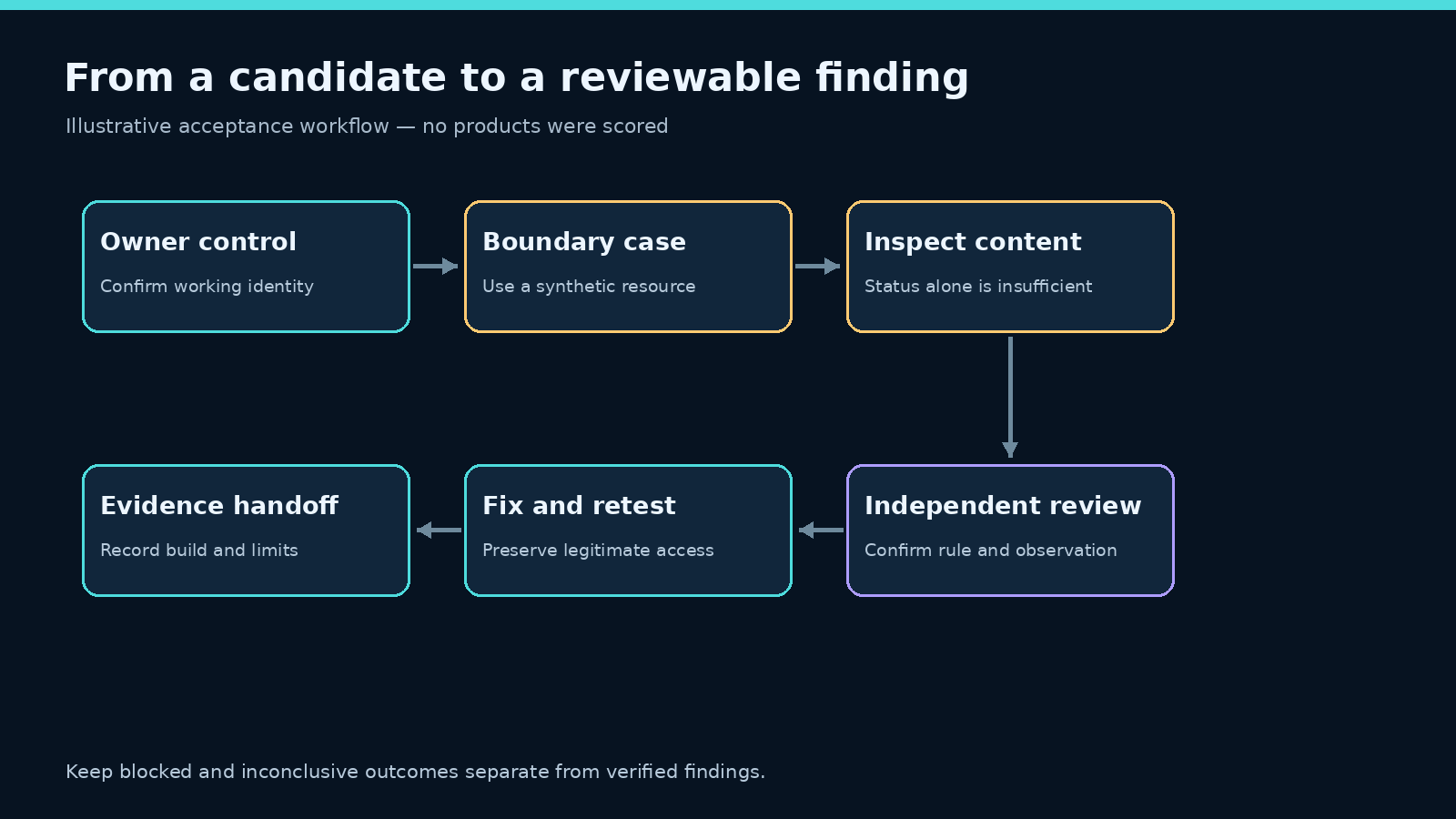
Establish successful owner access before interpreting a cross-account denial. Otherwise a logged-out session can look like a correctly enforced ownership boundary. Check the response body as well as status: a response can deny an action while still including protected data in a nested object or error message.
OWASP’s authorization guidance recommends checking permissions on every request and denying access by default. The pilot translates that principle into an observable business rule. It is a small coverage sample, not a complete assessment of authentication, authorization or business logic.
Accept a finding only when another engineer can explain it
A finding needs more than an agent’s assertion or a screenshot of a success badge. Preserve the resource identity, the active principal, the expected access rule and the relevant response. Include enough context to show that the requested record belongs to the other account, rather than assuming ownership from a convenient identifier.
Keep a valid owner request beside the disputed request. The pair helps a reviewer separate application reachability, authentication and authorization. Redact credentials and unrelated fields before creating a portable evidence bundle; preserve any necessary raw trace in the owner’s approved evidence system.
| Observed result | Reasonable conclusion | What remains to check |
|---|---|---|
| Owner request works; cross-owner response includes the protected synthetic value. | Candidate ownership failure under the recorded policy. | Reproduce independently and check intended sharing rules. |
| Both owner and cross-owner requests fail because the session expired. | Blocked authentication state. | Repair the session and repeat the authorized test. |
| The cross-owner request returns 200 but no protected content. | Status alone is insufficient. | Inspect semantics, redirection and the response fields. |
| The fixed build blocks cross-owner reads and preserves owner reads. | Useful evidence for this remediation case. | Record build and fixture identity; check adjacent cases separately. |
Run an offline evidence exercise before comparing reports
The following Python program uses synthetic in-memory observations. It sends no requests, imports no candidate product and calls no model. Save it as evidence_check.py and run it with Python 3. It demonstrates why a reviewer should check identity, a working owner control and protected content together.
from dataclasses import dataclass

@dataclass(frozen=True)
class Observation:
    label: str
    authenticated: bool
    owner_control_ok: bool
    cross_owner: bool
    allowed_by_policy: bool
    protected_value_visible: bool
    status: int

def review(item):
    if not item.authenticated or not item.owner_control_ok:
        return "blocked"
    if item.allowed_by_policy or not item.cross_owner:
        return "control"
    if item.protected_value_visible:
        return "candidate-failure"
    return "no-disclosure-observed"

cases = [
    (Observation("synthetic leak", True, True, True, False, True, 200),
     "candidate-failure"),
    (Observation("expired session", False, False, True, False, False, 403),
     "blocked"),
    (Observation("generic 200", True, True, True, False, False, 200),
     "no-disclosure-observed"),
    (Observation("owner read", True, True, False, True, True, 200),
     "control"),
    (Observation("permitted share", True, True, True, True, True, 200),
     "control"),
    (Observation("error body leak", True, True, True, False, True, 403),
     "candidate-failure"),
]

for item, expected in cases:
    actual = review(item)
    assert actual == expected, (item.label, expected, actual)
    print(f"{item.label}: {actual}")

print(f"{len(cases)} synthetic evidence cases passed")
The labels are deliberately narrow. “No disclosure observed” does not mean that the application is secure, and a candidate failure still needs policy confirmation and reproduction. The program illustrates interpretation of supplied observations; it does not generate those observations, discover endpoints or measure either product.
A report that classifies the expired-session case as a successful security test hides unfinished coverage. A report that calls the generic 200 case an access-control vulnerability may create a false positive. Use these examples to agree on terminology with the reviewer before a real pilot produces a much larger queue.
Detailed evaluation workbook
The sections below are for teams running a structured comparison. Start with the summary and first-task brief above; expand the parts that correspond to an actual purchasing or delivery requirement.
Prepare an evaluation that separates the product from the environment
Define a decision that the pilot can actually settle
Write one sentence describing the buying decision before creating a target. For example, a small application team may need a repeatable way to investigate authenticated Web behavior between releases. A researcher may instead need source-level control of an agent loop. Those objectives can lead to different choices even when both people type the same comparison query.
Choose a disqualifying requirement and a preferred outcome separately. If a permitted processing boundary excludes a route, there is little value in running it with production-like data and hoping that its output compensates for the mismatch. Conversely, a preferred report layout may be adjustable without changing the execution system. Keeping those categories separate prevents a pilot from collecting attractive but irrelevant features.
Decide what would make you keep the current workflow. A comparison that only rewards change is difficult to trust. Perhaps the current runner already produces reproducible evidence, and its main inconvenience is a setup script that the team can repair. Perhaps a packaged interface reduces handoff friction enough to justify a subscription. The test should make both conclusions possible.
Record the environment as part of the experiment
Give the target a build identifier and retain the fixture reset procedure. Two runs against applications that changed between attempts are not directly comparable. Even a harmless background job can change ownership, remove a record or expire an invitation. Record when the fixture was initialized and what ordinary behavior looked like before the candidate began.
Write down the worker’s position relative to the target. A local browser that reaches staging through an existing VPN does not prove that a cloud sandbox can reach the same origin. Likewise, a successful DNS lookup does not establish that authentication redirects, static assets and API requests all traverse the permitted route. Test those dependencies with the application owner before interpreting a quiet run as a detection result.
Use dedicated accounts whose identity and entitlement are easy to verify. Names such as test-a and test-b are not proof of separate tenants. Check the server-side fixture or the owner’s setup record, then keep a synthetic marker that identifies each protected record. This reduces the chance that a reviewer mistakes shared data for an ownership failure.
Keep the evaluator’s knowledge distinct from the runner’s input. The evaluator may know the seeded condition in order to score the result. The runner should receive only the information allowed by the chosen test design. If the operator supplies a hint after a failure, preserve the original attempt and label the assisted attempt. The correction can be useful without rewriting the earlier outcome.
Make interventions visible
Maintain a brief intervention log with time, reason, action and effect. An operator who repairs an expired session, changes a model or points the runner at an endpoint has changed the conditions. Those changes are part of the cost and reliability story. They are not embarrassing exceptions to hide from the final report.
Separate setup assistance from analytical assistance. Installing a required runtime helps the software start. Explaining the exact authorization mistake helps it solve the task. Both consume time, but only the second changes what discovery performance means. An evaluation record should allow a buyer to distinguish the two without reconstructing an entire conversation.
Record repeated failed actions as a sequence rather than a single successful final step. A run that reaches a useful result after several loops may still be valuable, but its cost and operator burden differ from a clean run. The purpose is to understand that burden, not to penalize every recoverable interruption.
Retain incomplete scope
Ask for an explicit list of blocked or untested cases. If the evaluation covers only one read workflow, do not let a polished executive summary imply that invitations, billing or administrative functions were assessed. Coverage should follow observed work, not the breadth of the product category or the number of tools available in a menu.
An incomplete run can support a useful purchasing decision. It may show that the chosen architecture cannot reach your environment or that the operator cannot obtain necessary evidence under the proposed plan. Record that limit directly. It is more actionable than assigning a zero detection score to a task that never reached the application.
Keep the source and product revisions with the record. A documentation-based comparison becomes stale when a mode, dependency or plan changes. A short version record makes a later re-evaluation cheaper because the team can identify what actually changed rather than redoing every question from memory.
Investigate setup, authentication and interrupted runs
Diagnose a failed start in layers
Begin with the narrowest observable failure. Can the application launch? Can the selected backend respond? Can the worker reach the target? Can the test identity access its own record? Each question belongs to a different layer. Repeating a broad instruction such as “finish the pentest” can consume usage while leaving the original prerequisite unresolved.
For a framework, retain dependency versions and the exact command that failed. For a hosted workflow, capture the selected execution route and the relevant product error. Avoid recording full environment dumps that may contain credentials. The diagnostic record should be sufficient to locate the failed layer without becoming a new repository of secrets.
If a documentation command conflicts with the checked code revision, stop treating the command as a verified recipe. The PentestGPT Docker discrepancy is an example of why a buyer should inspect the executable path, not merely copy the most convenient README paragraph. It does not establish that every other installation path is broken or that another product would behave better.
Distinguish a login page from authenticated application coverage
An agent may successfully load an application shell while its API calls are redirected or denied. The page title can remain unchanged after the session expires. Use a known owner-only record or another agreed authenticated control to verify the identity at the time of the security observation. A login screenshot from ten minutes earlier is weaker evidence.
Verify the account after switching tenants, browser contexts or execution routes. State that exists in an operator’s desktop browser may not exist in the runner’s browser. Likewise, a copied bearer token may be valid only for a particular audience or environment. A visible identity check helps avoid confusing these setup limits with an application’s authorization behavior.
Give the owner a supported way to refresh access. Do not rely on an agent inventing an authentication flow or placing credentials in an ordinary public note. The comparison should record whether access can be restored through the chosen workflow and how much operator attention that takes. It should not claim that a product supports a credential mechanism solely because another product does.
Interpret interruptions without losing the task
Before pausing or stopping a task, identify which artifacts are already durable. Some outputs may be saved even when the final summary has not appeared. Preserve those outputs and mark the unfinished phase. Starting again without checking can duplicate activity and make the eventual evidence harder to attribute to a particular run.
After resuming, verify the target, identity and remaining budget. Session persistence is useful only if the saved state still refers to a valid environment. A resource may have changed or a credential may have expired while the task was paused. Resume capability does not eliminate the need for these controls.
If the product exposes a stop control, test it on a benign approved action before relying on it for a larger assessment. Record what stopped and whether any already dispatched work continued. A visible button is not sufficient evidence that every underlying process, worker or queued action shares the same cancellation semantics.
Use failure labels that lead to the next action
| Label | Observable basis | Next action |
|---|---|---|
| Setup blocked | The runner or backend never became operational. | Repair the prerequisite; retain setup time. |
| Access blocked | The owner control cannot be completed. | Restore identity or reachability before scoring coverage. |
| Inconclusive | The action ran but evidence cannot settle the rule. | Request a narrower observation or reviewer check. |
| Rejected candidate | Observed behavior matches the intended policy. | Record the explanation and avoid duplicate tickets. |
| Confirmed finding | Independent reproduction demonstrates the recorded policy violation. | Assign remediation and preserve the exact retest case. |
These labels are an evaluation vocabulary, not promised product output fields. Maintain them beside the run if necessary. Their purpose is to keep different failure causes from collapsing into a misleading pass or fail badge.
Review the report, remediation handoff and retest
Write a finding for the engineer receiving it
The receiving engineer needs to know what application rule failed and what changed the result. A long transcript can be useful evidence, but it is not a substitute for a clear reproduction path. Lead with the affected workflow, the relevant identity and ownership relationship, the observed protected content, and the expected behavior.
Separate observed impact from possible consequences. Reading a synthetic invoice field establishes that field’s disclosure under the tested conditions. It does not by itself establish bulk data extraction, administrative takeover or the ability to modify records. State those as untested hypotheses if they matter to a later authorized assessment.
Record the tested build, route and account role. The same endpoint can behave differently for an administrator, an ordinary user and a support operator. If the result depends on a tenant switch or invitation state, preserve that state. A reviewer should not need to guess which application configuration made the observation possible.
Keep evidence minimal and sufficient
Choose a synthetic marker that shows the policy failure without exposing unrelated records. When a response includes many fields, preserve the relevant excerpt and enough context to identify its source. Keep a reference to the approved raw trace where required. This balances reviewer usability with the owner’s data-handling requirements.
Redact secrets in a way that preserves reasoning. Replacing every identifier with the same word can erase the ownership distinction that makes the finding intelligible. Use stable labels such as principal-a, tenant-b and record-b instead. Preserve the mapping only in the owner’s controlled evidence store when that mapping is needed.
A screenshot should explain something that text alone would make hard to verify: an active role, a workflow state or a visible protected field. Do not fill a report with decorative terminal captures. Captions should identify the step and what the image demonstrates, while the reproduction instructions remain usable without interpreting tiny text.
Distinguish report generation from report acceptance
A generated document may be structurally complete yet operationally incomplete. Check whether a second engineer can reproduce one finding without the original operator narrating it. Record the time spent locating evidence and clarifying assumptions. Those observations tell you more about handoff effort than the existence of an export button alone.
Review executive statements against the detailed evidence. A summary that says “the application is secure” overstates a narrow pilot even if every tested case passed. A useful summary identifies the assessed scope, material findings, unresolved limits and next action. It should remain accurate when read separately from the technical appendix.
If an external customer needs an independently delivered assessment, establish that requirement before choosing a self-service tool. A product-generated report and a consultant’s statement of work can involve different review responsibilities. Confirm the customer’s acceptance criteria rather than assuming that a familiar compliance label settles them.
Retest both the fix and the ordinary behavior
A remediation that denies every request can suppress the original disclosure while breaking the application. Keep the owner-access control alongside the cross-owner case when retesting. The useful result is a restored boundary with legitimate behavior preserved, not a single denial status divorced from the business rule.
Use the same synthetic fixtures where possible, but record changes that the fix requires. If the developer replaced the route or changed the sharing model, the original request may no longer be a sufficient test. Explain the connection between the old failure and the new behavior rather than marking the ticket resolved because one URL disappeared.
Keep the vulnerable and fixed build identifiers in the handoff. A successful retest against an unrecorded deployment is difficult to defend later. When a release rolls back or a parallel service retains the old logic, the team needs enough detail to know whether the original case applies.
A compact handoff record
Finding: cross-owner synthetic invoice disclosure
Environment: approved staging build and fixture revision
Principal: ordinary account A, active owner control confirmed
Resource: synthetic invoice owned by account B
Policy: no sharing relationship permits A to read B's protected fields
Observation: protected synthetic marker returned to A
Evidence: redacted request, response excerpt, identity and ownership record
Review: independently reproduced or explicitly pending
Remediation: server-side authorization at the relevant object boundary
Retest: owner access succeeds; cross-owner protected content is absent
Limits: adjacent routes and write operations were not assessed
This is an illustrative record, not an incident report or a claim about any candidate product. Replace the fields with observations from the authorized environment. Its value is that the developer, reviewer and buyer can discuss the same unit of evidence.
Estimate total cost and assign operating ownership
Compare the workload you will repeat
Define a workload before comparing monthly prices. One owner-reviewed Web check each release, a consultancy’s customer report and a research team’s repeated agent experiment are different purchases. Count the expected runs, their likely size, and the review and retest work. Keep assumptions visible so the budget can be revised after the pilot.
A hosted subscription can reduce some infrastructure work while leaving target preparation and evidence review with the customer. A source-accessible framework can provide control while requiring ongoing maintenance. Neither arrangement is automatically cheaper. The relevant question is which work your team can already perform and which work it must add.
Use a common currency for operator time and cash costs, but keep the original measurements. Converting an hour into a dollar estimate helps budgeting; it does not make a subscription credit equivalent to an API token. Retain both the measured usage and the costing assumption so a later pricing change does not erase the comparison.
A hypothetical budget example
Suppose a team plans four narrow evaluations in a month. It estimates three hours of initial environment work, two hours of combined supervision, and two hours of review. At an illustrative internal rate of $60 per hour, that labor estimate is $420 before product, model or infrastructure charges. These are invented planning inputs, not measured performance or a vendor quote.
If a different workflow saves one hour of review but adds two hours of setup, the first month and a later steady-state month may have different winners. A reusable setup can change the economics over repeated runs. Show both periods instead of choosing whichever horizon makes the preferred product look cheapest.
Retesting changes the budget again. A plan that covers the initial run may meter a repeat run differently, and a manual reproduction still consumes operator time. Include the next action you expect after a finding rather than treating the first result as the end of the work.
| Planning input | How to collect it | How to use it |
|---|---|---|
| Initial setup hours | Record work from an empty supported environment to a usable first task. | Separate one-time effort from recurring effort. |
| Run consumption | Retain the product’s actual task, credit or token record. | Apply the current rate without inventing unit equivalence. |
| Supervision hours | Log interventions and waiting that prevents other work. | Distinguish unattended runtime from human effort. |
| Review and repair | Have another engineer reconstruct a finding and identify missing fields. | Estimate the work needed for an accepted handoff. |
| Retest cost | Repeat the relevant case against the fixed build. | Budget the complete remediation loop. |
Give every dependency an owner
For a maintained framework, name the person responsible for runtime updates, backend changes, credentials and artifact storage. Source access is useful only if someone can operate the source when a dependency changes. A single successful demonstration does not establish a support process for the next release cycle.
For a hosted or packaged product, name the person who checks plan allowances, support routes and retained evidence. A managed execution component does not transfer responsibility for application authorization or the customer’s acceptance criteria. Record which problems the supplier supports and which remain the application owner’s work.
Keep access to the evidence independent of a single operator’s personal account where the chosen plan and company policy permit it. Before the pilot ends, test whether the intended reviewer can receive the necessary sanitized artifacts. Do not assume that a publicly shareable task link is appropriate for confidential assessment data.
Use a decision record rather than a universal winner
Write the reason for choosing a route in terms of requirements it satisfied. For example, the team may value owning the runner, simplifying its daily interface, or reducing the work needed for a reviewable report. Attach the actual pilot observations and unresolved limitations. This makes the decision useful when circumstances change.
Record a trigger for reconsideration. A change in target architecture, data-processing requirements, model availability or assessment volume can justify another pilot. This is more useful than locking the team into a ranking whose criteria nobody remembers. The original comparison should remain a traceable decision, not a permanent claim that one product is best for every buyer.
Run a fair comparison across research, consulting and application teams
For research teams, preserve inspectability
A research experiment should make the agent’s decision process observable enough to investigate failure. Retain the supplied context, relevant tool actions, returned observations and state transitions. A final finding count hides whether the system discovered the condition, repeated a supplied path or succeeded only after a manual correction.
Pin a source revision and record model configuration. A changing hosted alias, updated prompt or modified tool adapter can alter the experiment. If you intentionally evaluate the latest available service rather than a reproducible snapshot, say so and retain the date. Both study designs can be useful, but they answer different questions.
Use negative cases as carefully as seeded failures. A system that identifies a vulnerable record boundary but also accuses every correctly protected route creates an expensive review queue. Include ordinary owner behavior, permitted sharing and blocked authentication among the cases. The offline exercise above illustrates the distinctions without pretending to measure a model.
Separate task discovery from result verification in the score sheet. A candidate may miss a condition during discovery yet explain it accurately after being shown a trace. Another may discover a suspicious route but overstate its impact. These are distinct capabilities, and a single success percentage can conceal the difference.
For consultants, price the client handoff
A consulting workflow has obligations beyond running an agent. The assessor must agree scope, preserve evidence, explain limitations and answer a client’s remediation questions. Check whether the selected product’s artifacts can support that work under the chosen plan and the client’s confidentiality requirements.
Have a colleague review a sanitized sample without the original conversation. Ask them to identify the affected object boundary, reproduce the relevant observation and propose a retest. Capture missing information as a handoff defect. This measures the usefulness of the output without requiring a speculative comparison of detection rates.
Do not mix consultant judgment with product output in the final record. An assessor may correct severity, narrow impact or reject a candidate. Those are valuable review actions. Preserve them so a buyer understands which work the product performed and which work the professional supplied.
Clarify the client deliverable before purchasing a longer subscription. Some clients need raw technical evidence; others need a particular scope statement, reviewer identity or remediation meeting. A generic report export cannot establish those contractual requirements by itself. The decision belongs to the agreed engagement, not the name of the file format.
For application teams, test the release loop
A product team often needs a narrow answer quickly: did a changed permission boundary preserve the intended rule? Build the pilot around a realistic release change and the actual engineer receiving the result. This is a better test of operational fit than a sprawling target whose findings have no remediation owner.
Attach the relevant issue or change description to the evaluation record. The developer should be able to see why the test was run and what result would block or unblock the release decision. Keep the assessment conclusion narrower than the release as a whole; one passing case does not certify every feature.
Check the return path after a fix. A workflow that helps identify a candidate but loses the original fixture at retest time may be awkward for frequent releases. Evaluate whether the evidence, target revision and expected behavior remain understandable when another engineer opens the task a week later.
Measure interruptions that matter to the team’s schedule. A five-minute runtime is not a five-minute engineering task if authentication setup and report reconstruction take an hour. Conversely, a longer unattended run may be acceptable when its outputs are easy to review. Use observed labor rather than the most attractive duration on the screen.
For solo testers, constrain the first purchase
A solo practitioner should begin with the smallest task that demonstrates the desired workflow. Prepare the target and identity before starting a metered run. If the initial attempt is blocked by access, repair that issue before increasing the allowance. More usage is unlikely to compensate for a missing prerequisite.
Decide whether the immediate need is learning, investigation or delivery. Learning may justify a framework whose internals are visible. Investigation may favor an interface that helps maintain context. Delivery may make evidence organization and report entitlement more important. The same person can reasonably use different tools for these jobs.
Keep a simple record of spend, interventions and accepted findings. It need not be a formal benchmark. A few honest observations from your own authorized work can support a better purchasing decision than a generic claim that a particular agent is more intelligent. Review the record after several comparable tasks before committing to a larger recurring workload.
What a useful final evaluation looks like
The final record should identify the selected route, the requirement it met, the tested environment, the evidence reviewed and the limitations that remain. It should also identify who owns setup, execution supervision and remediation follow-up. These are the conditions under which the comparison is meaningful.
If the record cannot distinguish a documented feature from an observed result, revise it before using it to justify a purchase. Supplier documentation establishes what is offered; a controlled pilot establishes what happened in your environment. A buyer needs both, with their roles kept clear.
HackerAI and PentestGPT can both be reasonable choices. The practical winner is the workflow whose responsibilities your team can support and whose evidence survives independent review on the application you are allowed to test.
Inspect the deployment contract and the artifacts it should leave
Treat the hosted service and repository as separate evaluation subjects
For HackerAI, identify whether the purchase is a hosted subscription, a connection to local execution or an application deployment from source. The repository’s service dependencies describe the last of those arrangements. They do not show that a hosted customer must operate a database, authentication service and background worker. Conversely, a working hosted account does not prove that a source deployment has all of its required services configured.
Give each arrangement its own row in the evaluation record. Write the entry point, worker location, model route, durable storage and support owner. This makes the comparison more precise than a checkbox labeled “self-hosted.” A team can host the interface while using external model and execution services; another can run commands locally while using the supplier’s hosted application.
For PentestGPT, identify the executable and mode before selecting a backend. Its autonomous workflow and modernized legacy command are different paths. A provider listed for the interactive mode should not automatically appear as a supported autonomous backend in your internal purchasing matrix. Verify the exact adapter rather than assuming that all model names in the repository are interchangeable.
Use a dependency contract to diagnose the source route
| المكوّن | Question to settle | Evidence to retain |
|---|---|---|
| Application interface | Which revision is deployed, and does the task reach the intended worker? | Build identifier and a benign task’s visible activity. |
| Background execution | Which process or service owns a long-running task after the page closes? | Documented route and an approved interruption/resume observation. |
| Model integration | Which backend is authenticated for the selected mode? | Configuration identifiers and successful non-sensitive round trip, without credentials. |
| Target access | Can that worker reach the approved staging application and its authentication dependencies? | Owner control and relevant network prerequisites. |
| Durable artifacts | Where can the reviewer retrieve the trace after the original session ends? | Artifact reference, access boundary and a successful reviewer handoff. |
| Updates | Who repairs the route when an adapter, dependency or provider changes? | Named owner and the recorded revision being supported. |
This contract is not a list of deficiencies in either product. It is a way to identify the work associated with the route you choose. A missing worker configuration and an unsupported security conclusion require different fixes, and the record should allow an engineer to tell them apart quickly.
Keep credentials out of the comparison artifact
A useful evaluation record contains configuration names and observed behavior, not reusable secrets. Do not paste an environment file into the report to prove which service was configured. Record the relevant variable names or connection role, and keep the actual values in the owner’s approved secret-handling system.
The same principle applies to browser evidence. A full request capture can contain cookies or tokens that are irrelevant to the reviewer. Preserve a sanitized version with stable principal labels and the relevant protected synthetic field. If raw evidence must be retained, use the designated assessment store and refer to it from the portable report.
When comparing two routes, keep the credential handoff equivalent in purpose even when the interface differs. One route may receive a supported session input while another uses its own authenticated browser. Record that distinction. Do not silently grant one candidate a more privileged account because its setup was easier.
Inspect the provenance chain
A defensible artifact lets the reviewer connect the conclusion to the action that produced it. At minimum, retain a run identifier, target revision, principal label, resource label and evidence reference. The exact storage format can differ across tools; the relationship between those fields should remain clear.
For example, a screenshot of account A’s interface and a response containing account B’s marker are not sufficient if they came from unrelated sessions. Preserve the connection that shows which identity made the relevant request. A short observation record can be more useful than several visually impressive screenshots with no shared context.
Keep the candidate and reviewed conclusion separate. The original agent output may propose an issue; an independent reviewer may confirm, narrow or reject it. A final record that overwrites the original claim can conceal how much review work was required. Preserve the decision history without retaining unnecessary sensitive material.
Use an evidence identifier that survives export
An exported document should point to stable evidence labels rather than an operator’s memory of “the third request.” If the chosen plan does not include a particular export, record the gap before promising the artifact to a customer. Do not count a feature visible in a different plan as part of the evaluated route.
A simple identifier such as run-04/owner-control-a can work in a small pilot. A larger assessment may need the owner’s established evidence conventions. The important property is that a second reviewer can retrieve the right observation and understand its relationship to the finding.
Check links and attachments after export. A report that looked complete inside an application may rely on an authenticated session, an unavailable file or a task link the recipient cannot open. The handoff test should use the intended recipient’s access conditions, with the owner’s permission.
Close the comparison with a concrete operating agreement
After selecting a route, write down who prepares the target, who supervises execution, who accepts a finding and who verifies a fix. Include the supported product or source revision and the plan whose entitlements were checked. This agreement keeps a successful pilot from turning into an unsupported expectation of unattended delivery.
Record unresolved questions as specific follow-up observations. “Need better reporting” is vague; “the reviewer could not identify the active account from the exported evidence” is actionable. “Need more autonomy” is vague; “the operator had to restore the test session twice during the same bounded task” can guide the next evaluation.
Use the smallest follow-up that answers the unresolved question. A single sanitized export or a repeat run after a session refresh may be enough. Adding more target surface before fixing a broken handoff usually increases the amount of ambiguous evidence rather than improving the purchasing decision.
The final choice should remain proportional to the job. A researcher can reasonably accept maintenance work in exchange for framework control. A developer can reasonably prefer a packaged workflow after verifying its evidence and plan limits. A consultant can reasonably retain a tester-operated toolkit for precise investigation. The comparison succeeds when those responsibilities are explicit, rather than when every reader is pushed toward the same product.
A short acceptance meeting agenda
Start the acceptance meeting with the original buying question and the selected execution route. Have the operator show the owner-access control, the disputed observation and the reviewed conclusion. Ask the receiving engineer to explain the policy in their own words. If the participants disagree about the rule, resolve that disagreement before discussing detection quality.
Then inspect one rejected or blocked case. This reveals whether the process preserves uncertainty and unfinished work. A pilot that contains only its most attractive positive result gives the buyer little information about the review burden or failure recovery they will encounter during normal use.
Close with the applicable plan, measured consumption, human effort and next required artifact. Name the person who will own the next run and the person who will accept its evidence. Keep any unmeasured assumption visible rather than converting it into a confident recurring cost.
The meeting should produce one actionable decision: adopt this route for the defined workload, retain the current workflow, use the tools together with clear responsibilities, or collect one specific missing observation. That is a stronger outcome than a universal winner unsupported by the pilot.
Frequently asked questions
Is HackerAI just a chatbot?
- No. Its current public material describes Agent execution, including local and cloud routes. Evaluate the route and plan you intend to use rather than the appearance of its chat interface.
Can PentestGPT run tools autonomously?
- The current GreyDGL project documents autonomous execution and saved sessions, alongside a separate interactive legacy mode. Specify the revision, mode and backend when comparing it.
Which is cheaper, HackerAI or PentestGPT?
- There is no workload-independent answer. Compare the applicable subscription or source route, model access, infrastructure, setup, supervision and review. Free source code does not include every operating cost.
Does running locally keep all assessment data local?
- No. Command execution, model processing and artifact storage are separate boundaries. Check the actual provider and deployment configuration before using sensitive data.
Can I compare them using the same prompt?
- A shared prompt is only a starting point. Also hold target state, identity, scope, assistance, budget and acceptance criteria constant. Record interventions and blocked work.
When should I include Penligent in the evaluation?
- When a packaged desktop Web assessment workflow matches the work you want to supervise. Prepare one authorized task, inspect the available evidence and confirm report or retest entitlement before expanding.
Choose from a completed first task, not a claim of universal superiority. A useful pilot leaves you with an explainable result, a realistic operating cost and a clear owner for the work that comes next.
 Arabic
 English
 German
 French
 Spanish
 Portuguese
 Japanese
 Korean
 Hindi
 Turkish
 Hebrew