
If you are choosing HackerAI or PentestGPT, start with the work you expect to own. Building a testing environment, experimenting with an agent, and delivering an assessment to an engineering team are different jobs. A tool can be a good fit for one without being the obvious choice for the others. Penligent belongs in the comparison when the purchase is about a repeatable assessment workflow and its deliverables.
This article uses HackerAI to mean hackerai.co and its official repository, and PentestGPT to mean the GreyDGL project. “Pentest GPT” and “PentestGPT” are spelling variants here, not two products. The comparison is published by Penligent, uses official material checked on October 17, 2026, and does not claim that we ran a benchmark against either project.
Three starting points, not a league table
En official HackerAI repository is the starting point for its application architecture and setup requirements. The current PentestGPT repository is the reference for its current agentic and legacy workflows. For a managed assessment purchase, review Penligent’s current product and plan descriptions against the deployment and reporting requirements in your statement of work. These sources answer different questions; a shared “AI pentesting” label does not make their operating models interchangeable.
| Your primary objective | What to investigate first | What would justify the choice |
|---|---|---|
| Operate HackerAI’s application stack | HackerAI repository and dependencies | The stack fits your deployment, data, and support requirements |
| Experiment with PentestGPT workflows | Current PentestGPT repository and selected mode | You can reproduce the workflow and inspect useful artifacts |
| Procure an assessment workflow | Penligent’s relevant plan and a scoped demo | The deliverable and operating controls meet acceptance criteria |
| Compare real performance | A shared authorized evaluation | Reviewed evidence, recorded assistance, and comparable conditions |
This is a guide to where to begin, not a claim of exclusive capability. It deliberately avoids assigning a winner based on stars, product positioning, or the presence of a chat window. A chat interface can drive execution, and an autonomous run can still require substantial review.
Do not use a research paper as a current feature matrix
En USENIX Security 2024 PentestGPT paper evaluates an earlier system and addresses problems such as context loss during testing. It is valuable research, but its evaluation does not rank today’s HackerAI, PentestGPT, and Penligent deployments.
When a search result describes PentestGPT as only a command-writing assistant, check the publication date and the current repository. Conversely, a newer workflow does not automatically inherit every result reported in an earlier paper. The artifact, configuration, task, and success criterion must match before a number can support a buying decision.
The same caution applies to CTF results. Solving a challenge can demonstrate useful technical behavior, but it does not establish tenant isolation, report quality, or reliable operation inside a company’s release process. Use research evidence for the question it actually studied, then test the operational requirements separately.
For learning and research, value visibility
If your goal is to understand how an agent chooses its next action, prioritize observable intermediate steps. Can you see the hypothesis, the tool action, the returned evidence, and the reason for changing direction? Can another researcher repeat the run with the same configuration? A final success message is too little information to investigate a failure or compare a modification.
Record the exact code revision, selected mode, model configuration, environment, and target state. Keep failed runs as well as successful ones. Changing several variables at once can produce a better-looking outcome without explaining what improved. A small reproducible experiment is often more useful than an ambitious demonstration that nobody can repeat.
In this setting, setup effort may be an acceptable part of the work because the system itself is the subject of study. That preference can reasonably lead to a different choice from a team purchasing a recurring assessment service. Neither team needs to pretend its goal is universal.
For an engagement, value the handoff
A consultancy or application security team needs more than an interesting execution trace. Findings must connect to a scope, build, affected component, impact, and remediation owner. Decide how those fields will enter the team’s issue tracker and what evidence must remain available after the original operator leaves the project.
Use one deliberately seeded authorization flaw in a staging application. Ask each candidate to assess the same tenant boundary with the same accounts and limits. Have a reviewer reproduce any reported violation independently. Record whether the tool found the issue, whether the evidence was sufficient, and how much manual reconstruction the reviewer needed.
Now include a similar endpoint that enforces the boundary correctly. This checks whether the workflow can distinguish a real failure from a superficial resemblance. A larger count of reported issues is not an improvement if the extra items are unsupported. Keep suspected issues separate from confirmed ones so neither gets lost in the scoring.
Use a comparison record that prevents moving the goalposts
| Record | What to capture before or during the trial |
|---|---|
| Target state | Build identifier, seeded conditions, and reset procedure |
| Authorization | Allowed hosts, accounts, roles, actions, and stop conditions |
| Run configuration | Product version or revision, deployment, model, and mode |
| Recursos | Time window, execution budget, and actual consumption |
| Human assistance | Prompts, supplied endpoints, manual tests, and recovery work |
| Resultado | Confirmed, rejected, missed, or inconclusive; evidence location |
| Handoff effort | Review time, report edits, and remediation/retest work |
These fields are a proposed evaluation method, not output fields promised by any product. If a tool does not export the complete record, maintain it alongside the run. Apply the same rule to all candidates. Do not let one product receive extensive manual help while another is judged only on its first unattended attempt.
Agree in advance how to score an interrupted run. An outage might be an environment issue, a dependency issue, or a product issue. It still consumes operator time, but it should not be silently counted as either a passed security test or a confirmed vulnerability. Preserve enough detail to separate reliability from detection quality.
Compare operating roles before comparing features
A researcher, a platform engineer, and an engagement lead may all ask for an AI pentesting tool while expecting different work from it. The researcher wants to inspect reasoning and change an experiment. The platform engineer needs a service that can be deployed and supported. The engagement lead needs findings that can be delivered and defended. Identify the primary role before assigning weights to a feature matrix.
For a research workflow, a visible failure can be useful if its cause can be traced and the experiment repeated. For a delivery workflow, the same failure needs a recovery path and a clear statement of unfinished scope. Neither perspective is wrong. Problems arise when an evaluation rewards research flexibility in one column and assumes service-level delivery in another without accounting for the work between them.
Take a small team preparing a customer assessment. It may be willing to configure a project locally, but not to own a new production service. Another team may already operate a model gateway, execution environment, and artifact store, making additional integration work comparatively modest. The team’s existing environment changes the total effort; a generic recommendation cannot infer it from repository popularity.
For each candidate, write one sentence describing the work the customer will continue to own after the pilot. Include operation, review, and remediation handoff. If that sentence is unclear, the comparison is premature. A useful shortlist makes those responsibilities visible rather than promising that all three products remove the same tasks.
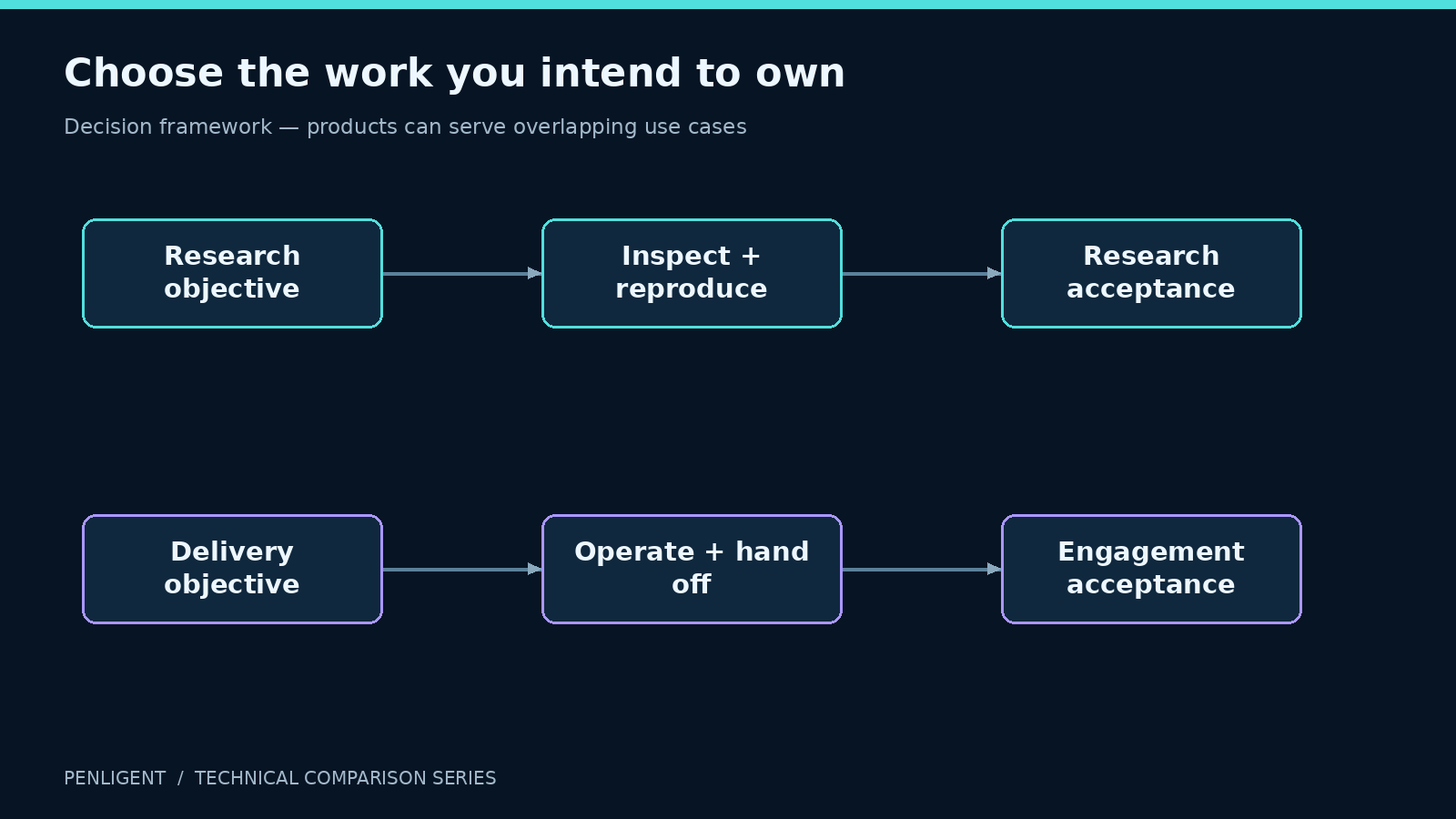
Three scenarios expose different strengths and gaps
For a learning or research scenario, choose a reproducible isolated target and a narrow hypothesis. Preserve intermediate actions and failed attempts, and change one experimental condition at a time. The question is whether the workflow helps explain behavior, not whether the final report looks suitable for a customer. A tool that is easy to inspect may be preferable even if it takes more manual preparation.
For an application security scenario, choose a staging workflow with a business rule and two roles. Provide the policy in advance and require a finding to connect the observed behavior to that rule. The reviewer should be able to distinguish a true cross-role violation from an expected privileged operation. This exercise tests the usefulness of the assessment to the organization rather than a challenge-solving finish condition.
For a recurring delivery scenario, add a second run after a patch. Keep the original finding identifier, compare the relevant evidence, and state whether closure is confirmed or the retest is incomplete. Include an ordinary operational interruption, such as an expired dedicated test session, so recovery is part of the result. Do not make the scenario destructive or use unrelated production accounts.
Run only the scenarios that match the intended purchase. Completing all three is unnecessary if the team is selecting a research framework. Conversely, an impressive research demonstration should not be accepted as proof of recurring delivery readiness. This keeps the trial focused while avoiding a single artificial score that hides incompatible requirements.
Give each claim the evidence it needs
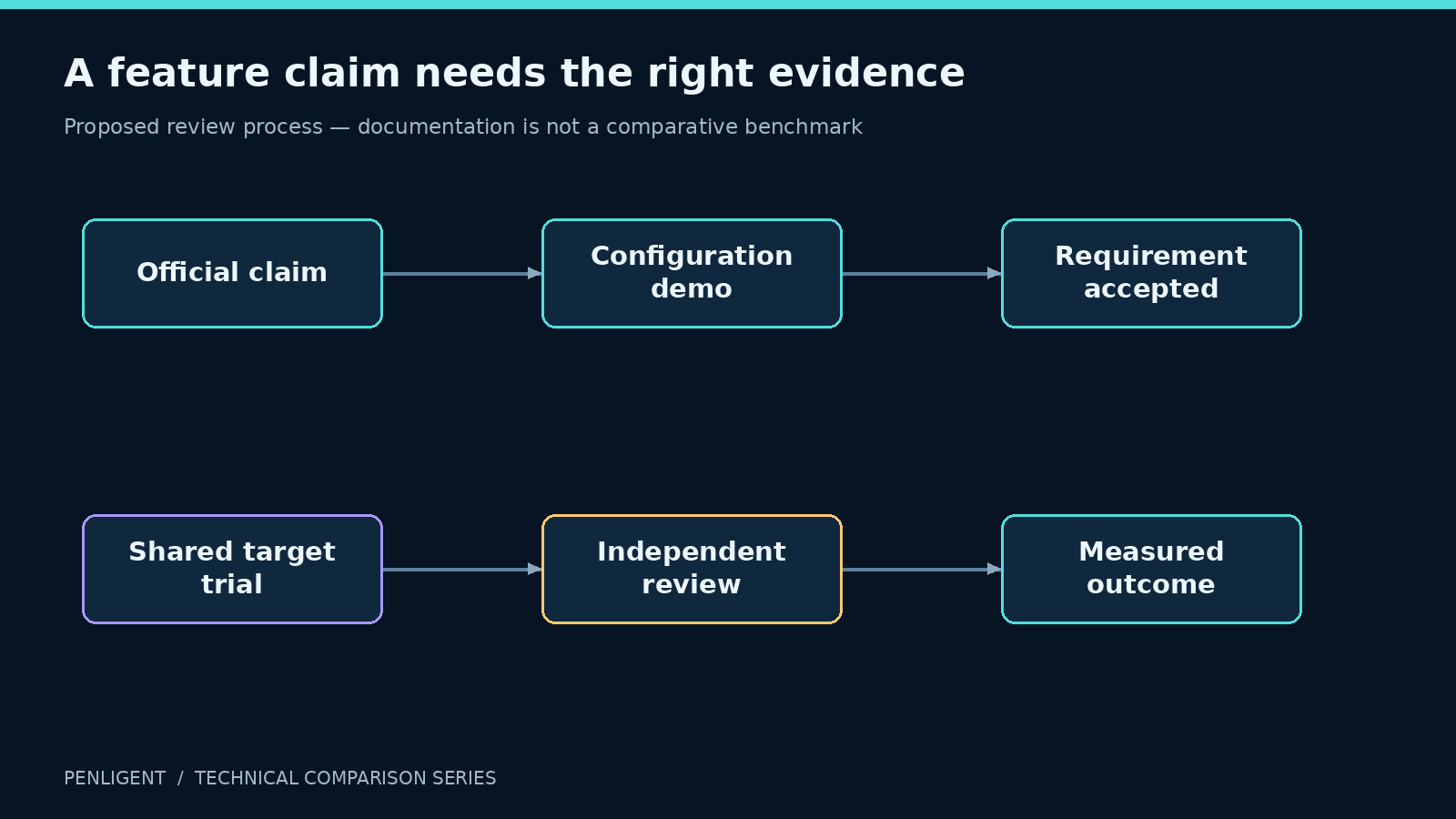
Feature comparisons often treat documentation, screenshots, demonstrations, and test results as interchangeable. They are not. A repository can establish that an implementation is available for inspection. A successful demo can establish that a particular workflow ran under demonstrated conditions. A controlled assessment can support a measured outcome on that target. None automatically proves the other two.
Use a small evidence hierarchy during review. Mark a capability as documented when the official source states it, demonstrated when it is observed in the proposed configuration, and accepted when it meets the team’s agreed criterion. Leave an unverified capability open. This avoids both unfairly marking a competitor as missing a feature and crediting a vendor with a feature that has not been shown in the purchased edition.
| Claim in a comparison | Adequate evidence for the decision | What it does not establish |
|---|---|---|
| The workflow can be self-deployed | Deployment instructions and a repeatable installation | Entirely local processing or low maintenance |
| The agent executes tools | Observed structured action and corresponding output | Correct interpretation of the result |
| The issue is validated | Reproducible evidence and independent review | Complete application coverage |
| The workflow integrates with a pipeline | Supported trigger, completion, error, and artifact contract | A suitable release policy without configuration |
| The report supports a customer engagement | A recipient can use the deliverable without reconstructing the run | Compliance certification or guaranteed audit acceptance |
This hierarchy also makes disagreements easier to resolve. If a public document and a demo appear inconsistent, identify the edition, revision, and deployment before changing the feature table. The mismatch may be a documentation issue, an unavailable configuration, or a real limitation. It should not be converted into a universal statement without that investigation.
Do not let autonomy hide human work
“Autonomous” can describe how a run proceeds after setup while saying little about how much setup and review it requires. Record the work before launch: target inventory, account preparation, business context, credential delivery, and environment resets. Then record intervention during execution and review after completion. This provides a fairer comparison than counting only the time between two buttons.
Use intervention categories rather than a vague assisted/unassisted label. Supplying missing credentials differs from revealing the vulnerable endpoint. Renewing an expired session differs from writing the successful test. Both can be legitimate, but they change what the outcome demonstrates. A team purchasing a copilot may welcome guided efficiency; a team requiring unattended operation needs that assistance visible.
Watch for hidden retries across multiple runs. Selecting the best of several outcomes can be useful for exploration, but it is not the same experiment as a single scheduled assessment. Record the number of attempts, resource limits, and conditions changed between attempts. If a product improves after receiving more context, preserve that context so the next run does not depend on the original operator’s memory.
The same rule applies to report editing. Correcting grammar is different from adding a missing reproduction or changing the vulnerability conclusion. Measure the substantive reconstruction work. Otherwise the comparison may attribute a strong final deliverable to the tool when the decisive analysis came from an experienced reviewer.
A weighted score should not override a failed requirement
Choose mandatory requirements first: an approved data boundary, permitted deployment, required target authentication, and usable evidence retention. Only eligible configurations should receive a weighted preference score. A high total should not cancel a violation of an organizational requirement that cannot be negotiated.
For the remaining criteria, assign weights based on real team costs. A team delivering reports every week may place substantial weight on review and handoff effort. A research group may emphasize observability and reproducibility. Keep the weight set fixed through the pilot and describe which observations support each score. A decimal total is not more objective than the evidence beneath it.
The following is an illustrative scorecard shape, not a benchmark result. Leave scores blank until the relevant demonstration or review has occurred. Use “not evaluated” rather than zero for an untested feature so missing evidence is not mistaken for a confirmed failure.
evaluation_record:
  purpose: recurring_staging_assessment
  mandatory:
    approved_data_flow: not_evaluated
    authorized_target_access: not_evaluated
    evidence_retention: not_evaluated
  preferences:
    confirmed_finding_quality:
      weight: 40
      score: null
    review_and_handoff_effort:
      weight: 25
      score: null
    operational_recovery:
      weight: 20
      score: null
    integration_effort:
      weight: 15
      score: null
  decision: pending_observed_evidence
The weights are a worked example for discussion, not recommended universal percentages. Replace them with the organization’s priorities and retain the justification. If the result changes dramatically after a small weight adjustment, investigate the underlying tradeoff rather than presenting the total as a decisive ranking.
Run a pilot that ends in a decision
Start with a kickoff that fixes scope, roles, time limits, evidence handling, and stop conditions. Agree who will operate each candidate and who will review the output. Keep the reviewers separate from the people configuring the tools where practical. This makes it easier to identify information that only the operator knew.
Use the next phase for configuration and a harmless connectivity check. Record setup effort and resolve authentication before evaluating detection. Then execute the selected scenario under the agreed conditions. Preserve interrupted and inconclusive results rather than replacing them silently with a cleaner rerun. A reliable comparison needs to show how the workflow behaves when prerequisites fail.
End with an independent finding review and a closeout discussion. For each candidate, state the accepted result, remaining gaps, required customer work, and conditions of any recommendation. An eligible tool may still need a narrow initial rollout. A failed pilot may justify a second trial if the failure was a correctable configuration issue, but that correction should remain visible.
For HackerAI, begin with the official application and execution requirements. For PentestGPT, identify the maintained workflow rather than combining every historical mode. For Penligent, request the plan and deployment that meet the stated requirements. The winner of a demonstration is less useful than a decision your team can explain after the demonstration is over.
Keep the comparison useful after a version change
An article can identify the right questions while its feature details age. During procurement, keep a dated copy of the official documentation and the configuration demonstrated. If a later version changes an execution path, revisit the affected requirement rather than treating the entire earlier comparison as permanently valid.
Retest the smallest meaningful case after a change. If the model gateway changes, verify structured execution and evidence handling. If report generation changes, repeat the independent handoff. If identity handling changes, repeat the role and revocation checks. A focused regression exercise is more informative than rerunning a large demonstration without knowing what the change could affect.
Retain the earlier result alongside the new one. A changed outcome may reflect the target, model, configuration, or product. Record those variables before assigning the difference to a single cause. This is particularly important when a repository workflow and a managed service evolve on different schedules.
The comparison should remain a decision record rather than a timeless ranking. State what was eligible, what was demonstrated, and which gaps remain. That lets a team revisit the choice when its own operating model changes, without rebuilding the entire evaluation from marketing claims.
Choose a workflow you can operate and review
Add Penligent when the central requirement is a workflow your team can procure, operate, review, and repeat. Ask for a demonstration that includes your hardest practical constraint: authenticated roles, a reporting handoff, an integration boundary, or a deployment restriction. Evaluate the proposed plan rather than assuming every feature applies to every customer.
If the immediate objective is research into the agent itself, start with the project whose implementation and workflow best match that experiment. If the objective is a security deliverable, start with acceptance criteria and make each candidate produce it. That distinction gives a more durable answer to “HackerAI or PentestGPT?” than a ranking built from unrelated demos.


 Spanish
  English
  German
  French
  Portuguese
  Japanese
  Korean
  Hindi
Hindi  Arabic
  Turkish
  Hebrew