
Ivanti’s November 2026 security updates require separate decisions for the management Core, endpoint agents, gateway trust, and mobile-management products. Each decision needs an identified installation, a verified release mapping, an exposure assessment, and an owner who can test the resulting service. A fleet-wide completion label becomes useful only after those component-specific results are reconciled against the systems that actually hold administrative authority.
The immediate EPM priority is CVE-2026-121653. NHS England’s November 11 alert identifies an unauthenticated Core SQL injection that can lead to remote code execution, with a CVSS v3.1 score of 9.8, affecting releases before 2024 SU8. The update decision should begin with the actual Core installation and its reachable interfaces, then extend to the systems whose administration depends on it.
CSA requires a separate trust review. The Ivanti-assigned record for CVE-2026-121683 describes missing authentication allowing arbitrary addition and deletion of trusted EPM Core certificate entries. That is a specific trust-configuration impact. It should not be rewritten as a confirmed generic remote-code-execution primitive.
The procedure below turns those facts into asset classification, controlled patching, certificate review, and repeatable acceptance evidence. It does not send SQL injection strings, invoke undocumented management endpoints, or attempt exploitation. The illustrative code operates only on fictional inventory rows in memory.
Set priority by administrative consequence and reachable scope
A management service is valuable because it can influence other systems. That influence should determine how the organization prioritizes remediation. Identify what each vulnerable installation administers, which identities can reach it, which network paths expose it, and which dependent services would be interrupted by maintenance. A small installation with broad production authority can matter more than a larger isolated test environment.
Do not wait for a public exploit to establish that a vulnerable, reachable management Core deserves urgent attention. The patch decision can be justified by the verified impact and the organization’s own exposure evidence. Exploitation intelligence is a separate input that can increase urgency or trigger an incident investigation. Keeping those inputs separate avoids turning “no exploitation observed by the vendor at disclosure” into an excuse to leave a high-consequence service unchanged.
Ivanti’s November 10 security release names five affected product families and states that it had no evidence of exploitation at that time. That is a dated vendor statement. It is not evidence that every installation remained uncompromised afterward, nor does it establish that all products carrying the Ivanti name are affected.
For operational prioritization, use three dimensions rather than one severity number. The first is applicability: whether the installed product and release match the affected scope. The second is opportunity: whether an unauthorized party can reach the relevant service or whether a required privileged context exists. The third is consequence: what authority, information, or dependent operations the service controls. Record uncertainty in each dimension instead of averaging it into a reassuring score.
A fictional example makes the distinction concrete. Core A is an older EPM installation used to administer production endpoints and reachable from a broad internal network. Core B is a disposable training system with no production identities and tightly restricted access. Both may require an update, but Core A should receive earlier containment, evidence preservation, and a coordinated maintenance window. Core B’s lower operational consequence does not make its version unaffected; it changes the order and method of remediation.
Reachability evidence should identify the vantage point. An external check that cannot reach a Core service does not establish that a compromised internal workstation could not reach it. A network rule that permits only an administrative subnet may be appropriate, but the trust of that subnet and its devices remains relevant. The organization should know which boundary is doing the protective work and what happens if that boundary fails.
Use “unknown” as an actionable state. If the team cannot identify the installed service update, treat applicability as unresolved and assign a verification task. If the network team cannot demonstrate the allowed sources, treat reachability as unresolved. Unknown is not the same as affected, but it is also not a reason to close the ticket. Temporary restrictions can reduce exposure while the missing evidence is collected.
Keep the product and vulnerability matrix precise
إن vendor’s Patch Tuesday summary reports 13 unique CVEs across five products. It identifies the EPM fix in 2024 SU8 and separate EPMM and Sentry updates. A portfolio summary is useful for planning, but each deployment still needs its own advisory and installation evidence.
| المكوّن | Verified issue or scope | Decision to make | Evidence required |
|---|---|---|---|
| EPM Core | CVE-2026-121653, before 2024 SU8 | Restrict exposure and apply the approved corrected release | Actual Core release, service update and post-change running state |
| EPM Agent | CVE-2026-18128, separate cleartext-transmission issue | Review agent rollout and relevant communication paths | Endpoint agent state and transport verification |
| CSA | CVE-2026-121683, trusted Core entry modification | Review applicability, update and reconcile trust configuration | Appliance release and approved certificate-entry baseline |
| EPMM and Sentry | Separate product advisories and prerequisites | Route to their owners rather than assuming the EPM update applies | Product-specific advisory and installed-release evidence |
The agent issue should not disappear behind the more severe Core issue. NHS England’s alert describes CVE-2026-18128 as cleartext transmission affecting the Agent before 2024 SU8, with a man-in-the-middle prerequisite. That changes what a verification plan must examine. A server-side release check does not by itself demonstrate that every managed endpoint has the intended agent state or communication protection.
The matrix should remain small enough to drive action. Do not fill it with unrelated historical Ivanti vulnerabilities merely because they share a vendor. Historical incidents can inform a general management-plane threat model, but they do not establish the mechanism or exploitation state of these November records. A responder should be able to tell which row comes from the current advisory and which control is an organization-specific recommendation.
Separate product names in tickets and deployment tooling. “EPM” and “EPMM” are not interchangeable abbreviations for the same installation. A task assigned to an endpoint-management owner may never reach the mobile-management owner unless the product is named explicitly. Likewise, an appliance update and a Windows management-server service update may require different backups, maintenance access, and validation procedures.
Link each row to an accountable owner and an exact maintenance target. The owner should confirm that the selected package belongs to the deployed branch, that prerequisites are satisfied, and that the rollback procedure is appropriate. Downloading a package whose filename contains a matching number is not sufficient provenance. Use the vendor’s supported distribution channel and retain the package identity and installation record in the change ticket.
Resolve version ambiguity without inventing certainty
إن Canadian Centre for Cyber Security advisory lists EPM through 2024 SU7 and CSA 5.0.8. AhnLab’s product update advisory lists CSA 5.0.8.1 as the corrected release. Confirm the current supported package and installation instructions with Ivanti before changing an appliance, especially if a later advisory revision supersedes that guidance.
There is also a record-quality issue worth preserving. During this review, the CSA CVE record’s description names 5.0.8, while its structured affected-version field marks that version unaffected and uses an affected default. That conflicts with the description and the Canadian bulletin. Automated inventory matching should flag this discrepancy for review rather than silently treating one machine-readable field as definitive. The CVE record and the vendor advisory remain important references, but their fields need contextual interpretation.
Preserve the conflict in the remediation ticket and identify which authoritative applicability statement the owner uses. Then verify the installed branch against the vendor’s current instructions. If the assessment team cannot access the required portal guidance, assign that check to an authorized product owner and keep the dependency visible. Broadening the claim to every release or inventing a corrected version table would replace a documented uncertainty with an unsupported deployment decision.
Version strings are evidence only when tied to the component that runs. A management database may record a desired package version while a service still uses an older binary. A deployment console may show a successful assignment while an offline endpoint has not installed it. An appliance may expose a build identifier that needs to be interpreted with the vendor’s release mapping. Preserve both the raw observation and the interpretation used to classify it.
For downstream or customized deployments, ask for explicit vendor confirmation when the release mapping is unclear. A later-looking internal build number does not automatically prove inclusion of a security fix. A lower-looking downstream package version may include a backport. The acceptance record should identify the evidence that connects the installed build to the corrected code, rather than relying on lexical comparison or a scanner’s display label alone.
Record the advisory retrieval date in the change ticket. If the vendor revises prerequisites, affected scope, or package instructions, the team can identify which deployments used the earlier information and review them deliberately. This is especially useful when a maintenance program spans several days. It avoids a situation in which two teams followed different advisory revisions but reported the same undifferentiated completion status.
Model the management trust boundary before changing it
The following diagram is a conceptual defensive model. It does not claim an undocumented request path or a complete exploit chain. It shows why Core execution authority, gateway trust configuration, and managed endpoint state need different controls. Use the actual deployment architecture to replace the generic relationships during an assessment.
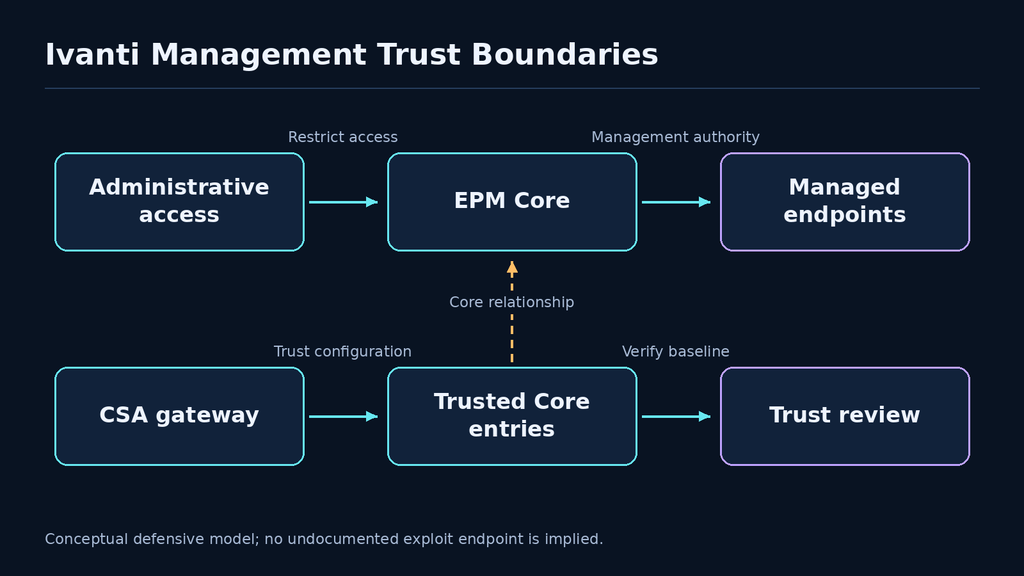
Start with the authority relationships that the business intends to permit. Which administrators manage the Core? Which network segments can reach it? Which gateway relationships are approved? Which endpoints trust the management service? Which accounts hold deployment or configuration privileges? These questions define the expected state against which the incident and maintenance records can be compared.
Then identify where a change to one component could affect another. A Core maintenance window may delay endpoint administration. A certificate-entry change may alter a trusted relationship. A network restriction may interrupt a legitimate integration. This dependency map should inform the maintenance plan, not become a reason to leave a vulnerable service broadly reachable. Where a restriction affects business operations, design an approved narrow route and test it.
Trust-entry review deserves particular care because a list can look plausible without being authorized. A familiar organization name is weaker evidence than a certificate fingerprint, issuance history, change record, and named owner. Compare the current entries with an approved baseline. Investigate additions, deletions, and replacements that the change process cannot explain. Do not publish real customer certificate inventories or private infrastructure identifiers in a shared report.
A topology diagram should distinguish confirmed relationships from assumptions. Use a solid connection when configuration and observation support it. Use a dashed connection when the relationship is expected but not yet verified. Add an owner and a verification task for each important unknown. The diagram then becomes a working assessment tool rather than a decorative picture that silently implies complete knowledge of the environment.
The boundary model also helps define safe validation. An assessor can verify network reachability from approved vantage points, inspect configuration through supported administrative interfaces, compare trust entries, and observe permitted business traffic. Those checks can establish substantial exposure and remediation evidence without invoking the vulnerable operation. Exploitation is not a prerequisite for every useful management-plane security conclusion.
Capture the right baseline before the maintenance window
A maintenance baseline should make two later questions answerable: what changed, and what should still work? Capture the installed product and release, relevant service state, configuration identity, approved trust entries, network policy, and critical integration tests. Use the vendor’s supported backup process for the deployed product. The baseline should be complete enough to support rollback and investigation without copying unnecessary endpoint or customer data into the change ticket.
For the Core, identify the business functions that depend on it and the people who can judge those functions. A service responding to a health check may still fail an administrative workflow used by the endpoint team. Define a small set of representative positive tests before maintenance, execute them once to establish the expected result, and repeat them afterward. Keep the test objects and accounts limited to approved fixtures.
For CSA, preserve the approved trust-entry list and the evidence establishing ownership of each entry. A baseline captured after a suspicious change can preserve the wrong state, so compare it with an earlier trusted record when available. If no trusted historical baseline exists, rebuild ownership from authoritative inventory and change records. Mark unresolved entries for review rather than approving them merely because they existed before the patch.
Verify backup usability before relying on it. Record where the backup is stored, who can retrieve it, what credentials or keys are needed, and which restoration steps have been tested. A backup file existing in a directory is not the same as a usable recovery capability. The maintenance owner should know whether rollback restores a vulnerable state and what compensating restrictions would be required if rollback becomes necessary.
Preserve relevant logs before retention windows or maintenance operations make them unavailable. The collection should support the suspected interval and the actions of interest, not indiscriminately archive every record forever. Record collection time, source, scope, and integrity information according to the incident procedure. If suspicious activity is already present, coordinate with the incident team so patching does not erase evidence needed to establish historical impact.
Finally, define the maintenance stop conditions. An unexpected trust change, an unverified package, a failed backup, or a critical business test that cannot be established may require pausing or changing the plan. The decision owner should be available during the window. A well-defined stop condition prevents a rushed operator from improvising an unsupported recovery step simply because a countdown or change deadline is approaching.
Execute a product-specific change with a controlled fallback
Separate containment from the update itself. A temporary access restriction can reduce opportunity while the team prepares maintenance. The restriction should be narrow enough to preserve an approved administrative path, and its owner should verify that the intended sources still work. Record the restriction’s purpose and expiry so it is neither removed accidentally during troubleshooting nor left indefinitely without review.
Choose a representative first deployment when the environment permits staged maintenance. The first target should exercise the important dependencies without exposing the largest business consequence. Define what success means before starting: installation completed, expected service state restored, approved trust relationships preserved, management operations functional, and security telemetry available. A package installer’s success code is one input to that decision, not the entire decision.
Use the vendor’s current instructions for package prerequisites, installation sequence, and any required restart or service action. This article does not substitute a generic command sequence for those product-specific requirements. Record the package identity and the advisory revision used. If an operator encounters a condition the procedure does not cover, escalate through the change process rather than borrowing steps from a different Ivanti product or an old incident blog.
Keep pre-change and post-change observations distinct. A screenshot captured before the installer runs should not become the final version evidence because it was attached to the same ticket. Timestamp every verification and identify the component observed. If the update requires endpoint rollout, record the server completion separately from the managed-agent completion. The change may have multiple valid intermediate states that should not be collapsed into one green status.
Rollback should be a decision path with consequences. If a critical business test fails, the owner should determine whether a supported repair is available, whether rollback is necessary, and what exposure restrictions will remain during the fallback. Returning to an affected release restores the original security problem. The ticket should reopen the applicability state and name the compensating controls, rather than continuing to report the asset as remediated.
For a failed update, preserve enough installation and service evidence to diagnose the problem. Avoid repeated reinstall attempts that obscure the first failure and make the environment harder to interpret. Record what changed on each attempt and which supported recovery action followed. A controlled retry can be appropriate, but the response should become more informed with each step instead of repeating an operation until the dashboard happens to turn green.
After the first target passes its acceptance tests, expand the rollout in batches that the team can observe and support. The batch size should reflect the ability to detect a failure and recover affected operations. A deployment wave that outruns the support team’s capacity can create pressure to bypass security restrictions or skip verification. The operational goal is verified completion across the scoped population, not the fastest possible package assignment.
Keep an exception queue for offline, unsupported, or otherwise blocked systems. Each exception needs an owner, a reason, a temporary exposure decision, and a scheduled next action. A system that cannot receive the corrected release may require isolation, retirement, or a vendor-supported alternative. Leaving it outside the rollout denominator makes the completion report look better while leaving the actual management authority unchanged.
Review CSA trust entries as authorization data
A trusted certificate entry is a policy decision. Its presence should correspond to an approved Core relationship with a known owner and purpose. Treat the review as an authorization-data reconciliation exercise rather than a cosmetic comparison of certificate names. The expected set should come from trusted configuration records and deployment ownership, with unexplained differences investigated before the appliance returns to its normal access posture.
Build the comparison around stable attributes. A fingerprint, serial number, issuer, validity interval, associated Core identity, change reference, and owner can help distinguish a legitimate renewal from an unexplained addition. The precise fields available depend on the product and supported interface. Preserve what the platform actually exposes; do not invent a field or assume an internal database structure to make the review look more complete.
Look for both additions and deletions. An unauthorized addition can alter trust, while an unexplained deletion can disrupt an approved relationship or conceal earlier changes. A replacement may be legitimate certificate renewal or a meaningful trust change. Compare the current state with the last trusted baseline and the intervening change records. A simple count of entries cannot distinguish these cases.
When a baseline is missing, reconstruct ownership deliberately. Ask the responsible infrastructure teams to identify the Cores that should be trusted and provide independent evidence of their identities. Reconcile that list with the appliance configuration. Unknown entries should remain unresolved until ownership is established or the incident lead approves a containment action. The existence of a working connection does not by itself establish that the relationship should exist.
A patch and a trust review support different claims. The patch addresses the reported software defect according to the vendor’s release guidance. The review assesses the configuration currently granting trust. An update does not automatically prove that historical unauthorized entries were absent or removed. Conversely, a clean-looking trust list does not establish that the vulnerable software was corrected. Preserve both results in the remediation evidence.
If suspicious trust changes are found, preserve the original observations and escalate through the incident process. Investigate the relevant administrative records, timing, associated systems, and any subsequent activity before drawing a broader conclusion. A trust-entry discrepancy is important evidence, but it does not alone prove every possible downstream action. The incident scope should follow the authority and activity that can be established.
Design future trust changes to be reviewable. Require a named owner and an approved purpose, retain a before-and-after record, and test the intended relationship after the change. Periodic reconciliation can then compare the current set with an intentional inventory rather than a screenshot whose origin no one remembers. This control remains valuable after the current vulnerability is remediated because it governs the authority the appliance is meant to express.
A safe inventory classifier exposes weak remediation labels
The following Python example evaluates fictional inventory data. It does not connect to an Ivanti installation, read local configuration, send a network request, or test a vulnerability. Its purpose is to demonstrate why a remediation classifier should preserve product identity and uncertainty. The reference releases are illustrative decision inputs drawn from the cited advisories; a real program must use current vendor-supported applicability data.
inventory = [
    {"asset": "lab-core-a", "product": "EPM", "version": "2024 SU7"},
    {"asset": "lab-core-b", "product": "EPM", "version": "2024 SU8"},
    {"asset": "lab-gateway-a", "product": "CSA", "version": "5.0.8"},
    {"asset": "lab-gateway-b", "product": "CSA", "version": "5.0.8.1"},
    {"asset": "lab-mobile-a", "product": "EPMM", "version": "unknown"},
]

known_affected = {"EPM": {"2024 SU7"}, "CSA": {"5.0.8"}}
reference_fixed = {"EPM": {"2024 SU8"}, "CSA": {"5.0.8.1"}}

def classify(row):
    product, version = row["product"], row["version"]
    if product not in reference_fixed:
        return "review separate product advisory"
    if version in known_affected[product]:
        return "affected reference: remediate"
    if version in reference_fixed[product]:
        return "reference release matched: verify running state"
    return "unknown mapping: verify with vendor"

results = {row["asset"]: classify(row) for row in inventory}
assert results["lab-core-a"] == "affected reference: remediate"
assert results["lab-mobile-a"] == "review separate product advisory"
assert "verify running state" in results["lab-gateway-b"]
print(results)
The classifier intentionally avoids comparing arbitrary version strings as ordinary text. It also avoids treating an unrecognized release as fixed. A later or customized release needs a supported mapping. The result for a reference fixed release remains “verify running state,” because an inventory value can describe a target or cached observation rather than the process that actually runs after maintenance.
Notice the separate result for EPMM. The program does not infer that the EPM service update fixes a different product. That behavior is useful even in a small spreadsheet. Product-specific review may feel slower than one broad deployment label, but it prevents a false completion state from spreading across several management systems whose owners and maintenance procedures differ.
A production inventory workflow should preserve the raw version observation, collection time, collection source, component identity, and the advisory mapping used. If the mapping changes, the organization can re-evaluate the recorded population without recollecting every fact. If the raw observation changes, the team can distinguish a new installation state from a revised interpretation of the same state.
Do not convert this educational classifier into a live exploit probe. The useful next step is to reconcile it with approved inventory and vendor documentation, then validate the actual deployment through supported administrative checks. A classification result helps prioritize work. It does not certify that a management service was never compromised or that its configuration contains no unauthorized trust.
Verify the update across version, reachability, trust, and service
Remediation verification should answer four different questions. Does the running component match a corrected supported release? Is access restricted to the intended sources? Does its trust configuration match the approved relationships? Do legitimate management operations still function? A test plan that answers only the first question can miss configuration drift or an accidental exposure introduced during the maintenance window.
For version evidence, collect the platform-supported release observation after installation and any required restart or relaunch. Identify the exact component and time. Where an endpoint agent rollout is involved, reconcile successful installations with the scoped endpoint population. Offline devices and failed deployments should remain exceptions. Do not infer fleet completion from the management server’s own release number.
For reachability, test from the approved administrative vantage point and from a controlled unauthorized vantage point within the assessment scope. The expected result should be defined before testing. A permitted administrator should reach the required function through the intended path; a disallowed source should be blocked. Avoid broad scanning or testing networks that the organization has not authorized.
For trust configuration, compare current approved entries with the reviewed baseline and retain the differences. If a certificate renewal occurred during maintenance, connect it to the approved change record and test the associated management relationship. The evidence should explain the change rather than merely record that two lists differ. Unexpected changes should block unconditional completion until they are understood or governed by an explicit exception.
For service functionality, repeat the representative tests established before maintenance. Use a designated endpoint and a limited administrative account where possible. Check the management operation that the business actually relies on, together with its audit record and result. A generic health page can be useful, but it should not substitute for the workflow whose failure would interrupt operations.
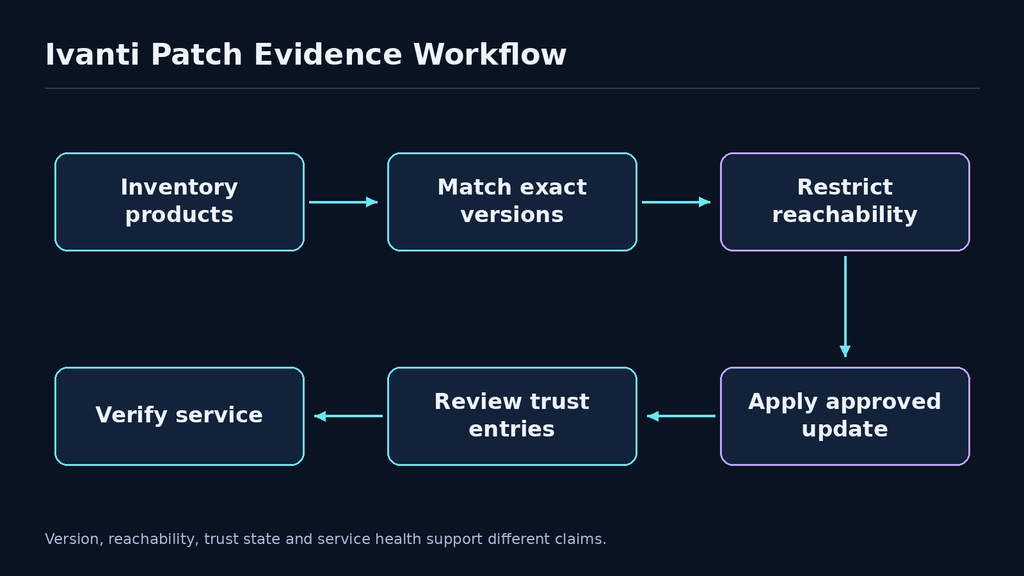
An authorized tool such as Penligent can help organize reachable-surface checks and evidence for the application boundaries included in an assessment. Keep the conclusion aligned with the observation: an external access-control test is not a substitute for authenticated release evidence, appliance trust reconciliation, or endpoint-agent inventory. Combine those records under one asset and change identifier.
Preserve failed tests as first-class results. A blocked administrative workflow may require a policy correction. An unauthorized source that remains reachable may require additional containment. A missing endpoint version may require another check-in. The maintenance owner should see those failures immediately, with an accountable next action. A final report should not discard them simply because the installer completed successfully.
Know when patch management must become incident response
A vulnerable installation is a remediation finding. Evidence of an unauthorized configuration change or unexplained execution can require an incident investigation. Establish that transition before maintenance begins so the operator does not have to invent an escalation threshold in the middle of a service restart. The threshold should identify concrete observations, a decision owner, and the evidence to preserve before further changes.
Examples of escalation leads include an unexplained trusted-Core entry, an administrative account or role change outside the approved process, an unexpected process chain on the management host, or management operations that the recorded operators cannot account for. These are investigation triggers, not automatic proof that a particular CVE was exploited. The incident team should test the relationship between the observation, the service, the relevant interval, and the authority involved.
Preserve the distinction between mechanism and attribution. A suspicious process on an EPM host does not by itself establish that SQL injection caused it. A changed trust entry does not identify the person or access route responsible. The response can still contain the system and protect dependent assets while those questions remain unresolved. A precise report states the observed action first, then the supported causal assessment and its limits.
Build the investigation scope from the authority the affected service held during the suspected interval. Identify the managed population, deployment credentials, administrative identities, integration accounts, and approved gateway relationships that were relevant then. Current configuration may differ after containment. Preserve historical records so the team can distinguish what the system could reach during the incident from what it can reach after remediation.
Coordinate patching with evidence preservation rather than treating them as mutually exclusive. Restrict access promptly when appropriate, collect the relevant baseline through approved methods, and apply the corrected release according to the incident plan. A responder should not leave a high-consequence service exposed indefinitely to obtain perfect evidence. Nor should an operator erase the only available evidence through an uncoordinated rebuild. The incident lead owns that tradeoff and documents the reasoning.
Do not claim historical safety from a successful post-patch test. A rejected request after maintenance demonstrates a current control outcome. It does not establish that earlier unauthorized access did not occur. Historical assessment depends on retained records, endpoint observations, configuration history, and other case evidence. The final report should keep current remediation and historical impact in separate sections so one conclusion does not silently stand in for the other.
If the investigation finds no corroborating activity, state the observation interval and evidence coverage. “No unauthorized changes were identified in the reviewed records” is a narrower conclusion than “the system was never compromised.” That precision helps the business decide whether the available confidence is sufficient for restoration. It also prevents later evidence from appearing to contradict a report that should have acknowledged its limits from the start.
Where rebuilding is chosen, restore from trusted media and approved configuration rather than a snapshot whose trust is under investigation. Reintroduce secrets and management relationships according to the recovery plan, review the authority they grant, and verify business functions before expanding access. The rebuild should produce a new, documented trust state. Merely moving the same uncertain configuration to a fresh virtual machine does not resolve the policy questions.
Keep the maintenance population honest as systems change
A management-platform rollout rarely happens against a static inventory. Devices go offline, ownership changes, a second Core appears in an acquisition, or an old appliance returns from a disaster-recovery environment. Define how newly discovered assets enter the remediation population. The program should be able to add scope without restarting verified work and without excluding inconvenient systems to preserve a completion percentage.
Use one durable asset identifier for the change record, inventory observation, deployment result, and verification evidence. Hostnames and display labels are useful to humans but can change or collide. If the organization replaces a host, connect the old and new identities in the record and mark the old one retired only after its administrative authority and network presence are addressed. A renamed asset should not disappear from the exception queue.
Offline endpoints need a return-to-service condition. The endpoint owner should know what happens when a device that missed the rollout reconnects. It may require an update before resuming normal management or a temporary network restriction until verification completes. The exact mechanism depends on the organization’s supported tools, but the condition should be explicit. Otherwise, an apparently completed fleet can quietly regain an affected component later.
Disaster-recovery copies deserve the same treatment. A standby management server or appliance may not be reachable during routine operations, yet become authoritative during an outage. Record its release, configuration baseline, and activation procedure. The recovery plan should not restore a vulnerable management service simply because that image was the last one tested for business continuity. Security maintenance and continuity testing need a shared inventory of the systems that can become active.
For an unsupported branch, distinguish inability to patch from a decision to accept risk. The owner should obtain a supported migration or retirement path, identify interim restrictions, and set a review date. An exception should specify which authority remains exposed and why the business temporarily needs it. A generic “legacy system” label does not tell the next operator which connections may be allowed or when the exception expires.
Retirement needs evidence too. Confirm that the old system no longer provides management service, that its network route is removed or restricted as intended, and that associated accounts, trust relationships, and scheduled integrations are reviewed. Deleting an inventory row is an administrative action, not proof that the authority disappeared. A retired system can remain consequential if another component still trusts it or a stored credential still grants access.
Reconcile the population at the end of each rollout wave. Report the number of identified assets, verified corrected assets, blocked assets, unresolved applicability cases, and retired assets with evidence. Explain changes in the denominator. This allows a reviewer to see whether progress reflects real remediation or merely a revised inventory. The report should make the remaining work easier to act on, not merely easier to present.
Finally, preserve the mapping logic used for that report. If a structured CVE field conflicts with an advisory, record the review decision and source. If a vendor later changes the applicability statement, the organization can re-evaluate the affected rows deliberately. The goal is a repeatable interpretation process that can accommodate new information without silently rewriting the history of what the team knew and did.
Make evidence useful to operations, security, and assurance
A remediation package should support several readers without requiring each one to reconstruct the entire maintenance event. Operations needs to know whether the service works and what to do if it fails. Security needs to know which exposure and authority were removed. An assurance reviewer needs to know who approved the work and whether the evidence supports the completion claim. These views can share one underlying record while emphasizing different decisions.
Use a compact evidence index rather than attaching a pile of unlabeled screenshots. For each claim, identify the asset, the expected state, the observation method, the observation time, the result, and the evidence location. Include the advisory revision and the change identifier. A reviewer should be able to distinguish a pre-change baseline from a post-change acceptance result without opening every attachment.
Keep sensitive details in the appropriate evidence store. Certificate fingerprints, internal addresses, account names, and configuration exports can reveal operational structure even when they are not secrets in the cryptographic sense. The shared report can use stable references and summarized outcomes. Restrict access to the originals according to the organization’s incident and change-management procedures, and retain them for a defined purpose and period.
Document the test’s vantage point and permissions. A network restriction result obtained from a designated assessment subnet supports a claim about that route. It does not necessarily cover a separate partner connection or an internal administrative segment. An authenticated release check performed by a read-only inventory identity is different from an unauthenticated banner observation. The evidence index should preserve those distinctions so a broad conclusion is not built on a narrow test.
Separate package provenance, installation success, running-state verification, and business acceptance. They are related but not interchangeable. The package record establishes what the team intended to install. The installer record shows what operation completed. The running-state observation shows the current component. The business test shows that a required function works. Together they support a stronger completion decision than any single screenshot or scanner result.
An assurance request should not force unsafe validation. If someone asks for proof that the vulnerability no longer works, explain which non-exploit checks establish applicability and corrected state, which supported controls verify the boundary, and what historical questions remain outside that test. A carefully scoped acceptance plan is often more reproducible than an ad hoc exploit attempt that changes the system or produces ambiguous results.
Retain the exceptions beside the successful results. A reviewer should see which assets remain unresolved, what temporary controls apply, and who owns the next action. Hiding exceptions in a separate system weakens the report because the completion claim loses its denominator. A remediation program can be effective while some work remains; its credibility depends on describing that work accurately.
At handoff, provide operations with the approved configuration baseline, the normal access paths, the relevant monitoring expectations, and the escalation route for unexpected trust or service changes. The security improvement should become part of the maintained operating state. If the only durable output is a closed vulnerability ticket, the organization may lose the configuration and verification knowledge needed to preserve that state through the next upgrade.
Test the decision process with realistic maintenance failures
A tabletop exercise can reveal whether the organization’s procedure handles ambiguity. Use fictional assets and sanitized records. Give the team an EPM Core with an affected service update, a CSA appliance with an unexplained trust entry, an offline endpoint agent, and a business owner who can offer only a short maintenance window. Ask for a prioritized plan, explicit stop conditions, and a completion report that preserves unresolved work.
In the first scenario, the installer succeeds but the running component still reports the earlier release. The team should investigate the supported restart or service requirements and confirm the actual state before closing the task. It should not replace the observation with the desired inventory value. The exercise tests whether the program measures an outcome or merely records an attempted deployment.
In the second scenario, the CSA version mapping is inconsistent across data sources. The team should identify the authoritative advisory, preserve the discrepancy, and obtain vendor clarification where needed. It should not silently trust the most convenient field. This is a useful exercise for automated vulnerability-management pipelines because a parsing success can conceal a semantic contradiction in the underlying record.
In the third scenario, an approved management function fails after a network restriction. The team should identify the required source and operation, then design the narrowest supported correction that restores the function. Removing every restriction to make the health check pass would abandon the containment goal. Leaving the service broken without an owner would abandon the operational goal. The exercise requires both to be satisfied deliberately.
In the fourth scenario, a previously unknown Core appears after the rollout report is issued. The team should add it to scope, determine its historical authority, and apply the same applicability and verification process. Existing verified assets need not be reworked without cause. The report should explain the new denominator and next action rather than pretending the original inventory was complete.
In the fifth scenario, rollback restores business functionality but returns the component to an affected release. The correct result is a reopened remediation state with documented restrictions and a new approved plan. The service can be operationally restored while the security finding remains open. Keeping those states separate prevents an emergency fallback from being misreported as a successful security update.
Evaluate the exercise by whether another reviewer can follow the reasoning. Did the team preserve product identity? Did it distinguish current remediation from historical compromise? Did it assign unknowns to owners? Did it verify trust and business behavior as well as version? Did it retain a supported fallback? Those questions test the quality of the management-plane program beyond a one-time response to a particular CVE.
Review scheduled work before restoring management authority
Maintenance can interrupt the work that a management system normally coordinates. Before the window, identify scheduled deployments, recurring administrative jobs, integrations, and operator-initiated tasks that may overlap it. The important question is what each workflow does when the service is unavailable and when it returns. Establish the actual supported behavior of the deployment rather than assuming every job pauses, retries, or resumes in the same way.
Give each important job an owner and an intended disposition. Some work can be paused and restarted deliberately. Some may need to complete before maintenance. Some may be safe to retry, while other operations can produce duplicate changes if repeated. The maintenance plan should identify these differences. A service returning to a healthy state does not by itself establish that the work around the outage has the correct business outcome.
For an operation that changes endpoint state, document what makes it safe to repeat. A package assignment, a configuration change, and a one-time business action can have different repetition semantics. Use a designated test asset or vendor-supported observation to establish what the actual workflow does. Do not discover the answer by allowing a broad production job to run twice and waiting for support tickets.
Review the authority carried by automation identities. A job that no longer serves a business purpose should not regain broad administrative access merely because the platform is back online. Connect each retained identity to an owner, a task, and the minimum required permissions. Where a secret changes during maintenance, update the approved dependent workflow through the normal secret-management process and verify its permitted operation without exposing the value in logs.
Use a controlled restart order for dependent work. Bring the management service to its verified state first, confirm the required trust and access relationships, then resume selected jobs with observation. The correct sequence depends on the deployment, but the decision should be explicit. Restarting every integration simultaneously can make a failure difficult to attribute and can obscure which change restored or broke the service.
A post-maintenance backlog should be reviewed for authorization and relevance before execution. Work requested before a role change, device retirement, or incident containment decision may no longer be appropriate. Determine how the platform represents pending work and which supported controls can cancel or reapprove it. This is a general administrative-safety review, not a claim that the November vulnerabilities create a particular queue behavior.
For evidence, retain the job identifier, requesting owner, approved target population, expected effect, resumption time, and observed result. If a job is canceled, record why and what replaces it. If a job fails, connect the failure to the maintenance timeline and assign a next action. These records let operations distinguish a delayed maintenance effect from a new security lead without dismissing either prematurely.
Include a small backlog test in the maintenance rehearsal. Create a harmless, bounded task against a designated fixture, interrupt the relevant service in the approved test environment, and observe its supported recovery behavior. Check whether the task requires reapproval, whether it can execute more than once, and whether the audit trail remains intelligible. The test should never target an unauthorized network or make an irreversible production change.
Finally, define when normal scheduling resumes. The service owner should accept the platform’s current state, the relevant integrations, and the disposition of interrupted work. If a dependency remains unresolved, keep its automation restricted and give it an owner. This prevents a technically successful patch from being followed by an uncontrolled burst of administrative actions that the team cannot explain or safely reverse.
Record one final resumption decision with the approved job population and its observation window. If the first resumed task behaves unexpectedly, pause the remaining population and investigate that result before widening the rollout. This gives the service owner a practical control over recovery speed and leaves a clear explanation of which administrative actions were authorized after maintenance.
The incident lead should review that record before closing related security exceptions.
Frequently asked questions about Ivanti’s November updates
Which EPM release is the key reference for CVE-2026-121653?
- NHS England identifies releases before 2024 SU8 as affected. Verify the current supported vendor package and the actual running Core state.
- Do not infer endpoint-agent completion from the management server’s version.
Is the CSA issue the same as the EPM Core RCE?
- No. The CSA record describes unauthorized trusted-Core certificate-entry modification. Keep that impact distinct from the Core SQL injection.
- A trust review and a software update answer different recovery questions.
Why flag the CSA affected-version field?
- The machine-readable field observed during review conflicts with the description and the Canadian advisory. Preserve the inconsistency and use current vendor guidance for applicability.
- Automated ingestion should create a review case rather than invent a corrected table.
Was exploitation confirmed in the release announcement?
- Ivanti’s November 10 statement said it had no evidence of exploitation at that time.
- That dated statement does not establish the history or current safety of a particular installation.
Can a scanner alone close the remediation ticket?
- Use scanner findings as evidence within their observed scope. Combine them with installed and running release evidence, access-control checks, trust review, and business acceptance.
- Record the test vantage point and the evidence gaps.
Should EPMM and Sentry use the EPM deployment plan?
- No. Route each product to its current advisory, supported package, owner, and maintenance procedure.
- A shared vendor name does not imply shared prerequisites or a shared corrected release.
What justifies incident escalation after patching?
- Unexplained trust changes, administrative actions, execution evidence, or other concrete leads should enter the incident process even if the release is now corrected.
- Current patch evidence cannot settle historical impact. Preserve the relevant records and define the investigation scope.
 Arabic
 English
 German
 French
 Spanish
 Portuguese
 Japanese
 Korean
 Hindi
 Turkish
 Hebrew