
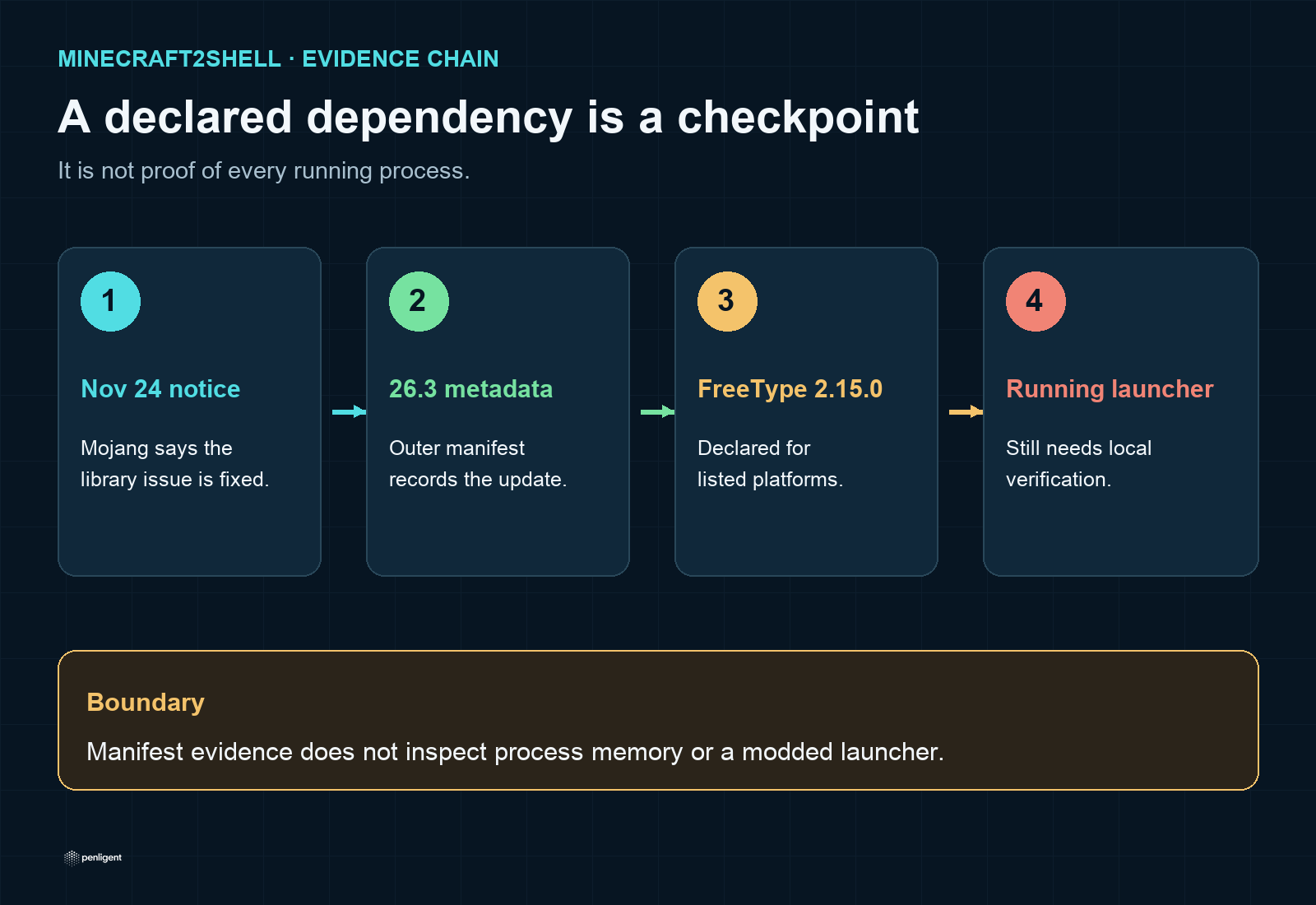
Minecraft2Shell should be treated as a runtime verification problem, not a version-number shortcut. Public research demonstrated a native code-execution condition on a specific Mojang-signed Minecraft Java 26.3 Windows x64 build that bundled FreeType 2.14.3. On November 24, Mojang announced that the critical library issue had been fixed and told official-launcher users to close their game sessions and restart the launcher. The useful question for a defender is therefore whether the launcher and its native libraries refreshed, not whether the game still displays “26.3.”
Mojang’s technical director also told third-party-launcher users to verify that their launchers received updated libraries from the official manifest. The original notice و third-party-launcher reply are the primary operational signals used here. This article does not claim an assigned Minecraft CVE, active exploitation, or exposure across every version and platform.
Why the game version is not enough
Minecraft’s outer version manifest records a November 24 update time for the 26.3 entry even though the game’s original release date remains earlier. The 26.3 package metadata checked on November 25 declares org.lwjgl:lwjgl-freetype:3.4.3-mojang-2.15.0 for the listed operating-system variants. That is meaningful evidence that Mojang’s declared dependency changed. It is not proof that an arbitrary third-party launcher has refreshed, nor proof of what a running process has loaded.
What the public research actually demonstrated
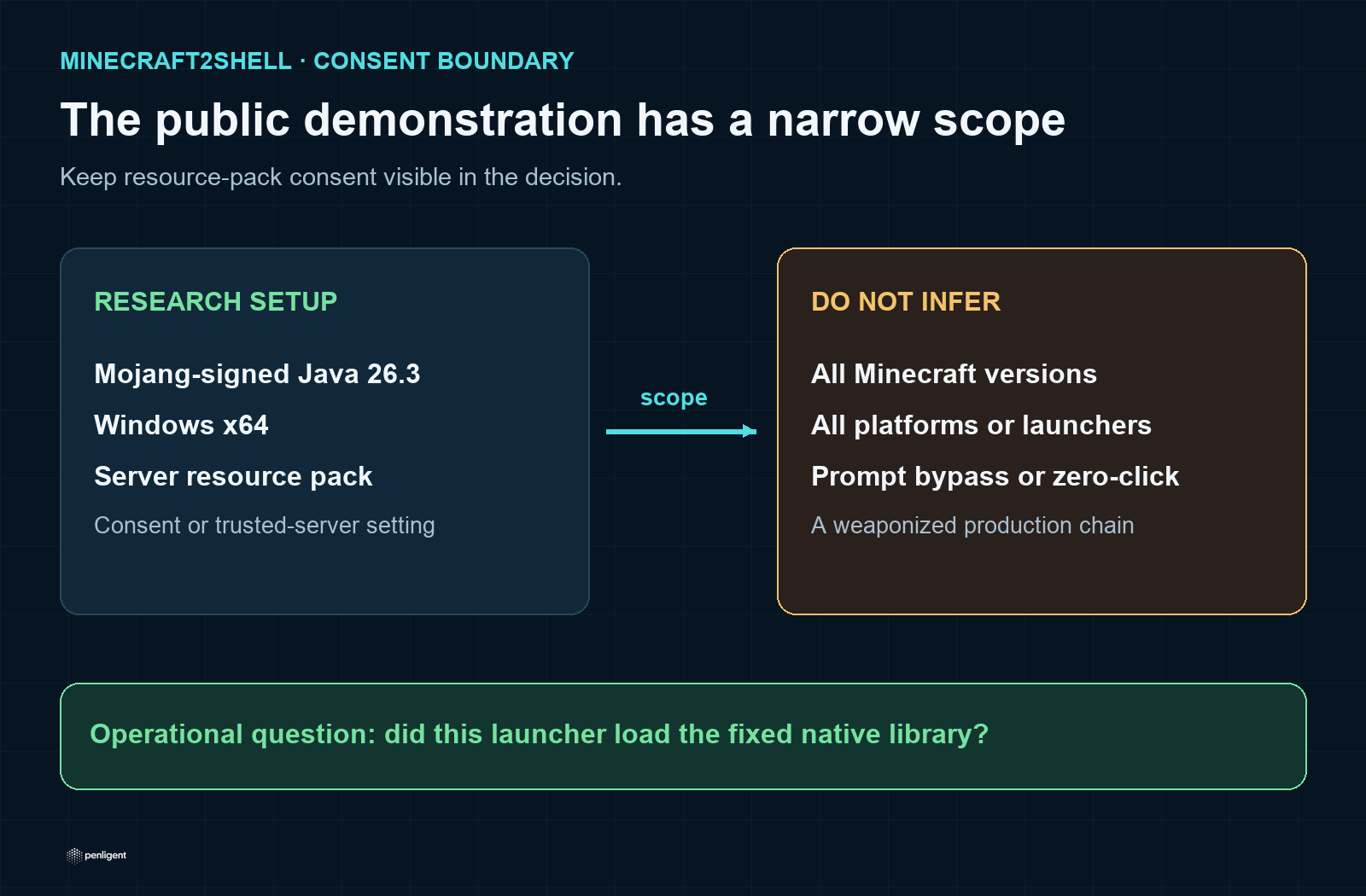
The researcher’s repository and README describe an exact-build demonstration against Mojang-signed Java 26.3 on Windows x64 with bundled FreeType 2.14.3. A server-delivered resource pack causes native TrueType font processing. The published setup does not justify a statement that every Minecraft release, every operating system, or every launcher is affected.
The resource-pack path also matters to the security boundary. The demonstration requires the pack to be accepted, or a trusted-server setting that automatically accepts it. That is a different claim from bypassing the prompt or proving a universal zero-click attack. Keep the consent condition in any internal risk record and do not turn the research setup into a production attack recipe.
A practical verification sequence
- Record the launcher. Identify the official launcher, a third-party launcher, or a modded profile. The update path differs, and Mojang’s instruction for third-party launchers is to verify their library state against the official manifest.
- Close active sessions and restart the official launcher. Mojang’s notice specifically tells official-launcher users to close game sessions and restart the launcher. Do not treat an already-running game as refreshed evidence.
- Compare the manifest checkpoint. Confirm that the 26.3 metadata your launcher resolves declares the FreeType 2.15.0-named dependency. Save the manifest timestamp and the launcher profile used for the check.
- Verify the selected runtime. Use the launcher’s resolved library inventory to verify the selected profile’s declared or installed dependency. Where running-runtime confirmation is required, collect separate approved process-level evidence; the launcher inventory alone does not show what the process loaded. Do not report this step as complete when only the game version is known.
- Keep the consent boundary in the ticket. Record whether the environment allows automatic resource-pack acceptance for trusted servers. This changes the exposure path, but it does not change the requirement to update the native library.
What the current evidence does not establish
The public record does not establish a portable exploit for every Minecraft Java version, a universal third-party-launcher update, or a prompt bypass. The official manifest proves a declared dependency, not that an arbitrary local process loaded it. The research repository is valuable for understanding the mechanism and its boundaries, but it is not a license to generalize the demonstrated build to a whole fleet.
For a security assessment, the defensible status labels are manifest updated, launcher refresh verifiedو running runtime verified. Keep them separate. A host that only shows “26.3” is undetermined until the launcher and native-library evidence are checked.
Method: source-based analysis prepared with AI assistance and checked against Mojang’s developer notice, official version metadata, and the original research repository. No JAR was downloaded, no exploit was run, and no running process was inspected by Penligent.
The following official Penligent 3.0 video demonstrates a general product workflow. It does not demonstrate Minecraft2Shell exploitation or prove that a launcher has loaded a fixed library.
 Arabic
 English
 German
 French
 Spanish
 Portuguese
 Japanese
 Korean
 Hindi
 Turkish
 Hebrew