
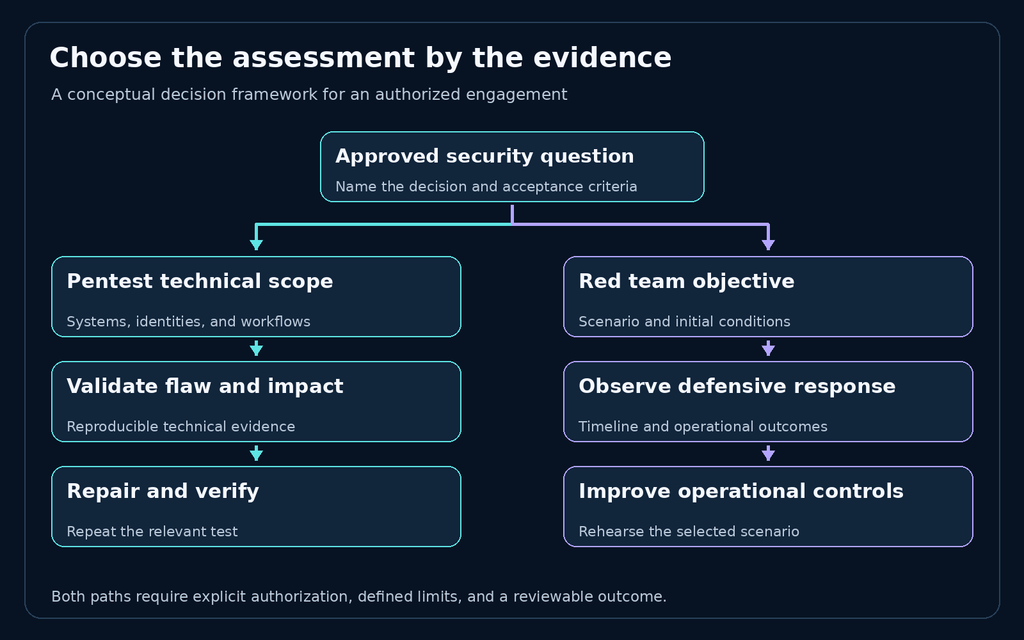
The main difference between red teaming and pentesting is the question each assessment organizes its work around. A penetration test investigates weaknesses in an agreed technical scope and produces findings that engineers can reproduce and fix. A red-team exercise pursues an approved operational objective and examines how defenses prevent, detect, investigate, and respond to the activity. The same application flaw can contribute to both assessments, with different evidence required to accept the work.
Choose a pentest when the decision concerns a particular application’s controls, an API’s authorization boundaries, a network segment, or a release that needs technical scrutiny. Choose a red-team exercise when the decision concerns an adversary’s path to an important objective and the organization’s ability to interrupt it. If the uncertainty is whether your team would recognize a serious attack, a longer vulnerability list will not settle it. If the uncertainty is whether one customer can export another customer’s records, a convincing attack narrative will not replace the relevant application tests.
The distinction has an authoritative basis without requiring a rigid industry taxonomy. NIST’s penetration-testing glossary describes constrained attempts to circumvent security controls. Its red-team definition emphasizes authorized adversary emulation, operational impact, and what works for defenders. Engagements can overlap. Read the proposed objectives and deliverables before treating either label as a guarantee of coverage, difficulty, or quality.
Red teaming vs pentesting at a glance
The comparison below describes engagement designs a buyer can specify. A pentest can chain weaknesses and examine detection. A red team can identify individual vulnerabilities and recommend precise repairs. Neither label guarantees those capabilities. The organizing question determines which work receives priority and what evidence the customer should expect at the end.
| Decision | Penetration test | Red-team exercise |
|---|---|---|
| Main question | Which weaknesses can be validated within this technical scope? | Can the agreed adversary scenario reach a business objective, and how do defenses perform? |
| Scope structure | Named applications, interfaces, systems, identities, and test cases | Approved objective, initial conditions, allowed paths, excluded assets, and operating limits |
| Work priority | Investigate relevant controls and demonstrate material findings | Pursue the objective and observe the defensive response along the authorized path |
| Typical evidence | Preconditions, affected component, reproducible behavior, impact, and repair verification | Activity timeline, objective outcome, defensive observations, decisions, and response effectiveness |
| Customer participation | Application and infrastructure owners supply context and help resolve findings | A control group coordinates the exercise; defender awareness follows the agreed design |
| Important limitation | Untested components and workflows remain outside the result | A selected path does not establish comprehensive vulnerability coverage |
| Useful follow-up | Repair the issue and repeat the relevant positive and negative cases | Improve controls or operations and repeat the scenario under recorded conditions |
Use the table to diagnose a disappointing earlier assessment. “Our last pentest was too easy” does not explain what the next engagement should change. Was access insufficient? Were important workflows excluded? Did the report lack reproducible evidence? Address that specific failure in the next scope. A carefully scoped application test can require substantial specialist work, while a deliberately small adversary exercise can answer a narrow operational question.
The report’s length is another unreliable shortcut. A technical assessment with two well-supported authorization findings can be more useful to a release owner than a large document filled with speculative issues. A red-team report with few software findings can still be valuable when it shows that a known signal reached the monitoring platform but nobody owned the resulting alert. Judge whether the work resolves its stated question.
Technical coverage and operational objectives organize work differently
A web pentest needs a meaningful model of the application. That can include public routes, authenticated behavior, user roles, tenant boundaries, sessions, APIs, and business workflows. The OWASP Web Security Testing Guide’s methodology covers those areas as parts of application testing. This supports a broader view than running an unauthenticated scan and counting the output.
Suppose a team is releasing a customer portal. It needs to know whether a support user can access another customer’s export, whether an ordinary user can invoke a privileged operation, and whether an expired session remains usable. Those questions suggest a technical test matrix. The assessor should identify which cases were reached, which were blocked, and which remained unresolved because of missing accounts or fixtures. A result from one identity does not establish the behavior of another.
A red-team objective might instead ask whether a simulated adversary starting with an approved low-privilege account can reach a synthetic business asset before defenders intervene. The exercise design establishes the initial access assumption, permitted paths, observable milestones, and stopping point. The operator’s work may concentrate on one viable route rather than exhaustively examining every portal feature. That concentration is useful for the operational question and a limitation for broad application assurance.
MITRE’s adversary-emulation plans connect threat-informed behavior with testing defenses. They also acknowledge the limits of the public intelligence used to construct a scenario. Treat a threat profile as a reasoned basis for selecting behavior, not proof that an exercise reproduces every capability of a named group. A provider should explain which assumptions were supplied and which parts of the scenario were actually exercised.
The distinction becomes especially useful at handoff. Engineering needs a technical finding it can fix without watching the whole exercise. Security operations needs an account of what telemetry arrived, how analysts interpreted it, and which response actions occurred. Management needs the business objective, the outcome, and the remaining uncertainty. A combined engagement can serve all three audiences, provided its contract funds and requires all three deliverables.
Avoid ranking the methods by apparent drama. A straightforward permission defect may create serious business exposure. An elaborate chain can depend on an unrealistic starting privilege or an exclusion that removes the strongest control. Assess the actual prerequisites and consequence before drawing a conclusion from the number of steps or the familiarity of the technique names.
Black box, white box, and defender awareness are separate choices
Information supplied to a tester is one axis of assessment design. A test may begin with only external information, with selected accounts and documentation, or with extensive architectural and source context. These choices affect what the assessor can investigate within the available time. Record them separately from the engagement type so the report can explain what the supplied information made possible.
An organization may give a red team an internal foothold because it wants to evaluate post-compromise defenses rather than spend the entire window investigating initial access. That assumption should remain visible in every conclusion. Success from the supplied foothold demonstrates a path under that condition; it does not establish how an external attacker would obtain the same access.
Defender awareness is another axis. A limited trusted group may know an exercise is running while operational analysts follow their ordinary procedures. In a collaborative validation session, defenders may know the exact scheduled behavior and work directly with operators. The first arrangement can examine ordinary recognition and escalation; the second can accelerate diagnosis and tuning. The engagement should say which question each arrangement is intended to answer.
Likewise, stealth is a design choice with costs and limits. It can be relevant when testing whether defensive operations recognize a realistic sequence, but it does not authorize the operator to conceal an availability problem from the control group. A customer’s ability to supervise and stop the exercise remains part of the design, even when a particular analyst is intentionally unaware of it.
Both assessments need a precise authorization boundary
Red teaming has scope. A business objective can leave flexibility in the route while retaining firm limits on assets, identities, data, timing, and permitted behavior. The NIST rules-of-engagement definition makes authorization and constraints explicit before testing. “Act like a real attacker” is not a usable replacement for that agreement.
Start with assets and ownership. A domain may rely on an identity provider, a payment service, a managed cloud resource, or customer-controlled integration. Permission to test your application does not automatically resolve those parties’ testing policies or contractual boundaries. Establish the approved destination and action before an operator or tool follows a dependency. Keep an ambiguous asset outside the executable scope until the authorized owners resolve and record the decision.
Then define the permitted evidence. In many exercises, a synthetic marker, a read-only observation, or a controlled operation can demonstrate the relevant consequence without collecting real customer data. The acceptance criterion should identify the smallest sufficient proof. An agreed proof threshold tells the operator when to stop and lets the customer accept that stopping point. Without it, the two parties can disagree about completion even after the relevant consequence has been demonstrated.
Rules should also cover changes to system state. Specify how test accounts, temporary configuration, synthetic records, and other approved artifacts are created and removed. Identify which actions require additional review and which are prohibited. The point is to give operators usable authority within a known envelope, rather than forcing them to improvise permissions during an investigation.
NIST SP 800-115 provides assessment-planning guidance and a rules-of-engagement template. Use it as a starting reference, then make the agreement specific to the actual environment. A useful authorization package should let a substitute operator or control-group member understand the same boundaries without relying on an informal conversation.
Agree what happens when something goes wrong
Name the person who can suspend the exercise and an alternate who can act when that person is unavailable. Establish a reliable communication path, a way to distinguish test activity from an unrelated incident, and a procedure for protecting evidence when the two overlap. Keep these details available to the people who need them during the approved window.
A stop condition should describe observable behavior. A production error threshold, loss of a required service, unexpected access to real sensitive information, or activity outside the agreed environment may require suspension and review. Choose conditions appropriate to the exercise rather than copying an arbitrary threshold from another organization. The operator should know which work can continue safely and which work must pause.
Check the communication mechanism with harmless activity before the exercise. Confirm that the designated contact receives the request, that operators and automated runners halt pending work, and that someone can verify the resulting state. Document who may authorize a restart. This small rehearsal tests whether the written stop procedure has an operational effect during the approved window.
Data handling needs the same clarity. Decide what may be recorded, who can inspect it, where it is retained, how secrets are redacted, and when temporary copies are removed. Protecting evidence should not make it impossible to distinguish the acting account, affected resource, and observed result. Use synthetic identities and stable internal identifiers where they can preserve those relationships with less exposure.
The authorization package is also where a combined engagement becomes manageable. Application owners can approve a bounded technical investigation while a separate exercise plan defines the defensive observations and business objective. Shared scheduling does not eliminate those distinct responsibilities. Write down the handoff between them, including the point where a technical finding would change the exercise’s permitted path.
Follow the same SaaS weakness through two assessments
Consider a fictional reporting service with two customers, Tenant A and Tenant B. An analyst may read reports belonging to its own tenant. A server-side authorization defect lets the analyst read a report owned by the other tenant. The identities, records, and markers are synthetic. This original teaching scenario illustrates the comparison; it describes no customer incident or commercial product test.
The application’s intended rule is the starting point. A successful login establishes identity, but the read operation still needs to check the relationship between that identity and the selected object. OWASP’s business-logic guidance emphasizes context such as the user, object, and workflow state. The relevant test therefore compares permitted access with the cross-tenant case, rather than interpreting any successful response as proof of a vulnerability.
For a pentest, the customer supplies the approved application, dedicated accounts, expected ownership policy, and synthetic records. The assessor verifies that the account can perform its legitimate task, then investigates whether the prohibited case produces the other tenant’s content. A report should connect the acting identity, target object, expected decision, observed behavior, and business consequence. It should also explain where the test stopped.
That work can expand across the agreed workflow. If reports are generated asynchronously, there may be separate questions about creating a job, checking its status, and retrieving its output. The assessor needs to know which operation enforces ownership and whether the same rule holds at every relevant transition. Those additional cases belong in the proposed investigation matrix. The simple cross-tenant example supplies no result for any real endpoint or asynchronous job.
إن OWASP WSTG business-logic chapter gives useful context for examining workflows rather than treating every request as an isolated technical check. The practical consequence is a test matrix that includes the path a real user follows. Where a path cannot be reached, record the missing condition instead of silently treating the case as passed.
After repair, the same identities and ownership conditions should be used against the changed deployment. Tenant A’s permitted access must still work, and the cross-tenant attempt must be denied for the intended reason. A denial caused by an expired session or a broken fixture does not establish that the ownership check was repaired. Preserve the deployment identity so the result cannot be confused with a test against an earlier build.
Give the red-team version a business objective and a defense question
Now design a limited exercise around the same service. The approved starting condition is a supplied Tenant A analyst account. The objective is to establish whether that account can reach a synthetic Tenant B marker and whether the organization’s defensive process recognizes and contains the relevant activity. The control group defines which actions and records are available, how much evidence is sufficient, and when the exercise ends.
The supplied account is an assumption, not an achievement. The report must not suggest that the team obtained an external foothold when that step was deliberately excluded. This keeps the result useful: the organization chose to isolate a particular part of its defenses, and the conclusion should stay inside that boundary. A later engagement can examine a different starting point if that uncertainty remains important.
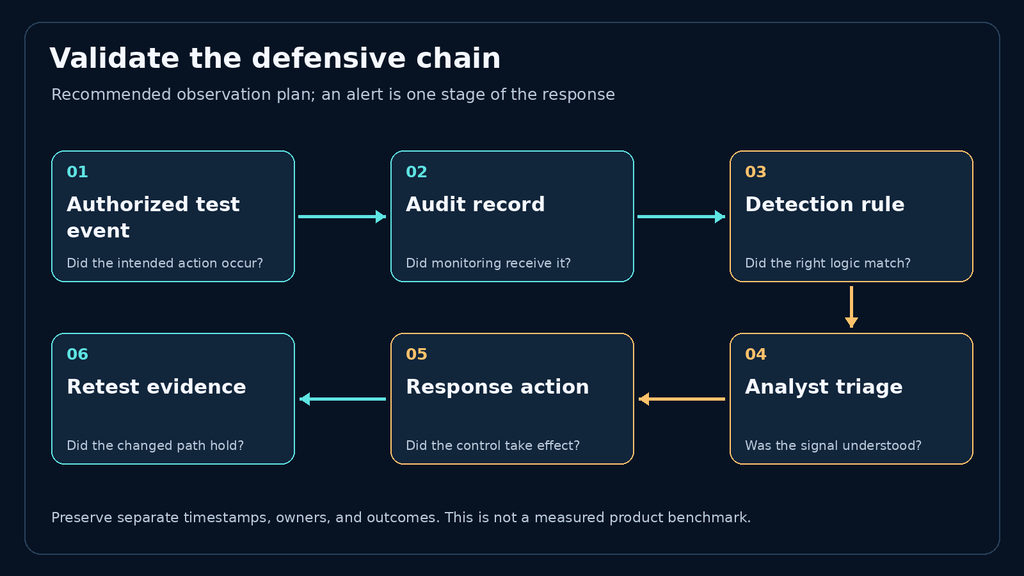
The application finding is only one part of the exercise record. The team also needs to establish whether an audit event was generated, whether monitoring received it, whether a rule produced a useful alert, whether an analyst investigated it, and whether an authorized response actually constrained the account or path. Those observations belong to different systems and owners. Combining them into a single “detected” result makes a failure difficult to diagnose.
Suppose the application records the read but the monitoring platform never receives the event. That points to a collection or delivery gap. If the event arrives and no rule matches it, the gap is in detection logic or configuration. If an alert exists but has no owner during the exercise, the problem has moved into operations. If an analyst acts but the account retains access through another approved session, the response outcome needs further investigation.
Each conditional outcome points to a different repair and a different owner. Adding another detection rule cannot fix a missing event feed. Correcting a parser does not establish that the response team has the authority or procedure to suspend access. The exercise should preserve the observations needed to identify the layer that failed.
Measure the defensive chain one transition at a time
Use separate timestamps for the action, event collection, alert creation, analyst acknowledgment, investigative decision, and completed response. Establish clock alignment and the meaning of each timestamp before calculating intervals. A ticket’s creation time may describe a connector’s behavior rather than the first moment an analyst had enough information to act.
The observation plan below keeps the stages independent so a team can identify a bottleneck without assigning every delay to the detection engine. It proposes what to measure; it contains no measured results from a real exercise.
| Observation | Evidence to retain | Question it answers |
|---|---|---|
| Authorized action occurred | Operator record and target-side observation | Did the intended behavior happen? |
| Event reached monitoring | Raw event, normalized fields, ingestion time | Did defenders have the relevant signal? |
| Alert was created | Rule identity, version, matched fields, alert time | Did the configured logic recognize the signal? |
| Analyst evaluated it | Case notes and decision time | Did a person interpret and escalate the evidence? |
| Response was completed | Approved action record and readback | Did the chosen control actually take effect? |
| Objective was interrupted or reached | Agreed marker or controlled outcome | What happened to the business goal under the exercise conditions? |
NIST SP 800-61 Revision 3 places incident-response capabilities within broader cybersecurity risk management. The observation plan above is an original way to apply that concern to an exercise. It is not a claim that NIST prescribes this exact sequence or that every organization needs the same response interval.
Agree how pauses affect the measurements. An operator may stop because the control group is investigating a production problem, because a test credential has expired, or because an action requires renewed approval. Those intervals should remain visible. Removing every inconvenient pause can make a report look favorable while hiding the conditions under which the organization actually operates.
Also distinguish an exercise’s end from a response deadline. Operators may stop after obtaining sufficient proof even if defenders have not yet completed an investigation. The report can preserve that outcome without declaring that the defenders would never have responded. Conversely, a response completed after the synthetic objective was reached may be operationally useful while still missing the agreed prevention goal.
A missed alert and a successful attack are different findings
Imagine a fixed application denying the cross-tenant read. The technical boundary works for the tested case. An exercise may still reveal that the denied attempt generates no useful signal, if observing that behavior was an agreed objective. Whether that is an actionable gap depends on the detection requirement and expected normal activity, not on the mere existence of a denial.
Now reverse the result. A vulnerable application returns the synthetic report, and monitoring immediately creates an alert. The improved signal does not repair the authorization failure. The organization may have more opportunity to intervene, but engineering still owns the technical defect. A combined report should retain both conclusions instead of marking the application safe because the activity was visible.
This is where the comparison becomes practical. A pentest provides the validated control failure and repair case. A red-team or collaborative validation exercise adds evidence about the organizational response to a selected path. They can share artifacts without pretending that one conclusion subsumes the other.
A local experiment makes the distinction observable
The following original Python model runs entirely in memory. It creates no server, sends no traffic, reads no external data, and invokes no exploitation tools. It represents a synthetic report read, an application policy, an audit event, and a deliberately narrow detection rule. It was executed locally for this article; its assertions passed. No commercial product or real defensive platform was tested.
Save the code in a local file and run it with Python 3. The two switches independently change authorization enforcement and detection logic. The intended detection policy in this toy example is to flag a cross-tenant read attempt whether the application allows or denies it.
import json


def assess(policy_fixed, rule_fixed, object_tenant="B"):
    actor_tenant = "A"
    permitted = actor_tenant == object_tenant
    allowed = permitted if policy_fixed else True
    marker = "SYNTHETIC-REPORT" if allowed else None

    event = {
        "action": "read_report",
        "actor_tenant": actor_tenant,
        "object_tenant": object_tenant,
        "allowed": allowed,
    }
    if rule_fixed:
        alert = (
            event["action"] == "read_report"
            and event["actor_tenant"] != event["object_tenant"]
        )
    else:
        alert = event["action"] == "bulk_export"

    return {
        "policy_fixed": policy_fixed,
        "rule_fixed": rule_fixed,
        "unauthorized_read": marker is not None and not permitted,
        "alert_created": alert,
    }


expected = {
    (False, False): (True, False),
    (False, True): (True, True),
    (True, False): (False, False),
    (True, True): (False, True),
}

for configuration, outcome in expected.items():
    result = assess(*configuration)
    assert (result["unauthorized_read"], result["alert_created"]) == outcome
    print(json.dumps(result, sort_keys=True))

normal = assess(True, True, object_tenant="A")
assert not normal["unauthorized_read"]
assert not normal["alert_created"]
print("All local synthetic checks passed")
| Application policy | Detection rule | Synthetic unauthorized read | Alert created |
|---|---|---|---|
| Defective | Misconfigured | نعم | لا يوجد |
| Defective | Correct for this model | نعم | نعم |
| Fixed | Misconfigured | لا يوجد | لا يوجد |
| Fixed | Correct for this model | لا يوجد | نعم |
The first result contains two failures: an authorization violation and a missed signal. The second changes only the signal. The third changes only the application’s behavior. The fourth enforces the application’s rule and identifies the prohibited attempt. The additional same-tenant check makes sure the model does not alert merely because an ordinary report is read.
The code uses ground truth supplied by the model: both tenant identifiers are already present and trustworthy in the event. A real monitoring platform may lack one field, receive a transformed identifier, or need to correlate separate records. That uncertainty must be tested in the real telemetry path. Before applying the same comparison, verify that both fields identify the intended tenants at the time of the action.
The model also omits legitimate cross-tenant exceptions. A production system may support a delegated administrator, an approved support workflow, or a shared organization structure. Detection and authorization need the actual policy for those cases. An event that looks suspicious under this teaching rule can be allowed behavior under a different contract. Do not deploy the toy rule as a production detector.
There is no analyst, response action, queue, clock, or recovery process in the program. Its output therefore cannot measure time to detect, time to contain, or the effectiveness of a security operations team. It demonstrates an evidence distinction, not a complete red-team exercise. Those omissions are useful boundaries because they prevent a passing local test from becoming a larger performance claim.
To extend the experiment, write down the observation the next layer would need before adding another component. For collection, identify the real event schema and delivery path. For triage, identify the analyst’s decision and the supporting case record. For response, define an approved action and a readback that establishes its effect. Each extension requires its own authorized test and acceptance criterion; copying the local output does not validate the new layer.
Compare cost by the work and evidence being purchased
A useful red teaming vs pentesting cost comparison starts with a statement of work. There is no defensible universal conversion between their prices: each quote funds a particular scope, staffing plan, delivery model, and set of obligations. A small, tightly bounded exercise may require less work than a large application assessment with many roles and workflows. A broader campaign may require specialist preparation and coordination that a technical test does not need. Ask which work is included before drawing a cost conclusion from the label.
Start by describing the decision in the request for a quote. “Assess the customer portal before release” and “evaluate whether our operations team contains a selected account-abuse scenario” are different jobs. If both are required, say so. Otherwise, a supplier can reasonably optimize for one outcome while the buyer assumes the other was included in the same fee.
إن planning and reporting guidance in NIST SP 800-115 provides a useful foundation for specifying an assessment. The cost worksheet below is an original procurement aid built around that principle. It does not provide market averages, supplier quotes, or a promise that either assessment will reduce a particular amount of financial risk.
| Cost driver | What to make explicit in a pentest quote | What to make explicit in a red-team quote |
|---|---|---|
| Technical surface | Applications, APIs, environments, interfaces, and exclusions | Allowed systems and paths needed for the selected objective |
| Identity and context | Roles, tenants, authentication flows, and documentation | Starting access, supplied knowledge, and permitted identity assumptions |
| Depth of investigation | Required controls, workflow cases, and proof standard | Objective milestones, scenario flexibility, and permitted stopping points |
| Preparation | Accounts, fixtures, access troubleshooting, and environment readiness | Control-group planning, scenario preparation, observation arrangements, and recovery readiness |
| Internal participation | Product owners, engineers, infrastructure teams, and finding review | Operators, defenders, decision-makers, service owners, and exercise coordination |
| Deliverables | Technical findings, limitations, remediation guidance, and retest record | Objective outcome, correlated timeline, defensive gaps, recommendations, and technical findings where agreed |
| Follow-up | Included repair cycles, retest window, and changed-scope treatment | Included validation of improved controls and conditions for a repeated scenario |
Counting endpoints alone leaves much of that work unspecified. One route may expose several roles, object relationships, and workflow states. Several routes may all reach the same underlying control. The useful unit is the security question that must be investigated with adequate context. If the quote uses a simpler billing unit, ask how the supplier maps that unit to the actual test requirements.
The same applies to a campaign’s list of allowed assets. A long asset list may define where the team can operate without requiring comprehensive examination of every asset. That can be appropriate for an objective-driven exercise, but it is not equivalent to a technical coverage commitment. If a release owner needs assurance about all listed interfaces, add an explicit coverage deliverable rather than assuming the campaign includes it.
Include the work the customer must supply
Calculate the cash quote separately from internal effort. A customer may need to prepare dedicated accounts, restore test data, arrange identity access, review findings, participate in the exercise, and schedule changes. Those responsibilities consume capacity even when the provider’s headline fee is fixed. Listing them early makes proposals more comparable and reduces the risk of discovering an unowned dependency during the booked window.
An original planning expression is:
Total assessment effort = provider delivery + customer preparation + coordination + evidence review + agreed retesting + closeout
Use a separate line for implementation and remediation work. A difficult repair may follow a valuable test; hiding that engineering effort inside the assessment fee can make a useful finding look like a supplier cost overrun. Keeping the lines separate lets the organization decide how much investigation, repair, and verification capacity it needs.
If the organization assigns a monetary value to staff time, document the rate and hours as its own planning assumptions. Do not mix that accounting estimate with money actually paid to a supplier. Two reports can use the same phrase, “total cost,” while one counts only an invoice and the other includes several teams’ time. State the definition beside the total so a reader can compare like costs without reconstructing the worksheet.
The same discipline applies to software credits, subscriptions, and usage charges. Record actual consumption from a bounded trial and include the review work needed to accept the result. A credit does not have a universal relationship to an application, an accepted finding, or an engagement day. An annual software subscription and a professional exercise purchase different responsibilities unless the proposal explicitly connects them.
Compare two fictional proposals with the same headline effort
Consider two hypothetical proposals, each describing six scheduled delivery days. These are invented worksheet inputs, not representative market durations. Proposal A examines one application and its API with three approved roles, two synthetic tenants, a documented control matrix, and one agreed retest. Proposal B runs a selected assumed-breach scenario and delivers an objective timeline with defensive-response observations.
The equal day count does not make the proposals interchangeable. Proposal A can leave the operations team’s response unmeasured. Proposal B can leave many application workflows unexplored. Neither omission is automatically a defect in the proposal; it becomes a problem when the buyer expects a result outside the stated design. The decision should depend on which uncertainty the organization is paying to resolve.
Now add a requirement that an external customer must receive a report about the application release. Proposal A may already describe the relevant technical deliverable, but acceptance still needs confirmation from the recipient. Proposal B would need an additional application-coverage commitment if the scenario alone does not meet that need. Adding a polished executive summary to its campaign narrative does not change what was tested.
Reverse the requirement: the security leader needs evidence that the on-call response process can interrupt account misuse. Proposal B addresses the operational question, subject to its actual observation plan. Proposal A could support it only if the engagement adds the relevant telemetry, defender participation, timing, and response validation. The buyer should ask for that work directly rather than assuming that successful exploitation automatically measures response.
This comparison also exposes scheduling dependencies. A day booked for an operator may be unusable if the required test account is unavailable. A planned defensive observation may become inconclusive if the monitoring feed was disabled during maintenance. Agree how blocked time, rescheduling, partial completion, and additional access requirements are handled. Record the blocked prerequisite and its effect on the promised deliverable. This gives both parties a basis for deciding whether to reschedule, narrow the conclusion, or commission additional work.
Buy deliverables that another team can accept
Write acceptance criteria before testing begins. The person approving an invoice may be different from the engineer repairing a finding or the analyst using a detection recommendation. Bring those recipients into the scoping conversation early enough to identify the evidence each needs. Otherwise, the provider can deliver a document that matches the proposal while leaving the people responsible for action unable to use it.
For a technical assessment, agree how the report identifies the tested deployment, accounts and roles, included interfaces, and limitations. Each material finding needs enough information to reproduce the behavior safely and understand the impact. A repair recommendation should identify the intended control rather than merely advising the team to “improve validation.” Define whether the supplier will examine the repair, what constitutes a retest, and which changes would create new scope.
OWASP ASVS provides a framework of application security requirements that can help make a technical specification more precise. If a requirement is used, name its version and identifier after checking the source. A broad reference to OWASP does not establish that every relevant control was tested. Keep the requirement, tested case, result, and limitation connected in the acceptance record.
For the red-team deliverable, require the starting assumptions and objective outcome alongside the activity narrative. Identify which paths were actually exercised, which were rejected by controls, and which were unavailable or deliberately excluded. Include a defender timeline with sufficient source references to distinguish an absent signal from a missed analysis or ineffective response. An operational recommendation should have an owner capable of changing the relevant process or control.
Useful recommendations can require several owners. Engineering may repair the cross-tenant check. A platform team may correct an audit schema. Detection engineers may update a rule. Operations may change routing or escalation. A single finding titled “improve monitoring” hides those dependencies. Split the corrective actions at the point where ownership, verification, or the required evidence differs.
Keep coverage and outcome in the same conversation
Give every planned case a clear disposition: an observed result, an unresolved condition, or not tested. For an observed result, record the actual behavior and whether it met the expected control. A provider should not need to force every planned case into pass or fail. Missing access, unreliable fixtures, a control-group stop, and an unavailable dependency are meaningful outcomes for planning, but they do not establish the security behavior of the unexamined path.
Do not calculate coverage from report volume. Count against the agreed matrix, with a clear definition of what it means to exercise a case. One finding may affect several cases, while a fully investigated case may produce no finding. The number of issues therefore has a different denominator from the amount of planned work completed. Retain both when they help a decision, and avoid using one as a substitute for the other.
For operational exercises, distinguish the selected objective from the entire threat landscape. Reaching a synthetic marker through one approved path can establish a consequential weakness. Failing to reach it during the available window can establish something useful about that attempted path. Neither result proves that all possible adversary paths have been examined. State the initial conditions and stopping rules whenever the result is summarized.
The business recipient also needs to understand the scope of a report. A software-generated document, a technical consulting assessment, and an adversary exercise are different forms of evidence. Ask the customer, assessor, or contractual recipient which form and independence requirements apply. This is a procurement step, not a claim that a particular framework universally requires a particular test frequency or provider type.
Make retesting a defined piece of work
Specify the original condition, changed component, required identity, and expected behavior for a technical retest. Include a legitimate-use control so that a broken feature is not mistaken for a repaired permission boundary. Record the replacement deployment and unresolved cases. The supplier’s willingness to “retest” is insufficient if nobody knows whether that includes one finding, the entire changed workflow, or a new release with materially different behavior.
For a defensive improvement, repeat the selected behavior with the changed observation and response path. Preserve the relevant rule version, collection configuration, analyst procedure, and response mechanism. This allows the team to explain why the outcome changed. If several controls changed at once, report that limitation rather than attributing the improvement to one convenient product or rule.
Cleanup belongs in closeout. Reconcile the temporary accounts, synthetic artifacts, permissions, and approved configuration changes created for the engagement. Confirm which items were removed and which were intentionally retained by an owner. A successful exercise is not complete while an unowned test account or temporary access path remains available simply because the report has been delivered.
Choose the next assessment from the decision you cannot yet make
A useful selection meeting begins with a sentence that someone must act on: “We need to approve this release,” “We need to know whether responders can interrupt this scenario,” or “We need evidence that a repaired boundary works.” Each sentence identifies a recipient and a decision. A request to “test our security” leaves both unspecified, making it easy to purchase impressive activity without receiving a usable answer.
For a release with new roles, tenant relationships, or sensitive workflows, begin with the technical questions those changes introduce. Supply the assessor with the expected rules, reachable fixtures, and relevant deployment. A penetration test can then investigate the changed behavior and report limitations against a defined matrix. The operations team may observe selected tests, but that participation should be planned if the resulting defense evidence matters to the release decision.
For a security operations team with established telemetry and response procedures, consider an objective-driven exercise when the uncertainty concerns how those components work together. Identify a business asset, a plausible starting condition, and the response that would count as interruption. Readiness is specific to that scenario. A team can be prepared to examine account-abuse handling while still lacking the visibility required for a different network or cloud exercise.
When basic preparation is missing, turn the gap into a work item before buying a broader campaign. If nobody can identify the owner of the audit feed, arrange a bounded collection check with that owner. If nobody can approve an emergency account suspension, resolve the decision path and rehearse it. These steps create the conditions for a meaningful later exercise. Record those steps as preparation and rehearsal. Independent recognition by ordinary defenders remains a separate question for the later exercise.
A small budget makes this sequencing more important. Choose the asset and failure mode whose answer would change an imminent decision, then fund a complete investigation of that question, including review and a defined follow-up. Spreading the same effort across many loosely specified targets can leave every recipient with a partial answer. There is no need to purchase the larger engagement label merely to signal seriousness to management.
Use collaborative validation when learning is the immediate goal
A collaborative session can bring an operator, a detection engineer, and an analyst together around one selected behavior. They can inspect the event, identify a missing field, adjust the observation path, and verify the result. This is often described as purple teaming. Define the actual participants and work in the proposal, because the label alone does not say whether the session includes response actions, engineering changes, or only a discussion of possible detections.
إن Center for Threat-Informed Defense adversary-emulation library includes full emulations and smaller micro emulations. It provides examples of how selected adversary behavior can become a bounded exercise. Selecting one such exercise still requires environment-specific authorization, preparation, and a useful expected observation. Running a named plan does not establish that every defensive layer worked or that the entire organization was assessed.
Choose a short validation session when the team already knows where it needs to investigate. Choose a broader exercise when the question concerns several interacting controls and operational decisions across an authorized path. The narrower session can produce a more precise explanation of one failure; the broader exercise can expose dependencies that nobody identified in advance. Neither design removes the need to report which parts were actually observed.
Account for learning when interpreting a repeat. An analyst who helped build the detection and knows the exact scheduled event is in a different position from an analyst handling an ordinary queue. That collaborative retest can establish that the changed path now works under the recorded conditions. A later exercise with a different awareness arrangement is needed if the organization also wants to examine independent recognition and escalation.
Preserve useful results across the sequence. The initial exercise identifies the gap, the collaborative work explains and repairs it, and a later agreed replay checks the changed behavior. Keep the original outcome alongside the improved result. Replacing the earlier record with a final success would erase the evidence needed to understand what changed and why the investment mattered.
Set cadence from changes and unresolved questions
The comparison does not imply a universal annual, quarterly, or continuous testing requirement. An assessment plan should account for relevant contractual obligations, product changes, known findings, defensive changes, and the time needed to implement repairs. A repeated test that cannot reach the changed feature or observation path may provide less useful evidence than a smaller assessment prepared around that change.
Use change records to connect the work. A new privilege model may justify revisiting application cases. A replaced audit pipeline may justify checking collection and field meaning. A new on-call procedure may justify a response rehearsal. A broader business change may justify reviewing the exercise objective itself. Record the reason for the next test so that frequency remains connected to a question the organization needs answered.
Continuous software execution and periodically scheduled professional work can coexist. The important procurement questions are what each run covers, who reviews its output, how incomplete runs are surfaced, and how changed scope receives authorization. Connect the dashboard’s activity to reviewed cases, unresolved conditions, and corrective action. That connection makes the cadence useful to the people who must decide whether to release, repair, or investigate.
Where agentic AI fits in pentesting and red teaming
Agentic AI describes a way to coordinate work, not a substitute for an assessment objective. Synack’s explanation of agentic AI for pentesting describes systems that plan, use tools, observe results, and adapt within constraints. That is useful context for a delivery model. It does not establish the coverage, accuracy, autonomy, or commercial performance of a particular product.
In a bounded pentest workflow, software may help organize observations, select a next permitted check, correlate evidence, or repeat an approved case after a repair. A person still needs to establish the scope, supply a correct account and policy model, decide what proof is sufficient, and review whether the result supports the reported impact. Automating a sequence does not make an incorrect premise more reliable.
For an objective-driven exercise, tool coordination is only part of the job. The control group must manage the approved conditions, operational contact, pauses, evidence, and closure. Defenders must make and execute their own decisions if their response is being assessed. A technically successful software run cannot, by itself, establish the effectiveness of those organizational responsibilities.
This gives buyers a more useful way to compare agentic pentesting software with a service proposal. List the duties the software performs, the duties the customer’s team retains, and the duties supplied by a professional operator. Then compare accepted evidence and total effort for the same bounded question. Avoid treating a subscription, an operator day, and a completed exercise as interchangeable purchasing units.
Evaluate a workflow with known outcomes and visible failures
Build a controlled evaluation around synthetic cases with independently known outcomes. Include a reachable permission defect, a repaired version of that defect, and a legitimate use case that should continue to work. Supply the same authorization and identity context to each candidate workflow. Keep the expected result separate from the run so the evaluator can compare the output with ground truth.
Evaluate more than whether a run produces a finding. Can a reviewer reproduce the result from the evidence? Does the reported impact follow from the observed behavior? Does the system distinguish a prohibited cross-tenant read from normal same-tenant access? If a credential expires or a fixture disappears, does the report identify an incomplete test rather than quietly recording a clean result?
Record the effort needed to review ambiguous output and repair the test setup. A fast first response may be less useful if an engineer spends substantial time reconstructing its assumptions. Conversely, an incomplete run that clearly identifies a blocked prerequisite can help the team restore the evaluation. Keep these outcomes visible instead of evaluating only the successful examples selected for a demonstration.
An evaluator considering Penligent or another agentic workflow can apply this same acceptance test. Inspect the actual evidence, approved scope, repeatability, failure reporting, and retained human responsibilities in a bounded trial. No comparative product benchmark was run for this article. Its executed Python experiment supports the narrow distinction between application policy and detection logic; it supplies no supplier speed, cost, or detection measurements.
Distinguish using AI to test systems from testing AI systems
“AI red teaming” can also describe evaluating an AI application as the target. Promptfoo’s red-teaming documentation addresses testing AI applications, including risks involving model behavior and the surrounding application. That use of the term is different from an AI-assisted operator examining a conventional web service, even though a project may contain both kinds of work.
For an AI-enabled product, specify the boundary that matters: the model’s response, the application’s handling of retrieved data, an agent’s tool permissions, or a downstream action. State the expected policy and observable outcome. A model producing an undesirable sentence and an agent taking an unauthorized action require different evidence and may require different repairs. A general pentest label does not settle which of those layers is included.
The same separation applies to red-team procurement. Ask whether “AI” identifies the operator’s delivery technology, the system under assessment, or both. Then require the relevant test cases, permissions, data boundaries, and acceptance evidence. Clear nouns in the statement of work prevent a buyer expecting application authorization testing from receiving only model-response evaluations, or the reverse.
Frequently asked questions
Is red teaming just a deeper penetration test?
- No. Depth can vary in either engagement. A penetration test organizes work around technical controls and validated weaknesses; a red-team exercise organizes work around an approved objective and the defenses encountered. They can share techniques and findings. Read the scope and deliverables to learn which questions the engagement will actually answer.
Does a red team need a defined scope?
- Yes. An objective can allow flexibility while the agreement still limits assets, identities, data, timing, and permitted actions. Starting assumptions and stop conditions belong in that agreement. A realistic scenario does not give an operator authority over unrelated systems or remove the control group’s ability to suspend the exercise.
Does red teaming always cost more than pentesting?
- No universal price relationship follows from the names. Compare the technical surface, scenario preparation, staffing, customer participation, deliverables, retesting, and closeout. A narrow exercise and a broad application assessment may require very different effort. Ask for a quote against the work you need, including the responsibilities retained by your team.
Can a penetration test evaluate detection?
- It can include selected defensive observations when those are explicitly designed into the engagement. Agree the behavior, telemetry, alert, analyst participation, and evidence required. A finding that proves a control failure does not automatically establish whether the monitoring and response process recognized or interrupted it.
What does it mean if a red team does not reach its objective?
- Interpret the result against the actual starting conditions, attempted paths, available time, constraints, and stopping rules. A control may have interrupted the selected path, or an unresolved prerequisite may have prevented a meaningful attempt. Preserve that distinction. An unreached objective does not establish that every possible adversary path has been examined.
Can agentic AI replace a human red team?
- Evaluate the particular duties, rather than making a blanket replacement claim. Software may coordinate bounded technical actions and evidence. Authorization, supervision, business interpretation, defender decisions, and acceptance still need accountable owners. A successful demonstration does not establish complete exercise coverage or prove how a different organization would respond.
Which report will a customer or compliance recipient accept?
- Ask the recipient before purchasing the engagement. Confirm the required scope, report form, independence, evidence, timing, and any applicable assessment criteria. A software report, a technical consulting assessment, and an adversary exercise may meet different needs. Neither the name of the test nor a reference to OWASP guarantees acceptance.
What should a small security team do first?
- Choose the question whose answer will change the nearest important decision. A release may need focused technical validation; an uncertain response path may need a bounded operational exercise or collaborative rehearsal. Assign an owner for the result and reserve effort for repair and verification. Expand after the first question has a usable answer.
Make the next purchase answer one clear question
Write the intended decision, the approved starting conditions, the evidence that would resolve it, and the owner who will act on the result. Use those statements to choose a pentest, a red-team exercise, a collaborative validation session, or an explicitly combined engagement. Then buy the preparation, review, and follow-up needed to complete that job. The strongest result is a defensible decision with a defined next action, whether the engagement discovers a technical flaw, a defensive gap, or a control that worked under the tested conditions.

 Arabic
 English
 German
 French
 Spanish
 Portuguese
 Japanese
 Korean
 Hindi
 Turkish
 Hebrew