
In the realm of offensive security and automated penetration testing, the CVSS score is often a deceptive metric. The recently disclosed CVE-2026-20805 is a prime example. While officially rated at a moderate 5.5, this vulnerability in the Windows Desktop Window Manager (DWM) is currently being exploited in the wild as a critical zero-day primitive.
For AI security engineers and red teamers, this vulnerability represents more than just a patching task; it is a masterclass in modern exploit chaining. By leaking memory addresses through the Advanced Local Procedure Call (ALPC) interface, CVE-2026-20805 effectively neutralizes Address Space Layout Randomization (ASLR), turning theoretical Remote Code Execution (RCE) bugs into deterministic, weaponized exploits against AI infrastructure and high-value workstations.
The Mechanics of the Leak: Inside DWM and ALPC
To understand the CVE-2026-20805 PoC logic, one must look beyond standard vulnerability reports and dissect the interaction between user-mode applications and the DWM process (dwm.exe).
DWM is responsible for composing the desktop on Windows, managing visual effects, and rendering windows. It runs with high privileges and interacts closely with the graphics subsystem—a critical vector for engineers running local LLMs or GPU-intensive tasks. The vulnerability resides in how DWM handles specific ALPC messages.
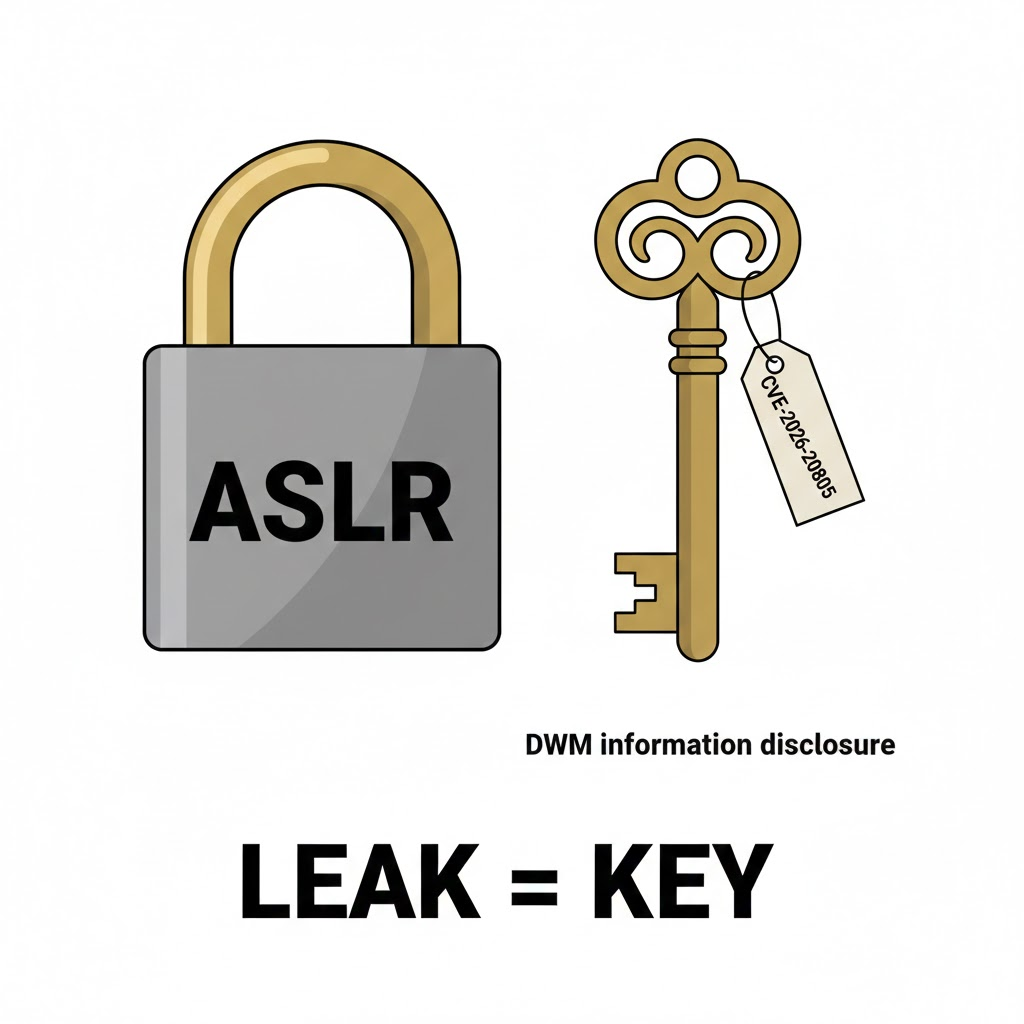
The ALPC Vector
ALPC is an internal, undocumented inter-process communication facility in the Windows kernel, optimized for high-speed message passing.
In the context of CVE-2026-20805, the flaw exists in the validation of the section mapping mechanism during an ALPC connection request. When a specially crafted ALPC message is sent to the DWM port, the service inadvertently returns a raw pointer to a kernel object or a heap address in the user-mode memory space of the DWM process.
Why is this catastrophic?
Modern exploits rely on precise memory offsets. ASLR defends against this by randomizing the locations of the heap, stack, and executables. A successful exploitation of CVE-2026-20805 provides the attacker with a “base address.” Once the base is known, the randomization is rendered useless. The attacker can then calculate the exact location of ROP (Return-Oriented Programming) gadgets required for a subsequent RCE attack.
Theoretical Exploitation Logic
While a public, fully functional exploit script is dangerous to distribute, we can analyze the pseudocode logic required to trigger the leak. This helps security engineers understand the attack surface.
C++
`// Pseudocode: Conceptual logic for triggering DWM ALPC Leak // Disclaimer: For educational and defensive analysis only.
#include <windows.h> #include <alpc.h> // Hypothetical header for ALPC structures
void TriggerDWMLeak() { HANDLE hPort; ALPC_MESSAGE msg; UNICODE_STRING portName;
// 1. Target the DWM ALPC Port
// DWM ports often have predictable names or can be enumerated
RtlInitUnicodeString(&portName, L"\\\\RPC Control\\\\DwmApi");

// 2. Connect to the port with specific attributes
// The vulnerability likely lies in how the connection attributes
// allow mapping of a view that shouldn't be accessible.
NTSTATUS status = NtAlpcConnectPort(
    &hPort,
    &portName,
    NULL,
    &ALPC_PORT_ATTRIBUTES_AllowSectionMap, // The trigger condition
    NULL,
    NULL,
    NULL,
    NULL
);

if (NT_SUCCESS(status)) {
    // 3. Receive the response message
    // The response structure contains the leaked heap address
    // in a field intended for harmless handle information.
    ULONG_PTR leakedAddress = (ULONG_PTR)msg.PortMessage.u1.s1.DataLength;

    printf("[!] Leaked DWM Heap Address: 0x%llx\\n", leakedAddress);
    printf("[*] ASLR Defeated. Offsets can now be calculated.\\n");
}
}`
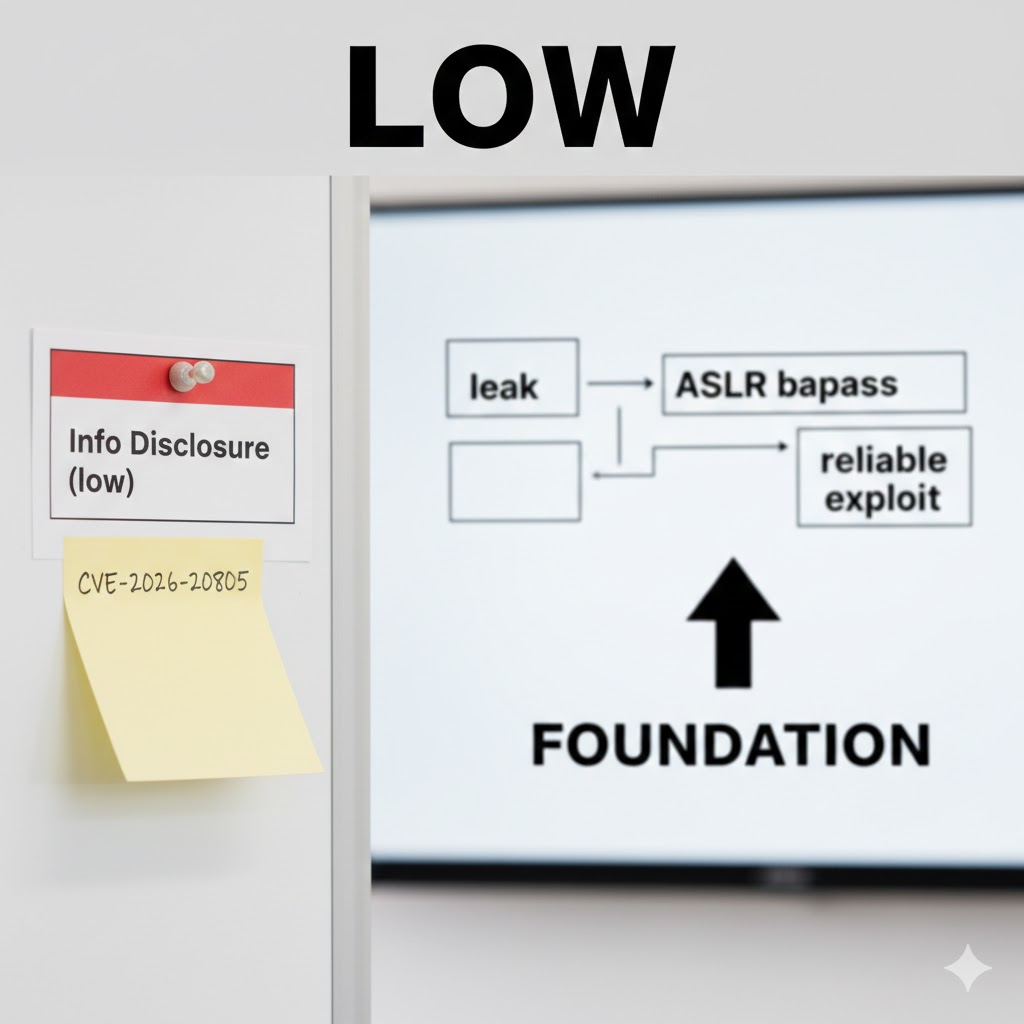
The “Stepping Stone” Philosophy in Exploit Chains
Security engineers often overlook vulnerabilities like CVE-2026-20805 because they do not allow for code execution on their own. This is a fatal mistake in threat modeling.
In advanced persistent threat (APT) campaigns, an “Information Disclosure” bug is the necessary precursor to a “Memory Corruption” bug.
- Stage 1 (CVE-2026-20805): The attacker gains local access (perhaps via a compromised low-privileged AI training script or a phishing macro). They run the PoC to read the memory layout of the system.
- Stage 2 (The Hammer): The attacker deploys a separate exploit (e.g., a Use-After-Free in a graphics driver or a browser renderer) that would normally crash the system due to ASLR.
- Stage 3 (Convergence): Using the address leaked in Stage 1, the Stage 2 exploit is modified dynamically to point to the correct memory addresses, achieving reliable SYSTEM privileges.
For AI infrastructure, this is particularly dangerous. An attacker who compromises a researcher’s machine can pivot to the GPU cluster, exfiltrating proprietary model weights or poisoning datasets.
Automating the Kill Chain: How AI Agents Perceive CVE-2026-20805
The complexity of chaining these vulnerabilities highlights the limitations of traditional, static vulnerability scanners. A standard scanner sees “CVE-2026-20805: Medium Severity” and places it at the bottom of the patch list. A human red teamer, however, sees “The Key to the Kingdom.”
This is where the next generation of offensive security tools, such as Penligent, fundamentally changes the game.
Beyond Static Scanning
Penligent acts as an autonomous AI penetration tester. Unlike a scanner that simply matches version numbers against a database, Penligent utilizes an LLM-driven reasoning engine to understand the context of a vulnerability.
When Penligent encounters a host vulnerable to CVE-2026-20805 during an engagement, it does not merely report it. Its reasoning engine performs the following cognitive steps:
- Contextual Analysis: “I have found a memory leak in DWM. I also see a browser service running with a known, hard-to-exploit RCE.”
- Strategic Planning: “If I use the DWM leak to map the memory, I can increase the success rate of the RCE from 5% to 100%.”
- Execution: The agent autonomously compiles the necessary exploit primitives, chains them together, and validates the attack path—mirroring the behavior of a sophisticated human adversary.
By simulating this logic, Penligent allows organizations to see their risks not as isolated CVEs, but as viable attack paths. For an AI security engineer, this means shifting from “patching everything” to “breaking the kill chain” where it matters most.
| Feature | Legacy Vulnerability Scanner | Penligent AI Agent |
|---|---|---|
| CVE-2026-20805 Assessment | “Medium Risk (Info Disclosure)” | “Critical Risk (ASLR Bypass Primitive)” |
| Action Taken | Logs to a PDF report | Attempts to chain with other flaws |
| Exploit Validation | None (Passive) | Active verification (Safe PoC execution) |
| Context Awareness | Zero (Stateless) | High (Understands OS & Process relationships) |
Detection and Mitigation Strategies
Given that the CVE-2026-20805 PoC is active in the wild, immediate remediation is mandatory. However, simply applying the patch is often insufficient for mature security postures. You must assume the vulnerability may have already been used to establish persistence.
1. Patching
Apply the Microsoft January 2026 cumulative update immediately. This update modifies dwm.exe to properly sanitize ALPC connection requests, ensuring that internal memory pointers are zeroed out before being returned to the caller.
2. Behavioral Detection (EDR Rules)
Since the exploit involves unusual ALPC traffic to the DWM port, security teams can craft EDR queries to detect the pre-exploitation phase.
- Indicator: High-frequency ALPC connection attempts to
\\RPC Control\\DwmApifrom non-standard processes (e.g.,powershell.exe,cmd.exe, or unknown binaries inAppData). - Memory Scanning: Monitor for processes attempting to read the memory space of
dwm.exeviaReadProcessMemoryor similar APIs without a valid debug handle.
3. Hardening AI Workstations
For environments developing sensitive AI models:
- Virtualization Based Security (VBS): Ensure VBS and Hypervisor-Enforced Code Integrity (HVCI) are enabled. These features can mitigate the impact even if ASLR is bypassed.
- Least Privilege: Ensure that AI training scripts and Jupyter notebooks do not run with Administrative privileges. CVE-2026-20805 is a local attack vector; limiting what a compromised low-privilege process can do is the last line of defense.
Conclusion
CVE-2026-20805 serves as a stark reminder that in the era of automated cyber warfare, “low severity” does not mean “low priority.” For the AI security engineer, protecting the integrity of the underlying operating system is as vital as securing the model weights themselves. By understanding the mechanics of ALPC exploitation and leveraging AI-driven offensive testing platforms like Penligent, teams can move from reactive patching to proactive threat elimination.
References & Authoritative Links:
 English
  German
  French
  Spanish
  Portuguese
  Japanese
  Korean
  Hindi
Hindi  Arabic
  Turkish
  Hebrew