
Why This CVE Is Different in Real Operations
“Chrome zero-day exploited in the wild” is one of those phrases that instantly collapses debate. Your organization may disagree on dozens of risk items, but browser RCE-class bugs with confirmed exploitation compress response time to hours, not weeks.
CVE-2026-2441 is exactly that kind of event:
- It’s a use-after-free memory safety flaw (CWE-416) in Chrome’s CSS component. (NVD)
- Google states an exploit exists in the wild, and shipped a Stable channel update to fix it. (Chrome Releases)
- CISA added CVE-2026-2441 to the Known Exploited Vulnerabilities (KEV) catalog update on February 17, 2026, which changes how many public-sector and regulated orgs must treat remediation deadlines. (CISA)
If you’re a responder, the questions that matter aren’t philosophical. They’re painfully concrete:
- Which endpoints are below the fixed version floor right now
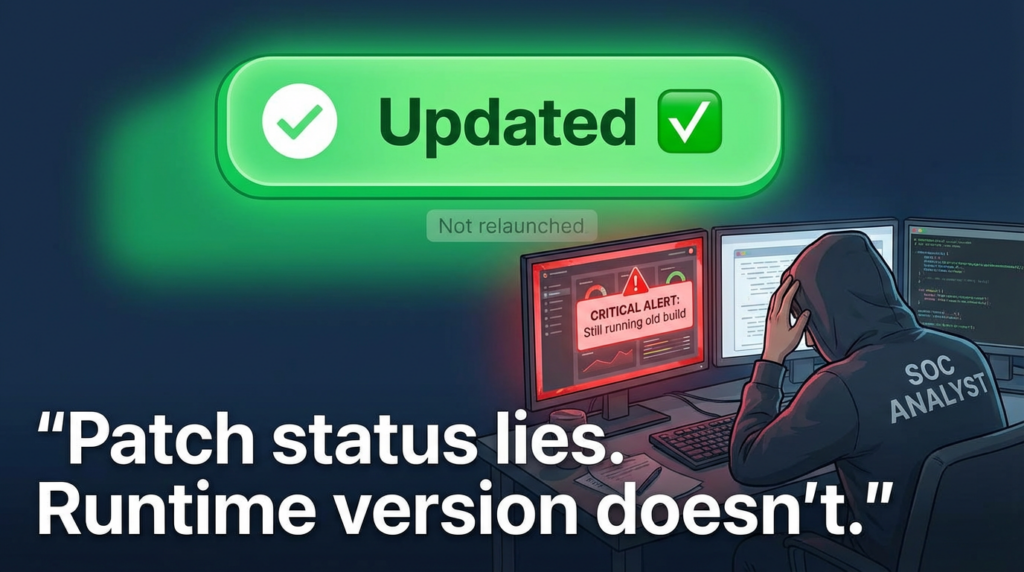
- Whether “updated” actually means “running the fixed build after relaunch”
- How to produce defensible evidence that the fleet is no longer exposed
This article is written to be dropped into a real internal advisory, a customer-facing security note, or an incident timeline—without adding speculative details Google didn’t publish.
What CVE-2026-2441 Actually Is
The National Vulnerability Database description is the cleanest single-sentence definition:
Use after free in CSS in Google Chrome prior to 145.0.7632.75 allowed a remote attacker to execute arbitrary code inside a sandbox via a crafted HTML page. (NVD)
This tells you almost everything you need for triage:
- Trigger: crafted web content (“crafted HTML page”)
- Impact: arbitrary code execution inside the browser sandbox
- Scope: Chrome versions prior to 145.0.7632.75
- Root cause class: use-after-free, CWE-416 (NVD)
Google’s Stable channel bulletin (Feb 13, 2026) lists CVE-2026-2441 as a High severity security fix and contains the operationally crucial statement: Google is aware an exploit exists in the wild. (Chrome Releases)
Fixed Versions You Can Put in a Runbook
When teams get burned on browser zero-days, it’s often because they tracked “patched” as a vague state instead of pinning to exact build numbers.
From Google’s Stable channel update:
- Windows and macOS: 145.0.7632.75/76
- Linux: 144.0.7559.75 (Chrome Releases)
From NVD:
- Vulnerable: prior to 145.0.7632.75 (NVD)
Here is a copy-paste table suitable for an internal bulletin:
| Platform | Fixed Stable version line | What counts as proof | Primary source |
|---|---|---|---|
| Windows | 145.0.7632.75/76 | Running version string from endpoint after relaunch | Chrome Releases (Chrome Releases) |
| macOS | 145.0.7632.75/76 | Running version string from endpoint after relaunch | Chrome Releases (Chrome Releases) |
| Linux | 144.0.7559.75 | Package version + google-chrome --version | Chrome Releases (Chrome Releases) |
| Any | Prior to 145.0.7632.75 is vulnerable | Use as policy threshold in vuln mgmt tools | NVD (NVD) |
A note that prevents bad assumptions
Chrome has multiple channels, and many enterprises use downstream Chromium browsers or vendor-managed builds. The safest posture is:
- Use Google’s fixed Stable builds as the upstream floor for “not vulnerable to CVE-2026-2441.” (Chrome Releases)
- For downstream browsers, require vendor confirmation or version evidence that incorporates the fix (do not assume parity just because it is Chromium-based).

Why In-Sandbox Code Execution Still Triggers a Fire Drill
You’ll see people try to downplay CVE-2026-2441 because the NVD wording says “inside a sandbox.” That’s not how exploitation risk works operationally.
In modern browser exploitation, “renderer compromise inside the sandbox” is often:
- the first stage to gain memory corruption primitives,
- a stepping stone for credential access or session hijacking,
- the entry point for chaining with additional bugs (sandbox escape, privilege escalation).
That’s one reason CERTs and CISA treat “exploited in the wild” browser vulnerabilities as urgent, even before deep technical details are public. CISA’s KEV inclusion is a strong external signal that the exploitation risk is real and active. (CISA)
The Timeline That Matters for Responders
February 13, 2026 Google ships the stable fix
Google posted the Stable channel update dated Friday, February 13, 2026, and listed CVE-2026-2441 as a High severity “Use after free in CSS.” (Chrome Releases)
February 13–18, 2026 public reporting converges on the same core facts
Security outlets largely re-stated what Google and NVD confirmed: active exploitation and fixed version lines. For example, BleepingComputer’s coverage highlights the “exploit exists in the wild” statement and the urgency to update. (BleepingComputer)
February 17, 2026 CISA includes it in KEV
CISA’s alert (Feb 17, 2026) lists CVE-2026-2441 as one of the vulnerabilities added to the catalog. (CISA)
If you run a program where KEV inclusion changes SLA and escalation, this is the date you cite in the incident record.
First-Hour Response: The Three Questions That Decide Outcomes
Where is Chrome used in a high-value context
Inventory isn’t just “does the machine have Chrome.” You care about:
- Admin workstations
- SOC analyst workstations
- Developer endpoints with prod credentials
- Jump hosts and bastions
- VDI pools shared across roles
- Any endpoint used to open external, untrusted content as part of work
In a browser zero-day, these are the systems where “a crafted page” becomes a realistic trigger.
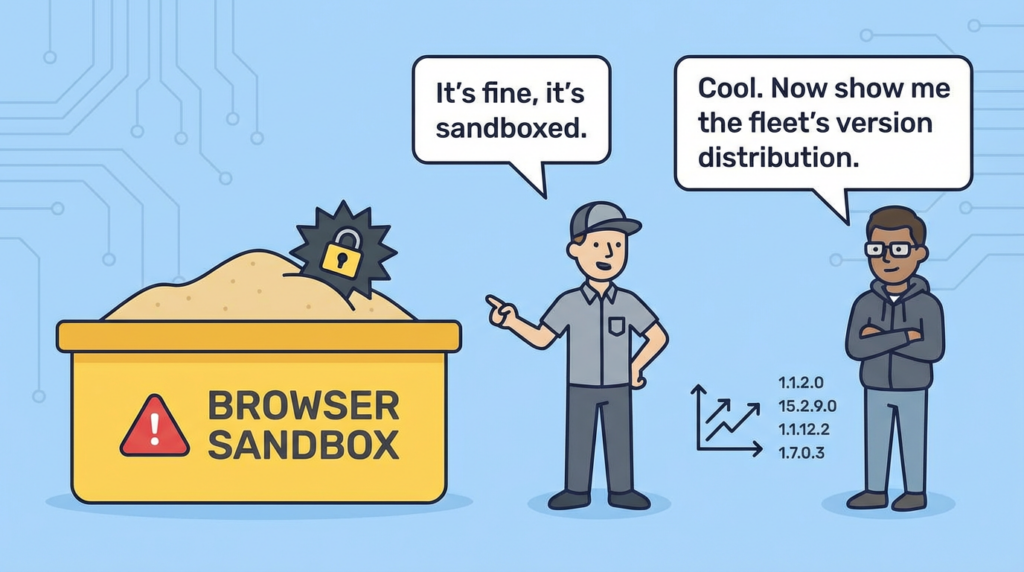
Which endpoints are below the fixed floor right now
Your fastest risk reduction comes from identifying endpoints below the fixed version threshold and prioritizing the highest-risk roles first.
Can you produce evidence you’re fixed
Incident response and governance converge on one deliverable: a proof pack that survives review.
You don’t want “we updated.” You want:
- version distribution before and after,
- timestamps,
- exceptions with owners and deadlines,
- artifacts that show the endpoint is running the fixed build.
Verification Without Exploit Content
Nothing in this section requires PoCs, malicious pages, or weaponized steps. It’s safe version validation and evidence collection.
macOS: verify running Chrome build
/Applications/Google\\ Chrome.app/Contents/MacOS/Google\\ Chrome --version
Store the output (or a signed screenshot in a change ticket) as evidence.
Windows: verify version from registry
# Chrome version in user context
Get-ItemProperty "HKCU:\\Software\\Google\\Chrome\\BLBeacon" -ErrorAction SilentlyContinue |
  Select-Object version

# Chrome version in machine context
Get-ItemProperty "HKLM:\\Software\\Google\\Chrome\\BLBeacon" -ErrorAction SilentlyContinue |
  Select-Object version
Linux: verify binary and package versions
google-chrome --version 2>/dev/null || google-chrome-stable --version 2>/dev/null
For Debian-based systems:
dpkg -l | grep -E "google-chrome|chromium" | head
The relaunch trap that breaks many “patch” reports
Chrome updates often download in the background, but the security fix does not become active until the browser is relaunched. Many public advisories explicitly remind users to restart/relaunch after updating. (Chrome Releases)
Treat “updated but not relaunched” as “not yet remediated” in your program.
A Simple Fleet Script Pattern That Produces Audit-Ready Output
The goal is not fancy; it’s consistent evidence.
Output format
Use a line-based CSV structure that you can store and diff:
hostname,os,chrome_version,observed_at_utc,collector_version
Example macOS collection snippet
#!/usr/bin/env bash
set -euo pipefail

HOST="$(scutil --get LocalHostName 2>/dev/null || hostname)"
OS="macos"
NOW="$(date -u +"%Y-%m-%dT%H:%M:%SZ")"

CHROME="/Applications/Google Chrome.app/Contents/MacOS/Google Chrome"
if [[ -x "$CHROME" ]]; then
  VER="$("$CHROME" --version | awk '{print $NF}')"
else
  VER="not_installed"
fi

echo "${HOST},${OS},${VER},${NOW},collector_v1"
Example Windows collection snippet
$HostName = $env:COMPUTERNAME
$OS = "windows"
$Now = (Get-Date).ToUniversalTime().ToString("yyyy-MM-ddTHH:mm:ssZ")

$ver = $null
try { $ver = (Get-ItemProperty "HKLM:\\Software\\Google\\Chrome\\BLBeacon").version } catch {}
if (-not $ver) {
  try { $ver = (Get-ItemProperty "HKCU:\\Software\\Google\\Chrome\\BLBeacon").version } catch {}
}
if (-not $ver) { $ver = "unknown_or_not_installed" }

"$HostName,$OS,$ver,$Now,collector_v1"
How you use it
- Collect baseline at T0
- Push updates
- Collect again at T+2h and T+24h
- Track exceptions explicitly
That is how you turn “we think we patched” into evidence.
Practical Risk Reduction While Patch Waves Roll Out
When exploitation is active, you may not have 100% patch coverage instantly. Your job is to reduce exposure while patching completes.
Useful controls include:
- enforce automatic updates and relaunch windows,
- restrict risky extensions,
- isolate browsing for privileged roles,
- strengthen endpoint hardening on high-risk workstations,
- temporarily constrain browsing behavior for specific teams if needed.
CISA’s KEV guidance emphasizes applying vendor mitigations or discontinuing use if mitigations aren’t available, which reinforces that “wait for the next cycle” is not the intended response class. (CISA)
Detection: What You Can Hunt Without Pretending You Have a CVE Signature
For many browser 0-days, you won’t have a clean signature that says “CVE-2026-2441 exploitation detected.” Instead, you hunt for behavior consistent with post-compromise activity originating from the browser.
High-signal behavioral clusters
- Browser spawning unusual child processes
- Unexpected script engines invoked from a browsing session
- New persistence mechanisms created shortly after browsing activity
- Credential access anomalies following suspicious link clicks
- Crash spikes or anomalous stability events correlated with targeted populations
KQL-style sketch for browser-driven child processes
Adapt to your telemetry schema:
DeviceProcessEvents
| where InitiatingProcessFileName in~ ("chrome.exe","msedge.exe","brave.exe","chrome","google-chrome")
| where FileName in~ ("powershell.exe","cmd.exe","wscript.exe","cscript.exe","mshta.exe","rundll32.exe")
| project Timestamp, DeviceName, InitiatingProcessFileName, InitiatingProcessCommandLine, FileName, CommandLine
| order by Timestamp desc
The objective is not to label CVE exploitation. The objective is to catch “browser -> suspicious execution” patterns on endpoints that lagged behind the fixed build.
How to Write an Internal Advisory Engineers Will Trust
A reliable advisory avoids embellishment and stays anchored to primary sources.
A template you can reuse
Summary
CVE-2026-2441 is a use-after-free vulnerability in Chrome’s CSS component that affects Chrome versions prior to 145.0.7632.75 and can allow arbitrary code execution inside the sandbox via a crafted HTML page. (NVD)
Exploitation status
Google states an exploit exists in the wild; CISA has added CVE-2026-2441 to the Known Exploited Vulnerabilities catalog. (Chrome Releases)
Remediation
Update Chrome to Stable 145.0.7632.75/76 (Windows/macOS) or 144.0.7559.75 (Linux) and relaunch the browser to activate the fix. (Chrome Releases)
Verification
Collect running version strings across endpoints and confirm no assets remain below the fixed floor; exceptions require owner and date.
This is boring—and that’s the point. Boring advisories are credible advisories.
Related Context: Why Your Browser Zero-Day Program Must Be Repeatable
CVE-2026-2441 isn’t a one-off. The operational lesson is that browser exploitation remains a high-frequency threat category, and your program must be able to do the same steps every time:
- pin to a fixed floor,
- measure exposure,
- remediate quickly,
- prove it,
- learn from the gaps.
CISA’s KEV model exists precisely to push orgs toward repeatable execution for vulnerabilities with evidence of exploitation. (CISA)
If your team already patches quickly, the next bottleneck is often evidence: turning patch execution into a defensible, queryable proof chain that you can reuse for every high-profile CVE.
This is one area where an AI-assisted security workflow can be legitimately useful: not by “finding the zero-day,” but by orchestrating a repeatable verification loop—inventory, version thresholds, exception management, artifact collection, and a single case narrative that survives audits and customer security questionnaires.
Penligent’s recent CVE-2026-2441 write-ups lean into the same responder reality: “proof, not promises,” and “starts inside the sandbox, rarely ends there.” If you want to align your public comms with those messages, link them as supporting reading rather than marketing copy. (Penligent)
One-Page Action Checklist
- Declare fixed version floors for each OS and channel in your runbook. (Chrome Releases)
- Snapshot current Chrome versions for high-risk roles first.
- Push updates and enforce relaunch so the fixed build is running. (Chrome Releases)
- Re-snapshot at T+2h and T+24h; publish distribution and exceptions.
- Hunt for suspicious browser-driven activity on lagging endpoints.
- Document the incident timeline including CISA KEV inclusion. (CISA)
References
- Chrome Releases Stable Channel Update for Desktop, Feb 13, 2026: https://chromereleases.googleblog.com/2026/02/stable-channel-update-for-desktop_13.html (Chrome Releases)
- NVD entry for CVE-2026-2441: https://nvd.nist.gov/vuln/detail/CVE-2026-2441 (NVD)
- CISA alert adding CVE-2026-2441 to KEV, Feb 17, 2026: https://www.cisa.gov/news-events/alerts/2026/02/17/cisa-adds-four-known-exploited-vulnerabilities-catalog (CISA)
- CISA Known Exploited Vulnerabilities Catalog: https://www.cisa.gov/known-exploited-vulnerabilities-catalog (CISA)
- BleepingComputer coverage: https://www.bleepingcomputer.com/news/security/google-patches-first-chrome-zero-day-exploited-in-attacks-this-year/ (BleepingComputer)
- CSO Online coverage: https://www.csoonline.com/article/4132879/exploit-available-for-new-chrome-zero-day-vulnerability-says-google.html (CSO Online)
- Penligent CVE-2026-2441 Proof not promises: https://www.penligent.ai/hackinglabs/cve-2026-2441-the-chrome-css-zero-day-that-demands-proof-not-promises/ (Penligent)
- Penligent CVE-2026-2441 Starts inside the sandbox: https://www.penligent.ai/hackinglabs/cve-2026-2441-the-chrome-css-zero-day-that-starts-inside-the-sandbox-and-rarely-ends-there/ (Penligent)
- Penligent Chrome zero-days exploited in 2025 analysis: https://www.penligent.ai/hackinglabs/chrome-zero-day-vulnerabilities-exploited-in-2025-a-comprehensive-analysis-of-cve-2025-14174-v8-type-confusion-and-sandbox-escapes/ (Penligent)
- Penligent CVE 2026 2441 Proof not promises version 2: https://www.penligent.ai/hackinglabs/cve-2026-2441-the-chrome-css-zero-day-that-demands-proof-not-promises-2/ (Penligent)
 English
  German
  French
  Spanish
  Portuguese
  Japanese
  Korean
  Hindi
Hindi  Arabic
  Turkish
  Hebrew