
CVE-2026-50751 is a critical Check Point VPN authentication bypass affecting Remote Access VPN, Mobile Access, and Spark Firewall deployments when a vulnerable deprecated IKEv1 remote-access path remains enabled. Under the affected conditions, a remote unauthenticated attacker may establish a VPN session without a valid user password.
This is not a direct remote code execution bug. It is also not a routine VPN patch note. The risk sits at the identity boundary of the network. A successful bypass can move an attacker from the public internet into a remote-access position that many organizations still treat as semi-internal.
The vulnerable condition is configuration-dependent. The highest-risk deployments are those where Remote Access VPN or Mobile Access is enabled, IKEv1 is enabled for remote access, legacy Remote Access clients are accepted, and machine certificate authentication is not mandatory. A version match alone is not enough to prove exploitability; a clean response requires software, configuration, reachability, and log evidence.
The urgency is real. Check Point confirmed active exploitation, with observed activity dating back to May 7, 2026 and increased activity in early June. Public technical analysis and a detection artefact generator are now available, which means defenders should assume the issue has moved from targeted exploitation into a broader validation and opportunistic scanning window.
The correct response is not to run untrusted exploit code against production gateways. The correct response is to inventory every Check Point remote-access surface, apply the vendor hotfix, remove the vulnerable IKEv1 legacy path where possible, require machine certificates where applicable, preserve logs from May 7 onward, and hunt for unauthorized VPN sessions followed by internal activity.
What CVE-2026-50751 is
CVE-2026-50751 is an authentication bypass affecting Check Point Remote Access VPN, Mobile Access, and Spark Firewall deployments when the vulnerable IKEv1 remote-access configuration is present. Check Point’s advisory says an attacker can exploit a logic flaw in certificate validation to establish a VPN session without possessing a valid password. The vendor also states that additional post-authentication activity is required to access internal resources or escalate privileges. (Check Point Blog)
That last sentence is important. The vulnerability gives an attacker a way past a VPN authentication boundary, not automatic domain administrator privileges. But for most enterprise networks, an unauthorized VPN session is already a serious foothold. A VPN connection can place the attacker inside routing paths that were never meant to be exposed to the public internet. From that position, the attacker may be able to reach internal web apps, identity services, file shares, administrative portals, jump hosts, source-control systems, build infrastructure, internal APIs, or legacy systems that were protected mainly by network location.
A useful way to think about CVE-2026-50751 is this: it is not the end of the intrusion chain; it is the door that can make the rest of the chain possible.
| Field | Current public information |
|---|---|
| CVE | CVE-2026-50751 |
| Vendor | Check Point |
| Affected area | Remote Access VPN, Mobile Access, Spark Firewall under vulnerable IKEv1 conditions |
| Weakness | Improper authentication, CWE-287 |
| Technical root | Logic flow weakness in certificate validation during deprecated IKEv1 key exchange |
| Impact | Remote unauthenticated attacker may establish a VPN session without a valid user password |
| CVSS v3.1 | 9.3 Critical |
| Known exploitation | Yes, according to Check Point, NVD, CISA KEV, Rapid7, and multiple security outlets |
| Key configuration conditions | Remote Access or Mobile Access enabled, IKEv1 enabled for remote access, legacy clients accepted, machine certificate not required |
| Immediate action | Apply Check Point hotfix or vendor-specified fixed version, remove vulnerable legacy conditions, hunt for compromise |
NVD’s KEV section lists CVE-2026-50751 as “Check Point Security Gateway Improper Authentication Vulnerability,” added on June 8, 2026, with a due date of June 11, 2026 and required action to apply mitigations per vendor instructions, follow applicable BOD 22-01 guidance for cloud services, or discontinue use if mitigations are unavailable. (NVD)
Why the public PoC changed the defender timeline
CVE-2026-50751 became more urgent after public technical analysis moved the issue from a vendor advisory into a reproducible research topic. The important defender takeaway is not the exploit code itself. It is the confirmation that the vulnerable path is tied to authentication-state handling in the legacy IKEv1 remote-access flow, and that exposure depends on configuration details many organizations do not track cleanly.
Public reporting on the research describes a connecting client manipulating authentication-related state during IKEv1 negotiation and reaching a condition where the gateway accepts a session that should have failed. That matters because the flaw is not simply “a missing password check.” It is a trust-decision failure in the part of the VPN stack that decides whether a remote client becomes a VPN participant.
Defenders should also avoid a narrow port-based view of exposure. UDP 500 and UDP 4500 are obvious places to check for IKE, but public reporting indicates that the bypass can also work over TCP 443 through Check Point Visitor Mode when UDP access is blocked or filtered. A safe exposure review should therefore include IKE reachability, Mobile Access and Visitor Mode paths, public DNS names, NAT rules, cloud security groups, load balancers, partner access paths, and MSP-managed appliances.
The existence of a public detection artefact or PoC should not change the patch priority from “maybe” to “yes.” That priority was already established by active exploitation, vendor confirmation, and CISA KEV inclusion. What public technical detail changes is the likely scale of follow-on testing. Once defenders, researchers, scanners, and attackers all understand the vulnerable path more clearly, organizations that still expose legacy IKEv1 remote access should expect more probing.
A safe validation policy should be explicit:
- Do not run untrusted public exploit code against production gateways.
- Use Check Point administrative evidence first: version, hotfix take, Remote Access settings, IKEv1 state, legacy client support, and machine certificate policy.
- Use authorized external discovery only to confirm reachable VPN services.
- Treat scanner output as an exposure signal, not proof of exploitability.
- If exploit-based validation is required, run it only under written authorization, controlled scope, full logging, and preferably against a lab replica or staging gateway.
- Preserve evidence showing the vulnerable condition has been removed, not just that a ticket was closed.
Why the IKEv1 condition matters
IKE, the Internet Key Exchange protocol, negotiates the cryptographic material and security associations used by IPsec VPNs. In remote-access VPN deployments, the protocol sits near the front of the identity boundary. If the gateway incorrectly accepts an authentication state that it should reject, the result is not a cosmetic bug. It can become unauthorized network entry.
The IKEv1 detail is not incidental. IETF RFC 9395 formally deprecated IKEv1 and moved RFCs 2407, 2408, and 2409 to Historic status. The RFC notes that IKEv2 replaced IKEv1 long ago and provides a full replacement for IKEv1 functionality. (datatracker.ietf.org)
Deprecation does not mean every IKEv1 deployment is immediately exploitable. It means the protocol generation is no longer where defenders should want their remote-access identity boundary to live. Deprecated protocol support usually survives for one of three reasons: old clients, old appliances, or old operational dependencies that nobody wants to break. Those are exactly the places where authentication logic, certificate rules, and client compatibility exceptions become fragile.
CVE-2026-50751 demonstrates the security cost of keeping that compatibility path alive. A modern VPN architecture should prefer IKEv2, current cryptographic requirements, machine certificate enforcement where appropriate, strong user authentication, and tight conditional access. A legacy path that accepts older clients and does not require a machine certificate creates a wider state machine. Wider state machines create more branches. Authentication bugs often hide in those branches.
Common misunderstandings that lead to bad triage
The first mistake is calling CVE-2026-50751 remote code execution. The public record supports a different conclusion: the vulnerability allows an unauthenticated attacker to establish a remote-access VPN session without a valid user password under specific IKEv1 conditions. That is serious initial access, but it is not the same as arbitrary code execution on the gateway.
The second mistake is assuming MFA fully solves the issue. MFA remains important for VPN security, but a control is only useful if it is enforced on the exact path being abused. If a deprecated IKEv1 remote-access path can establish a session before the expected user-authentication flow is completed, the team must verify path-level enforcement rather than relying on a general statement that “VPN has MFA.”
The third mistake is checking only UDP 500 and UDP 4500. Those ports matter for IKE discovery, but they are not the whole exposure story. A complete review should also account for TCP 443-based VPN access paths, Visitor Mode behavior, Mobile Access surfaces, NAT rules, cloud firewall rules, and alternate routes through MSP or partner networks.
The fourth mistake is treating machine certificate authentication as a checkbox. For this vulnerability, machine certificate enforcement is not just a generic best practice. It breaks one of the publicly listed vulnerable conditions. The evidence should show that machine certificates are mandatory for the relevant remote-access paths, not merely supported or optional.
The fifth mistake is closing the case after the hotfix. Patching removes the vulnerable code path, but it does not answer whether the gateway was accessed before remediation. If the environment matched the vulnerable conditions at any point after May 7, 2026, the response should include a compromise review across VPN, identity, endpoint, DNS, proxy, firewall, and file-access telemetry.
What must be true for exploitation
The most useful public detail about CVE-2026-50751 is that it has configuration preconditions. CSA Singapore lists four conditions that must be present: VPN Remote Access or Mobile Access is enabled, IKEv1 is enabled for remote access, gateways accept legacy Remote Access clients, and gateways do not demand a machine certificate for connections. (Cyber Security Agency of Singapore)
That should shape how security teams triage. A version number matters, but a version number alone is not enough. A gateway running an affected branch may not be exploitable if the vulnerable remote-access configuration is absent. A different gateway may be urgent if it has the vulnerable configuration and is reachable from the internet.
| Exposure component | Why it matters | How to verify defensively |
|---|---|---|
| Remote Access VPN or Mobile Access enabled | The vulnerable path is tied to remote-access functionality, not every possible gateway role | Check SmartConsole, gateway policy, software blade configuration, and exposed services |
| IKEv1 enabled for remote access | The vulnerable certificate validation path is in deprecated IKEv1 key exchange | Confirm remote-access VPN settings and test only within authorized scope for IKE service exposure |
| Legacy Remote Access clients accepted | Legacy compatibility can keep older authentication behavior reachable | Review Remote Access client compatibility and user migration exceptions |
| Machine certificate not mandatory | The vulnerable condition depends on the gateway not demanding a machine certificate for connections | Confirm Machine Certificate Authentication policy in Check Point configuration |
| Internet reachability | Remote exploitation requires the service to be reachable by the attacker | Validate external exposure from approved scanner locations and network paths |
The affected product/version picture also has two layers: Security Gateways and Spark Firewalls. CSA Singapore lists Security Gateways R82.10 Jumbo Hotfix Take 19 or below, R82 Jumbo Hotfix Take 103 or below, R81.20 Jumbo Hotfix Take 141 or below, and R81.10, R81, and R80.40 as end-of-support branches. For Spark Firewalls, CSA lists R80.20.X as end of support, plus R81.10.X and R82.00.X. (Cyber Security Agency of Singapore)
The practical mistake is to stop at either side of the equation. “We run R81.20” is not enough. “UDP 500 is open” is not enough. “We have Check Point” is not enough. A credible triage workflow needs product, version, enabled blade, remote-access configuration, IKE version, legacy-client setting, machine-certificate setting, and external reachability.
Why an authentication bypass can become a ransomware problem
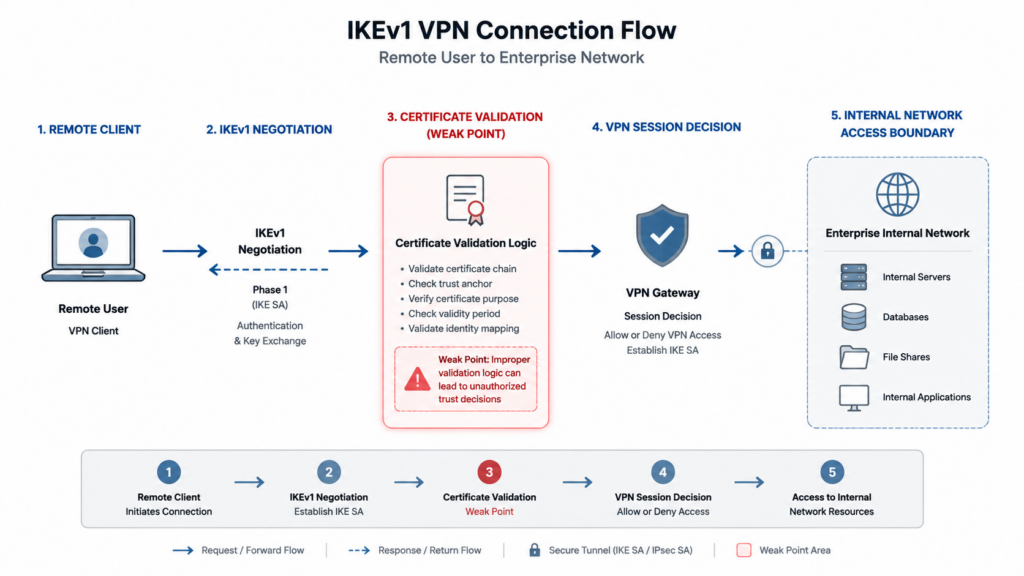
An authentication bypass on a VPN gateway is a first-access problem. Attackers still need to do work after entering. Check Point explicitly says additional post-authentication activity is required to access internal resources or escalate privileges. Rapid7 repeats that same boundary in its emergency threat response write-up. (Check Point Blog)
But “not direct RCE” should not lower urgency. Most real intrusions are chains. Initial access is followed by discovery, credential access, privilege escalation, lateral movement, persistence, collection, exfiltration, and sometimes ransomware deployment. A VPN session can make those later phases easier because the attacker may no longer appear as a random internet source hitting a public service. They may appear as a remote-access user or an internal route.
The public reporting around CVE-2026-50751 already points in that direction. Help Net Security reports that a Qilin ransomware affiliate is believed to be exploiting the vulnerability, and it summarizes Check Point’s observations around suspicious activity first noticed on June 4, earliest known attacks in early May, forensic review from May 7, and post-compromise activity that may involve Rclone, Tox, and attacker-operated VPS infrastructure. (Help Net Security)
BleepingComputer also reports that the attacks began on May 7, surged in early June, affected only a few dozen organizations worldwide, and were linked in at least one case to Qilin ransomware activity. It also notes that Check Point shared mitigation measures for customers who cannot immediately patch. (BleepingComputer)
A realistic attack path might look like this:
| Stage | Attacker objective | Defender telemetry to preserve |
|---|---|---|
| VPN entry | Establish unauthorized remote-access session | VPN session logs, IKE negotiation logs, source IPs, client profile, certificate decision evidence |
| Internal discovery | Identify reachable subnets, services, and identity systems | Firewall east-west logs, DNS logs, NetFlow, EDR network events |
| Credential access | Harvest tokens, passwords, hashes, or reusable secrets | EDR alerts, LSASS access, browser credential access, suspicious file reads |
| Lateral movement | Reach file servers, admin portals, backup systems, or hypervisors | Windows event logs, SSH logs, RDP logs, SMB logs, identity provider telemetry |
| Exfiltration | Move data outside the environment | Proxy logs, unusual outbound traffic, Rclone traces, large archive creation |
| Ransomware execution | Encrypt systems or pressure victim through leak threats | EDR detections, process ancestry, file modification spikes, backup access logs |
This is why the response should combine patching with compromise assessment. If a vulnerable gateway was exposed before remediation, “we patched” is not a complete sentence. The next question is whether anyone used the weakness before the fix landed.
Timeline defenders should use
The timeline matters because log review windows are often too short. If a team only checks activity after the public advisory date, it can miss the period when attackers had the most advantage.
| Date | Event | Why it matters |
|---|---|---|
| May 7, 2026 | Earliest observed exploitation date cited by Check Point and Rapid7 | Start historical VPN and endpoint review from here, not just from disclosure day |
| June 4, 2026 | Check Point says suspicious activity led to an investigation | Use this as a marker for increased attacker activity and possible detection opportunities |
| June 8, 2026 | Check Point public advisory and NVD publication | Patch, triage, and executive notification should begin immediately |
| June 8, 2026 | CISA KEV addition shown in NVD’s KEV section | Treat the issue as actively exploited, not merely theoretically critical |
| June 11, 2026 | NVD’s KEV section lists the due date for required action | For organizations outside the U.S. federal scope, the date is still a useful urgency benchmark |
Check Point’s advisory says incident response teams should prioritize forensic log audits and configuration reviews starting from the earliest observed exploitation date of May 7, 2026. (Check Point Blog) Rapid7 also reports observed activity dating back to May 7, an increase in early June, a campaign described by Check Point as limited in scope, and at least one incident linked by Check Point with medium confidence to a Qilin ransomware affiliate. (Rapid7)
How to find exposed systems without crossing into exploit testing
The first safe task is inventory. Security teams should identify all Check Point gateways and appliances, especially internet-facing Remote Access VPN, Mobile Access, Spark Firewall, branch firewall, and managed service provider customer edge deployments. Do not assume central firewall teams own every relevant device. Spark appliances and branch gateways are often managed separately from larger data-center firewalls.
Start with internal sources:
| Source | What to extract |
|---|---|
| CMDB | Product name, owner, location, version, support status |
| Firewall management | Gateway object, software blade, policy package, hotfix take |
| External attack surface management | Internet-facing IPs, DNS names, exposed UDP 500 and UDP 4500 |
| Identity provider logs | VPN users, groups, MFA policy, remote-access exceptions |
| Endpoint management | Installed Check Point clients, legacy client usage, certificate deployment |
| Change management | Recent VPN policy changes, emergency hotfix records, user migration exceptions |
For authorized external discovery, keep scans light and non-destructive. Nmap’s official ike-version NSE script is categorized as default, discovery, safe, and version, and the script summary says it obtains information such as vendor and device type from an IKE service by sending four packets to the host. (Nmap)
Example authorized inventory scan:
# Authorized exposure discovery only.
# Use approved targets, approved windows, and rate limits.

sudo nmap -sU -sV -p 500,4500 \
  --script ike-version \
  --version-intensity 0 \
  -oA checkpoint_ike_inventory \
  -iL authorized_vpn_targets.txt
The command above does not prove exploitability. It helps determine whether IKE services are reachable and whether a system may be a Check Point VPN endpoint. Treat the output as an inventory signal. A true CVE-2026-50751 risk decision requires configuration confirmation from the gateway.
A simple Bash wrapper can help normalize results for asset owners:
#!/usr/bin/env bash
set -euo pipefail

TARGETS="${1:-authorized_vpn_targets.txt}"
OUTDIR="${2:-ike-inventory-$(date +%Y%m%d)}"

mkdir -p "$OUTDIR"

echo "target,udp_500_state,udp_4500_state,notes" > "$OUTDIR/summary.csv"

while read -r target; do
  [[ -z "$target" || "$target" =~ ^# ]] && continue

  safe_name="$(echo "$target" | tr '/:' '__')"
  sudo nmap -sU -sV -p 500,4500 --script ike-version \
    --version-intensity 0 \
    -oN "$OUTDIR/$safe_name.nmap" \
    "$target" >/dev/null

  udp500="$(awk '/500\/udp/ {print $2; exit}' "$OUTDIR/$safe_name.nmap" || true)"
  udp4500="$(awk '/4500\/udp/ {print $2; exit}' "$OUTDIR/$safe_name.nmap" || true)"
  notes="$(grep -Ei 'Check Point|IKE|ISAKMP|vendor' "$OUTDIR/$safe_name.nmap" | tr ',' ';' | tr '\n' ' ' | sed 's/  */ /g')"

  echo "$target,${udp500:-unknown},${udp4500:-unknown},\"$notes\"" >> "$OUTDIR/summary.csv"
done < "$TARGETS"

echo "Wrote $OUTDIR/summary.csv"
runZero published a concise asset-query pattern for potentially impacted systems: hw:="Check Point%" AND protocol:ike AND ike.version:="1.0". That query captures the right mindset: the risk is not merely “Check Point exists,” but “Check Point plus IKE plus IKEv1.” (runZero)
External exposure discovery should be paired with internal verification:
For each candidate gateway:

1. Confirm product family and version.
2. Confirm whether Remote Access VPN or Mobile Access is enabled.
3. Confirm whether IKEv1 is enabled for remote access.
4. Confirm whether legacy Remote Access clients are accepted.
5. Confirm whether machine certificate authentication is mandatory.
6. Confirm applied hotfix or fixed software take.
7. Confirm whether May 7 onward logs are retained and searchable.
8. Confirm whether source IPs and authentication decisions are preserved in SIEM.
If any of those fields are unknown, the asset should remain in the triage queue. Unknown should not be treated as safe.
Configuration questions that matter more than a scanner hit
Security teams often overvalue scanner results and undervalue configuration state. For this vulnerability, configuration state is the center of the problem.
Ask the firewall or VPN owner these questions:
| Question | Safe answer | Risky answer |
|---|---|---|
| Is Remote Access VPN or Mobile Access enabled? | Disabled, or not exposed externally | Enabled on internet-facing gateway |
| Is IKEv1 enabled for remote access? | Disabled, IKEv2 only | Enabled for compatibility |
| Are legacy Remote Access clients accepted? | Removed or blocked | Accepted because some users still need them |
| Is machine certificate authentication mandatory? | Mandatory and verified | Optional, disabled, or unknown |
| Is the gateway running a fixed version or hotfix take? | Confirmed with evidence | “Probably patched” or based only on policy intent |
| Are logs retained from May 7, 2026 onward? | Yes, searchable across VPN, firewall, identity, and EDR | No, short retention, or fragmented ownership |
| Are source IPs, usernames, auth methods, and certificate decisions recorded? | Yes | Partial, missing, or not normalized |
When the team cannot answer these questions quickly, that is a governance signal. Remote-access infrastructure should not be a mystery asset. The whole point of VPN is controlled access; if the organization cannot identify who controls the VPN, what version it runs, which legacy paths are enabled, and where logs live, the environment is already fragile before a CVE arrives.
Hunting for compromise
Patch first if the system is exposed and vulnerable. Then hunt. The order matters because active exploitation has been reported, and an unpatched gateway can remain an entry point while analysts are still debating log queries.
A strong hunt should begin on May 7, 2026, the earliest observed exploitation date called out by Check Point. (Check Point Blog) The review should include VPN logs, gateway logs, identity provider logs, endpoint telemetry, DNS, proxy logs, NetFlow, file server logs, EDR, and any centralized SIEM data that can connect VPN session start to internal behavior.
Core questions:
| Hunt question | Why it matters |
|---|---|
| Were there VPN sessions from unusual source IPs, cloud VPS providers, or geographies not associated with users? | Check Point described attacker use of dedicated VPS infrastructure, including providers such as Kaupo Cloud HK, Shock Hosting, and Vultr Holdings. (Check Point Blog) |
| Were there IKEv1 remote-access sessions where the authentication trail is incomplete or inconsistent? | The vulnerability concerns the authentication path, so gaps between session establishment and expected credential or certificate evidence matter |
| Did any VPN session begin without expected MFA, user login, machine certificate, or client certificate telemetry? | A mismatch between VPN session and identity evidence can be a high-value anomaly |
| Did a VPN session immediately access internal file shares, domain controllers, admin portals, backup servers, or EDR management systems? | Attackers often move from access to discovery and collection |
| Were there signs of Rclone, unusual archive creation, large outbound transfers, or Tox-related communication? | Help Net Security reports suspected post-compromise activity involving Rclone and possible Tox use in the public Check Point summary. (Help Net Security) |
| Were Linux ELF files downloaded or executed after VPN entry? | Some public reporting around the campaign mentions malicious ELF downloads after access; treat this as a clue to validate against vendor IOCs and EDR telemetry |
A simple log-normalization script can help analysts structure VPN session data before writing SIEM-specific detections. The following example assumes a CSV export with common fields. It does not detect exploitation by itself. It helps find sessions that deserve review.
#!/usr/bin/env python3
"""
Defender-side triage helper for VPN session exports.

Expected CSV columns:
timestamp, username, source_ip, country, ike_version, auth_method,
machine_cert, client_type, action, assigned_ip

This script flags rows that look risky for CVE-2026-50751 triage:
- IKEv1 remote-access sessions
- missing or non-mandatory machine certificate evidence
- legacy client use
- session starts from unexpected geographies or cloud/VPS tags
"""

import csv
import sys
from pathlib import Path

if len(sys.argv) != 2:
    print(f"Usage: {sys.argv[0]} vpn_sessions.csv", file=sys.stderr)
    sys.exit(1)

path = Path(sys.argv[1])
if not path.exists():
    print(f"File not found: {path}", file=sys.stderr)
    sys.exit(1)

unexpected_countries = {"RU", "KP", "IR"}  # customize for your org
vps_markers = {"vultr", "shock", "kaupo", "hosting", "cloud", "vps"}

def norm(value: str) -> str:
    return (value or "").strip().lower()

def is_risky(row: dict) -> list[str]:
    reasons = []

    if norm(row.get("action")) not in {"login", "session_start", "connect", "accepted"}:
        return reasons

    if norm(row.get("ike_version")) in {"ikev1", "1", "1.0"}:
        reasons.append("IKEv1 remote-access session")

    machine_cert = norm(row.get("machine_cert"))
    if machine_cert in {"", "none", "optional", "false", "no", "not_required"}:
        reasons.append("machine certificate not mandatory or not recorded")

    client_type = norm(row.get("client_type"))
    if "legacy" in client_type or "old" in client_type:
        reasons.append("legacy remote-access client")

    country = (row.get("country") or "").strip().upper()
    if country in unexpected_countries:
        reasons.append(f"unexpected source country {country}")

    source_note = " ".join(
        norm(row.get(field))
        for field in ("source_ip", "source_org", "asn_org", "reverse_dns")
        if field in row
    )
    if any(marker in source_note for marker in vps_markers):
        reasons.append("source appears to match cloud or VPS marker")

    return reasons

with path.open(newline="", encoding="utf-8") as f:
    reader = csv.DictReader(f)
    writer = csv.DictWriter(
        sys.stdout,
        fieldnames=list(reader.fieldnames or []) + ["triage_reasons"]
    )
    writer.writeheader()

    for row in reader:
        reasons = is_risky(row)
        if reasons:
            row["triage_reasons"] = "; ".join(reasons)
            writer.writerow(row)
For SIEM teams, detection should focus on correlation rather than a single magic string. A useful rule might look for a cluster of conditions: IKEv1, remote access, legacy client, missing machine certificate evidence, unusual source network, and internal discovery shortly after session start.
title: Suspicious IKEv1 Remote Access VPN Session on Check Point Gateway
id: 9f1db9d2-7d70-4fb7-b814-cve-2026-50751-triage
status: experimental
description: >
  Flags Check Point remote-access VPN sessions that match high-risk
  CVE-2026-50751 triage conditions. Tune field names to your SIEM schema.
logsource:
  product: checkpoint
  service: vpn
detection:
  selection_session:
    event.action:
      - vpn_login
      - session_start
      - connect
    vpn.ike.version:
      - "IKEv1"
      - "1"
      - "1.0"
  risky_client:
    vpn.client.type|contains:
      - "legacy"
      - "old"
  missing_machine_cert:
    vpn.machine_certificate.required:
      - false
    vpn.machine_certificate.status:
      - "missing"
      - "not_required"
      - "optional"
  suspicious_source:
    source.as.organization|contains:
      - "Vultr"
      - "Shock Hosting"
      - "Kaupo"
      - "Cloud"
      - "VPS"
  condition: selection_session and (risky_client or missing_machine_cert or suspicious_source)
fields:
  - timestamp
  - source.ip
  - source.as.organization
  - user.name
  - vpn.ike.version
  - vpn.client.type
  - vpn.machine_certificate.status
  - destination.ip
falsepositives:
  - Approved legacy client migration windows
  - Known corporate VPN concentrator tests
  - Managed service provider maintenance activity
level: high
A second correlation can look for suspicious post-VPN behavior:
VPN session start from unusual source
  within 30 minutes followed by:
    - internal SMB enumeration
    - domain controller LDAP queries
    - access to backup management ports
    - large file archive creation
    - Rclone execution
    - outbound transfer to unapproved destination
Keep a clean separation between exposure detection and compromise detection. Exposure detection answers, “Could this system be vulnerable?” Compromise detection answers, “Was this weakness likely used?” The first belongs to vulnerability management and firewall operations. The second belongs to incident response.
Patching and mitigation priorities
For CVE-2026-50751, the best mitigation is to apply the Check Point fix for the affected deployment and verify that the vulnerable configuration path is gone. Rapid7 states that Check Point released hotfixes and that affected organizations should apply updates on an emergency basis rather than waiting for the next normal patch cycle. (Rapid7)
CSA Singapore advises users and administrators of affected products to upgrade to the minimum required Jumbo Hotfix Take or software version specified in the official Check Point advisory. (Cyber Security Agency of Singapore)
If patching cannot be completed immediately, reduce exploitability by breaking the necessary conditions:
| Action | What it breaks | Notes |
|---|---|---|
| Disable IKEv1 for remote access | Removes the vulnerable protocol path | Prefer IKEv2-only remote access |
| Remove support for legacy Remote Access clients | Removes compatibility path tied to exposure | Requires user migration planning |
| Require machine certificate authentication | Removes one of the explicit vulnerable conditions | Confirm enforcement, not just policy intent |
| Apply IPS protections and update signatures | Adds detection/prevention coverage | Do not treat IPS as a substitute for patching |
| Restrict VPN source networks where operationally possible | Reduces attack surface | Useful for admin VPNs and partner-only access |
| Review and disable stale VPN users | Reduces post-entry opportunity | Focus on contractors, old service users, shared accounts |
| Increase logging and retention | Improves hunt capability | Retain VPN, identity, firewall, EDR, proxy, and DNS logs |
BleepingComputer reports that Check Point mitigation guidance for customers who cannot immediately patch includes removing legacy remote access client support, configuring Remote Access VPN Authentication to IKEv2 only, setting Machine Certificate Authentication as mandatory, enabling IPS, and downloading signatures. (BleepingComputer)
The common failure mode is to apply only one mitigation and declare victory. For example, requiring MFA is valuable, but the public description of CVE-2026-50751 centers on a certificate validation logic path in IKEv1. If the vulnerable path can establish a session without the expected credential flow, MFA alone should not be treated as the only control. Disable or remove the vulnerable remote-access conditions.
How to validate that remediation worked
A good fix needs evidence. It should produce proof that can survive an audit, a post-incident review, or a retest.
| Validation area | Evidence to collect | Passing condition |
|---|---|---|
| Patch status | Gateway version, Jumbo Hotfix Take, Check Point hotfix record, change ticket | Vendor-specified fixed level installed on each affected gateway |
| IKEv1 remote access | Configuration export or screenshot from management plane | IKEv1 disabled for remote access unless a documented exception exists |
| Legacy clients | Remote Access client compatibility settings | Legacy client support removed or blocked |
| Machine certificate | Authentication policy and test connection evidence | Machine certificate authentication mandatory where used as mitigation |
| External exposure | Approved scanner output for UDP 500 and UDP 4500 | Exposure understood and expected, not unknown |
| Logs | SIEM queries covering May 7 onward | No unexplained suspicious sessions, or escalated incident case created |
| User migration | Help desk and endpoint deployment records | Users moved to supported clients without emergency rollback to vulnerable settings |
A version scanner can help, but it cannot prove the whole fix. A gateway can be patched while a risky legacy configuration remains. A configuration can be hardened while an unpatched branch office appliance remains exposed. A public IP can appear closed from one scanner location while still reachable through a different path. Good validation crosses all three layers: software, configuration, and reachability.
For organizations that use AI-assisted security testing inside authorized workflows, CVE-focused validation is useful only when it preserves evidence and avoids unsafe shortcuts. Penligent’s public material describes an AI pentesting workflow around scope, evidence, controlled tool use, CVE validation, and reportable evidence rather than treating AI as an unrestricted attacker. That framing is relevant here because CVE-2026-50751 triage is not just “run a scanner”; it is a controlled process of asset identification, configuration verification, safe exposure testing, post-fix retesting, and evidence capture. Penligent’s homepage positions the product as an AI-powered penetration testing tool, and its article on using AI for pentesting emphasizes authorization, evidence, control, and careful CVE validation. (Penligent)
The same discipline applies if the workflow is fully manual. The output should not be “CVE found.” It should be a reproducible finding or closure note with affected asset, product version, configuration state, reachability, fix evidence, residual risk, and retest result.
What not to do
Do not rely on public exploit repositories to decide whether to patch. Search results already show low-trust pages and repositories claiming PoC-style material for CVE-2026-50751, while authoritative sources focus on vendor mitigation, active exploitation, and configuration conditions rather than publishing a safe public reproduction. GitHub’s advisory database lists CVE-2026-50751 as a critical unreviewed advisory with unknown package and patched version fields, which is useful as a vulnerability reference but not a substitute for the vendor advisory or gateway configuration review. (GitHub)
Do not assume “no known compromise” if logs are missing. If VPN logs roll over after seven days and the organization was exposed from May 7 onward, the absence of evidence is weak. Create an incident note that states the limitation clearly.
Do not treat end-of-support versions as normal patch candidates. CSA Singapore lists several EOS branches in the affected product set. EOS systems may receive emergency guidance in some cases, but they should still be treated as architectural debt. (Cyber Security Agency of Singapore)
Do not close the case after disabling an external interface if internal access paths still exist. Some VPN gateways are reachable from partner networks, cloud interconnects, remote management networks, or managed service provider infrastructure. The exposure question is “reachable by a plausible attacker,” not only “listed on Shodan.”
Do not confuse Mobile Access web exposure with IKE exposure. CVE-2026-50751 is specifically tied to deprecated IKEv1 key exchange and certificate validation logic. Web portal hardening helps, but it does not automatically resolve IKEv1 remote-access risk.
How CVE-2026-50751 relates to CVE-2026-50752
Check Point says that during its CVE-2026-50751 investigation, an extended review of affected VPN components identified and enabled remediation of an additional vulnerability, CVE-2026-50752. Check Point describes CVE-2026-50752 as affecting certificate validation in deprecated IKEv1 key exchange and potentially allowing man-in-the-middle interference with site-to-site VPN communications under specific conditions; the vendor says it has not observed exploitation of CVE-2026-50752 in the wild. (Check Point Blog)
That relationship matters for defenders because it points to a broader lesson. When one serious bug appears in a legacy protocol path, do not fix only the named CVE and ignore the surrounding code and configuration. Review adjacent trust boundaries:
| Adjacent area | Reason to review |
|---|---|
| Site-to-site VPN using IKEv1 | CVE-2026-50752 affects site-to-site certificate validation under specific conditions |
| Certificate enrollment and revocation | Authentication depends on certificate lifecycle, not only protocol settings |
| Legacy client exceptions | Exceptions are often where authentication logic becomes complex |
| Branch appliances | Smaller firewalls may lag behind central gateway patching |
| MSP-managed gateways | Ownership gaps can delay emergency remediation |
| Monitoring coverage | VPN sessions need identity, network, and endpoint correlation |
Rapid7 notes that CVE-2026-50752 was found separately during the Check Point investigation, has CVSS 7.4, and had no observed exploitation at the time of its write-up. (Rapid7) That means it should be patched, but defenders should not conflate the two vulnerabilities. CVE-2026-50751 is the actively exploited remote-access authentication bypass. CVE-2026-50752 is the related site-to-site man-in-the-middle risk in the same legacy protocol area.
The earlier Check Point VPN lesson, CVE-2024-24919
CVE-2026-50751 is not the first recent Check Point VPN issue to create urgency around internet-facing gateway exposure. CVE-2024-24919 was an information disclosure vulnerability in Check Point Security Gateways connected to the internet with Remote Access VPN or Mobile Access enabled. NVD describes CVE-2024-24919 as potentially allowing an attacker to read certain information on Check Point Security Gateways once connected to the internet and enabled with Remote Access VPN or Mobile Access Software Blades. (NVD)
Check Point’s own advisory for CVE-2024-24919 listed vulnerable Quantum Gateway, CloudGuard Network, and Spark versions and described successful exploitation as allowing a remote attacker to obtain sensitive information. (Check Point Software)
The connection is not that the bugs have the same root cause. The connection is operational. Remote-access VPN and mobile-access gateways are high-value edge systems. They hold authentication logic, route decisions, certificates, secrets, and privileged network position. Attackers know this. If a gateway class has been targeted before, teams should treat new edge-facing authentication and information disclosure bugs with urgency, even when exploit details are incomplete.
| CVE | Product area | Main issue | Why it is relevant to CVE-2026-50751 |
|---|---|---|---|
| CVE-2024-24919 | Check Point Security Gateway with Remote Access VPN or Mobile Access | Information disclosure | Shows prior real-world pressure on Check Point VPN edge assets |
| CVE-2026-50751 | Check Point Remote Access VPN and Mobile Access with vulnerable IKEv1 conditions | Authentication bypass | Allows unauthorized VPN session establishment without valid user password |
| CVE-2026-50752 | Check Point site-to-site VPN under specific deprecated IKEv1 certificate validation conditions | Man-in-the-middle risk | Shows adjacent certificate validation risk in the same legacy protocol family |
For defenders, the pattern is bigger than Check Point. Internet-facing security appliances are no longer passive infrastructure. They are actively contested entry points. VPN, firewall, SSO, ADC, MFT, and remote management systems need the same treatment that mature teams already apply to externally exposed web apps: asset ownership, fast patch paths, configuration baselines, telemetry, attack-surface monitoring, and post-fix validation.
Building a defensible response plan
A strong response plan for CVE-2026-50751 should be short enough to execute and detailed enough to survive pressure.
Start with ownership. Every candidate gateway needs a named technical owner, business owner, and incident contact. If the gateway protects multiple business units, the emergency change process should still have one accountable owner.
Then classify assets:
| Class | Definition | Action |
|---|---|---|
| Confirmed vulnerable | Affected version and vulnerable configuration present | Patch immediately, disable risky conditions, begin compromise assessment |
| Potentially vulnerable | Check Point VPN or Spark exposure present but configuration unknown | Escalate to owner, verify configuration, apply precautionary controls |
| Not vulnerable by configuration | Affected version but no Remote Access or Mobile Access, or IKEv1 remote access disabled, or machine cert mandatory and legacy path absent | Document evidence, still patch per vendor guidance if applicable |
| Not affected | Product/version not affected and no vulnerable service path | Document evidence and keep in monitoring |
| Unknown owner | Asset found but ownership unclear | Treat as high operational risk until resolved |
Next, execute the controls:
Emergency checklist:

[ ] Freeze non-essential VPN configuration changes until triage completes.
[ ] Identify all Check Point Remote Access, Mobile Access, and Spark deployments.
[ ] Confirm product versions and Jumbo Hotfix Takes.
[ ] Confirm whether IKEv1 is enabled for remote access.
[ ] Confirm whether legacy Remote Access clients are accepted.
[ ] Confirm whether machine certificate authentication is mandatory.
[ ] Apply vendor hotfix or upgrade to fixed release.
[ ] Disable IKEv1 remote access where possible.
[ ] Remove legacy client support where possible.
[ ] Force machine certificate authentication where appropriate.
[ ] Update IPS signatures and confirm policy installation.
[ ] Export and preserve VPN logs from May 7, 2026 onward.
[ ] Hunt for suspicious VPN sessions and post-session activity.
[ ] Reset or review credentials for suspicious accounts.
[ ] Document retest evidence and residual exceptions.
For large organizations, split work into two tracks. The infrastructure track patches and hardens gateways. The incident response track hunts for compromise. Those tracks should communicate continuously, but one should not block the other.
Detection logic that avoids common false positives
A single IKEv1 event does not prove exploitation. A cloud source IP does not prove malicious activity. A legacy client does not prove compromise. The value comes from combining signals.
High-value combinations include:
| Signal combination | Confidence | Why it matters |
|---|---|---|
| IKEv1 VPN session plus missing machine certificate evidence plus unusual source ASN | Medium to high | Matches key vulnerable conditions and suspicious access pattern |
| New VPN source geography plus internal discovery within minutes | Medium | Indicates access followed by reconnaissance |
| VPN session with no corresponding identity provider or MFA event | High if logging is normally complete | Suggests authentication telemetry mismatch |
| VPN session followed by Rclone execution or large outbound transfer | High | Aligns with known data staging or exfiltration behavior |
| VPN session followed by domain controller queries and admin share access | Medium to high | Common lateral movement preparation |
| Session from provider names mentioned in vendor reporting plus affected gateway | Medium | Useful lead, but provider infrastructure can be reused by benign users too |
Weak signals include:
| Weak signal | Why it is weak |
|---|---|
| UDP 500 open | Many legitimate IPsec VPNs expose UDP 500 |
| Check Point fingerprint | Product presence alone is not exploitability |
| User login from another country | Remote workers travel and consumer ISPs geolocate poorly |
| IKEv1 support somewhere in the environment | The vulnerable path concerns specific remote-access conditions |
| No failed login before session | Some VPN flows may not log failed events consistently |
Tune detections to your environment. If the organization has a known remote workforce in Singapore, Taiwan, India, Germany, and the United States, geography alone is weak. If the organization never uses consumer VPNs, cloud VPS sources, or legacy clients, those signals become stronger.
Practical incident response workflow
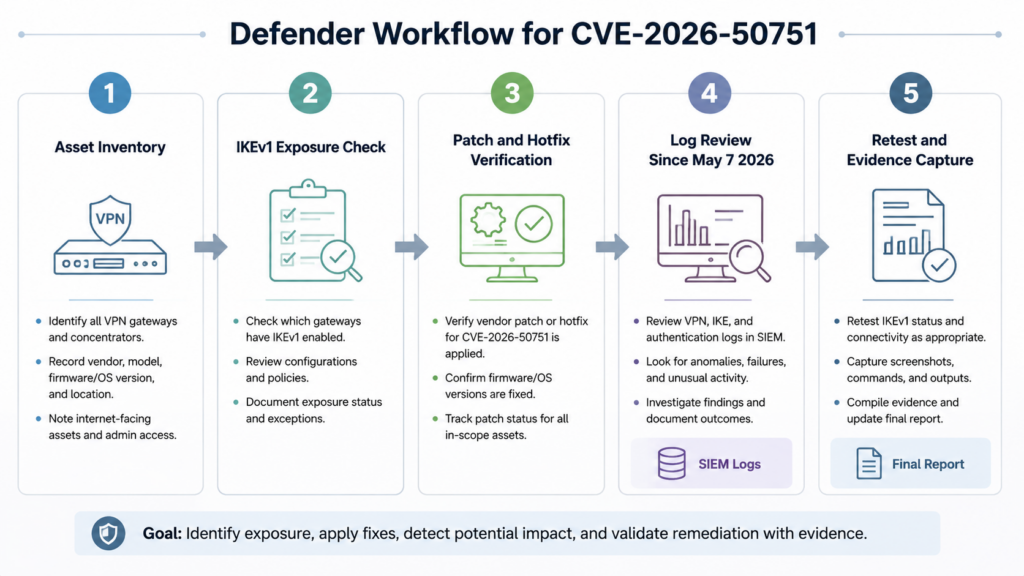
When a likely suspicious session is found, preserve before changing too much. Emergency patching is still priority, but evidence preservation matters for scope.
A useful workflow:
1. Preserve gateway logs, management logs, and VPN session logs.
2. Preserve identity provider logs for the same user and time window.
3. Identify assigned VPN client IP and internal routes.
4. Pull NetFlow, firewall, proxy, DNS, and EDR telemetry for the assigned IP.
5. Map internal systems touched during the session.
6. Check for credential use from the same source or assigned IP.
7. Review endpoint process execution for Rclone, archive tools, shells, and unknown ELF files.
8. Check file access and data movement from internal servers.
9. Disable or reset suspicious accounts and certificates.
10. Determine whether ransomware staging or persistence occurred.
11. Document scope, confidence, evidence gaps, and remediation.
The fastest mistake is to reset a user password and move on. If the session was established without a valid user password, password reset may not address the entry path. It may still be necessary if the attacker accessed credentials after entry, but the primary control remains gateway remediation and vulnerable-path removal.
Reporting the finding clearly
A good internal finding for CVE-2026-50751 should avoid vague language. “Critical Check Point CVE present” is not enough. Engineering teams need exact evidence.
Example finding structure:
Finding:
Potential exposure to CVE-2026-50751 on Check Point Remote Access VPN gateway

Affected asset:
vpn-edge-03.example.net, public IP 203.0.113.10

Evidence:
- Check Point Security Gateway R81.20, Jumbo Hotfix Take below vendor-fixed level
- Remote Access VPN enabled
- IKEv1 enabled for remote access
- Legacy Remote Access client support enabled
- Machine certificate authentication not mandatory
- UDP 500 reachable from approved external scanner
- VPN logs retained from May 7, 2026 onward

Impact:
A remote unauthenticated attacker may be able to establish a VPN session without a valid user password if the vulnerable certificate validation path is reachable. Additional post-authentication activity would still be required to access internal resources, but unauthorized VPN entry creates a serious initial-access risk.

Remediation:
- Apply Check Point vendor hotfix or upgrade to fixed take
- Disable IKEv1 remote access or migrate to IKEv2-only
- Remove legacy Remote Access client support
- Require machine certificate authentication where applicable
- Review logs from May 7, 2026 onward for suspicious sessions and follow-on activity

Retest:
- Confirm fixed version or hotfix take
- Confirm IKEv1 remote access disabled or protected by mandatory machine certificate
- Confirm legacy client support removed
- Confirm no unexplained suspicious sessions from May 7 onward
That format is useful because it separates exposure, impact, remediation, and retest. It also avoids overstating the bug as direct RCE or understating it as “just a VPN issue.”
Executive risk summary for security leaders
For CISOs and security directors, the decision is simple: treat CVE-2026-50751 as an active edge-device incident until proven otherwise.
The reason is not only CVSS. The reason is the combination of:
- Authentication bypass
- Remote network attack vector
- No required privileges
- No user interaction
- Edge security device
- Deprecated protocol path
- Active exploitation
- CISA KEV inclusion
- Ransomware-linked post-compromise reporting
NVD’s KEV section records the vulnerability as actively exploited enough to appear in the Known Exploited Vulnerabilities Catalog, with a June 11, 2026 due date shown for required action. (NVD) Check Point says exploitation was observed and that at least one case involved Qilin ransomware affiliate post-compromise activity. (Check Point Blog)
Leadership should ask for three artifacts within the first response window:
- A complete inventory of potentially affected Check Point Remote Access VPN, Mobile Access, and Spark Firewall deployments.
- A remediation evidence table showing patch status and vulnerable configuration removal.
- A compromise assessment summary covering May 7, 2026 onward.
If any of those artifacts cannot be produced, the organization has a process gap beyond this CVE.
FAQ
What is CVE-2026-50751?
- CVE-2026-50751 is a critical Check Point VPN authentication bypass.
- It affects Remote Access VPN and Mobile Access deployments under specific deprecated IKEv1 conditions.
- The flaw involves certificate validation logic during IKEv1 key exchange.
- A successful attacker may establish a remote-access VPN session without a valid user password.
- NVD maps it to CWE-287, Improper Authentication, and lists CVSS v3.1 9.3 Critical. (NVD)
Is CVE-2026-50751 a remote code execution vulnerability?
- No public authoritative source describes CVE-2026-50751 as direct unauthenticated remote code execution.
- Check Point says additional post-authentication activity is required to access internal resources or escalate privileges. (Check Point Blog)
- The risk is still critical because unauthorized VPN access can become initial access for internal discovery, credential theft, lateral movement, data theft, or ransomware.
- Treat it as an urgent edge-authentication failure, not as a simple version-scanner finding.
Which Check Point deployments are most at risk?
- Deployments with Remote Access VPN or Mobile Access enabled are the relevant starting point.
- Risk increases when IKEv1 is enabled for remote access.
- Gateways that accept legacy Remote Access clients are more concerning.
- Gateways that do not demand machine certificates match a key vulnerable condition.
- CSA Singapore lists affected Security Gateway versions and Spark Firewall versions, including several end-of-support branches. (Cyber Security Agency of Singapore)
How do I safely check whether IKEv1 is exposed?
- Start with internal configuration review in Check Point management tools.
- Confirm whether Remote Access VPN or Mobile Access is enabled.
- Confirm whether IKEv1 is enabled for remote access.
- Use only authorized external scanning for UDP 500 and UDP 4500 discovery.
- Nmap’s
ike-versionscript is documented as a safe discovery and version script for IKE services, but scanner output is only an exposure signal, not proof of exploitability. (Nmap)
What should I do if I cannot patch immediately?
- Break the vulnerable condition chain as fast as possible.
- Disable IKEv1 for remote access where operationally possible.
- Remove support for legacy Remote Access clients.
- Require machine certificate authentication where appropriate.
- Enable IPS protections and update signatures.
- Restrict VPN access paths and source networks if feasible.
- Continue to prioritize the vendor fix because mitigations should not become a permanent substitute for patching.
How far back should incident responders review logs?
- Start from May 7, 2026.
- Check Point says incident response teams should prioritize forensic log audits and configuration reviews from the earliest observed exploitation date of May 7, 2026. (Check Point Blog)
- Review VPN logs, gateway logs, identity provider logs, EDR, DNS, proxy logs, NetFlow, file server access, and internal firewall telemetry.
- If logs do not go back that far, document the visibility gap and increase monitoring around affected accounts, gateways, and internal systems.
Is there a public PoC for CVE-2026-50751?
- Low-trust repositories and pages may claim PoC material, but defenders should not base patch priority on whether a public exploit is easy to find.
- Authoritative sources already confirm active exploitation, which is stronger than public PoC availability as a remediation signal.
- GitHub’s advisory database lists CVE-2026-50751 as a critical advisory and references NVD, Check Point, and CISA, but it does not provide a reviewed package-level fix record. (GitHub)
- Use vendor guidance, CISA KEV status, configuration verification, and compromise hunting instead of running untrusted exploit code.
What evidence should prove closure?
- Fixed Check Point version or hotfix take on every affected gateway.
- Configuration evidence showing IKEv1 remote access disabled or the vulnerable conditions removed.
- Legacy Remote Access client support removed or formally excepted with compensating controls.
- Machine certificate authentication set to mandatory where used as mitigation.
- External exposure rechecked from approved scanner locations.
- Logs from May 7 onward reviewed and suspicious sessions investigated.
- A retest note that separates patch status, configuration status, exposure status, and compromise assessment.
Closing judgment
CVE-2026-50751 is a boundary failure, not a routine VPN maintenance item. The vulnerable path sits where external users become internal network participants. That is why the response must be faster and more evidence-driven than a normal patch cycle.
The right fix is not just “install update.” It is: identify every exposed Check Point remote-access deployment, remove deprecated IKEv1 dependency, end legacy client exceptions, require stronger certificate controls where applicable, apply the vendor fix, preserve logs from May 7, hunt for unauthorized VPN sessions, and prove the remediation with configuration and retest evidence.
The long-term lesson is simple. A remote-access gateway is an identity system, a cryptographic system, and a network boundary at the same time. If any one of those layers is kept alive through deprecated protocol compatibility, it deserves the same scrutiny as production authentication code.


 English
  German
  French
  Spanish
  Portuguese
  Japanese
  Korean
  Hindi
Hindi  Arabic
  Turkish
  Hebrew