
CVE-2026-91403 concerns Java certificate trust in the eMudhra incident. Oracle’s October 21 alert provides updates that distrust affected intermediate CA certificates. Its October 24 follow-up, CVE-2026-114820, removes affected root CA certificates. Review both notices for your vendor and build, then verify the runtime and truststore used by the application. An earlier emergency update alone does not establish that the follow-up remediation is complete.
Reviewed October 26, 2026. Installing an earlier emergency build is not enough evidence to close the follow-up alert: Oracle lists builds such as 21.0.13.0.2 and 17.0.21.0.2 as affected. This remains a certificate-trust remediation task; the cited notices do not demonstrate a Java remote code execution chain.
For a standalone JDK, follow the runtime vendor’s security update. For a distribution-provided OpenJDK, check the operating system’s certificate update guidance. For an application with a custom truststore or trust manager, review that configuration separately. These routes can coexist in one deployment; a containerized Java service and the host running it may need different work.
Java eMudhra repair matrix: system and private trust stores
The eMudhra response is not one universal “upgrade Java” task. CVE-2026-114406 covers Red Hat system CA stores distributed through ca-certificates; CVE-2026-111943 covers Go’s crypto/x509 verifier; CVE-2026-91403 is Oracle’s initial Java trust response; CVE-2026-114820 is the later Oracle JSSE follow-up. A host can contain more than one of these trust paths. See the Go vulnerability report, Red Hat CA-store notice and Oracle follow-up alert.
| Identifier / environment | Primary repair authority | What must be activated | Do not assume |
|---|---|---|---|
| CVE-2026-114406 / RHEL system trust | Red Hat ca-certificates errata and product advisories | Corrected system CA package, rebuilt images where the bundle is copied, restarted consumers when required | Updating a JDK replaces every system CA bundle |
| CVE-2026-91403 / initial Java response | Oracle/OpenJDK or downstream JDK vendor guidance | Vendor update or documented trust-store mitigation for the active runtime | The shell’s default java is the process runtime |
| CVE-2026-114820 / later Oracle JSSE follow-up | Oracle alert and the exact Java/GraalVM product update | Follow-up repaired build or approved mitigation, plus application restart | An earlier emergency update closes the later follow-up automatically |
| Portable or bundled JDK | JDK/application vendor | The bundled cacerts, jssecacerts or configured trust store | RHEL’s system package changes a portable runtime’s private store |
Identify the trust path used by the application
java -XshowSettings:properties -version 2>&1 | grep -E 'java.home|java.version|java.vendor'
ps -eo pid,args | grep '[j]ava'
rpm -q ca-certificates 2>/dev/null
For Java, review process arguments for -Djavax.net.ssl.trustStore, application-specific TLS configuration, jssecacerts and the runtime’s cacerts. Red Hat notes that non-portable RHEL OpenJDK RPMs can use the system ca-certificates store, while portable Linux and Windows builds bundle their own store and follow a separate update path. See Red Hat’s OpenJDK guidance and the JSSE trust-store documentation.
Containers and managed runtimes
If a container image copied a CA bundle or JDK before the repair, updating the host does not change that image. Rebuild, record the new digest, deploy it, restart the workload and verify from inside the running container. Managed services and application products may embed Java or Go; follow the product vendor’s update rather than replacing components outside its supported process.
Verification evidence
- Package or runtime vendor and full repaired build identity.
- The trust source actually selected by the application.
- New binary or image digest and proof the old artifact is no longer active.
- Application-level TLS checks for required destinations and expected rejection behavior.
- Fleet reconciliation across services, containers, desktop tools and CI workers.
Keep certificate distrust and incident attribution separate. A vulnerable trust store means interception was possible under the stated conditions; it does not prove a malicious certificate was presented. Preserve certificate, proxy, DNS and connection telemetry when historical review is justified.
CVE-2026-114820: the October 24 follow-up update
The new Oracle notice lists earlier emergency builds, including Java SE 21.0.13.0.2 and 17.0.21.0.2, as affected. It addresses certificate trust through root removal; do not describe this as a newly demonstrated Java RCE exploit. This page retains the earlier CVE context because the operational task remains identifying and repairing the application’s actual trust decision.
For Oracle JDK 21, the October 24 release notes explicitly identify 21.0.13.0.3+1 as fixing CVE-2026-114820. The same notes list the security baselines below and identify removal of three emSign roots and the Comodo AAA root from cacerts. These are Oracle build identities, not universal fixed-version labels for Temurin, every OpenJDK distribution or GraalVM.
| Oracle release family | October 24 security baseline |
|---|---|
| 21 | 21.0.13.0.3+1 |
| 17 | 17.0.21.0.3+1 |
| 11 | 11.0.33.0.3+1 |
| 8 | 1.8.0_511-b33 |
After selecting the appropriate vendor update, record the deployed artifact, restart or replacement and active trust source. Check custom stores separately and exercise both required connections and an approved rejection fixture. A default-store update does not establish that a separately configured application store changed.
Which remediation evidence closes which question?
| Evidence collected | What it supports | What remains to check |
|---|---|---|
| Earlier intermediate-distrust update | Response to the October 21 alert | The October 24 root-removal requirement and current vendor build |
| New JDK installed on disk | A replacement artifact is available | Each application actually runs it after restart or replacement |
| Four roots absent from default cacerts | That specific store no longer contains those entries | Custom stores, trust managers, and the application’s actual trust decision |
| Required connections still succeed | A positive compatibility control | An approved negative trust test; successful connections alone do not prove rejection |
The four aliases in the Oracle JDK release notes are emsignrootcag1 [jdk], emsignrootcag2 [jdk], emsigneccrootcag3 [jdk], and comodoaaaca [jdk]. These identify Oracle’s documented entries, not universal alias names for every distributor. Use the complete certificate identity and the relevant vendor procedure when another store uses different labels.
What CVE-2026-91403 changes for Java operators
The OpenJDK advisory of October 21, 2026 connects CVE-2026-91403 to eight compromised intermediate CA certificates. Its advice distinguishes standalone runtimes from operating-system packages. That distinction matters more to remediation than a generic instruction to update Java.
Oracle’s October 21 security alert assigns a CVSS 3.1 score of 9.1 to the JSSE issue, with network access, no authentication, and high confidentiality and integrity impact. Its availability impact is none. This is a certificate trust issue; the cited alert does not establish a Java remote code execution chain.
The threat concerns trusting a fraudulent identity, rather than only whether your own website bought a certificate from a particular issuer. A Java client connecting to an API, artifact repository, identity service, or other TLS peer deserves review when its trust path can accept the compromised CA material. Prioritize processes that handle credentials or sensitive responses and can reach untrusted networks. This is an operational prioritization recommendation, not evidence that any particular application has been intercepted.
| Official listing | Affected versions reported | How to use the listing |
|---|---|---|
| Oracle Java SE | 8u511, 8u511-perf, 11.0.33, 17.0.21, 21.0.13, 25.0.5, 27.0.1 | These are affected versions. Obtain patch availability from Oracle. |
| Oracle GraalVM for JDK | 17.0.21, 21.0.13 | Check the matching product’s update instructions. |
| Oracle GraalVM Enterprise Edition | 21.3.20 | Use the Enterprise Edition patch guidance. |
| OpenJDK source advisory | 27.0.1, 25.0.5, 21.0.13, 17.0.21, 11.0.33, 8u512 and earlier | Match the distribution and its security response, not only the feature release. |
The Oracle rows come from its affected-product table; the OpenJDK row comes from the source advisory. Their Java 8 version notation differs. Do not turn either affected-version list into a fixed-version recommendation. A downstream package may carry a backport; verify the vendor build and security notice.
Do not close the October Java CPU on the certificate fix alone
The October 2026 Oracle Java SE risk matrix contains 55 new security patches, including 49 vulnerabilities described as remotely exploitable without authentication. CVE-2026-91403 is one entry, not the complete update. Other rows cover different components and have their own affected releases and prerequisites. Oracle’s notes distinguish applications loading untrusted code from applications processing untrusted data through affected APIs. A network vector does not mean every ordinary Java server exposes every issue.
Use the actual JDK distributor’s release notice to select the replacement build. Oracle Java SE, Oracle JavaFX and GraalVM have distinct entries in the matrix; another distributor may use a different package identity or backport schedule. The affected-version column is not a recommended download list. Do not copy a version out of that column into a remediation ticket as the fixed version.
| Review | Evidence needed | Insufficient shortcut |
|---|---|---|
| Certificate distrust | The deployed JVM’s intended trust decision | A browser handshake |
| Other CPU entries | Component, affected branch, prerequisites and distributor fix | Closing every CVE from one certificate test |
| Rollout | Replacement runtime serving each application | A newer JDK installed beside the old one |
| Compatibility | Required application flows under the repaired runtime | A successful installer exit |
Keep a certificate-specific acceptance test in the deployment record, but attach it to the wider CPU change rather than substituting it for that change. If the application packages its own runtime, inventory that copy explicitly. The useful completion statement identifies the application, its active runtime build and the tested behavior; it avoids implying that a workstation update repaired an unrelated service.
The eMudhra incident reaches beyond the JVM
The researchers’ incident resource describes incorrectly generated intermediate-CA keys recoverable from the published certificates. This differs from establishing that an intruder stole keys from a CA server. Its analysis distinguishes browser protections from clients that do not consume the same revocation information. A repaired browser cannot stand in for a Java application, a bundled command-line tool or another independent verifier.
The researchers report no Certificate Transparency entries for the affected intermediates during the relevant period and explain the significance for CT-enforcing clients. They do not establish that non-CT clients were never targeted. Keep three records separate: what trust material the application accepted, what it rejects after remediation, and whether retained traffic evidence supports a historical interception claim.
For a mixed-language service, assign the trust update to each actual verifier: JVM, sidecar, outbound proxy, build tool and separately bundled client. Record the vendor’s security notice and deployed artifact for each. An operating-system certificate update may cover one row while leaving a bundled store untouched. Prefer maintained vendor updates; removing a familiar issuer by name across every store is not a substitute for its supported distrust policy.
Follow the application’s trust source before changing files
For the default SunJSSE trust-manager setup, the JSSE reference guide describes an explicit javax.net.ssl.trustStore setting, followed by jssecacerts and then cacerts under the runtime’s security directory when the property is absent. An application can supply a different SSLContext or trust manager, so this default selection is not a universal description of every HTTP client.
| Deployment you actually run | First repair authority | Evidence to retain |
|---|---|---|
| Standalone JDK archive or bundled application runtime | JDK or application vendor; OpenJDK emergency guidance when applicable | Runtime location, full build identity, update provenance, trust configuration |
| Distribution-provided OpenJDK | Distribution security notice and certificate package policy | Installed package versions and proof the app uses that package’s trust material |
| Homebrew or FreeBSD OpenJDK | Direct Java package update, as distinguished in the OpenJDK advisory | Package update record and actual runtime selected by the service |
| Application-defined truststore or trust manager | Application owner plus runtime/provider guidance | Configured file or provider, reviewed trust policy, application-level tests |
| Container or embedded runtime | Image/application maintainer and runtime vendor | New image digest, deployed revision, restarted process and trust-source evidence |
OpenJDK says common Linux distribution packages generally use operating-system certificates, while FreeBSD and Homebrew need direct Java updates. Treat that guidance as a route to verify for the installed package. A separately downloaded JDK inside an Ubuntu container does not become a distribution-managed runtime simply because the container uses Ubuntu.
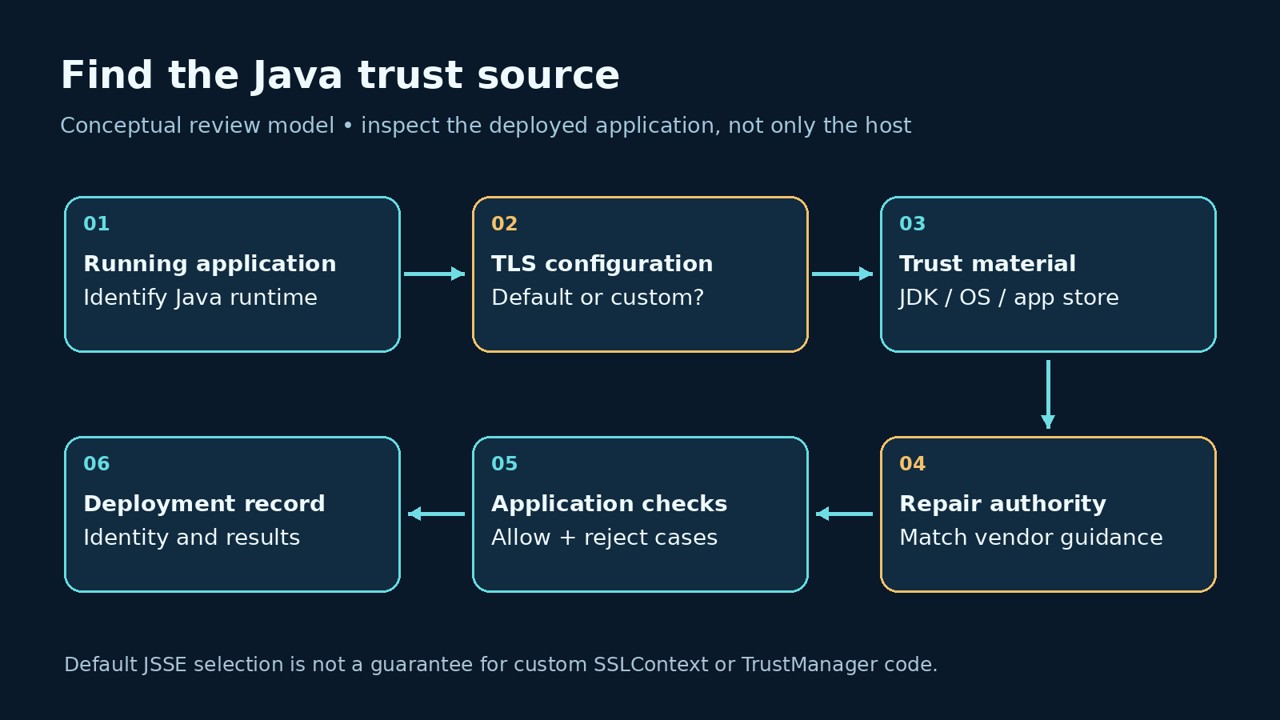
A useful deployment record names the process, the executable or image that started it, and the owner of its trust configuration. Ask the application owner whether an SDK, framework setting, or outbound proxy changes the TLS path. Record the answer beside the release, so the next engineer does not have to reconstruct it from a shell history.
RHEL packages and portable builds need different evidence
Red Hat’s CVE-2026-91403 statement says its non-portable RHEL OpenJDK RPMs use the system ca-certificates package for their default store. Its portable Linux and Windows builds bundle their own store and receive separate updates. The same host can therefore contain runtimes with different remediation paths.
For an RHEL package using the documented default store, retain the relevant ca-certificates erratum and installed package identity. For a portable build, retain that build’s update notice and deployed artifact. In either case, check whether the application overrides the default store before treating the package evidence as sufficient. A host certificate update does not establish that a bundled or custom store changed.
Vendor risk scores also differ. Oracle publishes CVSS 3.1 9.1; Red Hat’s page gives a preliminary 6.8 with different complexity and user-interaction assumptions. Preserve the vendor and vector beside the score rather than merging them into a single universal rating.
For Eclipse Temurin, verify the artifact rather than the release calendar
Eclipse Temurin users should distinguish an upstream security release from a binary available for their deployment. Adoptium’s support policy, reviewed October 23, explains that its roadmap dates are upstream OpenJDK dates; platform binaries follow build and test cycles. A date in the October column therefore does not establish that a particular operating system, architecture or container tag contains the emergency distrust change.
For the actual Temurin artifact, retain the complete build identifier, platform, download or package origin and the distributor’s release evidence. If an image tag is reused, record the digest deployed to each service. Match the distributor’s security response to the artifact before declaring remediation. This review has not established a universal fixed Temurin build across all platforms, so the affected OpenJDK versions above must not be relabeled as Temurin fixes.
Separate the runtime used by the build from the runtime shipped with the application. A CI job can compile and test with an updated Temurin installation while the final image still copies an older JRE from another stage. Conversely, updating the application image does not repair a separate build agent. Review the final deployment artifact and each independently operating Java process, then apply the documented trust-policy remedy to the runtime that actually verifies certificates.
TLS revocation checks and signed-JAR checks are separate
Oracle’s eMudhra guidance, updated October 24, distinguishes application TLS revocation settings from signed-JAR validation. For JDK 17 and later, it documents the following command for a signed JAR. This vendor-documented example has not been run against a signed artifact for this article; replace the filename with an approved local artifact.
A result from jarsigner applies to the selected artifact and verifier; it does not prove that an application’s HTTPS client enables revocation checking. The two TLS system properties in the remediation section likewise do not constitute a recorded signed-JAR verification. Choose the check that corresponds to the trust decision in scope and retain its artifact, runtime, result and relevant network conditions.
The durable response remains the maintained runtime or certificate-policy update appropriate to the installation. Where temporary revocation checking is used, validate its behavior in the application’s environment rather than treating a command-line flag as a completed repair. Do not disable certificate or hostname validation to resolve compatibility failures.
A local check that exposes a misleading success signal
You can inspect a small set of JVM properties without sending traffic or dumping every system property. The following Python standard-library experiment launches the Java executable on PATH twice. The second launch supplies a deliberately nonexistent truststore path. It checks whether the JVM reports that setting; it does not initialize TLS or test CVE exploitation.
import pathlib
import shutil
import subprocess
import tempfile

java = shutil.which("java")
if java is None:
    raise SystemExit("java is not on PATH")

keys = ("java.home", "java.version", "java.vendor", "javax.net.ssl.trustStore")

def settings(extra):
    result = subprocess.run(
        [java, *extra, "-XshowSettings:properties", "-version"],
        capture_output=True, text=True, timeout=15, check=True,
    )
    values = {}
    for line in (result.stdout + result.stderr).splitlines():
        key, sep, value = line.strip().partition(" = ")
        if sep and key in keys:
            values[key] = value
    return values

with tempfile.TemporaryDirectory(prefix="java-trust-check-") as directory:
    missing = pathlib.Path(directory) / "does-not-exist.p12"
    assert not missing.exists()
    baseline = settings([])
    override = settings([f"-Djavax.net.ssl.trustStore={missing}"])
    print("java.version=" + baseline.get("java.version", "<missing>"))
    print("java.vendor=" + baseline.get("java.vendor", "<missing>"))
    print("java.home=" + baseline.get("java.home", "<missing>"))
    print("baseline.property.present=" + str("javax.net.ssl.trustStore" in baseline).lower())
    print("override.property.matches=" + str(override.get("javax.net.ssl.trustStore") == str(missing)).lower())
    print("override.file.exists=" + str(missing.exists()).lower())
    assert override.get("javax.net.ssl.trustStore") == str(missing)

# No SSLContext, certificate validation, or network connection is created.
We ran this exact fixture on Ubuntu OpenJDK 17.0.20. The observed output was:
java.version=17.0.20
java.vendor=Ubuntu
java.home=/usr/lib/jvm/java-17-openjdk-amd64
baseline.property.present=false
override.property.matches=true
override.file.exists=false
The property matched while the file did not exist. That is the result the experiment establishes. It does not show that this runtime is repaired, that a certificate was blocked, or that a production service uses the same executable. No remote endpoint, compromised certificate, or exploit was used.
The distinction has a real troubleshooting consequence. A startup flag can look correct in a deployment manifest while referring to an absent mount. The JSSE documentation says an explicitly configured missing truststore gives the default trust manager an empty keystore. A failed request in that situation is not proof that the intended distrust policy was applied.
Run the inspection in a controlled environment matching the application. If the service starts from an absolute Java path, adapt the script’s java variable to that executable. If it starts in a container, inspect the deployed image rather than the host’s interactive shell. Keep truststore passwords, tokens, full environment dumps, and unrelated JVM properties out of the report.
Apply the current Oracle guidance to every runtime in scope
Oracle’s eMudhra guidance, updated October 24, now directs operators to the latest JDK patch. If that patch cannot yet be installed, its manual route calls for a keystore backup, removal of four specified roots and restart of live runtime instances; it also documents an alternative revocation-checking route. Follow the version-specific instructions for each standalone installation. Its linked CheckCerts.java supports JDK 8 and later. We have not run that checker against compromised certificate material for this update.
Use the live vendor instructions rather than an older copied certificate-blocklist procedure. Before changing a truststore, identify the file or provider the application actually uses and retain a recoverable backup. Review required dependencies in staging: removing trust material can change legitimate connection behavior. A successful restart is deployment evidence, not proof that the intended certificate chain was rejected.
The documented TLS revocation options are shown below. Their presence in a launch manifest does not establish their behavior in a running application:
-Dcom.sun.net.ssl.checkRevocation=true
-Dcom.sun.security.enableCRLDP=true
Review the application’s TLS provider, access to revocation services and failure handling before accepting this route. Record the actual process arguments and the outcome of an approved application-level certificate test. Keep TLS checks distinct from signed-JAR verification; one does not establish the other.
For distribution-managed Java, follow the distribution’s current security notice and verify the package’s trust integration. A host certificate update does not identify the state of a standalone JDK copied into a container. Retain the vendor notice, deployed package or image identity, active runtime and application test results together.
Make the repaired deployment produce reviewable evidence
A practical release gate needs a positive case and a negative case. The positive case is a required, authorized staging dependency that should continue working. The negative case is an approved certificate-policy test that should be rejected by the actual application client. Define both expectations before testing. A generic connection failure does not establish the negative case: DNS, routing, timeouts, missing files, and hostname errors can all prevent a connection for unrelated reasons.
| Question | Evidence worth collecting | What it does not prove |
|---|---|---|
| Did the intended update reach the workload? | Vendor/package security record, artifact or image digest, running revision | A host package update alone does not identify a bundled runtime. |
| Which trust policy was selected? | Runtime identity, reviewed app configuration, mounted-file identity | A printed property does not prove the file was loaded. |
| Does the allowed dependency still work? | Application-level result with hostname, route, time and expected response | A successful valid chain does not establish rejection of the compromised CA. |
| Was the intended policy rejection exercised? | Controlled fixture identity and a failure attributed to certificate validation | A timeout or wrong hostname is inconclusive for that policy. |
| Can the next release undo the repair? | Updated base image, pinned artifact and rollback plan reviewed together | A one-time manual file change does not protect future deployments. |
For a small app team, one record per deployed service is enough to start: runtime owner, trust owner, update action, deployment revision, allowed-path result, rejection-test result, and unresolved dependency. If a certificate fixture has not been approved or independently identified, mark that test incomplete. That is more useful than relabeling a normal HTTPS success as a CVE verification.
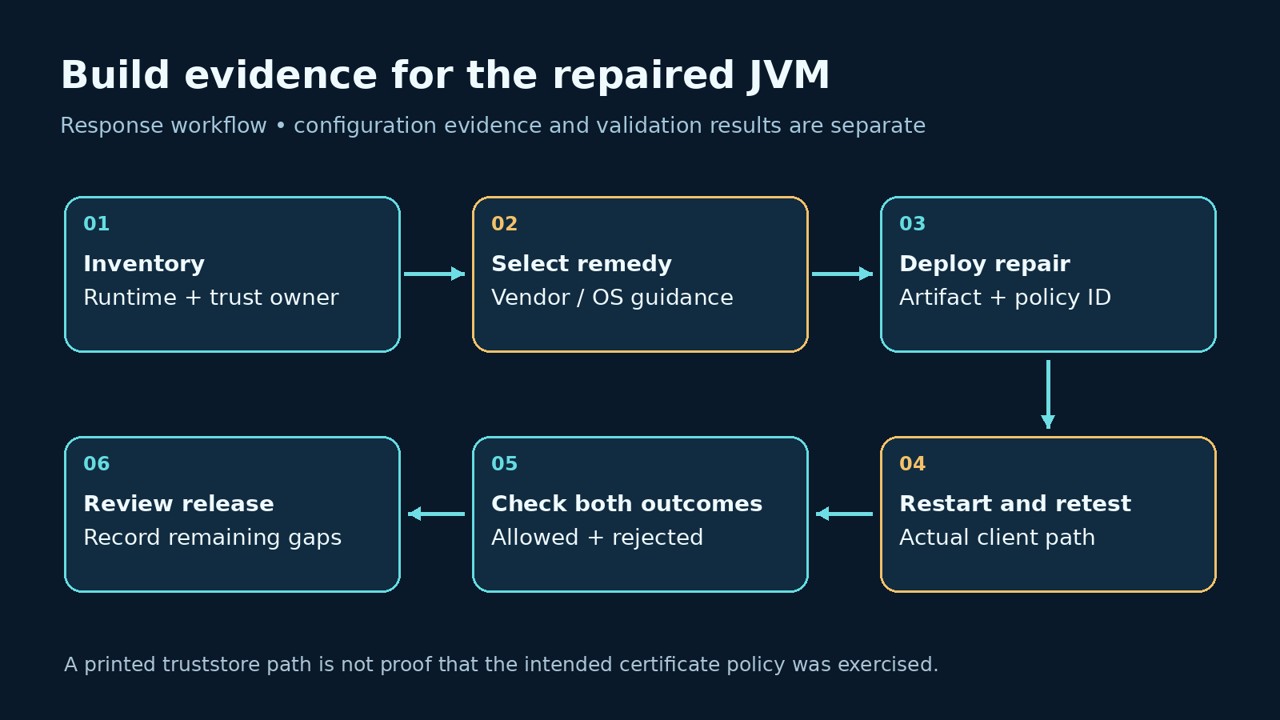
After changing a runtime or trust policy, redeploy or restart the affected application under its normal operational procedure, then repeat the application-level checks. This recommendation avoids relying on an old process or cached client configuration. Keep the before-and-after revisions together and confirm that a rollback would not silently restore the vulnerable artifact.
For an example of how remediation evidence can be organized for review, Penligent’s sample pentest report includes synthetic findings, SOC 2 criteria mapping, and ISO/IEC 27001 risk-treatment examples. The sample is available from the report link above after sign-in or registration. It is not Penligent’s own SOC 2 audit report or an ISO certificate, and it does not guarantee an auditor’s acceptance. Keep the application’s actual runtime, truststore, and validation records alongside any report template.
When the update breaks a connection
Preserve the failed application result before changing anything else. Record the intended hostname, time, deployed revision, Java error, route or proxy, and relevant public chain details. Compare the same application path before and after the repair. A browser result may help isolate the difference, but it cannot substitute for the Java client’s result.
Then separate three questions: did the application load the intended trust configuration; did the peer deliver the expected chain; and did the verifier reject that chain for the reason under investigation? Fixing a missing mount is different from replacing a peer’s certificate chain. If the service provider changes the chain, test what the application receives afterward rather than relying on a certificate issuance confirmation.
Do not recover availability with an accept-all trust manager or disabled hostname verification. Keep the authentication contract intact and resolve the runtime, trust configuration, or peer-chain problem responsible. Make the exception owner explicit if a dependency cannot immediately be restored; an unresolved dependency should remain visible in the release decision.
Current rejection behavior also cannot establish what happened to historical traffic. If interception is suspected, preserve relevant application, proxy, DNS and egress records under your incident process. A compromised CA key is a reason to investigate the applicable paths; it is not evidence that every connection from your application was intercepted.
Find the Java runtime that is actually running
Run version checks inside the same container, virtual machine, service account or application environment that executes the workload. The shell’s default java command may not be the binary referenced by a systemd unit, application launcher or embedded product.
java -version
command -v java
readlink -f "$(command -v java)"

# When a service PID is known on Linux
readlink -f /proc/<PID>/exe
tr '\0' '\n' < /proc/<PID>/environ | grep -E '^(JAVA_HOME|JDK_JAVA_OPTIONS|JAVA_TOOL_OPTIONS)='
Access to another process’s environment can require elevated privileges and may reveal sensitive arguments. Collect only the fields needed for the assessment, store the output in the authorized case record, and avoid exposing full environment dumps in a general-purpose ticket.
For containers and immutable images, record the image digest along with the output. Rebuilding a tag without changing a deployed digest is not remediation. For self-contained application packages, identify whether the runtime was copied during the build rather than inherited from the current base image.
Identify custom JSSE trust-store configuration
Review deployment manifests, startup scripts and Java options for trust-store selection. The following repository search is read-only and intended as a navigation aid:
rg -n 'javax\.net\.ssl\.trustStore|trust-store|truststore|cacerts' \
  Dockerfile* compose*.yml *.yaml *.yml . 2>/dev/null
A match does not prove exposure, and no match proves that a managed platform is using the default store. Configuration may be injected through an orchestrator, secret manager, application server or vendor launcher. Record where the setting originates and which deployment consumes it.
To list the default Java trust store for an authorized environment, use the keytool shipped with the same runtime:
"$JAVA_HOME/bin/keytool" -list -cacertsThe command may prompt for the trust-store password and can produce a large inventory. Do not publish certificate inventories or passwords. For a custom store, use the product’s supported inspection method and retain only the evidence needed to establish its provenance and update state.
Prioritize the deployments that make consequential TLS decisions
| Deployment | Why it matters | Evidence to retain |
|---|---|---|
| API clients and integration services | They authenticate remote services and may transmit credentials or regulated data | Runtime path, trust-store source, destination class and post-update TLS test |
| Identity, payment and signing workflows | A wrong trust decision can affect high-value authentication or data integrity | Application owner approval, chain validation result and change record |
| Java application servers | One server can host multiple applications with shared or per-application TLS settings | Server runtime, domain configuration and each custom trust store |
| Containers and CI workers | Old runtimes and CA files are frequently preserved in immutable layers | Image digest, SBOM or file provenance and redeployment timestamp |
| Oracle products that embed Java | Patch availability and installation steps can differ from standalone Java | Product version and the Oracle patch document used |
Internet exposure is not the only prioritization signal. A backend service that only calls a small set of external endpoints can still make a security-critical trust decision. Prioritize by the sensitivity of the authenticated connection, credentials presented, data transferred and ability to modify important records.
Incident review without overstating the evidence
An affected Java version is a remediation finding, not proof that a malicious certificate was presented. If a high-value service used an affected runtime, review available outbound connection telemetry, certificate observations, proxy logs, DNS activity, identity events and application changes during the relevant period. Preserve the chain or certificate evidence when policy permits.
A successful TLS connection is also not evidence of compromise. It can reflect an ordinary chain unrelated to the impacted eMudhra roots. Keep software exposure, trust-store state and observed suspicious activity as separate facts in the incident record.
Questions Java developers are asking
Does CVE-2026-91403 mean Java remote code execution?
- The cited Oracle alert describes a JSSE issue with confidentiality and integrity impact. The OpenJDK advisory concerns compromised CA certificates. Neither establishes an RCE exploit chain for your application.
Are 17.0.21 and 21.0.13 the fixed Java versions?
- They appear in the official affected-version listings. Use your runtime vendor’s security update or package notice to identify the repaired build and applicable mitigation.
Is updating Ubuntu ca-certificates enough?
- It can be the relevant fix for a distribution-managed OpenJDK using system trust, as the official advisories describe. Check standalone runtimes, container images and custom application trust settings separately.
Can I prove remediation by printing javax.net.ssl.trustStore?
- No. Our offline fixture reports a deliberately missing file path successfully. Check the real application’s selected trust configuration and perform controlled certificate-validation tests.
Does a working browser mean my JVM is protected?
- No. Establish the runtime and policy used by the Java application itself. A browser observation and an application-client observation are separate pieces of evidence.
For a broader authorized application-testing workflow, the video below provides Penligent context. It is not a CVE-2026-91403 exploit demonstration or a verification of your runtime’s certificate policy.
Close the change when the deployed Java process, its trust source, and the test evidence agree. A version string or a green browser check is a useful clue; the release decision needs a traceable connection between the repair and the application that handles your data.
 English
 German
 French
 Spanish
 Portuguese
 Japanese
 Korean
 Hindi
 Arabic
 Turkish
 Hebrew