
If you search for CVE Full Form, the short answer is simple:
CVE stands for Common Vulnerabilities and Exposures.
But that definition alone does not explain why CVE has become one of the most important pieces of infrastructure in modern cybersecurity.
A CVE is not simply another name for a security vulnerability. A CVE ID does not automatically tell you whether a vulnerability is critical, whether attackers are exploiting it, whether your organization is affected, or whether a working exploit exists.
Instead, CVE provides something more fundamental: a standardized way for the cybersecurity ecosystem to identify and refer to the same publicly disclosed vulnerability.
The CVE Program exists to identify, define, and catalog publicly disclosed cybersecurity vulnerabilities. This common naming system allows software vendors, security researchers, vulnerability scanners, operating system maintainers, SOC teams, penetration testers, government agencies, and enterprise security teams to discuss the same vulnerability without ambiguity.
When Microsoft, Cisco, Apache, NIST, CISA, a vulnerability scanner, and a security researcher all mention the same CVE ID, everyone can understand which vulnerability is being discussed.
That is the real meaning of CVE in cybersecurity.
What Is the CVE Full Form?
The full form of CVE is Common Vulnerabilities and Exposures.
The abbreviation can be broken down as follows:
| Term | Meaning |
|---|---|
| C | Common |
| V | Vulnerabilities |
| E | Exposures |
| CVE | Common Vulnerabilities and Exposures |
The CVE system was created to solve an important cybersecurity problem: different security products and organizations historically used different names and identifiers for the same vulnerability.
Imagine that one software flaw is described by several systems as:
- Vendor Security Issue 1245
- Scanner Plugin 8912
- Remote Execution Vulnerability A
- CERT Vulnerability XYZ
- ExampleServer Buffer Overflow
Without a common identifier, a security administrator may have difficulty determining whether these references represent five separate vulnerabilities or the same vulnerability described five different ways.
CVE gives that vulnerability a common identity.
For example:
CVE-2024-3094
Once a vulnerability receives a CVE ID, security tools and organizations can use that identifier as a shared reference.
This is why the word Common in Common Vulnerabilities and Exposures matters.
CVE provides a common language for vulnerability information.
What Does CVE Mean in Cybersecurity?
In practical cybersecurity work, a CVE is best understood as a standardized identifier associated with a specific publicly disclosed cybersecurity vulnerability.
A CVE identifier might look like this:
CVE-2026-12345
Security teams can then use that identifier to connect multiple sources of vulnerability information:
CVE-2026-12345
        │
        ├── CVE Record
        ├── Vendor advisory
        ├── Affected versions
        ├── Security patch
        ├── NVD information
        ├── CVSS score
        ├── CWE classification
        ├── CISA KEV status
        ├── Threat intelligence
        ├── Detection signatures
        └── Exploit research
This illustrates one of the most important things to understand about CVE:
The CVE number is primarily an identifier. It is not the complete security analysis.
Other systems and data sources help security teams determine severity, exploitability, affected configurations, active exploitation, remediation priority, and actual business risk.
How Does a CVE Number Work?
Modern CVE identifiers generally use the following format:
CVE-YYYY-NNNN...
For example:
CVE-2026-12345
The identifier contains three components:
CVE - 2026 - 12345
│      │       │
│      │       └── Numeric sequence
│      │
│      └────────── Year component
│
└──────────────── CVE prefix
The first section identifies the record as part of the CVE system.
The second section is the CVE year.
The final section is a numeric sequence containing at least four digits.
This means CVE identifiers are not limited to numbers such as:
CVE-2026-1234
They can also contain longer sequences:
CVE-2026-12345
CVE-2026-123456
The sequence number itself does not indicate how dangerous a vulnerability is.
For example:
CVE-2026-99999
is not necessarily more severe than:
CVE-2026-10001
CVE numbers are identifiers rather than severity rankings.
What Does the Year in a CVE Number Mean?
The year portion of a CVE identifier is commonly misunderstood.
Consider:
CVE-2026-12345
Many people naturally assume that this means the vulnerability was discovered in 2026.
That is not necessarily true.
The year is part of the CVE assignment and reservation process. It should not simply be interpreted as the year in which a security researcher originally discovered the vulnerability.
A vulnerability might, for example, be discovered privately near the end of one year and enter a coordinated disclosure process before becoming public later.
Similarly, a CVE ID can be reserved before detailed vulnerability information becomes publicly available.
A useful rule to remember is:
CVE year ≠ guaranteed vulnerability discovery year
When researching a vulnerability, security teams should therefore distinguish between:
Discovery date
CVE reservation date
Vendor notification date
Patch date
Public disclosure date
CVE publication date
These dates can be different.
What Is a CVE Record?
A CVE ID and a CVE Record are closely related, but they are not exactly the same concept.
The CVE ID is the identifier:
CVE-2026-12345
The CVE Record contains descriptive information associated with that identifier.
A simplified conceptual CVE Record could look like this:
{
  "cveId": "CVE-2026-12345",
  "state": "PUBLISHED",
  "description": "A vulnerability affecting Example Product...",
  "affected": [
    {
      "vendor": "Example Vendor",
      "product": "Example Product"
    }
  ],
  "references": [
    "Vendor advisory",
    "Security advisory"
  ]
}
Actual CVE Records can contain much richer structured information, including affected products, affected versions, descriptions, references, weakness information, and additional metadata.
This structured format is particularly valuable for automated vulnerability management.
Security platforms can correlate CVE information with asset inventories, package versions, security scanners, threat intelligence, patch information, and remediation systems.
Who Assigns CVE Numbers?
CVE identifiers are assigned through organizations known as CVE Numbering Authorities, commonly abbreviated as CNAs.
CNAs can include:
- software vendors,
- hardware manufacturers,
- open-source projects,
- security companies,
- CERT organizations,
- vulnerability coordination organizations,
- bug bounty providers,
- and other authorized organizations.
Each CNA operates within a defined scope.
A simplified disclosure workflow may look like this:
Vulnerability discovered
        │
        ▼
Researcher or vendor
        │
        ▼
Appropriate CNA
        │
        ▼
CVE ID reserved
        │
        ▼
Disclosure coordinated
        │
        ▼
CVE Record completed
        │
        ▼
CVE Record published
The distributed CNA model is important because the global vulnerability ecosystem is far too large for every security issue to be processed manually by a single organization.
Major vendors can therefore handle vulnerabilities within their own products, while other CNAs can coordinate vulnerabilities affecting open-source projects, third-party software, or other areas within their assigned scopes.
What Does CVE Reserved Mean?
Sometimes you may search for a CVE number and find that it is marked:
RESERVED
This does not automatically mean the CVE is invalid or fake.
A reserved identifier usually means a CVE ID has been allocated, but the full public CVE Record has not yet been published.
This can happen during coordinated vulnerability disclosure.
For example:
Security researcher discovers flaw
              │
              ▼
Vendor begins investigation
              │
              ▼
CVE ID reserved
              │
              ▼
Patch developed
              │
              ▼
Public disclosure
              │
              ▼
CVE Record published
You may therefore encounter a CVE identifier before detailed technical information becomes publicly available.
Another important state is Rejected.
A rejected CVE ID should no longer be treated as a valid vulnerability record. Rejected identifiers can remain visible so vulnerability-management systems understand that the identifier existed but was subsequently invalidated or replaced rather than simply disappearing.
CVE Is Not a Severity Score
One of the most common misunderstandings in cybersecurity is using expressions such as:
“This CVE is very high.”
Strictly speaking, the CVE identifier itself is neither high nor low.
CVE identifies the vulnerability.
CVSS helps describe vulnerability severity.
CVSS stands for Common Vulnerability Scoring System.
A security finding might therefore contain both:
CVE: CVE-2026-12345

CVSS: 9.8 Critical
These are separate pieces of information.
A CVE number tells you which vulnerability is being discussed.
A CVSS score describes characteristics related to its technical severity.
This distinction becomes particularly important in real-world vulnerability management because:
CVSS ≠ organizational risk
Suppose Vulnerability A has:
CVSS: 9.8
Asset: Internal development server
Internet exposure: None
Affected feature: Disabled
Now consider Vulnerability B:
CVSS: 8.1
Asset: Internet-facing production gateway
Active exploitation: Confirmed
Business criticality: High
A purely CVSS-based process might prioritize Vulnerability A.
A risk-based security team may reasonably prioritize Vulnerability B.
Technical severity is important, but it is only one part of the security decision.
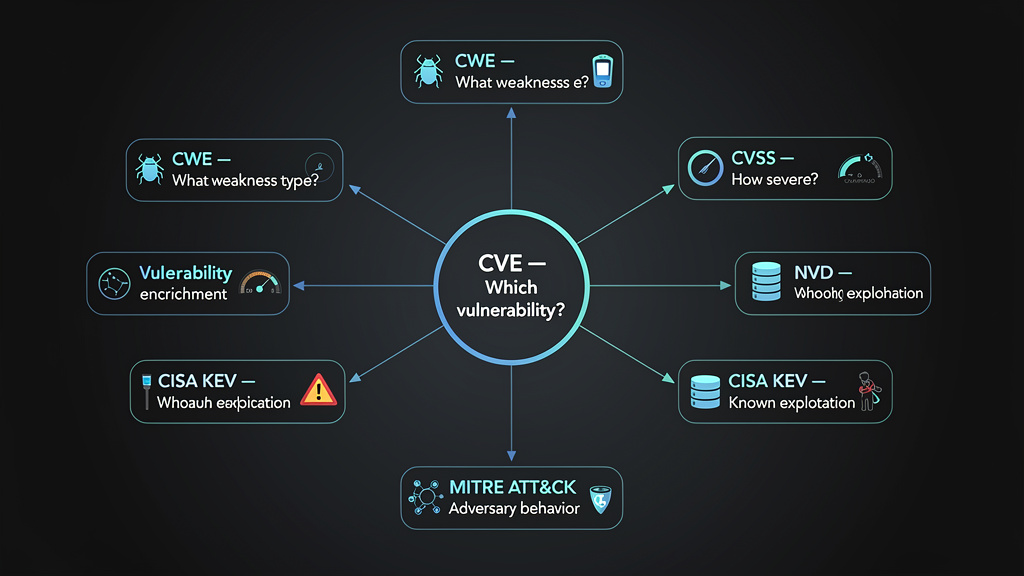
CVE vs CVSS
The difference between CVE and CVSS becomes easy to understand when we ask what question each system answers.
| System | Main Question |
|---|---|
| CVE | Which vulnerability are we talking about? |
| CVSS | How technically severe is the vulnerability? |
For example:
CVE-2026-12345
identifies the vulnerability.
A corresponding CVSS assessment can describe properties such as attack requirements, privileges, user interaction, scope, and security impact.
In simple terms:
CVE provides identity.
CVSS provides severity information.
Security teams often use both, but they should not be confused.
CVE vs CWE
Another common question is the difference between CVE and CWE.
CVE means:
Common Vulnerabilities and Exposures
CWE means:
Common Weakness Enumeration
The difference is fundamental.
A CVE generally identifies a specific vulnerability affecting a particular product or implementation.
A CWE describes a category or class of weakness that can lead to vulnerabilities.
For example, suppose several software products contain SQL injection vulnerabilities.
Conceptually:
SQL Injection Weakness
        │
        ├── Product A vulnerability
        │      └── CVE-XXXX-11111
        │
        ├── Product B vulnerability
        │      └── CVE-XXXX-22222
        │
        └── Product C vulnerability
               └── CVE-XXXX-33333
The weakness class can be shared across many products, while every individual vulnerability may have its own CVE identifier.
A useful way to remember the difference is:
CWE = What kind of security weakness is this?

CVE = Which specific vulnerability is this?
CVE vs NVD
Another common misconception is that CVE and NVD are the same thing.
They are not.
CVE provides the standardized vulnerability identification ecosystem and CVE Records.
The National Vulnerability Database, commonly called NVD, is a vulnerability-management resource maintained by the U.S. National Institute of Standards and Technology.
Conceptually, the relationship looks like this:
Vulnerability
      │
      ▼
CVE ecosystem
      │
      ▼
CVE-2026-XXXXX
      │
      ├── Vendor advisory
      ├── Security scanners
      ├── Threat intelligence
      ├── Asset management
      └── NVD
             │
             ▼
       Additional vulnerability
       management information
This distinction matters because users sometimes assume that every piece of information displayed on an NVD vulnerability page originated directly from the CVE Program.
That is not necessarily the case.
The two systems are closely connected but perform different roles.
CVE vs CISA KEV
CISA’s Known Exploited Vulnerabilities Catalog, commonly known as CISA KEV, adds another important piece of context.
CVE answers:
Which vulnerability is this?
CISA KEV addresses a different question:
Is there evidence that this vulnerability has been exploited in the wild?
That distinction has major consequences for vulnerability prioritization.
Consider two hypothetical vulnerabilities.
Vulnerability A
CVSS: 9.8
Internet-facing: No
Known exploitation: No
Asset importance: Low
Vulnerability B
CVSS: 8.1
Internet-facing: Yes
Known exploitation: Yes
Asset importance: Critical
Even though Vulnerability A has the higher CVSS score, Vulnerability B may deserve more immediate attention.
This is why mature security programs combine CVE and CVSS information with evidence of exploitation and environmental context.
CVE vs MITRE ATT&CK
CVE and MITRE ATT&CK also describe different layers of cybersecurity.
CVE focuses on vulnerabilities.
MITRE ATT&CK focuses on adversary behavior, including tactics and techniques attackers may use during security incidents.
An attacker might exploit a CVE as one step within a broader attack chain:
Specific CVE
     │
     ▼
Exploit public-facing application
     │
     ▼
Initial Access
     │
     ▼
Privilege Escalation
     │
     ▼
Credential Access
     │
     ▼
Lateral Movement
The CVE identifies the technical vulnerability.
ATT&CK can help describe how exploitation fits into broader adversary behavior.
An easy way to understand the ecosystem is:
CVE
Which vulnerability is this?

CWE
What weakness caused it?

CVSS
How severe is it technically?

CISA KEV
Is it known to be exploited?

MITRE ATT&CK
How might attackers use capabilities during an attack?
CVE vs CWE vs CVSS vs NVD vs KEV
The major vulnerability-related systems can be summarized as follows:
| System | Full Name | Primary Purpose |
|---|---|---|
| CVE | Common Vulnerabilities and Exposures | Identify specific vulnerabilities |
| CWE | Common Weakness Enumeration | Categorize weakness types |
| CVSS | Common Vulnerability Scoring System | Describe technical severity |
| NVD | National Vulnerability Database | Provide vulnerability-management enrichment |
| KEV | Known Exploited Vulnerabilities Catalog | Highlight known exploited vulnerabilities |
| MITRE ATT&CK | ATT&CK knowledge base | Describe adversary tactics and techniques |
These systems complement one another.
They should not be treated as interchangeable.
Does Every Vulnerability Have a CVE?
No.
The existence of a vulnerability does not automatically mean that a CVE Record already exists.
There are several possible reasons.
A vulnerability may still be private.
It may be undergoing coordinated disclosure.
A CVE may have been reserved but not published.
No one may have requested an identifier yet.
The issue might eventually be combined with another vulnerability record.
Or it may not qualify for a separate CVE assignment under the applicable rules.
Therefore:
No CVE ≠ No vulnerability
This is particularly important for penetration testers, security researchers, and incident responders.
A security team may discover an exploitable security problem before any public CVE exists.
The opposite is also important:
CVE exists ≠ your system is vulnerable
A CVE describes a known vulnerability under particular affected conditions.
Your environment still needs to be assessed.
Why CVE Is So Important to Cybersecurity
Without CVE, modern vulnerability management would involve an enormous identity and data-normalization problem.
Imagine that a vendor calls an issue:
Security Advisory ABC-123
A vulnerability scanner calls it:
Plugin 59281
A researcher calls it:
ExampleServer Authentication Bypass
A threat intelligence provider calls it:
Vulnerability EX-00932
How can automated systems determine that all four descriptions refer to exactly the same vulnerability?
A shared CVE ID helps solve this problem.
Vendor Advisory
        │
        ▼
CVE-2026-XXXXX
        ▲
        │
Scanner Plugin
        │
Threat Intelligence
        │
NVD
        │
Patch Management
        │
SOC Platform
This interoperability is one of CVE’s greatest contributions to cybersecurity.
How Security Teams Use CVEs
A CVE can enter an enterprise security workflow through several channels.
A vulnerability scanner may detect an affected version.
A software vendor may release a security advisory.
Threat intelligence may identify active exploitation.
CISA may add the vulnerability to KEV.
A software composition analysis platform may find a vulnerable dependency.
A penetration test may discover an exposed service associated with the vulnerability.
Once the CVE has been identified, defenders need to answer more important questions:
Do we use the affected product?
        │
        ▼
Which versions are deployed?
        │
        ▼
Are those versions actually vulnerable?
        │
        ▼
Is the vulnerable component enabled?
        │
        ▼
Can attackers reach it?
        │
        ▼
Is exploitation practical?
        │
        ▼
Is exploitation occurring?
        │
        ▼
How important is the asset?
        │
        ▼
Is a patch available?
        │
        ▼
Can remediation be verified?
This is why vulnerability management involves much more than collecting CVE numbers.
A CVE starts the investigation. It does not finish it.
Why CVE Matching Can Produce False Positives
Many vulnerability scanners identify possible CVEs by detecting products and versions.
Suppose a scanner discovers:
ExampleServer 4.2
A vulnerability database states that version 4.2 is affected by:
CVE-2026-12345
The scanner may generate a finding.
But this does not always prove that exploitation is possible.
Several factors can change the result.
The operating system vendor may have backported the security fix.
The vulnerable module may not be enabled.
The vulnerable endpoint may not be reachable.
The detected version might be inaccurate.
Authentication requirements may prevent the attack.
A required configuration may not exist.
Compensating controls may block exploitation.
This creates an important distinction:
Version Match
     │
     ▼
Potential Exposure
     │
     ▼
Environment Analysis
     │
     ▼
Safe Validation
     │
     ▼
Confirmed Finding
Security engineering should therefore distinguish between vulnerability identification and vulnerability validation.
CVE Identification vs Exploitability
A CVE Record tells security teams that a vulnerability exists under certain conditions.
It does not inherently prove that:
- your asset runs the vulnerable product,
- your version is affected,
- the vulnerable functionality is enabled,
- an attacker can reach the attack surface,
- required authentication conditions are satisfied,
- public exploit code exists,
- the exploit works reliably,
- attackers are using it in the wild,
- or exploitation would materially affect your business.
This leads to an important principle:
CVE identification should begin investigation, not automatically determine remediation priority.
Security teams still need to connect public vulnerability intelligence to the actual environment.
A Better CVE Prioritization Workflow
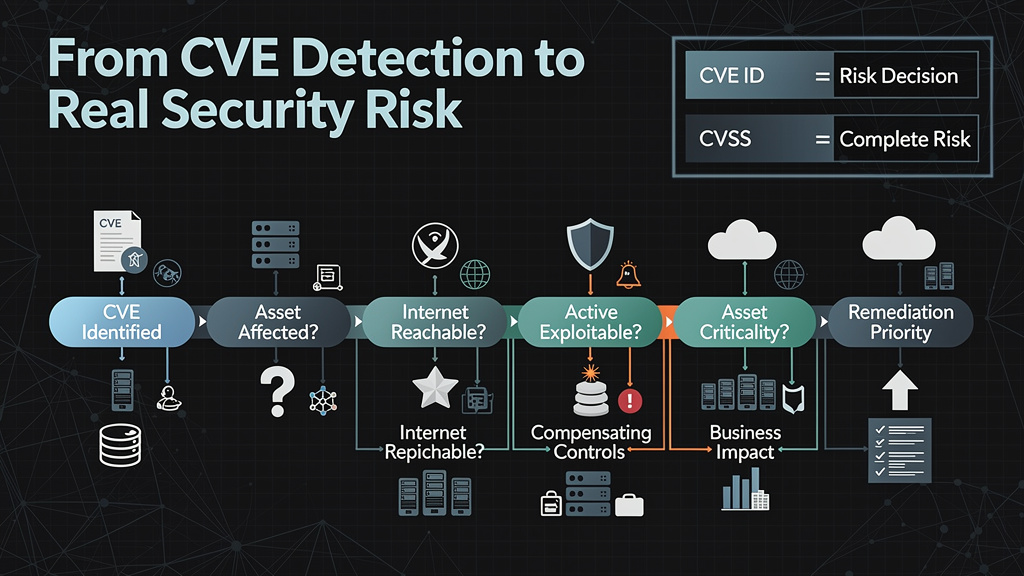
A more useful vulnerability-management process looks like this:
                 CVE
                  │
                  ▼
          Is the asset affected?
                  │
                  ▼
           Is it reachable?
                  │
                  ▼
       Is exploitation possible?
                  │
                  ▼
      Is exploitation occurring?
                  │
                  ▼
           Asset criticality
                  │
                  ▼
       Compensating controls
                  │
                  ▼
           Business impact
                  │
                  ▼
        Remediation priority
This provides more useful context than simply following:
CVSS 9.8
   │
   ▼
Patch immediately
A high CVSS score is an important signal, but real operational risk depends on more variables.
A conceptual risk model might consider:
Technical Severity
        +
Exploitability
        +
Exposure
        +
Threat Activity
        +
Asset Criticality
        +
Business Impact
        =
Remediation Priority
This is not a literal mathematical formula. It is a useful way to understand why vulnerability management requires more than CVE IDs and severity scores.
How Penetration Testers Use CVE Information
For penetration testers and red teams working within authorized environments, CVE information frequently becomes part of reconnaissance and vulnerability validation.
A typical workflow might look like:
Service Discovery
      │
      ▼
Technology Identification
      │
      ▼
Version Analysis
      │
      ▼
Potential CVE Matching
      │
      ▼
Vendor Advisory Review
      │
      ▼
Affected-Version Verification
      │
      ▼
Controlled Validation
      │
      ▼
Evidence Collection
      │
      ▼
Security Report
Professional penetration testing should not treat a scanner’s CVE match as proof that a target is vulnerable.
A tester may need to determine:
Is the product correctly identified?

Is the version correct?

Is the vulnerable feature enabled?

Is the attack surface reachable?

Does exploitation require authentication?

Has the patch been backported?

Is a mitigation already active?

Can the vulnerable behavior be reproduced safely?
Only after these questions are answered can the security finding be supported by meaningful technical evidence.
CVE Verification and AI-Powered Penetration Testing
Agentic security systems are creating another important use case for CVE information.
Traditional vulnerability scanners often operate primarily through detection and matching:
Target
   │
   ▼
Product Detection
   │
   ▼
Version Match
   │
   ▼
Possible CVE
More advanced AI-assisted security workflows can extend this process:
CVE Intelligence
      │
      ▼
Affected Product Analysis
      │
      ▼
Target Fingerprinting
      │
      ▼
Attack Surface Analysis
      │
      ▼
Tool Selection
      │
      ▼
Controlled Validation
      │
      ▼
Evidence Collection
      │
      ▼
Remediation Report
This distinction matters because vulnerability management has historically struggled with large numbers of unverified findings.
An AI-assisted penetration testing workflow can potentially move from:
“The scanner believes this server may contain CVE-XXXX-XXXXX.”
toward:
“The target was evaluated against the affected conditions, the relevant attack path was tested within authorization, and evidence indicates whether the vulnerability is actually present.”
For security teams, the second result is far more actionable.
Why a CVE Does Not Automatically Mean an Exploit Exists
Another common misconception is that every published CVE has public exploit code.
That is incorrect.
Several situations are possible:
CVE published
No public proof of concept
or:
CVE published
Technical PoC available
or:
CVE published
Reliable exploit available
or:
CVE published
Active exploitation observed
These scenarios represent very different risk conditions.
A CVE tells us that a vulnerability has been identified.
It does not tell us automatically what level of exploit maturity exists.
Security teams therefore need to combine CVE information with:
- vendor advisories,
- security research,
- exploit intelligence,
- CISA KEV,
- threat intelligence,
- asset exposure,
- and environmental testing.
Does Having a CVE Mean a Vulnerability Is Critical?
No.
CVEs cover vulnerabilities with many different types of impact.
Examples can include:
- information disclosure,
- denial of service,
- authentication bypass,
- privilege escalation,
- cross-site scripting,
- path traversal,
- command injection,
- SQL injection,
- memory corruption,
- sandbox escape,
- and remote code execution.
The CVE number itself tells you none of this.
Compare:
CVE-2026-11111
with:
CVE-2026-22222
There is no way to determine which one is more dangerous simply by looking at the identifiers.
The underlying vulnerability details must be analyzed.
Why CVE Numbers Appear Everywhere
Security professionals encounter CVEs throughout the cybersecurity ecosystem.
CVE IDs appear in:
- vendor advisories,
- operating system security updates,
- cloud security platforms,
- vulnerability scanners,
- security blogs,
- threat intelligence,
- EDR alerts,
- SIEM detections,
- GitHub security advisories,
- package manager alerts,
- SOC dashboards,
- penetration testing reports,
- incident response reports,
- and government security advisories.
This happens because CVE works as a universal correlation key.
A vulnerability-management platform might correlate:
CVE-2026-12345
        │
        ├── Asset inventory
        ├── Installed software
        ├── CVSS
        ├── CWE
        ├── CISA KEV
        ├── Threat intelligence
        ├── Internet exposure
        ├── Business criticality
        └── Patch availability
The CVE identifier allows these otherwise separate datasets to converge around the same vulnerability.
What Information Should You Check When Researching a CVE?
When researching an unfamiliar CVE, relying on a single blog post or vulnerability aggregator can produce incomplete conclusions.
A more reliable workflow starts with primary sources.
CVE Record
      │
      ▼
Vendor Advisory
      │
      ▼
Affected Versions
      │
      ▼
Patch or Security Update
      │
      ▼
NVD / CVSS Information
      │
      ▼
CISA KEV
      │
      ▼
Credible Security Research
      │
      ▼
Environment Validation
Vendor advisories are especially important because they often contain precise information about affected versions, fixed releases, workarounds, configurations, and patches.
For open-source vulnerabilities, security teams may also review:
- upstream commits,
- release notes,
- issue trackers,
- maintainer advisories,
- package security notices,
- and distribution-specific patches.
The important principle is to distinguish authoritative evidence from repeated secondary reporting.
Common Mistakes When Reading CVE Information
Mistake 1: CVE is a vulnerability score
Incorrect.
CVE identifies the vulnerability.
CVSS describes technical severity.
Mistake 2: CVE and NVD are the same system
Incorrect.
They are closely related, but they serve different roles.
CVE provides standardized identifiers and vulnerability records, while NVD provides additional vulnerability-management information.
Mistake 3: The CVE year always means discovery year
Incorrect.
The year portion of the identifier should not be automatically interpreted as the year the vulnerability was originally discovered.
Mistake 4: A high CVSS score means the vulnerability is automatically the highest priority
Not necessarily.
Exposure, active exploitation, asset importance, and environmental conditions all matter.
Mistake 5: Version matching proves vulnerability
Not necessarily.
Affected-version detection usually indicates potential exposure rather than confirmed exploitability.
Mistake 6: Every CVE has public exploit code
False.
Exploit availability is independent from CVE assignment.
Mistake 7: No CVE means no vulnerability
False.
Previously unknown, privately disclosed, or newly discovered vulnerabilities can exist without published CVE Records.
CVE and Modern Vulnerability Management
The importance of CVE becomes even clearer in large enterprise environments.
Imagine an organization operating:
30,000 endpoints
5,000 servers
1,200 cloud workloads
600 applications
hundreds of network appliances
thousands of software dependencies
A new vulnerability is disclosed.
The security team needs to determine where the vulnerable technology exists.
With a standardized CVE identifier, multiple platforms can use the same reference:
                   CVE-2026-XXXXX
                          │
        ┌─────────────────┼─────────────────┐
        │                 │                 │
       CMDB              EDR              SBOM
        │                 │                 │
   Cloud Inventory    SIEM Alerts      Dependencies
        │                 │                 │
        └─────────────────┼─────────────────┘
                          │
                          ▼
                Vulnerability Management
                          │
                          ▼
                  Remediation Workflow
That shared identity allows security systems to exchange information more efficiently.
CVE therefore functions as more than a list of security flaws.
It is a foundational piece of vulnerability-management interoperability.
CVE Is an Identifier, Not a Risk Decision
The most important lesson about CVE is simple:
A CVE tells you which vulnerability you are discussing. It does not automatically tell you what you should do about it.
Remediation decisions need context.
Security teams should ask:
What product is affected?

Which versions are vulnerable?

Do we run those versions?

Is the vulnerable feature enabled?

Is the asset internet-facing?

What authentication is required?

Does exploitation require user interaction?

What security impact is possible?

Is exploit code publicly available?

Has exploitation been observed?

Is the vulnerability in CISA KEV?

How critical is the affected system?

Are compensating controls present?

Is a patch available?

Has the patch actually fixed the problem?
Only after connecting these questions to the real environment does a CVE become actionable security intelligence.
Frequently Asked Questions About CVE
What is the CVE Full Form?
CVE Full Form is Common Vulnerabilities and Exposures.
CVE provides standardized identifiers for publicly disclosed cybersecurity vulnerabilities.
What does CVE stand for in cybersecurity?
CVE stands for Common Vulnerabilities and Exposures.
A CVE ID provides a consistent way to refer to a specific vulnerability across vendors, security tools, researchers, and vulnerability-management platforms.
What is a CVE number?
A CVE number, more accurately called a CVE ID, is a standardized identifier such as:
CVE-2026-12345
Modern CVE identifiers follow the general format:
CVE-YYYY-NNNN...
The numeric portion can contain more than four digits.
What does the year in a CVE mean?
The year is part of the CVE identifier assignment system.
It should not automatically be interpreted as the exact year in which researchers discovered the vulnerability.
Discovery, reservation, disclosure, patching, and publication may occur at different times.
Is CVE a vulnerability database?
CVE is commonly described informally as a vulnerability database, but its role is more specifically centered on providing standardized identification and records for publicly disclosed vulnerabilities.
Other systems, including NVD, build additional vulnerability-management information around CVE identifiers.
What is the difference between CVE and CVSS?
CVE identifies the vulnerability.
CVSS describes technical severity.
For example:
CVE-2026-12345
could identify the issue, while:
CVSS 9.8 Critical
could describe its severity.
They serve different purposes.
What is the difference between CVE and CWE?
CVE identifies specific vulnerabilities.
CWE categorizes weakness types.
A single CWE category can therefore be associated with many individual CVE vulnerabilities.
What is the difference between CVE and NVD?
CVE provides vulnerability identifiers and CVE Records.
NVD is a vulnerability-management resource maintained by NIST that consumes CVE information and provides additional security data and enrichment.
What is CISA KEV?
The CISA Known Exploited Vulnerabilities Catalog identifies vulnerabilities for which evidence of exploitation in the wild exists.
KEV status can therefore be an important vulnerability-prioritization signal.
Does every CVE have a CVSS score?
CVE and CVSS are separate systems.
A CVE identifier does not inherently guarantee that every source will have an immediately available CVSS assessment.
Different organizations may provide severity information at different stages.
Does every vulnerability have a CVE?
No.
A vulnerability can exist without a publicly available CVE.
The issue may be new, private, under coordinated disclosure, not yet assigned, or otherwise not represented by a separate published CVE Record.
Does a CVE mean my system is vulnerable?
No.
The CVE identifies a vulnerability affecting particular products, versions, or conditions.
Security teams still need to determine whether their actual environment matches those affected conditions.
Does a CVE mean hackers are exploiting the vulnerability?
No.
CVE assignment does not automatically mean exploitation has occurred.
Evidence of active exploitation must be established separately through sources such as threat intelligence, incident investigations, vendor reporting, or CISA KEV.
Is a CVE the same thing as an exploit?
No.
A vulnerability is the underlying security flaw.
A CVE is the standardized identifier associated with the vulnerability.
An exploit is a technique, process, or piece of code used to take advantage of the vulnerability.
Conceptually:
Software Weakness
      │
      ▼
Vulnerability
      │
      ├── CVE Identifier
      │
      ▼
Exploit Technique
      │
      ▼
Security Impact
Final Takeaway
The simplest answer to “What is the CVE Full Form?” is:
CVE stands for Common Vulnerabilities and Exposures.
But understanding CVE properly requires going one step further.
CVE is the common identity layer that allows the cybersecurity ecosystem to discuss the same vulnerabilities consistently.
It does not automatically tell you how dangerous a vulnerability is.
It does not prove that your systems are affected.
It does not prove that exploit code exists.
It does not prove that attackers are actively exploiting the issue.
It does not replace CVSS, CWE, NVD, CISA KEV, threat intelligence, asset context, or technical validation.
Instead, CVE answers one fundamental cybersecurity question:
Which vulnerability are we talking about?
From there, the security investigation begins.
                 CVE
                  │
     ┌────────────┼────────────┐
     │            │            │
    CWE          CVSS         NVD
     │            │            │
     └────────────┼────────────┘
                  │
                  ▼
             CISA KEV
                  │
                  ▼
          Threat Intelligence
                  │
                  ▼
         Technical Validation
                  │
                  ▼
          Environmental Risk
                  │
                  ▼
        Remediation Priority
For someone learning cybersecurity, understanding this relationship makes vulnerability terminology much easier.
For security engineers, vulnerability-management teams, SOC analysts, penetration testers, and red teams, the lesson is even more important:
A CVE should be treated as the starting point for investigation and validation, not as the final judgment on security risk.

 English
  German
  French
  Spanish
  Portuguese
  Japanese
  Korean
  Hindi
Hindi  Arabic
  Turkish
  Hebrew