
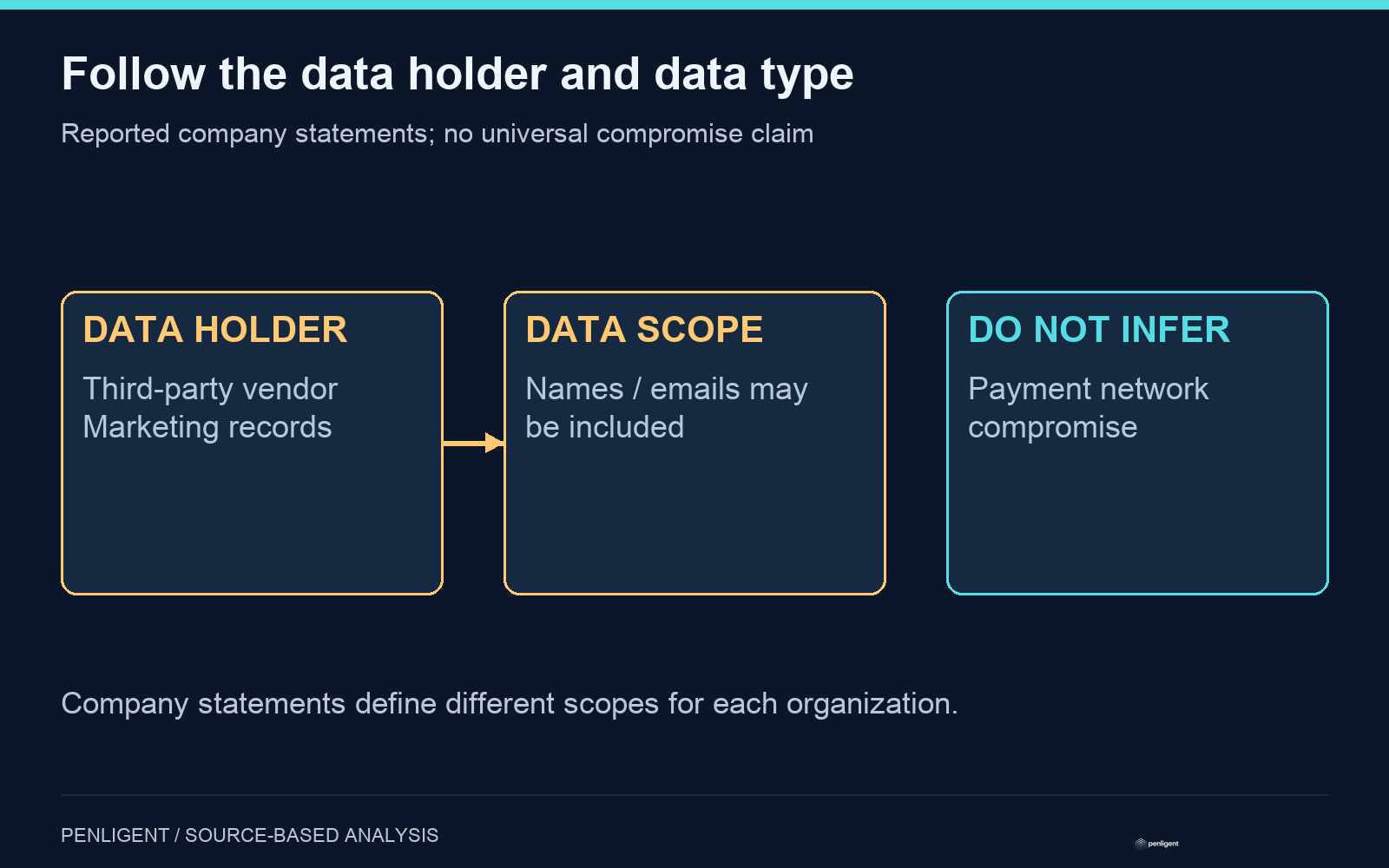
The JPMorgan Chase third-party cyberattack disclosed on November 19, 2026 concerns vendor-held marketing data. It should be assessed separately from the bank’s earlier service disruption. Reuters reports the bank’s spokesperson saying that some customer names and email addresses may be included, that affected customers would be contacted directly, and that the events were not connected. A disclosure date does not establish when an individual record was accessed.
What the reported company statements establish
The same Reuters report carries separate statements from Visa and Mastercard. Visa said the third-party incident did not involve its systems or payment-card numbers. Mastercard described limited email-address exposure from a subset of a benefit program and said its payment network and card use were unaffected. These are attributed, organization-specific statements, not a common exposure determination for every institution using a supplier.
Reuters also described material posted by an extortion group but did not independently authenticate that data. Treat leak counts, fields and attribution as unverified unless a responsible organization or corroborated investigation establishes them. This article does not inspect leaked records or identify affected individuals.
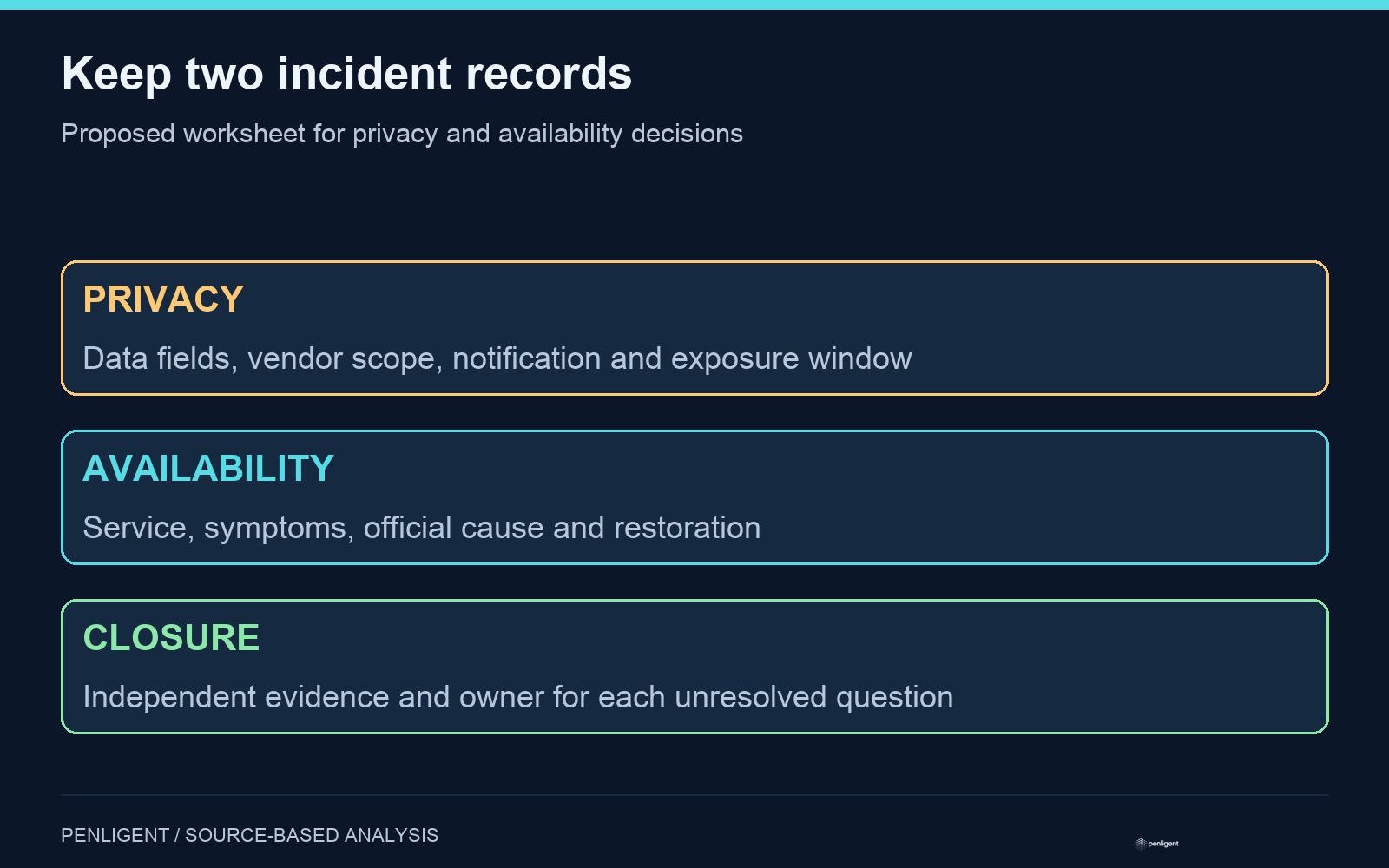
A practical worksheet for security and vendor-risk teams
The following is a proposed response method. Start with the organization’s own supplier inventory and notification, then maintain one row per distinct data-sharing relationship. A shared vendor name is not enough to infer shared data, permissions or retention. Keep customer identifiers and incident evidence in approved systems rather than copying personal information into a public tracker.
| Decision | Evidence to request | What remains open |
|---|---|---|
| Vendor scope | Contract owner, service, subprocessor relationship and organization-specific notice | Which environment and records were in scope? |
| Data exposure | Confirmed field types, relevant retention period and affected population from the responsible organization | A marketing record is not automatically an account credential or payment record. |
| Containment | Supplier change record, disabled integration or revoked access where relevant | Does the affected access path still exist? |
| Customer communication | Approved notification channel, audience and updated statements | Do not use an unverified leak list as a notification recipient list. |
Keep the Microsoft, banking and airline outage questions separate
An outage is an availability observation. It does not independently establish intrusion, data theft, a common attacker or a shared vulnerable component. Reports that several organizations were unavailable in the same week are a discovery lead, not a causal chain. For a Microsoft application, bank or airline incident, use that service owner’s exact incident record and time window before assigning a security cause.
Record the reported symptom, the service and region affected, the operator’s current explanation and its confidence, restoration time and the next promised update. Label an expert hypothesis as a hypothesis. If emergency patching is suspected, join the deployment change and health telemetry to the failure window; do not use timing alone as proof. A working service after rollback also does not prove the original cause.
Reduce phishing risk without assuming account takeover
If your organization receives an incident-related message, navigate through a known account portal or established support channel rather than using an unsolicited link or telephone number. For administrators, assess the disclosed fields against existing identity controls and telemetry. An email address exposure can support a targeted lure, but it is not evidence that a password, session or financial account was taken over. Preserve that distinction in internal alerts.
Close privacy and availability with different evidence
For the data event, document the supplier’s verified scope, containment and notification decisions, with an owner for unresolved records. For an outage, retain the service owner’s cause determination and functional recovery evidence. Neither completion substitutes for the other. This separation gives an incident lead a defensible answer without amplifying unverified claims or overlooking the real vendor-risk task.
The official Penligent 3.0 video below demonstrates a general product workflow. It is not evidence of this incident, exploitation or remediation.
Methodology, November 20, 2026: AI-assisted drafting with agent verification of Reuters’ direct company-statement reporting. No leaked dataset, private customer record or customer system was accessed. The worksheets and response decisions are proposed analysis, not first-hand incident-response results.
 German
 English
 French
 Spanish
 Portuguese
 Japanese
 Korean
 Hindi
 Arabic
 Turkish
 Hebrew