
CVE-2026-125396 affects Ghostscript before 10.08.0. The public record links a privileged helper recovery to a save/restore use-after-free and arbitrary code execution. The application need not launch gs itself: image libraries, preview workers, mail attachment rendering and print services may delegate documents to it. Close the finding only after identifying the processing path and confirming that the worker which handled it runs a fixed upstream release or a distribution package with the repair.
What the upstream repair changes
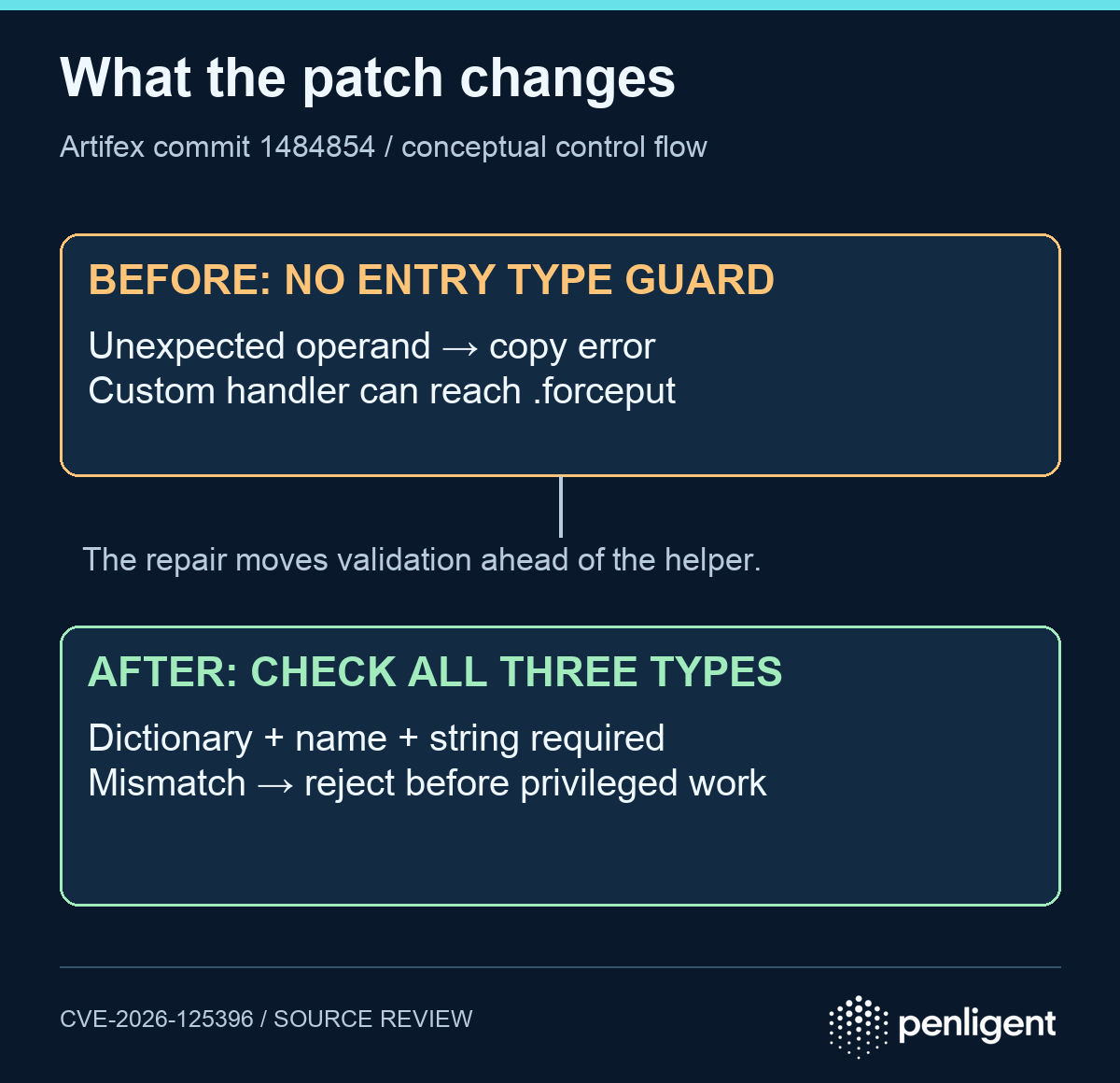
The CVE record describes a -dSAFER bypass involving /.putgstringcopy in gs_fonts.ps. Before the fix, the global-to-local branch copied an operand before checking its type. Artifex commit 1484854 first checks for a dictionary, name and string. A type mismatch raises an error before reaching the privileged helper path. The patch does not remove .forceput everywhere; -dSAFER is not an operating-system sandbox boundary. Run renderers with a dedicated low-privilege identity and constrained file access.
Trace the file to the interpreter
Inventory features that transform user-controlled content: upload previews, document conversion, email thumbnails, image resizing and print queues. Follow each job to the process or library that parses its bytes. A filename, declared media type, successful upload, or Ghostscript package on the web server does not establish which worker rendered the file.
Researcher Paulos Yibelo’s Upload2Shell report documents tested routes, versions, access conditions and outcomes. Those are the researcher’s results, not Penligent testing. The report distinguishes format identification from operations that decode pixels or generate previews. Record the accepted input, queue, executable or linked library, worker image, effective configuration and process identity. A dependency is a lead, not proof of remote exploitability.
Verify the package that runs
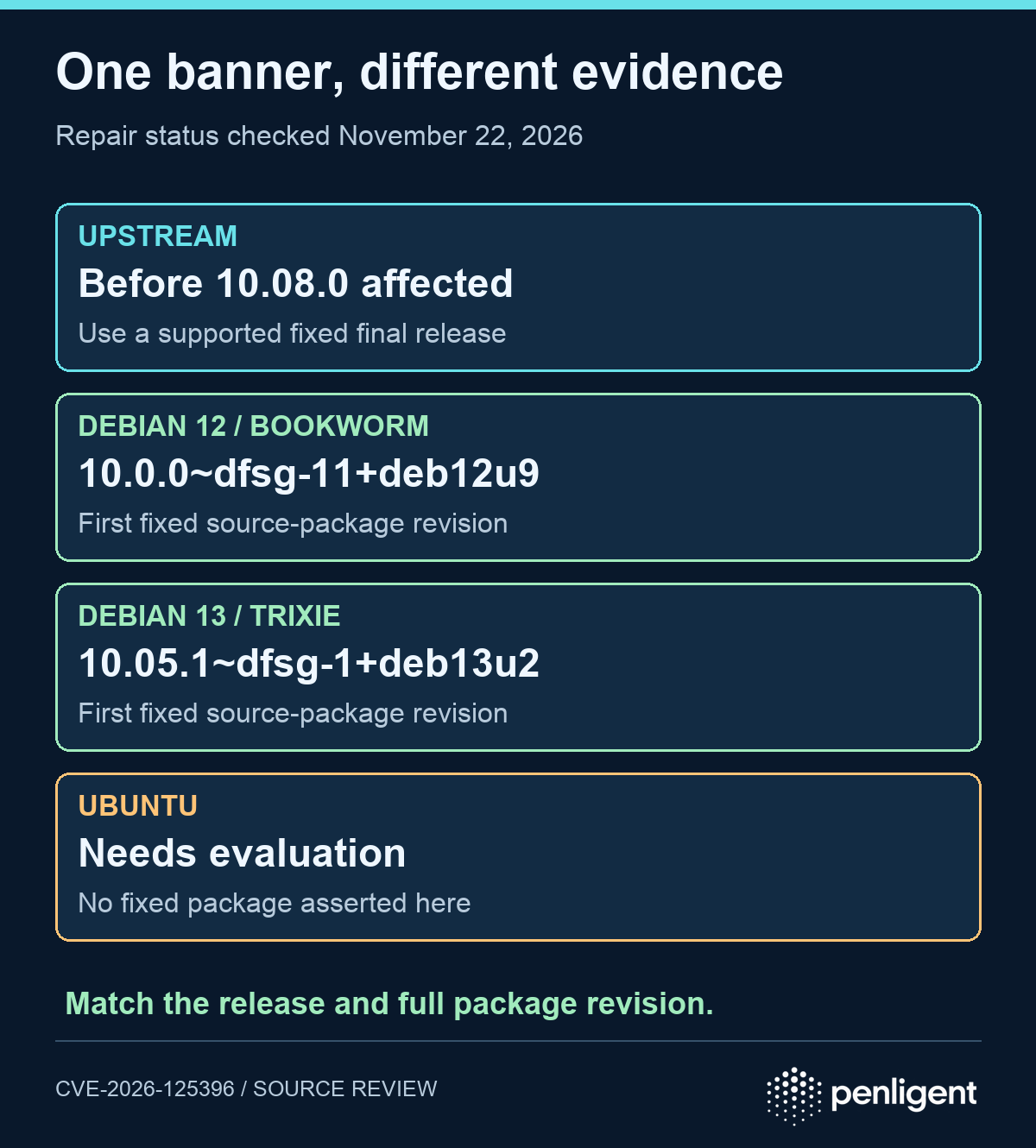
The upstream affected range is before 10.08.0, but distribution packages can backport a repair under an older upstream version string. Debian’s tracker, checked November 22, 2026, listed Bookworm first-fixed source package 10.0.0~dfsg-11+deb12u9 and Trixie 10.05.1~dfsg-1+deb13u2; its current Trixie summary showed 10.05.1~dfsg-1+deb13u3. Install the latest supported update from the matching release repository, and retain its package metadata.
Ubuntu’s CVE page, last updated November 18, 2026, listed displayed releases as “Needs evaluation.” That is unresolved, not confirmation of fixed or affected status. Check the current advisory and exact release package before closing the finding.
For containers and asynchronous services, record the distribution, full package revision, image digest and worker that actually handled a benign job. Replace old replicas and drain queues that can still route to them. Keep the finding open where the supplier’s repair evidence and repository metadata do not agree.
Close with a benign processing check
- Deploy the supported fixed package or image to every renderer.
- Submit a known-benign document through the normal authorized workflow; correlate the job with the worker identity, image digest and package revision.
- Confirm the expected preview succeeds. This checks routing and compatibility; it does not reproduce the vulnerability or prove the patch by itself.
- Account for queues, replicas, scheduled jobs and recovery workers before closing exceptions.
If immediate patching is not possible, the service owner can consider restricting the affected untrusted processing operation and reducing worker file and network permissions. Isolation is containment, not remediation.
For an authorized assessment documented with Sträflich, keep the input route, worker identity, package provenance and benign job result together as evidence.
Sources and limits
- CVE-2026-125396 record und Artifex issue.
- Artifex upstream patch.
- Debian Security Tracker und Ubuntu CVE status.
- Paulos Yibelo, Upload2Shell, published November 21, 2026.
Penligent did not reproduce this CVE or test a production stack. This AI-assisted analysis compares public vulnerability, patch and distribution records with the researcher’s report. The embedded Penligent 3.0 video is a general product workflow demonstration, not evidence of exploitation, exposure or remediation for this CVE.
 German
 English
 French
 Spanish
 Portuguese
 Japanese
 Korean
 Hindi
 Arabic
 Turkish
 Hebrew