
CVE-2026-114406 can be misread as a conventional vulnerable-code finding. Red Hat’s own bulletin says it is not a software vulnerability in Red Hat products: it tracks preventive certificate trust-store changes after a third-party certificate authority compromise. The operator task is to identify every trust bundle used by a workload and verify the package or image that contains the corrective distrust data.
This article is for RHEL, OpenShift, and Red Hat product administrators responsible for TLS trust. It focuses on package and runtime evidence, not on attributing an incident from a successful TLS connection.
Understand the trust condition
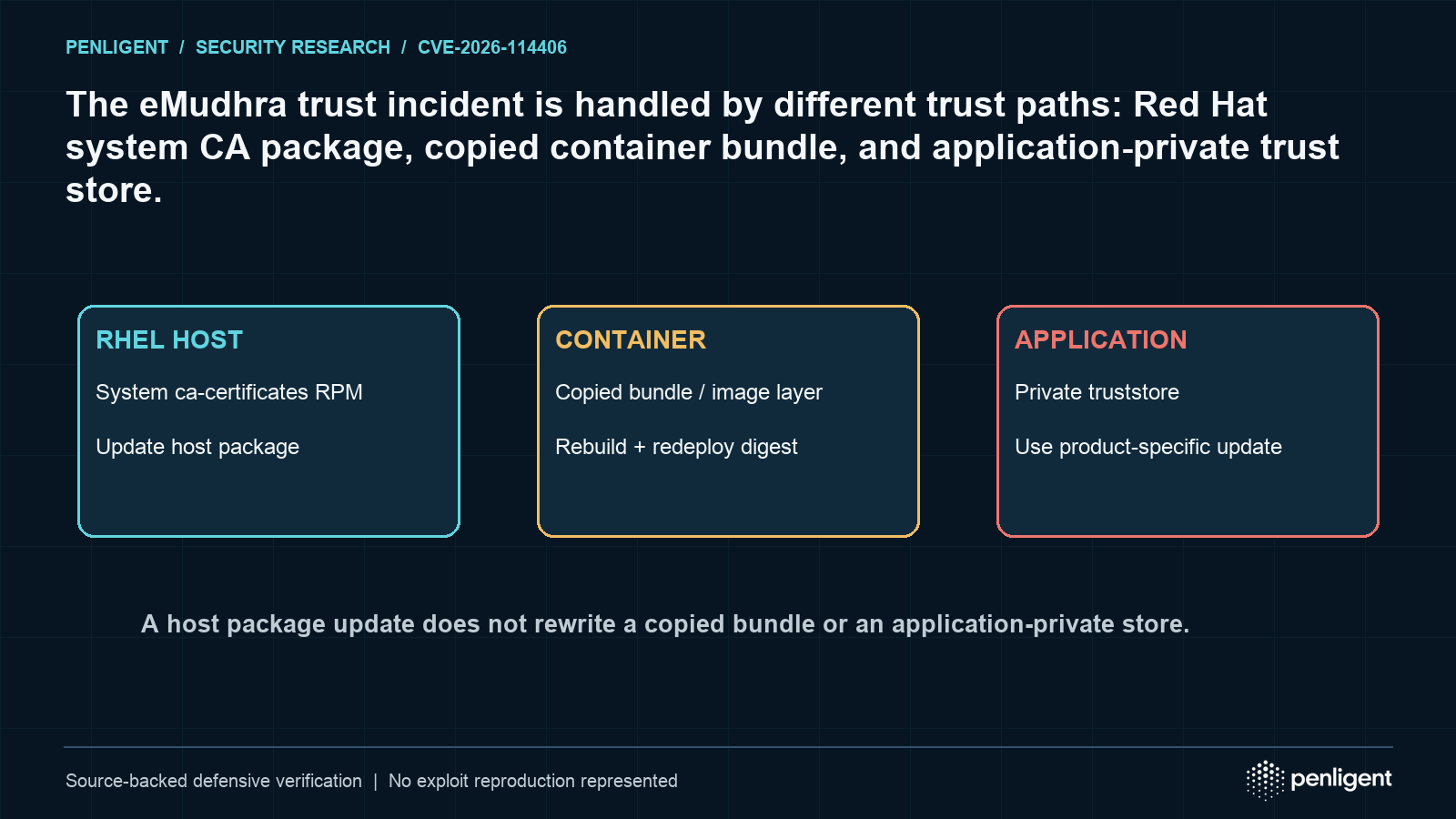
Red Hat’s RHSB-2026-012 explains that compromised eMudhra intermediate keys could be used to issue certificates for arbitrary hostnames. The relevant risk condition combines a system that trusts the affected chain, an attacker with one of the compromised private keys, and a network position that permits interception of a TLS connection. The key compromise does not by itself establish that a customer connection was intercepted.
Red Hat says the affected intermediates were signed by the Comodo AAA Services root and the emSign ECC Root CA – G3. Its published approach removes roots that signed the weak intermediates because selectively distrusting individual intermediates is not supported consistently by all clients. This can affect legitimate chains that depend on those roots, so test required business connections after the change.
The bulletin maps related identifiers across ecosystems: CVE-2026-114406 tracks Red Hat ca-certificates changes, CVE-2026-111943 tracks Go, and CVE-2026-91403 tracks Oracle Java’s initial response. Keep those implementation paths distinct even where they address the same incident.
Match the product to the package record
Die Red Hat CVE page and the published CVE record list product-specific fixed package versions. Examples include:
- RHEL 10
ca-certificates:2026.2.92_v9.0.319-100.3.el10_2. - RHEL 9
ca-certificates:2026.2.92_v9.0.319-90.3.el9_8. - RHEL 8
ca-certificates:2026.2.92_v9.0.319-81.3.el8_10. - RHEL 7 ELS, RHEL 6 ELS, EUS/AUS/TUS, OpenShift, and Red Hat product images have separate package or image-build entries.
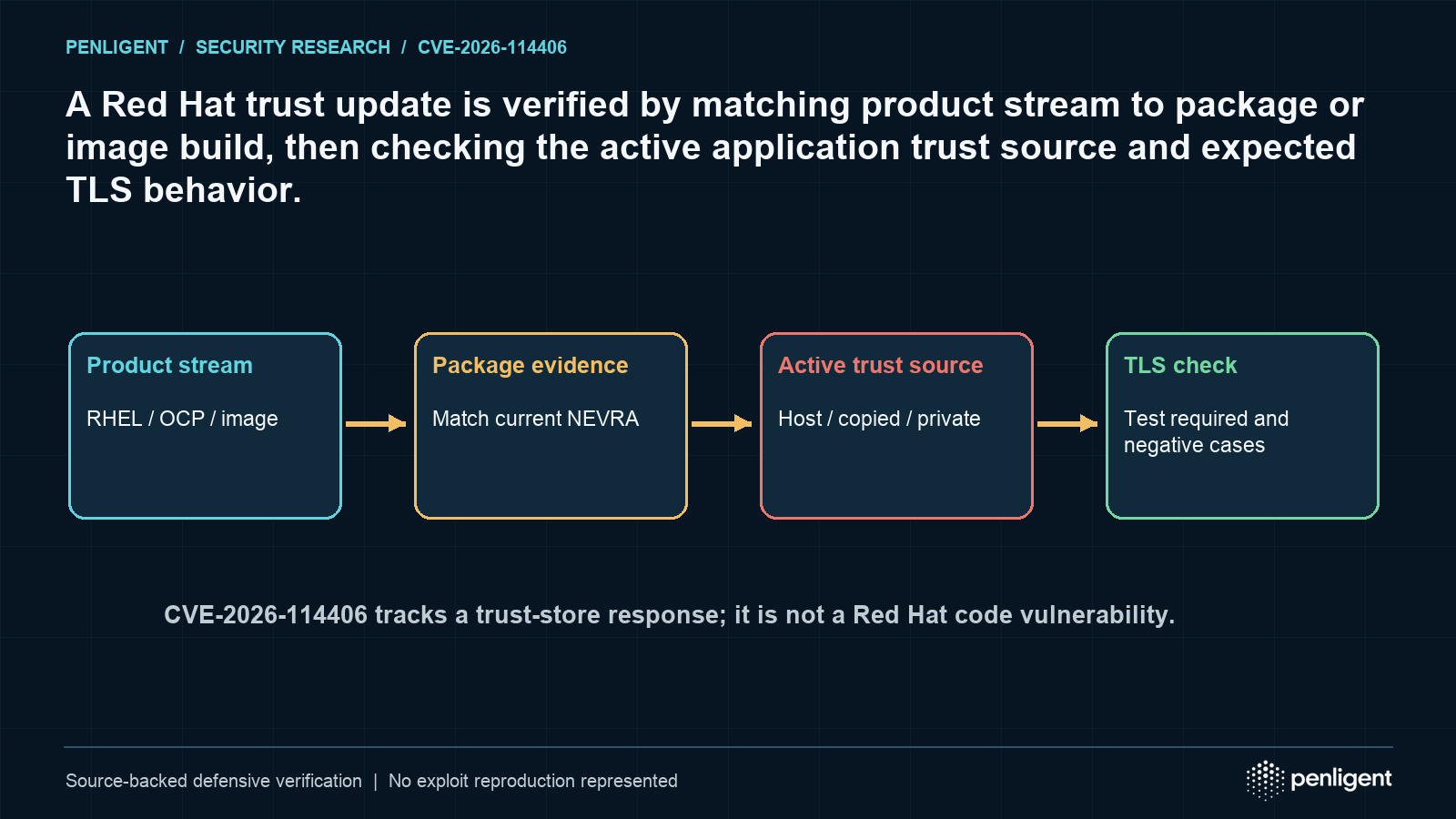
These examples are not a complete fleet matrix. Match the installed product, support stream, architecture, and package to the current Red Hat advisory before deciding that a version is corrected. Do not compare only the upstream Mozilla bundle version or assume all RHEL-derived images use the host package.
Verify the bundle applications actually consume
On a system you administer, record rpm -q ca-certificates and the installed package NEVRA. For containers, inspect the image’s package or trust-bundle state and digest; a host update does not rewrite a previously built image. Rebuild and redeploy images that copy certificate bundles during image construction. For Java, Go, Python, appliances, or vendor products that ship private trust stores, follow that product’s own update path and verify the trust store selected by the running process.
After updating, test required destinations and an approved negative certificate-chain fixture where your test process supports it. Preserve the package version, image digest, process/runtime identity, and test result. If historical interception is a concern, review available proxy, DNS, certificate, and outbound-connection evidence separately. Trust-store exposure alone is not evidence of compromise.
Method: This article was prepared with AI assistance from the primary sources linked below. The deployment checks are an editorial synthesis of those sources; no first-hand exploit validation is claimed.
Quellen: Red Hat RHSB-2026-012; Red Hat CVE-2026-114406; CVE record. Checked November 23, 2026. This page makes no claim that Penligent observed or reproduced certificate abuse.
 German
 English
 French
 Spanish
 Portuguese
 Japanese
 Korean
 Hindi
 Arabic
 Turkish
 Hebrew