
Updated November 3, 2026. CVE-2026-59310 is a critical VMware vCenter directory-traversal vulnerability in the Syslog server that can allow a network-accessible attacker to execute arbitrary code. Broadcom’s advisory rates it CVSS 9.8 and provides no workaround.
CISA added the vulnerability to the Known Exploited Vulnerabilities catalog on August 18, 2026. The catalog now marks known ransomware campaign use as Known and forensic triage as Ja. The federal remediation due date was August 21, 2026, which has passed.
That status changes the operating assumption. An organization that ran a vulnerable, reachable vCenter during the exploitation window should not treat patch installation as the end of the incident-response task.
Current decision table
| Artikel | Confirmed status |
|---|---|
| Schwachstelle | Directory traversal in the vCenter Syslog server |
| Auswirkungen | Arbitrary code execution |
| Attack position | Network access to vCenter |
| Authentifizierung | Broadcom and the CVE vector describe no privileges required |
| Schweregrad | CVSS 3.1 9.8, Critical |
| Ausbeutung | Listed in CISA KEV |
| Ransomware use | Known, according to the current CISA KEV feed |
| Forensic triage | Required by the KEV entry |
| Workaround | Keine |
| Primary action | Apply Broadcom’s fixed build for the deployed branch, then investigate the exposure window |
Why a path traversal flaw can become code execution
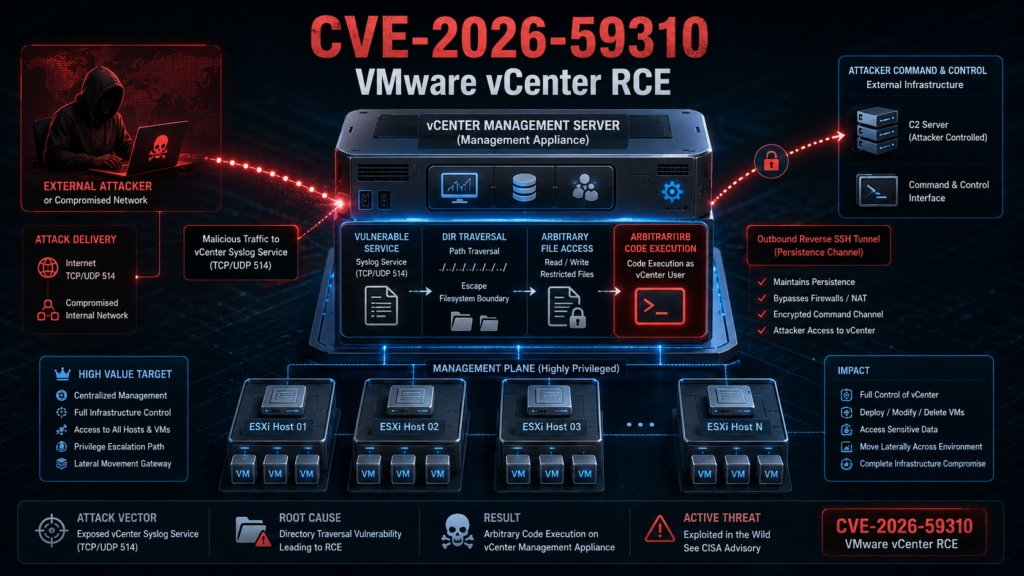
Path traversal is a filename and filesystem-boundary failure. Its impact depends on what the vulnerable operation can read, create, replace, or invoke. Broadcom’s advisory states that the vulnerable component is the vCenter Syslog server and that exploitation can result in arbitrary code execution.
Defenders do not need a public exploit chain to act on that conclusion. The vendor has already classified the end impact, supplied a critical score, published fixed builds, and stated that no workaround is available. CISA has independently placed the CVE in KEV.
Avoid reducing the issue to “a bad path in a log service.” The vulnerable system is the virtualization management plane. Code execution on vCenter can create a path to credentials, tokens, administrative sessions, inventory, configuration, and control over connected infrastructure.
Explore Penligent for authorized security testing and remediation verification.
Fixed versions from Broadcom
Broadcom’s VMSA-2026-0006.2 response matrix is the authoritative remediation source.
| Deployment or branch | Fixed version or vendor action |
|---|---|
| vCenter 9.1.x | 9.1.0.0300 |
| vCenter 9.0.x | 9.0.2.0100 |
| vCenter 8.0 current update train | 8.0 U3k |
| vCenter 8.0 alternate supported train listed by Broadcom | 8.0 U2f |
| vCenter 7.0 | Contact Broadcom Support if covered by an extended-support contract |
| VMware Cloud Foundation 5.x | Apply the async patch to 8.0 U3k following Broadcom guidance |
| Telco Cloud Platform 3.0, 4.x, 5.0.x, 5.1.x | Follow the Broadcom KB listed in the response matrix |
| Telco Cloud Infrastructure 3.0 | Follow the Broadcom KB listed in the response matrix |
Do not interpret a marketing product version as a vCenter build. Cloud Foundation and telco deployments can package vCenter through a separate lifecycle process. Record both the suite version and the embedded vCenter version or patch state.
Broadcom states that the relevant patches are cumulative. For 9.1, the latest listed build also includes the companion authentication-bypass fix for CVE-2026-59309.
CVE-2026-59309 and CVE-2026-59310 belong in the same change window
VMSA-2026-0006.2 addresses two critical vCenter flaws together:
| CVE | Komponente | Schwäche | Security result |
|---|---|---|---|
| CVE-2026-59309 | VMware Directory Service | Umgehung der Authentifizierung | Unauthorized system access |
| CVE-2026-59310 | vCenter Syslog server | Directory traversal | Arbitrary code execution |
An asset may be exposed to both conditions. Use the Broadcom matrix and the exact build, not a single-CVE scanner result, to determine whether the appliance is remediated.
Inventory before changing the environment
Build a list that distinguishes:
- standalone vCenter Server Appliance deployments;
- vCenter embedded in VMware Cloud Foundation;
- vSphere Foundation deployments;
- telco product bundles;
- disaster-recovery, lab, migration, and retired-but-still-running appliances;
- management interfaces reachable from user, server, partner, VPN, or internet networks.
For each instance, record the appliance version, build, management IPs and hostnames, lifecycle owner, external exposure, backup status, and the date the fixed build was installed.
Use the appliance management interface, vSphere administration interface, or approved asset-management tooling to capture the running version and build. Screenshots alone are weak evidence; pair them with an export, configuration record, or signed change ticket.
Prioritize by exposure and business control
Patch every affected system, but prioritize the queue using factors that change attacker opportunity and operational consequence:
- internet-reachable or broadly reachable management interfaces;
- vCenter reachable from user or application networks;
- instances controlling large or high-criticality virtualization estates;
- appliances with shared administrative credentials or weak identity isolation;
- systems that remained vulnerable after July 29, 2026;
- assets with unexplained restarts, outbound connections, account changes, or logging gaps.
Network segmentation remains useful risk reduction, but Broadcom lists no workaround. A firewall rule does not replace the fixed build.
Why patching does not close the historical exposure window
Patching removes the known vulnerable code path. It does not remove persistence, restore stolen credentials, or explain activity that occurred while the appliance was vulnerable.
For each asset, define an exposure window beginning no later than the public disclosure date unless earlier evidence suggests risk. End the window when the fixed build was successfully installed and the system was verified.
If the appliance was reachable by untrusted networks during that period, perform forensic triage proportionate to the asset’s role. CISA’s current KEV record explicitly marks forensic triage as required and identifies known ransomware campaign use.
A practical forensic-triage plan
Preserve evidence before making broad cleanup changes when operationally possible. Coordinate with the virtualization and incident-response teams so that evidence collection does not unnecessarily disrupt running workloads.
Review at least these areas:
Appliance and service activity
- Syslog service logs and related error records;
- unexpected files or file modifications in service-writable and execution-sensitive locations;
- process launches that do not match the approved appliance baseline;
- service restarts, crashes, or configuration changes;
- new scheduled tasks, startup entries, or persistence mechanisms;
- outbound connections from the management appliance to unusual destinations.
Identity and administrative control
- new or modified SSO users, groups, roles, and identity sources;
- unexpected administrator sessions and token use;
- password, certificate, key, or trust-store changes;
- changes to permissions, alarms, tasks, extension registrations, or automation accounts;
- administrative actions that do not match approved change records.
Virtual infrastructure impact
- unusual VM power, snapshot, clone, console, export, or configuration operations;
- changes to hosts, clusters, distributed switches, storage, or backup integrations;
- evidence that credentials available to vCenter were reused elsewhere;
- suspicious access to management-plane backups or appliance snapshots.
Do not treat one indicator as definitive attribution. Establish a timeline, correlate multiple evidence sources, and document collection gaps.
If compromise is suspected
The response may need to expand beyond the appliance.
- Isolate management access without unnecessarily stopping guest workloads.
- Preserve vCenter, network, identity, hypervisor, and backup evidence.
- Identify credentials and tokens that the compromised appliance could access.
- Rotate affected secrets using an order that avoids destroying required evidence or locking out responders.
- Review connected ESXi hosts, automation systems, backup platforms, identity providers, and administrative workstations.
- Rebuild or restore the management appliance when integrity cannot be established.
- Verify the replacement build, configuration, trust relationships, and logging before returning it to service.
Whether a full rebuild is required depends on evidence, organizational policy, vendor guidance, and the trust that can be placed in the existing appliance. A patched but previously compromised system is not automatically trustworthy.
Explore Penligent for authorized security testing and remediation verification.
Safe validation
Exploit replay is not required for routine remediation verification and should not be performed against production vCenter.
A safe validation package can include:
- the exact pre-change version and build;
- the Broadcom matrix row used for the decision;
- the installed fixed version and build;
- a successful appliance health and service check;
- proof that intended management paths still function;
- management-network reachability tests from approved and disallowed segments;
- the exposure-window and forensic-triage record;
- artifact, log, and case identifiers for retained evidence.
If vulnerability verification is required for an authorized assessment, use an isolated lab and define stop conditions before testing. The objective should be to verify the security property with the least harmful method, not to demonstrate persistence on a production management plane.
What this update changes from earlier coverage
The essential vendor facts remain the same: CVE-2026-59310 affects the vCenter Syslog server, can lead to arbitrary code execution, has a CVSS score of 9.8, and has no workaround.
The response context is now stronger. CISA’s KEV record confirms exploitation, marks known ransomware use, requires forensic triage, and sets a remediation date that has already passed. Those fields justify an incident-response posture for historically exposed systems rather than a patch-only posture.
Final guidance
Apply the Broadcom fixed build for every affected vCenter deployment. Do not use segmentation or lack of a public exploit as a reason to delay.
Then answer the second question: was this appliance vulnerable and reachable during the known-exploitation period? If yes, preserve evidence and complete forensic triage. For CVE-2026-59310, remediation is both a software-maintenance task and a management-plane trust decision.
Explore Penligent for authorized security testing and remediation verification.
 German
 English
 French
 Spanish
 Portuguese
 Japanese
 Korean
 Hindi
 Arabic
 Turkish
 Hebrew