
Last updated: November 4, 2026.
HIPAA-related penetration testing can provide technical evidence for a healthcare organization’s security risk analysis and remediation program. It does not by itself establish HIPAA compliance. The engagement should focus on systems that create, receive, maintain or transmit electronic protected health information, plus identities and services that can affect their security.
Evidence handling matters as much as vulnerability discovery. Use synthetic records whenever possible, minimize access to real ePHI, define secure evidence storage and identify business associates or third parties whose systems require separate authorization.
For the assessment framework, consult HHS HIPAA Security Rule Guidance and map the relevant guidance to the actual environment and authorized scope.
Build an ePHI and security-impact scope
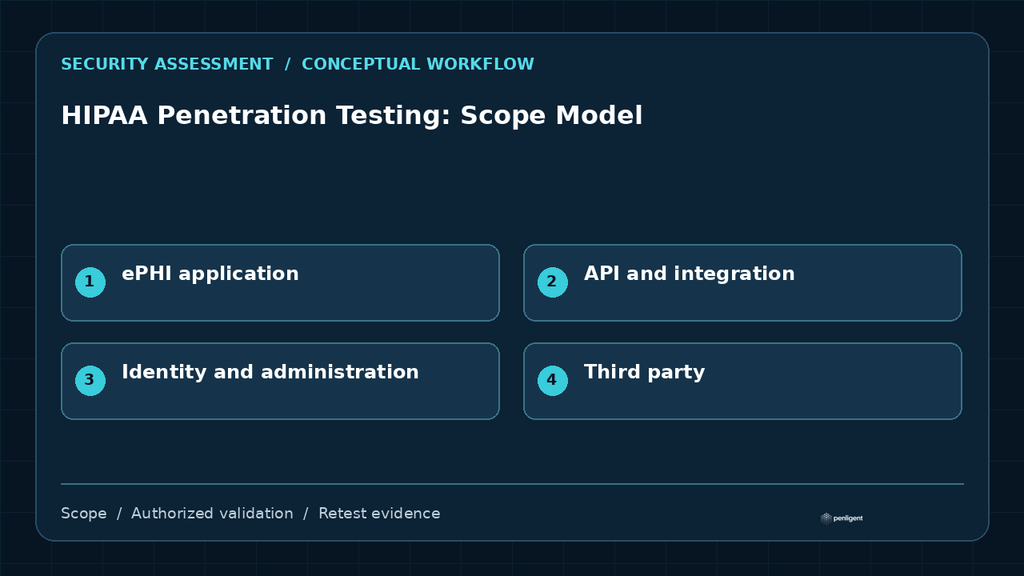
Start with data flows, not only hostnames. Include patient and clinician applications, APIs, identity providers, integration engines, cloud storage, administrative tools, backups, monitoring and software delivery paths when they can expose or change ePHI controls.
| Scope element | Frage | Beweise |
|---|---|---|
| ePHI application | Which users and workflows access protected records? | Role and workflow matrix |
| API and integration | How do partners, devices and internal systems exchange data? | Authentication and data-flow record |
| Identity and administration | Who can grant access or change controls? | Role, audit and approval evidence |
| Third party | Which vendor or business associate operates the component? | Authorization and responsibility boundary |
Turn the scope into testable evidence
Define an authorized target, validate meaningful attack paths, and keep the evidence connected to remediation and retesting.
Test confidentiality, integrity and availability controls
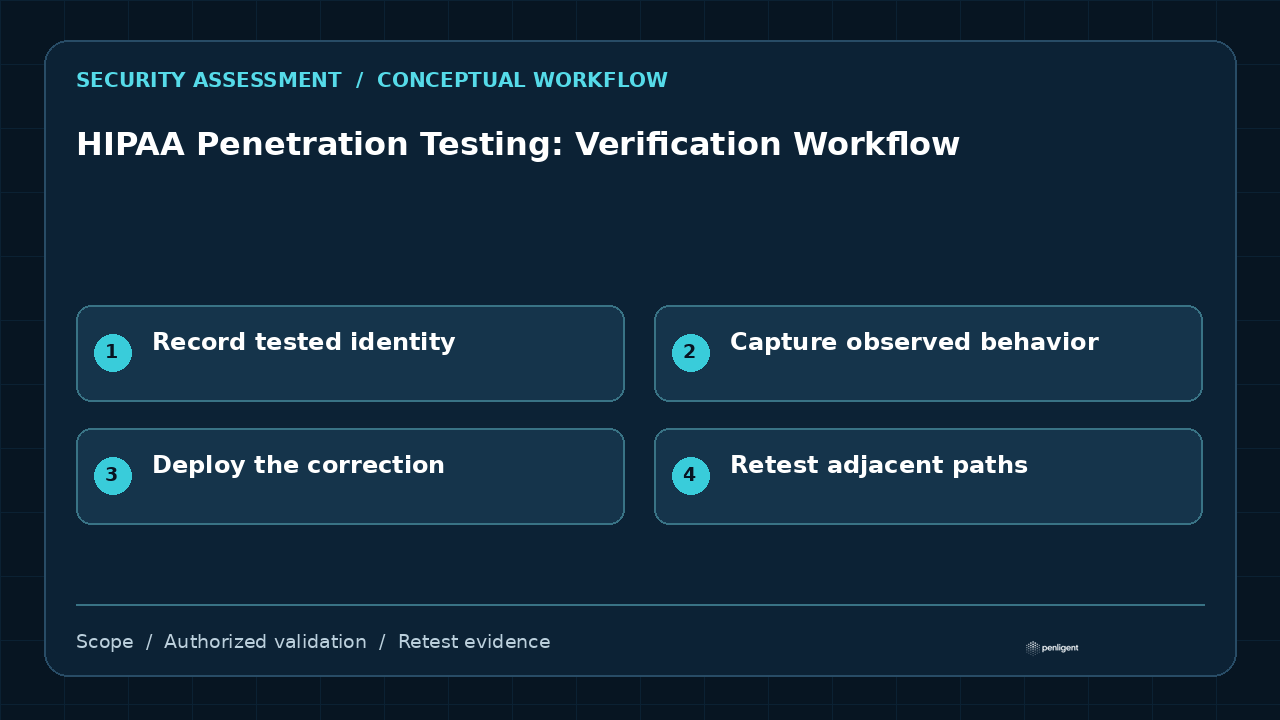
Assess authentication, authorization, tenant or patient boundaries, session handling, data export, administrative access and relevant availability risks. Use non-destructive methods and avoid collecting medical data when a synthetic record or metadata proves the control failure.
Connect findings to risk analysis
The report should state the affected system, threat condition, control failure, potential impact, existing safeguards and evidence confidence. The organization can then evaluate likelihood and impact in its broader risk-management process rather than treating the pentest severity as the final compliance decision.
Retest and protect the evidence
Retest the deployed fix and record corrected access results. Store reports and evidence under appropriate access, retention and disclosure controls. Share only the minimum necessary detail with third parties.
Turn the scope into testable evidence
Define an authorized target, validate meaningful attack paths, and keep the evidence connected to remediation and retesting.
Questions buyers should ask
- Which ePHI data flows and security-impacting systems are included?
- Can synthetic patient and clinician records be used?
- Are business associates and cloud services separately authorized?
- How will findings feed the organization’s risk analysis and remediation records?
Schlussfolgerung
Healthcare penetration testing should provide controlled technical evidence without creating new exposure of patient data. Map ePHI flows, test identity and application boundaries, minimize sensitive evidence and connect remediation results to the organization’s risk-management process.
 German
 English
 French
 Spanish
 Portuguese
 Japanese
 Korean
 Hindi
 Arabic
 Turkish
 Hebrew