
GitHub’s November 17, 2026 Enterprise Server releases fix several distinct authorization and execution paths. CVE-2026-116643 concerns SSH certificate identity validation: an organization member could read and modify another user’s private repositories under the conditions GitHub describes. The important boundary is the trusted certificate authority and its repository scope, not simply whether SSH is enabled. Start with the 3.22.5 release notes.
Confirm the patch for the installed release branch
| Installed branch | November 17 patch release | Official release notes |
|---|---|---|
| 3.19 | 3.19.16 | 3.19 notes |
| 3.20 | 3.20.12 | 3.20 notes |
| 3.21 | 3.21.10 | 3.21 notes |
| 3.22 | 3.22.5 | 3.22 notes |
These are branch-specific security releases verified on November 18, not interchangeable installers. Read the exact branch’s notes and supported upgrade procedure. The detailed feature conditions below are described in the 3.22.5 security section; do not assume every branch exposes an identical feature set.
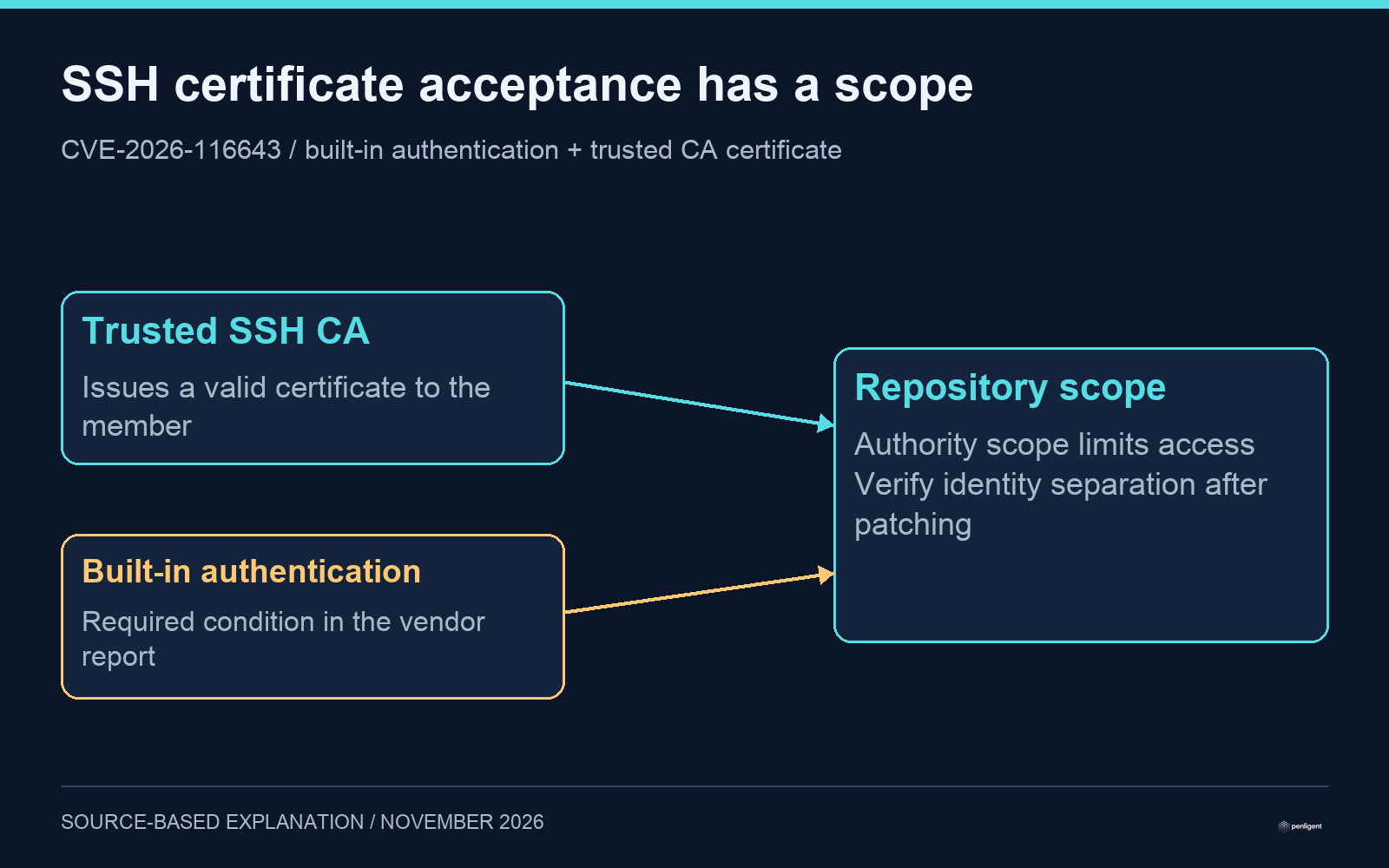
For CVE-2026-116643, inventory the certificate authority
GitHub says exploitation required an instance using built-in authentication and a valid certificate issued to the attacker by a trusted SSH certificate authority. Access was limited to repositories within that authority’s scope. Preserve all of those conditions in the assessment. A statement that this is an unauthenticated takeover of all private repositories would exceed the vendor’s description.
In an owned test instance, use two synthetic accounts and test repositories with explicit, different access grants. Validate that a certificate for one approved identity cannot obtain the other’s repository permissions. Confirm legitimate clone and push behavior as well. Record the trusted CA, scope, authentication mode and patched appliance version with the result. This is a proposed acceptance procedure, not a claim that we tested a GHES appliance.
Other fixes need different review questions
| Vendor-described issue | Prerequisite to assess | Defensive follow-up |
|---|---|---|
| CVE-2026-112740, peer Git-node command execution | Site administrator and a clustered instance; custom pre-receive hook environment | Review cluster nodes and environment ownership |
| CVE-2026-116637, host-file modification and repository disclosure | Site administrator; pre-receive hook environment setup | Inspect approved environment configuration and host change records |
| CVE-2026-111801, review-thread authorization bypass | Authenticated attacker with an accessible pull request | Use synthetic repositories to verify cross-repository review isolation |
| CVE-2026-131820, Slack validity-check SSRF | Repository write access; Secret Protection, secret scanning and partner validity checks enabled | Review configured checks and ensure legitimate validation still works after patching |
| CVE-2026-130824, Pages deployment command injection | Authenticated user permitted to deploy a GitHub Pages site | Inventory deployment permissions and validate the supported deployment path |
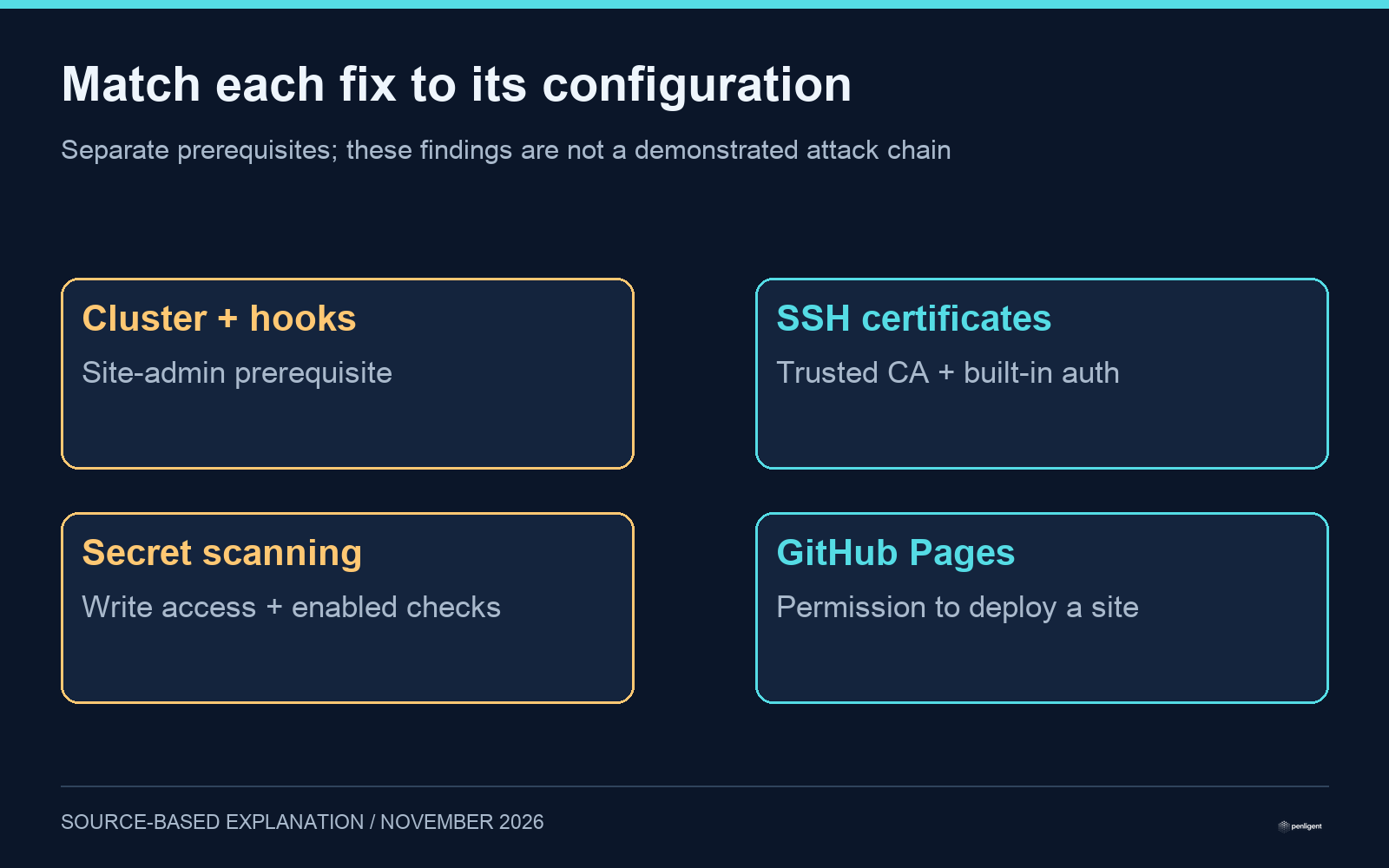
These are separate findings, not steps in a demonstrated attack chain. A site-administrator prerequisite and a repository-writer prerequisite describe different trust assumptions. Review the corresponding identities and features before deciding which historical evidence to preserve.
Recheck the Git update and upgrade consequences
GitHub explicitly says the Git fixes in this release were previously communicated in the preceding patch notes but had not been fully resolved. Do not close the new change solely because an earlier ticket cited those same Git CVEs. Verify the corrected branch release actually reached every relevant instance.
The 3.22.5 known-issues section also warns that custom firewall rules are removed during an upgrade and must be reapplied. Incorporate that documented behavior into the change window: retain the approved rule set, perform the supported upgrade and verify the intended network restrictions afterward. Do not discover a missing custom rule only after reopening access.
A useful closure record links the appliance release to the feature-specific tests, trusted identities, configuration evidence and any unresolved investigation. Successful patch installation answers the software state; it does not prove that historical misuse never occurred.
Method: four official release branches reviewed November 18, 2026 with AI-assisted drafting and agent validation. Feature-to-test mapping is our operational analysis. No exploitation or appliance upgrade was performed. The Penligent 3.0 video is a general product demonstration.
 German
 English
 French
 Spanish
 Portuguese
 Japanese
 Korean
 Hindi
 Arabic
 Turkish
 Hebrew