
Apache Roller 6.1.6 or later is the vendor remediation for an actively exploited XML-RPC deserialization flaw. Die Apache-authored CVE-2026-129448 record covers 4.0.0 through 6.1.4 and explicitly identifies the same vulnerability as CVE-2026-82384, which lists 6.1.5. Treat those identifiers as one remediation task. Moving from an older affected version to 6.1.5 does not close it.
Two identifiers describe the same vulnerable boundary
| Record | Published affected scope | Operator decision |
|---|---|---|
| CVE-2026-129448 | 4.0.0 through 6.1.4 | Include older deployments, not only the latest pre-fix release. |
| CVE-2026-82384 | 6.1.5 | Do not accept 6.1.5 as a workaround or fixed target. |
| Vendor remediation | 6.1.6 or later | Upgrade through the supported process and confirm the active application. |
The newer record expands the version coverage; it is not evidence of a second independent chain requiring a second exploit test. Group the records under the same asset and change ticket while preserving both identifiers for scanners and reporting. Unsupported or unlisted historical builds require vendor assessment rather than an automatic unaffected label.
The old feature switch was checked too late
The vulnerable XML-RPC path accepts extension types and deserializes request data before requester authentication. The 6.1.5 record says the servlet is mapped unconditionally, so parsing can occur even when the global XML-RPC feature is disabled. A screenshot showing the administration switch off is therefore incomplete mitigation evidence for an old deployment.
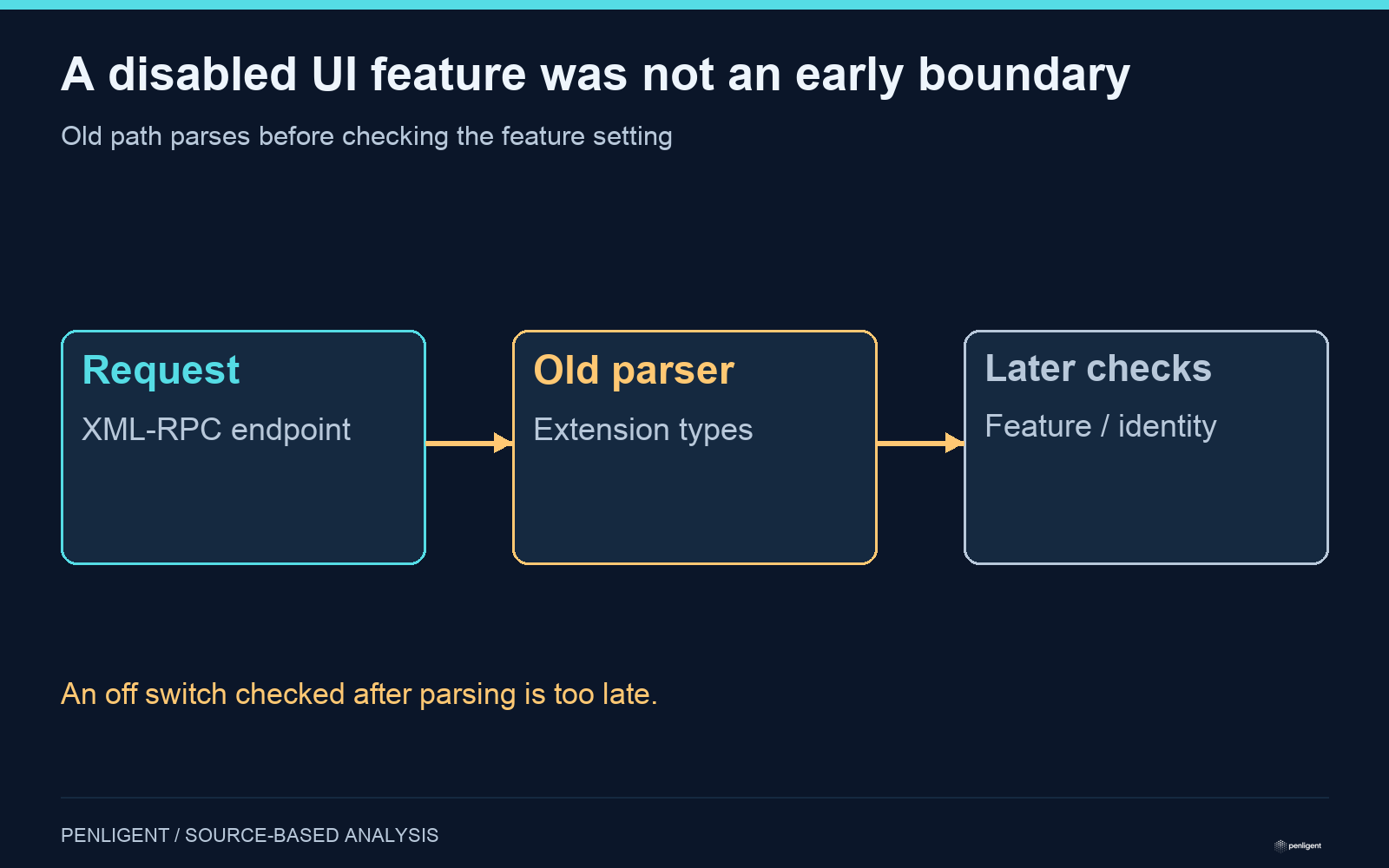
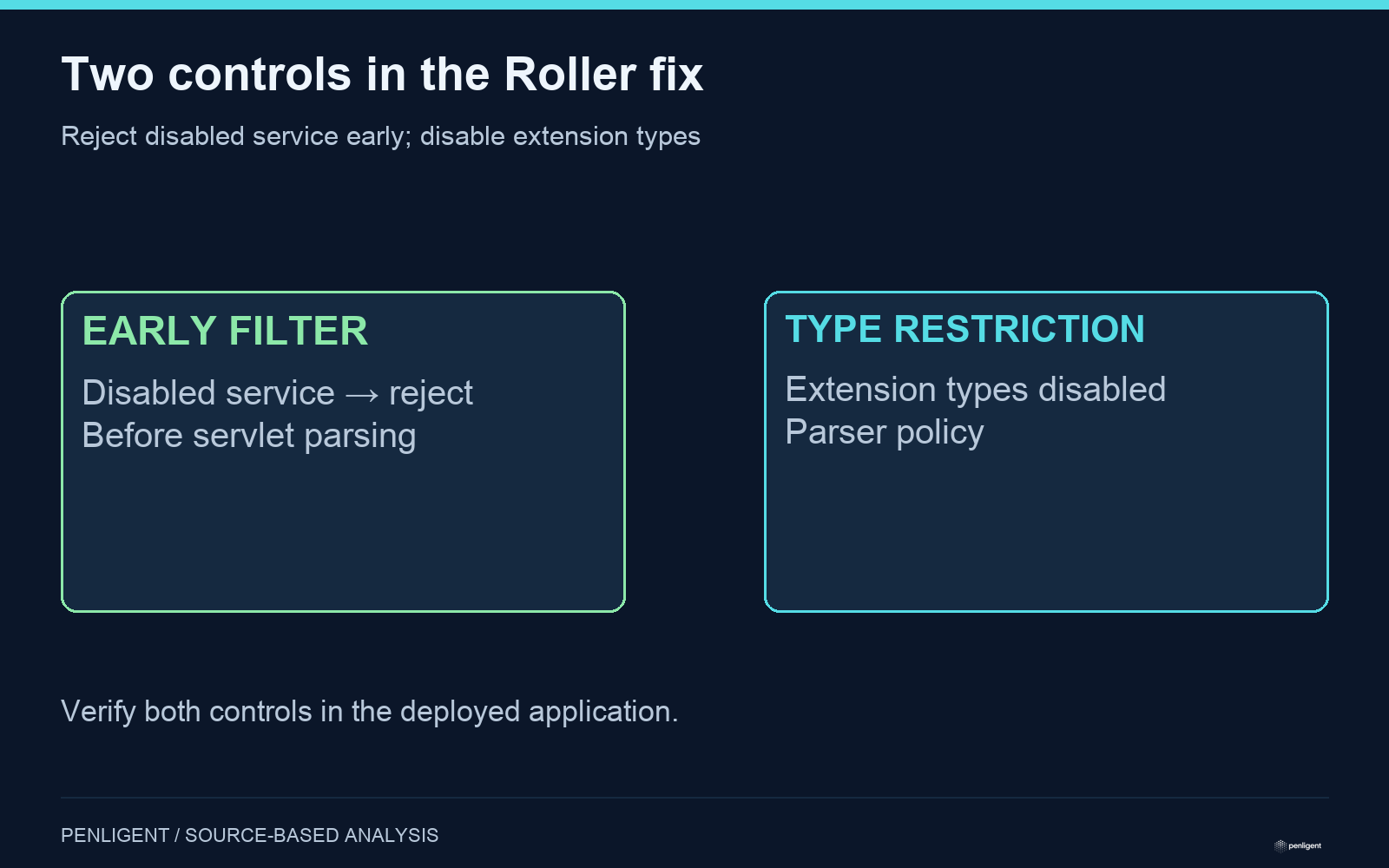
Die upstream patch changes two different controls. Its web.xml changes disable extension handling. It also adds XmlRpcEnabledFilter before the servlet, allowing a disabled feature to reject a request before XML-RPC parsing. These controls answer different questions: which types can be parsed, and whether the parser is reached at all. The source includes regression coverage; this article does not claim to have executed those tests.
Use the vendor workaround only as a tracked interim state
Apache instructs administrators who cannot immediately upgrade to set enabledForExtensions zu falsch in WEB-INF/web.xml, or remove the /roller-services/xmlrpc servlet mapping, then restart Roller. Disabling XML-RPC only in the old administration UI is explicitly insufficient. Apply the change to the deployed application, not merely to a source checkout or a configuration copy outside the active deployment.
Record the selected workaround, the application archive or configuration revision, restart evidence and any publishing integration affected by the change. If several application nodes serve the same site, verify each node. A proxy restriction may reduce reachability, but it does not prove that an internal route or a second virtual host cannot reach the vulnerable servlet.
Verify the intended feature state after remediation
| Intended state | Safe acceptance question | Beweise |
|---|---|---|
| XML-RPC disabled | Is a benign request rejected before the XML-RPC servlet parses it? | Patched filter/configuration and application-side evidence, not only a proxy error page. |
| XML-RPC required | Do supported normal publishing operations still work with extension types disabled? | Approved test account and synthetic content in staging. |
| Temporary mapping removal | Did the actual deployed mapping change on every node? | Deployed web.xml, restart time and route inventory. |
A 404 response by itself is not a deserialization test. It may originate from a load balancer or an unrelated route. Pair normal request observations with the deployed source and configuration evidence. Do not send serialized attack objects to a production blog to prove the fix.
Investigate the period before the fix separately
Apache states that this issue is actively exploited. Preserve available application, access and host records before routine cleanup, then correlate unusual XML-RPC activity with behavior of the application service account. The sources do not provide a universal indicator that proves every request was malicious. A corrected deployment prevents future use of the vulnerable path; it does not establish that earlier access never occurred.
The following Penligent 3.0 video is a general product workflow demonstration. It is not evidence of exploitation or proof that this vulnerability was remediated.
Methodology, November 19, 2026: AI-assisted drafting with agent verification against the linked primary records and source changes. The deployment decisions and proposed acceptance checks are analysis. No exploit was executed and no first-hand incident response is claimed.
 German
 English
 French
 Spanish
 Portuguese
 Japanese
 Korean
 Hindi
 Arabic
 Turkish
 Hebrew