
Why people are urgently searching CVE-2026-22769
Security engineers aren’t looking up CVE-2026-22769 because it’s academically interesting. They’re looking it up because it hits a rare, dangerous intersection:
- Maximum severity and operational impact (Dell rates it critical; NVD carries the same core statement). (Dell)
- A trusted, privileged product class: backup and recovery infrastructure that already has deep reach into VMware environments. (Dell)
- Credible evidence of active exploitation tied to real intrusions investigated by Google’s threat teams and Mandiant. (Google Wolke)
- CISA KEV inclusion, which turns “patch soon” into “patch now, then prove it.” (CISA)
If you’re triaging a production environment, your practical questions are predictable:
- Are we vulnerable
- Can this be reached from anywhere risky
- Are there signs we were hit
- What’s the fastest safe remediation path
- How do we produce evidence that stands up to scrutiny
This article is organized around those questions, using vendor and threat-intel sources as the factual baseline.
What CVE-2026-22769 actually is
The cleanest canonical definition comes from the vendor advisory and is repeated in NVD and CVE.org:
Dell RecoverPoint for Virtual Machines (RP4VM), versions prior to 6.0.3.1 HF1, contain a hardcoded credential vulnerability. Dell considers it critical because an unauthenticated remote attacker with knowledge of the hardcoded credential could potentially exploit this vulnerability leading to unauthorized access to the underlying operating system and root-level persistence. Dell recommends upgrading or applying remediations as soon as possible. (Dell)
That sentence matters because it tells you how to reason about risk:
- This is not a flaky crash bug. It’s a predictable authentication bypass-by-design once the credential is known.
- “Root-level persistence” is not “one command.” It’s the ability to stick around after reboots.
- The “unauthenticated” part is about initial access. If your management plane is reachable, the barrier is dramatically lower.
NVD also tags the weakness class as CWE-798 Use of Hard-coded Credentials, which is the right mental model for mitigations: reduce exposure, rotate and invalidate access, and treat the system like a Tier-0-adjacent asset. (NVD)
What defenders are calling it in searches and alerts
You asked for “the highest click-through” terms people are likely using around this CVE. There isn’t a public, authoritative CTR feed for a single CVE keyword that we can cite like a standard, but we can ground a high-intent keyword set by looking at how major advisories and coverage consistently phrase the incident:
Common high-intent search patterns appearing across vendor, KEV, and reputable security media include:
- “CVE-2026-22769” + “RecoverPoint for Virtual Machines” + “RP4VM” (NVD)
- “hardcoded credential” / “hard-coded credentials” (CWE-798 language) (Dell)
- “exploited in the wild” + “UNC6201” (threat cluster) (Google Wolke)
- “CISA KEV” + “due date 2026-02-21” (CISA)
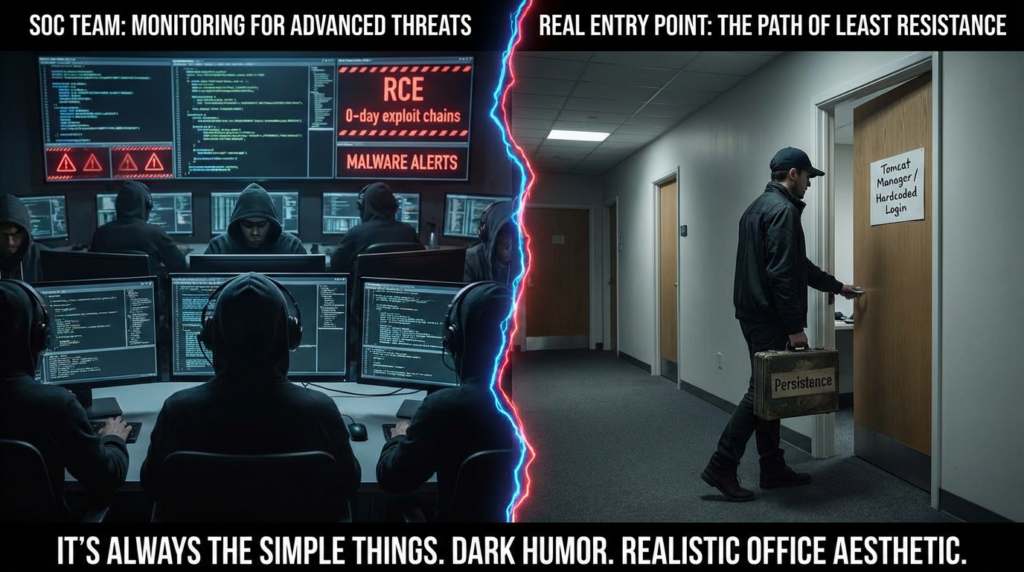
- “Tomcat Manager” / “/manager” (investigation signal highlighted by Mandiant) (Google Wolke)
If you’re optimizing for SEO/GEO, those phrases map cleanly to user intent: exposure, exploitation reality, patch/remediation, and incident response.
Why hardcoded credentials are worse in backup and recovery infrastructure
Hardcoded credentials are always bad. They are uniquely catastrophic in disaster recovery and backup systems for two structural reasons.
Backup tools live inside your trust boundary by design
RecoverPoint for Virtual Machines is meant to operate inside the VMware environment as a data protection and disaster recovery solution. That means it typically has:
- privileged access paths
- deep network adjacency
- operational legitimacy that makes “management traffic” less suspicious than a random inbound exploit attempt
Dell’s own advisory emphasizes that these systems should be deployed only in a trusted internal network with segmentation and firewall controls, not exposed to untrusted networks. That guidance is a quiet acknowledgment of the product’s privileged position. (Dell)
Credentialed abuse is stealthier than memory corruption
Mandiant/GTIG describe an intrusion investigation where the actors accessed management surfaces and used Tomcat-related paths and deployment behaviors. This is operationally different from a crashing exploit chain: it can blend into admin traffic if you don’t have specific detections. (Google Wolke)
Exploitation reality check
You should never treat “in the wild” as marketing language. For this CVE, it’s supported by multiple independent signals:
- Google’s Mandiant and GTIG report exploitation by a suspected China-nexus threat cluster tracked as UNC6201, with activity observed since at least mid-2024. (Google Wolke)
- NVD reflects that CISA KEV includes CVE-2026-22769, and CISA’s catalog entry shows a Due Date: 2026-02-21. (NVD)
- CISA also published an alert about adding vulnerabilities to the KEV catalog on February 18, 2026. (CISA)
A key nuance: “limited active exploitation” does not mean “low impact.” It often means a higher-skill actor is using it selectively for strategic access, which is consistent with Mandiant’s reporting style and the presence of bespoke tooling names in their write-up. (Google Wolke)
Affected scope and what fixed looks like
The vendor advisory is your source of truth for affected versions and the remediation target:
- Affected: Dell RecoverPoint for Virtual Machines versions prior to 6.0.3.1 HF1. (Dell)
- Fix target: upgrade to 6.0.3.1 HF1 or apply Dell’s remediations as documented. (Dell)
Dell also provides a dedicated knowledge-base article describing how to apply a remediation script, noting that reboot is not required, the script is nondisruptive to main operations, and run time is short per appliance. (Dell)
That’s important for real enterprises: it suggests a path to mitigation even if you need time to plan a full upgrade window.
Your fastest safe triage plan
This section is intentionally defensive. It focuses on proof, inventory, and log-anchored confirmation—not exploitation.
Step 1 Inventory where RP4VM exists
Before you talk about patching, make sure you know how many instances you have and where they sit. If you discover “one forgotten appliance” later, you’ll lose time and credibility.
If you have a modern asset discovery platform, use it. If you don’t, you can still do practical discovery:
- Search CMDB entries
- Search VMware inventory notes
- Query internal DNS for RecoverPoint/RP4VM naming patterns
- Review firewall objects referencing RP4VM subnets
RunZero published guidance specifically on finding RecoverPoint deployments and prioritizing the upgrade to 6.0.3.1 HF1 or applying the Dell remediation script if you can’t upgrade immediately. (runZero)

Step 2 Confirm version and hotfix level
Your goal is to answer one question per instance:
- Is it at or beyond 6.0.3.1 HF1
- If not, is Dell’s remediation script applied per their KB
Create a small evidence table that you can attach to tickets and audit packets:
| RP4VM Instance | Location | Version | Hotfix | Reachable from admin subnet only | Remediation applied | Evidence artifact |
|---|---|---|---|---|---|---|
| rp4vm-01 | DC1 | 6.0.3.1 | HF1 | Ja | Upgrade | screenshot + CLI output |
| rp4vm-02 | DC2 | 6.0.2.x | n/a | Ja | Script | KB script log + ticket ID |
The “Evidence artifact” column is what prevents future arguments.
Step 3 Validate management-plane exposure
Dell’s advisory strongly implies the worst case: if the system is reachable from untrusted networks, the hardcoded credential issue becomes an easy initial access vector. Deploy in a trusted internal network and segment it. (Dell)
Practically, that means:
- Restrict inbound access to RP4VM management surfaces to a dedicated admin subnet.
- Remove any NAT or proxy exposure that makes it reachable from user networks.
- Log all access. If you can’t log it, you can’t prove you were safe.
Step 4 Hunt for high-signal paths referenced by Mandiant
Mandiant’s report is unusually useful for defenders because it includes details about where evidence was found and the type of web requests observed.
They describe observing web requests prior to compromise and discuss management endpoints and deployment behavior through Tomcat Manager. (Google Wolke)
They also reference log locations and configuration artifacts used in their analysis. (Google Wolke)
The right approach is to hunt for “signals of admin-surface abuse,” not secret strings.
Detection and hunting patterns you can operationalize today
Below are examples you can adapt for Splunk, Elastic, or Sentinel. These are defensive queries that look for suspicious management endpoint usage and anomaly patterns.
Splunk hunt for Tomcat Manager access
index=web OR index=appliance OR index=proxy
(uri_path="/manager" OR uri_path="/manager/" OR uri_path="/manager/text" OR uri_path="/manager/html")
| stats count as hits
        min(_time) as first_seen
        max(_time) as last_seen
        values(src_ip) as src_ips
        values(user) as users
        values(status) as statuses
  by host, uri_path, http_method
| convert ctime(first_seen) ctime(last_seen)
| sort - hits
What to flag:
- Any
/manageraccess from outside the admin subnet - POST/PUT patterns if you expect only GETs
- Any time windows that correlate with suspicious changes or outages
This aligns with Mandiant’s emphasis on management-surface activity. (Google Wolke)
KQL pattern for reverse-proxy HTTP logs
HttpRequest
| where Url has "/manager"
| summarize Hits=count(),
            FirstSeen=min(TimeGenerated),
            LastSeen=max(TimeGenerated),
            SrcIPs=make_set(SrcIp, 25),
            Users=make_set(User, 25),
            Statuses=make_set(StatusCode, 25)
  by Host, Url, Method
| order by Hits desc
If you don’t have RP4VM logs in Sentinel, run this against your proxies, WAF, or network telemetry where management access would pass.
Incident response guidance if you suspect compromise
If you have reason to suspect compromise, your priorities should be:
- Stop additional access
- Preserve evidence
- Scope blast radius
- Confirm persistence mechanisms
- Rotate credentials and rebuild trust
Mandiant’s report describes intrusion activity discovered during investigation, including follow-on malware families and persistence behaviors. (Google Wolke)
This is the practical lesson: treat an exploited backup appliance as a control-plane breach until you can prove otherwise.
High-value evidence categories to collect
| Evidence category | Warum das wichtig ist | Examples of where it lives |
|---|---|---|
| Management access logs | Confirms whether /manager endpoints were accessed suspiciously | RP4VM web/audit logs, proxy logs, firewall logs (Google Wolke) |
| Configuration integrity | Hardcoded credential issues often map to config files and service users | Tomcat config artifacts referenced by investigators (Google Wolke) |
| Change artifacts | Unauthorized webapp deployments or unusual files | Webapp dirs, timestamps, package histories (Google Wolke) |
| Startup and persistence | Root persistence implies boot-time changes | rc.local equivalents, modified scripts and cron jobs (Google Wolke) |
| Network beacons | Confirms C2 patterns | NDR, DNS logs, egress proxy telemetry (Google Wolke) |
The exact file paths and scripts can vary across deployments and versions; your forensic team should align with Dell/Mandiant details and your environment’s baseline.
Remediation that stands up to audits
A lot of teams “patch” and then get burned later because they can’t prove what they did, on which system, and when.
For CVE-2026-22769, a defensible remediation packet typically includes:
- Version evidence proving 6.0.3.1 HF1 (or Dell-approved remediation script application) (Dell)
- A ticket with change-control approvals and maintenance window timestamps
- Firewall rule evidence showing segmentation that matches Dell’s guidance (Dell)
- Hunt output showing no suspicious management endpoint access after remediation
- A historical lookback hunt (because exploitation was observed since mid-2024) (Google Wolke)
If you operate in regulated environments, KEV inclusion is the external forcing function that auditors recognize. The KEV entry for this CVE includes the due date 2026-02-21. (CISA)
Why the CISA KEV due date matters outside government
A common mistake is to treat KEV as “federal-only.” In practice, KEV is used as a vulnerability prioritization signal across many industries because it’s tied to evidence of exploitation.
CISA’s KEV catalog entry for CVE-2026-22769 explicitly lists a due date of 2026-02-21. (CISA)
Even if you are not bound by federal directives, KEV is a strong argument for accelerating remediation and documenting exceptions.
Related vulnerabilities and why defenders should think in chains
CVE-2026-22769 is about initial access into a privileged backup and recovery system. In real intrusions, attackers often chain initial access with lateral movement in virtualization control planes.
Rather than guessing at a single chain, the right defensive posture is to treat RP4VM, hypervisors, and management planes as mutually reinforcing risks.
- Mandiant’s report places exploitation in the context of broader activity in victim environments, including follow-on actions and stealth tradecraft. (Google Wolke)
- Industry incident-response writeups and advisories have repeatedly emphasized that virtualization infrastructure is a common ransomware and espionage battleground, especially when management planes are not segmented and monitored. (SecurityWeek)
This is why “patch RP4VM” is necessary but not sufficient; you also harden the network and detect management plane anomalies.
If you’re only looking for a patch link, you don’t need a platform. But if your organization needs to answer “are we exposed” and “can we prove we’re remediated” across multiple environments, standardizing the verification workflow matters.
Penligent can fit in two defender-friendly ways:
- Evidence-driven verification and reporting Build repeatable checks that collect version evidence, network exposure evidence, and hunt outputs into a consistent remediation report your stakeholders can sign. This aligns with Dell’s framing that the product should be deployed with segmentation and that customers should upgrade or apply remediations quickly. (Dell)
- Operationalizing triage for KEV-grade issues When CISA adds something to KEV, teams often scramble. A standardized workflow reduces scramble and makes your post-incident documentation faster and more credible. (CISA)
No magic claims needed. The value is consistency, speed, and audit-quality output.
Practical checklist you can paste into an internal runbook
- Identify all RP4VM instances and owners (runZero)
- Confirm versions and hotfix level; remediate to 6.0.3.1 HF1 or apply Dell’s remediation script (Dell)
- Restrict management plane access to admin subnet; confirm segmentation matches Dell guidance (Dell)
- Hunt logs for suspicious management endpoint access patterns referenced in Mandiant’s report (Google Wolke)
- Preserve evidence and investigate persistence indicators if compromise suspected (Google Wolke)
- Produce an evidence packet for compliance and future incident retrospectives (CISA)
Referenzen
Dell advisory DSA-2026-079 https://www.dell.com/support/kbdoc/en-us/000426773/dsa-2026-079 NVD entry for CVE-2026-22769 https://nvd.nist.gov/vuln/detail/CVE-2026-22769 CVE.org record for CVE-2026-22769 https://www.cve.org/CVERecord?id=CVE-2026-22769 Google Mandiant and GTIG report on UNC6201 and RP4VM exploitation https://cloud.google.com/blog/topics/threat-intelligence/unc6201-exploiting-dell-recoverpoint-zero-day CISA Known Exploited Vulnerabilities catalog https://www.cisa.gov/known-exploited-vulnerabilities-catalog CISA alert Feb 18, 2026 about adding vulnerabilities to KEV https://www.cisa.gov/news-events/alerts/2026/02/18/cisa-adds-two-known-exploited-vulnerabilities-catalog Dell KB remediation script instructions https://www.dell.com/support/kbdoc/en-us/000426742/recoverpoint-for-vms-apply-the-remediation-script-for-dsa SecurityWeek summary https://www.securityweek.com/dell-recoverpoint-zero-day-exploited-by-chinese-cyberespionage-group/ The Hacker News summary https://thehackernews.com/2026/02/dell-recoverpoint-for-vms-zero-day-cve.html Penligent CVE-2026-22769 article https://www.penligent.ai/hackinglabs/cve-2026-22769-the-hardcoded-credential-that-turns-backup-infrastructure-into-an-intrusion-beachhead/ Penligent CVE-2026-2441 Chrome CSS zero-day article https://www.penligent.ai/hackinglabs/cve-2026-2441-the-chrome-css-zero-day-you-dont-patch-on-faith-you-prove/ Penligent CVE-2025-4517 tarfile boundary bug article https://www.penligent.ai/hackinglabs/cve-2025-4517-the-python-tar-extraction-bug-that-breaks-trust-boundaries-in-real-automation/
 German
  English
  French
  Spanish
  Portuguese
  Japanese
  Korean
  Hindi
Hindi  Arabic
  Turkish
  Hebrew