
CVE-2026-70229 is an incorrect-authorization vulnerability in Windows Active Directory Domain Services that Microsoft classifies as remote code execution. The CVE record assigns CVSS 3.1 HIGH (8.1) and lists a network attack vector with high attack complexity. Its affected-product list spans multiple Windows client and Server releases, but a product build is not proof that a machine is operating as a domain controller.
The public record does not describe a reproducible request, protocol sequence, or root cause beyond incorrect authorization. This guide focuses on the verifiable task: inventory listed Windows builds, identify systems that provide AD DS, and confirm the corresponding fixed build from Microsoft’s update record.
Fixed build thresholds
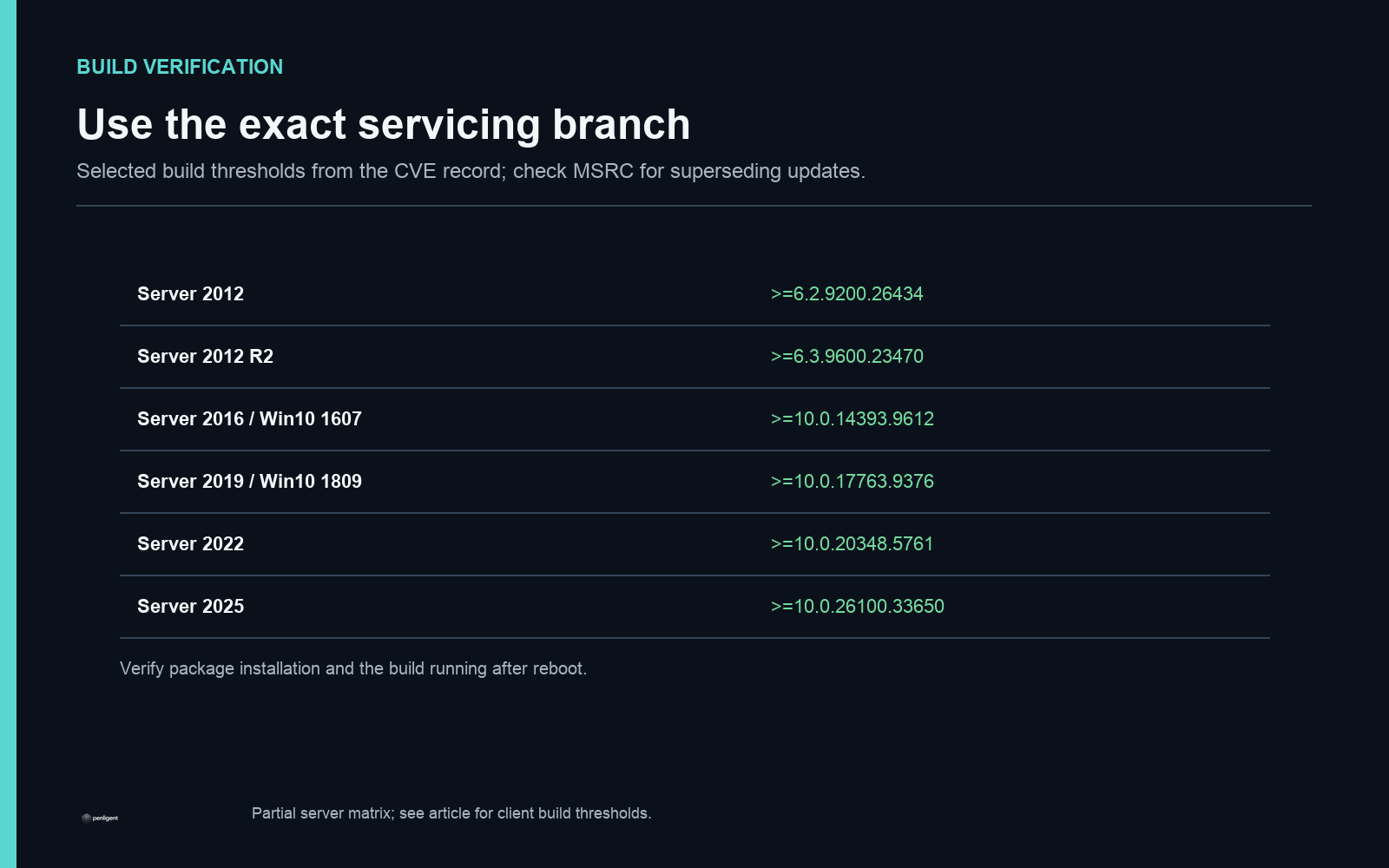
The CVE record lists affected versions below these fixed builds. Match the exact product release and architecture; do not compare only the first four digits. Cumulative updates may supersede the listed minimum, so use Microsoft’s MSRC page as the controlling source.
| Product family | Fixed build threshold |
|---|---|
| Windows Server 2012 | 6.2.9200.26434 |
| Windows Server 2012 R2 | 6.3.9600.23470 |
| Windows Server 2016 / Windows 10 1607 | 10.0.14393.9612 |
| Windows Server 2019 / Windows 10 1809 | 10.0.17763.9376 |
| Windows Server 2022 | 10.0.20348.5761 |
| Windows Server 2025 | 10.0.26100.33650 |
| Windows 10 21H2 | 10.0.19044.7807 |
| Windows 10 22H2 | 10.0.19045.7807 |
| Windows 11 23H2 | 10.0.22631.7652 |
| Windows 11 24H2 | 10.0.26100.9711 |
| Windows 11 25H2 | 10.0.26200.9711 |
| Windows 11 26H1 | 10.0.28000.3231 |
| Windows 11 26H2 | 10.0.26300.9711 |
Separate software scope from server role
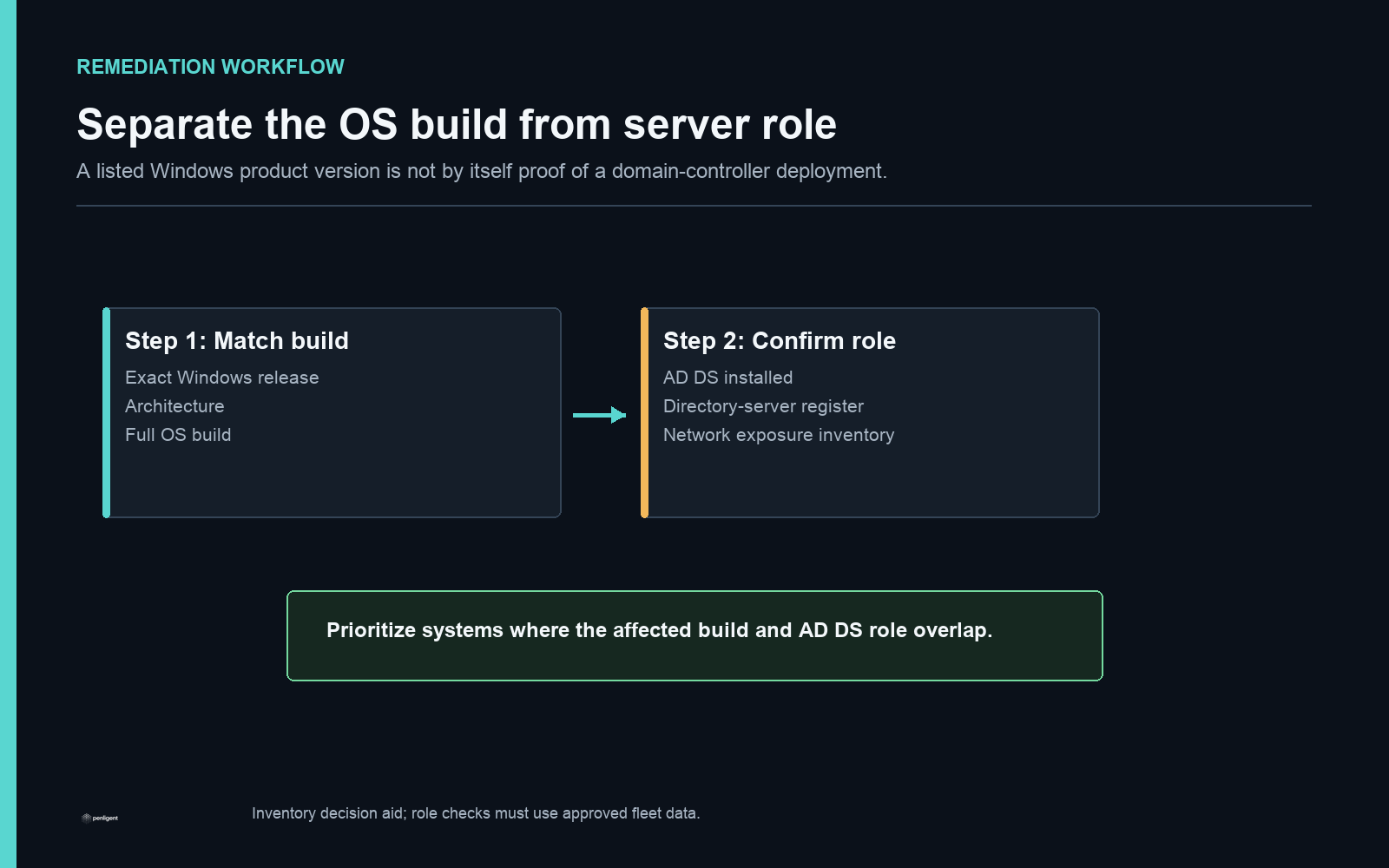
Begin with endpoint-management data: edition, release, architecture, and full OS build. Then join that inventory to a directory-services asset register or trusted server-role inventory. Prioritize domain controllers and other systems where AD DS is installed and reachable. Do not label every Windows 10 or Windows 11 endpoint a domain controller merely because the CVE record lists its product version.
The record’s network attack vector makes reachability a useful prioritization attribute, but it does not disclose the exact service path. Do not invent a port-level exposure test from the title alone. Use approved asset and firewall inventories, and rely on Microsoft’s advisory for any protocol-specific assessment.
Close the patch verification
For each in-scope server, record the hostname, OS edition, architecture, current full build, AD DS role state, the update or superseding update installed, and the post-update build. Reboot if the update requires it, then re-query the running build. A package marked installed is not sufficient if the host has not completed its required restart.
For systems that cannot be patched in the current window, assign an owner and due date, restrict network access according to the organization’s change and continuity process, and track the exception. Do not disable directory services as a generic mitigation; that can break authentication and business operations, and the public record does not identify such a measure as a vendor recommendation.
Sources and limits
CVE-2026-70229 record | Microsoft Security Response Center advisory
This is a version and asset-inventory guide based on public records. Penligent did not reproduce the vulnerability or validate a production Windows environment.
The embedded Penligent 3.0 video is a general workflow demonstration, not proof of exploitability or remediation for CVE-2026-70229.
 German
 English
 French
 Spanish
 Portuguese
 Japanese
 Korean
 Hindi
 Arabic
 Turkish
 Hebrew