
ImageTragick2 is the name used in CERT/CC’s November 12, 2026 advisory for file-read and file-write risks in applications that process untrusted images through insufficiently restricted ImageMagick configurations. The advisory describes an SVG-to-MSL path and a content-detection path that invokes Ghostscript. Impact depends on the processing components and the files the process can access; arbitrary code execution is a possible consequence in some deployments, not a universal property of every image upload. See CERT/CC vulnerability note VU#580079.
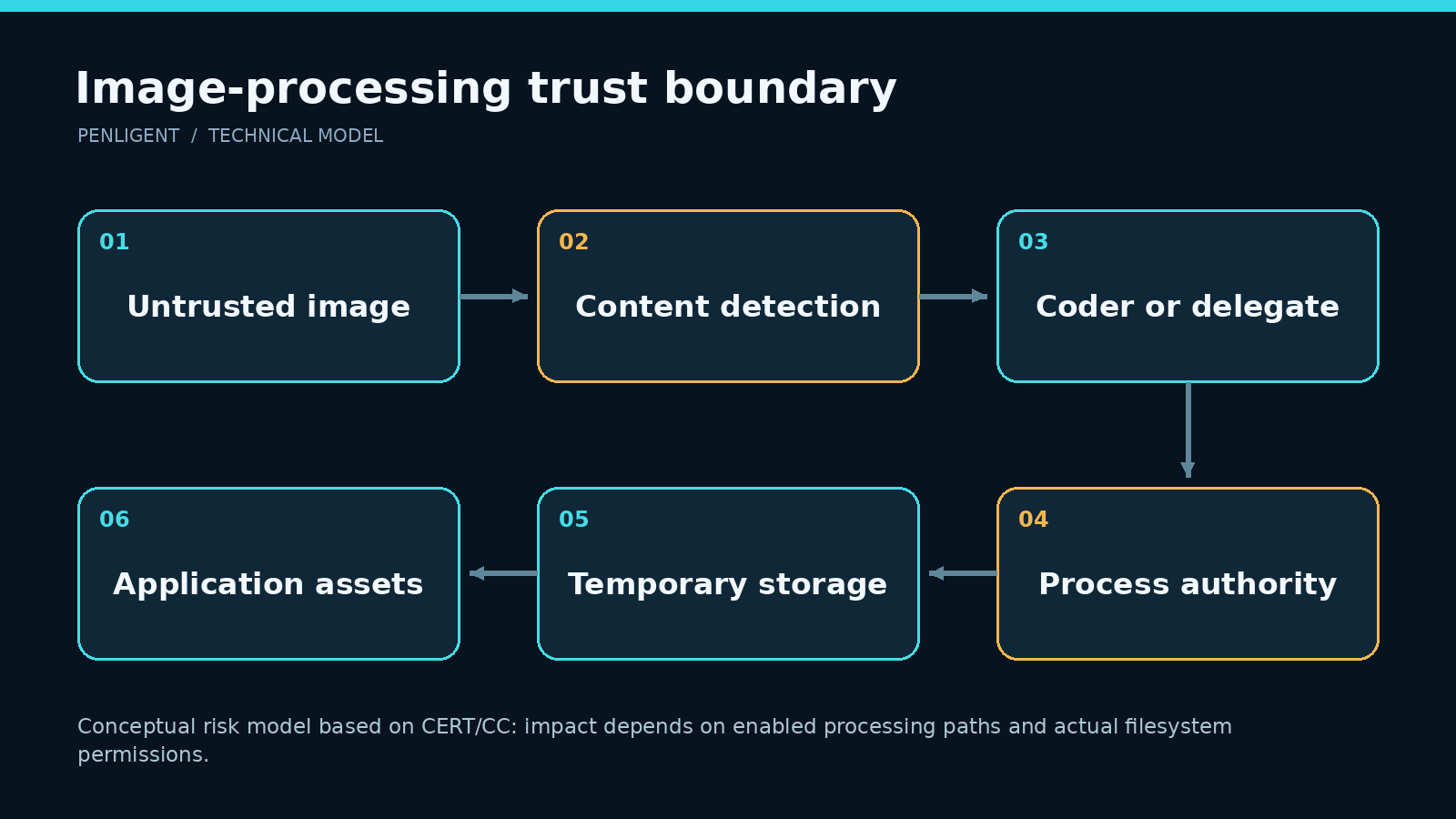
The remediation question is broader than which package version is installed. An application owner needs to know what content reaches each worker, which coders and delegates that worker can invoke, and what authority the process has over temporary files and application assets. A corrected or current binary can still be deployed with a policy that is unsuitable for the application. This article develops a configuration and verification method around that boundary, without providing a malicious image or a production exploit.
Locate the image processor behind the upload feature
A visible upload form is only one possible entry point into an image-processing pipeline. A service may also fetch images from an approved URL, import a dataset, process a document attachment, or transform generated output. Inventory those inputs according to the actual application. The relevant question is which path eventually supplies bytes to the processor, not which user interface appears to accept pictures.
In a fictional media service, a browser request stores an object and creates a thumbnail job. A worker later reads the object, selects a conversion path, writes a temporary result, and publishes the thumbnail. The browser server and worker can have different packages, configuration, credentials, and mounted volumes. Looking only at the browser server’s installed ImageMagick package can therefore miss the component that actually processes the input.
Map the processing decision for each business operation. A profile avatar may require only a small raster output, while a document-preview service may intentionally accept PDF input. Those functions have different format requirements. A universal policy copied from another service can either leave unnecessary interpreters enabled or break a required feature without establishing a sustainable correction.
Identify every worker population that can process the relevant job. Autoscaled instances, scheduled converters, retry consumers, and a disaster-recovery environment can each matter. Record the executable or library identity and the effective configuration for the running process. A dependency inventory is a useful lead, but it does not by itself establish that an affected processing path is reachable.
Keep object identity attached to the job. The source upload, the queued message, temporary files, and published derivative should be traceable through stable identifiers. A human-readable filename is not a reliable join key when files are renamed or normalized. This relationship helps both a controlled test and a later investigation of unexpected output.
The inventory should end with an owner for every processing path. If no team can explain why a converter accepts a format or mounts a directory, the uncertainty is itself an operational issue. Resolve the requirement before deciding whether to disable, isolate, replace, or retain that capability. Security policy should follow the service’s intended function rather than an accidental historical configuration.
Understand the two documented processing paths
CERT/CC describes one variant in which SVG processing can reach a dangerous coder such as MSL, and another in which content recognition can select PostScript and invoke Ghostscript despite the filename or declared type. The note also explains that access depends on available components and policy. Its WordPress reference, CVE-2026-65640, concerns the second variant; it is not a single CVE identifier for every application discussed under ImageTragick2. These distinctions are documented in the CERT/CC description and acknowledgements.
The common architectural lesson is that a file can trigger more processing authority than its surrounding application expected. An application may believe it has accepted an inert image while the processing stack recognizes a language, dispatches a delegate, or reads another resource. The review should follow the actual interpreter and resource decisions, rather than stopping after a filename check.
Do not turn that lesson into an unsupported claim about every SVG parser or every Ghostscript installation. The advisory concerns specific processing paths and configuration conditions. A deployment may lack a relevant coder, prohibit the format, or isolate the process so that a file-access primitive has a smaller consequence. Those conditions should be verified using the deployed environment and the supplier’s guidance.
Keep three layers of conclusion separate. A component may be present in the image-processing stack. An untrusted input may be able to reach a dangerous processing path. A demonstrated result may then show access to a particular file or resource. The evidence needed becomes more specific at each layer. An inventory match should not be reported as if a complete application compromise has been reproduced.
The opposite error is to dismiss the issue because the application code never explicitly asks to run an interpreter. A delegate can be selected by a lower processing layer. The application owner needs to know what the library or command can do with the accepted bytes under its effective policy. Reviewing only the high-level upload handler leaves that question unanswered.
Use the mechanism to choose safe verification targets. A controlled test should establish that prohibited processing is rejected and required normal formats still work. It need not attempt to read a real secret, overwrite executable content, or trigger code execution in a production service. The correction can be evaluated through bounded policy and isolation evidence.
Separate filenames, declared types, and actual processing
A file extension expresses a name. A client-supplied media type expresses a claim. A format recognizer examines bytes according to its own rules. None of those layers should be assumed to imply the others. The upload service should define which inputs it intends to accept and which processing path is allowed to handle them.
Die OWASP file-upload guidance treats extension, content type, signature, storage, and permissions as distinct controls. For this review, use those categories to identify where a decision is made and where it is merely assumed. A successful extension check is not evidence about an interpreter selected later in a worker.
Consider a fictional service that accepts a file named as a raster image but routes its contents to a general conversion command. The application’s admission decision and the processor’s format decision may differ. A verification record should therefore capture both the application’s accepted type and the processor’s selected path when that observation is available through supported logging or an isolated test.
Use harmless controlled samples to test the intended distinctions. A normal allowed image should complete its required transformation. An explicitly prohibited format should be rejected at the documented layer. A mismatched declaration should be handled according to the application’s policy. The owner should define those expectations before running the test, because rejecting every mismatch and normalizing some mismatches are different product choices.
Do not rely on a filename rewrite as the complete repair. Renaming an input may be useful for storage safety while leaving its bytes unchanged. If the processor still performs content-based dispatch, the security decision remains at that dispatch layer. The application should retain enough evidence to show which controls apply before and during processing.
Also review outputs. A conversion result can be stored under a generated name while carrying a format or metadata that downstream consumers interpret differently. The output contract should state the permitted representation, size, and use. A pipeline is not finished when the converter returns success if another service later processes or serves the result under a different trust assumption.
Define the formats the business operation actually needs
Start from the smallest format set that supports the feature. An avatar service, a print-production system, and a document-preview service should not inherit the same interpreter authority by default. List the required inputs, outputs, transformations, and delegate dependencies for each feature. Have the feature owner approve that list.
ImageMagick publishes documentation for its policy mechanisms. Review the official security-policy documentation for the syntax and configuration behavior of the deployed release. A snippet copied from a blog is not enough evidence that the intended policy file was loaded by the worker or that its rules match the desired operation.
Keep format admission and processor permission as separate records. An application may reject a format at its API while another import path still reaches the same worker. A worker policy can provide a second boundary when an input arrives through an unexpected route. The review should show where each rule is enforced and which paths it covers.
If a feature legitimately needs a powerful interpreter, consider a dedicated processing boundary for that feature. A service that renders documents may require capabilities an avatar worker does not. Separate workers, storage, or authority can make those requirements explicit. This is a design recommendation for the application owner, not a claim that one particular isolation method is sufficient for every deployment.
Test business compatibility with representative normal files. A policy change can affect transparency, color handling, document pagination, or a required output format. The owner should select a small set of legitimate samples that cover the real feature. The security test should not call a broken feature a successful long-term fix merely because dangerous inputs are now rejected.
Track temporary restrictions separately from the final design. Disabling a format immediately may be an appropriate containment choice, but the application team may need to provide an alternative workflow or a supported isolated implementation. Record the owner and the condition for restoring the feature. Otherwise an emergency restriction can be removed later without the security review that justified it.
Inspect process authority and temporary storage
The consequence of a processing failure depends on the authority of the process that handles the input. Inventory the user identity, writable directories, mounted volumes, accessible credentials, and connections to other services. A container label does not answer those questions. The effective permissions and mounts determine what the process can reach.
Temporary storage deserves explicit ownership. A converter may write intermediates, a framework may store uploaded bodies, and another application component may use the same directory for a different purpose. Identify which data classes share the space and whether one worker can name, replace, or observe another worker’s files. The review should follow actual directory and volume relationships.
For the fictional media service, give each job a controlled workspace and record the lifecycle of its contents. The directory should be created, used, and retired by the intended workflow. A unique directory name is useful but does not independently establish permission isolation. The worker’s operating-system rights and the behavior of other processes still matter.
Do not use production secrets as verification fixtures. A harmless marker file inside an authorized isolated test environment can demonstrate a filesystem boundary without accessing sensitive application data. The test plan should specify where the marker is allowed to exist and what observation would establish that a prohibited path was blocked.
Review whether executable application content is writable by the processing identity. The advisory’s possible escalation to code execution depends on additional deployment conditions. An application owner can reduce the consequence by separating writable output from executable code and from privileged configuration. Verify the separation rather than assuming a directory name such as “uploads” or “cache” guarantees it.
Lifecycle matters after a process exits. A temporary file may remain available to a later job or another tenant, and a persistent volume may survive a container replacement. A corrected image therefore does not automatically establish that old intermediates or modified files are trustworthy. Include retained storage in the remediation decision.
A harmless local model of format admission
The example below models a feature that intentionally accepts only two named raster representations. It does not invoke ImageMagick, Ghostscript, an image decoder, a network service, or an external file. It is not a detector for ImageTragick2. Its purpose is to make the application’s admission contract explicit and distinguish it from the behavior of a real processor.
ALLOWED = {"image/png", "image/jpeg"}

def admit_upload(declared_type, detected_type, size_bytes):
    if size_bytes <= 0 or size_bytes > 2_000_000:
        return False
    if detected_type not in ALLOWED:
        return False
    if declared_type != detected_type:
        return False
    return True

assert admit_upload("image/png", "image/png", 1200)
assert not admit_upload("image/png", "application/postscript", 1200)
assert not admit_upload("image/svg+xml", "image/svg+xml", 1200)
assert not admit_upload("image/jpeg", "image/jpeg", 3_000_000)
The toy receives the detected type as an input rather than pretending to implement a safe format recognizer. A real service needs a supported detection and decoding approach, a policy appropriate to its processor, and isolation that reflects the actual risk. This function can illustrate a business rule while proving none of those downstream properties.
The size limit is an arbitrary test value for this fictional feature, not a recommended production maximum. Real limits should reflect the operation’s resource requirements and the application’s budget. A compressed file’s byte size may not describe the work performed after decoding. The feature owner should choose and verify the controls relevant to the deployed processor.
Run positive and negative samples through the full owned workflow when validating a deployment. If the toy policy rejects a format but the actual worker still processes it through another route, the application has not established the intended boundary. Keep the educational example, the application admission test, and the processor-policy test as separate evidence.
Verify the policy loaded by the running worker
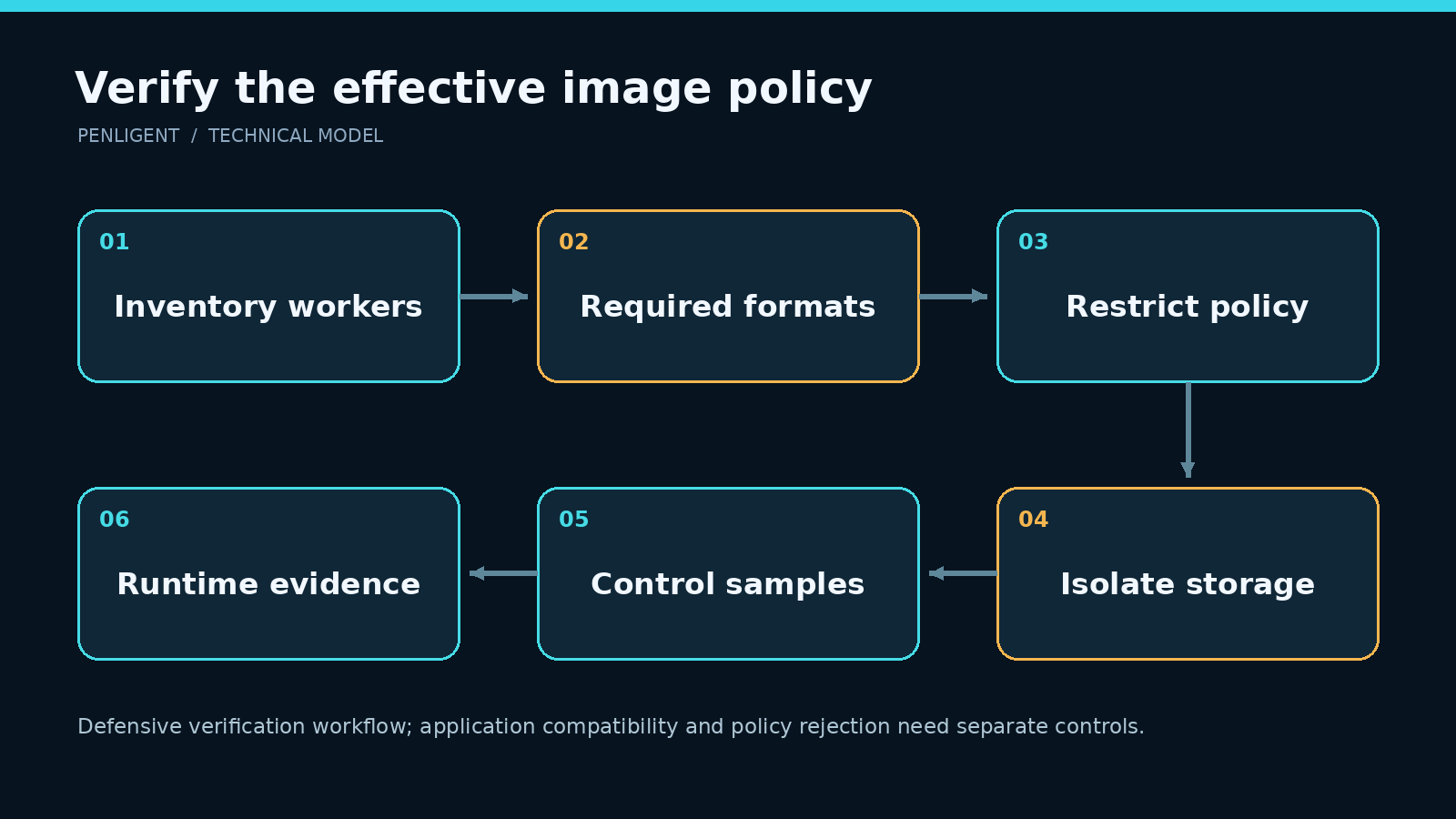
A policy file in a repository is evidence of intended configuration. The response needs evidence of the configuration used by the worker that processes untrusted input. Identify the worker’s executable, startup method, configuration search path, and deployment environment through the organization’s supported administration process. A developer’s shell can have a different environment from the service process.
ImageMagick’s own policy documentation should guide version-specific inspection. Where the deployed command supports it, a policy-listing command can help identify active rules. Run administrative inspection only in an owned or authorized environment, and retain the artifact identity with the observation. An output copied from a different host does not establish the worker’s state.
# Read-only inspection in an owned administration environment.
magick -version
magick identify -list policy
These commands are inspection examples, not a universal recipe for every wrapper or packaged integration. Some applications use an older command name, an embedded library, or a bundled runtime. Determine the command or supported diagnostic for the actual integration. If the processor cannot expose the relevant state safely, record that limitation and obtain supplier evidence rather than substituting a nearby installation.
Match the effective rules to the approved feature contract. A rule can exist but fail to match the actual coder, delegate, resource, or path category intended by the operator. Conversely, a broad rule can disable a required normal operation. The verification should show both the configured policy and the controlled behavior it produces.
Review configuration precedence and packaging changes during upgrade. A replacement image may introduce a new default policy path or omit a locally mounted file. An application update may change which processing backend is selected. Record the actual supplier build and integration behavior instead of assuming that a previously tested file remains authoritative after every release.
Keep the observation close to the workload. If there are separate workers for avatars and document previews, record both. If a job can be retried in another environment, include that environment or retain an exception. A verified policy on the primary worker should not be generalized to every consumer that can process the same stored object.
Test policy rejection and application compatibility separately
Create a controlled sample set with a known purpose for each item. The set should include required normal inputs, explicitly prohibited format classes, and safe mismatches that test the application’s admission contract. Use synthetic content and an isolated environment for any sample intended to exercise an interpreter boundary. Do not use a public exploit file whose behavior has not been reviewed.
| Sample class | Frage | Beweise |
|---|---|---|
| Required normal raster | Does the intended transformation still work? | Expected output type, dimensions, and fixture marker |
| Prohibited format | Is it rejected by the intended layer? | Application result and processor-policy observation |
| Declared and detected type differ | Does the admission contract handle the mismatch? | Recorded admission decision |
| Queued retry | Does another worker enforce the same relevant rule? | Consumer identity and controlled result |
| Tenant-isolated job | Are temporary and final objects kept within intended access? | Owned fixture and access observations |
Define the success condition in application terms. A worker can return an error while still creating an unintended artifact. A thumbnail can be generated successfully while its ownership or storage location is wrong. Record the state changes relevant to the feature, not only the converter’s exit status. The controlled fixture should make those changes observable without touching sensitive files.
Keep rejection outcomes distinguishable. A request blocked by authentication, a file rejected by admission validation, and a processing attempt stopped by an effective ImageMagick policy are different controls. Each may be useful, but they answer different questions. If the test never reaches the worker, it does not establish the worker’s policy behavior.
Use the positive control to detect accidental feature removal. A repaired avatar path should still process the approved raster fixture under the intended account. If the worker is disabled entirely, document that as containment and its business effect. Do not label service unavailability as a completed functional remediation.
Retest after the final deployment change, not only after editing a configuration file in a diagnostic container. The final image, mounts, environment, and startup process should be the ones that serve the feature. Preserve the identity of that artifact with the verification record so that a later operator can tell what was actually tested.
Plan the rollout around queued work and persistent artifacts
An asynchronous pipeline can continue processing work accepted before the correction. Identify pending jobs, retries, delayed tasks, and alternate consumers. The response owner should decide whether to pause, drain, revalidate, or retire those jobs according to the application’s requirements. Updating the primary worker does not automatically decide what should happen to already stored untrusted inputs.
Keep the source object and processing attempt separate. One upload may produce several attempts, each with a different worker and configuration. A later successful attempt should not overwrite the evidence that an earlier attempt used a different processing path. This distinction is useful for diagnosing both security behavior and normal conversion failures.
Review artifacts that survive worker replacement. Temporary volumes, output directories, object storage, and caches may retain files written under the earlier configuration. Decide which artifacts can be trusted, which can be regenerated from approved inputs, and which require investigation. A fresh process does not make retained storage fresh.
A controlled rollout should identify all serving and standby worker populations. A retry routed to an old image can reintroduce the relevant behavior even when new jobs usually reach corrected workers. The inventory should name the selection mechanism and the conditions under which an older consumer can become active. Keep unavailable populations as owned exceptions rather than silently excluding them.
Consider the effect of a rollback. Restoring the previous image or policy can restore the old processing authority. If availability requires rollback, record which containment remains in place, which feature is restricted, and which security decision is reopened. A release rollback is not independent of the vulnerability response.
Finally, update deployment and recovery recipes. A corrected running service can later be recreated from an old image or a template that omits the restrictive policy mount. Tie the approved policy and verification requirement to the service’s normal deployment process. This makes the repair durable beyond the current incident or maintenance window.
Investigate processing behavior without inventing indicators
Begin detection work with the processing behavior the service should have. An avatar worker that needs only approved raster transformations should have a different expected activity profile from a document-preview worker that intentionally invokes a delegate. Establish the intended process tree, file locations, and normal failure patterns with the service owner before treating every unusual event as an attack.
Useful investigation questions include whether a prohibited processing path was attempted, whether unexpected files were created, and whether the processor accessed storage outside the job’s intended workspace. The available observations depend on the platform. A policy rejection message may be informative, but the absence of that message is not proof that no attempt occurred.
Correlate activity with the source object and job identity. A timestamp alone can be ambiguous on a busy converter. A stable job identifier can connect an upload, worker invocation, policy error, and output object. Preserve the original time zone and any known clock differences when joining records from separate components.
Distinguish normal malformed inputs from a confirmed security result. A corrupt image can cause an ordinary decode error. A user can submit an unsupported document accidentally. The investigation needs to establish the processing path and consequence supported by the evidence. Do not turn an application error count into a count of successful exploit attempts.
Review published vendor guidance for the specific integrated product. CERT/CC’s note includes product-specific statements and emphasizes that configuration and application integration matter. The vendor-information section of VU#580079 is a starting point for that review, not permission to apply one vendor’s status to every other integration.
Where logs are missing, state the interval and components that could not be examined. The owner may decide to regenerate outputs, replace affected workers, or review accessible credentials because visibility is insufficient. Document those decisions as precautionary or investigative actions when appropriate. A limited investigation should not be described as either a clean bill of health or a confirmed compromise without evidence.
Review credentials and mounted data according to actual authority
A processing worker may have access to storage credentials, queue credentials, database connections, or model-service tokens. Inventory only the authority actually available to that process. A secret stored elsewhere in the organization is not automatically exposed by the existence of the image-processing issue. The response needs a traceable relationship between the affected process and the data or credential.
Use the platform’s effective identity and mount configuration, not only environment-variable names. A process can obtain authority through a workload identity, a shared volume, or an application-specific credential store. Different identity types require different recovery procedures. Coordinate with the owner of the source system before changing or revoking access.
If there is evidence of unexpected file access or modification, preserve the relevant state under the incident process. The owner should decide how to contain the worker and investigate the data it could reach. Do not keep processing untrusted inputs merely to collect a larger sample of suspicious behavior. The goal is to answer the response questions while protecting the service.
Replacement and revocation are separate steps. A new credential does not establish that the old one is unusable, and a replaced worker may leave another consumer using the old value. Track dependent services and verify that intended operations work after recovery. Record any temporary overlap and the condition for ending it.
Retained outputs need their own trust decision. A thumbnail that can be regenerated from an approved source may be handled differently from an application file whose provenance is unknown. The correct action depends on the evidence and business function. Avoid a bulk deletion or rebuild that removes the only evidence of a suspected modification without the response owner’s decision.
Keep tenant isolation visible in the processing design
A media service can enforce object ownership at the download API while still exposing another tenant’s temporary artifacts to the processing worker. Those are separate boundaries. The upload review should identify who can submit work, which process handles it, where intermediates are stored, and which identities can retrieve the final result.
Use synthetic tenants and distinct markers when testing the end-to-end workflow. An authorized control should complete its own transformation and retrieve its own result. A prohibited identity should not obtain the other tenant’s source or derivative. The file-processing correction and the application authorization test should be recorded independently, because a pass in one does not prove the other.
Review shared caches and content-derived keys. A cache can legitimately deduplicate identical images, but its retrieval policy must still reflect the application’s intended access model. The assessment should determine whether a returned object belongs to the requested fixture and whether the caller is entitled to it. A successful cache hit is an application result, not automatically a security success.
Queued work also needs an ownership relationship that survives retries. If a worker stores only a filename and loses the submitting tenant or object identity, later components may have to infer ownership from an unreliable label. Keep the necessary relationship in the application’s supported job model. This is a design recommendation for the fictional pipeline, not a statement about every framework that integrates ImageMagick.
When a test fails, identify the boundary precisely. A prohibited coder invocation, an unintended filesystem access, and cross-tenant retrieval are different findings with potentially different repairs. A report that merges them into one dramatic title can obscure which controls need to change. Preserve the evidence for each observed result and explain any demonstrated relationship between them.
Trace a job across admission, processing, and retrieval
A fictional upload job can pass through three security decisions that belong to different owners. The API decides whether a caller may submit an object. The worker decides how bytes are interpreted and where processing can occur. The retrieval service decides who can obtain the derivative. A failure in one decision should not be hidden by a successful result in another.
Give the synthetic test job a stable identifier and record the source object’s ownership before processing starts. The admission record should show which feature accepted the object and which declared and detected representation it considered. The worker record should identify the attempt and the active processing configuration. The retrieval record should identify the derivative and the requesting test identity.
Suppose the API correctly rejects direct document uploads, but an import feature creates jobs from stored objects without applying the same feature contract. The API result remains valid for its route. The import path needs a separate decision about which processing authority it can reach. This is an example of an assessment question to investigate, not a claim that any named framework has that specific defect.
A second example involves retries. The first worker rejects the prohibited fixture under the intended policy. A general retry handler later sends the same source object to a different converter because the first attempt failed. If that fallback is part of the real design, the assessment must evaluate its policy and authority. A rejection that triggers broader processing elsewhere does not establish the intended end-to-end restriction.
Use the job history to distinguish intentional fallback from unexpected routing. The application owner should be able to explain why the second converter is eligible and which input contract it enforces. If the design intentionally supports a broader format set through that route, define a separate isolated feature boundary rather than allowing an implicit fallback to bypass the narrower feature’s assumptions.
After processing, verify that the derivative is associated with the expected source object and tenant. A converter’s output filename can be unrelated to the original name, and a storage key may be generated independently. Preserve the relationship through application identifiers. Otherwise a correct conversion can still be delivered through an incorrect ownership mapping.
Review shared workspaces without confusing names with isolation
A per-job directory helps organize processing, but the directory name is not a permission boundary. If the worker can freely read and write every job directory, a file-access failure can still reach other jobs within that authority. The owner should decide whether the workload requires separation by job, tenant, feature, or service, then verify the relevant operating-system or platform control.
Consider an isolated test with two synthetic jobs and ordinary marker files. The assessment can ask whether the processing context assigned to one job has the authority to access the other job’s workspace. The exact test should use supported administration or a reviewed isolated fixture. It does not require reading a customer file or constructing an ImageTragick2 exploit.
Path resolution and file lifecycle are separate concerns. A generated path can remain inside an approved directory while referring to an artifact created by an earlier job. A cleanup operation can remove the file while leaving a queued retry that recreates it. The review should identify which component owns creation, use, retention, and removal, and how those actions remain associated with the intended job.
Where symbolic links or shared mounts are part of the deployment, evaluate them through the actual platform’s semantics. A string-prefix check is not a complete filesystem authority model. The processing identity’s effective rights, the mount configuration, and the supported file-opening behavior determine what can be reached. Do not infer isolation from a path printed in a log.
Use a trusted baseline when reviewing retained workspace contents after a concern. Some intermediates can be regenerated safely from approved input; others may need preservation for investigation. The response owner should decide which applies. A bulk cleanup that is convenient operationally may remove evidence or interfere with jobs that have not yet been reconciled.
Make backend changes trigger a fresh processing review
An application can change its security boundary without changing the upload route. A framework update may select a different image backend, a wrapper may change which executable it launches, or a new feature may introduce document rendering. Treat those changes as changes to the processing contract rather than assuming the earlier ImageMagick policy result still applies.
Keep an integration record that names the application feature, backend, supplier artifact, selected configuration, and required formats. The record should describe what actually runs. A dependency file that lists several possible backends does not establish which one handled the tested job. Conversely, a command installed on the host may be irrelevant if the application uses an embedded library.
For a backend migration, test the normal fixture set against the replacement and review the replacement’s own security guidance. A policy mechanism from one processor should not be assumed to exist in another. The application’s high-level requirement can remain stable while the technical controls that implement it change.
Compare output behavior as well as acceptance. Differences in dimensions, metadata, transparency, or document rendering can matter to the product. A migration that improves one security boundary while producing unusable outputs still needs a functional decision. Keep compatibility failures visible instead of broadening interpreter authority until every historical sample happens to work.
Update the recovery and rollback instructions with the new backend relationship. An old deployment recipe can restore the previous processor or omit the policy configuration that was reviewed. The next operator should know which artifact and configuration must be verified before the feature returns to use. This turns a one-time repair into a maintained boundary.
For vendor-managed integrations, request the supplier’s specific determination about the service and processing path you use. A generic statement that a platform is updated may not explain customer-configurable policies or retained worker images. Preserve the answer with its date and scope. Where the supplier cannot provide the necessary evidence, retain the limitation and decide whether additional containment is required.
Work through three different application requirements
An avatar service with no document requirement
In the first fictional deployment, the feature owner approves only small raster avatars and a single normalized output representation. The worker has no business reason to render vector documents or invoke a document interpreter. The review can therefore ask why those processing capabilities are present and whether the effective policy prevents their use. That is a concrete requirement, not a claim that every application should support the same restricted set.
The team prepares a normal avatar fixture, a safely constructed unsupported-format fixture, and a declared-type mismatch. It records the expected admission result for each. The normal fixture should complete the transformation and remain retrievable only through the intended account. The unsupported fixture should be rejected at the agreed layer. The mismatch should follow the feature’s documented contract rather than whichever behavior happens to occur during the test.
After a policy change, the unsupported fixture is rejected, but the normal avatar also fails because the worker cannot write its output directory. This is a partial outcome: the processing restriction appears active, while the feature is not functionally restored. The team repairs the intended write permission without granting access to application code or unrelated storage, then reruns both controls. The record keeps the security and availability decisions separate.
A later retry is handled by a standby worker whose configuration differs. The first worker’s result remains valid for that worker, but the deployment population is not yet verified. The team updates the inventory, corrects the standby path, and records the second result. This is why the response should be attached to actual consumers rather than a single service name.
A document-preview service with a legitimate interpreter path
The second fictional feature intentionally creates previews from documents. If its chosen implementation depends on a document interpreter, simply disabling every related format may remove the feature. The owner must decide whether to suspend the feature temporarily, replace the implementation, or provide a more isolated processing boundary that can support the required inputs under controlled authority.
Start with the actual document types and outputs the product supports. A broad “documents” label can conceal legacy formats or transformations no current customer uses. The feature owner should approve a precise set, and the processor owner should explain which coders or delegates are required. Remove assumptions inherited from a general-purpose conversion tool’s available feature list.
For an isolated design, define what the worker may read and write and what external communication it needs. Use the application’s real deployment and platform controls to implement those limits. A diagram of a sandbox is not evidence that the intended files and credentials are inaccessible. Verification should show the controlled observations that support the claimed boundary.
Test normal compatibility across the representative document set, then challenge the intended restrictions with approved harmless cases. Keep the input, selected processing path, output, and worker identity together. If one required document class cannot be processed under an acceptable boundary, the product decision may be to keep that class unavailable. The assessment should make the tradeoff visible rather than promising a universal configuration snippet.
An AI image workflow with multiple content origins
The third fictional pipeline normalizes images before an inference task and converts results afterward. Its inputs can come from direct uploads, stored datasets, or approved remote sources. The risk review should follow the bytes into the actual processor, regardless of which upstream system supplied them. “Generated” or “already stored” is not an access-control or format-validation result.
Map preprocessing and post-processing separately. They may use different worker images, policies, storage mounts, and credentials. A correction to the preprocessing service does not establish the post-processing service’s state. Conversely, a safe post-processing result does not tell the owner which input paths reached the earlier converter.
Define the contract between stages. The inference service may expect normalized raster data, while a later converter accepts a broader file representation. Record which component validates that contract and what happens when the representation is unexpected. Without this boundary, downstream components may inherit more interpretive authority than the upstream stage’s designers intended.
Use synthetic jobs whose data can be retired cleanly. A controlled fixture can demonstrate whether a prohibited processing path is rejected without involving model weights, production datasets, or live credentials. The review should distinguish the image-processing concern from separate questions about model behavior or training data. Sharing a pipeline does not make every security issue the same issue.
Make resource controls reflect the operation being performed
File-access restrictions do not answer every resource question in a converter. The owner should also understand which limits apply to image dimensions, memory, disk use, execution time, and job concurrency for the required operation. Use the deployed processor and platform documentation to choose appropriate controls. This article does not provide one numeric configuration that is suitable for every workload.
Measure resource behavior using representative harmless fixtures in an owned environment. A small compressed file can require substantially more work after decoding, and a multi-page document can behave differently from a single image. The important result is whether the selected limits bound the feature’s expected work while preserving the legitimate cases the owner has approved.
Separate per-process limits from queue-level limits. A worker can remain within its own allowance while a queue accepts enough concurrent jobs to exhaust a shared dependency. Conversely, a queue limit can reduce concurrency while leaving one pathological job unbounded. The test plan should identify which control protects which resource.
Record cleanup behavior after cancellation or failure. A terminated job can leave temporary files, partial outputs, or a retry message. Those artifacts can affect later jobs even if the original process is gone. A controlled cancellation test should therefore observe the state transition the application promises, including whether an interrupted job can re-enter the queue.
Resource observations should not be advertised as a reproduction of ImageTragick2. They are part of a broader processing-boundary review. Keeping that distinction helps the application owner assign the right repair: a coder policy, filesystem isolation, queue control, or functional handling may each address a different observed problem.
Content hashes can help join an input object to a processing attempt and its retained evidence. They do not establish that the content is an allowed format or that processing is safe. Record the hash’s role explicitly: byte identity, not a security verdict. If a transformation intentionally changes the bytes, preserve the source-to-output relationship using the job record rather than expecting the two hashes to match.
Record the build and configuration relationship for a standby processor as well as the active one. If failover selects a different executable, library, or policy location, the active-worker result cannot establish the standby’s behavior. Keep that processor unavailable to untrusted jobs until its own benign control set has passed. Reuse the same fixture identities so the comparison remains clear, while retaining the distinct worker and activation records.
Use an evidence package that survives an image replacement
A deployment record should identify the application feature, worker population, processor build, effective policy, fixture set, and tested result. Retain supplier references for any product-specific correction. The next operator should be able to determine why the team considers the processing path acceptable without reconstructing the entire debugging session.
Store a reviewable policy artifact with its deployment relationship. The artifact can be a configuration revision or a managed-policy record, depending on the environment. A file copied into a chat without a path, version, or running-worker association is weak evidence because it cannot establish which service consumed it.
Use distinct conclusions for format admission, processor restriction, filesystem isolation, and tenant retrieval. These controls may be tested by different teams or tools. A combined “upload secure” checkbox hides which boundary was actually examined and which remained unverified. The evidence package should allow a later change to invalidate only the relevant conclusion.
For an application assessment using Penligent or another testing workflow, prepare dedicated identities and synthetic uploads and ask for reproducible observations tied to the feature. That can help review application behavior. It does not replace the platform owner’s evidence about the worker’s loaded policy, process identity, or mounted storage.
Preserve the reason for exceptions. A required legacy document type, an unavailable worker, or an incomplete historical log interval may remain unresolved. Give each an owner and a condition for closure or continued restriction. An exception with a specific next action is more useful than a general statement that the rest of the environment is probably similar.
Avoid five misleading closure signals
The package was updated. That establishes an installation action when supported by a package record. It does not establish the active worker, its effective policy, the state of retained files, or the behavior of the full application path. Connect the installed artifact to the process and the controlled verification.
The file extension is blocked. That can be a useful admission control, but another path may supply the same content to the processor. Verify the relevant processing and import routes rather than assuming the visible upload form is the only entry point.
The worker runs in a container. A container can still have writable host mounts, shared volumes, credentials, or broad service authority. Inspect the effective boundary and test the specific restriction being claimed.
The conversion failed. An error does not prove that no file was read or written before the failure. Observe the relevant synthetic state and the intended rejection layer. Do not use a crash or error message as a substitute for a complete result.
No suspicious log matched. That conclusion depends on the covered components, interval, fields, and query method. Preserve retention gaps and unobserved paths. A missing observation should not become evidence that a historical event was impossible.
Questions about ImageTragick2
Is ImageTragick2 one universal ImageMagick CVE?
- CERT/CC uses the name for the described risks across integrations and processing configurations. The note references CVE-2026-65640 for a particular independently reported variant.
- Use the applicable product and configuration guidance rather than assigning every affected application the same version rule.
Does every uploaded SVG produce code execution?
- No. The relevant processing components, policies, reachable inputs, and process permissions determine the available path and consequence.
- Do not describe file-access risk as a universally demonstrated code-execution result.
Is an ImageMagick upgrade sufficient?
- The response also needs an application-appropriate effective policy and review of the actual processing boundary.
- Follow product-specific supplier updates and verify the running workload, not only a package installed on a nearby host.
Should every service disable document formats?
- Start from the formats the feature actually requires. An avatar worker and a document-preview worker can have different requirements.
- When a required interpreter path remains, define and verify an appropriate isolation and authority model.
How can a team test safely?
- Use an owned isolated environment, synthetic fixtures, clear positive and negative controls, and observations of the relevant state.
- Avoid unreviewed public exploit files and do not use real secrets or executable application files as demonstration targets.
What does a successful retest prove?
- It supports the documented boundary for the tested worker, configuration, input paths, fixtures, and time.
- It does not establish the integrity of earlier outputs or resolve a separate incident investigation.
What should happen to queued work and old artifacts?
- The owner should make an explicit decision about pending jobs, retries, retained temporary storage, and outputs generated under the old state.
- Keep the decision and its evidence separate from the software deployment record.
An image pipeline is ready to close when the organization can explain which content is accepted, which processing authority is available, where the process can read and write, and how the corrected behavior was observed. That explanation should survive a worker restart and a later deployment. The goal is a processing contract backed by evidence, rather than a package version or a reassuring file extension.
 German
 English
 French
 Spanish
 Portuguese
 Japanese
 Korean
 Hindi
 Arabic
 Turkish
 Hebrew