
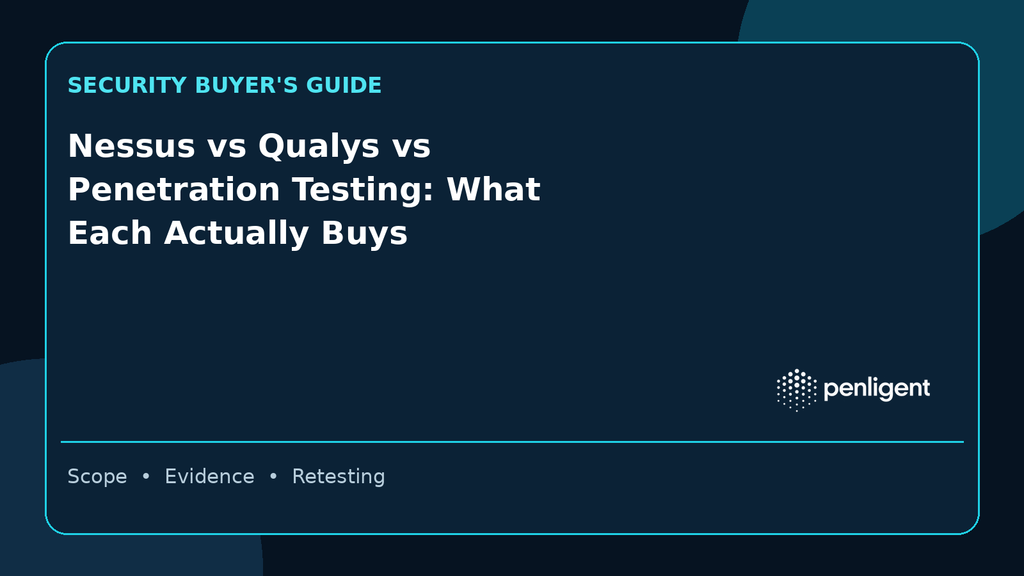
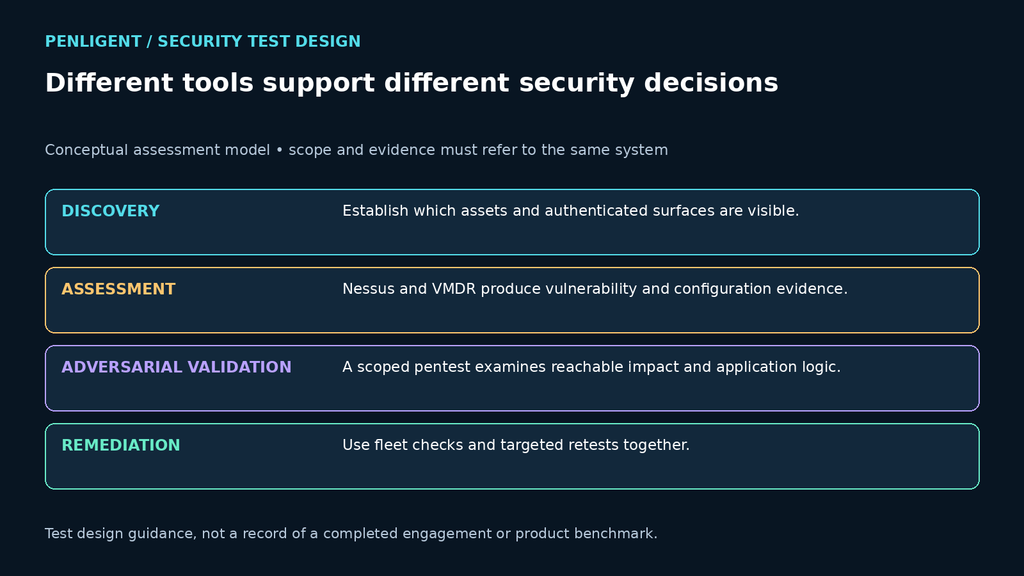
Nessus and Qualys VMDR are vulnerability assessment and management products; a penetration test is an adversarial validation activity. They can complement one another, but buying a scanner license does not automatically buy authenticated workflow testing, chained exploitation analysis or human validation of business impact.
The category difference
| Fähigkeit | Nessus | Qualys VMDR | Penetration test |
|---|---|---|---|
| Asset vulnerability scanning | Core capability | Core platform capability | Usually limited to the agreed scope |
| Continuous asset program | Depends on product and deployment | Central VMDR use case | Depends on engagement or PTaaS model |
| Known CVE and configuration coverage | Strong focus | Strong focus | Used as input, not the only objective |
| Business-logic reasoning | Not the primary product purpose | Not the primary product purpose | Can be included with roles and workflows |
| Exploitability validation | Plugin-dependent detection evidence | Detection and risk workflow | Safe, authorized validation of actual impact |
| Remediation workflow | Reports and guidance; broader Tenable products add workflow | Asset, prioritization and optional patch workflows | Finding remediation advice and retest |
Explore Penligent for authorized security testing
Tenable describes Nessus as a vulnerability assessment product for flaws, missing patches, misconfigurations, compliance checks and reporting. Qualys VMDR documentation emphasizes asset discovery, vulnerability detection, prioritization and remediation workflows. Those are valuable security functions, but neither product label should be used as proof that a manual or adaptive pentest occurred.
When Nessus is a strong fit
Nessus is useful when a practitioner needs flexible vulnerability and configuration assessment with direct control over scanner placement, policies, credentials and reports. The exact fit depends on the edition and current licensing. Review the current Nessus documentation rather than assuming all web, attack-surface or reporting features exist in every tier.
When Qualys VMDR is a strong fit
VMDR is suited to organizations building an ongoing asset and vulnerability-management program across a broad environment. Its value depends on asset coverage, agent and scanner deployment, tagging, ownership, prioritization and the licensed remediation modules. A platform can identify and track a vulnerability at scale without proving the exact business impact of exploiting it in a specific application.
When a pentest is still required
- cross-tenant and cross-role authorization;
- multi-step business workflows and race conditions;
- chained impact across application, API and cloud boundaries;
- custom protocols or unusual architecture;
- safe validation of ambiguous scanner findings;
- developer-ready reproduction and remediation retesting;
- customer or compliance assurance requiring an independent assessment.
Do not compare alert counts
Scanner findings are influenced by plugin coverage, credentials, network reachability, policy settings and deduplication. Pentest findings are influenced by scope, time, tester expertise and evidence standards. A larger count does not prove better risk reduction.
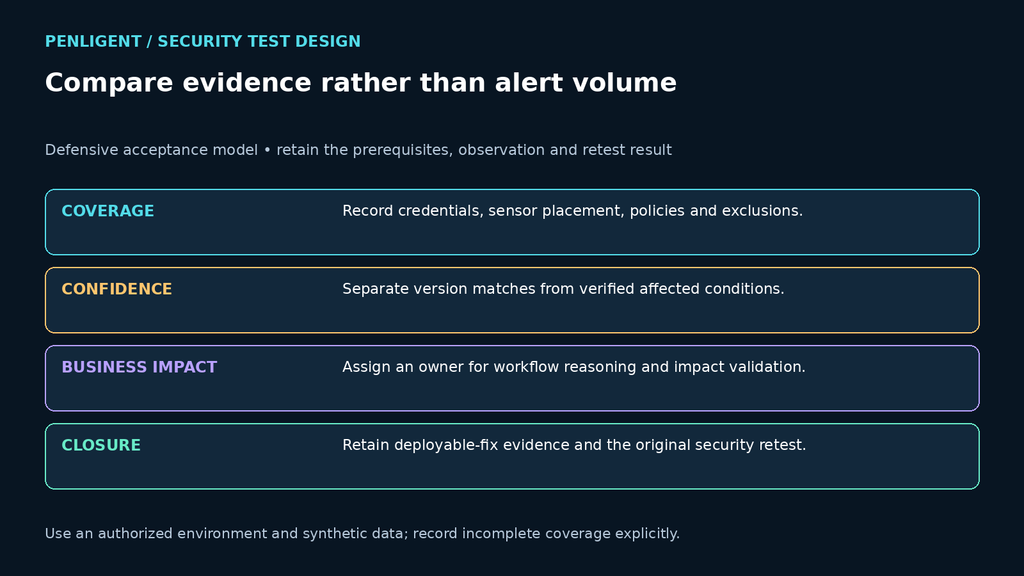
Normalize results into root causes and affected assets. Measure whether each item is attributable, actionable and verifiable after remediation.
Authentication changes the result
For infrastructure scanning, authenticated access can provide package, configuration and patch evidence that remote fingerprinting cannot. For applications, valid user accounts expose authorization and workflow paths. These are different uses of authentication and should be planned separately.
Current pricing should be time-stamped
Verwenden Sie Tenable’s public purchase page to record the price and edition available at purchase time. Public prices and included features can change, while Qualys enterprise pricing commonly depends on quote and modules. Record the date, asset unit, edition, support, web-app allowance and optional modules whenever cost is compared.
Do not compare a standalone scanner price with a managed pentest quote. Add deployment, credentials, operations, triage, false-positive review, remediation coordination and retesting.
A practical combined program
- Use asset discovery and authenticated scanning to maintain broad hygiene.
- Route high-risk or ambiguous findings to technical validation.
- Run application and business-logic pentests around critical releases and trust boundaries.
- Feed confirmed findings into the vulnerability-management workflow.
- Re-scan for fleet coverage and retest the original security property.
Buyer scorecard
| Frage | Warum das wichtig ist |
|---|---|
| Which assets are visible and authenticated? | Coverage gaps invalidate program-level conclusions |
| Which findings are version matches versus active validation? | The evidence supports different decisions |
| Who investigates business impact? | Platforms do not automatically supply product context |
| How are duplicates and root causes consolidated? | Counts otherwise distort priority and cost |
| How is remediation verified? | Installed patches and closed tickets may not equal active fixes |
| Can evidence be exported? | Security history must survive tool and vendor changes |
Explore Penligent for authorized security testing
Make the purchase measurable
Choose Nessus or Qualys for the vulnerability-management operating model that fits the environment. Add penetration testing where the organization needs adversarial reasoning, application context and verified business impact. AI-assisted validation platforms such as Penligent should be measured by the evidence they add between scanning and remediation—not by claims that they replace every layer of the program.
The following Penligent overview introduces a general authorized testing workflow. It does not demonstrate that every assessment capability discussed in this guide is included in a particular product plan.
 German
 English
 French
 Spanish
 Portuguese
 Japanese
 Korean
 Hindi
 Arabic
 Turkish
 Hebrew