
pac4j-jwt became a front-line security issue
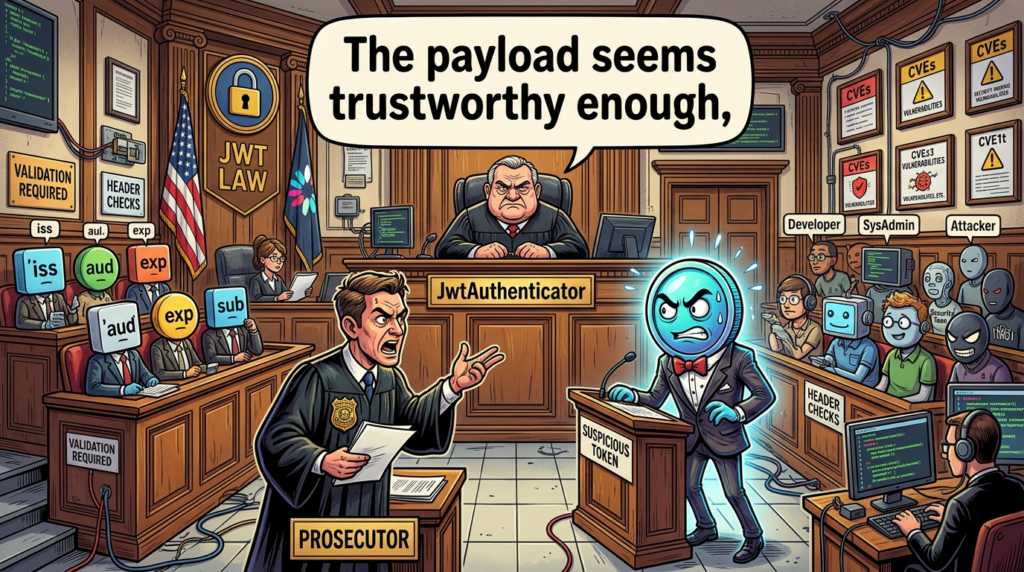
For years, pac4j-jwt sat in a category many engineering teams quietly underestimate: the library that “just handles tokens.” In practice, it is anything but that. pac4j is a Java security framework used across multiple Java stacks and frameworks, and its JWT module is responsible for turning externally supplied identity material into trusted application profiles. When that layer fails, the problem is not “bad token parsing.” It is a direct failure of the application’s trust boundary. The pac4j project describes itself as a Java security framework for protecting web applications and web services across many implementations, while its JWT module is documented as the component that validates JSON Web Tokens and builds profiles from them. (pac4j.org)
That distinction matters because JWT handling libraries do not live on the edge of the stack. They often sit exactly where login state, session continuity, API identity, service authorization, or delegated trust is decided. In other words, if your application accepts a token and pac4j-jwt says “this maps to user X with role Y,” the rest of the system usually stops asking questions. That is why the latest pac4j-jwt vulnerability matters so much: it turns a seemingly technical parsing issue into a full identity forgery path. (pac4j.org)
The current wave of attention around pac4j-jwt is not driven by a generic JWT debate. It is being driven by a specific, critical vulnerability: CVE-2026-29000. According to NVD, GitHub Advisory Database, and the pac4j project’s own security advisory, affected versions of pac4j-jwt contain an authentication bypass in JwtAuthenticator when processing encrypted JWTs. The official fix guidance is unambiguous: upgrade to 4.5.9 or newer on 4.x, 5.7.9 or newer on 5.x, oder 6.3.3 or newer on 6.x. (NVD)
What makes this vulnerability stand out is not only its severity score, though that is already alarming. NVD records a CVSS 3.1 base score of 10.0 and classifies the weakness as CWE-347, Improper Verification of Cryptographic Signature. More importantly, the vulnerability allows a remote attacker who has the server’s RSA public key to craft a malicious token that can authenticate as any user, including an administrator, under affected conditions. The idea that a public key can become enough to mint trusted identities is the kind of failure that cuts to the heart of how developers mentally model JWT systems. (NVD)
What pac4j-jwt actually does
To understand why CVE-2026-29000 is so dangerous, you need a clean mental model of what pac4j-jwt is supposed to do. pac4j’s JWT documentation says the module supports validating JSON Web Tokens using the Nimbus JOSE + JWT library, and JwtAuthenticator can validate tokens and return either a pac4j profile or a claims map. The same documentation also explains that JwtGenerator can create plaintext, signed, and encrypted JWTs depending on the signature and encryption configuration you attach to it. (pac4j.org)
That sounds straightforward, but JWT systems are rarely simple in production. A single token can represent claims, signature state, encryption state, key identity, lifetime, issuer relationship, and application-specific authorization data. RFC 7519 defines JWT as a compact claims container that may be represented either as a JWS-protected object or as the plaintext of a JWE object. RFC 7515 defines JWS as the mechanism for signature or MAC-based integrity protection. RFC 7516 defines JWE as the mechanism for encryption. RFC 8725, the JWT Best Current Practices document, exists precisely because real-world implementations repeatedly blur these boundaries and make invalid trust assumptions. (IETF Datatracker)
The central lesson is simple but often ignored: encryption and signature are not interchangeable properties. Encryption gives confidentiality. Signature gives integrity and origin assurance. In layered JOSE designs, you may need both. Connect2id’s Nimbus algorithm selection guide makes that distinction explicit: digital signatures provide integrity, authentication, and non-repudiation, while authenticated encryption provides confidentiality plus integrity/authentication properties depending on the construction. The guide also notes that signed and encrypted JWTs are a valid pattern when both confidentiality and authenticity are required. (Connect2id)
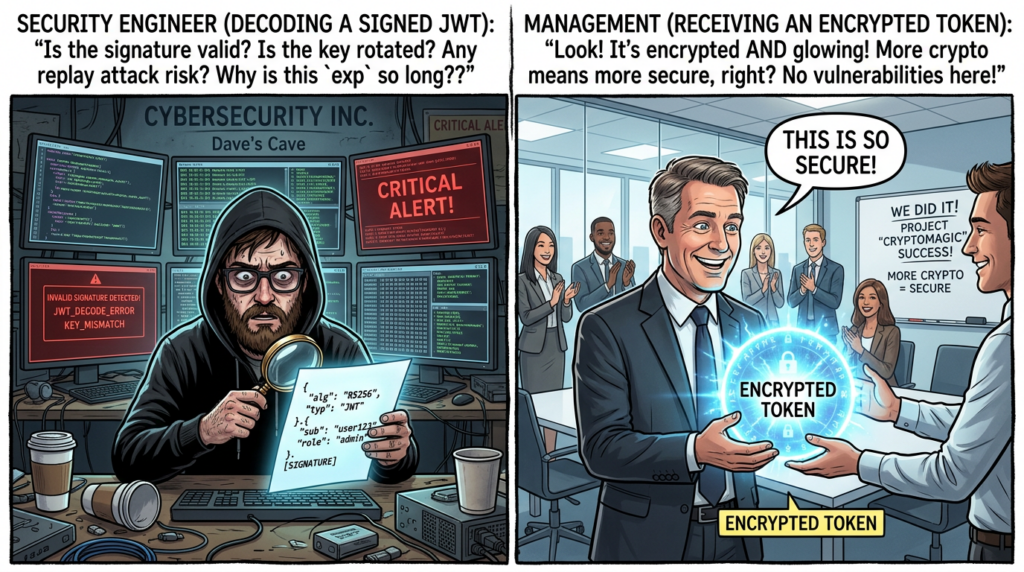
That is why this pac4j-jwt issue is more than an implementation bug. It is a reminder that teams often say “we use encrypted JWTs” as if encryption alone makes identity trustworthy. It does not. If the application decrypts a token but fails to prove that the claims came from a trusted signer, the system has preserved secrecy while surrendering authenticity. CVE-2026-29000 weaponizes exactly that misunderstanding. (NVD)
The vulnerability that changed the conversation
The public descriptions of CVE-2026-29000 are consistent across the most important sources. NVD states that pac4j-jwt versions prior to 4.5.9, 5.7.9und 6.3.3 contain an authentication bypass in JwtAuthenticator when processing encrypted JWTs. The attacker can create a JWE-wrapped PlainJWT with arbitrary subject und Rolle claims and bypass signature verification, authenticating as any user including administrators. GitHub Advisory Database mirrors the same description. Arctic Wolf’s bulletin adds an especially useful explanation: after decryption, the library can end up on a logic path where the inner token is not actually validated as signed, yet its claims are still used to build the user profile. (NVD)
The pac4j project itself published a short but urgent advisory confirming that a vulnerability in JwtAuthenticator had been fixed and that users must upgrade to the patched lines. The brevity of the advisory is notable. The maintainers did not publish a long narrative there; they published a direct instruction to upgrade. When a project maintainer says “you MUST upgrade,” it is usually because the exploit conditions are practical enough that nuance is less important than immediate action. (pac4j.org)
Arctic Wolf’s write-up, which aligns with the NVD description, is useful because it translates the failure into operational language. In its analysis, the flaw affects deployments that use RSA-based JWE together with JwtAuthenticator configured with both EncryptionConfiguration und SignatureConfiguration. If the inner token is a PlainJWT, the signature verification path can be skipped, but claims still flow into profile creation. That is the specific breach of trust that turns malformed input into authenticated identity. (Arctic Wolf)
This is not a vague theoretical issue, and it is not a “maybe exploitable if the stars align” bug. It is a condition where the library may accept attacker-controlled claims as authenticated user state. When the affected claims include unter, roles, or linked identity information, the result is not partial corruption. It is total account impersonation at the identity layer. NVD’s scoring reflects that reality: no privileges required, no user interaction, network reachable, high confidentiality and integrity impact. (NVD)
Why JWE was not enough
A good way to understand the bug is to forget the jargon for a moment and think about what the application believes happened.
The application receives a token.
The application sees that the token is encrypted.
The application successfully decrypts it.
The application then uses the decrypted claims to create a user profile.
That sequence looks reasonable until you ask the missing question: who proved that the decrypted payload was signed by a trusted issuer?
In JOSE terms, encryption by itself is not a statement of issuer authenticity. RFC 7516 defines how encrypted content is represented. RFC 7515 defines how signatures are represented. RFC 7519 explicitly allows JWT claims to be either signed or encrypted or both. RFC 8725 was published because libraries and applications repeatedly made unsafe assumptions when parsing or validating tokens across these representations. (IETF Datatracker)
Connect2id’s algorithm guide expresses the same principle from a cryptographic design angle. If you need others to verify who issued a token, you need digital signatures. Encryption solves a different problem. A JWE can keep token contents hidden from observers, but it does not magically tell your application whether the payload was approved by the legitimate signer unless the design explicitly enforces nested signing semantics. (Connect2id)
pac4j’s current documentation now spells this out more clearly than many teams probably remember from older versions. The JWT docs say that if a token is encrypted and signature configurations are defined, then the decrypted payload must be a signed JWT, and a JWE decrypting to a plain unsigned JWT is rejected. That wording is important because it codifies the safe model: if your application expects signed claims, decrypting into an unsigned claims object is not “close enough.” It is a hard failure. (pac4j.org)
That is also why CVE-2026-29000 should be read as a design lesson for the wider Java security ecosystem. The problem was not that cryptography failed in the abstract. The problem was that the trust policy after decryption was not enforced strongly enough. The outer layer did what encryption does. The inner layer was where identity truth should have been established. That is the layer attackers reached. (NVD)

Reading the pac4j behavior model the right way
The pac4j JWT documentation is unusually helpful here because it gives us the intended semantics in plain language. It states that if at least one SignatureConfiguration is defined, a non-signed PlainJWT is rejected. It also explains that encryption is controlled by an encryptionRequired flag, which defaults to false, and that if encryptionRequired ist wahr and encryption configurations are present, a non-encrypted JWT is rejected. Most importantly, the docs now explicitly say that if a token is encrypted and signature configurations are defined, the decrypted payload must be a signed JWT, not a plain unsigned one. (pac4j.org)
That gives us the intended security contract in a concise form:
| Token scenario | What the system should trust | What pac4j docs now require |
|---|---|---|
| Plain JWT with no signature config | Very little, and only in narrowly controlled designs | May be accepted only when no signature configuration is defined (pac4j.org) |
| Signed JWT with signature config | Integrity and origin, if signature verifies | Accepted if a matching signature configuration verifies it (pac4j.org) |
| Encrypted JWT with no signature expectation | Confidentiality of claims, but authenticity depends on the broader design | May be decrypted if the encryption configuration matches (pac4j.org) |
| Encrypted JWT plus signature config | Confidentiality plus authenticity of the inner token | The decrypted payload must be a signed nested JWT, not a PlainJWT (pac4j.org) |
That model tracks with the current code path visible in pac4j’s GitHub source. In the JwtAuthenticator class, the current code parses the token, decrypts EncryptedJWT where appropriate, and then checks whether a signed JWT exists before continuing with signature verification. In the current source, if signature configurations are not empty and signedJWT remains null, a credentials exception is raised using the “non-signed JWT cannot be accepted” logic. The code also shows that encryptionRequired remains false by default for backward compatibility. (GitHub)
That default deserves attention. The library’s own source comments say the encryptionRequired flag exists for backward compatibility and may be set to true in a future version. In other words, pac4j itself recognizes that optional encryption behavior introduces ambiguity that security teams need to reason through carefully. Backward compatibility is understandable in a mature library, but backward compatibility and modern security expectations are often in tension. (GitHub)
The technical shape of CVE-2026-29000
At a high level, the vulnerability arises when a token is encrypted, successfully decrypted, and then treated as if its inner claims are trustworthy without the application proving that the inner object was actually signed by the legitimate party. NVD summarizes the exploit condition clearly: an attacker who has the server’s RSA public key can create a JWE-wrapped PlainJWT with arbitrary subject and role claims. Those claims can then bypass signature verification and be accepted as identity information. (NVD)
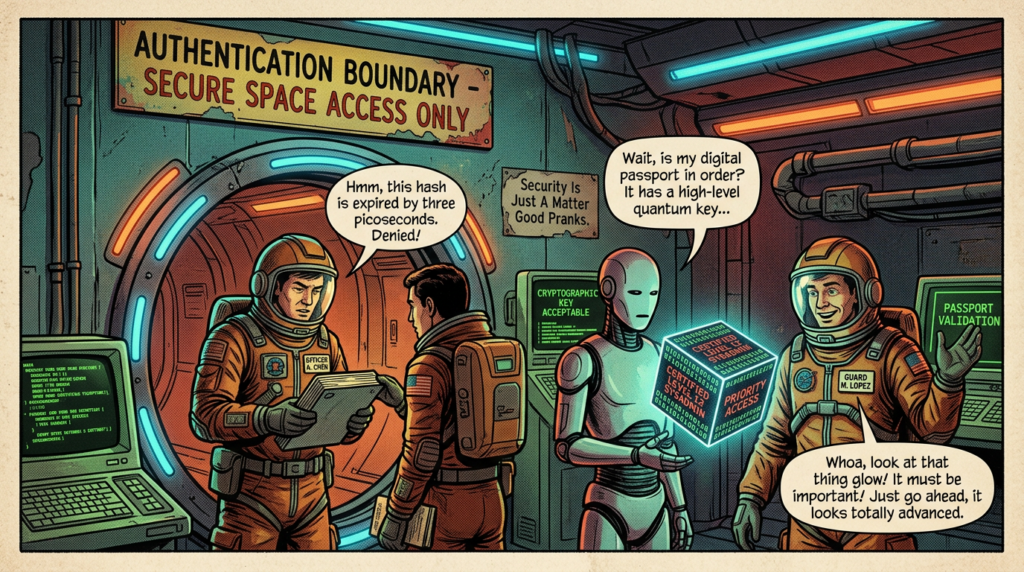
Arctic Wolf’s explanation fills in the operational details. Their analysis states that when JwtAuthenticator decrypts a JWE, it attempts to parse the inner token as a SignedJWT. If the decrypted payload is instead a PlainJWT, the signing object is null and the signature verification path can be skipped due to the logic flaw, after which the code builds a profile from unverified claims. That is exactly the kind of branch condition that many teams miss in code review because the code “usually works” for normal signed tokens. Attackers do not send normal tokens. (Arctic Wolf)
There is an important conceptual detail here. This was not a failure of RSA itself, and it was not a case where the attacker had to steal the private signing key. The public key was enough because the vulnerable behavior sat in how the library interpreted the token structure after decryption, not in breaking the cryptography. That is why this vulnerability feels so counterintuitive at first glance. Developers correctly learn that a public key is meant to be public. The exploit chain does not contradict that; it exploits an implementation that treated the result of decryption as a trustworthy basis for identity even when the inner authenticity proof was missing. (NVD)
That distinction is worth dwelling on because it generalizes far beyond pac4j-jwt. Many library consumers still think in terms of “can an attacker sign a token” when they should often be asking “can an attacker cause the verifier to accept claims without a valid signature.” Those are not the same question. The first is cryptographic compromise. The second is verifier logic compromise. RFC 8725 exists largely because the second class of mistake has repeated across ecosystems for years. (RFC-Editor)

Why this matters in real Java systems
The pac4j homepage emphasizes broad framework reach across Spring Web MVC, Spring Security, JAX-RS, Undertow, Jooby, Play, Vert.x, Ratpack, and other Java stacks. A vulnerability in pac4j-jwt therefore matters not only where engineers explicitly wrote “we use pac4j-jwt,” but also where it appears as part of a larger authentication setup or a transitive dependency chain. Maven Repository shows the artifact has many versions and is used by other packages, reinforcing the practical need for dependency inventory rather than assumption. (pac4j.org)
That changes the response burden. A team may not know pac4j-jwt is in scope until they inspect their software bill of materials, dependency tree, or packaged application runtime. If they do find it, the next question is not simply “what version?” It is “how are we using it?” The publicly described exploit conditions point most strongly at deployments using encrypted JWTs, especially with RSA-based JWE and both encryption and signature configuration present. Teams that only use signed JWS may not be on the vulnerable path in the same way, but they still need to verify their actual configuration rather than infer safety from architecture diagrams. (Arctic Wolf)
The risk is amplified when application authorization is tightly coupled to token claims. pac4j’s current source shows that profile creation ultimately reads the JWT claim set, extracts subject and attributes, and can hydrate roles and linked identity values into the user profile. In a healthy system, that is the point of JWT processing. In an unhealthy system, it becomes the place where forged claims become operational permissions. (GitHub)
This is why identity-layer vulnerabilities often produce outsized damage. An RCE bug might give one route to server control. An authentication bypass gives control over what the system believes about who you are. In large systems, identity forgery can lead to privilege escalation, administrative actions, data access, lateral service authorization, or hidden persistence through trusted control planes. That is why vulnerability write-ups around pac4j-jwt focus so heavily on administrator impersonation: it is the shortest path from malformed token handling to total trust failure. (NVD)
pac4j has seen this movie before in other forms
CVE-2026-29000 is the current crisis, but it is not the first time the broader pac4j ecosystem has revealed a dangerous gap between token-like input and verified trust.
One earlier example is CVE-2021-44878, which NVD describes as a flaw in pac4j v5.1 and earlier where clients could, by default, accept OpenID Connect ID tokens using the "keine" algorithm. NVD notes that the "keine" algorithm does not require signature verification, allowing token validation bypass via a malformed ID token. This was a different module and a different context, but the security lesson rhymes closely with the current pac4j-jwt issue: unsigned or insufficiently validated identity data can cross the boundary from untrusted input into trusted session state. (NVD)
Another important example is CVE-2023-25581 in pac4j-core. NVD describes a deserialization vulnerability in UserProfile attribute handling, where externally controlled values with a special prefix could be treated as serialized Java objects, potentially leading to remote code execution in the worst case. Again, the specifics differ, but the underlying theme remains consistent: once a framework assumes that identity-adjacent data structures are safe and richly trusted, an attacker only needs to find one path to smuggle hostile content into them. (NVD)
These examples do not mean pac4j is uniquely flawed compared with every other framework. Identity libraries across ecosystems have struggled with similar problems for years. What they do mean is that teams using pac4j should be especially disciplined about the difference between parsing, decrypting, Überprüfung von, normalizingund authorizing. Those are distinct stages. When they collapse into a single black box in the minds of developers, security bugs become much more likely. (RFC-Editor)
What a safer pac4j-jwt posture looks like
The first and most obvious step is patching. If you are on a vulnerable line, you need to move to 4.5.9, 5.7.9, oder 6.3.3, or newer versions in those lines. That is the recommendation from the pac4j maintainers, NVD, GitHub Advisory Database, Arctic Wolf, and Snyk. There is no responsible argument for delaying that upgrade if your deployment is plausibly affected. (pac4j.org)
But patching is not the whole story. JWT vulnerabilities are often revealed by one CVE and truly fixed by architecture changes. RFC 8725 recommends rigorous validation, clear algorithm expectations, and avoiding confused trust between token classes. Curity’s best-practices guidance likewise emphasizes full validation of signature, issuer, audience, and token purpose, and warns against sloppy interchangeability between token types or overstuffing business logic into tokens. (RFC-Editor)
In the pac4j-jwt context, that usually means five concrete moves.
First, ask whether you need JWE at all. Many systems primarily need authenticity and integrity, not confidentiality of claims on every hop. Connect2id’s algorithm guidance is explicit that JWS and JWE solve different problems. If your application only needs to prove the issuer and the claim set, JWS alone may be simpler and safer than a nested JWE design that your team barely audits. (Connect2id)
Second, if you do need encrypted tokens, require nested signed JWTs. pac4j’s own docs now say exactly that: when signature configurations are defined, a decrypted JWE must yield a signed JWT. Treat any unsigned inner token as a protocol violation, not a fallback case. (pac4j.org)
Third, lock down algorithms and key handling. The algorithm guide from Connect2id recommends RS256 for broad support and notes the tradeoffs of EC and EdDSA families. More broadly, RFC 8725 warns against algorithm confusion and insufficient validation. Accept only the algorithms you explicitly intend to use, and make sure key discovery and key identifiers do not create ambiguous trust paths. (Connect2id)
Fourth, treat claims as input to policy, not policy itself. A token’s roles claim should not automatically become the whole authorization story if it arrived from a path your application has not fully authenticated. Claims should be tied to issuer, audience, expiration, not-before time, and sometimes additional server-side authorization context. Curity recommends full validation of these surrounding properties, which is exactly right. (Curity)
Fifth, test the unhappy path. Most identity stacks are heavily tested with valid tokens and barely tested with malformed nested tokens, unsigned payloads inside encrypted wrappers, stale keys, mis-tagged algorithms, or claim shape mismatches. CVE-2026-29000 is a reminder that those are not corner cases for attackers. They are the main path. (Arctic Wolf)
A configuration pattern that deserves scrutiny
The following example is not exploit code. It is a representative configuration pattern that security teams should review carefully because it combines the exact concepts that matter here: encryption, signing, and trust in claims.
JwtAuthenticator jwtAuthenticator = new JwtAuthenticator();

// Signature verification
jwtAuthenticator.addSignatureConfiguration(
    new RSASignatureConfiguration(rsaKeyPair)
);

// Encryption support
jwtAuthenticator.addEncryptionConfiguration(
    new RSAEncryptionConfiguration(rsaKeyPair)
);

// Default behavior may still allow ambiguity if teams
// do not reason carefully about encrypted vs signed paths.
jwtAuthenticator.setEncryptionRequired(false);
The pac4j documentation shows that JwtAuthenticator supports both signature and encryption configurations, and the current source still documents encryptionRequired as defaulting to false for backward compatibility. That does not automatically make the configuration unsafe on patched versions, but it does mean teams need to understand exactly what token shapes the application will accept. If an engineering team cannot answer “must the inner decrypted JWT be signed” without checking code or docs, that team is carrying avoidable identity risk. (pac4j.org)
A better defensive posture is to make the intended token contract explicit and then verify it in tests.
JwtAuthenticator jwtAuthenticator = new JwtAuthenticator();

// Accept only signatures from the trusted issuer key
jwtAuthenticator.addSignatureConfiguration(
    new RSASignatureConfiguration(trustedIssuerKeyPair)
);

// If encrypted tokens are truly required, only decrypt using the
// intended recipient key and require encryption explicitly.
jwtAuthenticator.addEncryptionConfiguration(
    new RSAEncryptionConfiguration(recipientKeyPair)
);

jwtAuthenticator.setEncryptionRequired(true);

// Add surrounding validation in your own integration layer:
// issuer, audience, expiration, not-before, key ID,
// and route-specific authorization checks.
This still is not “secure by magic.” It is simply closer to the trust contract teams actually mean. The application is saying that encrypted tokens are mandatory on this path, signatures from a trusted key are mandatory on this path, and token acceptance is not reduced to “the library could parse it.” That mindset is much closer to RFC 8725’s best-practice posture. (RFC-Editor)
How to audit your dependency and exposure fast
When a vulnerability lands in a library like pac4j-jwt, the first engineering failure is often visibility. You cannot fix what you do not know you ship.
A practical first step is to inspect your Maven or Gradle dependency tree and surface both direct and transitive references.
mvn dependency:tree | grep pac4j-jwt
./gradlew dependencies | grep pac4j-jwt
Maven Repository currently shows the pac4j-jwt artifact line and the existence of the patched versions 5.7.9 und 6.3.3, which makes dependency inventory immediately actionable. Teams should not stop at root dependencies, because authentication libraries are often pulled in through higher-level framework integrations or packaged identity modules. (Maven Repository)
A second step is to search your codebase for likely configuration points and token processing touchpoints.
grep -R "JwtAuthenticator" src/
grep -R "SignatureConfiguration" src/
grep -R "EncryptionConfiguration" src/
grep -R "RSASignatureConfiguration" src/
grep -R "RSAEncryptionConfiguration" src/
A third step is runtime verification. In staging, feed the service a set of deliberately malformed tokens and confirm that every path fails closed. You do not need a public exploit to do this responsibly. The goal is not to weaponize the bug. The goal is to confirm that your application rejects unsigned inner payloads, mismatched issuers, incorrect audiences, expired tokens, bad key IDs, and unexpected JOSE algorithms. That is the kind of negative testing RFC 8725 implicitly demands, and it is exactly the kind of test many teams skip until a CVE teaches them otherwise. (RFC-Editor)
The engineering mistake behind many JWT incidents
The deepest lesson here is not “always patch faster,” although you should. It is that JWT incidents frequently happen because teams reduce trust to syntax.
The token parsed successfully.
The token decrypted successfully.
The claims object exists.
The user profile was built.
None of those events prove identity on their own. They only prove that the application processed input. RFC 7519 defines the container. RFC 7515 defines signature semantics. RFC 7516 defines encryption semantics. RFC 8725 exists because too many deployed systems blurred these layers and treated successful processing as successful validation. (IETF Datatracker)
The current pac4j JWT documentation is actually a strong corrective in this respect. It clearly distinguishes how plain, signed, and encrypted JWTs should be handled and now makes the nested signed-JWT requirement explicit when signatures are configured. That is the documentation language security engineers should propagate internally: a decrypted token is not automatically an authenticated token. (pac4j.org)
This also explains why vulnerabilities like CVE-2021-44878 and CVE-2026-29000 tend to feel familiar even when they happen in different modules. In both cases, the attacker found a path where the verifier could be made to accept a token that lacked the authenticity proof the application thought it was requiring. Once that happens, the system is no longer doing authentication. It is doing claim ingestion. (NVD)
A practical defensive checklist for pac4j-jwt teams
The table below captures the highest-value defensive moves for teams responsible for pac4j-jwt in production.
| Risk area | What to verify | Warum das wichtig ist | Practical action |
|---|---|---|---|
| Vulnerable library version | Are you below 4.5.9, 5.7.9, or 6.3.3 | Those lines are explicitly affected by CVE-2026-29000 | Upgrade immediately (pac4j.org) |
| Token mode confusion | Are JWS and JWE requirements clearly separated | Encryption and signature solve different problems | Document accepted token shapes per endpoint (RFC-Editor) |
| Nested token enforcement | Can a JWE decrypt to an unsigned inner JWT | That is the core dangerous pattern for this CVE | Require signed nested JWTs when signature configs exist (pac4j.org) |
| Optional encryption defaults | Is encryptionRequired false without intentional review | Backward-compatible defaults can preserve ambiguity | Set policy explicitly and test unhappy paths (GitHub) |
| Claim trust | Do roles and subject immediately drive authorization | Forged claims can become real privileges | Re-validate issuer, audience, lifetime, and route policy (Curity) |
| Dependency visibility | Is pac4j-jwt transitive in your build | Teams often miss auth libraries in indirect deps | Inspect SBOM, dependency tree, and runtime packaging (Maven Repository) |
Identity-layer bugs like this tend to expose a blind spot in traditional security workflows. A version scanner can tell you that org.pac4j:pac4j-jwt is present. An SCA tool can tell you whether the version is below the fixed line. What those tools usually do not tell you is whether your application is actually reachable through the vulnerable token path, whether it accepts nested JWE flows in production, whether claims from those flows reach authorization decisions, and whether your patch actually closed the exploit condition under your own reverse proxies, gateways, and application code. The public descriptions of CVE-2026-29000 make clear that configuration and token shape matter, not just package presence. (NVD)
That is the point where an AI-native validation workflow becomes more useful than static alerting alone. In a platform like Penligent, the value is not merely “scan the dependency.” The real value is chaining together dependency discovery, token-processing path discovery, test request generation, malformed-claim validation, and regression retesting after patch deployment. That is especially relevant for JWT handling, where the presence of a vulnerable library does not tell the whole story, but a reproducible request path often does. Penligent’s own Hacking Labs coverage already includes a dedicated article on CVE-2026-29000 in pac4j-jwt and related JWT security material, which makes it a natural internal reference point for teams trying to move from awareness to validation. (Sträflich)
What secure JWT validation should look like after this
After this CVE, the right response is not “be more careful with pac4j-jwt.” The right response is broader and more durable.
A secure JWT pipeline should begin by deciding what kind of token each route accepts and what security property that route actually needs. If a route only needs origin authenticity and claim integrity, a signed JWS may be enough. If it also needs confidentiality in transit or at rest outside the application, a signed-and-encrypted nested design may be appropriate. But that decision must be deliberate. RFC 8725 exists because the industry repeatedly built flexible token systems and then validated them ambiguously. (RFC-Editor)
From there, verification has to be layered and explicit. The application should validate the JOSE algorithm against an allowlist, validate the key relationship, validate issuer and audience, validate time claims, validate token purpose, and validate that the token representation matches the contract for that route. Only then should claims be eligible to influence authorization. Curity’s guidance to fully validate signature, issuer, and audience is basic but still widely under-applied, especially in internal APIs and service-to-service paths that teams incorrectly treat as trusted by default. (Curity)
The pac4j-jwt story is particularly valuable because it collapses a common illusion. Engineers often feel safest when they see more crypto, more JOSE structure, more layers, more abstraction. But complexity is not assurance. A signed token that is cleanly validated is safer than an encrypted nested token the team does not fully understand. In security engineering, simpler and explicitly validated often beats richer and ambiguously trusted. (Connect2id)
Final take
The reason pac4j-jwt matters right now is not that JWT suddenly became dangerous in 2026. JWT has always demanded precise validation. What changed is that CVE-2026-29000 made one specific validation failure painfully visible: the difference between decrypting a token und trusting a token. The library accepted a path where those two ideas could drift apart, and attackers could step into that gap. (NVD)
That is why this vulnerability deserves more than a patch note. It deserves an architectural review. If your Java applications use pac4j-jwt, you should upgrade immediately. Then you should audit whether you truly need JWE, whether nested signed JWTs are enforced where they should be, whether claims are overtrusted, and whether your token validation tests include adversarial cases rather than only happy-path fixtures. The official pac4j advisory gives you the upgrade target. The RFCs and best-practice guidance tell you how to think about the design. The only remaining question is whether your engineering process is willing to treat identity parsing as the critical boundary it actually is. (pac4j.org)
Further Reading
- pac4j JWT documentation (pac4j.org)
- pac4j security advisory for
JwtAuthenticator(pac4j.org) - NVD entry for CVE-2026-29000 (NVD)
- GitHub Advisory Database entry for CVE-2026-29000 (GitHub)
- Arctic Wolf analysis of CVE-2026-29000 (Arctic Wolf)
- RFC 7519, JSON Web Token (IETF Datatracker)
- RFC 7515, JSON Web Signature (IETF Datatracker)
- RFC 7516, JSON Web Encryption (IETF Datatracker)
- RFC 8725, JWT Best Current Practices (RFC-Editor)
- Nimbus JOSE + JWT algorithm selection guide (Connect2id)
- Penligent on CVE-2026-29000 in pac4j-jwt (Sträflich)
- Penligent JWT token decode tutorial (Sträflich)
- Penligent API testing guide with JWT authorization examples (Sträflich)

 German
  English
  French
  Spanish
  Portuguese
  Japanese
  Korean
  Hindi
Hindi  Arabic
  Turkish
  Hebrew