
Singapore’s API security advisory is a practical warning about personal data leaving through apparently legitimate application functions. An authenticated request can still access the wrong record, return unnecessary fields, or initiate work outside the caller’s purpose. The strongest response is to make those boundaries explicit and test them with controlled accounts and synthetic data.
The Cyber Security Agency of Singapore and Personal Data Protection Commission issued their joint advisory on November 12, 2026. Die official advisory PDF describes risks involving exposed internal APIs, weak or compromised credentials, inadequate authorization, configuration problems, and insufficient monitoring. It notes that data retrieval through valid credentials and legitimate API functions can be difficult to distinguish from ordinary use without suitable controls and observation.
This article provides a technical assessment and implementation framework. Its test results are not a legal compliance certification. The examples use fictional records and in-memory policy decisions, with no production extraction, credential guessing, or testing of systems outside an authorized scope.
The central acceptance condition is straightforward: a caller can perform the approved operation on the approved records and fields for the approved purpose, while the corresponding out-of-scope operation is denied. That condition must remain true across list routes, detail routes, exports, background workers, caches, partner integrations, and deployment changes.
Turn a data-protection concern into a testable policy
An API review becomes useful when it identifies what data a function is intended to return and to whom. “This endpoint requires a token” is only an identity condition. The policy also needs a tenant or account relationship, a record scope, a field set, an operation, and any relevant workflow state. Without those details, a tester can observe behavior but cannot reliably distinguish a defect from an intended product feature.
Write the policy with the business owner and developer before testing. A customer may read their own contact details but not another customer’s support notes. A partner may receive shipment status but not billing information. A support role may view a case only while assigned. These are fictional examples, but they illustrate the level of precision needed for a meaningful authorization assessment.
Use a compact policy matrix. Each row should identify the principal type, resource relationship, operation, permitted fields, state condition, and expected decision. Add a corresponding negative case. The negative case should change one meaningful authority condition while keeping the rest of the request valid. This makes a failure easier to interpret and easier for the developer to reproduce.
Keep the policy separate from implementation details initially. The same business rule may be enforced in a service, a shared policy component, or another supported application layer. The assessment needs to know which component owns the decision, but it should not accept the current implementation as the definition of what is allowed. Otherwise, the test merely confirms that the application does what its existing code happens to do.
Record ambiguity as a decision task. If no one can say whether a former team member should still download an old export, the first problem is an undefined policy. The organization should resolve that question and assign an enforcing owner. A tool cannot create a reliable finding from a business rule that changes depending on who answers the question during the test.
Inventory data paths rather than only endpoint names
An endpoint inventory should describe the data path behind the route. Identify the owner, purpose, caller population, authentication method, authorization rule, data categories, downstream systems, and generated artifacts. Include the API version and deployment environment. An inventory that lists only URLs can tell a team what exists without telling it which personal data and authority are at risk.
Start from the business function. A customer profile screen may call several services, use a cache, and trigger a background enrichment job. A partner integration may consume a separate route with a different field set. A report may create a downloadable file outside the original request path. Map those relationships so the assessment includes the result a caller can actually obtain, not just the first JSON response.
Use owned configuration and application records to establish scope. Compare gateway routes, service definitions, deployment manifests, API specifications, and observed authorized traffic where available. Each source can reveal a different part of the population. Preserve discrepancies for review rather than assuming one source is complete. A route missing from a specification can still be deployed, and a documented route can be retired or inaccessible.
Include legacy and alternate versions. A corrected current API does not establish the behavior of an older route that remains available to a mobile client or partner. Identify why the older version exists, who still uses it, and which controls apply. Retirement should have an owner and a migration plan. Leaving an old version outside the assessment because it is inconvenient to document does not reduce its authority.
Record internal and external audiences explicitly. An API intended for service-to-service use may have different controls from a customer-facing API. If a deployment or integration change makes it reachable by a broader audience, the assessment should revisit authentication, authorization, data minimization, and monitoring. The intended audience should be a maintained property of the service, not an assumption inherited from its original launch.
Capture third-party access as a relationship, not just a credential. Identify the provider, business purpose, allowed data, allowed operations, owner, and revocation process. A key stored in a secret manager can still grant more authority than the integration needs. The inventory should make that authority visible enough for a reviewer to decide whether it remains appropriate.
For each important path, identify the evidence source. A gateway may observe request routing, the application may observe policy decisions, and a worker may observe artifact creation. The inventory should tell the incident team where to answer a question about accepted work or data access. If no component records a consequential action, that is a concrete observability gap to address.
Finally, make the inventory changeable without losing history. A route owner, field set, or integration purpose can change. Preserve the prior state and the approval reference so a later investigation can reconstruct what the API was intended to permit during a particular interval. The current specification alone cannot explain the authority of an older deployment.
Prove tenant and object boundaries with paired fixtures
OWASP’s API1 guidance on Broken Object Level Authorization explains the need to verify whether the caller may access the requested object. Authentication does not establish that relationship. A useful authorized test creates a permitted fixture and an otherwise comparable fixture outside the caller’s scope, then compares the observed decisions.
Create two synthetic tenants or accounts according to the product’s model. Give each one a record containing a distinctive harmless marker. Define which identity owns or may access each record. The positive test retrieves the permitted record. The negative test requests the other fixture through the same operation. Stop after the controlled mismatch is demonstrated; do not enumerate real customer records to increase the apparent severity.
Test the response contents as well as the status. A rejected response should not include the protected fixture marker in an error body or debug field. A successful response may be correct if the policy intentionally returns an empty filtered set. The expected result should identify the actual data and side effects, not rely on a universal assumption that one HTTP code always means safe or unsafe behavior.
For nested resources, define the relationship the service must verify. A caller allowed to access a project may still be denied a child resource belonging to another tenant or a protected part of that project. The assessment should use a small set of explicit parent-child fixtures rather than a large uncontrolled identifier search. The developer can then see exactly which relationship check is missing or misplaced.
Compare list, search, and detail operations. A list can filter correctly while a detail route trusts a supplied identifier. A detail route can be protected while search results include out-of-scope records. The policy matrix should cover the operation families that expose the same data, with evidence from each deployed route. Fixing one code path should not be reported as correcting every representation of the resource without a retest.
Include ownership and membership transitions. Remove a synthetic user from a team, transfer a fixture to another tenant where the product supports it, or expire a support assignment. Define when access should change and test the relevant routes afterward. If the design permits a bounded propagation interval, document and test it. An unexplained stale authorization result is different from an explicit supported policy.
Review the enforcement location. The service performing the consequential read or write should receive enough trusted context to make the intended decision. A front-end filter is useful for user experience but should not be the only record boundary. The test should exercise the API through its authorized deployed path and confirm that the server-side result matches the policy even when the client requests the out-of-scope fixture.
Define what a denied response should reveal about the fixture’s existence. Some products deliberately use the same external response for missing and inaccessible resources; others expose a distinction for an approved business reason. Choose the intended behavior with the owner and test it consistently. The internal policy record can retain a precise reason without requiring the public response to disclose a protected record’s identity or attributes.
Include error text and diagnostic fields in that test. A response that denies the main operation but names the protected customer or includes a record summary can still violate the data contract. Use harmless fixture markers to check those surfaces. Keep the result tied to the defined audience and purpose, and give the developer the exact response field that requires correction.
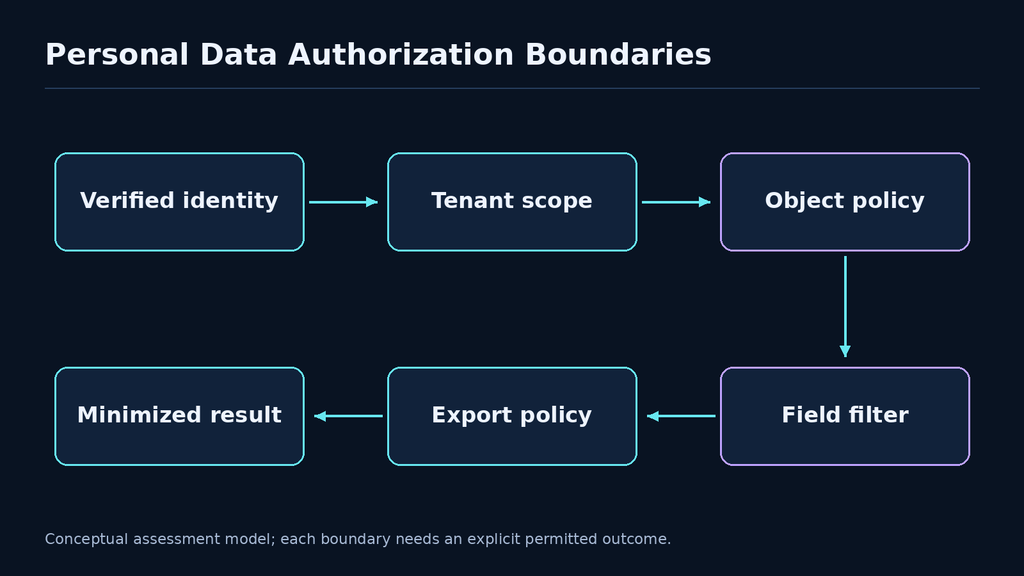
Preserve the finding as a policy mismatch. Include the synthetic principal, permitted relationship, changed condition, expected decision, observed result, and minimum supporting evidence. This is more useful than a screenshot labeled “IDOR” without the business rule. It gives the owner a repair target and a regression test that can survive changes to route names or identifier formats.
Authorize returned and writable properties independently
A caller can be allowed to access a record without being allowed to read or change every property. OWASP’s API3 guidance addresses both excessive property exposure and unauthorized property modification. A record-level success should therefore lead to an explicit field policy, not an unrestricted serialization of the internal object.
For reads, define the exact permitted field set for each principal and purpose. A shipping integration may need a delivery address but not account notes. A customer may see a public status but not an internal risk label. Use synthetic records containing both permitted and protected markers, then assert which keys and values appear in the response. A test that checks only one required field can miss several unwanted fields returned beside it.
For writes, define an allowlist of fields the caller may change. A profile update should not become a general object update because the request includes an additional property. Test an ordinary permitted change and a controlled disallowed field using fixtures. Verify the stored result or an approved observable effect. An error response alone is not enough if the service has already applied the change.
Keep read and write policies separate. A support agent may be permitted to view a field but not edit it. A customer may submit a value that is stored but not later exposed to another caller. A field’s presence in a schema does not decide who may use it in every direction. The policy matrix should identify the operation and audience for each sensitive property.
Review nested and derived values. A protected field can appear inside a related object, a computed summary, an audit view, or an exported artifact even when the primary serializer omits it. Follow the data path identified in the inventory and use a small set of distinctive synthetic markers. The assessment should verify the representations the caller can actually obtain rather than assume that one corrected response covers every downstream view.
Make minimization part of the response contract. The application should return the data required for the purpose, and the test should assert the allowed set rather than only search for a short blacklist of known secrets. A blacklist can miss a newly added sensitive property. An explicit contract makes a new field a deliberate review decision and gives developers a stable regression expectation.
After a repair, test both the public contract and the internal side effect. A write rejection should leave the protected fixture unchanged. A filtered read should preserve the legitimate fields the caller needs. This paired result helps avoid a repair that prevents the finding by breaking the entire operation. The desired state is a useful authorized function with a narrow data boundary.
Give sensitive functions their own authority rules
A user permitted to read a resource is not necessarily permitted to export, delete, approve, transfer, or administer it. OWASP’s API5 guidance on Broken Function Level Authorization addresses the boundary around functions and roles. The assessment should identify the operations that change authority or create a larger data consequence, then test them independently of ordinary reads.
Build a role-to-operation matrix with the business owner. Use actual product roles but synthetic accounts. For each sensitive function, identify who may invoke it, on which resources, in which workflow state, and with which additional conditions. A broad administrator role may be intentional, but a routine customer or integration identity should not inherit it because the route is difficult to discover or absent from the user interface.
Test the server-side decision through the approved API route. Hiding a button can reduce accidental use, but the acceptance criterion is the operation’s result when a disallowed principal requests it. Use a harmless fixture or a fake dependency for actions with external effects. The test should not delete production data or send real customer communications to prove a role boundary.
Separate a function’s visibility from its authority. A route can be documented for integration purposes and still require strict authorization. Conversely, an undocumented route can remain reachable and consequential. The policy should not depend on whether a tester knows its name. The inventory and role matrix should identify it as a maintained capability with an owner and an expected audience.
Review bulk and administrative variants of ordinary functions. A single-record update can have appropriate controls while a bulk operation accepts a broader target set. A support-only convenience function can bypass a relationship check used by the customer route. The assessment should compare those variants according to the same business policy, while preserving any deliberately different authority and audit requirements.
After role changes, retest sensitive functions with the purpose-created account. Define when a removed grant should stop working and how existing sessions or tasks are handled. A current role assignment and a cached permission decision can diverge if the lifecycle is not designed and tested. Preserve the expected timing and observed result rather than treating every delayed change as either automatically acceptable or automatically malicious.
Authorize exports at creation, execution, and retrieval
An export is a data path with several decisions, not merely a request that returns later. Identify the authority to create the job, the record scope the worker may process, the fields the artifact may contain, and the audience allowed to retrieve it. A strong creation check does not establish the other three. The test plan should follow the synthetic data through the entire lifecycle.
At creation, test the caller’s permitted scope. A tenant-limited user should not be able to request another tenant’s fixture by supplying a different filter or resource selection. The service should derive or validate the scope against trusted policy context. Record the expected scope and the accepted job parameters in the test evidence, without storing real personal data or reusable credentials.
At execution, verify that the worker honors the approved authority model. The product may use a narrow snapshot of an approved request or re-evaluate current permissions, depending on the business requirement. Define that rule explicitly. The worker should not silently expand the target population because it runs under a more privileged service identity than the user who requested the work.
At artifact creation, assert the exact synthetic records and fields included. The test can use a small file with known harmless markers. Check that an out-of-scope marker is absent and that a protected property does not appear in a different column, metadata field, or summary. A successful job status does not establish that the content matches the approved data contract.
At retrieval, test who can obtain the result and under what sharing rule. A job identifier, file identifier, or difficult-to-guess link should not be confused with an explicit business decision about audience. If the product deliberately supports bearer-link sharing, document its scope, lifetime, and revocation behavior and test that intended model. Do not imply that every sharing design uses the same authorization mechanism.
Include lifecycle changes in the test. Remove the synthetic user’s access after job creation, expire a support assignment, or change the fixture’s ownership where the application supports it. Verify the expected behavior at execution and retrieval. The policy may preserve some previously approved work, but that choice should be intentional and reviewable. An undefined lifecycle is a policy gap before it is a tool finding.
Budget exports according to their consequence. The application may need limits on record count, field sensitivity, task frequency, concurrent work, or another business dimension. Use a deliberately small test budget and confirm that a rejected request does not create hidden work. This verifies the control without generating a production load event or extracting a large data set.
Finally, define artifact retention and cleanup. A corrected live API can coexist with older generated files that still contain unnecessary data. The organization should know which artifacts remain accessible, who owns them, and how they are retired through supported procedures. The repair assessment should include the relevant historical artifacts when the finding concerns generated output, rather than assuming a code deployment changes existing files.
Check whether caching preserves the same data boundary
A cache can change which component supplies a response, so the assessment should verify the data boundary through the deployed caching path. Use two synthetic identities and distinct harmless response markers. Request the relevant function through the approved route in a controlled sequence, then confirm that each caller receives only the permitted representation. The test should remain small and avoid manipulating unrelated cache entries.
RFC 9111 defines HTTP cache storage and reuse rules, including conditions involving shared caches, authorization, and response directives. Those protocol rules are a reference for reviewing the design, but the effective result also depends on the deployed application and cache configuration. Verify the observed behavior rather than inferring isolation from the presence of one header alone.
Identify whether a response is public, private to a principal, scoped to a tenant, or unsuitable for shared caching under the application’s requirements. Connect that classification to the actual cache policy and keying behavior through supported configuration. The assessment should not assume that every route with personal data has the same performance or sharing requirement, but it should require an explicit decision for each consequential representation.
Test authority changes as well as steady state. If a synthetic user loses access or a field policy changes, define what should happen to previously cached representations. Verify the intended invalidation or expiry behavior and record any approved interval. A result that remains available beyond the business rule’s allowed window is a different problem from a correctly documented cache lifetime.
Inspect error and redirect responses where they carry meaningful data or route the caller to an artifact. A policy failure should not become a cached response that exposes another user’s information or redirects to an out-of-scope result. Keep fixtures harmless and the test scoped to the owner’s environment. The goal is to verify the application’s intended audience, not to poison a shared production cache.
If the team cannot establish safe sharing behavior for a sensitive route, choose a supported restrictive cache policy while the design is reviewed. Record the performance and operational consequence and assign an owner to the final decision. A temporary reduction in caching can be a deliberate control; it should not be an undocumented workaround that later disappears during performance tuning.
After a repair, test a newly generated response and the disposition of relevant previously stored representations. The evidence should identify which cache layer was observed and which paths remain outside the check. An origin-only test does not demonstrate the behavior of a shared cache, and a cache-only response does not establish that the origin’s policy is correct. Keep those claims separate.
Make third-party access a governed data relationship
A third-party integration should have a purpose, an owner, a permitted data set, allowed operations, and a supported way to revoke access. A credential is only one part of that relationship. The assessment should ask what the provider can do after authentication and whether that authority still matches the business purpose. A securely stored key can still authorize an unnecessarily broad operation.
Use a dedicated integration identity where the product supports it. Avoid making the integration’s authority indistinguishable from a human administrator’s routine account. The owner should be able to identify the provider’s actions in the relevant records and revoke the relationship without disrupting unrelated users. Test the intended access with a synthetic provider fixture or approved sandbox.
Minimize the data contract. Identify the fields and records required for the integration’s function, then assert the returned set. A provider that needs status information should not automatically receive every internal property of the object. The contract should also describe how changes are reviewed. Adding a field to a shared serializer should not silently expand a provider’s data access.
Review the deployment changes needed to connect the provider. A network restriction removed for integration can alter the audience of an internal service. Before approving the change, identify the replacement or compensating controls and test them through the new route. The integration’s successful business test does not establish that the broader exposure remains appropriately constrained.
Test revocation and narrowing. Disable the synthetic integration or remove a permission, then verify that the relevant operation is rejected according to the supported policy. Include any background tasks and generated artifacts that the integration can use. The organization should know what authority remains during a documented propagation interval and how to contain it if the relationship must end urgently.
Define the provider’s evidence and notification interface. The API owner should know which records it can obtain when investigating an unusual access pattern, which organization owns the next action, and how sensitive evidence will be shared. This does not require the provider to expose unrelated customer data. It requires a practical path to investigate the specific relationship the integration creates.
Retire unused relationships deliberately. Confirm that the credential is revoked, the permission grant is removed or narrowed, unnecessary network access is closed, and relevant artifacts or schedules are handled according to policy. Deleting a name from an integration catalog does not establish those outcomes. Retain a minimal retirement record with the owner, date, and verification result.
A safe in-memory example makes data scope explicit
The following example uses fictional records and a simplified server-side policy context. It opens no socket, reads no file, and contacts no API. It is not an authentication library or a production authorization component. Its purpose is to show how identity status, tenant, object relationship, role, and field scope can produce separate allowed or denied outcomes.
records = {
    "fixture-a": {"id": "fixture-a", "tenant": "blue", "owner": "alice",
                  "display_name": "Synthetic Alice", "email": "alice@example.invalid",
                  "internal_note": "PROTECTED_FIXTURE_A"},
    "fixture-b": {"id": "fixture-b", "tenant": "green", "owner": "bob",
                  "display_name": "Synthetic Bob", "email": "bob@example.invalid",
                  "internal_note": "PROTECTED_FIXTURE_B"},
}
field_policy = {
    "customer": {"id", "display_name"},
    "support": {"id", "display_name", "email"},
}

def read_fixture(principal, record_id, requested_fields):
    record = records.get(record_id)
    if not principal["active"]:
        return "deny_identity", None
    if record is None or record["tenant"] != principal["tenant"]:
        return "deny_object", None
    role = principal["role"]
    if role not in field_policy:
        return "deny_role", None
    if role == "customer" and record["owner"] != principal["id"]:
        return "deny_relationship", None
    if role == "support" and record_id not in principal["assignments"]:
        return "deny_assignment", None
    requested = set(requested_fields)
    if not requested <= field_policy[role]:
        return "deny_field", None
    return "allow", {key: record[key] for key in requested}

alice = {"id": "alice", "active": True, "tenant": "blue",
         "role": "customer", "assignments": set()}
status, result = read_fixture(alice, "fixture-a", {"id", "display_name"})
assert status == "allow" and set(result) == {"id", "display_name"}
assert read_fixture(alice, "fixture-b", {"id"}) == ("deny_object", None)
assert read_fixture(alice, "fixture-a", {"internal_note"}) == ("deny_field", None)
assert read_fixture({**alice, "active": False}, "fixture-a", {"id"}) == ("deny_identity", None)
support = {**alice, "id": "support-fixture", "role": "support"}
assert read_fixture(support, "fixture-a", {"email"}) == ("deny_assignment", None)
support["assignments"] = {"fixture-a"}
assert read_fixture(support, "fixture-a", {"email"})[0] == "allow"
print("Synthetic identity, object, assignment and field boundaries verified")
The positive assertion checks the exact returned field set. The negative assertions demonstrate different policy failures without extracting any real data. A customer cannot cross the tenant boundary or request the protected internal field. An inactive identity is rejected. A support role needs an assignment before it can use the role’s permitted field set. The role name alone does not supply the relationship.
The example trusts the principal object because it represents context already established by a fictional server. A production API must not accept a client’s claim that it is active, belongs to a tenant, or has a role without verification through the application’s supported identity and policy controls. The toy intentionally omits those implementation details so the data-scope decisions remain easy to inspect.
Extend the fixture with a write operation and a background export represented by another in-memory record. Define the allowed writable fields, the job’s approved scope, and the retrieval audience. Then assert what happens after a support assignment expires. The exercise is useful because it forces a policy decision at each stage before the implementation or testing tool is asked to classify the outcome.
Use the same structure in a real authorized assessment: expected rule, synthetic principal, synthetic resource, operation, observed decision, and evidence reference. Keep the fixture population small. A well-designed proof establishes the missing boundary without requiring a large sample of personal records. Broader impact assessment belongs to the organization’s controlled investigation and data inventory.
Protect credential authority across its lifecycle
An API credential should have a named owner, an approved purpose, a defined scope, a lifetime or review condition, and a supported revocation path. The assessment should verify those properties as an operating process. Storing a key securely is necessary for many designs, but it does not establish that the key grants the right data access or that an obsolete integration loses authority promptly.
Inventory credentials by relationship and consequence. Identify which human or service uses each credential class, which APIs it can call, which tenant or resource scope applies, and which operations it can authorize. Do not copy the secret values into the inventory. A reference to the approved secret-management record is usually enough to connect ownership, scope, and rotation work.
Use dedicated test credentials for validation. Create one with a narrow permitted scope, verify an allowed fixture, then test the corresponding out-of-scope fixture. Revoke or narrow it through the supported process and verify the expected rejection afterward. Record the relevant timing and any documented propagation behavior. Do not use a real leaked key or another customer’s credential to test the control.
Review the authority behind a replacement credential. Rotation can change the secret while preserving the same broad grant. If the business purpose has narrowed, update the permission or trust relationship as well. The completion record should say which secret changed and which authority changed. This prevents a successful rotation task from being reported as a completed least-privilege review.
Plan for compromise from a trusted administration environment. The team should know how to restrict the affected relationship, preserve relevant evidence, revoke or replace authority, and update legitimate dependents without exposing replacement secrets in tickets or logs. An incident plan should identify the owner of each step rather than leave the developer, infrastructure team, and provider to assume another party is handling it.
Test deprovisioning. A departed employee, retired service, expired partner contract, or completed support assignment should trigger the relevant permission and credential review. The organization should be able to demonstrate the intended result with a synthetic identity or controlled record. An inactive name in a directory does not establish that every API grant, generated artifact, or scheduled integration has been removed.
Keep the recovery claim bounded. A revoked test credential demonstrates current enforcement for that authority. It does not prove that no data was accessed before revocation. Historical assessment needs the retained request, policy, task, and data-access evidence appropriate to the case. Keep current containment and historical impact separate in both the incident record and the stakeholder update.
Observe data use without logging the data itself
A useful API event should explain the authority and outcome of an operation. Consider a request identifier, principal reference, tenant reference, route class, operation, resource class, policy version, decision, reason category, result count, task reference, and observation time. Choose fields according to the business question. The event stream should not become a second repository of full personal records and reusable authentication material.
Log accepted consequential work as well as denied requests. A caller using valid authority can create a large or unusual data effect without triggering a syntax or authentication error. The investigation may need to know which resource population was accessed or which export completed. Use appropriately minimized identifiers and aggregate measures where they answer the question, with controlled access to more detailed evidence when required.
Correlate the stages of asynchronous work. The creation request, worker decision, artifact identity, and retrieval event should be connectable through stable references. Keep the initiating principal and the policy basis visible according to the application’s authority model. A log of job creation alone cannot establish who later obtained the result, and a download event alone may not explain the job’s approved purpose.
Use reason categories that support action. Invalid identity, disallowed tenant, disallowed object, disallowed field, disallowed function, invalid structure, and exhausted budget are different failures. A generic error total cannot tell the owner which boundary needs attention. The client response can remain appropriately limited while the internal record provides enough context for authorized investigation and support.
Define monitoring around the product’s normal use. A high-volume integration can be legitimate, while a smaller unfamiliar pattern can matter because it crosses an unusual resource population or invokes a sensitive function. Investigate changes with the owner and business context. A threshold is a lead. It should not turn every burst into an incident or every sequence below the threshold into proof of safety.
Watch evidence coverage itself. Missing route logs, worker outages, clock differences, or changed routing can limit an investigation. Make collection gaps visible and record the interval they affect. A quiet dashboard should not imply complete observation when a relevant service stopped sending events. The final assessment should state which components and stages were actually visible.
Test the monitoring path with benign fixtures. Trace one allowed operation, one denied operation, and one small asynchronous result through the relevant systems. Verify that a reviewer can connect them without access to a secret value or the full personal record. If the join fails, repair the evidence design before relying on it for a broad incident conclusion.
Retest the boundary before and after deployment changes
An API change should identify which data and authority boundaries it can affect. A new field, route, client, identity provider, proxy, cache policy, worker, or third-party connection can change the effective data path. The change review should map that difference to a small set of relevant regression cases rather than rerun an unrelated scan and assume it covers the new behavior.
Capture the pre-change policy and representative result. Use the same synthetic principal and fixture that will be used afterward. Record the route version, deployment identity, policy version, and observation method. This gives the reviewer a meaningful comparison. Without a stable fixture, an apparent improvement may simply reflect a different account, record, or route selected for the second test.
Test the permitted case before the denied case. Establish that the fixture and route are functioning as expected. Then change one authority condition and verify the rejection. If both cases fail because the service is unavailable, the result does not demonstrate authorization. A paired test makes that distinction visible and reduces false confidence from a broadly broken deployment.
For an internal-to-external route change, verify the new audience and ingress controls explicitly. The integration’s functional success is only one acceptance condition. The service owner should also confirm which identities and sources can reach the route, what data they may request, and how the activity is observed. An old assumption that the API is internal should not survive a deployment that changes its reachability.
For a serializer or data-model change, assert the exact returned field set for each relevant purpose. A new internal property should not automatically become part of a customer or partner response. Review nested and generated representations as well as the main detail route. The test should identify the contract the business intends to expose, not merely snapshot every current field and accept the snapshot as policy.
For an identity or role migration, test membership removal, session change, and service-account scope. The application should implement the intended lifecycle rule through its supported policy components. Preserve any documented propagation interval and verify it with purpose-created authority. A successful login after migration does not establish that permission removal or tenant isolation still behaves correctly.
For a worker or export change, follow the fixture through creation, execution, artifact content, and retrieval. The deployment may alter one stage while leaving the initial request unchanged. The regression case should therefore observe the consequential output. Keep the data set small and the downstream dependency controlled so the test cannot become a production extraction or load event.
Define rollback with its security consequence. If a change must be reverted for availability, record which data boundary or fix returns to the earlier state and what temporary control applies. The service can be operationally restored while the security finding remains open. Treating those states separately prevents an emergency fallback from being reported as completed remediation.
After deployment, run the relevant fixtures through the actual approved route and retain the evidence. A unit test can establish policy logic in isolation, while the deployed test establishes that routing, middleware, configuration, and the service invoke the intended decision. Both are valuable. The report should identify which layer each result observes rather than imply one result proves the other.
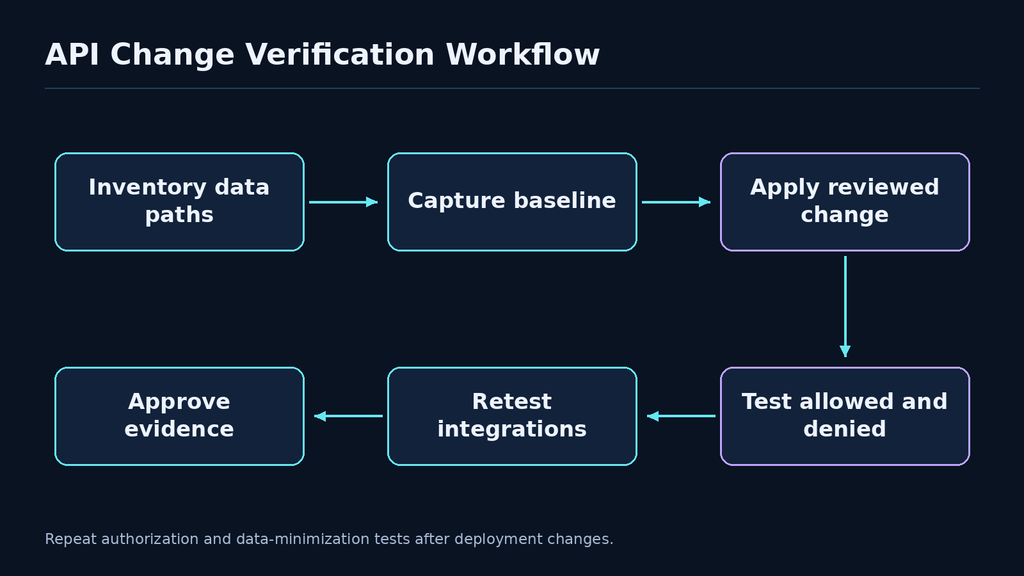
An authorized workflow using a platform such as Penligent can organize scoped API checks, synthetic fixtures, and retest evidence. The owner should still supply the business policy and the service-specific records needed to assess background processing, identity changes, and data impact. The tool’s result should remain tied to the route and outcome it actually observed.
Repair the policy mismatch and preserve the impact question
A confirmed authorization finding should produce two workstreams. The engineering workstream repairs the rule and verifies the deployed behavior. The assessment workstream determines what the available historical evidence says about earlier access or data exposure. A successful repair does not settle the historical question, and an investigation should not prevent a controlled protective change when the owner can preserve the necessary evidence first.
Give the developer a minimal reproducible case. Include the synthetic principal, resource relationship, operation, requested fields, expected decision, observed decision, and relevant state. Attach the minimum response or side-effect evidence needed to show the mismatch. Avoid a large collection of real personal records. The repair target should be understandable without reconstructing the tester’s entire session.
Identify the enforcing component and shared code paths. A missing object rule in one route may also affect another route using the same service function, while a separate worker may require its own review. The developer should map the repair’s intended coverage and choose corresponding tests. Do not assume a shared name proves shared enforcement or that one route’s failure proves every related route is vulnerable.
Test the original denied case after the change and retain the permitted counterpart. For a field repair, assert the exact allowed output or stored state. For a function repair, verify the disallowed role cannot perform the action. For an export repair, inspect the synthetic artifact and retrieval policy. The test should match the boundary that failed rather than rely on a generic clean scan.
Assess historical scope using the organization’s records and data inventory. Identify the relevant interval, routes, identities, resource populations, generated artifacts, and evidence coverage. A finding demonstrates a capability under the tested conditions; it does not automatically prove that an unauthorized party exercised it. Conversely, missing records can limit the ability to exclude earlier access. Preserve both distinctions in the assessment.
Use the privacy and incident owners for consequential decisions about personal-data handling and communications. The technical team should provide the observed facts, plausible data paths, completed controls, and evidence limits. It should not turn a successful test into an unsupported legal conclusion. A technical validation package can support those decisions while remaining precise about what it establishes.
Review existing generated or cached data where relevant. A corrected live route may leave earlier artifacts with an overly broad audience or field set. Determine which outputs remain accessible and apply the supported retention, access, or cleanup procedure approved by the owner. The repair record should distinguish changed code from changed historical output so the remaining work is visible.
Retain a clear closure record. State which policy now applies, which components enforce it, which fixtures passed, which historical questions were reviewed, and which exceptions remain. Assign each exception an owner and next action. The closure should be narrow enough that a future reader can assess it without interpreting a broad claim that the API is now universally secure.
Convert the fixture into a maintained regression case. Connect it to the route family, role, resource relationship, and data contract that matter. When those properties change, the owner should review the expected result deliberately. This is a more durable improvement than a one-time ticket because it preserves the business rule through later development and deployment changes.
Rehearse the assessment with realistic but harmless cases
A short tabletop exercise can test whether the organization can turn the advisory into decisions. Use fictional tenants, records, credentials, and artifacts. Give the application, infrastructure, identity, and privacy teams the evidence each would normally control. Ask them to identify the policy, the enforcing component, the observation needed, the immediate containment option, and the retest that would establish a repair.
In the first case, a customer detail route returns an internal field beside the permitted profile data. The team should define the intended field set, demonstrate the mismatch with a harmless marker, repair the serializer or policy boundary, and retest both the protected field and the legitimate response. Merely removing the field from the web interface should not close a server-side response finding.
In the second case, an internal API becomes reachable through a new partner route. The partner’s ordinary function works, but the service audience is broader than expected. The team should verify the effective ingress and identity controls, define the provider’s allowed operations, and test an out-of-scope fixture. The integration’s business success should not be confused with acceptance of its full authority.
In the third case, an export worker uses a broad service identity and includes another tenant’s fixture. The team should identify how the approved resource scope reaches the worker, repair that boundary, and inspect the generated artifact. It should also determine which existing outputs need review. A correct job-creation response is not sufficient evidence that the worker’s data set is constrained.
In the fourth case, the live API is repaired but a cached representation still contains the protected marker. The team should identify the cache layer, intended sharing policy, and supported invalidation or expiry behavior. The retest should cover the deployed path and relevant stored representation. A direct origin response can be correct while the caller still receives an older overly broad result.
In the fifth case, a partner credential is rotated but retains unnecessary access. The team should separate secret replacement from permission review, narrow the grant, and verify both the required integration function and the denied operation. The completion record should explain which authority changed. A rotation receipt alone should not be reported as evidence of least privilege.
In the sixth case, the application can show job creation but cannot show who retrieved the result. The team should preserve that evidence limit and design the missing observation. It should neither assert a completed extraction nor declare safety from the absence of a record the system never collected. The exercise rewards accurate reasoning and a concrete monitoring repair.
Evaluate the rehearsal by the quality of the handoff. Could another engineer reproduce the fixture? Did the team avoid collecting real personal data unnecessarily? Did every unresolved question receive an owner? Did the retest observe the actual boundary and its permitted counterpart? Did the final record separate current protection from historical impact? Those questions make the advisory operational without turning the exercise into a live data-extraction test.
Frequently asked questions about the Singapore API advisory
What did CSA and PDPC publish?
- They issued a November 12 joint advisory on personal-data risks arising from insecure APIs.
- The technical response should examine data scope, authority, deployment paths, and evidence across the API lifecycle.
Is a valid API token enough protection?
- No. Authentication identifies the caller; the application still needs to enforce the permitted records, fields, functions, and workflow state.
- Use paired synthetic fixtures to verify the actual policy.
Do random record identifiers solve BOLA?
- An identifier format does not define the caller’s permission. Verify the resource relationship at the enforcing boundary.
- The test should assess an explicit owned fixture rather than enumerate real records.
Can a WAF replace field and tenant authorization?
- No. A structurally ordinary request can ask for data outside the caller’s purpose or scope.
- Test the application’s object, field, and function decisions separately from edge filtering.
Why test an export more than once?
- Creation, execution, artifact content, and retrieval are different decisions. Follow the fixture through the relevant stages and lifecycle changes.
- A job’s successful creation does not establish its final data audience.
What should a third-party integration review retain?
- Keep the purpose, owner, allowed data and operations, credential reference, revocation process, and allowed and denied test results.
- Review authority as well as secret storage and rotation.
Does passing this assessment certify legal compliance?
- No. It provides technical evidence for the defined scope and interval. The responsible privacy and legal owners should assess their own obligations using the relevant facts.
- Keep historical evidence limits and unresolved data paths visible.
The useful outcome is a maintained data boundary: known APIs, intentional audiences, explicit record and field policies, governed integrations, and repeatable checks after change. The advisory becomes actionable when a team can demonstrate the permitted operation, reject its out-of-scope counterpart, and explain the evidence without extracting unnecessary personal data in the process.


 German
 English
 French
 Spanish
 Portuguese
 Japanese
 Korean
 Hindi
 Arabic
 Turkish
 Hebrew