
Microsoft released the November 2026 security updates on November 10. The operational priority is to match exploitation evidence and deployment conditions to the products actually in use. A Windows update record does not, by itself, close Office, Defender or an application-bundled runtime.
En official November CVRF feed, checked November 11, marks Outlook CVE-2026-124194 as exploitation detected. It also contains product-specific prerequisites and remediation records. This guide uses those records to propose a deployment queue and acceptance criteria; it does not report an exploitation test.
Read the release as product records
The feed includes Microsoft vulnerabilities and republished third-party records. Its total number of vulnerability objects is not a reliable count of newly disclosed Microsoft flaws. Keep the source snapshot date, CVE, affected product identifier and relevant remediation together when importing records into a patch queue.
November Patch Tuesday fell on Tuesday, November 10, 2026. The feed snapshot used here carries a current-release timestamp of November 11. Later revisions can change guidance. Recheck the individual Security Update Guide entry before approving a deployment or closing an exception.
Prioritize exploitation and reachable conditions
| Artículo | Microsoft source position | Deployment decision |
|---|---|---|
| CVE-2026-124194, Outlook spoofing | Exploitation detected; malicious-file opening and network access required; Preview Pane is not an attack vector. | Identify affected Office products and channels promptly, then verify the active corrected Outlook build. |
| CVE-2026-120003, Office RCE | Microsoft identifies Preview Pane as an attack vector. | Assess this entry independently; Outlook 124194’s preview limitation cannot be transferred to it. |
| CVE-2026-125136, network-device auto-setup RCE | Adjacent-network attacker; network-device discovery enabled; no user interaction in the advisory scenario. | Identify affected Windows devices and discovery configuration, especially on shared network segments. |
| CVE-2026-125134, Function Discovery RCE | Adjacent-network reachability with low-memory and timing conditions; high attack complexity. | Record service exposure and affected product applicability without describing it as ordinary Internet-facing RCE. |
| CVE-2026-125137, graphics-kernel privilege escalation | Local access and a VM with multiple assigned graphics adapters of differing configurations. | Route the finding to virtualization owners and check the specific host/guest deployment. |
These are triage examples, not the complete November release. Except for Outlook 124194, the cited entries were marked Exploited:No in this snapshot. That is a dated vendor assessment, not a guarantee against future exploitation. Direct references are the Microsoft entries for 124194, 120003, 125136, 125134 y 125137.
Close Office findings by product and channel
Inventory Microsoft 365 Apps separately from Office LTSC releases. Use the exact affected product row and Microsoft’s linked Office security-release history. A build threshold for one LTSC product is not a universal Microsoft 365 channel threshold.
Retain the installed product, architecture, update channel, applicable fixed build and the build observed after Outlook or the relevant Office application restarts. If an endpoint remains offline or awaits application restart, keep it pending. An update offered by the management service is not evidence that the application in use changed.
En dedicated Outlook patch-verification guide covers channel-specific handling. It serves the per-CVE task; this monthly page covers sequencing and closure across product families.
Use separate acceptance records for Windows and Defender
For Windows, match the operating-system release, servicing branch and architecture to the applicable Microsoft remediation. Review the associated KB’s known issues, plan the deployment and required restart, and record the resulting OS build. A successful installer result is one observation; active-state verification is another.
For Defender CVE-2026-122194, consult its product-specific advisory. Preserve the relevant Defender component and remediation version rather than assuming the Windows cumulative-update number establishes that correction. Test the ordinary protection-health workflow after the approved update.
Keep runtime lifecycle work visible
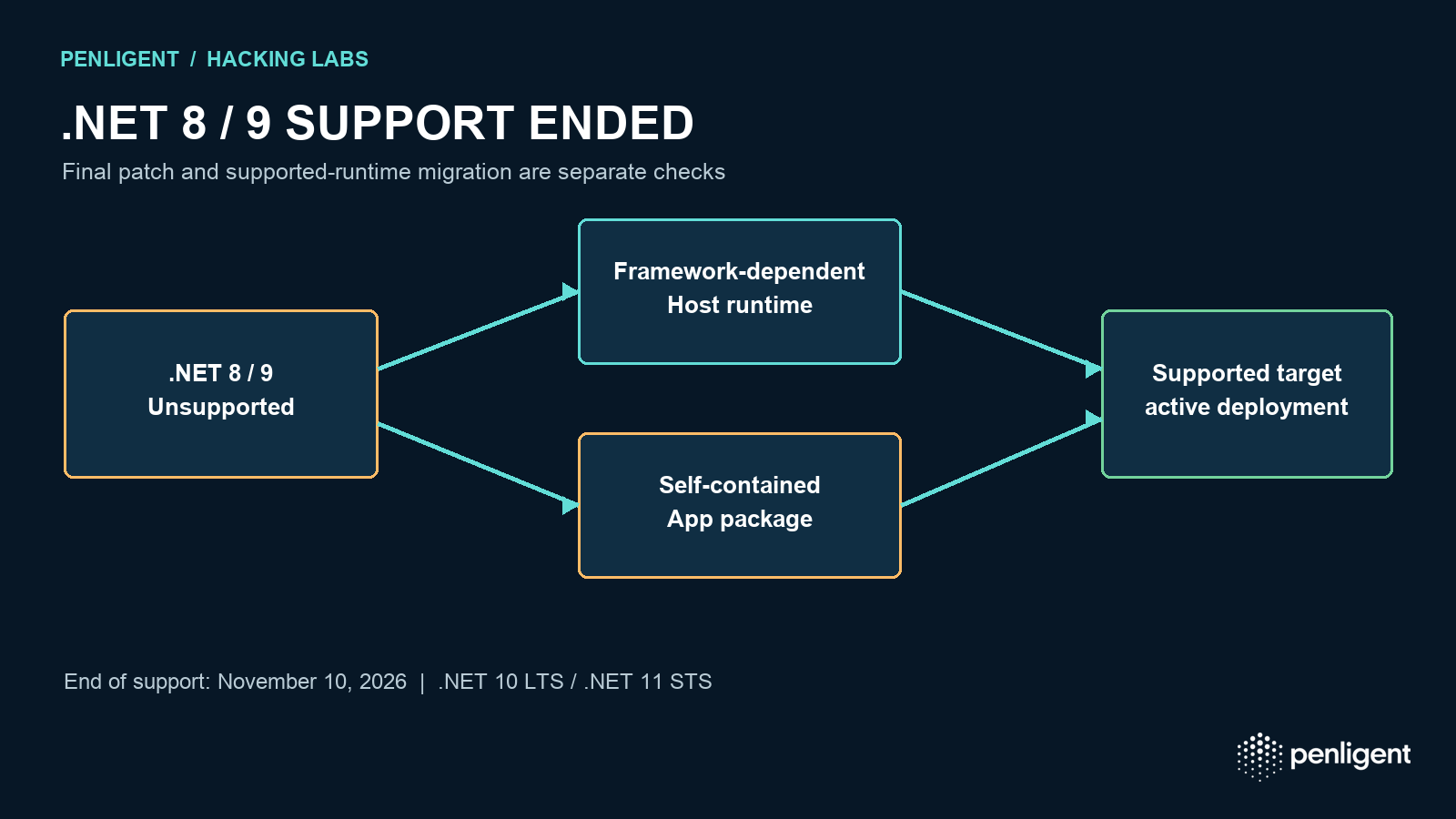
Microsoft’s .NET support policy lists November 10, 2026 as the end of support for .NET 8 and .NET 9. A final patch and continued support are different acceptance conditions. Track migration to a supported runtime as its own work item.
The same policy distinguishes framework-dependent applications from self-contained deployments. Updating the shared host runtime does not update the runtime bundled with every self-contained application. Ask application owners to identify the active deployment and rebuild/redeploy bundled runtimes through their supported process.
Retain one decision record per deployment
Asset and owner:
Exact product, branch and architecture:
CVE and source snapshot:
Applicable vendor remediation:
Exposure or configuration condition:
Approved deployment and restart evidence:
Active build or component version:
Ordinary service check:
Unresolved scope, owner and next review:
This is a blank proposed acceptance record. Populate it with observations from the deployment under review. Keep exceptions, offline devices, old application copies and unfinished incident investigations explicit. A corrected current build does not establish that no earlier compromise occurred.
Method: AI-assisted research and drafting against Microsoft primary sources checked November 11, 2026. The prioritization and acceptance records are proposed operational analysis. No customer systems or exploit payloads were tested.
 Spanish
 English
 German
 French
 Portuguese
 Japanese
 Korean
 Hindi
 Arabic
 Turkish
 Hebrew