
A compromised signing server creates a release-trust problem even before an investigation establishes whether a private signing key was exported. A defender needs to determine which artifacts reached the signer, who authorized their signing, and what was distributed during the period of uncertainty.
The November 16, 2026 reporting on BO Team brings that decision into focus. It describes a software developer intrusion involving legacy Log4Shell exposure, virtualization infrastructure and a server used to sign commercial software builds. The underlying Kaspersky ICS CERT publication is dated November 5. This is renewed reporting on an investigation, not a new Log4Shell disclosure.
The practical distinction is between access to a signing host, permission to request a signature, export of key material and distribution of an altered signed artifact. These are separate propositions. Evidence for one does not establish all four.
Read the incident claim at the right level
En Kaspersky report is titled “Supply chain attack: BO Team in a software developer’s infrastructure.” Its indexed publication date is November 5, 2026. The November 16 news account describes the investigation and attributes the technical account to Kaspersky.
The news account reports access to a signing server and discusses possible supply-chain objectives. It does not demonstrate that customers received a malicious signed release, nor establish that an exportable code-signing private key was stolen. Those outcomes should remain unconfirmed in an incident comparison or executive briefing.
The historical vulnerability is CVE-2021-44228. VMware’s VMSA-2021-0028 advisory, now hosted by Broadcom, documents Log4j-related product exposure and the vendor response. Use the product-specific advisory and exact build history for remediation. A major product version by itself is not enough to establish the complete patch state of a particular appliance.
The release framework below is original proposed defensive analysis. It can be applied when an investigation reaches build or signing infrastructure without replaying the reported intrusion or assuming every organization has the same architecture.
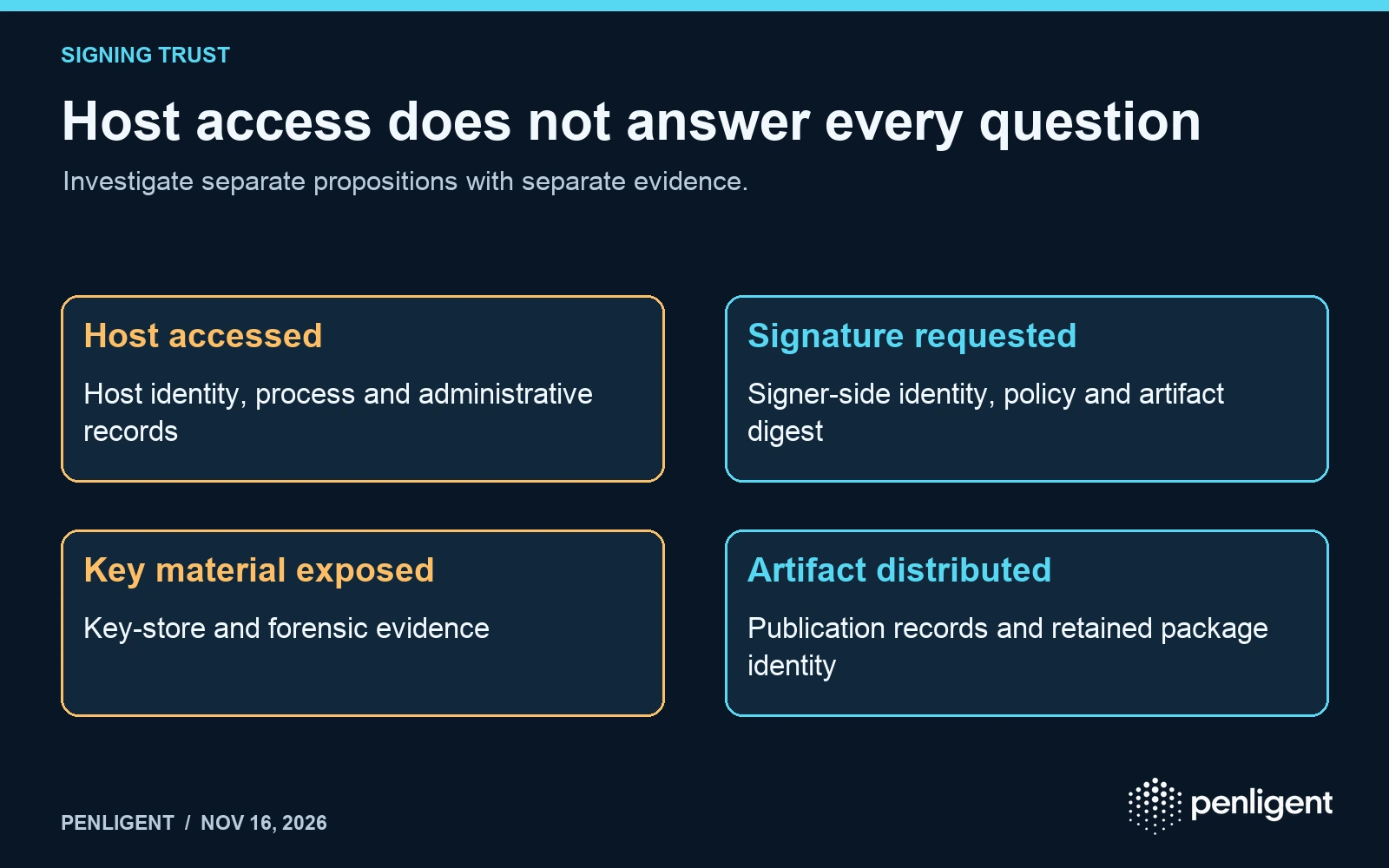
Separate the signer from the signing key
Start by documenting what “signing server” means in the affected environment. It may hold an exportable key, submit requests to a separate signing service, or invoke a hardware-backed key through an authorized identity. Those arrangements create different evidence and recovery requirements.
If the host stores an exportable private key, investigate access to the key material and its protection. If the host can invoke a remote or hardware-backed signer, investigate request authorization, signing-policy changes and the records held by that independent service. A key that cannot be exported can still be misused if a compromised client remains authorized to request signatures.
This is a threat-model distinction, not a statement about the key protection used by the victim in the BO Team account. The public reporting available for this draft does not establish that architecture.
| Proposition | Evidence to seek in your environment | Conclusion it cannot establish alone |
|---|---|---|
| Signing host accessed | Host authentication, process and administrative activity | That the private key was exported |
| Signing authority exercised | Signer-side request record, requesting identity and artifact digest | That the artifact was malicious |
| Key material exposed | Key-store access evidence, export records where available and forensic findings | Which signed artifacts reached customers |
| Build input altered | Repository, pipeline, dependency and build evidence | That the altered result was signed or distributed |
| Release distributed | Publication records, immutable package identity and delivery evidence | That every recipient executed the artifact |
Preserve the uncertainty in the table. “Unknown” is useful when it triggers a defined investigation task. Converting it to “no” because one log is absent creates false assurance.
Establish an incident window before enumerating releases
Choose the earliest defensible time at which the relevant infrastructure or identity may have become untrusted. The first alert is a discovery time; it may not be the beginning of the intrusion. Record the source of the lower bound, the confidence in it and the visibility gaps.
Extend the review through the time that trusted signing and distribution controls were restored. Rebuilding a host and reconnecting it to unchanged compromised automation does not, by itself, establish that restoration. The recovery owner needs to identify which identities, configuration sources and release channels were trusted when signing resumed.
Build a release inventory across that window. Include installers, update packages, libraries and other signed deliverables actually produced by the organization. These are categories for the organization’s own inventory, not a list of artifacts known to have been affected in the BO Team case.
Use artifact digests as the join key where the systems support them. A filename, semantic version or certificate subject may be shared by several different files. Preserve the algorithm and source of each digest so that later comparisons remain interpretable.
Keep one worksheet row per exact artifact. Record the build run, unsigned input digest if available, signed output digest, signing identity, release authorization and distribution destination. Empty cells remain unresolved evidence, rather than passing by default.
Join three independent records
The central investigation task is to connect build intent, signature creation and publication. Obtain these records from systems with different administrative trust where possible. Three logs copied from the same compromised host may describe three stages, but they are not three independent witnesses.
Build intent identifies the reviewed source revision, pipeline definition, approved inputs and build run. Review changes to the machinery that selects those inputs as well as changes to the source repository. A clean application commit does not establish a clean build when a pipeline can substitute an unreviewed artifact.
Signature creation identifies the digest submitted to the signer, the requesting identity, the applicable signing policy and the time. The post-signing file can have a different digest from its unsigned input, so do not expect those digests to match. Preserve the documented relationship through the signing job’s records.
Publication identifies the exact distributed artifact, destination, time and release approval. Compare the output of the signing job with the content actually published. A legitimate signature on a file in a build directory does not prove that the same file was delivered through every release channel.
For a release in the incident window, ask whether the three records agree and whether the systems providing them remained trustworthy. Where an artifact lacks a reliable path back to approved inputs, preserve it for investigation and have the release owner decide its disposition. Do not replace missing evidence with the fact that signature verification succeeds.
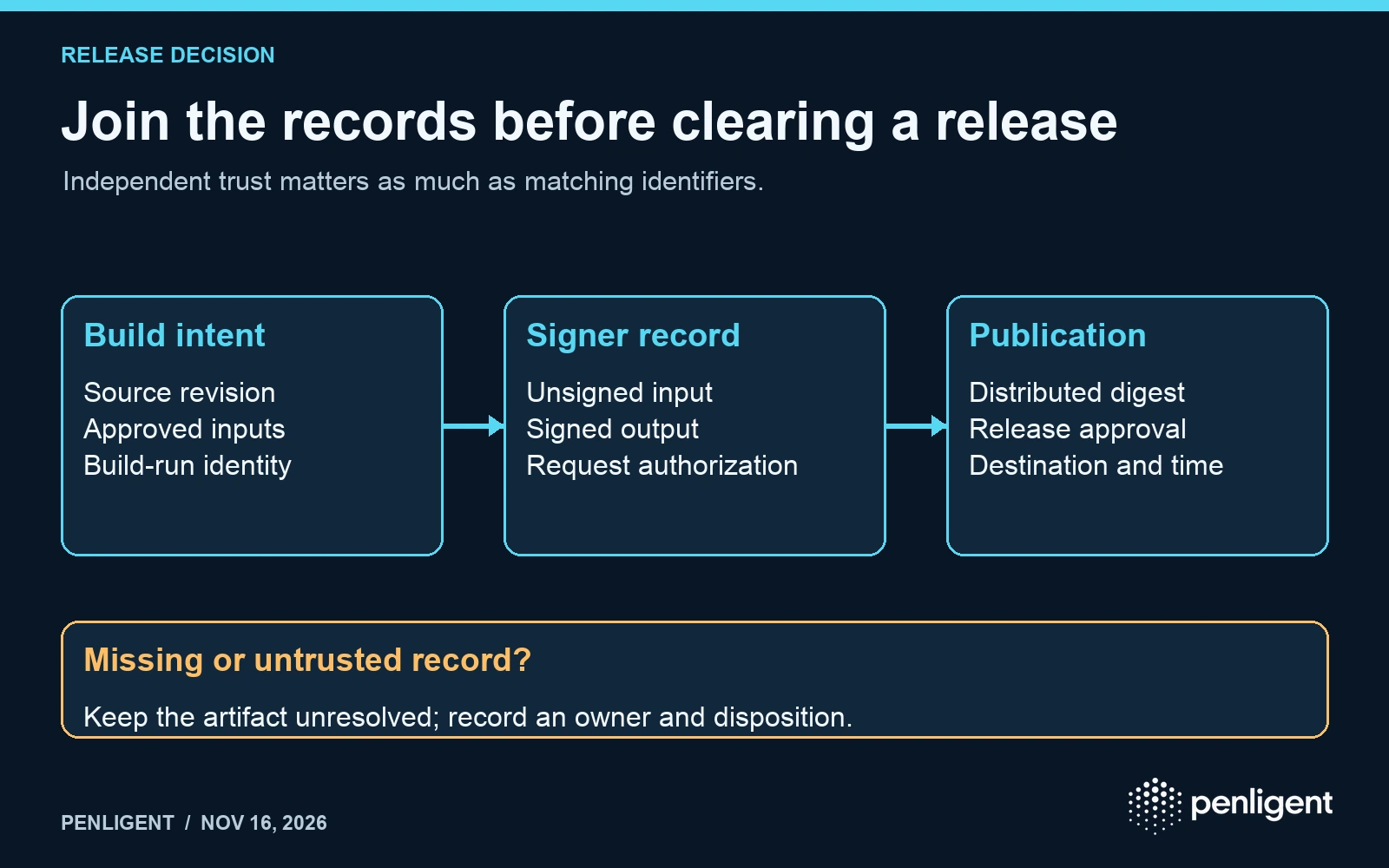
Make a release decision for each uncertainty
The following matrix is a proposed decision framework. It does not replace the organization’s incident-response authority, contractual notification obligations or certificate authority procedures.
| Evidence state | Immediate release-control question | Evidence needed before clearing the item |
|---|---|---|
| Host compromise; signer access unknown | Should signing from the affected path be suspended while authority is assessed? | Signer architecture, authorized identities and trustworthy request history |
| Unexplained signing request | Which exact artifact and identity does the request concern? | Input and output digests, request authorization and build relationship |
| Published artifact differs from approved signed output | Which distribution path introduced the difference? | Retained package copies, publication history and channel access records |
| Key export suspected or established | Which issuer and internal owners control the key response? | Key exposure assessment and the applicable replacement/revocation process |
| Records agree but share a compromised trust source | What independent evidence can support the release? | External signer records, protected approvals or independently retained artifacts |
| No anomalous retained records; collection incomplete | Which period and systems remain unobservable? | A documented visibility limit and an owner-approved disposition |
Do not make certificate revocation an unqualified command in a general article. The appropriate action depends on key exposure, the issuer’s procedures and the way deployed software verifies signatures. The security owner should coordinate the specific decision with the release and certificate owners while containing further unauthorized use.
Likewise, do not assert that replacing a certificate makes an already delivered artifact disappear. Distribution review and customer impact assessment have their own evidence. A response plan should identify the exact artifact and channel affected rather than treating a certificate change as the entire recovery.
Review virtualization as a separate trust dependency
The BO Team news account describes movement through virtualization infrastructure before the signing-server activity. The broader architectural question is whether the infrastructure that runs a builder or signing client can change its behavior or access its authority.
Document the actual control relationship. A guest operating-system team may maintain the signing application while a separate virtualization team controls snapshots, guest administration and recovery. An application-only patch check does not answer whether the underlying management plane was trustworthy during a build.
Review administrative identities and recovery artifacts with their owners. A restored VM can reintroduce an old secret, a vulnerable application or an untrusted pipeline configuration. Treat the restoration source as part of the release decision and preserve the evidence that justified trusting it.
This does not establish that every hypervisor compromise exposes every hardware-protected key or that every guest was modified. Record actual privileges, connectivity and observations. The question is which control paths existed and what evidence shows they were used.
Resume signing with explicit acceptance evidence
Define recovery criteria before the first new release. The record should identify the trusted build environment, authorized signing identity, reviewed policy and distribution path. Confirm that emergency access granted during response has an owner and a disposition.
Use a benign organization-owned test artifact through the recovered path. Retain its build reference, signing request, output identity and publication destination in a nonproduction channel. This validates the expected record linkage and release controls; it does not prove the entire historical environment was clean.
Test a denied action as well where the design supports it. A test identity lacking release authority should not be able to sign or publish the controlled artifact. Have the responsible administrator define that test in the appropriate nonproduction environment. No malicious payload, stolen certificate or public target is needed to assess the permission boundary.
For entry-surface work, keep the existing Log4Shell deployment-verification article as the canonical reference. Its patch and inventory task is distinct from deciding whether a signed release remains trustworthy after infrastructure compromise.
A follow-up assessment using Penligente should state whether it covers the repaired application surface, release authorization controls or both. Application assessment results should not be presented as forensic clearance of a signing key.
Report what is known about the artifact
An engineering report should let its reader distinguish “the host was accessed,” “this identity requested a signature,” “this artifact was altered” and “this package was distributed.” Attach evidence and visibility limits to each statement.
The BO Team reporting is a useful prompt to make those relationships reviewable. Its value is not a new CVE number. It is the reminder that infrastructure access can reach the machinery that turns a build into a trusted release. Closure requires evidence about that machinery and the artifacts it produced.
Method: AI-assisted defensive analysis prepared November 16, 2026. The VMware advisory was read directly. Incident details above are attributed to the linked November 16 reporting; the Kaspersky original was located in search but could not be read in full during preparation. Detailed incident-chain claims are therefore withheld pending primary-source review. The release matrix and worksheet are proposed methods; no affected organization, signing key or production pipeline was tested.
General product workflow
The official Penligent 3.0 video demonstrates the general product workflow. It does not reproduce the BO Team intrusion or establish the security of a signing environment.
 Spanish
 English
 German
 French
 Portuguese
 Japanese
 Korean
 Hindi
 Arabic
 Turkish
 Hebrew