
A public GitHub repository named Private-CISA reportedly exposed AWS GovCloud credentials, plaintext passwords, tokens, logs, internal deployment material, and software build documentation tied to the U.S. Cybersecurity and Infrastructure Security Agency and DHS systems. The repository was not a theoretical risk model. It was a real-world exposure discovered by GitGuardian researcher Guillaume Valadon and first reported in detail by KrebsOnSecurity. Krebs reported that the repository was maintained by an employee of Nightwing, a CISA contractor, and that CISA said it was investigating while seeing “no indication” at that point that sensitive data had been compromised. (krebsonsecurity.com)
The event matters because the exposed material sat at the intersection of cloud identity, source control, CI/CD, software artifacts, contractor access, and public repository hygiene. GitGuardian’s own write-up described the repository as 844 MB of data containing plaintext passwords, AWS tokens, Entra ID SAML certificates, Kubernetes manifests, ArgoCD application files, Terraform infrastructure code, GitHub Actions workflows, internal backups, and operational scripts. That is not simply a password leak. It is the kind of leak that can give an attacker both credentials and the map for using them. (blog.gitguardian.com)
The available public record does no prove that an attacker used the exposed credentials before researchers found them. It also does not allow outsiders to conclude the opposite. The difference is important. In a secrets exposure, “no public proof of compromise” is not the same thing as “no compromise.” A defender has to answer a narrower and harder set of questions: who cloned the repository, which credentials were valid during the exposure window, which cloud API calls were made, whether any build artifacts or deployment workflows changed, and whether internal package repositories were accessed.
What happened
The clearest public account came from KrebsOnSecurity. According to the report, a CISA contractor maintained a public GitHub repository that exposed credentials to several highly privileged AWS GovCloud accounts and many internal CISA systems. The same report said the repository contained files describing how CISA builds, tests, and deploys software internally. (krebsonsecurity.com)
GitGuardian’s postmortem says Valadon found the public repository on May 14, 2026. The repository was named Private-CISA, had been exposed since November 2025, and contained 844 MB of data across the working tree and Git history. GitGuardian listed CI/CD build logs, deployment workflow documentation, Kubernetes manifests, ArgoCD application files, Terraform code, GitHub Actions workflows, internal documentation backups, and scripts for GitHub, Kubernetes, ArgoCD, and infrastructure operations among the exposed materials. (blog.gitguardian.com)
The file names made the incident look almost implausible at first. GitGuardian said the repository contained names such as Important AWS Tokens.txt, AWS-Workspace-Firefox-Passwords.csv, Kube-Config.txt, external-secret-repo-creds.yaml, and directories such as LZ-Artifactory, Kubernetes-Important-Yaml-Filesy ENTRA ID - SAML Certificates. Valadon said the repository looked like a “catalogue of unsafe practices,” including plaintext passwords, backups committed to Git, and instructions to disable GitHub secret scanning. (blog.gitguardian.com)
Krebs reported that one exposed file, titled importantAWStokens, included administrative credentials to three AWS GovCloud servers. Another file, AWS-Workspace-Firefox-Passwords.csv, reportedly listed plaintext usernames and passwords for dozens of internal CISA systems. Security consultant Philippe Caturegli, founder of Seralys, told Krebs that he validated the exposed AWS credentials could authenticate to three AWS GovCloud accounts at a high privilege level. (krebsonsecurity.com)
The same Krebs report said the archive included plaintext credentials to CISA’s internal Artifactory, described as a repository for code packages used to build software. Caturegli warned that such access could be valuable to attackers seeking lateral movement or persistence through package tampering. That supply-chain angle is what separates this incident from a simple credential hygiene failure. (krebsonsecurity.com)
The incident in one table
| Question | Publicly reported answer | Por qué es importante |
|---|---|---|
| What was exposed | A public GitHub repository named Private-CISA reportedly held cloud keys, tokens, plaintext passwords, logs, internal documentation, CI/CD materials, Kubernetes and ArgoCD files, Terraform code, GitHub Actions workflows, and Entra ID SAML certificates. (blog.gitguardian.com) | The repository combined credentials with operational context, which can shorten the path from discovery to abuse. |
| Who found it | GitGuardian researcher Guillaume Valadon found the repository and reported it through CERT/CC and parallel contacts. (blog.gitguardian.com) | External discovery suggests internal controls did not catch or remediate the exposure quickly enough. |
| How long was it public | GitGuardian and Dark Reading reported exposure since November 2025; The Register described the repository as open for roughly six months. (Lectura oscura) | A multi-month exposure window changes incident response from “remove it” to “assume secrets may have been copied.” |
| What did CISA say | CISA said it was aware of the reported exposure, continued to investigate, and had no indication at that time that sensitive data was compromised. (krebsonsecurity.com) | That statement is cautious, not exculpatory. Public sources cannot confirm complete log review. |
| What remains uncertain | Whether unknown third parties accessed, cloned, or used any exposed material before takedown is not publicly proven. | That uncertainty is exactly why credential rotation and log review are required. |
| Why did it become a larger issue | Sen. Maggie Hassan requested an urgent classified briefing from CISA’s acting director after the exposure was reported. (Axios) | The issue moved from a security incident into federal oversight territory. |
Timeline
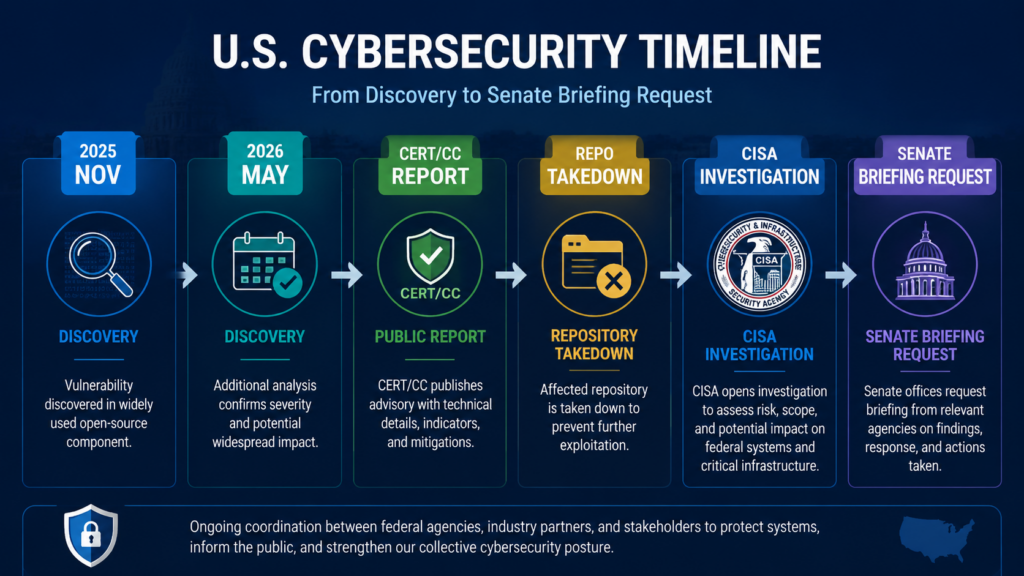
The public timeline begins in November 2025. Krebs reported that Caturegli said the Private-CISA repository was created on November 13, 2025. GitGuardian and Dark Reading also described the repository as publicly accessible since November 2025. (krebsonsecurity.com)
On May 14, 2026, GitGuardian found what appeared to be leaked CISA secrets in the public repository. GitGuardian says the repository contained 498 MB in the working tree, with the rest of the 844 MB total held in Git history and objects. Git history matters because deleting a file from the current tree does not remove it from previous commits, branch history, forks, clones, or caches. (blog.gitguardian.com)
GitGuardian reported the leak through the CERT/CC portal on May 14 at 4:14 PM CET and used personal contacts in parallel to speed disclosure. The company’s public write-up says CISA pulled the repository offline within 26 hours of the discovery process described in its post. (blog.gitguardian.com)
Krebs reported that the GitHub account exposing the CISA secrets was taken offline shortly after KrebsOnSecurity and Seralys notified CISA. Krebs also reported Caturegli’s statement that the exposed AWS keys remained valid for another 48 hours after the GitHub account went offline. (krebsonsecurity.com)
On May 19, 2026, Axios reported that Sen. Maggie Hassan requested an urgent classified briefing from acting CISA director Nick Andersen. The letter requested details on how the exposure happened, what was exposed, what steps CISA took to limit damage, and which contractor was responsible. Axios also repeated CISA’s statement that there was no indication at that time that sensitive data had been compromised. (Axios)
That timeline gives defenders the minimum mental model: a repository exposed for months, discovered externally, reported through multiple channels, taken down, and then followed by questions about credential validity, contractor control, and oversight.
Why AWS GovCloud makes the leak more sensitive
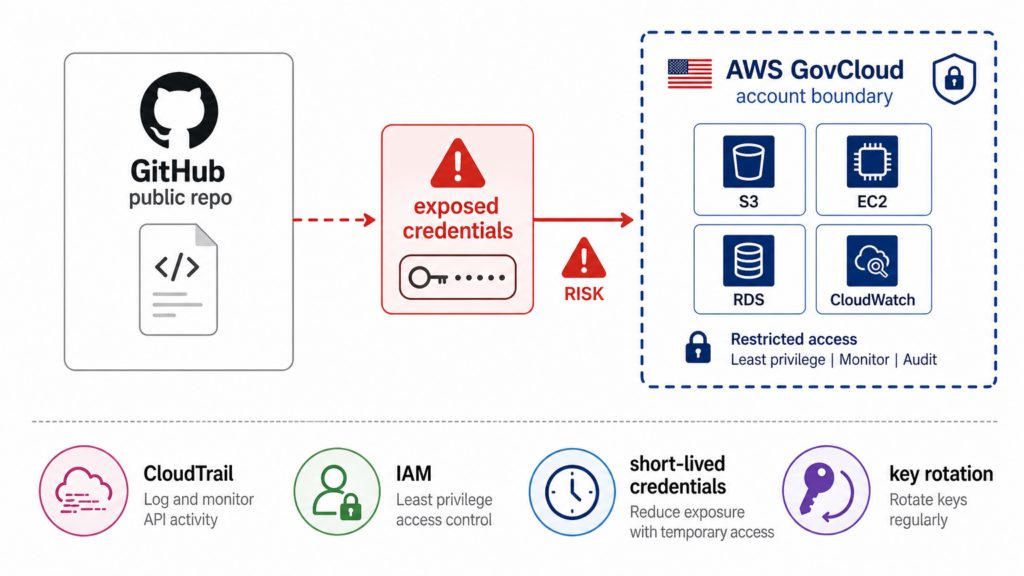
AWS GovCloud is not just another AWS region with a different name. AWS describes AWS GovCloud US as isolated AWS Regions designed to let U.S. government agencies and eligible customers move sensitive workloads into the cloud while addressing regulatory and compliance requirements such as FedRAMP High, DoD SRG Impact Level 5, CJIS, ITAR, and EAR. AWS also says GovCloud regions are physically isolated, logically isolated from other AWS Regions, and administered by vetted U.S. citizens under distinct controls. (docs.aws.amazon.com)
That does not mean the CISA GitHub leak exposed classified information. Public reporting does not establish that. The sensitivity comes from the trust boundary. AWS GovCloud is commonly used for regulated and government workloads, and AWS documentation states that GovCloud uses separate credentials from standard AWS. Standard AWS credentials cannot access GovCloud, and GovCloud credentials cannot access standard AWS Regions. (docs.aws.amazon.com)
That separation is a security feature, but it also means exposed GovCloud credentials are highly specific. They are not generic cloud keys floating in a developer’s hobby project. If valid and privileged, they can authenticate into an environment that exists precisely because normal cloud-region assumptions were not sufficient for the workload.
AWS’s own IAM guidance makes the broader lesson clear: use IAM roles and temporary credentials for human users and workloads where possible, require MFA when IAM users or root users are necessary, and rely on access-last-used information to update and remove long-term keys safely. AWS also warns that IAM users with access keys are an account security risk and says not to put access keys or credential information in application files. (docs.aws.amazon.com)
The Private-CISA incident is almost a perfect inversion of that advice. The reported leak involved long-lived credential material, plaintext files, and a public repository. Even if no attacker used the keys, the exposure path violated the operating assumptions that make sensitive cloud environments defensible.
What was reportedly exposed
The most useful way to understand this incident is to separate exposed material into classes.
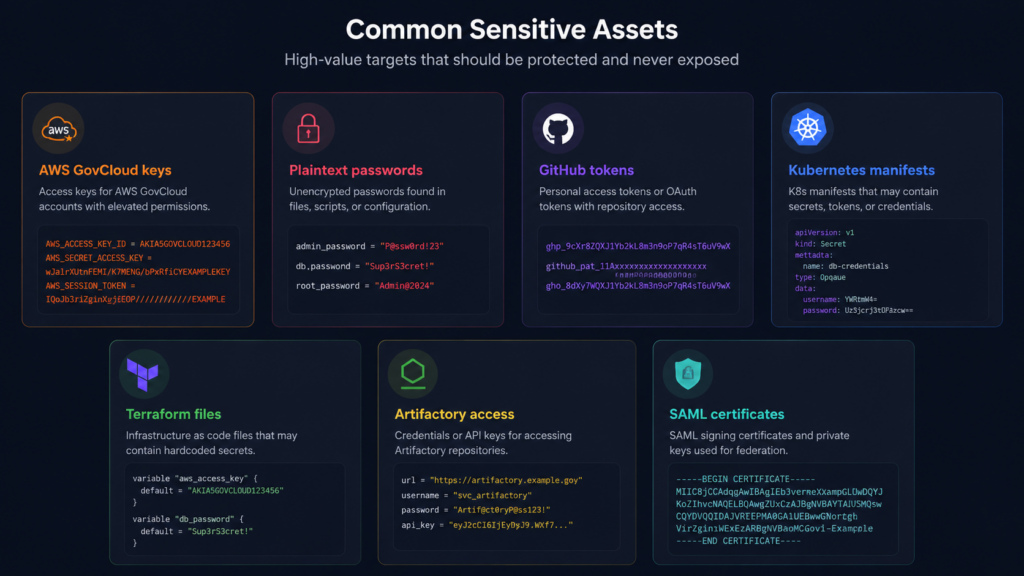
| Exposed material | Reported examples | Security meaning |
|---|---|---|
| Cloud credentials | AWS GovCloud tokens or keys, including a file described as importantAWStokens. (krebsonsecurity.com) | Potential direct cloud control-plane access if still valid and sufficiently privileged. |
| Plaintext passwords | AWS-Workspace-Firefox-Passwords.csv, reportedly listing usernames and passwords for internal systems. (krebsonsecurity.com) | A reusable credential source for internal access, password spraying, lateral movement, or service login attempts. |
| CI/CD and deployment materials | Build logs, deployment workflow documentation, GitHub Actions workflows, ArgoCD files. (blog.gitguardian.com) | A map of how code becomes deployed software, including where secrets may be injected. |
| Infrastructure-as-code | Terraform infrastructure code and related bundles. (blog.gitguardian.com) | Cloud architecture, IAM relationships, naming schemes, resources, and dependencies may become easier to enumerate. |
| Kubernetes material | Kubernetes manifests and secret-related YAML files. (blog.gitguardian.com) | Cluster structure, namespace names, service accounts, and deployment assumptions may be exposed. |
| Identity federation material | Entra ID SAML certificates. (blog.gitguardian.com) | Depending on exact content and validity, federation metadata may require review, rotation, or trust reassessment. |
| Artifact repository access | Plaintext credentials to CISA’s internal Artifactory, according to Krebs. (krebsonsecurity.com) | A possible path to package discovery, tampering, or persistence in build pipelines. |
The key point is that credentials rarely travel alone. A password file tells you where to log in. A Terraform bundle tells you what exists. A deployment document tells you which systems matter. A GitHub workflow tells you what secrets are available during automation. An Artifactory credential tells you where build inputs and outputs live. A Kubernetes manifest tells you how workloads are named and deployed.
Attackers do not need a single “magic” secret if the repository gives them a guided tour of the environment.
Public GitHub was not the problem by itself
The irony of a repository named Private-CISA being public is easy to understand, but the deeper issue is not that CISA uses GitHub. CISA has a public development guide that explicitly describes an “open-by-default” development policy. The same guide says CISA develops software in the open while protecting sensitive information, and it lists secret keys, access tokens, API keys, TLS keys, SSH keys, OAuth secrets, and other secrets as information that must be protected. (GitHub)
That distinction matters. Working in public can improve transparency, collaboration, and software quality. Public repositories are not inherently unsafe. The failure is letting private operational material enter a public collaboration channel without effective controls, review, or emergency containment.
The CISA guidance also says team members should ask CISA Infrastructure if they are unsure whether something should be public. That is a governance pattern: public-by-default requires strong classification, exception handling, and tooling that prevents “public-by-default” from becoming “secrets-by-accident.” (GitHub)
The Private-CISA leak shows what happens when that boundary collapses. A public repo can be appropriate for source code. It is not appropriate for plaintext passwords, cloud keys, SAML certificates, internal system inventories, or package repository credentials.
Why “no indication of compromise” is not the end of the story
CISA’s reported statement that it had no indication sensitive data was compromised is not the same as a public forensic conclusion. It is a careful incident response statement at a moment in time. (krebsonsecurity.com)
For a secrets leak, defenders have to avoid two equally bad assumptions. One bad assumption is panic: treating every system as certainly compromised without evidence can destroy forensic visibility and waste time. The other bad assumption is comfort: treating lack of confirmed abuse as proof that no abuse happened.
The practical middle path is evidence-driven containment. A security team would need to determine at least the following:
| Question | Evidence source |
|---|---|
| Was the repository cloned or downloaded by unknown parties | GitHub audit logs, repository access logs where available, public cache review, fork and mirror searches |
| Were exposed AWS keys used outside expected locations | AWS CloudTrail, IAM access-key last-used metadata, GuardDuty findings, VPC flow logs where applicable |
| Did internal systems receive logins using exposed credentials | SSO logs, VPN logs, application logs, IdP events, failed and successful authentication history |
| Did Artifactory receive suspicious reads or publishes | Artifactory access logs, package publish history, checksum changes, metadata changes |
| Did CI/CD workflows change | Git history, branch protection audit logs, workflow file diffs, runner logs |
| Were Kubernetes or ArgoCD credentials used | API server audit logs, ArgoCD logs, Kubernetes RBAC review, service account token usage where available |
| Were SAML or federation materials exposed in a way that affects trust | Certificate validity, IdP configuration, service provider trust metadata, signing key rotation history |
The absence of one signal is not enough. Public repository exposure, cloud authentication, internal application login, and CI/CD tampering leave different evidence trails. Incident response has to join those trails before making a confident statement.
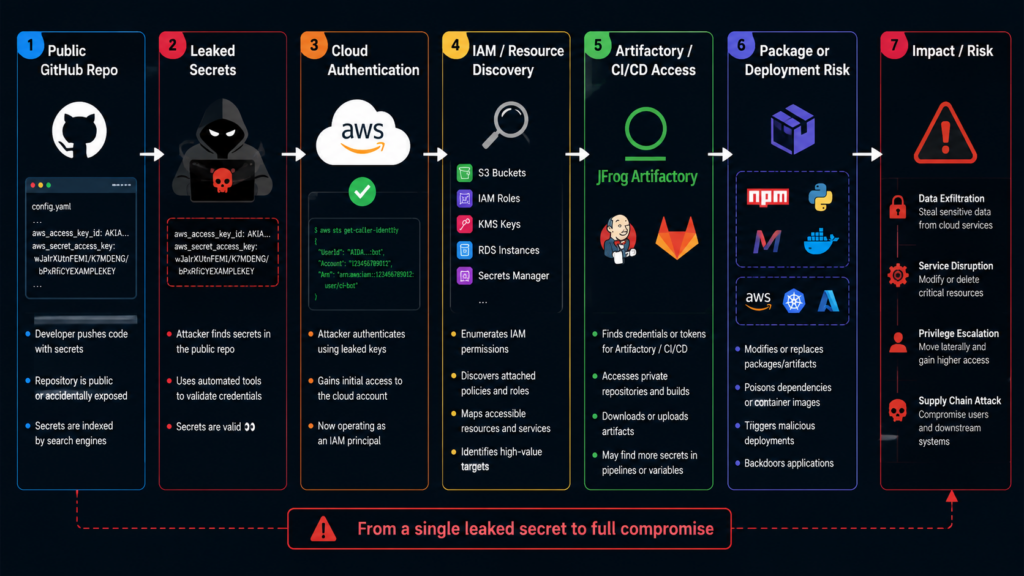
The likely risk model, from public repo to build-chain control
No public source has shown that attackers used the Private-CISA materials. Still, defenders can model the risk without making unsupported claims.
A realistic abuse path starts with discovery. Attackers routinely search public GitHub for secrets, tokens, private keys, .env files, cloud credentials, configuration files, and sensitive infrastructure names. A repository named Private-CISA with obvious filenames would be attractive because the contents signal both sensitivity and organizational identity.
The next phase is credential validation. A responsible researcher may test only enough to confirm validity and report. An attacker may do the same validation quietly, then enumerate permissions, list accessible resources, inspect IAM roles, read storage metadata, test internal services, or search for additional credentials.
The third phase is context assembly. Terraform files, Kubernetes manifests, ArgoCD definitions, and deployment documentation can tell an attacker how environments are structured. This can reduce the time needed to identify high-value systems, service accounts, package registries, deployment jobs, and naming patterns.
The fourth phase is persistence or tampering. If package repository credentials are valid, an attacker may look for ways to alter dependencies, poison internal packages, introduce a malicious build step, or place a backdoor in an artifact consumed by downstream automation. This is why Artifactory access is so important. A build-chain credential can be more dangerous than a single application login.
The final phase is cleanup and delay. With enough access, an attacker may avoid noisy actions, create secondary credentials, modify automation, or wait for future builds to spread tampered artifacts. That is not an assertion about what happened here. It is the reason Caturegli’s Artifactory warning matters. (krebsonsecurity.com)
How this differs from a normal source code leak
A source code leak is serious, but code alone often requires additional steps before it becomes access. A secrets-and-build leak can collapse those steps.
| Leak type | Riesgo primario | What defenders usually check |
|---|---|---|
| Source code only | Intellectual property exposure, vulnerability discovery, internal logic disclosure | Repository access, secret scanning, dependency review, code-specific vulnerability analysis |
| Secrets only | Direct account or service access | Key rotation, last-used logs, credential scope, authentication events |
| Infrastructure code | Environment mapping and policy discovery | IAM policies, exposed resource names, network paths, cloud inventory |
| CI/CD workflow leak | Pipeline logic, runner behavior, secret injection points | Workflow permissions, runner logs, protected branches, release jobs |
| Artifact repository credentials | Build-input and build-output trust | Package integrity, publish logs, checksums, provenance, downstream consumers |
| Private-CISA-style combined leak | Credentials plus operating map plus build-chain context | Full incident response across repository, cloud, IdP, CI/CD, package registry, and internal systems |
The Private-CISA exposure was dangerous because several categories appeared together. The attacker would not have to guess the environment from scattered clues. Much of the context was reportedly stored in one place.
GitHub secret scanning and push protection, useful but not magic
GitHub push protection is designed to stop hardcoded credentials before they land in a repository. GitHub’s documentation says push protection blocks supported secrets in command-line pushes, commits made in the GitHub UI, file uploads, REST API requests, and interactions with the GitHub MCP server for public repositories. (GitHub Docs)
That is exactly the kind of control that should prevent many accidental exposures. But it is not a complete security boundary. GitHub states that repository-level push protection requires GitHub Secret Protection, is disabled by default, and can be enabled by repository administrators, organization owners, security managers, or enterprise owners. GitHub also says user-level push protection is enabled by default for public repositories but does not generate bypass alerts unless repository-level protection is enabled. (GitHub Docs)
GitHub also documents important limitations. Push protection only blocks leaked secrets on a subset of the most identifiable user-alerted patterns; older token versions may not be supported; large pushes can time out; and if more than five new secrets are detected, GitHub shows only the first five at one time. (GitHub Docs)
Those limitations mean defenders should not treat push protection as a single control that guarantees clean repositories. It should be one layer among pre-commit scanning, repository history scanning, branch protection, organization-level policy, code review, secret inventory, automatic revocation, and audit logging.
The Private-CISA reporting adds another concern: Valadon told Krebs that commit logs showed the administrator disabled the default setting that blocks users from publishing SSH keys or other secrets in public repositories. (krebsonsecurity.com)
That is the governance failure. A control that can be disabled without escalation is not a reliable control for sensitive work.
AWS IAM lessons from the leak
AWS’s guidance is direct: use temporary credentials, such as IAM roles, instead of creating long-term credentials like access keys when possible. AWS also says access keys are long-term credentials for IAM users or the root user, and that the access key ID and secret access key must be used together to authenticate AWS CLI or API requests. (docs.aws.amazon.com)
Long-term keys are not always avoidable, but they should be rare, narrowly scoped, monitored, and rotated. In CI/CD, the stronger pattern is federation. GitHub’s documentation for OpenID Connect with AWS explains that OIDC lets GitHub Actions workflows access AWS resources without storing long-lived AWS credentials as GitHub secrets. The workflow requests a short-lived token, and AWS trust policy decides whether that token can assume a role. (GitHub Docs)
For defenders responding to a leak, the first task is not to run leaked credentials. It is to inventory and revoke credentials inside accounts you are authorized to manage.
# Defensive AWS IAM inventory for an account you own or are authorized to administer.
# Do not test third-party credentials.

aws iam list-users --output table

aws iam list-access-keys \
  --user-name EXAMPLE_USER \
  --output table

aws iam get-access-key-last-used \
  --access-key-id AKIAEXAMPLEKEYID

# If a key is confirmed exposed, deactivate first to stop use,
# then delete after emergency break-glass review.
aws iam update-access-key \
  --user-name EXAMPLE_USER \
  --access-key-id AKIAEXAMPLEKEYID \
  --status Inactive
A mature response should also search CloudTrail for use of exposed keys. The exact query depends on where logs are stored, but the logic is stable: find events where the access key ID appears, review source IPs, user agents, regions, event names, errors, and any resource changes.
# CloudTrail lookup for authorized accounts.
# This is useful for triage but may not be enough for long retention or high-volume environments.

aws cloudtrail lookup-events \
  --lookup-attributes AttributeKey=AccessKeyId,AttributeValue=AKIAEXAMPLEKEYID \
  --max-results 50
That command alone does not prove safety. CloudTrail lookup has practical limits, and many organizations centralize logs in S3, CloudTrail Lake, SIEM, or security data lakes. The investigation should check all authoritative log stores, not just the fastest CLI path.
Safer GitHub Actions access to AWS
GitHub’s secure-use guidance says pinning actions to a full-length commit SHA is currently the only way to use an action as an immutable release. That is because tags can move, while a specific SHA identifies a concrete Git object. (GitHub Docs)
GitHub’s OIDC guidance gives defenders another key improvement: stop storing long-lived cloud credentials as repository secrets when a cloud provider supports short-lived federation. For AWS, the workflow needs id-token: write only in jobs that need OIDC. The AWS side should restrict the trust policy to the exact organization, repository, branch, or environment that should assume the role. (GitHub Docs)
A safer workflow shape looks like this:
name: deploy

on:
  push:
    branches:
      - main

permissions:
  contents: read

jobs:
  deploy:
    runs-on: ubuntu-latest

    permissions:
      contents: read
      id-token: write

    steps:
      - name: Checkout
        uses: actions/checkout@8f4b7f84864484a7bf31766abe9204da3cbe65b3

      - name: Configure AWS credentials through OIDC
        uses: aws-actions/configure-aws-credentials@e3dd6a429d7300a6a4c196c26e071d42e0343502
        with:
          role-to-assume: arn:aws:iam::123456789012:role/github-actions-deploy-main
          aws-region: us-east-1

      - name: Deploy
        run: ./scripts/deploy.sh
The AWS trust policy should be narrow. A broad trust policy that allows every workflow in an organization to assume a production role recreates the same problem in a different form.
{
  "Version": "2012-10-17",
  "Statement": [
    {
      "Effect": "Allow",
      "Principal": {
        "Federated": "arn:aws:iam::123456789012:oidc-provider/token.actions.githubusercontent.com"
      },
      "Action": "sts:AssumeRoleWithWebIdentity",
      "Condition": {
        "StringEquals": {
          "token.actions.githubusercontent.com:aud": "sts.amazonaws.com"
        },
        "StringLike": {
          "token.actions.githubusercontent.com:sub": "repo:example-org/example-repo:ref:refs/heads/main"
        }
      }
    }
  ]
}
This does not solve every problem. If a trusted workflow is maliciously changed and merged, it can still request the role. That is why workflow files need CODEOWNERS, branch protection, required reviews, environment approvals, and monitoring for changes under .github/workflows.
Repository scanning after a secrets exposure
A common mistake after a public repository leak is checking only the current branch. Secrets often live in old commits, deleted files, tags, branches, patches, release assets, issue attachments, or workflow logs. Git history is part of the incident.
A quick defensive repository sweep can start with suspicious filenames and patterns:
# Run only on repositories you own or are authorized to assess.

git grep -n -I -E \
  'AWS_ACCESS_KEY_ID|AWS_SECRET_ACCESS_KEY|BEGIN RSA PRIVATE KEY|BEGIN OPENSSH PRIVATE KEY|password|passwd|token|secret|saml|kubeconfig|client_secret' \
  -- ':!node_modules' ':!vendor' ':!dist'

git log --all --name-only --pretty=format: \
  | sort -u \
  | grep -Ei 'password|passwd|secret|token|aws|kube|saml|artifactory|terraform|argocd|backup|credentials|\.csv$|\.env$'
That is not enough for enterprise assurance, but it catches the obvious. A deeper review should use purpose-built secret scanners, check all refs, inspect large-file storage, scan historical commits, search workflow logs, and compare results against a central secret inventory.
The important operational rule is simple: when a secret has ever been public, deletion is not remediation. Rotation is remediation. Audit is remediation. Rebuilding trust is remediation.
Artifactory and package repositories are a different class of risk
The Artifactory detail is one of the most important parts of the CISA GitHub leak. According to Krebs, the archive included plaintext credentials to CISA’s internal Artifactory, and Caturegli described it as a place where software packages used to build software are stored. (krebsonsecurity.com)
Package repositories sit between source code and production. They hold internal libraries, build artifacts, container images, plugins, release candidates, and sometimes third-party dependency caches. A compromised application credential may expose one system. A compromised artifact repository credential can alter what many systems install or deploy.
Defenders should therefore review:
| Zona | Qué verificar |
|---|---|
| Package publish history | Unexpected package versions, unusual publishers, modified metadata, abnormal publish times |
| Checksums and signatures | Differences from expected checksums, missing provenance, unsigned artifacts, new signing keys |
| Access logs | Reads or writes from unusual IPs, automation users used outside normal windows, failed login bursts |
| Build consumers | Which CI jobs, containers, servers, and deployment scripts consumed packages during the exposure window |
| Admin changes | New users, new API keys, changed permissions, new remote repositories or mirrors |
| Cached dependencies | Whether malicious or unauthorized packages were cached internally after public removal elsewhere |
The goal is not merely to rotate an Artifactory password. The goal is to prove that the artifact trust chain remained intact or to rebuild it if that proof is impossible.
Related CVEs that clarify the supply-chain risk
The Private-CISA incident does not need a CVE to be serious. It is not a conventional software vulnerability with a CVSS score. Still, two recent CVEs help explain why exposed CI/CD and artifact credentials deserve urgent treatment.
| CVE or incident | Why it is relevant | Exploitation condition | Real-world risk | Defensive priority |
|---|---|---|---|---|
| CVE-2025-30066, tj-actions changed-files | It shows how CI/CD automation can expose secrets through build logs when a trusted workflow component is compromised. NVD describes tj-actions/changed-files before version 46 as allowing remote attackers to discover secrets by reading Actions logs after tags were modified by a threat actor. (NVD) | A workflow used the affected Action during the compromise window and secrets were available in the runner environment. | CI/CD secrets could be printed to logs visible to repository readers, especially in public repositories. | Rotate exposed secrets, inspect workflow logs, remove affected versions, pin Actions to SHAs, and reduce workflow permissions. |
| CVE-2024-3094, XZ Utils backdoor | It shows how trusted upstream release artifacts can contain malicious code inserted through a build-time path. NVD describes malicious code in XZ upstream tarballs starting with version 5.6.0, using complex obfuscation to modify liblzma during build. (NVD) | A distribution, build system, or host used affected XZ versions in a vulnerable path. | A trusted library could affect software linked against it, with Red Hat assigning a critical CVSS 3.1 score of 10.0. (NVD) | Remove affected versions, verify build provenance, audit release inputs, and distrust artifacts whose origin cannot be proven. |
The connection is not that the CISA GitHub leak was “like XZ” in technical mechanics. It was not. The connection is that both cases punish over-trusted execution paths. If an attacker can influence what a build system consumes or what credentials a CI/CD system uses, the blast radius moves beyond one machine.
CVE-2025-30066 is even closer to this event. The GitHub Advisory Database says the compromised tj-actions/changed-files Action executed a malicious Python script that extracted secrets from the Runner Worker process memory and printed them in GitHub Actions logs. (GitHub)
That is the same class of lesson as Private-CISA: automation secrets are production assets, even when they live in developer tooling.
Defensive validation workflow
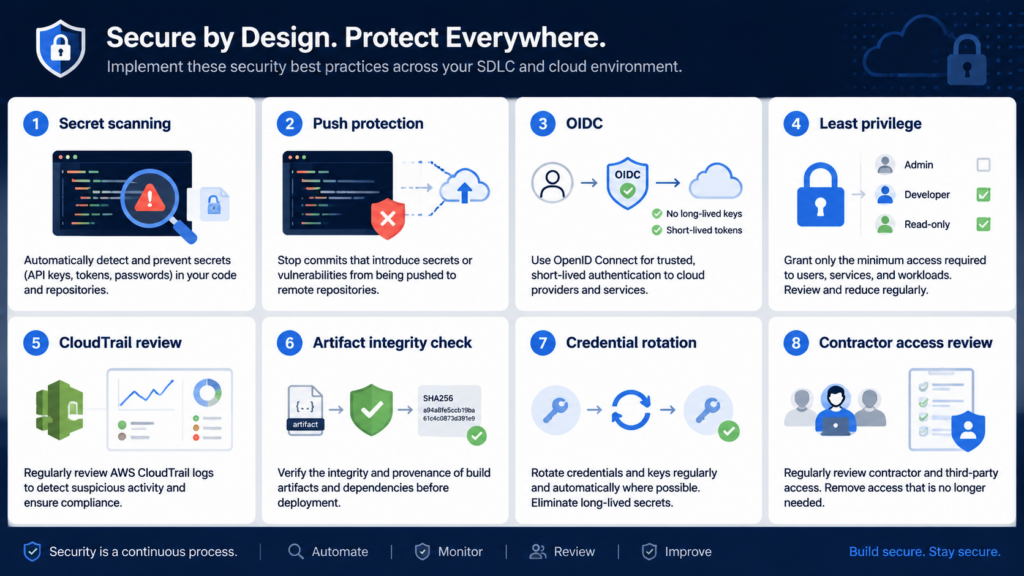
Security teams responding to a Private-CISA-style leak should use a staged workflow. The first stage is containment, not complete attribution. The second is evidence. The third is trust rebuilding.
Stage 1, stop further exposure
Take the repository offline or make it private, but do not treat that as sufficient. Preserve evidence before destructive changes where possible. If the repository is public and contains live secrets, assume it may already be cloned.
Immediate actions:
| Acción | Reason |
|---|---|
| Disable or rotate exposed cloud keys | Public credentials can be copied instantly. |
| Revoke exposed GitHub PATs and automation tokens | Source control tokens can reveal more secrets and alter workflows. |
| Rotate plaintext internal passwords | Password reuse and internal reachability are common lateral movement paths. |
| Revoke package registry and Artifactory API keys | Build-chain credentials can create downstream persistence. |
| Review SAML certificates and IdP trust | Federation material may require certificate rollover or metadata review. |
| Snapshot logs before retention loss | Cloud, GitHub, IdP, package registry, and CI logs may age out quickly. |
Stage 2, determine what the exposed identities could do
The key question is not only “which secrets leaked?” It is “what authority did each secret carry?”
Build a credential inventory:
| Secret class | Questions to answer |
|---|---|
| AWS access keys | Which IAM user or role? Which policies? Which accounts? Which last-used timestamps? Which source IPs? |
| GitHub tokens | Which owner? Which scopes? Which repositories? Which organization permissions? Any workflow or secret changes? |
| Internal passwords | Which systems? MFA enforced? SSO or local auth? Successful logins from abnormal locations? |
| Artifactory tokens | Read-only or publish? Which repositories? Any package upload or metadata change? |
| Kubernetes configs | Which cluster? Which namespace? Which RBAC verbs? Any token still valid? |
| SAML certificates | Signing or encryption? Still trusted? Any unusual IdP or SP events? |
Stage 3, review activity during the exposure window
A six-month public exposure window changes the investigation. Defenders should not focus only on the day of discovery. They should review the entire exposure interval where logs allow, with special attention to discovery, takedown, and credential rotation windows.
For AWS, review:
# Authorized defensive review only.
# Replace the example values with your own account and log setup.

aws iam get-access-key-last-used \
  --access-key-id AKIAEXAMPLEKEYID

aws cloudtrail lookup-events \
  --lookup-attributes AttributeKey=AccessKeyId,AttributeValue=AKIAEXAMPLEKEYID \
  --max-results 50
For GitHub, review:
# Requires GitHub CLI authentication and appropriate org permissions.

gh api \
  -H "Accept: application/vnd.github+json" \
  /orgs/EXAMPLE_ORG/audit-log \
  --paginate \
  -f phrase="secret_scanning_push_protection" \
  > github-audit-secret-scanning.json

gh api \
  -H "Accept: application/vnd.github+json" \
  /orgs/EXAMPLE_ORG/audit-log \
  --paginate \
  -f phrase="oauth_authorization" \
  > github-audit-oauth.json
For workflow changes:
git log --all -- .github/workflows
git log --all --name-status -- .github/workflows
git diff OLD_TRUSTED_COMMIT..HEAD -- .github/workflows
For artifact repositories, the exact commands depend on product and deployment model. The logic is stable: export access logs, list token creation and last use, list package publishes, compare checksums with trusted baselines, and identify downstream systems that pulled packages after the exposure began.
Stage 4, rebuild trust
If a credential could modify a build input, the response cannot stop at credential rotation. The team must prove build integrity or rebuild from a known-good state.
That may require:
| Rebuild action | When it is needed |
|---|---|
| Rebuild packages from trusted source | Any package registry credential had publish access. |
| Rebuild containers | CI/CD secrets or base images may have been exposed or tampered with. |
| Reissue signing keys | Signing material or release automation credentials were exposed. |
| Rotate deploy keys | Source control or deployment secrets appeared in the repository. |
| Regenerate SAML certificates | Federation signing or encryption material was exposed. |
| Re-provision service accounts | Kubernetes or cloud service account credentials were valid. |
| Re-run security tests | The environment changed after containment and needs proof, not assumptions. |
A security team using agent-assisted validation should keep the scope explicit and authorized. Tools such as Penligent focus on authorized security testing, evidence collection, exploit verification, and reportable workflows for security engineers and red teams, which is relevant when teams need repeatable validation rather than a one-off manual checklist. (penligent.ai) Penligent has also published technical analysis of supply-chain incidents where developer, CI, cloud, and package-registry secrets become the real blast radius, a pattern that is closely related to the Private-CISA lessons even though the specific incident is different. (penligent.ai)
Common mistakes after a GitHub secrets leak
The most dangerous mistakes are usually operational, not technical.
| Mistake | Why it fails |
|---|---|
| Deleting the repository and stopping there | Public Git repositories can be cloned, mirrored, cached, forked, or preserved in history. |
| Rotating only the most obvious AWS key | The repository may contain GitHub tokens, internal passwords, SAML material, Kubernetes configs, package registry tokens, and secondary secrets. |
| Checking only the current branch | Deleted secrets may still exist in Git history, tags, old branches, release assets, or workflow logs. |
| Treating “no evidence” as “no access” | The right standard is whether logs can support a conclusion, not whether public proof exists. |
| Ignoring package repositories | Artifact credentials can affect downstream builds and deployments. |
| Ignoring contractor identity | Contractor accounts, personal devices, personal GitHub accounts, and email mixing can become uncontrolled trust paths. |
| Letting admins bypass scanning silently | Push protection and secret scanning need policy, alerting, and exception review. |
| Reusing old credentials after cleanup | Any public secret should be considered burned. |
Contractor access is a security boundary
Krebs reported that the Private-CISA repository was maintained by an employee of Nightwing, a government contractor based in Dulles, Virginia, and that Nightwing declined comment and directed questions to CISA. (krebsonsecurity.com)
That detail matters because contractor access is not a procurement detail. It is part of the attack surface. A contractor may need deep access to operate systems, but the customer still owns the risk of identity lifecycle, repository boundaries, exception approvals, device posture, monitoring, and offboarding.
A strong contractor-access model should answer:
| Control area | Practical requirement |
|---|---|
| Identity source | Contractor identities should be managed through enterprise IdP controls, not unmanaged personal accounts. |
| Source control | Work repositories should live in approved organizations with enforced policies. |
| Personal GitHub use | Personal accounts should not host customer secrets, backups, internal diagrams, or credential material. |
| Device posture | Access should depend on managed devices, disk encryption, EDR, and policy compliance where appropriate. |
| Ciclo de vida de los tokens | Contractor tokens should expire, be reviewed, and be revoked on role change or contract end. |
| Admin exceptions | Disabling secret scanning, push protection, branch protection, or audit controls should require approval and alerting. |
| Supervisión | Contractor activity should be visible in audit logs with unusual behavior reviewed. |
| Data handling | Backups, exports, screenshots, and local sync folders need explicit rules. |
The Private-CISA repository reportedly looked less like a curated project and more like a working scratchpad or synchronization mechanism. Caturegli told Krebs that use of both a CISA-associated email address and a personal email address suggested the repository may have been used across differently configured environments, while Git metadata alone did not prove which endpoint or device was used. (krebsonsecurity.com)
That is exactly the kind of ambiguity mature governance tries to prevent. Sensitive work should not depend on guessing which laptop, account, or sync path held the keys.
How defenders should prioritize remediation
A useful remediation plan starts with blast radius, not embarrassment. The most urgent systems are those where a leaked credential can still authenticate or where logs show suspicious use.
| Prioridad | Acción | Por qué |
|---|---|---|
| Immediate | Revoke or disable exposed cloud, GitHub, Artifactory, Kubernetes, SAML, and internal credentials | Public secrets are no longer secrets. |
| Immediate | Preserve logs and repository evidence | Deleting first can destroy the evidence needed to know what happened. |
| Immediate | Identify all credential owners and scopes | You cannot contain what you cannot map. |
| Alta | Review CloudTrail, IdP, GitHub, Artifactory, CI/CD, ArgoCD, and Kubernetes logs | Each system leaves different evidence. |
| Alta | Review package and artifact integrity | Build-chain tampering can persist after credentials are rotated. |
| Alta | Replace long-lived cloud keys with OIDC or short-lived roles where possible | Reduces the value of future repository leaks. |
| Medio | Enforce repository-level push protection and secret scanning policy | User-level protections alone may not provide sufficient organizational visibility. |
| Medio | Require review for workflow, IaC, and package-publishing changes | CI/CD changes can silently alter deployment trust. |
| Medio | Add contractor-specific access reviews | Prevents unmanaged exceptions from becoming hidden production access. |
| Long term | Build continuous external exposure monitoring | Public GitHub, package registries, paste sites, and cloud assets must be treated as attack surface. |
The order matters. Do not spend the first day writing a policy memo while valid credentials remain active. Do not spend the second day celebrating takedown while artifacts and logs remain unchecked.
Practical controls that would have reduced the blast radius
No single control would have made this incident harmless. Several controls together would have made it less likely, less severe, or easier to contain.
Short-lived credentials
Long-lived AWS access keys should be the exception. GitHub Actions can use OIDC to obtain short-lived AWS credentials without storing long-lived cloud secrets in GitHub, and AWS recommends temporary credentials such as IAM roles where possible. (GitHub Docs)
Narrow IAM permissions
If a credential leaks, least privilege decides whether the incident is a small cleanup or a major compromise. A deployment key should deploy one workload, not administer multiple accounts. A documentation workflow should not read cloud secrets. A package-build job should not manage IAM.
Repository-level secret protection
User-level push protection is helpful, but sensitive organizations need repository, organization, or enterprise policy with alerting. GitHub documents that repository-level push protection can generate alerts for bypasses, while user-level push protection does not generate bypass alerts unless repository-level protection is also enabled. (GitHub Docs)
Immutable workflow dependencies
GitHub advises pinning Actions to full-length commit SHAs because that is the way to use an action as an immutable release. Tag-based references are easier to read but weaker against tag movement or compromised maintainership. (GitHub Docs)
Workflow permissions by job
Set low default permissions and grant only what a job needs.
permissions:
  contents: read

jobs:
  lint:
    permissions:
      contents: read

  release:
    permissions:
      contents: read
      id-token: write
      packages: write
Branch and workflow change protection
Any change to .github/workflows, deployment scripts, Terraform modules, ArgoCD manifests, package publishing scripts, or repository settings should be treated as a high-risk change. Require CODEOWNERS review and block direct pushes to protected branches.
Artifact provenance
Internal package repositories should record who published what, from which build, using which signing key, and from which commit. If a leaked Artifactory credential could publish packages, package provenance becomes an incident response requirement.
Secrets inventory
A secret that is not inventoried cannot be rotated reliably. Teams should know which systems issue secrets, where they are stored, who owns them, which automation uses them, when they were last used, and how to revoke them.
The role of AI in this kind of incident
The CISA GitHub leak was not an AI-agent incident. It should not be forced into that box. But AI changes the operational tempo around these exposures.
An attacker can use AI assistance to triage a large leaked repository faster: summarize file trees, identify likely credential formats, cluster internal systems, generate cloud enumeration checklists, compare Terraform resources, or draft queries for logs. None of those tasks requires a frontier exploit model. They are ordinary analysis tasks accelerated by automation.
Defenders can use similar automation, but the difference is governance. Defensive AI-assisted workflows should operate inside an authorized scope, avoid running unknown credentials, preserve evidence, and produce reproducible findings. The advantage comes from reducing time-to-understanding, not from replacing incident response judgment.
This is also why external exposure monitoring and attack-surface validation need to be continuous. A six-month public repository exposure is not a problem a quarterly manual review will reliably catch.
What security teams should check in their own environment
Even if an organization has no connection to CISA, the Private-CISA event is a useful test case. A security team can ask whether the same failure could happen internally.
Start with source control:
# Find repositories with risky names or content patterns.
# Example for local mirrored repos or exported repository lists.

grep -RInaE \
  'AWS_SECRET_ACCESS_KEY|BEGIN OPENSSH PRIVATE KEY|BEGIN RSA PRIVATE KEY|client_secret|password|passwd|kubeconfig|saml|artifactory|argocd' \
  ./repos \
  --exclude-dir=.git \
  --exclude-dir=node_modules \
  --exclude-dir=vendor
Then check GitHub organization policy:
| Question | Good answer |
|---|---|
| Is secret scanning enabled across sensitive repositories | Yes, at org or enterprise level where licensing and platform allow |
| Is push protection enforced | Yes, with bypass alerts reviewed |
| Can repository admins disable scanning silently | No, exceptions require approval and generate audit events |
| Are public repositories allowed by default | Only where classification rules are clear and automated checks are in place |
| Are personal accounts allowed to host work material | No sensitive work material outside approved orgs |
| Are workflow changes protected | Yes, with CODEOWNERS and required review |
| Are GitHub Actions pinned | High-risk and third-party Actions pinned to SHAs where practical |
| Are cloud credentials stored as long-lived secrets | Prefer OIDC or short-lived credentials |
Then check cloud identity:
| Question | Good answer |
|---|---|
| Do human users use federation | Yes, with MFA and centralized identity controls |
| Do workloads use IAM roles | Yes, with short-lived credentials |
| Are long-term access keys rare | Yes, inventoried and justified |
| Are access keys reviewed by last used date | Sí |
| Are unused keys disabled | Sí |
| Are exposed keys automatically revoked | Yes, where provider integrations support it |
| Are CloudTrail logs centralized and retained | Yes, long enough for exposure windows measured in months |
Then check CI/CD and artifact systems:
| Question | Good answer |
|---|---|
| Which jobs can publish packages | Only approved release workflows |
| Which tokens can write to package registries | Narrowly scoped, rotated, logged |
| Are package publishes signed or traceable | Sí |
| Can a developer workstation publish production artifacts | No, or only through controlled release paths |
| Are internal mirrors monitored | Sí |
| Are build logs checked for secrets | Sí |
| Are workflow secrets exposed to pull requests | No, except through carefully controlled patterns |
PREGUNTAS FRECUENTES
What happened in the CISA GitHub leak?
- A public GitHub repository named Private-CISA reportedly exposed sensitive CISA and DHS-related materials, including AWS GovCloud credentials, plaintext passwords, tokens, logs, and internal build or deployment files. (krebsonsecurity.com)
- GitGuardian researcher Guillaume Valadon discovered the repository and reported it through CERT/CC and other channels. (blog.gitguardian.com)
- CISA said it was aware of the reported exposure, was investigating, and had no indication at that time that sensitive data had been compromised. (krebsonsecurity.com)
Were CISA systems confirmed compromised?
- Public reporting does not prove that unknown attackers used the exposed credentials.
- Public reporting also does not prove that no one accessed or copied the repository before discovery.
- A reliable conclusion would require repository access data, cloud audit logs, identity-provider logs, CI/CD logs, package-registry logs, and credential last-used evidence.
- In a secrets incident, defenders should rotate exposed credentials and review logs even when compromise is not confirmed.
Why are AWS GovCloud keys sensitive?
- AWS GovCloud US is designed for U.S. government agencies and eligible customers running sensitive or regulated workloads, including environments tied to FedRAMP High, DoD SRG, CJIS, ITAR, EAR, and CUI requirements. (docs.aws.amazon.com)
- GovCloud uses separate credentials from standard AWS Regions. Standard AWS credentials cannot access GovCloud, and GovCloud credentials cannot access standard AWS Regions. (docs.aws.amazon.com)
- If valid and privileged, exposed GovCloud credentials can represent direct access to a high-trust environment.
Why does Artifactory access matter?
- Artifactory and similar package repositories sit inside the software supply chain.
- A credential with write access may allow an attacker to modify packages, publish malicious artifacts, or alter build inputs.
- Even read access can reveal package names, internal dependencies, build structure, and software architecture.
- Defenders should review package publish history, access logs, checksums, signing keys, and downstream consumers after any artifact-repository credential exposure.
Does GitHub push protection prevent this kind of incident?
- GitHub push protection can block supported secrets before they reach a repository, and it is an important control. (GitHub Docs)
- It does not detect every possible secret. GitHub documents limitations involving supported patterns, older token formats, large pushes, and cases where only a subset of detected secrets is shown. (GitHub Docs)
- Repository-level and organization-level enforcement matter because user-level protection alone may not produce the audit visibility a security team needs. (GitHub Docs)
- Secret scanning must be paired with policy, review, automatic revocation, history scanning, and incident response.
What should defenders check first after a GitHub secrets leak?
- Identify every exposed credential and its owner.
- Disable or rotate credentials that are confirmed exposed.
- Preserve repository, cloud, IdP, CI/CD, and package-registry logs before they age out.
- Check Git history, branches, tags, release assets, and workflow logs, not only the current branch.
- Review whether any exposed credential could modify source code, CI/CD workflows, packages, containers, infrastructure, or identity trust.
- Rebuild affected systems if integrity cannot be proven.
How is this different from a normal source code leak?
- A normal source code leak may reveal logic, vulnerabilities, or intellectual property.
- The Private-CISA leak reportedly combined credentials, passwords, cloud keys, infrastructure code, deployment workflows, internal documentation, and package-repository access. (blog.gitguardian.com)
- That combination can reduce the attacker’s work from “find a path” to “follow the map and test the keys.”
- The supply-chain risk is higher when exposed credentials can affect build systems or artifact repositories.
What is the biggest lesson from the Private-CISA leak?
- Treat public code platforms as part of the attack surface.
- Treat CI/CD, package registries, and cloud identities as production systems.
- Replace long-lived credentials with short-lived, scoped identity wherever possible.
- Do not allow administrators to disable protective controls silently.
- Audit contractor access as carefully as employee access.
- Assume a public secret has been copied, then prove what it could and could not access.
Closing judgment
The CISA GitHub leak was not just a bad filename, a careless upload, or a contractor embarrassment. It was a failure of boundaries. Secrets crossed into Git. A public repository reportedly held cloud credentials, plaintext passwords, SAML material, infrastructure code, deployment context, and package-repository access. A control meant to stop secrets from reaching public code was reportedly disabled. Long-lived keys allegedly remained valid after the repository was taken down.
The lasting lesson is practical: modern security programs cannot separate repository hygiene from cloud identity, CI/CD, artifact integrity, and contractor governance. The systems are connected in production, so they have to be defended as one connected attack surface.

 Spanish
  English
  German
  French
  Portuguese
  Japanese
  Korean
  Hindi
Hindi  Arabic
  Turkish
  Hebrew