
CVE-2026-53434 is a revocation-checking failure in Apache Tomcat, not a generic HTTPS break and not a remote code execution bug. The issue appears when Tomcat is using the FFM-based connector path and is configured with certificate revocation lists. In affected versions, invalid CRL configuration could be ignored instead of treated as a hard failure. That matters when Tomcat is expected to reject revoked client certificates at an authentication boundary, such as an mTLS-protected API, an internal control plane, an administrative interface, a partner gateway, or a service-to-service endpoint that relies on client certificates for identity.
Apache lists the affected ranges as Tomcat 11.0.0-M1 through 11.0.22, Tomcat 10.1.0-M7 through 10.1.55, and Tomcat 9.0.83 through 9.0.118. The recommended fixed versions are 11.0.23, 10.1.56, and 9.0.119. NVD records the same affected and fixed version ranges, while Apache’s security pages classify the issue as Low severity. NVD’s page, however, shows a CISA-ADP CVSS 3.1 score of 9.1 Critical, which makes this a good example of a vulnerability where the operational risk depends heavily on how the affected component is used. (nvd.nist.gov)
The useful way to read this CVE is simple: if a Tomcat deployment uses the affected FFM/OpenSSL path and treats CRL-based client certificate revocation as part of the access control model, this is not a cosmetic bug. If a site is only serving ordinary HTTPS to browsers and never asks Tomcat to validate client certificates against a CRL, the exposure is likely different. The same CVE can be low priority in one environment and urgent in another because the security boundary is not the Tomcat process alone. The boundary is the trust decision created by Tomcat, the certificate authority, the CRL, the connector implementation, and the application’s authorization model.
What actually fails
A certificate revocation list is part of the X.509 public key infrastructure model. RFC 5280 describes CRLs as signed and time-stamped lists that identify revoked certificates, usually by serial number. In practical terms, a certificate can be mathematically valid, issued by a trusted CA, and still be unacceptable because the CA has revoked it. That is why revocation checking exists. It lets a verifier reject certificates that were once valid but should no longer grant access. (datatracker.ietf.org)
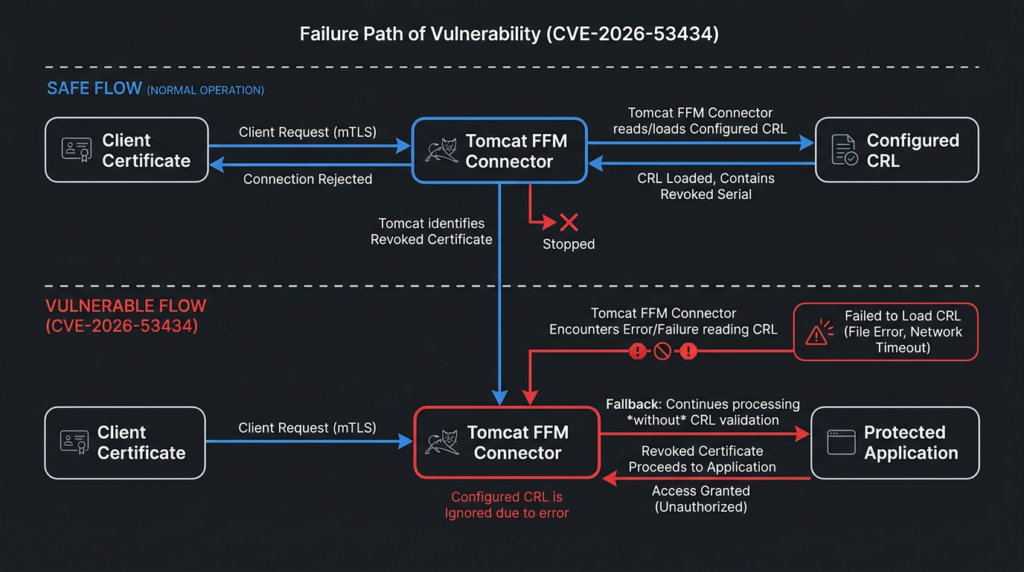
CVE-2026-53434 is about what happens when Tomcat is told to use CRLs but the CRLs cannot be loaded correctly in the affected FFM connector implementation. The NVD description calls it “Detection of Error Condition Without Action” in Apache Tomcat when configuring CRLs for the FFM connector. Apache’s own wording says that invalid CRLs were ignored. The weakness mapping is CWE-390, which is the class of bug where software detects an error condition but fails to act on it in a security-relevant way. (nvd.nist.gov)
That phrasing is important. The bug does not say Tomcat trusts any certificate from the internet. It does not say a remote unauthenticated attacker can run commands. It does not say the server certificate becomes invalid. The dangerous case is narrower but still serious: Tomcat may be configured to check whether a client certificate has been revoked, but the configured CRL is invalid, missing, malformed, inaccessible, or otherwise not loadable. Instead of failing closed, affected code could continue. When a revoked client certificate is presented, the system may behave as though the revocation data were not part of the decision.
A minimal way to think about the pre-fix failure mode is this:
try {
    loadConfiguredCrls();
} catch (CrlLoadException e) {
    log.error("Could not load CRL", e);

    // Vulnerable behavior pattern:
    // the process continues, leaving the certificate validation path
    // without the revocation data the operator intended to enforce.
}
A safer pattern is closer to this:
try {
    loadConfiguredCrls();
} catch (CrlLoadException e) {
    throw new IllegalArgumentException(
        "Configured certificate revocation list could not be loaded", e
    );
}
Apache’s fix moved in that direction. The relevant Tomcat commit is titled “Align OpenSSL/Panama TLS implementation with other implementations,” and its message says to throw an exception if there is an error loading the provided CRL or CRLs. The patch changes failures in OpenSSL CRL file and directory loading from a logged error into an exception, which turns a quiet revocation downgrade into a startup or configuration failure that an operator can see and fix. (GitHub)
Affected versions and fixed releases
The affected version ranges are straightforward, but the exposure test is not just “is Tomcat installed.” A deployment needs to combine the affected Tomcat version range with the relevant connector path and CRL configuration.
| Tomcat line | Versiones afectadas | Versión corregida | What to check first |
|---|---|---|---|
| Tomcat 11 | 11.0.0-M1 through 11.0.22 | 11.0.23 | Whether the FFM/OpenSSL implementation is enabled and CRL configuration is used |
| Tomcat 10.1 | 10.1.0-M7 through 10.1.55 | 10.1.56 | Whether client certificates are required or accepted on the affected connector |
| Tomcat 9 | 9.0.83 through 9.0.118 | 9.0.119 | Whether CRL file or CRL path configuration is part of the trust decision |
The fixed versions are not optional hardening releases if CRL-backed client certificate authentication matters in the environment. They change the error-handling behavior. A post-upgrade startup failure caused by a bad CRL path or malformed CRL should be treated as a useful security signal, not as a regression to work around.
Tomcat 8.5 is not listed in the NVD affected ranges for this CVE. One industry write-up of the June 2026 Tomcat batch noted that CVE-2026-53434 was the only issue in that batch not affecting Tomcat 8.5 because the FFM connector did not exist there. That does not make Tomcat 8.5 a good long-term option. Tomcat 8.5 reached end of life on March 31, 2024, so unsupported lines should be handled as a broader lifecycle risk rather than a one-CVE exception. (herodevs.com)
Why a low severity label can still matter
Apache labels CVE-2026-53434 as Low. Amazon Linux’s advisory also assigns a Low CVSS 3.1 score of 3.7, with high attack complexity and low integrity impact in its scoring model. NVD’s page, meanwhile, shows a CISA-ADP CVSS 3.1 score of 9.1 Critical with network attack vector, low attack complexity, no privileges required, no user interaction, high confidentiality impact, high integrity impact, and no availability impact. The same NVD page says NVD itself had not yet provided its own full assessment at the time captured. (tomcat.apache.org)
Those differences are not just bureaucratic noise. They come from different assumptions about what a failed CRL check means in the real system.
If CRL checking is a secondary defense in a system where the application also performs strong independent authorization, the immediate impact may be limited. A revoked certificate being accepted at TLS might still hit application-level checks, device status checks, role checks, or account disablement. In that model, the vulnerability is a configuration hardening issue and a defense-in-depth failure.
If CRL checking is the primary revocation mechanism for access, the risk changes. A certificate that should have been cut off may still authenticate. A former contractor, a stolen device certificate, a decommissioned service identity, or a compromised partner credential may continue to reach an endpoint that operators believed was protected by revocation. In a high-trust mTLS architecture, that can become a serious authorization failure even though the bug itself is only about error handling.
CISA-ADP also marked the SSVC “automatable” field as yes and “technicalImpact” as total on the NVD record, while also showing exploitation as none in the same ADP metadata. That combination should not be read as proof of active exploitation. It means defenders should separate two questions: whether exploitation has been observed, and whether the condition can be tested or abused automatically once an attacker has a suitable revoked certificate and an exposed affected endpoint. (nvd.nist.gov)
The practical severity test should be based on four questions:
| Question | Low-risk answer | Higher-risk answer |
|---|---|---|
| Is the affected FFM/OpenSSL path enabled | No, connector does not use it | Yes, explicit FFM/OpenSSL implementation is configured |
| Is CRL checking configured | No CRL file or path is configured | CRL file or directory is configured and expected to block revoked certs |
| Are client certificates used for access control | No client certificate authentication | Required or accepted client certificates gate API, admin, service, or partner access |
| Can a revoked cert still map to privileges | No, app has independent disablement | Yes, cert identity alone maps to access or a service account |
This is why the “Low versus Critical” debate is less useful than an environment-specific trust-boundary review. A vulnerability that affects an unused path is low priority. A vulnerability that silently disables a revocation boundary in production identity infrastructure deserves immediate attention.
CRLs, client certificates, and the Tomcat FFM path
Tomcat supports multiple TLS implementation and configuration styles. The security impact of CVE-2026-53434 depends on which path is actually used. Tomcat documentation describes JSSE Java, JSSE OpenSSL, and APR/native approaches, and it also notes that the OpenSSL JSSE configuration style can use JSSE or OpenSSL attributes, but JSSE and OpenSSL attributes must not be mixed in the same SSLHostConfig or Connector. (tomcat.apache.org)
The CRL-related configuration attributes are also specific. Tomcat’s SSL configuration reference describes certificateRevocationListFile as a file containing one or more concatenated PEM-encoded CRLs. If this file is not defined, client certificates are not checked against a revocation list unless an OpenSSL connector is used and certificateRevocationListPath is defined. The same documentation describes certificateRevocationListPath as an OpenSSL-only directory containing PEM-encoded CRL files. Relative paths are resolved against CATALINA_BASE. (tomcat.apache.org)
That last detail causes real operational failures. A CRL path that works on a developer laptop can point somewhere else in a container. A Kubernetes Secret may mount at a different path from what the XML references. A CRL file may be created by a cron job on a VM but absent in an immutable image. A relative path may resolve against a different CATALINA_BASE after a packaging change. CVE-2026-53434 becomes dangerous when those mistakes are present and the affected implementation does not stop the server from running without the intended revocation data.
Tomcat’s certificateVerification setting defines whether client certificates are required, optional, optional without CA validation, or not requested. The default is none in common configurations, meaning the connector does not require a certificate chain unless the application uses CLIENT-CERT authentication for a protected resource. In other words, merely running Tomcat over TLS is not the same as using CRL-backed client certificate authentication. (tomcat.apache.org)
OCSP is a separate revocation mechanism, and Tomcat’s support is not universal across every connector and configuration style. The documentation says OCSP verification of client-provided certificates is supported only in a subset of TLS implementations, including NIO and NIO2 with the OpenSSL implementation and Tomcat Native OCSP enabled, NIO and NIO2 with the OpenSSL/Panama FFM implementation using OpenSSL-style configuration and Java 22 or later, and APR/native with OCSP-enabled Tomcat Native. It is not supported with the JSSE implementation or JSSE configuration style. (tomcat.apache.org)
The important lesson is that Tomcat TLS behavior is configuration-sensitive. A team cannot safely say “we use Tomcat” and then infer revocation behavior. It has to inspect the connector, the SSL implementation, the verification mode, the CRL attributes, and the identity model around the application.
The failure mode, silent revocation downgrade
Security engineers often focus on bugs that grant new capabilities. CVE-2026-53434 is more subtle: it can remove a negative control. The attacker’s certificate may still need to be issued by a trusted CA. The attacker may need access to a private key. The certificate may need to map to an application identity. The application may need to accept the TLS identity as sufficient. But if the certificate was revoked and the CRL is supposed to block it, ignoring the CRL can reopen an identity that defenders believed was dead.
A realistic scenario looks like this:
- An organization uses mTLS for a partner API.
- The partner’s client certificate is compromised or the partner relationship ends.
- The CA revokes the certificate and publishes a new CRL.
- Tomcat is configured to use that CRL through the FFM/OpenSSL path.
- The CRL file in production is invalid, missing, empty, corrupted, or unreadable.
- Affected Tomcat code logs or detects the problem but does not stop the connector from operating.
- The revoked certificate can still authenticate because the revocation data is not actually enforced.
That chain has conditions. It is not a drive-by exploit against every Tomcat server. But the conditions are common enough in environments that rely on mTLS for service identity, device identity, partner identity, or privileged administrative access.
The highest-risk deployments tend to share several traits. They use client certificates as a primary authentication factor. They rely on certificate revocation to immediately terminate access. They have long-lived client certificates. They use static CRL files rather than a tightly monitored revocation distribution process. They do not run negative tests with revoked certificates after configuration changes. They treat TLS errors as infrastructure noise rather than security events.
A lower-risk deployment may still need to patch, but its exploitability is more constrained. For example, a public website that uses Tomcat TLS only for browser HTTPS and never requests client certificates will not create the same revoked-client-certificate acceptance problem. A service that uses mTLS but maps the certificate only to a disabled application account may also reduce impact. A service that uses short-lived certificates and independent identity revocation may have additional safety layers.
The vulnerability is therefore best understood as a revocation assurance failure. It does not create trust from nothing. It can preserve trust that should have been removed.
What Apache changed
The Apache Tomcat fix is technically small but security-significant. In the affected OpenSSL/Panama TLS implementation path, failures from OpenSSL CRL lookup operations were previously handled in a way that could allow continuation after logging. The fix changes those failures into IllegalArgumentException, aligning behavior with the security expectation that a configured revocation source must load successfully or the configuration should fail. (GitHub)
The practical result is fail closed behavior. A bad CRL path should break startup or connector initialization. A malformed CRL should be visible immediately. A directory containing invalid CRL material should not silently degrade the validation path.
That is the right default for certificate revocation. A revocation list is not decorative metadata. It is an input to an access decision. If the input is explicitly configured but cannot be consumed, continuing without it changes the security model without operator approval.
For defenders, the fix also changes what “healthy” looks like after the upgrade. Before the patch, an invalid CRL might allow the service to appear healthy. After the patch, the same invalid CRL may prevent startup. Operations teams may be tempted to remove the CRL configuration to restore availability. That is dangerous if CRL checking is part of the access control model. The safer response is to repair the CRL file, repair the path, correct file permissions, or fix the deployment artifact so that revocation checking works as intended.
The difference is visible in operational behavior:
| Situación | Vulnerable behavior pattern | Patched behavior expectation | Defender action |
|---|---|---|---|
| CRL file path points to a missing file | Connector may continue without effective CRL checking | Connector initialization should fail | Fix path, mount, or deployment artifact |
| CRL file is syntactically invalid | Error may be logged but not enforced | Exception should block unsafe operation | Regenerate CRL and validate before deployment |
| CRL directory is unreadable | Revocation data may not be loaded | Startup or connector failure should occur | Fix ownership, permissions, or container mount |
| CRL is valid and contains revoked serial | Revoked client cert should be rejected if checking works | Revoked client cert should be rejected | Keep negative test in regression suite |
This is why upgrading can uncover existing configuration debt. CVE-2026-53434 is not only a code fix. It is also an opportunity to find out whether the environment’s revocation system has been quietly broken.
Who is exposed and who is probably not
Exposure is a combination of version, connector, configuration, and trust model. The following conditions increase the likelihood that CVE-2026-53434 matters in practice:
| Exposure condition | Por qué es importante |
|---|---|
| Tomcat version is in an affected range | The vulnerable error-handling behavior may be present |
| FFM/OpenSSL Panama implementation is used | The CVE is specific to the FFM connector CRL configuration path |
certificateRevocationListFile o certificateRevocationListPath is configured | The bug concerns configured CRL loading |
| Client certificates are required or used for identity | Revocation only matters if client cert validity affects access |
| Revoked certificates may still possess valid private keys | The attacker or stale service can present a cert that should be rejected |
| Application authorization trusts the certificate identity directly | TLS acceptance may translate into real application access |
| CRL updates are manual or weakly monitored | Invalid or stale CRL material is more likely to persist |
The following conditions reduce the likelihood of direct impact, though they do not remove the need for lifecycle patching:
| Reducing condition | Why it reduces risk |
|---|---|
| Tomcat is not in the affected version range | The specific vulnerable behavior should not apply |
| The service does not use the FFM/OpenSSL path | The vulnerable connector path may not be active |
| No CRL configuration is used | The vulnerable CRL loading path is not part of runtime behavior |
| No client certificate authentication is used | There is no client certificate revocation boundary to bypass |
| Revoked identities are also disabled in the application | A TLS-level acceptance mistake may still fail app authorization |
| Certificates are short lived and rotated aggressively | The value of a revoked certificate may be lower |
| Revocation tests run in CI and after deployment | Broken CRL behavior is more likely to be detected quickly |
Security teams should avoid two common mistakes. The first is treating every Tomcat instance as equally exposed. That leads to noisy emergency work and weak prioritization. The second is treating a Low label as a reason not to investigate. That misses environments where certificate revocation is a real access control boundary.
Inventory checks for standalone Tomcat
Start with the Tomcat version. On a traditional server deployment, the following commands are useful:
# Common standalone Tomcat version check
"$CATALINA_HOME/bin/version.sh"

# Alternative when scripts are not available
java -cp "$CATALINA_HOME/lib/catalina.jar" \
  org.apache.catalina.util.ServerInfo
Then search for the connector and revocation configuration. The exact paths vary by packaging, but these checks are a practical starting point:
# Look for FFM-related Tomcat artifacts
find "$CATALINA_HOME" "$CATALINA_BASE" -type f \
  \( -name '*tomcat-coyote-ffm*.jar' -o -name '*tomcat-coyote*.jar' \) \
  2>/dev/null

# Search connector configuration for FFM, OpenSSL, CRL, and client certificate settings
grep -RInE \
  'openssl\.panama|OpenSSLImplementation|certificateRevocationList|certificateVerification|clientAuth|SSLHostConfig' \
  "$CATALINA_BASE/conf" "$CATALINA_HOME/conf" 2>/dev/null
Look closely at server.xml. A deployment that references the OpenSSL/Panama implementation and a CRL file or path deserves review:
<Connector
    port="8443"
    protocol="org.apache.coyote.http11.Http11NioProtocol"
    SSLEnabled="true"
    sslImplementationName="org.apache.tomcat.util.net.openssl.panama.OpenSSLImplementation">

    <SSLHostConfig
        certificateVerification="required"
        caCertificateFile="conf/pki/client-ca-chain.pem"
        certificateRevocationListFile="conf/pki/client-ca.crl.pem">

        <Certificate
            certificateFile="conf/tls/server.crt"
            certificateKeyFile="conf/tls/server.key"
            type="RSA" />
    </SSLHostConfig>
</Connector>
This sample is not a universal template. The point is to identify the combination of FFM/OpenSSL implementation, client certificate verification, CA material, and CRL material. Tomcat’s configuration reference should be treated as the source of truth for supported attributes and implementation-specific behavior. (tomcat.apache.org)
Also check file permissions and runtime paths:
# Confirm CATALINA_BASE and the resolved CRL path
echo "CATALINA_BASE=$CATALINA_BASE"
realpath "$CATALINA_BASE/conf/pki/client-ca.crl.pem"

# Confirm Tomcat user can read the CRL
sudo -u tomcat test -r "$CATALINA_BASE/conf/pki/client-ca.crl.pem" \
  && echo "CRL readable by tomcat user" \
  || echo "CRL not readable by tomcat user"

# Confirm the CRL parses as a CRL, not just as a file
openssl crl -in "$CATALINA_BASE/conf/pki/client-ca.crl.pem" -noout -text >/dev/null
A readable file is not necessarily a valid CRL. A valid PEM block is not necessarily the current CRL. A current CRL is not necessarily the one Tomcat is actually using. Each of those assumptions should be tested.
Inventory checks for embedded Tomcat
Embedded Tomcat needs a different approach because there may be no traditional server.xml. The dependency graph, framework configuration, and application code may create the connector.
For Maven projects:
mvn -q dependency:tree \
  -Dincludes=org.apache.tomcat,org.apache.tomcat.embed \
  -DoutputFile=/tmp/tomcat-deps.txt

cat /tmp/tomcat-deps.txt
For Gradle projects:
./gradlew dependencies --configuration runtimeClasspath \
  | grep -Ei 'tomcat|coyote|ffm'
Then search application code and configuration for FFM and CRL-related settings:
grep -RInE \
  'tomcat-coyote-ffm|OpenSSLImplementation|openssl\.panama|certificateRevocationList|certificateVerification|clientAuth|SSLHostConfig|TomcatServletWebServerFactory' \
  src/ build.gradle* pom.xml application*.yml application*.properties 2>/dev/null
Spring Boot deserves a specific mention because embedded Tomcat is common there. A Spring Boot issue requesting support for tomcat-coyote-ffm describes the FFM approach as native SSL without APR or tomcat-native, using Java’s FFM API to call libssl directly. The same issue notes that enabling embedded Tomcat FFM is not especially intuitive and involves custom factory configuration. That means many Spring Boot applications will not be exposed by default, but custom hardening, performance, or TLS configuration work can still enable the relevant path. (GitHub)
Embedded inventory should produce a short evidence record:
Application: billing-partner-api
Runtime: Java 22
Framework: Spring Boot, embedded Tomcat
Tomcat artifacts:
  tomcat-embed-core: 10.1.55
  tomcat-coyote-ffm: present
TLS connector:
  Custom TomcatServletWebServerFactory
  sslImplementationName = org.apache.tomcat.util.net.openssl.panama.OpenSSLImplementation
Client certificates:
  Required for /partner/*
Revocation:
  certificateRevocationListFile = /etc/pki/partners/partner-ca.crl.pem
Initial status:
  Affected until Tomcat upgrade to 10.1.56 or later
A record like that is more useful than a generic vulnerability scanner finding because it ties the CVE to the actual trust boundary.
Configuration patterns to review
The most dangerous CRL failures are mundane. They rarely look like clever exploitation. They look like file paths, deployment artifacts, and certificate lifecycle scripts.
| Pattern | Why it is dangerous | Safer practice |
|---|---|---|
| Relative CRL path used across different environments | Relative paths resolve against CATALINA_BASE, which may differ between build, staging, and production | Resolve and test full paths at startup |
| CRL file generated outside the deployment artifact | Fresh image or container may miss the file | Mount CRL through a tested secret or config volume |
| Empty file created before CRL download completes | File exists but is not valid CRL data | Validate with openssl crl before exposing it to Tomcat |
| CRL update job overwrites file in place | Tomcat may read a partial file during update | Write to temporary file, validate, then atomic rename |
| File permissions differ after image hardening | Tomcat user cannot read CRL | Test read access as the runtime user |
| Multiple CA chains share one CRL file accidentally | Revocation list may not correspond to the issuing CA | Keep CA, CRL, and client cert test fixtures paired |
| Logs show CRL load errors but service stays up | Operators may miss the trust downgrade | Treat CRL load errors as security incidents |
A safer deployment process validates CRL material before Tomcat starts. For example:
#!/usr/bin/env bash
set -euo pipefail

CRL_FILE="${1:-/etc/tomcat/pki/client-ca.crl.pem}"
CA_FILE="${2:-/etc/tomcat/pki/client-ca-chain.pem}"

echo "[*] Checking CRL file exists and is readable"
test -r "$CRL_FILE"

echo "[*] Checking CRL parses"
openssl crl -in "$CRL_FILE" -noout -text >/dev/null

echo "[*] Checking CA file exists and is readable"
test -r "$CA_FILE"

echo "[*] Printing CRL metadata for deployment logs"
openssl crl -in "$CRL_FILE" -noout -issuer -lastupdate -nextupdate

echo "[+] CRL preflight passed"
That script does not prove Tomcat will enforce revocation correctly. It catches the basic mistakes that CVE-2026-53434 made more dangerous in affected releases.
For CRL directories, use a similar approach but validate every file:
#!/usr/bin/env bash
set -euo pipefail

CRL_DIR="${1:-/etc/tomcat/pki/crls}"

test -d "$CRL_DIR"

shopt -s nullglob
files=("$CRL_DIR"/*.pem "$CRL_DIR"/*.crl)

if [ "${#files[@]}" -eq 0 ]; then
  echo "No CRL files found in $CRL_DIR" >&2
  exit 1
fi

for file in "${files[@]}"; do
  echo "[*] Validating $file"
  test -r "$file"
  openssl crl -in "$file" -noout -issuer -lastupdate -nextupdate >/dev/null
done

echo "[+] CRL directory preflight passed"
The point is not to replace the Tomcat fix. The point is to make revocation failure obvious before it becomes a production trust decision.
Safe validation workflow
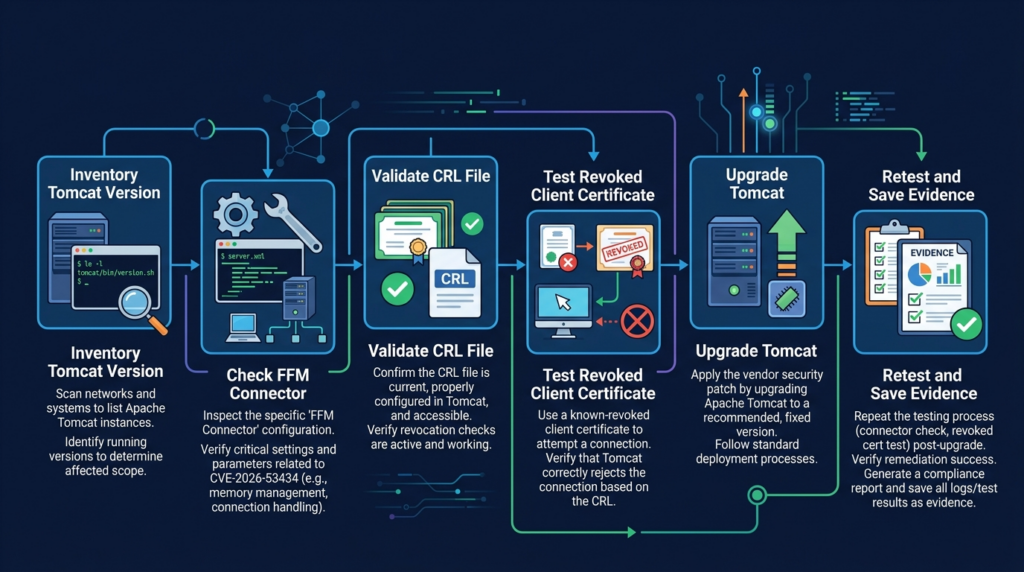
A useful validation workflow should answer three questions:
- Does the configured CRL parse correctly?
- Does Tomcat reject a revoked client certificate?
- Does Tomcat fail closed when the configured CRL is invalid after the fix?
The test should run in an authorized lab or staging environment. It should not use production private keys. It should not test partner certificates without approval. It should use a dedicated CA, a dedicated client certificate, and a dedicated endpoint.
A simplified lab flow looks like this:
# 1. Create a small test CA
openssl genrsa -out lab-ca.key 4096
openssl req -x509 -new -nodes \
  -key lab-ca.key \
  -sha256 \
  -days 365 \
  -subj "/CN=Tomcat Revocation Lab CA" \
  -out lab-ca.crt

# 2. Create a client certificate key and CSR
openssl genrsa -out client.key 2048
openssl req -new \
  -key client.key \
  -subj "/CN=revoked-client/O=Revocation Lab" \
  -out client.csr

# 3. Sign the client certificate with the test CA
openssl x509 -req \
  -in client.csr \
  -CA lab-ca.crt \
  -CAkey lab-ca.key \
  -CAcreateserial \
  -out client.crt \
  -days 90 \
  -sha256
A full CA revocation workflow usually uses an OpenSSL CA database, serial file, and CA configuration. The exact implementation depends on your internal PKI. The important point is to produce a CRL that contains the client certificate serial and then verify the certificate fails local revocation checking before testing Tomcat.
A local check should look conceptually like this:
# Confirm the CRL parses
openssl crl -in lab-ca.crl.pem -noout -text

# Confirm the certificate is rejected when CRL checking is enabled
openssl verify \
  -CAfile lab-ca.crt \
  -CRLfile lab-ca.crl.pem \
  -crl_check \
  client.crt
Expected result for a revoked certificate is a verification failure. If local OpenSSL verification accepts the certificate, the lab is not ready. Fix the CA and CRL workflow before testing Tomcat.
Then test the Tomcat endpoint:
openssl s_client \
  -connect tomcat-lab.example.internal:8443 \
  -servername tomcat-lab.example.internal \
  -cert client.crt \
  -key client.key \
  -CAfile lab-ca.crt \
  -state \
  -tlsextdebug
The exact observable result depends on the connector, client-auth mode, and application response. A rejected certificate may cause a TLS alert, a failed handshake, a closed connection, or an application-level denial if the connector accepts the handshake but the application enforces CLIENT-CERT constraints later. The test is useful only if the team records expected behavior before and after revocation.
A good validation matrix is more reliable than a single command:
| Test case | CRL status | Client certificate status | Expected safe behavior |
|---|---|---|---|
| Valid CRL, valid client cert | CRL parses and is current | Certificate not revoked | Connection reaches protected endpoint if authorization allows |
| Valid CRL, revoked client cert | CRL parses and contains cert serial | Certificate revoked | Certificate is rejected or protected endpoint is denied |
| Invalid CRL, any client cert | CRL file is malformed or unreadable | Any | Patched Tomcat fails closed during startup or connector initialization |
| Missing CRL path | Referenced file is absent | Any | Patched Tomcat fails closed rather than silently omitting revocation |
| No CRL configured | No CRL file or path | Any | Behavior matches documented configuration, but revocation is not being enforced through CRL |
The third and fourth rows are where CVE-2026-53434 becomes visible. If the service continues without effective CRL loading, the operator has not proved the revocation boundary is safe.
Detection and evidence
There is no single network signature that reliably proves CVE-2026-53434 is exploitable in a given environment. A remote scanner might find a Tomcat version. It might find that client certificates are requested. It usually cannot prove whether Tomcat loaded the intended CRL, whether the CRL contains a specific revoked serial, whether the FFM/OpenSSL path is active, or whether the application maps that certificate to meaningful access.
Detection should combine four evidence streams.
The first is configuration evidence. Capture the Tomcat version, connector implementation, SSLHostConfig, CRL file or path settings, client certificate verification mode, and resolved filesystem path. Do not rely on memory or infrastructure diagrams.
The second is PKI evidence. Capture the CA certificate, CRL issuer, CRL lastUpdate, CRL nextUpdate, and the revoked certificate serial number used for testing. If the CRL is stale, malformed, or issued by the wrong CA, the test result is not meaningful.
The third is runtime evidence. Enable Tomcat TLS handshake logging in a controlled environment. Tomcat documentation shows handshake debug logging can be enabled for NIO and NIO2 endpoints through logging configuration such as org.apache.tomcat.util.net.NioEndpoint.handshake.level=FINE or the corresponding NIO2 endpoint logger. (tomcat.apache.org)
Por ejemplo:
# conf/logging.properties

org.apache.tomcat.util.net.NioEndpoint.handshake.level = FINE
org.apache.tomcat.util.net.Nio2Endpoint.handshake.level = FINE
The fourth is behavioral evidence. Use a known-good client certificate and a known-revoked client certificate. Record the handshake result, HTTP status, application identity, and server logs. If the revoked client certificate reaches a protected function, the finding is not merely “Tomcat is vulnerable.” It is “this access boundary fails under revoked certificate conditions.”
A concise evidence bundle for an internal report can look like this:
Finding: Revoked client certificate accepted by Tomcat mTLS endpoint when CRL is invalid

Environment:
  Service: partner-settlement-api
  Host: staging-api-03
  Tomcat: 10.1.55
  Java: 22
  Connector: org.apache.tomcat.util.net.openssl.panama.OpenSSLImplementation
  Client certificate mode: required
  CRL config: /etc/tomcat/pki/partner-ca.crl.pem

PKI fixture:
  Test CA subject: CN=Partner API Lab CA
  Revoked client serial: 4A:11:91:...
  CRL issuer: CN=Partner API Lab CA
  CRL nextUpdate: 2026-07-10T00:00:00Z
  Local openssl verify -crl_check result: revoked

Observed behavior before upgrade:
  CRL file replaced with malformed PEM for negative test
  Tomcat service remained running
  Revoked client certificate reached /partner/v1/account/status
  Access log identity mapped to partner-test-revoked

Observed behavior after upgrade:
  Tomcat 10.1.56 failed connector initialization with invalid CRL
  With valid CRL restored, revoked client certificate was rejected
That type of evidence is strong because it ties together the CVE, the configuration, the revocation mechanism, and the business-facing endpoint. It also avoids overstating impact beyond what was actually demonstrated.
For teams that use AI-assisted security validation, the valuable automation is not “spray an exploit.” It is keeping the evidence chain intact: version discovery, connector fingerprinting, configuration review, CRL parsing, negative certificate tests, retest after upgrade, and report generation. Penligent describes its platform as an AI-powered penetration testing tool, and in a workflow like this the practical value is structured validation and evidence capture rather than inventing attack steps that the CVE does not support. (Penligente)
Remediación
The primary fix is to upgrade Apache Tomcat to a fixed release: 11.0.23 or later for Tomcat 11, 10.1.56 or later for Tomcat 10.1, and 9.0.119 or later for Tomcat 9. Apache’s own advisory pages identify those affected ranges and fixed releases, and NVD records the same version boundaries. (nvd.nist.gov)
For standalone deployments, the patch plan should include these steps:
# Example pre-upgrade capture
"$CATALINA_HOME/bin/version.sh" | tee evidence-tomcat-version-before.txt

grep -RInE \
  'OpenSSLImplementation|openssl\.panama|certificateRevocationList|certificateVerification|SSLHostConfig' \
  "$CATALINA_BASE/conf" \
  | tee evidence-tls-config-before.txt

openssl crl \
  -in "$CATALINA_BASE/conf/pki/client-ca.crl.pem" \
  -noout -issuer -lastupdate -nextupdate \
  | tee evidence-crl-before.txt
After upgrade, repeat the same checks and run the negative revocation test. The patch is not fully validated until a revoked client certificate is rejected under a valid CRL and an invalid CRL causes a visible failure.
For embedded deployments, update the dependency version and confirm the packaged artifact contains the fixed Tomcat line. Maven projects should avoid relying on transitive dependency surprises. Pin or update through the framework’s supported dependency management path:
<!-- Example only. Use the version line supported by your framework. -->
<properties>
    <tomcat.version>10.1.56</tomcat.version>
</properties>
Then verify the resolved dependency tree:
mvn -q dependency:tree \
  -Dincludes=org.apache.tomcat,org.apache.tomcat.embed
For Gradle, inspect the runtime classpath after changing the platform or dependency constraints:
./gradlew dependencies --configuration runtimeClasspath \
  | grep -Ei 'tomcat-(embed|coyote|coyote-ffm)|tomcat'
The most common remediation mistake is upgrading the package but failing to retest the trust decision. A version number proves the vulnerable code should be gone. It does not prove the CRL is valid, current, loaded, and enforced.
Hardening beyond the patch
CVE-2026-53434 is a code vulnerability, but the durable fix is operational. Revocation systems fail when they are treated as static configuration rather than live identity infrastructure.
A stronger design uses fail-closed behavior at every layer. Tomcat should fail if configured CRL material cannot load. A deployment preflight should fail if the CRL cannot be parsed. A CI job should fail if the test revoked certificate is accepted. A monitoring rule should alert if the CRL is past nextUpdate. An operations runbook should treat CRL load errors as security events, not as harmless TLS noise.
A practical hardening checklist:
| Controlar | Why it helps | Example implementation |
|---|---|---|
| Upgrade Tomcat to fixed release | Removes the vulnerable error handling | 11.0.23, 10.1.56, or 9.0.119 |
| Validate CRLs before startup | Catches missing, empty, or malformed files early | openssl crl -in file -noout -text |
| Test revoked certificates in CI | Proves the actual trust boundary rejects revoked identity | Lab CA plus revoked client cert fixture |
| Monitor CRL freshness | Prevents stale revocation state | Alert before nextUpdate passes |
| Use atomic CRL replacement | Avoids partial file reads during updates | Write temp file, validate, rename |
| Avoid long-lived client certificates | Reduces value of compromised or stale certs | Short certificate lifetime plus automation |
| Keep app-level disablement | Adds a second revocation mechanism | Disable partner, device, or service account independently |
| Record evidence during retest | Makes remediation auditable | Save commands, config hash, logs, and cert serials |
Short-lived certificates can reduce the risk window, but they do not eliminate the need for revocation if the business requirement is immediate access termination. OCSP can reduce latency in some PKI designs, but Tomcat’s OCSP support depends on specific connector and configuration choices. CRL and OCSP should be treated as design components with documented behavior, not interchangeable checkboxes. (tomcat.apache.org)
One useful pattern is to separate identity termination from certificate revocation. Revoking a certificate should block TLS authentication. Disabling the corresponding application identity should block authorization even if TLS misbehaves. Removing the service account from sensitive roles should reduce blast radius if any credential survives. That layered model turns CVE-2026-53434 from a potential access bypass into a detectable control failure.
Related Tomcat revocation issues
CVE-2026-53434 is easier to understand when placed next to other Tomcat certificate revocation issues. Earlier in 2026, CVE-2026-24734 covered an Apache Tomcat OCSP revocation bypass scenario in which revoked client certificates could be accepted under specific Tomcat Native and FFM-related revocation conditions. A Penligent technical write-up on CVE-2026-24734 framed it around the same core security lesson: revocation checks are authentication controls, and they need negative testing with revoked certificates rather than only configuration review. (Penligente)
The two issues are not identical. CVE-2026-24734 concerns OCSP revocation behavior. CVE-2026-53434 concerns invalid CRL configuration being ignored in the FFM connector path. The shared theme is that certificate revocation is easy to overestimate. Operators often assume that because a CRL or OCSP setting exists, revoked certificates will be rejected. Real assurance comes from testing the revoked certificate path.
CVE-2026-53434 was also disclosed in a broader June 29, 2026 Tomcat security batch. One summary of the batch noted seven Tomcat CVEs disclosed that day and that Tomcat 9.0.119 closed all seven for the supported Tomcat 9 line. The exact exploitability of each CVE differs, but the operational message is consistent: supported Tomcat lines should move to the current fixed maintenance release rather than cherry-picking one issue while leaving adjacent fixes behind. (herodevs.com)
The related-CVE view is useful for prioritization:
| CVE theme | Why it is relevant to CVE-2026-53434 | Defensive takeaway |
|---|---|---|
| CRL configuration ignored | Directly describes this CVE’s failure mode | Treat invalid revocation inputs as hard failures |
| OCSP revocation bypass | Similar identity-revocation boundary, different mechanism | Test revoked client certs under each configured revocation method |
| Same-day Tomcat security batch | Shows that multiple Tomcat fixes may land together | Prefer full supported maintenance upgrade |
| Unsupported Tomcat lines | Older lines may not receive full security maintenance | Do not use unsupported versions as a risk exception |
A team that has never tested a revoked client certificate against its mTLS endpoints should assume it has an assurance gap, even after patching. Patching removes a known vulnerable behavior. Testing proves the intended security decision is actually happening.
Common false assumptions
The first false assumption is that mTLS automatically solves identity lifecycle. It does not. mTLS proves possession of a private key corresponding to a certificate that chains to a trusted CA. Lifecycle control still depends on certificate expiration, revocation, CA hygiene, application mapping, and authorization decisions.
The second false assumption is that a configured CRL is the same as an enforced CRL. CVE-2026-53434 is a direct counterexample. A CRL file can exist in configuration while the runtime trust decision fails to use it correctly under error conditions.
The third false assumption is that a vulnerability with a low vendor severity label cannot matter. In most generic deployments, it may not be urgent. In a certificate-gated control plane, it can become an access problem. Severity labels are starting points, not substitutes for architecture review.
The fourth false assumption is that upgrading alone proves remediation. The upgrade changes Tomcat’s behavior, but a bad CRL file, stale revocation process, or weak application authorization model may remain. Verification should include both positive and negative tests.
The fifth false assumption is that scanners can fully validate the issue remotely. Remote scanners can help with version identification and TLS posture. They usually cannot prove the revoked certificate path without controlled credentials and test fixtures.
A practical response plan
A good response plan for CVE-2026-53434 has four phases.
The first phase is triage. Identify all Tomcat 9, 10.1, and 11 deployments. Separate standalone and embedded Tomcat. Capture versions and dependency trees. Search for FFM/OpenSSL implementation settings, CRL file settings, CRL directory settings, and client certificate verification settings. Mark instances that do not use the affected path as lower priority, but do not lose them from the lifecycle upgrade plan.
The second phase is trust-boundary analysis. For each potentially affected connector, identify what client certificates represent. Are they employee identities, service identities, partner identities, device identities, workload identities, or administrator identities? What happens if a revoked certificate is accepted? Does the app map certificate subject, SAN, issuer, or serial to an account? Can the account be disabled separately? Are there IP allowlists, role checks, or transaction-level controls?
The third phase is remediation. Upgrade to the fixed Tomcat release for the relevant line. Repair any CRL configuration that fails after upgrade. Do not remove CRL checking merely to restore availability unless there is a documented compensating control and an approved temporary exception. Treat broken CRL loading as evidence that the old deployment may not have enforced revocation.
The fourth phase is validation. Build a revoked certificate test. Confirm it fails local OpenSSL verification with CRL checking. Confirm Tomcat rejects it. Confirm a valid certificate still works. Confirm an invalid CRL fails closed after upgrade. Save the evidence.
The response can be summarized like this:
| Fase | Output | Done when |
|---|---|---|
| Triage | Asset list with Tomcat versions and connector paths | Affected-version instances are separated by CRL and client-cert usage |
| Trust-boundary review | Impact map for each mTLS endpoint | Each endpoint has a clear answer for what a revoked cert could access |
| Remediación | Fixed Tomcat versions deployed | 11.0.23, 10.1.56, or 9.0.119 is active where needed |
| Validación | Evidence bundle with revoked cert test | Revoked cert is rejected and invalid CRL fails closed |
| Hardening | CI and monitoring controls | CRL parsing, freshness, and negative tests are automated |
This plan keeps the team from overreacting to instances that do not use the affected path while still treating real revocation boundaries seriously.
PREGUNTAS FRECUENTES
Is CVE-2026-53434 remote code execution?
No.
- CVE-2026-53434 is not described by Apache or NVD as remote code execution.
- The issue concerns invalid CRL handling in Apache Tomcat’s FFM connector path.
- The realistic risk is revoked client certificate acceptance where CRL checking is part of the authentication or authorization boundary.
- An attacker still needs a certificate that chains to a trusted CA and should have been rejected by revocation.
- Treat claims of unauthenticated RCE for this CVE as unsupported unless a credible primary source provides new evidence.
Which Apache Tomcat versions are affected?
The affected ranges are specific.
- Tomcat 11.0.0-M1 through 11.0.22 are affected and should move to 11.0.23 or later.
- Tomcat 10.1.0-M7 through 10.1.55 are affected and should move to 10.1.56 or later.
- Tomcat 9.0.83 through 9.0.118 are affected and should move to 9.0.119 or later.
- Version exposure alone is not the full risk test; the connector path, CRL configuration, and client certificate usage matter.
- Unsupported Tomcat lines should be handled as lifecycle risk even when a specific CVE does not list them.
Am I affected if my Tomcat server only uses normal HTTPS?
Probably not in the direct revoked-client-certificate sense.
- Ordinary HTTPS usually validates the server certificate to the browser or client.
- CVE-2026-53434 concerns CRL configuration for client certificate validation in the FFM connector path.
- If the server never requests or requires client certificates, there may be no client certificate revocation boundary to bypass.
- You should still patch supported Tomcat versions as part of normal security maintenance.
- Confirm configuration rather than relying on assumptions, especially in internal services where mTLS may have been added later.
How do I confirm whether the FFM connector path is in use?
Use configuration and dependency evidence.
- Search Tomcat configuration for
openssl.panama,OpenSSLImplementation,certificateRevocationListFileycertificateRevocationListPath. - Busque
tomcat-coyote-ffmartifacts in standalone installations or embedded dependency trees. - In embedded applications, inspect Maven or Gradle runtime dependencies and custom connector configuration.
- For Spring Boot applications, search for custom
TomcatServletWebServerFactorycode that configures the FFM/OpenSSL implementation. - Record the evidence because “Tomcat is installed” is not enough to prove exposure.
Why do severity scores differ so much for this CVE?
The impact depends on deployment assumptions.
- Apache labels the issue Low.
- NVD’s page shows a CISA-ADP CVSS 3.1 score of 9.1 Critical, while NVD itself had not provided its own full assessment in the captured record.
- Amazon Linux lists a Low 3.7 score for its advisory.
- If CRL checking is a secondary defense, impact may be limited.
- If CRL checking is the primary way to revoke access to a sensitive mTLS endpoint, accepting a revoked certificate can be a major access-control failure.
- Use the score as a prompt for review, not as the final risk decision.
Should a patched Tomcat deployment fail to start when the CRL is invalid?
Yes, that is the safer behavior.
- The Apache fix changes CRL loading failures into exceptions in the affected OpenSSL/Panama path.
- If a CRL is explicitly configured but cannot be loaded, continuing silently weakens the intended trust decision.
- After upgrade, startup or connector initialization failure may reveal a previously hidden configuration problem.
- Do not remove CRL checking just to restore uptime without an approved compensating control.
- Fix the CRL path, file contents, permissions, mount, or deployment pipeline.
Can OCSP replace CRLs for this issue?
Not automatically.
- OCSP and CRLs are different revocation mechanisms.
- Tomcat’s OCSP support depends on specific connector and configuration choices.
- Some Tomcat TLS implementation paths do not support OCSP client certificate verification.
- If you use OCSP, test it with revoked client certificates the same way you test CRLs.
- Short-lived certificates, OCSP, CRLs, and application-level disablement can complement each other, but none should be assumed to work without negative tests.
How do I prove remediation worked?
Use a revoked certificate test, not just a version check.
- Capture the Tomcat version before and after upgrade.
- Capture the connector configuration and CRL path.
- Generate or obtain a test client certificate that is revoked in a lab CRL.
- Confirm
openssl verify -crl_checkrejects the certificate locally. - Confirm patched Tomcat rejects the revoked certificate when the CRL is valid.
- Confirm patched Tomcat fails closed when the configured CRL is invalid.
- Save command output, logs, certificate serial numbers, and configuration snippets in the remediation ticket.
Make the trust decision observable
CVE-2026-53434 is easy to understate and easy to overstate. It is not a universal Tomcat compromise. It is also not harmless when Tomcat is enforcing client certificate revocation for a sensitive endpoint. The right response is to locate the trust boundary, confirm whether the affected FFM/OpenSSL CRL path is active, upgrade to the fixed Tomcat release, and run a real revoked-certificate test.
The deeper lesson is that certificate revocation is not a checkbox. It is a runtime security decision that needs fail-closed behavior, monitored inputs, current revocation data, and repeatable negative testing. When a revoked certificate should lose access, the system must prove that loss of access in logs, tests, and operational evidence.

 Spanish
  English
  German
  French
  Portuguese
  Japanese
  Korean
  Hindi
Hindi  Arabic
  Turkish
  Hebrew