CVE-2026-66066 is a critical Ruby on Rails vulnerability in Active Storage image processing that can allow an unauthenticated attacker to turn a seemingly ordinary file upload into an arbitrary file read against the Rails server. The vulnerability is particularly dangerous because the initial primitive is not limited to uploaded files: an attacker may be able to read files accessible to the Rails process, potentially exposing secret_key_base, Rails master keys, database credentials, cloud-storage credentials, API tokens, and other secrets.
Rails assigned the issue a Critical 9.5 CVSS v4 score. The official advisory lists patched Active Storage versions 7.2.3.2, 8.0.5.1, and 8.1.3.1. Applications using libvips as their Active Storage image processor and accepting image uploads from untrusted users are the primary affected configuration. Rails has used :vips as the default Active Storage variant processor for applications loading Rails 7.0 defaults and later. (GitHub)
The vulnerability has also become known as KindaRails2Shell, a name reflecting the fact that arbitrary file read can, in realistic Rails environments, become substantially more dangerous than information disclosure alone. If an attacker retrieves application-signing material or infrastructure credentials, the compromise may progress toward remote code execution or lateral movement into databases, object stores, queues, cloud services, and other connected systems. (GitHub)
As of August 26, 2026, CISA’s enrichment data attached to the NVD record marks exploitation status as PdC, rather than merely theoretical. That does not by itself mean widespread exploitation in the wild, but it makes treating CVE-2026-66066 as a routine patch-cycle issue increasingly difficult to justify. (NVD)
CVE-2026-66066 at a Glance
Artículo
Detalles
CVE
CVE-2026-66066
Componente
Ruby on Rails Active Storage
Processing backend
libvips
Clase de vulnerabilidad
Arbitrary file read, possible RCE escalation
Gravedad
Crítica
CVSS v4
9.5
Authentication required
No, in affected attack scenarios
Interacción con el usuario
Ninguno
Primary prerequisite
Untrusted image uploads processed through Active Storage/libvips
Rails 7+ default relevance
High — :vips became the default variant processor with Rails 7.0 defaults
Fixed Active Storage versions
7.2.3.2, 8.0.5.1, 8.1.3.1
Required libvips baseline
8.13 or later
GHSA
GHSA-xr9x-r78c-5hrm
Common name
KindaRails2Shell
The official Rails advisory describes the vulnerable package range broadly as Active Storage versions before 7.2.3.2, Rails 8.0 releases before 8.0.5.1, and Rails 8.1 releases before 8.1.3.1. Real-world exploitability, however, depends on configuration: the application needs to expose untrusted uploads to a vulnerable libvips-backed processing path. (GitHub)
That distinction matters. A dependency scanner can tell you that an Active Storage version is vulnerable, but it cannot automatically tell you whether the vulnerable path is reachable in your application.
Why CVE-2026-66066 Is More Serious Than a Normal Image Upload Bug
The most important thing to understand about CVE-2026-66066 is that it is not simply a malformed-image crash and not primarily a bug in JPEG or PNG parsing.
The vulnerability emerges from a chain of trust decisions across multiple software layers.
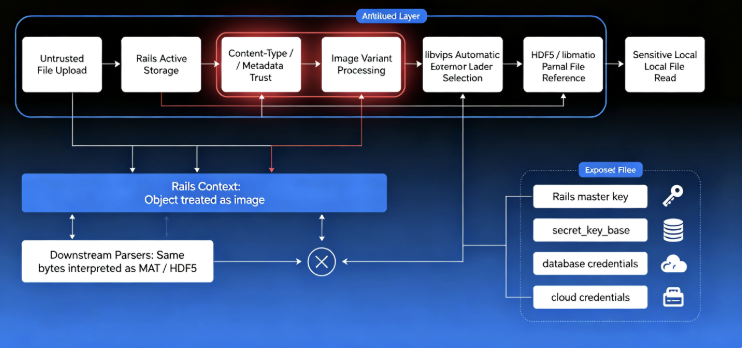
Rails Active Storage decides whether an uploaded object should be treated as an image. Later, libvips independently determines which internal loader should process the object’s actual bytes. Some libvips loaders delegate processing to additional third-party libraries. Under vulnerable conditions, an attacker can cause these layers to disagree about the nature of the same file.
That disagreement turns out to be security-critical.
Rails sees something that is allowed into its image-processing pipeline. libvips sees a different format based on the bytes it receives. A downstream parser then interprets internal metadata in yet another way. Eventually, functionality intended to support legitimate external data references can be abused to cause data from another file on the server to become part of the processing result. (GitHub)
This is therefore better understood as a cross-layer parser and trust-boundary failure than as a conventional image decoder memory-corruption vulnerability.
Understanding Active Storage and libvips
Active Storage is Rails’ built-in abstraction for attaching files to application records. Files can be stored locally or in remote services such as Amazon S3, Google Cloud Storage, and Azure Blob Storage.
A typical application might use it for:
profile pictures;
organization logos;
product images;
document previews;
message attachments;
screenshots;
content-management uploads.
When an application needs a resized image, thumbnail, or transformed representation, Active Storage sends the file through an image-processing backend.
Modern Rails applications commonly use libvips.
libvips is deliberately much broader than a PNG/JPEG decoder. It supports numerous formats through a collection of loaders, savers, and other operations, including functionality backed by third-party libraries.
That breadth is one reason libvips itself has a concept of operations that should not automatically be exposed to untrusted web content.
The libvips project introduced runtime blocking of these less-trusted operations in libvips 8.13. Its documentation specifically explains that some supported format libraries are well fuzzed while others are not, and provides VIPS_BLOCK_UNTRUSTED and lower-level APIs to prevent untrusted operations from being invoked by attacker-controlled input. (libvips.org)
The security problem in CVE-2026-66066 is that vulnerable Rails Active Storage configurations did not enable this protection.
The Core Vulnerability: Unsafe libvips Operations Remained Available
The Rails advisory summarizes the root problem clearly: Active Storage did not disable libvips operations marked unsafe for untrusted input.
libvips describes certain operations as unfuzzed or untrusted. These operations may involve format handlers that were not designed or sufficiently hardened for arbitrary Internet input.
In a normal web image pipeline, users expect uploaded JPG, PNG, WebP, AVIF, GIF, or similar content to be processed.
But if libvips is permitted to automatically select from a much larger collection of loaders, an attacker may be able to craft a file whose contents cause libvips to enter a parser that the application developer never intended to expose through an image-upload endpoint.
That is exactly the security boundary the Rails fix is designed to close. (GitHub)
The important lesson is that the vulnerability is not simply:
Rails accepts the wrong MIME type.
The deeper problem is:
attacker-controlled bytes are eventually handed to a parser-selection system with more capabilities than the application’s security model assumes.
How the CVE-2026-66066 Attack Chain Works
The publicly available Rails forensic material documents several important junctions in the attack path. The following explanation describes those mechanics without turning them into a weaponized payload recipe.
Step 1: The Attacker Gets a File into Active Storage
One important documented path uses Active Storage direct uploads.
With server-side attachment, Rails normally has an opportunity to inspect the uploaded object’s real contents and determine what it is.
Direct uploads work differently.
The Rails forensic analysis notes that blobs created through:
POST /rails/active_storage/direct_uploads
can persist the client-declared content type before the application has inspected the file contents in the same way a traditional server-side attachment would. (GitHub)
That creates the first important discrepancy:
Attacker declaration:
"This object is an image."

Actual bytes:
"This object is something else."
For normal benign uploads this discrepancy might be accidental.
For exploitation it is deliberate.
Step 2: Rails Uses Stored Metadata to Decide Whether the Blob Is Variable
Active Storage determines whether a blob can be transformed using logic conceptually equivalent to checking whether its stored content_type belongs to a known set of variable image types.
The Rails forensic analysis highlights this decision as one of the key junctions in the vulnerability.
The important point is that the decision is made using Active Storage metadata rather than re-evaluating the complete file through the same parser that will later consume it. (GitHub)
So Rails may conclude:
This is an image.
It is safe to send into the image variant pipeline.
That is only Rails’ interpretation.
It is not necessarily libvips’ interpretation.
Step 3: A Valid Active Storage Variation Is Reused
Active Storage representations contain signed information describing transformations such as resizing.
A critical detail documented in the Rails forensic repository is that exploitation does not inherently require an attacker to forge Rails’ cryptographic signature at this stage.
A valid transformation key can be obtained from an existing representation and legitimately pass Rails’ signature verification. The blob identifier and variation information are resolved independently. (GitHub)
This distinction matters because defenders might otherwise assume:
“Our Active Storage transformation URLs are signed, therefore an attacker cannot reach the vulnerable transformation pipeline.”
That assumption is unsafe.
The cryptographic verification can work exactly as intended while the surrounding composition remains dangerous.
Security bugs often arise this way: every local security mechanism functions correctly, but the assumptions between components are wrong.
Step 4: Active Storage Hands the Blob to libvips
The uploaded object is eventually downloaded to a local temporary file and passed into the image-processing pipeline.
En image_processing Ruby library then reaches libvips.
When no specific loader has been explicitly selected, the pipeline can call the equivalent of:
Vips::Image.new_from_file(path, **options)
At that point, libvips looks at the actual file and chooses a loader itself. (GitHub)
This creates the second major interpretation:
Rails:
"Image."

libvips:
"Let me inspect the bytes and determine the format myself."
It tests file contents and selects an appropriate loader based on format-identification logic.
In the attack chain documented by Rails, the crafted object reaches the MATLAB-related loading path rather than a conventional web-image loader. (GitHub)
This is an important architectural lesson.
An application’s endpoint may be called “upload avatar.”
Its HTML form may say:
accept="image/*"
Its database may say:
content_type = image/png
Yet the parser operating on the bytes may still decide:
This is a MATLAB file.
The endpoint’s business semantics do not constrain native parser capabilities.
Step 6: Another Format Interpretation Happens Below libvips
The documented attack goes one layer deeper.
The selected MATLAB processing path interacts with libmatio, which itself examines the object’s internal structure.
A deliberately inconsistent file can therefore produce another disagreement:
libvips format detection:
one interpretation

libmatio internal format dispatch:
another interpretation
The Rails forensic write-up describes this as essentially the same bug shape occurring twice at different layers. (GitHub)
This is why simply adding one more MIME-type check at the Rails layer is not a complete architectural defense.
There are multiple parsers.
Each parser has its own source of truth.
Step 7: HDF5 External Data Functionality Becomes the File Read Primitive
The downstream parsing path eventually reaches HDF5 functionality.
HDF5 is a legitimate scientific data format with capabilities far beyond those required for ordinary website image resizing. Among those capabilities is support for datasets that can reference external file-backed storage.
That functionality is useful in scientific computing.
It is dangerous when attacker-controlled input reaches it from an Internet-facing image pipeline.
The documented CVE-2026-66066 chain abuses that behavior so that data from another file becomes input to the processing pipeline. The resulting bytes can then flow back through the otherwise normal image transformation process. (GitHub)
Conceptually, the attack looks like this:
Untrusted upload
        ↓
Active Storage believes it is processable image content
        ↓
libvips chooses a non-web-image loader
        ↓
downstream parser interprets embedded structure
        ↓
external-file functionality accesses another local file
        ↓
file contents enter processing pipeline
        ↓
processed representation returned to attacker
This is the essence of the Rails Active Storage libvips arbitrary file read.
CVE-2026-66066 Attack Chain: From Active Storage Upload to Arbitrary File Read
The Rails advisory explicitly describes an unauthenticated attacker being able to exploit affected applications. (GitHub)
Whether an individual deployment exposes the required path without authentication depends on application behavior.
Consider common applications with:
public account registration;
public profile-image uploads;
anonymous support-ticket attachments;
marketplace listing images;
public CMS contribution forms;
customer-uploaded logos;
free-trial accounts.
A vulnerability does not become low risk merely because the attacker must interact with an upload form.
If anybody on the Internet can obtain access to that upload functionality without administrative privileges, the effective attack surface remains very large.
Who Is Affected by CVE-2026-66066?
The most important affected configuration is straightforward.
According to Rails, an application is affected when it:
uses libvips for Active Storage image processing; and
accepts image uploads from untrusted users. (GitHub)
The relevant configuration commonly looks like:
config.active_storage.variant_processor = :vips
Rails notes that applications using Rails 7.0 defaults use :vips, and no subsequent default changed that behavior. (GitHub)
That makes Rails 7 and Rails 8 deployments particularly important to inventory.
Affected Rails and Active Storage Versions
The official Rails security advisory identifies these fixed releases:
Rama
Zona vulnerable
Versión corregida
Rails / Active Storage 7.2
Before 7.2.3.2
7.2.3.2
Rails / Active Storage 8.0
8.0 through before 8.0.5.1
8.0.5.1
Rails / Active Storage 8.1
8.1 through before 8.1.3.1
8.1.3.1
The advisory’s gem-level range is broader than the set of configurations that are commonly exploitable. Older Rails applications can also become relevant where developers manually configured libvips. GMO Flatt Security’s analysis specifically distinguishes older Rails branches where additional configuration is required from Rails 7 and later, where libvips became the normal default. (GitHub)
This is why defenders should not reduce the question to:
Are we running Rails 8?
La pregunta correcta es:
Does any version of our application accept untrusted files
and pass them into libvips through Active Storage?
Are ImageMagick Deployments Affected?
The reported CVE-2026-66066 attack path is specifically associated with libvips.
Applications using ImageMagick rather than Vips for Active Storage variants are not exposed through the same reported libvips chain. Rapid7 likewise notes that the disclosed vector concerns Vips rather than Magick. (Rápido7)
That does not mean ImageMagick should automatically be regarded as a generic security mitigation for every file-upload problem.
It only means the specific vulnerability described in CVE-2026-66066 relies on the libvips processing path.
Why Rails Requires libvips 8.13 or Later
One of the most significant remediation details is easy to overlook.
Upgrading Rails alone is not the entire story.
Rails requires libvips 8.13 or later for the secure configuration because versions before 8.13 do not have the necessary mechanism for blocking unfuzzed operations. (GitHub)
libvips 8.13 introduced a runtime security feature specifically for applications processing untrusted input.
The project explains that applications can use:
VIPS_BLOCK_UNTRUSTED
to prevent operations classified as unsafe for untrusted data from executing. (libvips.org)
Applications with compatible ruby-vips versions may also programmatically enable the control using:
Vips.block_untrusted(true)
Rails’ advisory states that this option is available when using ruby-vips 2.2.1 or later. (GitHub)
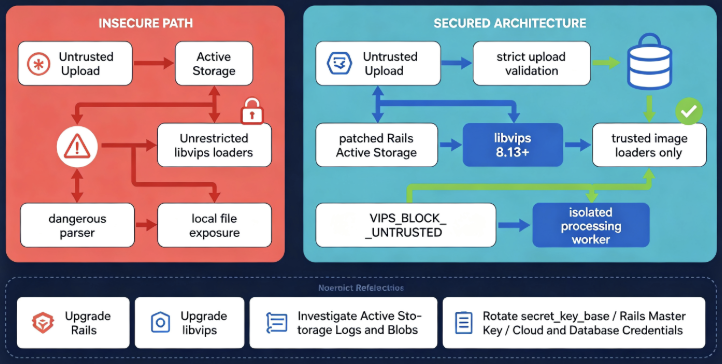
The architectural fix can therefore be summarized as:
Before:

Internet file
   ↓
Active Storage
   ↓
All available libvips operations

After:

Internet file
   ↓
Active Storage
   ↓
Trusted libvips operation set
   ✕
Unsafe/unfuzzed operations
That is a much stronger control than attempting to enumerate individual malicious file signatures.
Why Arbitrary File Read Can Become RCE in Rails
The official vulnerability title deliberately says:
possible arbitrary file read and remote code execution.
The initial primitive is file disclosure.
But Rails applications often store security-critical information in files or environment variables accessible to the application process.
The advisory specifically instructs affected organizations to consider the following compromised:
The security impact therefore depends heavily on what the Rails process can access.
secret_key_base Is Especially Important
secret_key_base sits at the center of several Rails cryptographic mechanisms.
Losing it is much more serious than exposing an ordinary configuration value.
The Rails forensic analysis explicitly observes that the initial arbitrary file read does not require possession of the application’s secrets, but obtaining secret_key_base can unlock significantly more downstream capabilities. (GitHub)
The Rails advisory therefore instructs operators to rotate it after exposure.
Cambiar secret_key_base also invalidates security artifacts that depend on it, including:
If a system bases trust on one interpretation while the eventual native parser bases execution on another, validating only one layer may still leave a gap.
The Rails forensic analysis explicitly concludes that simply adding another Rails-layer content-type opinion would not solve the underlying multi-parser disagreement. Blocking the dangerous handoff to untrusted loaders is the stronger security boundary. (GitHub)
How to Check Whether Your Rails Application Is Vulnerable
Start with dependency inventory.
From a Rails application:
bundle info activestorage
or:
bundle list | grep activestorage
You can also inspect the lockfile:
grep -A 2 "activestorage (" Gemfile.lock
The safest target is one of the fixed releases:
7.2.3.2
8.0.5.1
8.1.3.1
or a later supported version containing the fix. (GitHub)
Next, verify the processor.
Search the application:
grep -R "variant_processor" config/
Look for:
config.active_storage.variant_processor = :vips
Remember that the setting may not appear explicitly. Rails applications loading 7.0 defaults or later can inherit Vips as the default. (GitHub)
Then inspect the runtime version:
vips --version
A vulnerable system with libvips before 8.13 cannot use the required runtime untrusted-operation blocking mechanism. (GitHub)
Determine Whether Untrusted Users Can Upload Files
This step is as important as checking versions.
Search the product for every upload surface:
avatars
profile photos
ticket attachments
support portals
CMS media
chat attachments
product images
community posts
organization logos
user-generated documents
API uploads
direct uploads
Do not limit the investigation to routes labelled “image upload.”
The actual security question is whether attacker-controlled bytes can eventually reach a libvips processing function.
Check Whether Active Storage Direct Uploads Are Used
The documented forensic chain places special emphasis on Active Storage direct uploads because of how client-declared content-type metadata is persisted. (GitHub)
Applications commonly expose direct-upload functionality through Rails’ JavaScript integrations.
Search templates and JavaScript code for constructs associated with Active Storage direct upload behavior.
You can also inspect traffic and server logs for:
/rails/active_storage/direct_uploads
Presence of this endpoint alone does not prove exploitation.
It does, however, increase the relevance of the documented attack chain.
Safe Configuration Verification
You can inspect relevant configuration without executing malicious content.
Por ejemplo:
puts Rails.version
puts Rails.application.config.active_storage.variant_processor
puts Vips.version_string if defined?(Vips)
The result should be interpreted together with the Active Storage gem version.
A useful defensive inventory table looks like:
Consulte
Safe state
Active Storage
Parcheado
Rails branch
Supported
Variant processor
Known and intentional
libvips
>= 8.13
Untrusted operation blocking
Enabled
Public uploads
Authenticated/validated where appropriate
Secretos
Rotated if historical exposure cannot be excluded
Emergency Mitigation When You Cannot Upgrade Rails Immediately
The preferred remediation is upgrading Active Storage/Rails.
Rails nevertheless documents an interim mitigation for environments running libvips 8.13 or later.
Set:
VIPS_BLOCK_UNTRUSTED=1
before libvips initialization.
Alternatively, environments using ruby-vips 2.2.1 or later can initialize:
Vips.block_untrusted(true)
Rails explicitly documents both mitigations. (GitHub)
Do not interpret these workarounds as a reason to postpone the framework update indefinitely.
They are useful for emergency containment.
The patched Rails versions should remain the target state.
What If You Run libvips Older Than 8.13?
This case is more serious.
Rails states that libvips versions before 8.13 cannot disable the unfuzzed operations required to close the dangerous processing path.
There is therefore no equivalent runtime workaround.
The advisory recommends removing the libvips dependency where possible until the stack can be upgraded. (GitHub)
In practical terms:
libvips < 8.13
+
untrusted uploads
+
vulnerable Active Storage
=
do not rely on configuration-only mitigation
Upgrade or remove exposure.
Why Patching Alone May Be Insufficient
A crucial sentence in the Rails advisory is that upgrading closes the vulnerability but does not undo a secret that has already been exfiltrated. (GitHub)
Suppose an attacker exploited the vulnerability yesterday.
Today you deploy Rails 8.1.3.1.
The arbitrary file read is now closed.
But an AWS key stolen yesterday still works.
A database password stolen yesterday still works.
A Rails signing secret stolen yesterday may still be valid.
Remediation therefore has two separate phases:
Phase 1
Stop exploitation.

Phase 2
Invalidate anything that may already have escaped.
Many incident responses fail because teams stop after phase one.
Secrets That Should Be Considered for Rotation
Rails explicitly recommends treating all secrets readable by the application process as potentially exposed.
Do not rotate only the secret you believe an attacker “probably wanted.”
An arbitrary file read lets the attacker choose.
Do Not Retain Old Secrets as a Permanent Fallback
Rails makes another important recommendation: rotation should not mean leaving the compromised credential usable forever as a fallback.
For example, an organization might temporarily support both:
NEW_SECRET
OLD_SECRET
to avoid immediately invalidating sessions.
That may simplify migration.
But if the old secret was stolen, keeping it active preserves the attacker’s capability.
Rails explicitly warns against retaining an exposed secret as a fallback. (GitHub)
How to Hunt for CVE-2026-66066 Exploitation
CVE-2026-66066 creates an unusual forensic problem.
Evidence can exist across:
HTTP logs;
Active Storage metadata;
active_storage_blobs;
active_storage_attachments;
variant records;
local storage;
S3/GCS/Azure objects;
application logs;
CDN logs;
object-store access logs.
The Rails-maintained forensic repository specifically warns that relevant evidence may disappear as logs expire and unattached Active Storage blobs are purged. (GitHub)
This means forensic investigation should begin quickly.
Examine Direct Upload Activity
Start by searching reverse-proxy, Rails, CDN, and WAF logs for:
/rails/active_storage/direct_uploads
Look for anomalies such as:
upload bursts from unusual IP addresses;
newly created accounts uploading files immediately;
unusual content types;
objects followed quickly by representation requests;
failed variant-processing attempts;
uploads that were never attached to normal application records.
The last category is particularly important.
An exploitation attempt may not resemble a legitimate user workflow.
Look for Suspicious Active Storage Blobs
You can inspect recent blobs defensively in Rails:
This does not tell you whether a blob is malicious.
It helps establish an investigation set.
Useful questions include:
Was the blob ever attached?

Who caused it to be created?

Was the claimed image type consistent with its actual contents?

Was a representation generated?

Was the source IP associated with normal application behavior?
Unattached Blobs Deserve Attention
The Rails forensic repository specifically notes that scheduled removal of unattached blobs can destroy evidence relevant to CVE-2026-66066 investigation. (GitHub)
For incident response, temporarily preserving suspicious or recently created unattached objects may therefore be appropriate.
Do not indiscriminately delete them before completing forensic review.
What looks like garbage collection may also be destruction of evidence.
Detecting Suspicious MAT/HDF5 Objects
The documented attack chain uses a deliberately inconsistent file structure in which different layers interpret the same object differently.
The Rails forensic repository notes that legitimate writers do not normally produce the particular conflicting format markers needed for the documented attack chain. Its detection strategy can therefore classify suspicious objects by inspecting small portions of the header rather than executing the file. (GitHub)
For defenders, the right approach is:
Read bytes
      ↓
classify structure
      ↓
flag impossible/inconsistent format combinations
      ↓
do NOT process object through libvips
Avoid building a detector that passes suspicious files back into the vulnerable parser merely to discover what they are.
Use the Rails Forensics Project
Rails maintains a dedicated repository for CVE-2026-66066 incident investigation.
Its goal is explicitly to answer:
Was this application vulnerable?
Was it exploited, and what data may have been exposed?
The project deliberately does not include a working malicious payload generator. Instead, it focuses on evidence identification and safe classification of suspicious stored objects. (GitHub)
That separation is useful for defenders because it provides investigation methodology without requiring organizations to reproduce exploitation against production infrastructure.
Watch for Representation Requests
The documented flow ultimately uses Active Storage representation processing.
Relevant URLs may contain patterns similar to:
/rails/active_storage/representations/
Search historical access logs for unusual request sequences.
A particularly interesting pattern is:
direct upload
      ↓
new blob
      ↓
representation request
      ↓
variant generated
especially where the object has no legitimate application attachment or originates from a suspicious account or IP.
Do not rely on URL matching alone.
URLs can differ according to Active Storage routing and service configuration.
WAF Rules Are Not a Strong Primary Fix
A WAF might reduce exposure in a specific application by blocking known upload patterns or endpoints.
But CVE-2026-66066 is fundamentally a parser-reachability problem.
The vulnerable behavior occurs after legitimate application functionality has accepted an object.
A WAF would need to reliably understand all relevant file-format semantics and application routing behavior to become a durable security boundary.
GMO Flatt Security similarly cautioned that WAF mitigation is limited to particular configurations and should not substitute for the actual fix. (GMO Flatt Security Blog)
Patch the framework and restrict the parser.
Containerization Does Not Automatically Eliminate the Risk
Many Rails applications run inside Docker or Kubernetes.
That can reduce the accessible filesystem.
It does not eliminate the vulnerability.
A containerized Rails process may still be able to read:
What can the Rails process read from inside that container?
Least privilege remains extremely important.
Reduce Filesystem and Credential Exposure
CVE-2026-66066 demonstrates why application runtime isolation matters even after patches are deployed.
A well-hardened production application should not have filesystem access to secrets it does not need.
Similarly:
avoid baking unnecessary credentials into container images;
use narrowly scoped cloud roles;
restrict object-store permissions;
restrict database accounts;
limit access to internal services;
rotate temporary credentials frequently;
avoid exposing cloud metadata endpoints where unnecessary;
prevent one application service account from becoming an organization-wide credential.
These controls do not fix CVE-2026-66066.
They reduce the impact when a file-read vulnerability appears.
Why Rails 7 Applications Should Be Prioritized
Rails 7 is particularly relevant because Rails changed the default Active Storage variant processor to Vips through the Rails 7.0 defaults.
The official advisory explicitly calls this out. (GitHub)
That means an application team may be vulnerable without ever consciously deciding:
"We want to expose libvips to user uploads."
They may simply have created a Rails application using modern defaults.
Defaults scale.
That is useful for developer productivity.
It also means security flaws in defaults can create unusually large exposure.
Does the Attacker Need to Generate Image Variants Directly?
Rails makes an important clarification:
Generating variants is not a separate prerequisite.
The application does not necessarily need to expose some special “generate thumbnail” API specifically for attackers.
If the application configuration otherwise satisfies the vulnerable conditions, ordinary Active Storage representation behavior can bring the file into the relevant processing path. (GitHub)
Therefore, security reviews should not dismiss the vulnerability merely because:
"Users cannot choose custom resize parameters."
The vulnerable parser access is the central issue.
The Role of Signed Variation Keys
It would also be incorrect to describe CVE-2026-66066 as “Rails signed URLs are broken.”
They are not.
The documented chain uses legitimately signed transformation information.
The flaw is compositional.
A valid variation can be combined with a different blob in a way that still reaches dangerous processing. (GitHub)
This is an important distinction for security engineers.
Cryptographic authenticity answers:
Was this token signed?
It does not automatically answer:
Is every object this token can be combined with safe?
Exploitation Status and Public Technical Information
The vulnerability was disclosed by Rails on July 29, 2026 and credited to researchers from Ethiack and GMO Flatt Security. (GitHub)
Initial public disclosure intentionally withheld a complete weaponized attack chain to give administrators time to patch.
Since then, public defensive and forensic material has expanded significantly. The Rails-hosted forensic repository documents the internal call sequence and parser-confusion mechanics while deliberately withholding a payload generator that could simply be pointed at arbitrary target files. (GitHub)
Meanwhile, NVD’s CISA enrichment records now describe exploitation status as poc, demonstrating why defenders should assume technical reproduction is feasible even when they have not observed confirmed compromise in their own environment. (NVD)
PoC availability and mass exploitation are different claims.
As of the information reviewed for this article, organizations should avoid claiming that every vulnerable Rails instance has been attacked, but they should also avoid treating the vulnerability as purely hypothetical.
CVE-2026-66066 Remediation Checklist
The most important remediation steps are:
Prioridad
Acción
Crítica
Upgrade Active Storage/Rails to 7.2.3.2, 8.0.5.1, 8.1.3.1, or a later fixed supported release
Crítica
Ensure libvips is 8.13 or later
Crítica
Stop exposing unfuzzed libvips operations to untrusted input
Crítica
Inventory every untrusted upload path
Alta
Review direct upload and representation logs
Alta
Preserve suspicious/unattached blobs during investigation
Alta
Rotate secret_key_base if historical exposure cannot be ruled out
Alta
Rotate Rails master key and decrypted credentials if applicable
Alta
Rotate database/cloud/API credentials reachable by Rails
Medio
Reduce runtime filesystem access
Medio
Reduce IAM and service-account privileges
Medio
Improve upload/content-type validation as defense in depth
The first three actions close the primary vulnerability.
The remaining actions address the possibility that exploitation happened before remediation.
Recommended Upgrade Path
For Rails 7.2:
gem "rails", "~> 7.2.3", ">= 7.2.3.2"
For Rails 8.0:
gem "rails", "~> 8.0.5", ">= 8.0.5.1"
For Rails 8.1:
gem "rails", ">= 8.1.3.1"
Then update:
bundle update rails activestorage
Confirm the resolved version in:
bundle list | grep -E "rails|activestorage"
Do not blindly copy version constraints into an application without considering that application’s dependency compatibility and supported Rails branch.
The important requirement is that the installed Active Storage code contains the security fix. (GitHub)
Confirm the Runtime libvips Version
After deployment:
vips --version
Do this inside the actual production container or host.
A developer laptop reporting:
vips-8.18.x
does not prove production is using the same package.
Container base images frequently contain different system-library versions than local machines.
This matters because Active Storage may be patched while the underlying libvips runtime remains too old to enforce the required security boundary.
Rebuild Containers, Do Not Only Update Gemfile.lock
libvips is generally a system dependency rather than a Ruby gem.
Consequently:
bundle update
does not necessarily update libvips.
For Docker-based Rails applications, review the image packages and rebuild the production image.
A security team does not need to perform arbitrary file exfiltration to verify remediation.
Safe verification can establish:
Active Storage is patched.
libvips is at least 8.13.
untrusted operations are blocked.
public upload flows continue to function.
legitimate JPEG/PNG/WebP variants still generate normally.
suspicious unsupported formats fail closed.
This gives defenders evidence that the vulnerable architecture has been removed without attempting to read /etc/passwd, environment files, Rails secrets, or other sensitive resources.
Why This Vulnerability Matters Beyond Rails
CVE-2026-66066 demonstrates a broader principle that applies to many modern frameworks.
An application may perform:
validation in language A
but eventually pass the object to:
native library B
which selects:
parser C
which depends on:
library D
which implements capabilities the original application developer never knew existed.
The attack surface is therefore the transitive closure of the parser stack.
Not merely the API exposed by the framework.
This pattern appears repeatedly in:
document conversion;
video transcoding;
archive extraction;
image processing;
XML processing;
machine-learning model loading;
PDF rendering;
office-file previews.
Whenever untrusted content enters a rich parser ecosystem, developers should ask:
Which parsers can this input ultimately reach?
not merely:
Which file extensions does our frontend allow?
Defending Rails Against CVE-2026-66066: Patch, Restrict, Detect, and Rotate
Patching CVE-2026-66066 is mandatory, but mature applications should add additional boundaries.
Explicitly Restrict Accepted Formats
Where possible, only permit formats required by the product.
For avatars:
JPEG
PNG
WebP
may be enough.
If the application does not need scientific datasets, SVG, PDFs, TIFF, HEIF, RAW files, or exotic formats, do not expose processing support for them merely because the underlying library happens to support them.
Re-encode Uploads in an Isolated Environment
For particularly sensitive workloads, an architecture can decode expected formats inside a sandbox and produce a canonical output before the main application consumes them.
This costs performance and complexity but dramatically reduces parser capability leakage.
Separate Media Processing From the Web Process
Image processing does not necessarily need to run with the same credentials as the Rails web application.
Consider:
Rails API
   ↓
restricted object storage
   ↓
isolated image-processing worker
The worker can operate with:
no database credentials;
no Rails master key;
no production signing secrets;
restricted network access;
restricted filesystem access;
read access only to specific uploaded objects.
Then even a future parser vulnerability has a smaller blast radius.
The Key Lesson From KindaRails2Shell
The most interesting lesson from CVE-2026-66066 is not that Rails accidentally supported a dangerous file format.
It is that trust was evaluated at the wrong abstraction boundary.
Rails trusted database metadata.
libvips trusted format-detection bytes.
libmatio trusted internal format metadata.
HDF5 legitimately followed a feature of its own data model.
Individually, these components had understandable behavior.
Together, they produced an Internet-reachable arbitrary file read.
The Rails forensic analysis puts the problem particularly well through its observation that two layers disagreed about the same file twice. (GitHub)
That is a valuable pattern for vulnerability researchers to remember.
Whenever different components independently answer:
"What type of object is this?"
ask whether their answers can disagree.
Then ask what happens when they do.
Frequently Asked Questions About CVE-2026-66066
What is CVE-2026-66066?
CVE-2026-66066 is a critical Rails Active Storage vulnerability involving libvips image processing. Under affected configurations, an unauthenticated attacker can use a crafted upload to trigger unsafe processing behavior and read arbitrary files accessible to the Rails process. (NVD)
Is CVE-2026-66066 an RCE vulnerability?
The direct documented primitive is arbitrary file read.
However, Rails and NVD both warn that exposed secrets such as secret_key_base, cloud credentials, or external-service tokens can enable escalation to remote code execution or lateral movement. (NVD)
Therefore it is reasonable to describe the vulnerability as arbitrary file read with possible RCE escalation, rather than pretending that every successful exploitation immediately executes arbitrary native commands.
Does the attacker need authentication?
The official Rails advisory states that affected applications may be exploitable by an unauthenticated attacker. (GitHub)
Actual reachability depends on how the application exposes uploads.
Does CVE-2026-66066 affect every Rails application?
No.
The important conditions include use of Active Storage, libvips-backed processing, and exposure of untrusted image uploads.
Applications not using libvips through the affected path are not exposed through the reported attack chain.
Why are Rails 7 applications particularly relevant?
Porque config.active_storage.variant_processor = :vips became the Rails default through Rails 7.0 defaults. (GitHub)
For libvips versions earlier than 8.13, Rails says there is no equivalent workaround other than removing the libvips dependency/exposure until it can be upgraded. (GitHub)
Should secrets be rotated after patching?
If the application was exposed while vulnerable and exploitation cannot be confidently ruled out, yes.
Rails specifically recommends changing every secret the application process could read. (Ruby on Rails Discussions)
Final Assessment
CVE-2026-66066 deserves its Critical rating because the vulnerable behavior sits behind functionality that is extremely common in modern web applications: uploading and resizing images.
The entry point looks mundane.
The internal parser stack is not.
An attacker-controlled upload can cross several trust boundaries:
Once sensitive Rails or infrastructure credentials are exposed, the incident can move beyond the original application. The Rails team therefore recommends not only upgrading to 7.2.3.2, 8.0.5.1, or 8.1.3.1, but also using libvips 8.13 or later and rotating secrets that may have been accessible during the vulnerable period. (GitHub)
For defenders, the correct response to CVE-2026-66066 is therefore not simply:
bundle update
It is:
Patch Rails
        ↓
verify libvips
        ↓
close unsafe loaders
        ↓
inventory every upload path
        ↓
preserve and analyze historical evidence
        ↓
rotate potentially exposed credentials
        ↓
reduce parser and runtime privileges
And for application-security engineers, the longer-term lesson is even more important: never assume that the file type validated by your framework is necessarily the file type understood by the parser several layers below it.
CVE-2026-66066 is ultimately a failure of those assumptions—and a reminder that in complex file-processing pipelines, parser boundaries are security boundaries. (GitHub)
CVE-2026-93674: Critical Langflow RCE Vulnerability Exposes AI Agent Infrastructure A critical remote code execution vulnerability in Langflow has raised fresh

 Spanish
  English
  German
  French
  Portuguese
  Japanese
  Korean
  Hindi
Hindi  Arabic
  Turkish
  Hebrew