
XBOW’s November 24 thread on ARTEX poses a useful question for anyone buying or building an AI pentesting workflow: if agents can find possible weaknesses quickly, how do you prove that a finding is real, stay inside the engagement, and hand the result to someone who can fix it? The question became urgent after the FBI’s November 13 FLASH advisory described threat actors using ARTEX in intrusions. That advisory concerns observed misuse of an offensive framework; it does not mean every ARTEX user or contributor is a threat actor.
ARTEX and Penligent both bring natural-language objectives, agentic investigation, real security tools, and evidence into an authorized assessment. Their starting points differ. ARTEX is an open-source framework you can inspect, modify, and operate yourself through a surviving independent fork. Penligent is a packaged desktop-led product with a documented project, verification, review, and reporting workflow. Neither a GitHub license nor a polished report proves that a particular deployment enforces its scope or produces low false-positive rates. Those are properties a team has to test.
The comparison below uses the currently public BaaRai/ARTEX continuation as an example of a living fork and the current Penligent product documentation y plan descriptions for the product side. It is not a head-to-head benchmark, a live exploit contest, or an assertion about every ARTEX derivative. Features and plan entitlements can change; validate them again before procuring either system.
Why the ARTEX timeline changes the comparison
The FBI says ARTEX was originally released in 2026, later removed from its original GitHub home after misuse was reported, and remains available through forks and other copies. CERT-EU similarly says the surviving public versions are independent, rather than an official upstream release, and that integrations and capabilities may vary. See the FBI threat overview y CERT-EU’s ARTEX analysis. That provenance matters more than a star count: when someone says “ARTEX supports approval gates,” you need to ask which repository, commit, configuration, and execution path they mean.
The public continuation reviewed here says its planner splits a goal into intents, workers use real tools, and results connect to an asset graph and an exploration graph. Its README describes captured traffic, evidence tied to findings, retesting, human approval, budgets, and a target gate. That is materially more detailed than a shorthand description of the earlier project. Conversely, CERT-EU’s warning that the original framework relied on configurable rules and model behavior rather than hard technical scope enforcement is a serious historical observation. It should not be copied into a present-tense claim that no later fork has added controls. Even the reviewed fork says its API-only target gate is off by default; “feature exists” and “protection is enabled and mediates every network path” are different statements.
The FBI reports some observed intrusions progressing from initial targeting to privileged access in under three hours. It also reports more than 1,600 publicly exposed ARTEX consoles as of early November. Those figures describe a subset of observed activity and exposed installations, respectively. They are not a reproducible speed benchmark for all assessments and do not establish the probability that a random ARTEX deployment is compromised. The FBI advisory is the appropriate source for both claims; product comparisons should not turn them into marketing performance statistics.
This distinction cuts both ways. The documented attacker use shows that autonomous tooling has operational consequences, not that openness is itself a defect. A closed product can also cross an unintended boundary if its executor, integrations, or operator policy are wrong. A self-hosted project can be run responsibly inside an isolated environment with clear authorization, while a managed workflow can be run irresponsibly against an unapproved target. Evaluate the configured system and the engagement, not the moral character of its distribution model.
ARTEX vs Penligent at a glance
| Decision area | ARTEX, using the reviewed public fork | Penligent, based on current public pages | What to verify in a pilot |
|---|---|---|---|
| Distribution | Source-available GitHub continuation under AGPL-3.0; original upstream is gone | Proprietary application with public product and pricing pages | Exact build, license obligations, update channel |
| Configurar | Self-hosted Go application with embedded web UI, PostgreSQL, a supported LLM, and operator-managed hosting | Install the supported desktop client, sign in, create an authorized project and configure the required runtime | Actual time to first authorized test and support burden |
| Agent workflow | Planner and parallel workers run tools against scoped objectives | Agent and Manual modes with a connected project and tool workflow | Which actions a person can pause, approve, or override |
| Model selection | Fork documents external LLM profiles, including compatible relays and Ollama | Enterprise plan lists private model integration through an inference gateway | Which model sees prompts, tool output, credentials, or traffic |
| Boundary controls | Fork documents scope rows, approvals, budgets, and an API-only target gate that is off by default | Project setup requires target and authorization confirmation; public pages describe human review | A denied out-of-scope action observed at the executor and network layers |
| Finding evidence | Fork documents traffic capture, evidence association, replay, and retest states | Public product describes verification, editable findings, evidence, and PDF or Markdown reports | Can an independent reviewer reproduce the specific claim? |
| Operating model | Team owns infrastructure, secrets, patching, model spend, and fork selection | Vendor plan and support model; enterprise deployment terms require confirmation | Total cost, data flow, incident response ownership |
| Informes | Fork lists findings, evidence and task archives | Product describes reviewable client reports and remediation/retest status | Export quality at the actual purchased tier |
The ARTEX cells come from the reviewed fork’s documentation; the Penligent cells come from its product overview and current plan page. The table deliberately leaves out unverified claims about detection rates, exploit success, and absolute security. Those require a common test set and measured outcomes. It also leaves room for a reader to discover that a particular deployment does less or more than a website implies.
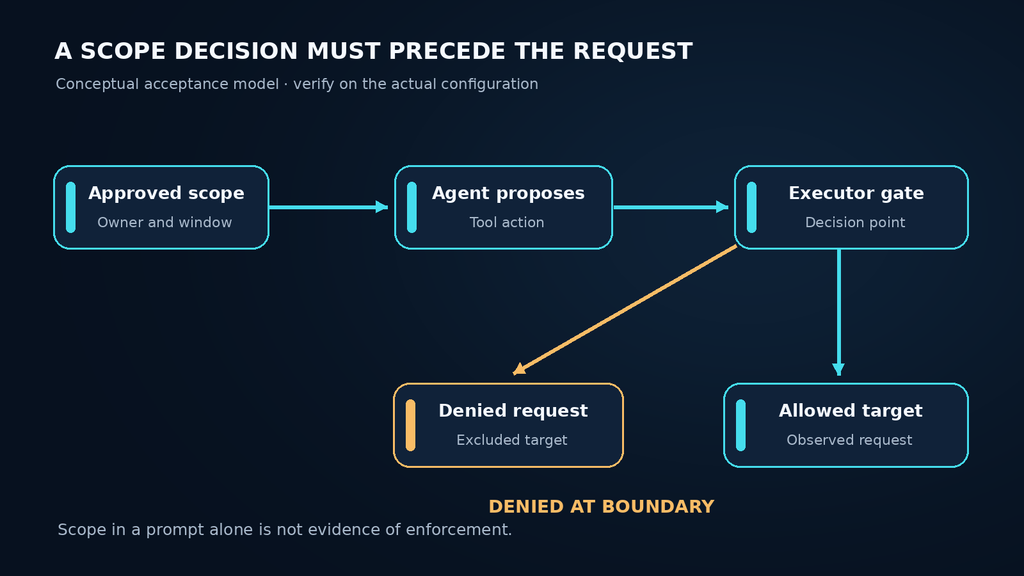
An AI agent is not a security boundary
An operator might authorize testing app.example.test
while excluding billing.example.test. A browser, crawler,
or agent can still discover a link, redirect, API hostname, shared
login, or cloud resource outside the written scope. The fact that a
request succeeds does not expand the owner’s authorization. The correct
decision point is before the tool sends a request or runs a command
against the new destination, using an independently enforced policy that
knows the approved asset set, the action class, and the active
engagement window.
CERT-EU describes ARTEX as taking a natural-language goal and decomposing it into goals and worker steps, with a dashboard for observation and approval. It also warns that, in the version it analyzed, rules and the model did not amount to hard technical enforcement. The surviving fork now describes more controls, including an approval gate and a target gate. Its own documentation qualifies that target gate as API-only and off by default. See CERT-EU y el fork’s control section. A buyer should inspect whether a browser extension, shell, proxy, custom tool, DNS lookup, or redirected request can take a different path around an apparent gate.
Penligent’s project setup guide instructs the user to enter an authorized domain, hostname, or IP and confirm legal authorization. Its product overview describes Agent and Manual modes, task review, and verification. These are valuable operator controls, but a setup confirmation is not by itself evidence of complete network-level egress enforcement. A serious evaluation should ask Penligent to demonstrate how its actual executor treats out-of-scope destinations and observe the result in an isolated test. Apply the same standard to ARTEX. No comparison article can establish that control without access to the relevant builds and a repeatable test.
The boundary problem becomes harder when work is delegated. If one worker receives a scope rule but launches another tool, the controlling decision must survive that handoff. If a command uses a proxy, the policy must evaluate the effective destination after proxy behavior. If a DNS record changes, a policy based only on the original hostname may permit traffic to an unintended address. If a redirect changes hosts, a check on the first URL alone is insufficient. These are proposed acceptance tests, not claims that either product fails them. They translate “stays in scope” into observable decisions.
Authorization also needs a time dimension. A test started at 16:59 should not keep launching new work after a 17:00 engagement cutoff simply because its original job was valid. A queued worker should observe cancellation or expiration before executing the next action. The report should preserve which scope revision governed each step. An asset discovered while a task runs should enter a review queue when ownership is uncertain, not become automatically approved because the agent found it interesting.
What a verified finding actually requires
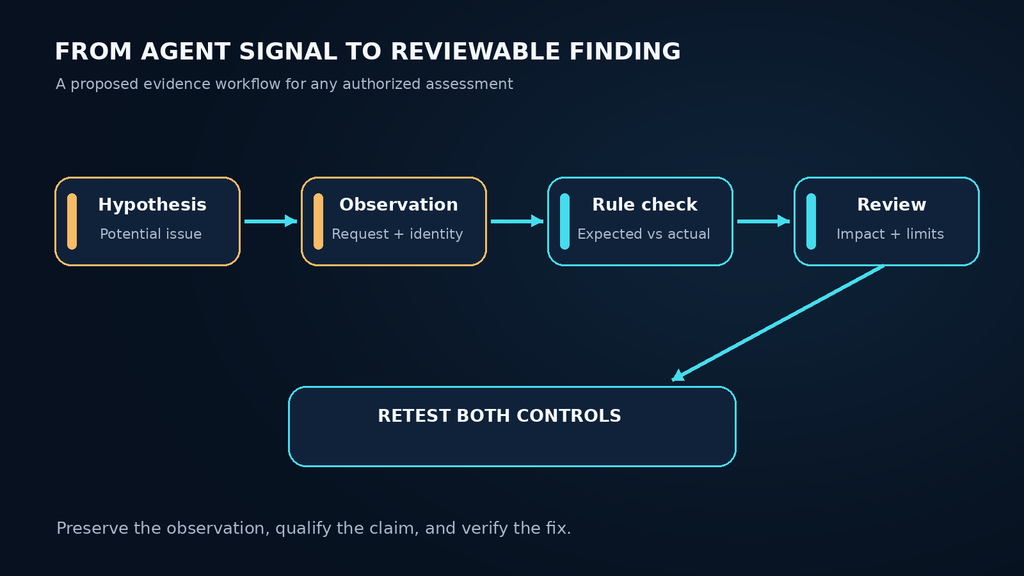
An AI summary saying “SQL injection found” is a hypothesis, not a finding an engineer can act on. A useful record identifies the exact authorized asset, relevant version or configuration where known, user role, request or action, expected security rule, observed behavior, reproduction conditions, impact boundaries, and a safe retest. The evidence must support the claim’s strength. A single anomalous response may justify a follow-up; it rarely justifies “database compromise.” A finding can be valid even if its maximal exploit chain has not been attempted, as long as the report says exactly what was observed and what remains unproven.
The reviewed ARTEX fork says it associates captured HTTP traffic with findings, can replay recorded requests, and has a retester that labels a result “Still reproducible,” “Fixed,” or “Cannot confirm.” Those are meaningful capabilities in the fork README. They do not guarantee that every generated finding is accurate: recorded traffic can show that a request was sent without proving that an authorization rule was violated. A replay can fail because a session expired, because the application was fixed, or because the original observation depended on state that the tool did not preserve. The report must distinguish those cases rather than collapsing them into “fixed.”
Penligent’s public workflow asks an operator to inspect evidence behind a possible issue, run Verify, review or edit findings, and prepare an editable report. Its pricing page places some reporting and retesting functions in paid plans, so a free trial should be evaluated against the entitlement it actually offers. Again, the existence of a Verify button is a workflow fact; the strength of the proof depends on what the test observed, what it saved, and whether a different person can reproduce the condition. Ask for the raw evidence, not merely a screenshot of a green status badge.
Consider a fictional authorized API test. A user with role
viewer-A asks for an object owned by viewer-B.
A 200 response alone is ambiguous: perhaps the object is intentionally
shared. A solid finding states the owner rule, the two identities, the
expected denial, the observed response, a harmless synthetic record that
proves the data belonged to B, and a control request showing A could
still access A’s own object. If the owner fixes the endpoint, a retest
should show the B read denied and the A read still working. That paired
result shows a security rule was restored without breaking legitimate
behavior.
This is the reason XBOW’s phrase “proving they’re real” deserves more attention than “finding vulnerabilities is getting cheaper.” In a report review, three questions matter: Can another operator tell exactly what the agent did? Does the evidence establish the claimed security rule was broken? Can a developer rerun the same negative and positive controls after remediation? An agent’s speed does not answer those questions, and a large finding count may increase review work if the chain of evidence is thin.
The practical difference between an evidence trail and a useful report
Capturing every action is useful for incident review, but a complete transcript can overwhelm the engineer who owns a fix. Evidence becomes useful when it is selected and interpreted against one stated rule. A report should keep the original artifact available, then present the smallest sufficient excerpt that supports the claim. That excerpt should not silently omit a failed control, an expired credential, or a later attempt that contradicted the first success. The reviewer needs to see both the decisive observation and the limits of the test.
Suppose an agent tries 40 variations of an input and one produces an unusual response. The audit log answers what happened across the session. The finding answers whether the one variation exposed a real control failure. The remediation ticket answers what component and rule should change. The retest answers whether that rule now holds. Those are four different objects, even when an application presents them in one interface. Ask an ARTEX operator or Penligent vendor to export each and show how the links between them survive a handoff to the engineering team.
Evidence can be incomplete in ways that matter. A request and response may omit the account’s role, the test fixture’s ownership, a server-side audit event, or the state that existed before the request. A browser screenshot may show that a page rendered without proving which tenant’s data it contained. A model explanation may correctly hypothesize a path without having exercised it. An export may preserve raw credentials or personal information that need redaction. A good reporting workflow flags these gaps and allows the tester to qualify the impact rather than assigning an unsupported severity.
Use three result labels in your own review even if the product uses different terms: “hypothesis” for a lead worth checking, “observed” for a repeatable behavior with known context, and “confirmed security impact” for behavior shown to violate a defined rule. A fourth label, “cannot confirm,” is honest when the environment changes. You can still prioritize a credible observation for further investigation without claiming that it has crossed the final threshold. This classification prevents the product’s visual polish from turning uncertainty into a false positive or an exaggerated finding.
The same principle applies to an AI-generated remediation suggestion. “Add authorization” is not a fix. The owner needs to know which service must check object ownership, whether the rule is user-, role-, or tenant-based, and which ordinary reads should remain allowed. A successful retest should check the denied unauthorized fixture and at least one allowed fixture. When a vulnerability requires more invasive proof, agree on the minimal evidence before running it; a limited demonstration can justify a recommendation without extracting a production dataset.
A local acceptance exercise that separates claims from controls
You can compare the products without touching a real third-party
service. Build a small isolated lab with two synthetic applications,
app.example.test y excluded.example.test,
and two synthetic accounts. The first application is explicitly in
scope. The second is explicitly excluded, but has a visible link or
redirect from the first. Give the approved app one synthetic object for
account A and another for account B. Place an independent observer at
the excluded service and another in the allowed app’s audit stream.
These are illustrative hostnames and fixtures, not a production scanning
target.
Before launching either agent, write the expected decisions. A read of A’s own object should be allowed; A’s read of B’s object should be denied by the target application; an assessment request to the excluded service should never reach its observer; a paused or expired assessment should launch no new tool action. Also define a request budget, a model budget, and a maximum amount of synthetic data the assessment may collect. The goal is to establish a predictable acceptance contract before seeing the product’s output.
Run each system at the same level of privilege, with the same approved target list, the same synthetic identities, and a comparable objective. Record the release or commit, model profile, tool configuration, policy settings, and whether the network-level gate was enabled. For the ARTEX fork, pay special attention to its documented target-gate default and which paths it covers; for Penligent, ask what scope checks the shipped executor actually applies. An operator confirmation screen and an underlying egress control are distinct evidence sources. The ARTEX fork and Penligent setup guide document their starting points, but the pilot supplies the observed result.
| Lab check | Expected outcome | Independent evidence |
|---|---|---|
| Authorized account-A read | Test may read A’s synthetic record | Application audit event and product trace agree on identity and object |
| Account-A request for B’s record | Target rejects the unauthorized read | Server authorization log, response, and fixture ownership |
| Out-of-scope redirect | No assessment request reaches the excluded service | Observer records no test traffic while a known test signal confirms it is healthy |
| Expired engagement | No new worker or tool action begins | Timestamped policy decision and target-side log |
| Operator pause | Queued work stops under documented semantics | Operator action, worker state, and absence of subsequent target activity |
| Fixed vulnerability | Unauthorized synthetic read remains denied; permitted read succeeds | Before/after evidence with the same identities and scope |
The excluded observer’s silence is useful only if you first prove the observer can see a harmless permitted control signal. Otherwise “no log entry” could mean a broken observer rather than a successful scope gate. Similarly, when an agent reports that an action was blocked, check the server and network observations to establish that the request never reached the excluded target. If a tool does send traffic, stop the lab run, identify the path that was not mediated, and adjust the configuration or decide that the current deployment does not meet the engagement’s policy.
The account-B case is intentionally different from the excluded-service case. The first tests the target’s application authorization rule inside an approved assessment. The second tests whether the assessment respects its own scope. A tool can correctly stay on the approved hostname while demonstrating a broken object authorization rule; it can also discover a genuine weakness on a hostname it was never permitted to test. Conflating these outcomes makes both the security result and the engagement record unreliable.
Finally, repeat the exercise after a clean restart and after changing the scope revision. A budget that only exists in worker memory may reset; an approval that exists only in a conversational instruction may not apply to a new child process. An operator needs to know whether the result is stable across the execution conditions that will exist in practice. The purpose is not to stage an adversarial contest. It is to expose assumptions that a brochure or README cannot prove.
Self-hosting, proprietary software, and the real cost of control
ARTEX’s reviewed continuation makes source inspection and local operation possible. The repository lists an AGPL-3.0 license and documents a Go application, embedded web interface, PostgreSQL dependency, external LLM profiles, and encrypted-at-rest secret handling in the current fork. A team can choose the model, inspect the code and network paths, change a control, and run the system in its own environment. Those are substantial benefits for an engineering team with the time and skill to maintain a security-sensitive application. They are not the same as a fully packaged, zero-cost service: the team still owns hosts, model use, monitoring, backups, patches, secret rotation, access control, and incident response.
The original upstream repository is no longer public, and independent continuations can diverge. If you use a fork, pin a known commit or release and record where it came from. Review what changed from the version assessed by your team, especially in the executor, proxy, approval logic, session handling, and logging. The README lists current protections such as encrypted secret storage and local binding by default, but the most important question for a deployment is whether the configuration you actually run preserves those properties. An internet-exposed administration console is a new attack surface, and the FBI advisory reports many publicly exposed instances. The exposed-instance figure does not mean all those systems were breached; it is a reason to avoid needless exposure and check access paths.
Penligent’s product page documents desktop clients for Windows, macOS, and Linux and a project workflow tied to scope, tool results, verification, and reports. Its pricing page offers free, paid, team, and enterprise tiers; the listed enterprise features include private deployment, data localization, identity integration, and a private-model inference gateway. Verify the applicable contract, available client build, included features, data processing, support terms, and deployment architecture before assuming that an enterprise feature applies to a trial account. A proprietary vendor may reduce the need to operate the orchestration stack yourself, but your assessment still needs a policy owner and an engineer who checks results.
The direct cost comparison is therefore not “free GitHub repository versus paid subscription.” An honest monthly estimate for a self-hosted framework includes infrastructure, LLM tokens, secure administration, staff time for updates, evidence storage, and the cost of reviewing findings. A vendor estimate includes subscription or usage credits, user seats where relevant, setup, any enterprise deployment charge, and the same review time. Use the actual pilot consumption, not an estimated count of agent steps, as the baseline. A report that takes a senior engineer hours to triage can dominate the cost of a cheap scan.
Do not use “self-hosted” as a shortcut for “all data stays local.” The framework may call external LLM providers, web search, package services, notifications, or remote MCP integrations. The reviewed fork documents external LLM profiles and Ollama as an option; a particular configuration determines which traffic leaves the environment. Likewise, a desktop product does not by itself prove where its model processing happens. Ask for a data-flow map with trust boundaries: what leaves the test machine, what reaches model endpoints, what is kept in a report, how long it persists, and who can access it. Inspect the actual enterprise deployment option if localization is a requirement.
Licensing deserves a separate check. The reviewed fork states AGPL-3.0 terms, including obligations that can matter when you modify software and make it available over a network. This article is not a legal interpretation of a derivative deployment; engineering and legal teams should read the license of the exact code they use. Open code permits inspection and extension, but it does not guarantee a project will remain maintained or that a mirror is trustworthy. Packaged software offers a support and purchasing relationship, but it does not eliminate the need to verify its implementation and the claims in its contract.
Model choice changes the threat model, not just the bill
En FBI advisory y CERT-EU analysis both describe ARTEX as connecting to external models rather than shipping a proprietary model as part of the framework. The public fork lists several LLM configuration routes. Penligent’s enterprise page lists private model integration. Neither statement establishes the behavior of a particular model under your workload. It tells you where to start the procurement questions: whose model receives the instructions, what data it sees, and what action is taken if it refuses, fails, or produces a confident but wrong plan.
Separate reasoning quality from tool authority. A better model may generate a better hypothesis but will still be unsafe if the executor accepts an out-of-scope action. A cheaper model may save money per token yet consume more tokens through retries or create more false positives. Test end-to-end cost per verified, reviewable finding rather than cost per token or number of exploratory steps. Use the same fixtures and review criteria across model profiles. Otherwise a change in model, scope, and tool permissions at the same time makes the result impossible to explain.
Tool output is also an untrusted input. A page might contain instructions that look like a system message or an agent plan. The reviewed fork says it frames tool results as data to reduce prompt-injection confusion. That is a documented safeguard, not proof that every malicious document or custom plugin is contained. In a controlled lab, place a harmless instruction in a test page that asks the agent to ignore the approved task and contact the excluded fixture. Observe whether the agent’s proposed action is rejected by the policy even if the model tries to comply. The test measures the combination of model behavior and independent enforcement.
For either product, list the people and systems that can change the agent’s authority. An administrator may alter policy; a tester may choose a target; a model may propose a tool call; an integration may add a new tool; a proxy may route traffic. Record which principal approved each transition and where that decision is audited. If the same credential can both edit the scope and launch the job, a nominal approval step may be less meaningful than it appears. A useful assessment architecture limits who can widen scope and preserves the old and new versions for review.
What defenders should take from observed ARTEX campaigns
There is a separate reason to study ARTEX even if your organization never runs it: attackers have been observed using it. The FBI FLASH summarizes campaigns across several sectors, describes reconnaissance through later intrusion phases, and includes mitigations and indicators. Google Threat Intelligence’s analysis reports cases in which actors supplied compromised credentials and let agents carry out subsequent work. These are observations by the named organizations, not direct measurements of the software’s normal performance in an authorized enterprise test.
The defensive consequence is a shorter window between an exposed weakness and follow-on activity. If an application leaks a privileged credential, the defender cannot count on an attacker taking days to connect the pieces. Prioritize reachable high-value systems, review application and cloud identities for excess privilege, and test whether a single exposed secret can unlock a second system. This is also why a defensive assessment should show the path from initial condition to verified impact without unnecessarily reproducing data theft. A safe demonstration of a permitted synthetic object may establish the same authorization failure that a risky large export would establish.
Do not build a detector that simply searches for an “ARTEX” user-agent string or a product name. A framework can be forked, customized, or run through ordinary tools. The Google analysis describes compressed bursts of actions and noisy iterative behavior in some incidents, but it also documents pauses and variation. Those are investigative leads, not a reliable single signature. Correlate identity, request origin, application behavior, authorization outcomes, cloud audit events, and timing. The underlying question is whether an identity did things it was never meant to do, even if the tools and headers looked ordinary.
For a web team, maintain an inventory of public login and administration surfaces and the identities that can reach them. Look for internet-facing management consoles, development credentials in production paths, and endpoints where a broad integration role can read many records. For a cloud team, review API keys and application principals that can read secrets, change roles, or create new access. CERT-EU recommends limiting exposed management panels and monitoring privileged account activity in its defensive ARTEX guidance. These controls are useful independently of which agent or human operator is on the other end.
For an incident responder, start with facts about the target rather than a guess about the attacker tool. Preserve affected account IDs, the first observed authentication, changes to privilege, requests to sensitive objects, and any outbound transfers. Build a timeline that separates an initial request from later privileged activity. If a credential was exposed, revoke or rotate it and determine where it could have been reused. Then examine what the identity actually reached. An AI framework can accelerate a chain, but a missing authorization check or overprivileged identity is still the condition you can fix.
The public reporting on ARTEX does not justify assuming that every scanning burst is malicious or that every unrecognized sequence is AI-driven. Your own authorized tester might create similar traffic. Coordinate test windows, test accounts, and source ranges with your defensive team, then use the assessment logs to explain expected activity. If you cannot distinguish your own authorized agents from an intrusion in your telemetry, that is an actionable finding about observability, irrespective of which product produced the traffic.
Measuring a pilot without rewarding noise
A fair evaluation starts with a fixed corpus and a review standard. Include several known vulnerabilities, several similar but safe behaviors, at least one authenticated role boundary, an excluded destination, and an application that changes state. Define which observations count as a finding before either tool runs. For example, “successfully retrieved a synthetic account-B object using account A, while A’s own read remains allowed” is a verifiable positive. “Agent named a potential IDOR” is not. If the team can only use a staging environment, say so; a staged test may not represent production complexity.
Measure four quantities separately: eligible cases attempted, cases with a supported finding, false claims submitted for review, and human minutes to reach a disposition. A fifth quantity, total cost, should include model usage, hosting or product credits, and reviewer time. Avoid a single composite score that hides a serious scope violation behind many successful easy checks. Boundary failures should be reported as their own acceptance gate. The number of agents and tool calls is diagnostic, not a measure of value by itself.
When comparing products, hold scope, test account permissions, starting evidence, and test time constant. Record differences you cannot hold constant, such as model selection or available browser tooling. A result from one vendor using a privileged administrator account and another using a restricted user is not a fair comparison of vulnerability discovery. Similarly, a longer run with more model budget may find more issues at higher cost. Report the tradeoff instead of declaring a universal winner.
Give the reviewer access to the same raw observations but hide the product label if practical. Ask them to classify each claim as confirmed, plausible but incomplete, unsupported, duplicate, or out of scope. A duplicate can still be accurate, but it should not be counted as a new finding. An out-of-scope result may be technically correct yet unacceptable for a client engagement. A review standard that treats all of these as “positive detections” will overstate usefulness and understate risk.
Time-to-finding alone is also misleading. One system might alert in three minutes and take an hour to produce usable evidence; another might take ten minutes and deliver a concise, reproducible report. Track time from launch to reviewer acceptance and time from remediation to a reliable retest. Where reporting is a paid feature, test with the plan you intend to buy; otherwise you may be measuring a demo path that differs from normal operations. The Penligent plan page is the current published starting point, and the ARTEX fork README states the current self-hosted feature set; neither substitutes for a measured engagement.
Use a failure diary. Record every action that required an operator to rescue the job, every false lead that consumed engineering time, and every claim whose evidence disappeared after restart. Record any unauthorized request, even if the target returned an error. That diary will reveal whether a platform fits your team’s workflow better than a screenshot of its best result. It also gives a vendor or maintainer a concrete bug report: exact build, fixture, expected rule, observed action, and saved trace.
Do not treat “could not confirm” as an automatic false positive. Sometimes the target changed, test state was consumed, or the safe rules of engagement prohibit a second attempt. Preserve the reason and classify the evidence actually available. Conversely, do not treat a model’s confident explanation as confirmation when the target never exhibited the behavior. The point of a benchmark is to measure what the tool and reviewer know, not to force every case into success or failure.
Questions to settle before a client engagement
An internal experiment can tolerate an uncertain feature or a messy export. A client engagement cannot. The agreement should name the asset owner, approved domains or IP ranges, accounts provided, testing window, prohibited actions, data collection limit, notification route, and stop procedure. Ask whether each tool can carry that exact engagement definition through to every worker. If the client later adds a hostname, preserve the old scope and a timestamped approval of the new one. A quiet edit to a project description is a weak audit record.
The owner of the assessment should decide what happens when an agent discovers a valuable-looking but excluded system. “Pause and ask” is a sensible default, but the implementation matters: can already queued workers still reach it, can a browser follow its redirect, and does an integration share the same scope? A demonstration should include an excluded fixture that is deliberately discoverable, because an invisible excluded asset does not test the policy. The result should show the attempted action, the reason it was refused, and an independent observation that the fixture received no request.
Define a safe proof threshold for each risk category. For a suspected unauthorized read, use synthetic records and stop after a minimal proof. For an exposed administrative interface, confirm reachability and access rules without changing production settings. For a potential code-execution path, use an isolated lab or an agreed harmless signal; do not run a destructive chain simply to make the report sound stronger. The client and tester should know in advance who can grant an exception, how long it lasts, and what evidence will be retained. These decisions belong to the engagement, not to a model prompt improvised midway through a run.
Discuss evidence handling before data arrives. Raw request bodies, screenshots, and tool transcripts can include credentials, personal information, or customer content. Choose a retention period, access list, encryption method, and redaction procedure that fit the engagement. A polished PDF is not sufficient if an unredacted traffic archive is available to a larger audience. Ask who can delete or export that archive, and whether the client can obtain it when they need to reproduce a finding. The useful comparison is the complete path from collection to controlled handoff.
Decide how the team will triage findings. A verified critical issue may need an immediate, out-of-band notification, while a low-confidence lead should remain in the tester’s work queue. If an agent claims to have accessed another tenant’s record, the operator should validate identity, ownership, and scope before sending a client-wide alert. Conversely, do not wait for a beautifully formatted report before telling the owner about an independently confirmed urgent exposure. Specify an escalation threshold and an accountable person for each decision.
Make retesting part of the original plan. Reserve access to the same synthetic identities and fixtures after a fix, record the version or deployment state of the first test, and decide whether changes to scope require a new authorization. A reopened vulnerability and a failed retest caused by expired credentials are different outcomes. A good final report says what was fixed, which original behavior was rechecked, which legitimate behavior still works, and which conditions were outside the retest. That precision makes the artifact useful after the assessment team has moved on.
Finally, verify the procurement language against the real feature set. Does the contracted tier include report export, scheduled retests, collaboration, private deployment, or an audit log? The current Penligent pricing page assigns features by plan; the public ARTEX continuation provides software under its own license with operational responsibilities left to its users. Neither model should be sold to a client under vague promises of “fully autonomous coverage.” State the assets tested, evidence collected, limitations, and human review completed. An honest scope statement increases the value of the report because the recipient can see exactly what it establishes.
How to choose for a real security team
Choose the reviewed ARTEX fork for a pilot when you have an engineer who wants to inspect and adapt the orchestration, operate the infrastructure, select the model and tooling, and prove the required gates in your own environment. Its evidence and retest features deserve a fair look; describing the current fork as a bare autonomous scanner would be inaccurate. Make ownership explicit: who maintains the fork, which commit is approved, who watches for security changes, and who audits the results? If the team cannot name those owners, source access alone does not solve the operational problem.
Choose Penligent for a pilot when your primary need is a defined application workflow for authorized projects, a tester-controlled Agent or Manual mode, findings that can be reviewed and verified, and a report that can be handed to a client or development team. Its product overview and plan page describe those steps. Validate the specific tier and the actual deployment before promising a feature in a statement of work. The purchase decision should turn on the evidence quality and operator fit observed in your own test, not on the fact that the vendor and the author of this article are the same company.
Some teams will use both types of system. A research group may experiment with a transparent framework on synthetic targets to understand how agent behavior changes by model and policy. A consulting team may prefer a packaged workflow for repeatable client delivery. A large organization may compare both against one acceptance lab before creating a standard. Using two products can also generate duplicate findings, so the team needs a consistent deduplication key: asset, identity, expected rule, observed behavior, and fix owner. A second report is useful only if it adds independent evidence or covers a different surface.
Before committing, ask both providers or operators for a recorded demonstration of five things: an out-of-scope request denied before network contact; a finding with reproducible evidence and a known negative control; an operator pause with queued work; a retest that preserves normal behavior; and an export that a developer can understand without the original tester. Add model/data-flow disclosure and total cost at the intended scale. If one vendor cannot demonstrate a criterion, record “not established” rather than guessing that the feature is absent or present.
Frequently asked questions
Is the original ARTEX repository still the one to install?
- No. The FBI
y CERT-EU
say the original upstream was removed. Public continuations are
independent projects. Check a specific fork’s maintainer, commit,
license, release integrity, and security documentation before using
it.
Does the FBI advisory mean using ARTEX is illegal?
- No such conclusion follows from the advisory. It documents
threat-actor use of a framework and defensive actions. Authorized
assessment and unauthorized intrusion have different scope and consent.
For any tool, obtain explicit permission from the asset owner and follow
the agreed rules of engagement. The FBI’s FLASH addresses
observed abuse, not a blanket prohibition on research.
Does a surviving ARTEX fork support human approval and evidence?
- En BaaRai/ARTEX
README documents approval gates, traffic-linked findings, replay,
budgets, and retesting. Other forks may differ. The same README says its
API-only target gate is off by default, so confirm configuration and
scope coverage in the build you run.
Is Penligent open source or free to operate?
- The public Penligent product and pricing pages describe a
proprietary application with a free entry tier and paid plans. The free
workflow and paid verification or export entitlements should be checked
on the current plan page before promising them to a team.
Which one has a lower false-positive rate?
- The cited public materials do not provide a controlled, comparable
benchmark that answers this. Run both against the same authorized lab,
record each claimed finding, and have an independent reviewer classify
it against the known fixture and evidence. Report the denominator,
model, configuration, and review standard before comparing rates.
Is self-hosted AI pentesting safer for confidential testing?
- It can give an organization more control over infrastructure and
model selection, but the answer depends on configured LLM endpoints,
integrations, administrators, logging, and evidence retention. The ARTEX fork documents external
model profiles; Penligent’s enterprise page lists private deployment and
model options. Request an actual data-flow diagram for either
despliegue.
Can an autonomous report replace a human pentester?
- No report should bypass human judgment on authorization, impact,
false positives, or remediation. Agents can reduce repetitive
investigation and help capture evidence. A responsible owner still
approves the engagement, reviews claims against the target’s rules,
decides whether proof is sufficient, and communicates limits to the
customer.
What is the fastest fair pilot?
- Use one isolated application pair with a known excluded destination,
two synthetic identities, one known broken authorization rule, and one
known safe control. Write the expected outcomes first. Compare
observable scope decisions, evidence and retest quality, operator
effort, and total cost rather than raw alert count.
The comparison that matters
The current ARTEX continuation offers source-level control and documents meaningful work on evidence, approval, and retesting. Penligent offers a packaged assessment workflow with explicit project setup, human review, verification, and reporting features described in its public materials. The FBI’s ARTEX advisory makes misuse and exposed consoles part of the threat landscape; it does not settle which product is better for an authorized team. A defensible choice comes from testing both under the same written scope, watching where agent actions really go, and checking whether each final claim survives independent review.
That review should produce a decision record, not merely a preference. Name the version tested, the model and tool permissions, the known fixtures, the actions that were denied, the findings accepted, and the work required to maintain the setup. If a capability is described in documentation but was unavailable in the tested plan or configuration, record the difference. If an agent found a real issue but crossed a contractual boundary to do it, record both outcomes. Security teams need enough detail to repeat the decision six months later, when the model, code, pricing, and application have changed.
The strongest result is modest and specific: this configured system, under this approved scope, produced these reviewable findings without sending traffic to the excluded fixture, and the owner could retest the fix. Neither open source nor a commercial label makes that result automatic. It has to be demonstrated in the environment where the team will rely on it.
For a client-facing summary, translate that record into decisions. State which assets were actually reached, which tests were deliberately withheld, which observations justify immediate remediation, and which claims remain provisional. Separate an excluded asset from an asset that was in scope but never tested because of time or budget. These omissions have different implications for a buyer reading the report. Record the date and configuration because a patch, new model, changed credential, or added integration can alter the outcome. When the next assessment runs, compare it against the same boundary and evidence criteria before crediting a larger finding count as progress.
 Spanish
 English
 German
 French
 Portuguese
 Japanese
 Korean
 Hindi
 Arabic
 Turkish
 Hebrew