
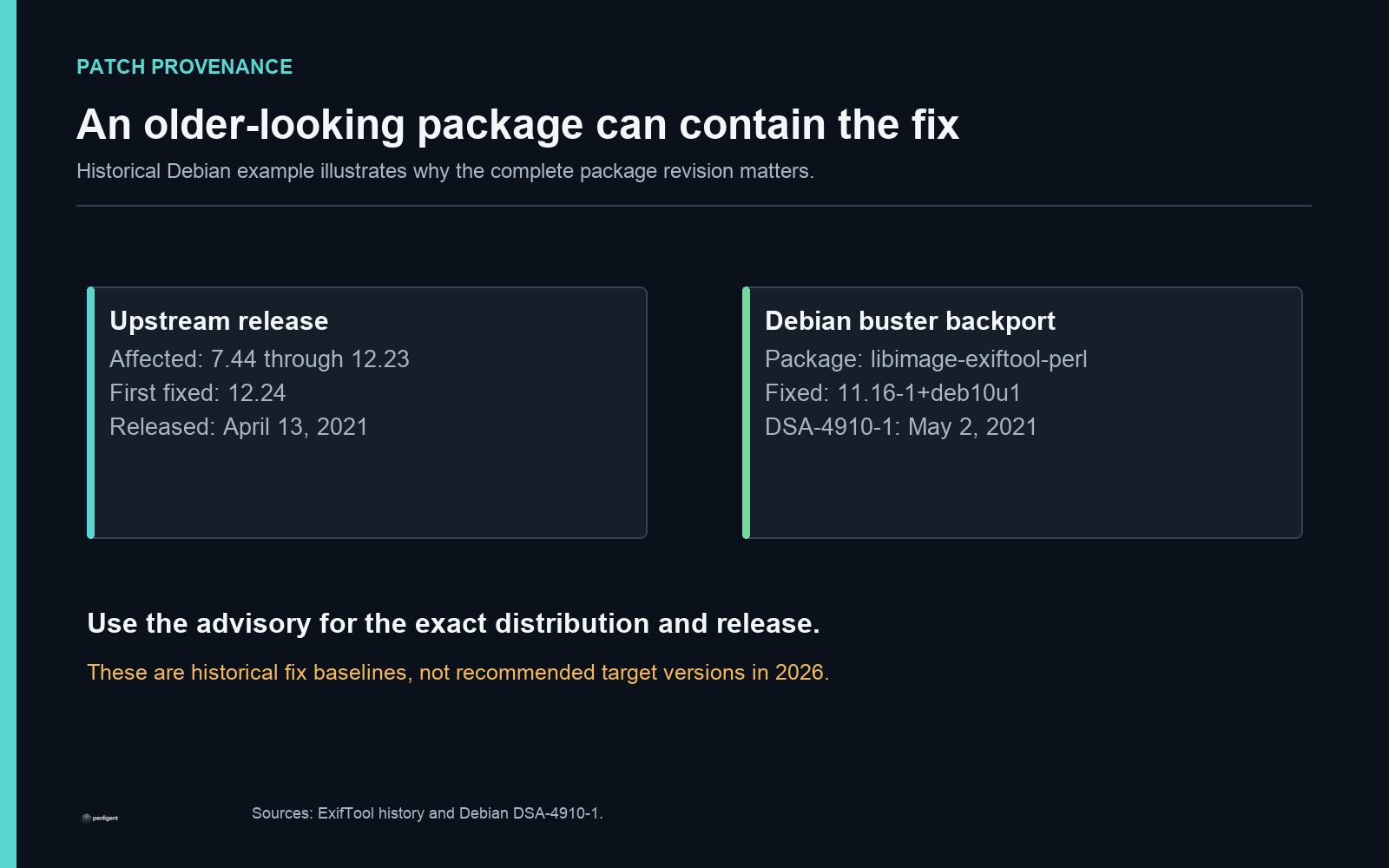
CVE-2021-22204 allows arbitrary code execution when a vulnerable ExifTool installation parses a malicious DjVu image. The upstream affected range is 7.44 through 12.23; ExifTool 12.24 introduced the DjVu-reader security update on April 13, 2021. These are historical remediation boundaries, not recommended target versions for a deployment in 2026. Use a currently supported release or a vendor package with the fix documented.
The operational question is which copy of ExifTool actually processes untrusted files. An updated utility on an administrator’s workstation does not establish the state of a separate upload worker, container, or bundled Perl library. This guide connects the published version boundary to a practical evidence record for the runtime that handles the file.
Fuentes: NVD affected-product record y ExifTool historical release notes.
Trace the file to the parser
Start with the application’s documented processing path. Identify the service accepting the upload, any storage or queue handoff, and the process extracting metadata. Record the executable or library location, image or deployment identifier, and service account. The queue shown below is a conceptual deployment example; a queue is not a prerequisite for this vulnerability.
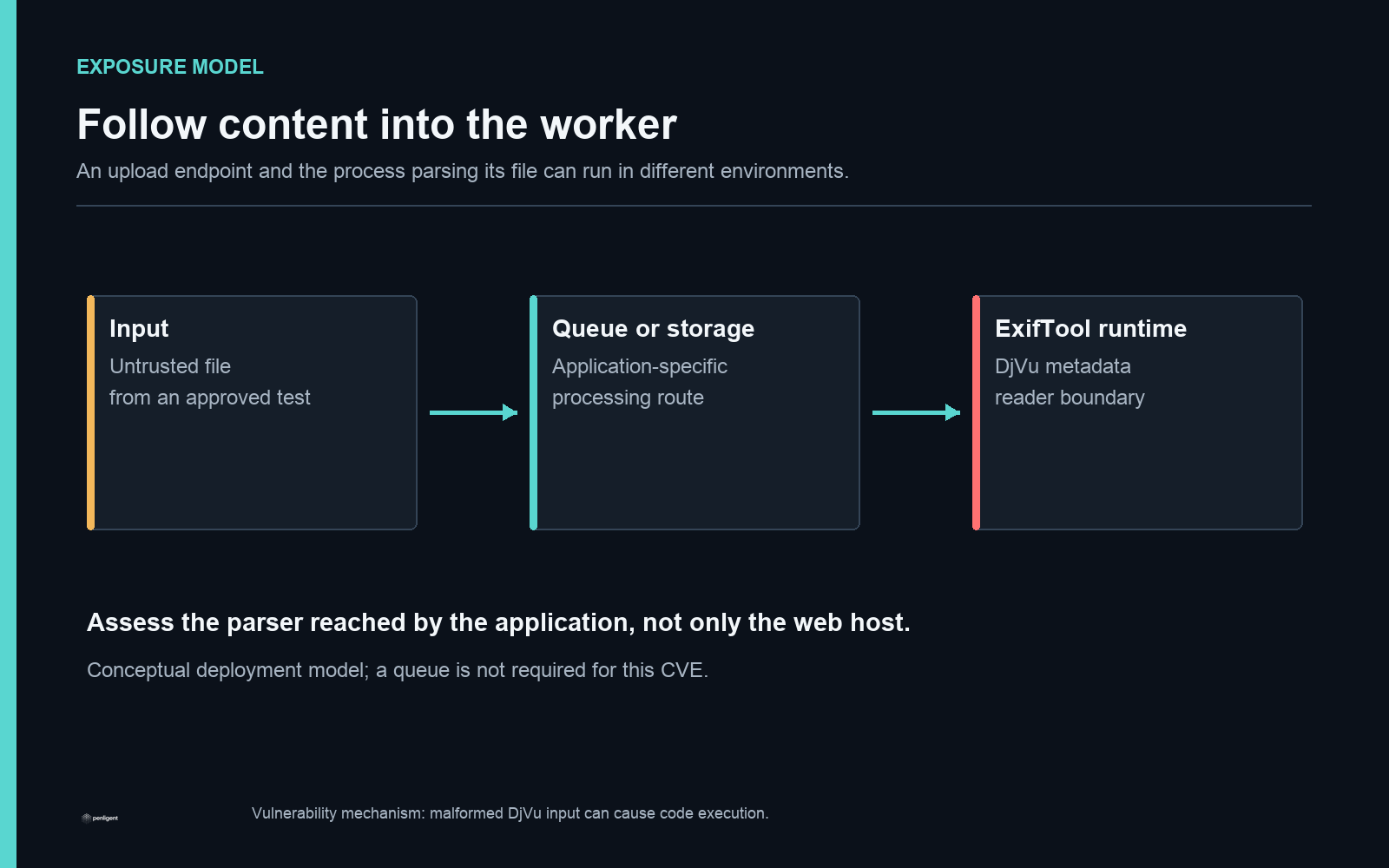
For each parsing component, establish whether files from an untrusted source can reach the DjVu reader. Do not infer safety from an upload endpoint’s filename policy alone. Conversely, finding ExifTool installed somewhere is not enough to prove that an externally reachable application invokes the vulnerable parser. Keep software presence, parser reachability, and runtime privileges as separate findings.
The published impact is code execution in the parsing context. The eventual privileges and accessible resources depend on that process’s account and deployment. Root access, a particular public endpoint, and a specific application-level authentication bypass are not universal properties established by the ExifTool CVE.
Compare upstream releases with vendor package revisions
There are two different forms of patch evidence. An upstream copy can be compared with the upstream fixed release. A distribution package must be assessed against its vendor’s security advisory for that distribution and release. A backported fix can retain a base version lower than 12.24.
| Installation source | Verified historical fix | How to use the evidence |
|---|---|---|
| Upstream ExifTool | 12.24, April 13, 2021 | Confirm the runtime uses a fixed upstream copy; choose a supported release for deployment. |
| Debian buster package libimage-exiftool-perl | 11.16-1+deb10u1, DSA-4910-1 | Illustrates a vendor backport. Do not apply this revision to another Debian release or distribution. |
Debian DSA-4910-1, issued May 2, 2021, explicitly identifies 11.16-1+deb10u1 as the fix for buster. That reconciles the apparently older version with the upstream 12.24 boundary. It does not make an obsolete operating-system release a suitable destination for a new deployment.
Collect runtime evidence without an exploit
On an authorized Linux runtime, the following read-only inventory commands report the executable selected by the current shell and its version. The Debian command reports the installed package revision. Run them inside the relevant container or worker environment when that is where processing occurs.
command -v exiftool
exiftool -ver
# Debian-family package inventory, when applicable:
dpkg-query -W -f='${Package} ${Version}\n' libimage-exiftool-perl
These commands do not exercise the vulnerable parsing path. Shell PATH resolution may differ from an application’s configured executable path, and a vendored library may be independent of the operating-system package. Reconcile the output with the worker configuration and dependency inventory before assigning a status.
After deploying the corrected package or image, restart or redeploy the affected worker as appropriate to its lifecycle. Recheck the runtime actually serving jobs. A harmless, known-good media file can verify that the approved processing route still works; successful metadata extraction is a functional check, not proof that a malicious-input exploit has been blocked.
Decide whether the finding can close
Close the finding only when the record connects the processing runtime to its patch provenance. Preserve the service name, executable or library path, upstream version or complete vendor package revision, controlling advisory, deployed image or build identifier, and validation time. For a service with multiple replicas, collect evidence for every active revision or demonstrate that all replicas use the corrected immutable image.
Keep the finding open when the only evidence is a host-level package update while the application still points to an unidentified bundled copy. If untrusted processing must be suspended while remediation is prepared, assess that change with the application owner. Reduced network access and least privilege can limit consequences, but they do not repair a vulnerable DjVu reader.
This is an evidence-based closure workflow: it distinguishes a fixed runtime from an unverified installation without requiring a weaponized file or a production exploit attempt.
Method and limits
AI assisted article organization and diagram production. Material version claims were checked against ExifTool release history, the NVD record, and Debian DSA-4910-1. The deployment model and closure workflow are defensive analysis. Penligent did not reproduce this vulnerability, run the inventory commands against a customer environment, or test an exploit.
The video below is a general Penligent product workflow demonstration. It does not demonstrate or validate CVE-2021-22204.
 Spanish
 English
 German
 French
 Portuguese
 Japanese
 Korean
 Hindi
 Arabic
 Turkish
 Hebrew