
CVE-2026-109518 is an APT package-verification bypass that can turn a manipulated software download into code execution as root. Debian disclosed the issue on November 4, 2026: an HTTP redirect can make separate package downloads converge on the same URI, and incorrect file handling during a resumed download can allow a package to be replaced after verification. The corrective action is to update the APT client and its related packages, then verify the environment that actually performs package installation. See Debian security advisory DSA-6607-1.
The difficult operational question is where that environment lives. It might be a production server, but it can also be a short-lived build container, a runner image, or an older recovery system that becomes active only during an outage. A patched administrator workstation says little about those paths. Treat the response as a review of package installation boundaries, with a specific owner and an observable result for each boundary.
Reviewed November 5, 2026. The commands below are maintenance examples for systems you own or administer. No production exploit was executed for this article. The local demonstration illustrates a file-identity mistake without making network requests, building a malicious package, or invoking APT.
What CVE-2026-109518 requires
The published description requires an attacker who can influence HTTP traffic between the APT client and an archive, including a malicious mirror or proxy. The relevant sequence involves redirects, package-download retries, and reuse of hard links. A nonzero Acquire::Retries setting is required; the distribution defaults changed to three retries with Debian 12 and Ubuntu 22.04 LTS. Older releases therefore need a configuration check rather than an assumption that their age makes them safe. These conditions are documented in the Debian CVE tracker.
| Question | Verified answer | Operational consequence |
|---|---|---|
| Which component? | APT package acquisition and verification | Inventory the installer environment, including build stages. |
| What can success mean? | Installation of attacker-controlled package contents with root execution | Package installation belongs inside the trust boundary. |
| What network position matters? | Influence over the relevant HTTP download path | Document mirrors, proxies, and transport termination. |
| What configuration matters? | Redirects and retries, with nonzero Acquire::Retries | Inspect the effective invocation, not just one configuration file. |
| What does Ubuntu assign? | High priority and CVSS 4.0 7.7 | Use the vector and local conditions alongside the numeric score. |
The Ubuntu priority and score come from its CVE-2026-109518 record. A numeric score does not tell you which of your systems installs packages through an exposed path. That mapping remains an inventory and configuration task.
Separate three claims in the response ticket. An affected package version establishes a software condition. A reachable, attacker-influenceable download path establishes part of the opportunity. Evidence that a substituted package was installed establishes something much more serious. Combining these claims into one field labeled “vulnerable” makes it harder to decide whether the next action is a routine change, urgent containment, or incident investigation.
For example, a disposable builder that installs packages from an HTTP mirror through an unmanaged network deserves different handling from an archived image that never executes. The archive may still need replacement before anyone uses it. Its present operational state, however, differs from an active runner processing builds every few minutes. Assign priority to the actual workflow while keeping dormant copies visible as future activation risks.
Canonical locates the flaw in the HTTP backend used by the APT library, so changing from apt to apt-get is not an avoidance strategy. It separately excludes snap installation and FTP transport from this issue. See the Ubuntu component-scope explanation. Keep those boundaries specific to this advisory.
The trust boundary is between verification and installation
APT normally relies on authenticated repository metadata and hashes to connect the archive to downloaded package content. Debian’s apt-secure manual explains this chain and the distinction between trusting an archive maintainer and proving that every package is harmless. Archive authentication addresses provenance and integrity; it is not a general certification of software behavior.
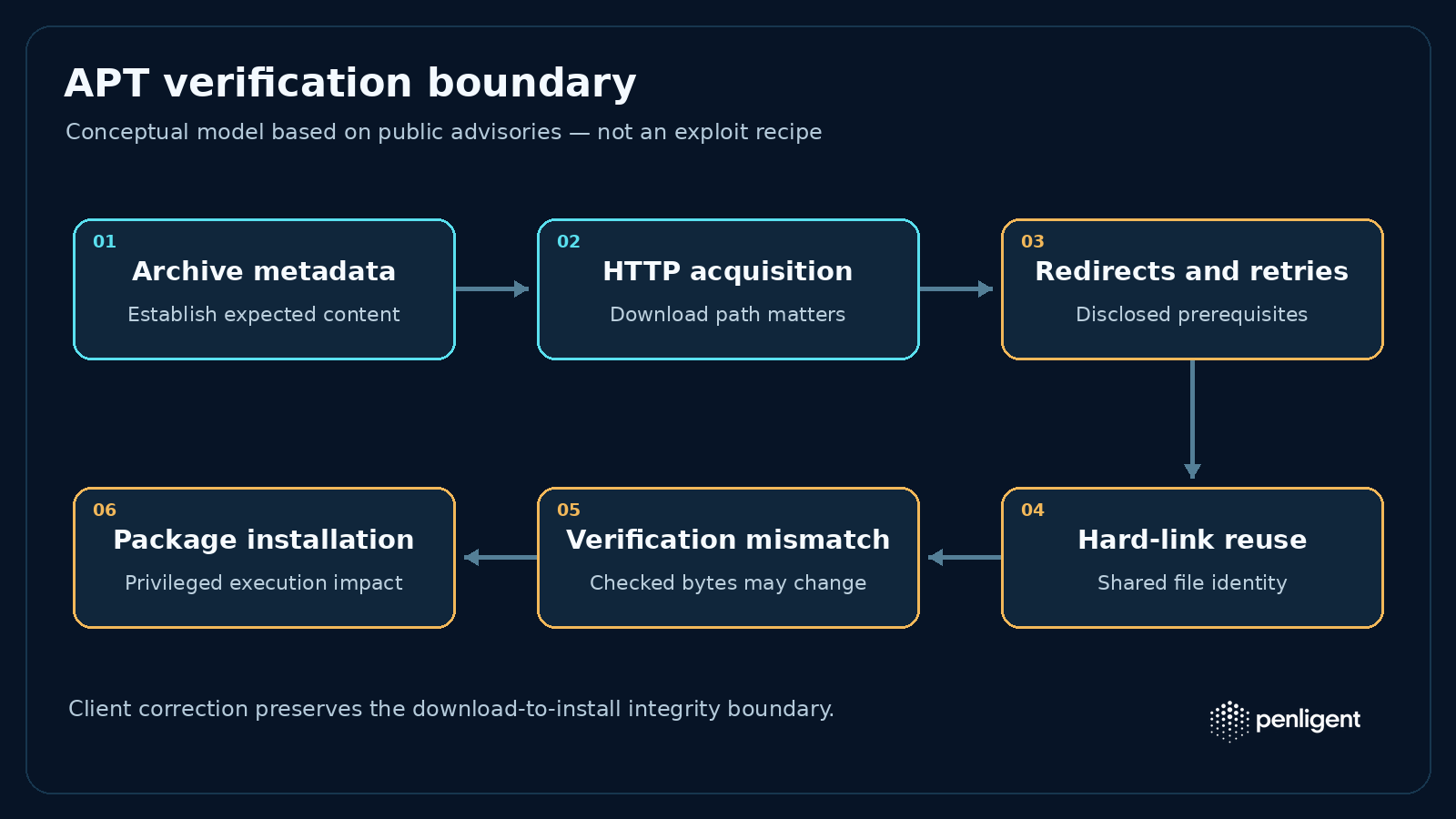
A useful way to reason about CVE-2026-109518 is to ask what object a successful verification describes. A check is meaningful only if the later consumer receives the same bytes under the same security assumptions. A file path alone cannot provide that guarantee when other names or operations can still modify the underlying data. The public advisory identifies a concrete failure involving download state; it does not imply that the repository signing key was stolen or that the signature algorithm was broken.
Imagine an internal review record that says “download verified at 10:03.” That statement is incomplete without an identity for the verified object and a rule governing changes before use. If a later operation writes through a different name that refers to the same storage, the earlier result can become stale. The installation step then inherits confidence that belonged to an earlier state. This is a general explanation of the trust problem, rather than a reconstruction of the undisclosed request sequence.
This distinction changes the investigation. A team focused only on repository keys might spend its first hour rotating keys while leaving vulnerable installers active. A team focused only on HTTPS might overlook an internal component that terminates TLS and serves packages over HTTP. A team focused only on disk inventory might miss an old build stage that executes before a new runtime image is assembled. The relevant object, connection, and execution context all need to be named.
Keep cryptographic failures and state-management failures separate in technical communication. The appropriate question is not whether a hash remains a good integrity primitive. It is whether the correct bytes are checked and whether those bytes remain the ones that will be consumed. That question is equally useful during patch review, regression testing, and a supplier discussion because it points to a testable invariant instead of an abstract promise of “secure downloads.”
Redirects, retries, and file aliases form the disclosed mechanism
Debian’s advisory describes downloads converging after an HTTP redirect, followed by incorrect handling when a download resumes. Ubuntu’s USN-8996-1 identifies incorrect hard-link handling during redirects and retries. Those disclosures support a mechanism-level explanation, but they do not justify inventing a production-ready redirect recipe, response body, or timing sequence.
Each operation has a legitimate purpose. Redirects allow an archive to send a client to an appropriate download location. Retries let a package transaction survive a transient transport failure. A local acquisition system may also keep several names for data as it manages partial and completed work. The engineering challenge is preserving ownership and verification state when those operations interact. A security review that examines each feature in isolation can miss the composition.
For defenders, the important relationship is that retry behavior creates another transition after an earlier check or acquisition decision. That transition needs the same integrity discipline as the first download. A prior successful operation cannot authorize arbitrary later data simply because the logical package name has not changed. Treat any cached “verified” state as a claim about a specific object and revision, not as a permanent property of a path.
This also explains why a normal successful update is a weak test of the vulnerable behavior. The test may never involve a redirect, a retry, or the relevant aliasing condition. Successful package installation after a patch is still useful for compatibility verification. It is not, by itself, a targeted regression test of the underlying defect. Keep the purposes of those tests separate in the change record.
A deployment team usually does not need to reproduce the full attack to make the patch decision. The vendor has identified affected software and released corrections. The team’s higher-value work is mapping those corrections to its own distributions and confirming that the corrected client is used at every installation boundary. Reproduction becomes a separate laboratory activity when a security engineering team needs additional assurance or must evaluate a downstream patch.
Debian fixed versions must match the release family
For Debian 12 bookworm, DLA-4880-1 specifies APT 2.6.2. For Debian trixie, DSA-6607-1 specifies 3.0.4. The tracker also lists the unstable fix as 3.3.6. The following snapshot was checked on November 5; use the live tracker when planning a later deployment.
| Debian branch | Fixed version in reviewed records | Decision |
|---|---|---|
| bookworm | 2.6.2 | Use the applicable security update and verify installation. |
| trixie | 3.0.4 | Use the security repository for the installed release. |
| sid | 3.3.6 | Verify the actual package available to the environment. |
| forky | Tracker still lists 3.3.5 as vulnerable at review | Do not infer migration of a fix from a different branch. |
The last two rows follow the Debian package-status table. They illustrate why “Debian fixed it” is insufficient evidence for a particular release channel. An update entering one branch does not establish that an image built from another branch has received it.
Compare within the distribution’s package family. A lower upstream-looking version can contain a backported correction, while a numerically larger package from an unrelated branch can be the wrong artifact for the host. Avoid solving an urgent package issue by mixing repositories casually. That can introduce dependency or support problems which obscure whether the intended correction is active.
For a derivative distribution, obtain its advisory or its documented relationship to the upstream package. Record the repository origin and complete revision. An image label such as “Debian compatible” cannot establish that its maintainer has imported a security update. If the supplier has not published a mapping, leave that row unresolved and identify the owner who will obtain it. Uncertainty should be actionable rather than silently translated into “not affected.”
Ubuntu fixes include standard and extended-support packages
Ubuntu publishes the following corrected APT versions in USN-8996-1. The support entitlement matters for older releases; availability in a public table does not mean every machine is configured to receive the package.
| Ubuntu release | Corrected APT package | Delivery consideration |
|---|---|---|
| 26.10 | 3.3.3ubuntu0.1 | Standard security update |
| 26.04 LTS | 3.2.1ubuntu0.1 | Standard security update |
| 24.04 LTS | 2.8.4ubuntu0.1 | Standard security update |
| 22.04 LTS | 2.4.15ubuntu0.1 | Standard security update |
| 20.04 LTS | 2.0.12+esm1 | Ubuntu Pro ESM |
| 18.04 LTS | 1.6.19+esm1 | Ubuntu Pro ESM |
| 16.04 LTS | 1.2.36+esm1 | Ubuntu Pro with Legacy Support |
| 14.04 LTS | 1.0.1ubuntu2.24+esm4 | Ubuntu Pro with Legacy Support |
The practical acceptance criterion is a corrected package from the supported channel for that system. It is reasonable to use a later supported package containing the correction; preserve the vendor mapping that supports that conclusion. Do not hard-code one release’s version string across an estate that spans several releases, because the resulting comparison will either miss old systems or create false alerts on valid backports.
An inaccessible update deserves its own status. A machine can be affected, have a published fix, and still lack access because its entitlement or mirror configuration is wrong. Calling that machine “pending reboot” would misdirect the response. Separate package acquisition, installation, and execution checks so a repository or support problem reaches the appropriate team.
Likewise, an unattended-update policy is an intention rather than an observation. Confirm the package transaction and the relevant environment after the expected update window. Failed repository access, a held package, or a machine that has not checked in can break the assumed path to remediation. Use the same evidence requirements for an automatic update that you would use for a manually initiated one.
Collect read-only evidence before changing the system
Start with the system release and the installed package database. The following commands query local state; they do not download packages or exploit the flaw. Debian documents formatted package queries in dpkg-query.
cat /etc/os-release
dpkg-query -W -f='${binary:Package}\t${Version}\t${db:Status-Abbrev}\n' apt
apt-cache policy apt
apt-config dump | grep -i 'Acquire::Retries'
Record both the installed version and the candidate. The candidate tells you what the currently configured package indexes would select; it does not prove that the package was installed. Conversely, the installed version can be corrected even if a mirror has since changed. Retain the repository origin and collection time with the output so a later reviewer can interpret the observation in context.
Use an account and collection method appropriate to the environment. These observations should be possible without handing a general-purpose agent unrestricted administrative access. If evidence comes from an inventory system, preserve its freshness and the exact object it describes. A report from yesterday’s runner pool may say nothing about the fresh instances launched from a different template this morning.
The absence of a retries line needs interpretation. It is not a universal declaration that retries are disabled. Review the installed release’s defaults, invocation-specific options, and configuration supplied by automation. The apt-config manual describes configuration inspection, while apt.conf documents configuration loading and command-line overrides.
Read the job definition that actually launches installation. A developer’s interactive shell and a privileged automation process may load different settings. Check whether a wrapper supplies -o Acquire::Retries=... or a separate configuration file. A configuration screenshot is useful only when it belongs to the same invocation being assessed.
Inspect repository and proxy configuration locally. Source files can reveal private mirror names or embedded credentials, so avoid pasting a complete dump into a public issue. Extract the transport, ownership, and trust relationships needed for the decision. If credentials appear in a source URL, redact them from the review copy while retaining the original evidence in the approved restricted location.
| Pruebas | What it establishes | What it leaves open |
|---|---|---|
| Installed package revision | The package database’s current state | Whether every build or running process uses it |
| Candidate and repository origin | The configured update selection | Whether acquisition and installation will succeed |
| Effective retries setting | A prerequisite for a particular invocation | The condition of other invocations |
| Source and proxy mapping | The intended download route | Whether the observed transaction followed it |
| Fresh workload identity | Which host, image, or job was observed | The state of unobserved copies |
That final column is not a reason to collect everything indefinitely. It tells you which next observation closes the specific gap. For a static server it may be a new package query after maintenance. For a transient builder it may be a controlled new job that records its base image and APT package before installing dependencies. Choose the smallest observation that answers the unresolved question.
Protect the update transaction while installing the correction
The update process itself is part of the exposure question. Canonical recommends temporarily disabling retries during installation of the security update, and publishes both a full-upgrade command and a targeted APT-source-package command. Its APT remediation guidance also describes HTTPS as protection against manipulation on the network path. Use the procedure for your distribution and approved change window.
# Ubuntu vendor example: review the planned package transaction first.
sudo apt update
sudo apt upgrade -o Acquire::Retries=0

# Vendor alternative when the immediate change must target APT packages.
sudo apt install -o Acquire::Retries=0 --only-upgrade '?source-package(^apt$)'
These commands change system software. They are published examples, not commands executed against a reader’s environment. Review package holds, disk space, maintenance constraints, and recovery access before applying them. In automation, preserve the command’s outcome and the package transaction result; a shell session ending without a visible error is not enough evidence that every intended package changed.
A temporary override should have a defined lifetime and an owner. If it remains in a wrapper, document why. If it is removed after the corrected client is installed, make the removal an explicit part of the record. A mitigation that was useful during one transaction should not become an unexplained configuration difference that causes unrelated jobs to fail months later.
Consider a maintenance controller that updates a server fleet in small batches. The first batch should demonstrate package acquisition, successful configuration, and expected service behavior. Later batches should collect the same compact evidence automatically. If a batch cannot reach its security repository, stop attributing its failure to the vulnerability itself. Resolve the transport or repository condition, then retry the controlled change with a fresh observation.
For a managed image, changing a live instance can provide immediate relief but leave the template vulnerable. Schedule template replacement as a separate deliverable. Otherwise an autoscaling event or disaster-recovery exercise can restore the original installer and silently reopen the download path. The correct unit of completion includes both current execution and the source from which future execution will be created.
HTTPS and retry controls address different parts of the risk
HTTPS protects the connection to the endpoint that terminates TLS. A retry override changes whether the client takes a required acquisition path. Neither observation should be expanded into a statement about every package operation in the organization. Preserve the endpoint and invocation scope whenever recording a temporary control.
A common architecture makes the distinction visible. A runner contacts an internal caching service over HTTPS, while that service obtains packages from an external mirror using HTTP. Another organization terminates TLS on an enterprise proxy and forwards plain HTTP inside its network. Review the downloader that performs the package transaction and the relevant segment it actually uses. A single “HTTPS enabled” checkbox can conceal several different connections.
For the change record, treat the corrected client as durable remediation and the verified transport policy as an additional control. Record each independently. This makes a later transport change reviewable without losing the package evidence, and a later package rollback visible without assuming that an older network assessment still applies.
Do not replace repository authentication with an insecure workaround to make an urgent update succeed. The apt-secure documentation warns against options that permit insecure repositories. If signature or trust errors appear, investigate key configuration, repository identity, clock state, or the vendor’s documented process. An update completed after suppressing integrity checks creates a different assurance problem.
A mirror migration also deserves a compatibility check. Confirm that the selected endpoint supports the desired transport and that authentication continues to work. Preserve third-party repositories as separate decisions rather than applying an unreviewed blanket replacement across every configuration file. The maintenance goal is a predictable corrected download path, not merely removal of the string http:// from one machine.
A local demonstration of stale verification state
The following Python example demonstrates why two pathnames are not necessarily two independent file objects. It creates harmless text files in a temporary directory, makes a hard link, and compares hashes before and after a local write. It performs no network activity, invokes no package manager, and executes no package content. It is not a reproducer for CVE-2026-109518 and does not model APT’s internal state machine.
from pathlib import Path
from tempfile import TemporaryDirectory
import hashlib
import os

def digest(path):
    return hashlib.sha256(path.read_bytes()).hexdigest()

with TemporaryDirectory(prefix="verification-model-") as root:
    root = Path(root)
    checked = root / "checked.txt"
    alias = root / "retry-view.txt"
    checked.write_bytes(b"approved example content\n")
    expected = digest(checked)
    os.link(checked, alias)

    print("same file object:", os.path.samefile(checked, alias))
    alias.write_bytes(b"different harmless example content\n")
    print("earlier check still describes current bytes:",
          digest(checked) == expected)

    independent = root / "independent.txt"
    independent.write_bytes(checked.read_bytes())
    print("copy has independent identity:",
          not os.path.samefile(checked, independent))
On a filesystem supporting these operations, the first comparison should be true and the second false. The copy should have independent identity. Python documents the file-link operation in its os.link reference. If the environment does not support hard links or denies them, treat that as a limitation of the demonstration environment, not as evidence about an APT installation elsewhere.
The lesson is narrow. Hashing a path at one moment does not protect the underlying bytes from a later authorized write through another name. A security-sensitive consumer needs a design that preserves the relationship between the checked object and the consumed object. A separate copy illustrates independence in this toy example, but it is not a proposed substitute for the vendor’s APT patch.
Use the example in an engineering review to make the invariant concrete. Ask which component owns the object after verification, which operations can still mutate it, and what invalidates a cached success state. Those questions are more useful than asking whether a function named “verify” exists. A system can perform a correct calculation while applying the result to the wrong object or to an object that has changed.
Do not turn a successful toy run into a vulnerability finding against a server. It establishes a general filesystem property under laboratory conditions. Assessing an actual product requires its package state, configuration, vendor mapping, and, where necessary, a separately authorized test. Keep the demonstration output out of the evidence field labeled “production exploitation.”
Verify package activation in the environment that will run next
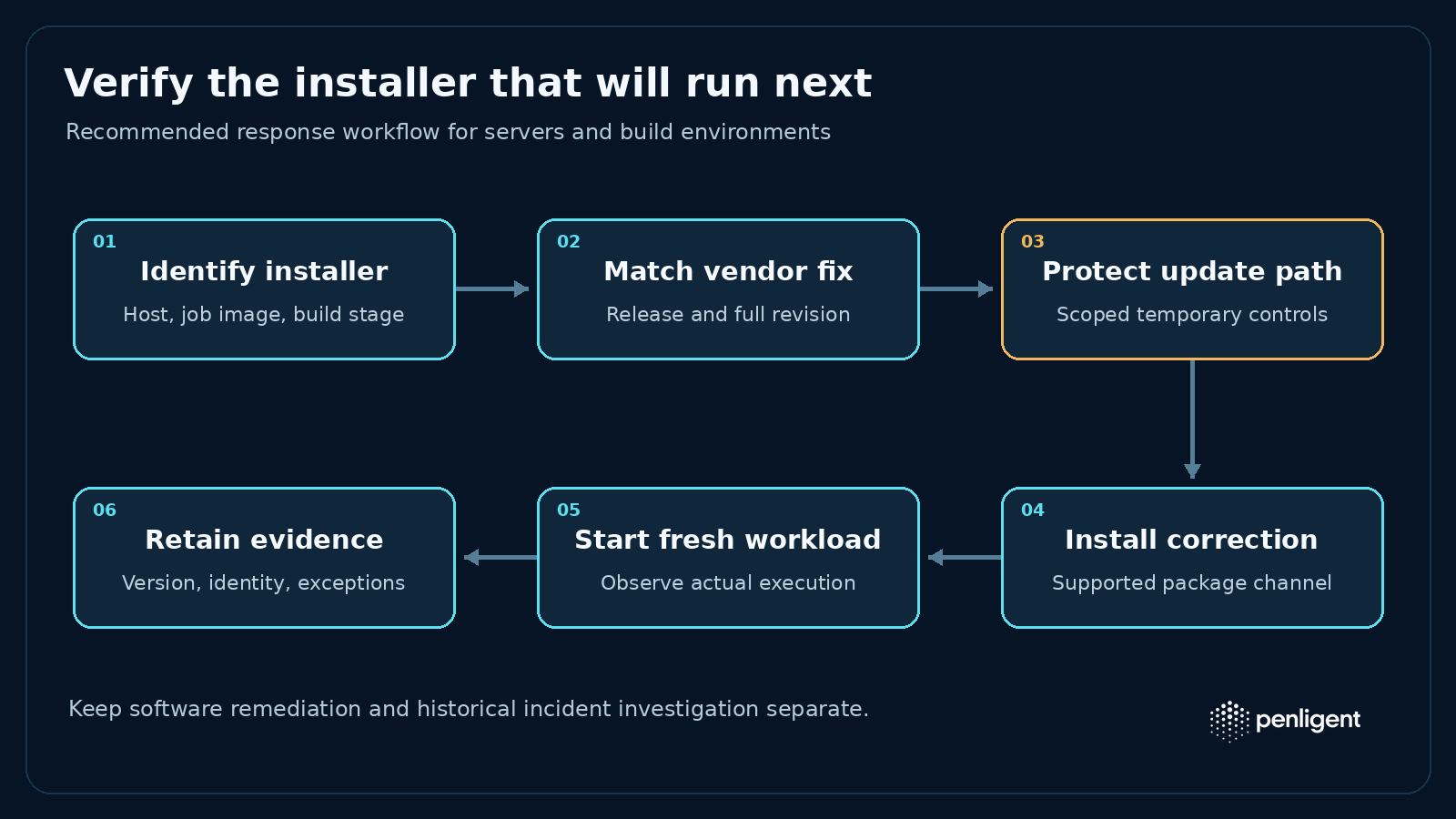
After installation, repeat the local package query and retain the complete revision with the host or image identity. Also confirm that the next installation process uses the corrected environment. A package on disk, a persistent process, and a future child process can represent different moments in the deployment lifecycle. Do not compress them into a single version field without understanding which one matters.
For a conventional server, start a fresh approved maintenance invocation after the update and confirm normal package operations. For an automation service, follow the service owner’s restart or replacement procedure where required, then check the replacement worker. For an immutable runner, launching a new instance from the corrected template is stronger evidence than modifying a worker that will disappear at the end of its current job.
Keep a lightweight compatibility test alongside the security evidence. A controlled package-list refresh, an approved benign package operation where appropriate, and a representative build can show that the corrected environment still serves its intended purpose. These checks do not reproduce the security defect. They reduce the chance that a nominal patch rollout is immediately reversed because a normal workflow was never exercised.
Record failed and missing observations explicitly. A disconnected node is not corrected because the other nodes passed. A rebuild that never ran is not corrected because its Dockerfile was edited. A supplier confirmation without a package revision can be a useful interim answer, but it is not the same kind of evidence as a verified image. Different evidence types can coexist as long as the final status preserves the distinction.
CI runners need separate host and job-image decisions
A self-hosted runner can install packages in several contexts: directly on the runner host, inside the job container, or inside a nested build. Name those contexts before assigning the ticket. Updating the host does not update an old job image, and rebuilding the job image does not necessarily replace the host’s package manager. This is an operational scoping recommendation, not a claim that every runner supports the same execution model.
Start with one representative pipeline. Identify the runner image, executor type, job image, and commands that install operating-system dependencies. Follow the dependency installation to the environment where the APT process actually executes. If the pipeline delegates building to another service, include that service’s image and update ownership in the diagram. A diagram ending at “CI platform” is too coarse to locate the correction.
Then inspect reusable job templates. A centrally corrected template may cover many repositories, but a repository can pin an older version or define its own installation step. Search configuration under your authorized source-management scope and have repository owners confirm exceptions. The purpose is to locate execution paths, not to count matching strings. An unused template and a frequently executed production-release job have different urgency.
For credential handling, separate prevention from investigation. A build process may have access to deployment credentials, signing services, or artifact registries. That access affects the potential consequence of a compromised build. It does not prove that any credential was exposed. Use the credential scope to prioritize investigation and containment when evidence justifies them, while preserving the distinction between a vulnerable build and a confirmed malicious transaction.
A practical closeout for a runner pool can include the corrected template revision, retirement of old instances, a new job identifier, the observed APT package revision inside that job, and a successful representative build. If one pool cannot be replaced during the window, isolate its remaining work and give the exception a short, explicit expiry. An aggregate “CI patched” label should not hide that pool.
Container builds can execute vulnerable software before producing a clean image
Review build-time and runtime inventories separately. A final application image might omit APT entirely while an earlier build stage used it to install compilers or libraries. A scanner examining only the final filesystem can therefore answer a different question from the one posed by this incident. The build definition and the build logs establish which stage performed acquisition.
Consider a hypothetical two-stage build. The first stage installs build dependencies and creates an application artifact. The second copies that artifact into a smaller runtime. If the first stage is compromised during dependency installation, removing its package manager from the final stage does not undo the actions that already happened. This scenario illustrates a trust boundary; it is not evidence that any specific project was attacked.
Refresh the base image under the project’s normal provenance policy and record the selected digest. Then inspect the actual packages and commands in the stage that will run. A floating tag can change over time, while a pinned digest can preserve an old environment indefinitely. Neither choice is inherently a remediation record. The record needs to identify the artifact used for the successful corrected build.
Build caches add another distinction. Reusing a previously completed layer may avoid a new package transaction during that build, but it also preserves the state and provenance of that layer. Invalidating a cache can force acquisition again. Plan that action together with the corrected client and download-path controls so the first clean rebuild does not recreate the same vulnerable operation.
Do not equate “rebuilt today” with “built from corrected inputs.” Preserve the base digest, relevant stage identity, APT revision, and evidence that the intended instructions executed or were deliberately reused. If a build system obscures that information, establish a temporary diagnostic job that records only the necessary nonsecret observations. Remove diagnostic exposure after the review, while retaining the evidence in the approved change record.
Internal mirrors and proxies need an explicit trust map
List the archive endpoint, the cache or proxy between it and the client, the transport on each segment, and the owner of each component. That map makes two questions answerable: where could traffic be influenced, and which client must receive the corrected APT implementation? They are related questions with different owners. A network team may control transport while a platform team controls the installer image.
For a trusted internal mirror, ask how it obtains updates and how clients authenticate repository content. Trust in the organization operating a mirror does not automatically establish that every process or network segment is trustworthy. At the same time, avoid turning a theoretical network position into an accusation against a mirror operator. Record the capability or missing control that matters, with evidence and an owner.
Proxy authentication can complicate evidence collection. Logs may contain internal hostnames, user identifiers, or authorization material. Collect the smallest set of fields needed to correlate package operations: time, client identity, destination, response outcome, and relevant retry or redirect context where available. Keep raw records restricted. A public screenshot of a proxy configuration is rarely necessary for explaining the vulnerability.
If the repository is operated by a supplier, request an attributable advisory or correction statement. Ask which package or image changed, when it became available, how downstream clients receive it, and what remains unsupported. “Our mirrors are secure” does not answer whether a vulnerable client is still in use. A useful answer maps a named product and release to an observable corrected artifact.
Detection should connect package activity to subsequent behavior
The cited advisories establish the defect and the correction, but they do not provide a universal network signature that proves successful exploitation. Build detection around the observations your environment actually retains. Redirects and retries can be routine; package installation can be legitimate; root execution can be expected during maintenance. Their presence needs context rather than an automatic compromise verdict.
A useful investigation begins with an installation window. Correlate the job or administrator action with package-manager logs, proxy records, repository access, and endpoint process telemetry. Preserve the time source and time zone. If a transaction crosses a build service and a runner, correlate their identifiers before drawing a sequence. Events that appear adjacent in a dashboard can belong to different jobs or systems.
Next, inspect the outcome. Did the intended package transaction complete? Were unexpected packages installed? Did the maintenance process spawn unusual descendants, change scheduled tasks, or modify credentials or startup configuration? These are investigation questions, not CVE-specific indicators. Their interpretation depends on the normal package scripts and workload behavior for the system under review.
Distinguish transport errors from tampering. A burst of retries during a mirror outage may be ordinary availability trouble. A changed destination might be an expected mirror redirect. Anomalous activity becomes more persuasive when several independent observations agree: an unexpected package origin, an unexplained content discrepancy, and subsequent unauthorized behavior on the same asset. Keep the underlying observations visible instead of reducing them to a single opaque alert score.
| Observation | Reason to investigate | Limit |
|---|---|---|
| Unexpected archive destination | May alter the assumed trust path | Legitimate archives can redirect clients. |
| Unusual retry pattern during installation | Relevant to the disclosed prerequisites | Network failure can produce the same pattern. |
| Unplanned package transaction | May show an unauthorized maintenance action | Automation and recovery activity need reconciliation. |
| Unexplained privileged process activity | May show impact after installation | Maintainer scripts can legitimately run privileged operations. |
| Missing build or proxy logs | Reduces confidence in historical conclusions | Missing evidence is not evidence of compromise. |
Test any detection logic against an approved benign transaction before deploying it broadly. Confirm that the expected fields exist and that the query associates events with the correct host or job. If a log source does not record redirect or retry details, state that gap. A rule that refers to nonexistent fields can look precise while never evaluating the condition it claims to detect.
Patch closure and incident closure require different evidence
Installing a corrected APT package can stop the identified software condition from persisting. It cannot establish what happened before installation. If an investigation finds credible evidence of an unauthorized package or subsequent system modification, handle the system through the organization’s incident-response process. Preserve evidence before a destructive rebuild where operationally feasible and consistent with that process.
For a builder, an investigation may need to include artifacts produced during the suspect window. Define that window from evidence rather than from the date a headline was published. Record which builds ran, what inputs they used, where their outputs were published, and which downstream deployments consumed them. The objective is a bounded provenance question, not a speculative claim that every historical artifact is compromised.
Credential decisions should follow the same discipline. Identify what a suspect job or host could access, then decide containment and rotation with the incident owner. A repository token available only to an unrelated job should not be swept into the same claim without evidence. Conversely, a short-lived build environment is not harmless merely because it disappears: its accessible secrets and published outputs may persist after the worker is gone.
Use separate status fields for software remediation and investigation. An asset can be patched while its historical integrity remains under review. Another asset can have no suspicious events in retained logs while still running an affected installer. These are not contradictory states. Keeping them separate prevents a maintenance completion from prematurely ending an investigation or a clean investigation from excusing an unresolved software condition.
Plan rollback without silently restoring the vulnerable installer
A rollback procedure needs a security-state consequence. Restoring an older image can recover availability while reintroducing an affected package. If that happens, reopen the exposure decision immediately, preserve the temporary controls that still apply, and assign a new correction path. Do not let a successful service-health check overwrite the package-remediation status.
Before a large rollout, retain access to a supported recovery environment and document the approved replacement image. For systems with tightly constrained dependencies, test the intended vendor package in a representative environment. A small pilot should exercise the package operation and the dependent workflow, not just confirm that the machine boots. This gives operations a concrete result to compare when a later batch behaves differently.
Offline or disconnected environments need a provenance plan for transferred packages. Use the organization’s approved repository or signed update process, and record how the correction maps to the target release. Avoid downloading an arbitrary package from a search result to bypass an access problem. The original defect concerns trust in software acquisition; an emergency workaround should not discard the independent controls that normally establish that trust.
Also identify who can authorize an exception. A system that cannot be updated within the window should have a named owner, a documented reason, specific temporary controls, and a review date. Those fields allow another operator to act when circumstances change. An exception without an expiry or an observation plan is simply an unresolved asset hidden inside a completed project.
Use evidence states that an engineer can audit
A compact evidence record can make the response more reliable than a large spreadsheet of ambiguous yes-or-no answers. The following JSON is an invented example of a remediation record, not a scan result or an observation from a real customer. It separates the advisory, execution context, package state, and remaining uncertainty.
{
  "asset": "owned-ci-runner-example",
  "context": "job-image",
  "cve": "CVE-2026-109518",
  "distribution": "Ubuntu 24.04 LTS",
  "installed_apt": "2.8.4ubuntu0.1",
  "fix_reference": "USN-8996-1",
  "image_digest": "record-the-observed-digest",
  "verification": {
    "fresh_job_observed": true,
    "package_query_retained": true,
    "normal_build_passed": true
  },
  "historical_incident_review": "separate-work-item",
  "remaining_gaps": []
}
The important design choice is that each positive field should point to retained evidence. The digest is not a decorative identifier; it connects the observation to the artifact that will be launched again. The package revision maps to the vendor’s correction. The normal-build result addresses compatibility. None of those fields independently establishes that historical exploitation did or did not occur.
Define a small set of meaningful outcomes. “Corrected and observed” means the intended environment has been inspected after the change. “Mitigated pending correction” means a specific temporary control is established but the software update remains open. “Unknown” means an observation or supplier mapping is missing. “Retired” means the execution path has actually been removed, including the template that could restore it.
Avoid treating missing data as a negative finding. When a collector cannot reach a runner, the result should be unknown rather than not vulnerable. When a third-party package has a different revision scheme, the result should request a supplier mapping rather than compare it lexicographically against Ubuntu’s table. Clear states make it possible to automate routing without pretending that automation can resolve every technical ambiguity.
An authorized security workflow can use Penligent to help organize investigation steps and reviewable findings alongside the operator’s package and deployment evidence. Keep the claim specific: evidence organization and controlled assessment do not replace a distribution’s patch mapping, and this article does not establish a dedicated detector for this CVE.
The evidence should let the next engineer reproduce the decision without repeating the entire investigation. Keep the observation method alongside its result, and distinguish a supplier assertion from a locally measured state. Those distinctions are especially valuable when responsibility passes between a platform team and an application team during a change window.
Compare package revisions with distribution-aware tooling
When automating the inventory, preserve the complete package revision and compare it using the distribution’s rules. The dpkg manual documents --compare-versions. A shell’s string comparison or a spreadsheet’s alphabetical sort is not a substitute for package-version ordering.
The example below is deliberately restricted to the Ubuntu 24.04 family from the table above. It does not select the appropriate threshold automatically and does not certify a custom or third-party package. Run it only after confirming that the system’s release and package origin match that family. It performs local comparisons and prints a narrow result.
installed_apt_revision=$(dpkg-query -W -f='${Version}' apt) || exit 2
required_apt_revision='2.8.4ubuntu0.1'

if dpkg --compare-versions "$installed_apt_revision" ge "$required_apt_revision"; then
    echo 'Revision comparison passed for the selected Ubuntu 24.04 family.'
else
    echo 'Revision is below the selected fixed boundary.'
fi
A passing comparison means exactly what the message says. It does not establish the origin of an unfamiliar package or prove that another execution context uses that package. A custom revision can sort after a vendor version without incorporating the same patch. Resolve those cases with build provenance or a supplier statement instead of changing the comparator until it produces a desired result.
Keep collection errors distinct from failed comparisons. If the package query fails, the example exits before reporting a version result. An estate-level collector should also distinguish absent packages, unreachable machines, unsupported releases, and malformed observations. Those outcomes need different follow-up actions. Silently converting all of them into an empty version string makes the resulting report look consistent while destroying the reason each row needs attention.
For a concrete hypothetical case, suppose a platform inventory reports a corrected APT revision for a runner host but the job log reports an older revision inside its container. Both observations can be accurate. The response is to correct the job image and its deployment path, not to choose whichever inventory is more convenient. Retain both context identifiers so a later run can verify that the two rows now describe the intended state.
Package state also matters. A partial transaction should not be treated as a completed correction merely because a new version appears in some output. Inspect the reported installation state and resolve pending configuration through the normal maintenance procedure. If the machine was interrupted during the update, preserve that fact rather than using a later healthy machine as a proxy for its status.
Check source formats and invocation overrides without guessing
APT sources can be stored in traditional .list files or deb822 .sources files. The sources.list manual describes both formats and their locations. A review that reads only the older main file can miss an active source defined in a drop-in directory.
Use a read-only local review first. Identify active entries, the archive hosts they reference, and whether a separate proxy changes the actual connection. Do not publish complete files if they contain internal infrastructure or secrets. A normalized review record can capture the source type, archive owner, transport, and relevant trust configuration without exporting every line of operational detail.
Configuration is also specific to an invocation. A command-line retry override in a build script can differ from the value observed in an interactive configuration dump. An environment-specific configuration file can alter acquisition behavior for a job. Match your observation to the process definition that matters, including the wrapper or scheduler that supplies its options. A comment in a template is weaker evidence than the effective command used in a retained job record.
Candidate-package output needs a freshness check. The apt-cache manual explains that it operates on local package metadata, which can be outdated. If a corrected candidate is absent, determine whether the repository lacks the package, the local indexes are stale, or policy selects a different origin. These are separate conditions; repeatedly launching an upgrade does not diagnose them.
Once the download path has the intended temporary protection, refresh indexes using the approved process and inspect the candidate again. Preserve both the observation and the repository state used to interpret it. If the candidate still does not map to the supported correction, escalate that specific gap. Avoid adding an unrelated repository solely because it exposes a numerically attractive package.
Finally, distinguish configuration cleanup from security closure. Removing an obsolete HTTP source may be desirable but does not demonstrate that the active client has the correction. Updating the client may close the identified software condition while an obsolete source remains a separate maintenance problem. Keeping those work items distinct lets the security record stay precise without losing the broader hygiene issue discovered during review.
Questions to resolve with platform owners and suppliers
Ask the platform owner where package installation executes, which base or recovery images remain launchable, and how a corrected image reaches new instances. These questions identify work that a single host scan cannot close. Ask for evidence in the form the platform can reliably produce, rather than demanding a shell transcript from a service that does not expose a shell.
For a managed build service, request the affected execution context, corrected release, rollout status, and any tenant action still required. Some services own the host while customers own the job image. Others supply a complete image but allow customers to pin an older revision. The shared responsibility should be written down for the particular service, not inferred from its marketing category.
For an appliance or a derivative distribution, ask whether the vendor uses APT in the installed system, its update tooling, or its build pipeline. These are separate possibilities. An appliance with no interactive package manager may still be manufactured through a package-installation stage, but that possibility does not establish customer exposure. The vendor’s response should identify the relevant boundary and the corrected artifact, if applicable.
A useful supplier response has four parts: named product or service, release or package identity, deployment or delivery state, and unresolved scope. Preserve the response date because availability can change. If the supplier cannot yet provide a correction, record the next expected update and the contact responsible for it. That is more useful than repeatedly asking whether the supplier is “fully secure.”
Frequently asked questions
Is apt cve referring to an advanced persistent threat?
- In this advisory, APT is the Debian and Ubuntu package-management system. The matching identifier is CVE-2026-109518.
- The acronym alone is ambiguous; use the product name and CVE when communicating the finding.
Does every affected-version host allow immediate remote root access?
- No. The published attack has download-path and configuration prerequisites, and package installation must occur.
- An affected package is sufficient reason to plan correction, but it is not proof that a particular remote attack succeeded.
Does a repository signature make the old client safe?
- A signature protects a defined trust chain; the disclosed issue concerns keeping acquired file contents aligned with verification state.
- Install the vendor correction rather than assuming the presence of signed metadata resolves the client defect.
Is an older Debian or Ubuntu release automatically unaffected?
- No. Review its actual retry configuration and the applicable vendor record.
- Do not turn a default-configuration qualification into a claim about customized scripts or automation.
Can HTTPS replace the APT security update?
- Use transport protection within its documented scope and verify where TLS terminates.
- The supported corrected client remains the durable remediation; retain any interim control as a separate scoped decision.
Is upgrading the runner host enough for container builds?
- Only if that host is the environment performing the relevant package installation.
- Inspect job images, build stages, and delegated builders separately, then verify newly launched work.
Does the hard-link demonstration test my APT version?
- No. It illustrates local file identity using harmless text.
- It neither invokes APT nor reproduces the disclosed redirect-and-retry sequence.
What evidence should close a remediation ticket?
- The applicable vendor mapping, complete corrected package revision, and identity of the environment that will execute installation.
- A fresh post-change observation, relevant compatibility result, and explicit disposition of missing nodes or old templates.
- Historical compromise review remains a separate decision when the evidence calls for it.
The response is complete when corrected installers are active at the package-installation boundaries that matter, future templates preserve that state, and any historical integrity question has an owner. A version table starts that work. An attributable observation of the environment that will run next is what makes the conclusion defensible.
 Spanish
 English
 German
 French
 Portuguese
 Japanese
 Korean
 Hindi
 Arabic
 Turkish
 Hebrew