
CVE-2026-20267 is a critical Cisco IOS XE security issue with an unusual characteristic: it does not represent one narrowly documented software bug.
Instead, Cisco uses CVE-2026-20267 as an umbrella identifier for multiple internally discovered improper access control vulnerabilities in Cisco IOS XE Software. The vulnerabilities are grouped under CWE-284: Improper Access Control, and Cisco assigns the group a maximum CVSS v3.1 score of 9.0 Critical based on the most severe underlying issue. (sec.cloudapps.cisco.com)
That distinction matters.
Security teams accustomed to seeing a CVE mapped to a specific vulnerable function, endpoint, parser, authentication workflow, or packet format should not assume that CVE-2026-20267 has one universal exploitation technique. Cisco’s August 2026 hardening advisory deliberately provides less bug-level detail and instead focuses on affected software trains and remediation.
At the time of writing, Cisco says the vulnerabilities were discovered during internal security testing using both existing testing processes and frontier AI models. Cisco PSIRT is not aware of public malicious exploitation or public announcements describing exploitation, and there is no workaround that fully addresses the vulnerabilities. The recommended remediation is to upgrade IOS XE. (Cisco)
For defenders, this makes CVE-2026-20267 less useful as a traditional “search for this HTTP request” vulnerability and more important as an asset inventory, software exposure, trust-boundary, and patch-management problem.
CVE-2026-20267 at a Glance
| Atributo | CVE-2026-20267 |
|---|---|
| Producto | Cisco IOS XE Software |
| Clase de vulnerabilidad | Improper Access Control |
| CWE | CWE-284 |
| CVSS v3.1 | 9.0 Critical |
| Vector de ataque | Red |
| Attack Complexity | Alta |
| Privilegios requeridos | Ninguno |
| Interacción con el usuario | Ninguno |
| Alcance | Changed |
| Confidentiality Impact | Alta |
| Integrity Impact | Alta |
| Availability Impact | Alta |
| Public disclosure | August 5, 2026 |
| Known active exploitation | None reported by Cisco |
| Official workaround | Ninguno |
| Primary remediation | Upgrade to fixed IOS XE release |
The Cisco CNA CVSS vector is:
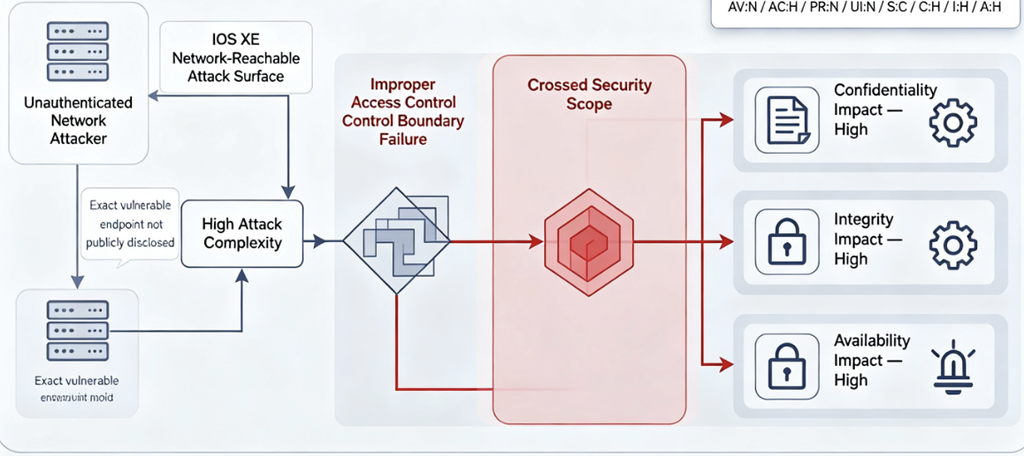
CVSS:3.1/AV:N/AC:H/PR:N/UI:N/S:C/C:H/I:H/A:H
NVD currently reproduces Cisco’s 9.0 Critical assessment. (NVD)
What Is CVE-2026-20267?
Cisco describes CVE-2026-20267 as a collection of vulnerabilities discovered during a comprehensive internal security review of IOS XE.
The bugs share the same highest-level weakness category:
CWE-284 — Improper Access Control
Cisco summarizes this category as covering areas such as authentication, authorization, privilege handling, and access-control bypasses. The important point is that CVE-2026-20267 may therefore represent several different ways in which IOS XE fails to correctly enforce a security boundary, rather than one identical flaw appearing across every affected component. (Cisco)
Cisco’s wording is important because the company explicitly states that the CVSS score assigned to each umbrella CVE represents the maximum potential severity of the most impactful underlying bug within that CWE group.
Consequently, the 9.0 rating does not necessarily mean that every individual access-control issue grouped into CVE-2026-20267 independently produces complete compromise.
It means at least one underlying vulnerability in the group reaches that severity.
That is a significant difference from the way defenders traditionally interpret CVSS.
Why CVE-2026-20267 Is an Unusual CVE
The structure of CVE-2026-20267 reflects a broader change in Cisco’s security disclosure strategy.
Beginning in July 2026, Cisco introduced what it calls a risk-based vulnerability disclosure model. Under this approach, vulnerabilities sharing the same Common Weakness Enumeration category may be consolidated into an “umbrella” CVE.
Cisco states that:
- bugs sharing a CWE may be grouped together;
- the umbrella CVE receives the highest CVSS severity found among the underlying bugs;
- IOS XE, IOS XR, NX-OS, Secure Firewall, and ASA may receive platform-level hardening releases;
- hardening advisories are intended to give organizations predictable patching cycles as AI-driven vulnerability discovery increases finding volume. (Cisco)
Cisco also says the new model is partially a response to the increased speed and volume of vulnerabilities being discovered through AI-assisted analysis.
CVE-2026-20267 is therefore useful not only because it is a critical IOS XE vulnerability, but because it illustrates what vulnerability management may look like when AI discovers bugs faster than traditional advisory workflows can comfortably document them.
There is, however, an industry debate around this approach.
In June 2026, the CVE Program published guidance emphasizing the importance of maintaining vulnerability-level identifiers. It stated that separate vulnerabilities should generally retain separate CVEs when they can be independently understood, exploited, fixed, or are independently relevant to defenders. (CVE)
That creates an important operational tension.
Cisco’s umbrella model can simplify patch management:
Upgrade the affected IOS XE release and remediate the vulnerability class.
But it can complicate threat hunting:
Which exact service was vulnerable? Which log entry represents exploitation? What network request should be blocked? Which bug produced the CVSS 9.0 score?
For CVE-2026-20267, much of that bug-level information is currently not public.
Understanding CWE-284 Improper Access Control
Access control is the mechanism that decides whether a subject is allowed to perform an action against an object.
In simplified form:
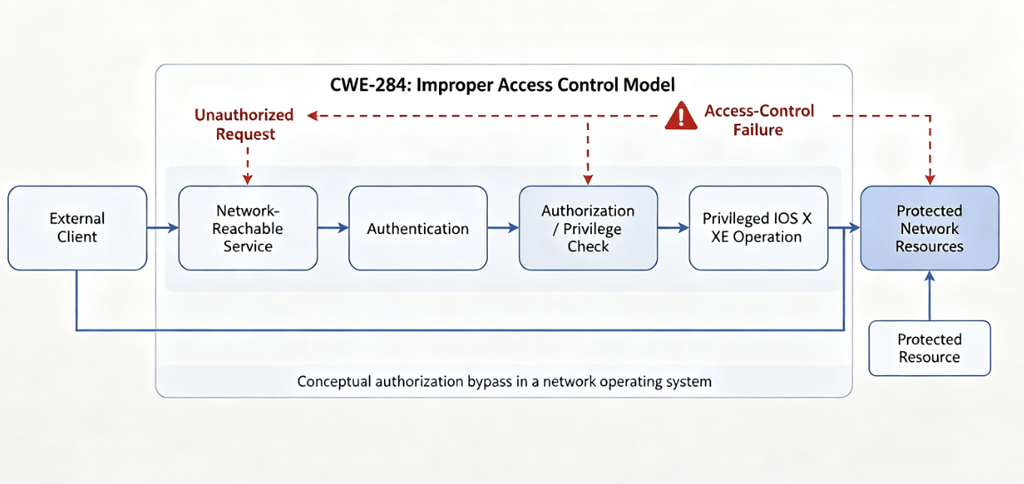
A secure system should reject the operation whenever the actor does not satisfy the required policy.
Conceptually:
request -> identify actor -> validate credentials
        -> resolve privileges -> check policy
        -> authorize operation -> execute
An improper access control vulnerability introduces a failure somewhere in that chain:
request -> [missing / incorrect access-control decision]
        -> protected operation becomes reachable
CWE-284 is intentionally broad.
It can encompass scenarios involving authentication enforcement, missing authorization checks, privilege boundaries, access-control policies, trusted contexts, authorization bypasses, and other failures to properly restrict access.
That breadth is especially relevant to CVE-2026-20267 because Cisco is grouping multiple underlying bugs at this CWE level rather than publishing all of their exact implementation details.
Why Improper Access Control Is Dangerous in IOS XE
Improper access control is dangerous in almost any application.
It is substantially more serious when the vulnerable software is a network operating system.
Cisco IOS XE can sit at an extremely privileged location in an enterprise architecture.
Depending on the platform, an IOS XE device may influence:
- packet forwarding;
- VLAN segmentation;
- routing;
- wireless infrastructure;
- WAN connectivity;
- management traffic;
- network policy;
- authentication integrations;
- telemetry;
- automation;
- infrastructure configuration.
An authorization error in an ordinary SaaS application might expose one application’s data.
A comparable authorization failure at the network infrastructure layer may cross a much more consequential trust boundary.
An attacker who obtains unauthorized control over a network device could potentially affect traffic visibility, segmentation, routing behavior, availability, or access to downstream environments.
This does no mean Cisco has stated that CVE-2026-20267 provides every one of those capabilities.
It explains why an access-control vulnerability in IOS XE can receive critical severity even where exploitation requires additional conditions.
Breaking Down the CVSS 9.0 Score
CVE-2026-20267 uses:
CVSS:3.1/AV:N/AC:H/PR:N/UI:N/S:C/C:H/I:H/A:H
Each field provides information about Cisco’s assessment of the most severe underlying bug.
Attack Vector: Network
AV:N
The vulnerability can be reached across a network boundary rather than necessarily requiring physical or local access.
For infrastructure security teams, this should immediately trigger an exposure question:
Which interfaces and management-plane services on the affected device are reachable from untrusted or less-trusted networks?
Network-accessible does not automatically mean internet-exploitable.
ACLs, management VRFs, firewall rules, jump hosts, control-plane policies and architectural segmentation may all influence actual reachability.
But the network attack vector means physical access is not fundamentally required.
Attack Complexity: High
AC:H
The CVSS vector says successful exploitation requires conditions beyond simply sending an ordinary malicious request.
Cisco has not publicly documented those conditions at the individual-bug level.
They could involve state, configuration context, protocol behavior, timing, an uncommon request sequence, another security boundary, or other environmental conditions.
It would be inaccurate to claim a specific prerequisite without supporting disclosure.
High complexity reduces exploit reliability.
It does not make a vulnerability unimportant.
Especially for infrastructure products, attackers frequently invest substantial effort in making initially difficult exploit chains reliable.
Privileges Required: None
PR:N
The highest-severity underlying vulnerability does not require the attacker to begin with an authenticated privileged account.
That is one of the reasons CVE-2026-20267 deserves serious attention.
An access-control issue that merely lets an administrator perform another administrator’s function would have a very different risk profile.
An unauthenticated network-reachable access-control failure creates a possible initial-access path.
User Interaction: None
UI:N
Successful exploitation does not require a victim to click a link, open a document, approve a request, or otherwise participate.
This removes one common barrier to automation.
Scope: Changed
S:C
Changed scope is particularly notable.
Under CVSS v3.1, this indicates that exploitation can affect resources managed by a different security authority than the vulnerable component itself.
In practical security thinking, this is a signal that the vulnerability may cross an important trust boundary.
The exact boundary crossed by CVE-2026-20267 has not been publicly documented in Cisco’s umbrella advisory.
Defenders should therefore avoid inventing a mechanism but should still treat the metric seriously.
Confidentiality, Integrity and Availability: High
C:H/I:H/A:H
The worst-case underlying vulnerability has high potential impact across all three traditional security properties.
That means Cisco considers the most serious bug in the group capable of materially affecting confidentiality, integrity, and availability if exploitation succeeds. (NVD)
What Products Are Affected?
Cisco says the vulnerabilities affect Cisco IOS XE Software in both autonomous and controller modes, regardless of device configuration. (Cisco)
This wording should be read carefully.
It means administrators should not assume that switching between autonomous and controller operation eliminates the underlying vulnerable software.
Cisco’s August 2026 review specifically focused on:
| IOS XE Release Family |
|---|
| 17.9 |
| 17.12 |
| 17.15 |
| 17.18 |
| 26.1 |
Cisco also explicitly states that Catalyst 3650 and 3850 Series switches do not run those evaluated releases and therefore were not evaluated as part of this particular review. If vulnerabilities are later confirmed for those platforms, Cisco says they will be addressed according to its vulnerability policy. (Cisco)
That is not equivalent to Cisco declaring every older platform safe.
For real production inventory decisions, teams should use the current Cisco advisory and Cisco Software Checker rather than extrapolating vulnerability status from the five release families alone.
Fixed Versions for CVE-2026-20267
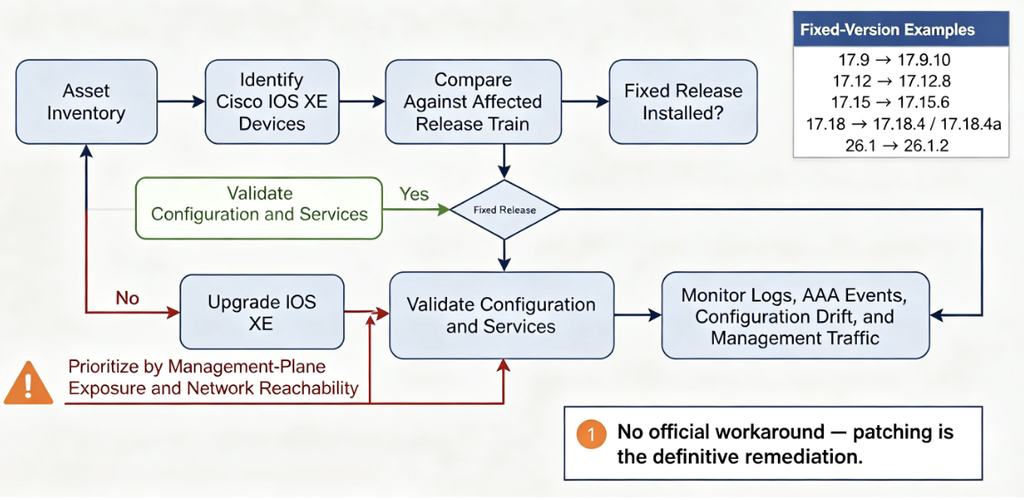
Cisco’s advisory provides the following first fixed IOS XE releases for the August 2026 hardening vulnerabilities:
| Cisco IOS XE Train | First Fixed Release |
|---|---|
| 17.9 | 17.9.10 |
| 17.12 | 17.12.8 |
| 17.15 | 17.15.6 |
| 17.18 | 17.18.4 / 17.18.4a |
| 26.1 | 26.1.2 |
Cisco strongly recommends upgrading to the fixed software. (Cisco)
There are no official workarounds that address the vulnerabilities. (Cisco)
This makes patching the definitive remediation.
Is CVE-2026-20267 Being Exploited?
As of August 24, 2026, Cisco PSIRT says it is not aware of malicious use or public announcements describing exploitation of the vulnerabilities covered by the IOS XE hardening advisory. (Cisco)
CISA’s enrichment of the CVE record also currently lists exploitation as ninguno, while rating the potential technical impact as total. (NVD)
This is good news, but it should not be interpreted as proof that exploitation is impossible.
There are several reasons.
First, the vulnerabilities were internally discovered, meaning offensive research did not necessarily begin only after public disclosure.
Second, the CVSS vector provides researchers with useful hints about the highest-severity underlying bug:
Network reachable
No authentication required
No user interaction
High attack complexity
Changed security scope
High C / I / A impact
That is enough information to make patch-differential analysis potentially attractive to sophisticated researchers.
Third, fixed binaries are now publicly available to customers, which means researchers may be able to compare vulnerable and patched IOS XE components.
The absence of exploitation should therefore be treated as a patching window, not as a reason to defer remediation.
CVE-2026-20267 Is Not Necessarily Another IOS XE Web UI Vulnerability
This distinction is important.
Cisco IOS XE has a famous history of serious Web UI security issues, particularly CVE-2023-20198.
In 2023, Cisco disclosed active exploitation of an IOS XE Web UI vulnerability that allowed unauthenticated attackers to create a privilege-level-15 account. Attackers subsequently chained that access with CVE-2023-20273 to obtain further control and deploy an implant. (Cisco)
CISA subsequently added CVE-2023-20198 to its Known Exploited Vulnerabilities catalog. (CISA)
It may therefore be tempting to assume:
IOS XE + access control + unauthenticated
            =
another Web UI bug
That conclusion is not supported by Cisco’s current disclosure.
Cisco does no identify the underlying CVE-2026-20267 bugs as exclusively involving the Web UI.
Nor does Cisco publicly disclose an HTTP endpoint, RESTCONF route, RPC function, parser, CLI interface, protocol message, authentication token, or other singular entry point that can be used to characterize all vulnerabilities represented by CVE-2026-20267.
The 2023 vulnerability is useful historical context.
It should not be treated as the technical mechanism of CVE-2026-20267.
A Plausible Access-Control Attack Model
Because individual bugs are undisclosed, the safest way to reason about CVE-2026-20267 is through a generic security-boundary model.
Consider an IOS XE management operation:
External Client
      |
      v
Network-Reachable Service
      |
      v
Authentication Boundary
      |
      v
Authorization / Privilege Check
      |
      v
Privileged IOS XE Operation
      |
      v
Configuration / System / Network State
In a correctly functioning system, unauthorized requests are stopped before privileged operations execute.
A generic CWE-284 vulnerability could conceptually create something like:
External Client
      |
      v
Reachable Service
      |
      v
[Access-Control Failure]
      |
      +--------------------+
      |                    |
      v                    v
Privileged Action     Protected Resource
      |
      v
Security Boundary Crossed
This is not a CVE-2026-20267 exploit diagram.
It is a defensive model illustrating why improper access control can become critical in a network operating system.
Impacto potencial
Because Cisco gives the most severe underlying flaw high confidentiality, integrity, and availability impact, defenders should consider several categories of consequence.
Unauthorized Information Access
An access-control error may expose information intended for a higher-privileged security context.
For network infrastructure, potentially sensitive information can include configuration data, topology information, interface state, policy configuration, operational metadata, or authentication-related material.
Cisco has not stated which of these, if any, is directly exposed through CVE-2026-20267.
Unauthorized Configuration Changes
Integrity impact becomes especially serious if a vulnerable authorization path reaches configuration or control functionality.
Network infrastructure configuration can influence traffic handling and trust boundaries.
Again, no specific unauthorized configuration operation has been publicly attributed to CVE-2026-20267.
Privilege Boundary Bypass
CWE-284 naturally raises questions around whether an attacker can move from one security context to another without satisfying the intended authorization requirement.
En S:C CVSS metric reinforces the importance of examining privilege and trust boundaries, although Cisco does not publicly identify which boundary is crossed.
Availability Impact
Unauthorized access to privileged infrastructure functionality may potentially cause service disruption.
Because Cisco assigns high availability impact to the worst-case bug, organizations should not treat this solely as a confidentiality problem.
Why “Regardless of Device Configuration” Matters
Cisco’s advisory states that affected IOS XE software can be vulnerable in autonomous or controller mode regardless of device configuration. (Cisco)
This has an important operational implication.
For some vulnerabilities, defenders can determine exposure using logic such as:
Vulnerable version
AND
specific feature enabled
AND
specific interface exposed
CVE-2026-20267 does not currently provide such a simple configuration-based exclusion.
The primary exposure question therefore becomes:
Are we running an affected IOS XE release?
followed by:
Has it been upgraded to Cisco's fixed release?
Network reachability remains relevant to exploitation risk, but configuration assumptions should not be used as evidence that the software itself is unaffected.
How to Detect CVE-2026-20267 Exposure
Because there is currently no publicly documented universal exploitation request for the umbrella CVE, software inventory is the most reliable first detection mechanism.
Administrators should identify IOS XE devices and capture at least:
device identifier
platform
IOS XE version
software train
management address
operating mode
internet exposure
trusted management sources
patch status
last configuration change
On authorized infrastructure, a basic read-only inventory often begins with:
show version
show running-config
show users
show logging
Cisco documentation also commonly uses show version to identify whether a device is running IOS XE. (Cisco)
The exact commands collected in production should match the platform, operational policies, AAA architecture, and logging configuration.
Do not start by scanning devices aggressively.
Start by answering:
Which IOS XE devices do we actually own, and which release does each device run?
Build a Version-Based Vulnerability Matrix
A useful internal representation might look like this:
Device: edge-router-01
Platform: Cisco IOS XE
Release: 17.12.x
Management Network: 10.x.x.x
Internet Reachable: No
Controller Mode: No
Required Fixed Release: 17.12.8
Patched: Pending
Priority: High
Repeat that across the estate.
Once the software inventory exists, map release trains to Cisco’s fixed versions.
This is significantly more dependable than trying to create a CVE-2026-20267 “signature” from incomplete public technical information.
Prioritizing Which Devices to Patch First
All affected devices should ultimately be upgraded.
However, large enterprises may have hundreds or thousands of IOS XE systems and cannot necessarily perform a simultaneous maintenance event.
A useful remediation order is:
- internet-reachable management surfaces;
- devices reachable from low-trust or user networks;
- edge and externally connected infrastructure;
- devices controlling high-value network segments;
- devices with weak management-plane segmentation;
- devices with broad administrative trust relationships;
- remaining affected IOS XE infrastructure.
This is risk prioritization, not a substitute for patching.
Cisco itself recommends upgrading immediately under its new disclosure model. (Cisco)
Management Plane Exposure Still Matters
The fact that Cisco has not published a workaround does not mean security architecture is irrelevant.
Network devices should normally have tightly controlled management surfaces.
Good architecture includes concepts such as:
Internet
   |
   X
   |
Management Interface
   ^
   |
Firewall / ACL
   ^
   |
Dedicated Management Network
   ^
   |
Jump Host / Admin Workstation
   ^
   |
Authenticated Administrator
An attacker who cannot reach the vulnerable attack surface has fewer exploitation opportunities.
But this is defense in depth.
It should not be interpreted as a Cisco-supported fix for CVE-2026-20267.
Cisco explicitly says no workaround addresses the vulnerability set. (Cisco)
Examine Unexpected Administrative Activity
Because CVE-2026-20267 involves improper access control, defenders should pay particular attention to behaviors that would indicate unauthorized privileged actions.
Algunos ejemplos son:
- unexplained configuration modifications;
- newly created administrative accounts;
- unexpected privilege changes;
- changes to AAA configuration;
- unexpected management sessions;
- changes to remote management exposure;
- unusual configuration writes;
- unexpected software or package changes;
- new outbound connections from infrastructure devices;
- anomalous control-plane traffic;
- unexplained device reloads or crashes.
These are generic network-device compromise indicators rather than CVE-2026-20267-specific IOCs.
That distinction is important.
Until individual underlying vulnerabilities are publicly described, defenders should avoid claiming that a particular log entry proves exploitation of CVE-2026-20267.
Compare Running and Intended Configuration
Configuration drift monitoring becomes useful when exploit-specific telemetry is limited.
A defender can model the environment as:
Known-Good Configuration
          |
          v
  Configuration Diff
          |
          v
Current Device State
          |
          v
Unexpected Change?
     /          \
   No            Yes
                  |
                  v
            Investigate
Important changes may include management interfaces, ACLs, local accounts, routing, DNS, logging, telemetry, AAA servers, SNMP settings, automation credentials, or trust relationships.
For high-value infrastructure, configuration integrity should already be continuously monitored independently of this CVE.
Network Telemetry
Network telemetry can provide another layer of detection.
Organizations should look for unusual connections to device management services from systems that do not normally administer network infrastructure.
A simple behavioral model is often more useful than searching for a nonexistent public exploit signature:
Normal:

admin-jump-host -> router management plane

Suspicious:

workstation -> router management plane

Suspicious:

guest network -> router management plane

Suspicious:

internet host -> router management plane
This type of detection remains useful even if attackers eventually discover multiple different CVE-2026-20267 exploitation paths.
Snort Detection
Cisco’s August 2026 IOS XE hardening advisory links Snort rule groups including 66891–66896 and 66897–66898 in its action section. (Cisco)
Organizations using Cisco security products should consult the current advisory and Snort rule documentation to determine applicability to their deployment.
Because CVE-2026-20267 is an umbrella identifier containing several underlying bugs, defenders should not assume that every linked rule detects every possible access-control issue grouped under the CVE unless Cisco explicitly maps the rule accordingly.
Why There Is No Public PoC
At present, publicly available authoritative information does not expose enough implementation detail to responsibly describe a verified CVE-2026-20267 proof of concept.
There is no confirmed universal:
GET /vulnerable-endpoint
or:
POST /privileged-operation
or special protocol payload publicly documented by Cisco for CVE-2026-20267.
Any article presenting such an endpoint as an established CVE-2026-20267 exploit without primary evidence should therefore be treated cautiously.
This is particularly important for security researchers because umbrella CVEs change the relationship between:
ID CVE
and:
one reproducible vulnerability
The relationship may now instead be:
CVE-2026-20267
        |
        v
CWE-284
        |
        +--> underlying bug A
        |
        +--> underlying bug B
        |
        +--> underlying bug C
        |
        +--> ...
Different underlying bugs may have different attack surfaces and exploitation conditions.
Patch Diffing May Change the Situation
Although no public exploitation is currently reported, the release of fixed software can create information for researchers.
Conceptually:
Vulnerable build
      |
      | binary / behavior comparison
      v
Fixed build
      |
      v
Changed component
      |
      v
Security-sensitive code path
      |
      v
Candidate vulnerability
Patch-differential analysis has long been used in vulnerability research.
AI-assisted code analysis and binary analysis may accelerate this process further.
Cisco’s own explanation for its 2026 disclosure changes acknowledges that AI-driven discovery is increasing both the volume and velocity of security findings. (Cisco)
That is another reason defenders should prioritize the period immediately following disclosure.
The exploit-development clock may now move substantially faster than traditional quarterly enterprise patch cycles.
CVE-2026-20267 and AI-Driven Vulnerability Discovery
Cisco specifically states that the IOS XE vulnerabilities in the August hardening release were found through internal testing involving existing techniques as well as frontier AI models. (Cisco)
This is arguably one of the most important aspects of the disclosure.
Security engineering is entering a phase where vulnerability discovery can become much more scalable.
Historically, researchers might manually inspect:
authentication code
authorization logic
parsers
RPC handlers
protocol implementations
state machines
memory management
privilege boundaries
Now AI-assisted systems can potentially help search much larger codebases and reason about suspicious execution paths.
The economics change when the cost of investigating one additional function approaches zero.
Instead of asking:
Which 20 functions should our researchers audit this month?
security teams can increasingly ask:
Which security invariant should an automated system attempt to violate across the entire product?
Access control is particularly suitable for this style of analysis because the desired invariant can often be expressed abstractly:
Untrusted actor
MUST NOT
perform privileged operation
AI systems can then search for cases where implementation behavior contradicts that policy.
Cisco’s umbrella CVE strategy is partly a response to what happens when that process finds vulnerabilities faster than traditional disclosure pipelines were designed to handle.
The Defender’s New Problem: Vulnerability Density
Traditional vulnerability management assumes approximately:
1 CVE
=
1 vulnerability
=
1 severity
=
1 remediation mapping
CVE-2026-20267 breaks that mental model.
The real structure is closer to:
1 umbrella CVE
=
multiple bugs
=
one CWE category
=
one worst-case CVSS score
=
one hardening release
Operationally, that can make remediation simpler.
Upgrade IOS XE.
Analytically, however, it creates uncertainty.
Suppose a scanner reports:
CVE-2026-20267
CVSS 9.0
Does every device have the 9.0 underlying bug?
Does it have only a lower-severity bug that belongs to the same umbrella category?
Can the high-impact bug be reached through the device’s exposed services?
The public advisory does not provide enough individual-bug detail to answer all of these questions.
Therefore, vulnerability management teams should avoid excessive precision when the source data itself is aggregated.
Do Not Downgrade Risk Because Attack Complexity Is High
Security teams sometimes make the mistake of seeing:
AC:H
and immediately reducing a critical vulnerability to low priority.
That is dangerous here.
CVE-2026-20267 simultaneously has:
AV:N
PR:N
UI:N
S:C
C:H
I:H
A:H
So while exploitation may require nontrivial conditions, the attacker does not need prior privileges or victim interaction, and successful exploitation can have substantial impact.
Attack complexity should be incorporated into prioritization.
It should not erase the rest of the vector.
Do Not Rely on EPSS Alone
Current public vulnerability databases may display a relatively low EPSS probability for newly disclosed CVE-2026-20267. For example, GitHub’s advisory view recently showed an EPSS probability around 0.2%. (GitHub)
That number should be interpreted cautiously.
EPSS is a probabilistic model based on observed vulnerability and threat characteristics.
CVE-2026-20267 introduces an unusual data-model problem: one identifier represents multiple underlying vulnerabilities without their individual technical details.
This can make a traditional CVE-level exploitation probability less intuitively meaningful.
More importantly, Cisco has already provided fixed software and recommends immediate upgrading.
A low current EPSS score is therefore not a strong reason to postpone remediation on critical network infrastructure.
Historical Context: Why IOS XE Bugs Deserve Attention
Cisco IOS XE is no stranger to attacker interest.
The 2023 CVE-2023-20198 campaign demonstrated why management-plane vulnerabilities can be especially dangerous.
Cisco determined that attackers exploited CVE-2023-20198 to obtain privilege-level-15 access before chaining another Web UI vulnerability to obtain deeper system control and install an implant. (Cisco)
That incident offers a broader lesson applicable to CVE-2026-20267:
Access-control failures can be much more valuable as the first stage of an exploit chain than their description alone suggests.
An attacker may not need one vulnerability to do everything.
A real operation could look conceptually like:
Access-control bypass
        |
        v
Initial privileged capability
        |
        v
Internal reconnaissance
        |
        v
Second vulnerability / legitimate function
        |
        v
Expanded device control
        |
        v
Persistence or network manipulation
There is no evidence that this exact chain applies to CVE-2026-20267.
It demonstrates why network-device authorization bugs should be assessed in the context of an entire attack path rather than isolated CVSS values.
Recommended Remediation
The primary recommendation is straightforward:
Upgrade Cisco IOS XE to the fixed release specified by Cisco.
For the currently documented trains:
17.9  -> 17.9.10 or later appropriate fixed release
17.12 -> 17.12.8 or later appropriate fixed release
17.15 -> 17.15.6 or later appropriate fixed release
17.18 -> 17.18.4 / 17.18.4a or later appropriate fixed release
26.1  -> 26.1.2 or later appropriate fixed release
Cisco recommends using the appropriate fixed software and validating compatibility before deployment. (Cisco)
Enterprise teams should also check for later releases that combine fixes for additional advisories rather than blindly installing the minimum first-fixed version months after publication.
Before Upgrading
Network operating system upgrades require more planning than patching a typical web application.
Validate:
- device model support;
- available memory and storage;
- boot variables;
- image integrity;
- configuration compatibility;
- high-availability behavior;
- controller compatibility;
- routing protocol behavior;
- automation compatibility;
- maintenance windows;
- rollback procedures.
Cisco similarly advises customers to ensure that devices have sufficient resources and that existing hardware and software configurations remain supported before performing upgrades. (Cisco)
After Upgrading
Do not consider the project finished when the installation succeeds.
Validate:
1. Confirm running IOS XE release
2. Confirm expected boot image
3. Confirm management connectivity
4. Compare configuration against baseline
5. Validate routing / switching / wireless functions
6. Confirm AAA and logging
7. Confirm monitoring and telemetry
8. Re-run authorized vulnerability inventory
Also verify that older vulnerable images have not remained configured as the default boot target.
If Immediate Patching Is Impossible
Cisco states there is no workaround that addresses CVE-2026-20267 and the related hardening vulnerabilities.
If operational constraints make immediate upgrading impossible, defenders can still reduce exposure through general risk controls:
- isolate the management plane;
- remove unnecessary external reachability;
- permit management only from trusted administrative networks;
- require controlled jump hosts;
- review AAA policies;
- monitor privileged sessions;
- watch configuration changes;
- restrict east-west access to infrastructure interfaces;
- increase logging and telemetry;
- prioritize patching once the maintenance window becomes available.
These measures are compensating controls, not substitutes for Cisco’s software fix.
That terminology matters.
What Security Teams Should Not Do
CVE-2026-20267 creates several traps.
Do not search for a random public script and assume it is a verified exploit simply because the filename contains CVE-2026-20267.
Do not assume the vulnerability is specifically an IOS XE Web UI vulnerability.
Do not assume a disabled HTTP server proves that the device is unaffected.
Do not assume every bug grouped under CVE-2026-20267 independently has CVSS 9.0 characteristics.
Do not assume “no exploitation observed” means attackers are not currently researching the patch.
And do not interpret network isolation as equivalent to remediation when Cisco explicitly recommends upgrading.
Implications for Vulnerability Scanners
CVE-2026-20267 also exposes an interesting problem for security scanners.
A traditional scanner often maps:
Product + Version
      |
      v
CVE
      |
      v
Severity
But with an umbrella CVE, that result becomes less granular.
A scanner may correctly tell you:
Cisco IOS XE 17.12.x
Potentially affected by CVE-2026-20267
CVSS: 9.0
while still being unable to tell you:
Underlying bug #4 is reachable
Underlying bug #7 is not reachable
Underlying bug #11 requires a specific service
Organizations should therefore increasingly separate two concepts:
vulnerability presence
y
attack-path validation.
Version detection is still valuable because it identifies the need for remediation.
But validation increasingly requires security-context understanding rather than just a CVE lookup.
Implications for AI Pentesting
Umbrella disclosures are also likely to change offensive security testing.
When detailed vulnerability information is unavailable, an intelligent security-testing system should not simply retrieve a CVE description and replay a public exploit.
Instead, it must reconstruct security assumptions.
For CWE-284, an authorized tester could model the target around questions such as:
What services are reachable?

Which actions require authentication?

Which actions require authorization?

Are authorization decisions consistent?

Can lower-trust contexts invoke higher-trust functions?

Do alternate protocols enforce the same policy?

Do state transitions change authorization behavior?

Can one valid operation expose a second privileged path?
This moves testing away from:
CVE -> exploit template
toward:
Asset discovery
     ->
Attack surface mapping
     ->
Security invariant modeling
     ->
Access-control testing
     ->
Evidence validation
That distinction will become increasingly important if major vendors continue adopting aggregated vulnerability disclosures.
PREGUNTAS FRECUENTES
What is CVE-2026-20267?
CVE-2026-20267 is a Cisco IOS XE umbrella CVE covering multiple internally discovered improper access control vulnerabilities categorized under CWE-284. Cisco gives the group a highest CVSS v3.1 score of 9.0. (NVD)
Is CVE-2026-20267 critical?
Yes. Cisco assigns CVE-2026-20267 a 9.0 Critical CVSS v3.1 score. (Cisco)
Can CVE-2026-20267 be exploited remotely?
The CVSS vector uses AV:N, meaning the highest-severity underlying issue has a network attack vector.
However, Cisco has not publicly disclosed the precise affected protocol or service for every underlying bug.
Does exploitation require authentication?
The maximum-severity CVSS vector uses PR:N, meaning no prior privileges are required for the underlying bug represented by that vector.
Does CVE-2026-20267 require user interaction?
No. The CVSS vector specifies UI:N.
Is there a CVE-2026-20267 PoC?
No authoritative public universal PoC is documented in Cisco’s advisory. Because this is an umbrella CVE covering multiple bugs, claims about a single universal exploit should be verified carefully.
Is CVE-2026-20267 actively exploited?
Cisco currently says it is not aware of malicious exploitation or public announcements describing exploitation. (Cisco)
Is CVE-2026-20267 in CISA KEV?
The authoritative information reviewed for this article does not show CVE-2026-20267 as a known exploited vulnerability, and CISA’s CVE enrichment currently marks exploitation as none. (NVD)
This status can change and should be rechecked during ongoing vulnerability management.
Is there a workaround?
No. Cisco states that there are no workarounds that address these vulnerabilities. (Cisco)
What IOS XE version fixes CVE-2026-20267?
Cisco’s August 2026 advisory lists first fixed releases of 17.9.10, 17.12.8, 17.15.6, 17.18.4/17.18.4a, and 26.1.2 for the affected release trains covered by the hardening advisory. (Cisco)
Is disabling IOS XE Web UI enough?
Cisco does not describe CVE-2026-20267 as exclusively a Web UI vulnerability and says affected software is vulnerable regardless of device configuration. Therefore disabling a specific interface should not be considered remediation for this umbrella CVE. (Cisco)
Is CVE-2026-20267 one vulnerability?
Not in the traditional sense.
Cisco explicitly groups multiple bugs sharing CWE-284 under this umbrella CVE as part of its new risk-based disclosure model. (Cisco)
Reflexiones finales
CVE-2026-20267 is important for two reasons.
The immediate reason is straightforward: Cisco IOS XE contains critical improper access control vulnerabilities, the worst of which is remotely reachable, requires no privileges or user interaction, can cross a security scope, and has high potential confidentiality, integrity, and availability impact.
Cisco has released fixes, reports no known exploitation, and says no workaround addresses the vulnerabilities. Organizations should use this window to upgrade before detailed public exploitation techniques emerge. (Cisco)
The second reason is more structural.
CVE-2026-20267 represents what vulnerability management looks like when AI-assisted security research starts finding bugs at a scale that strains traditional disclosure models.
Cisco’s response is to group vulnerabilities by CWE and ship hardening releases.
The CVE Program has simultaneously emphasized preserving individual vulnerability-level identification where separate vulnerabilities are independently meaningful. (Cisco)
Defenders now have to operate between those two realities.
The CVE number alone may tell you less about the exact exploit.
The software release tells you more about whether remediation is required.
That means the practical response to CVE-2026-20267 should not begin with hunting for a copy-pasted exploit.
It should begin with four questions:
Where are our IOS XE devices? What versions are they running? Which trust boundaries can reach them? And how quickly can we move them onto Cisco’s fixed software?
For CVE-2026-20267, those questions are currently far more valuable than an unverified PoC.


 Spanish
  English
  German
  French
  Portuguese
  Japanese
  Korean
  Hindi
Hindi  Arabic
  Turkish
  Hebrew