
CVE-2026-59084 is easy to misread. It is not a newly disclosed pre-authentication remote code execution primitive in Apache Tomcat, and it does not make every Internet-facing Tomcat server immediately exploitable. Apache describes it as a Low-severity documentation vulnerability: the requirements for securely configuring the Tomcat EncryptInterceptor were not stated clearly enough.
That narrow description still matters. The missing detail concerned a security assumption at the center of the interceptor’s replay defenses. Tomcat’s revised documentation states that replay protection is effective only when the configured encryption algorithm is not malleable. It identifies AES/GCM/NoPadding as the recommended option and warns that supported alternatives such as AES/CBC/PKCS5Padding are malleable, which means the replay protection cannot provide the expected guarantee when those modes are used. (GitHub)
The practical response is therefore not limited to checking a version number. A defensible assessment must answer several configuration questions:
- Is Tomcat clustering enabled?
- Es
EncryptInterceptorpresent in the active channel? - Which encryption algorithm does every node actually use?
- Can an untrusted system observe, modify, inject, or replay cluster traffic?
- Are the pre-shared key and cluster network adequately protected?
- Are node clocks synchronized?
- Can the selected upgrade process temporarily create mixed algorithms or mixed keys?
A package scanner can identify a potentially affected Tomcat release. It cannot, by itself, establish the presence of the vulnerable security assumption or prove an exploitable outcome.
CVE-2026-59084 at a Glance
Apache disclosed CVE-2026-59084 on July 14, 2026, after the issue was reported to the Tomcat security team on June 29, 2026. Apache rates the issue Low and identifies documentation-focused commits for the maintained Tomcat 11, 10.1, and 9 branches. The recommended fixed releases are Tomcat 11.0.24, 10.1.57, and 9.0.120. (Apache Tomcat)
| Artículo | Confirmed status |
|---|---|
| CVE | CVE-2026-59084 |
| Componente | Apache Tomcat Tribes EncryptInterceptor |
| Apache severity | Bajo |
| Core problem | Requirements for secure configuration were not clearly documented |
| Reported to Apache | June 29, 2026 |
| Public disclosure | July 14, 2026 |
| Tomcat 11 affected range | 11.0.0-M1 through 11.0.23 |
| Tomcat 10.1 affected range | 10.1.0-M1 through 10.1.56 |
| Tomcat 9 affected range | 9.0.13 through 9.0.119 |
| Tomcat 8.5 affected range | 8.5.38 through 8.5.100 |
| Tomcat 7 affected range | 7.0.100 through 7.0.109 |
| Recommended maintained releases | 11.0.24, 10.1.57, or 9.0.120 and later |
| Preferred algorithm | AES/GCM/NoPadding |
| Unsafe assumption | Encryption and timestamp checks are sufficient even when the cipher mode is malleable |
| Public exploitation status in CISA-ADP data | Listed as ninguno when the CVE record was enriched |
| Direct RCE claim | Not stated by Apache |
NVD includes the same affected ranges and upgrade recommendations. At the time of writing, July 27, 2026, NVD does not display an independent NIST CVSS assessment. It does display a CISA-ADP CVSS 3.1 vector producing a 9.1 score, along with SSVC metadata recording exploitation as ninguno. That score should not be presented as proof of active exploitation or universal critical exposure. It represents a particular set of assumptions about network reachability and potential confidentiality and integrity impact, while Apache’s Low rating reflects the optional component, configuration dependencies, and narrower direct defect. (NVD)
Neither label is a substitute for local analysis. A Tomcat instance that does not use clustering does not have the same exposure path as a cluster that explicitly uses CBC over a network reachable from untrusted workloads. Conversely, a Low project rating should not cause a team to ignore a cluster that replicates security-sensitive sessions across a poorly isolated network.
What CVE-2026-59084 Actually Changed
The fix associated with CVE-2026-59084 is revealing because it changes documentation rather than introducing a large new runtime enforcement mechanism. The Tomcat 10.1 commit modifies two files, adding explanatory text to the cluster interceptor documentation and recording the clarification in the changelog. The commit contains 17 added lines and three removed lines. (GitHub)
The most important new statement is that replay protection depends on the non-malleability of the configured encryption algorithm. The updated explanation uses GCM as the safe example and CBC with PKCS5 padding as a malleable example. It also strengthens the recommendation to use GCM because of weaknesses associated with the other supported block-cipher modes. (GitHub)
That distinction matters because three security properties are often collapsed into a single word, “encryption”:
- Confidencialidad prevents an observer from learning plaintext.
- Integrity and authenticity allow a receiver to detect unauthorized modification.
- Freshness allows a receiver to reject old or duplicated messages.
A system may encrypt data without authenticating it. It may authenticate data without maintaining state sufficient to detect replays. It may implement a timestamp check whose assumptions fail when an attacker can alter the protected representation.
CVE-2026-59084 is fundamentally about that third-order dependency. The old documentation discussed timestamp-based replay protection and clock synchronization, but it did not make clear that the encrypted message also had to be resistant to undetected modification. An operator could reasonably read the old guidance, keep a backward-compatible CBC configuration, synchronize clocks, and conclude that replay protection was complete.
The revised guidance says that conclusion is unsafe.
Why a Documentation Vulnerability Can Be Operationally Serious
Documentation defects are sometimes dismissed because they do not look like memory corruption, injection, or an authentication bypass. That is the wrong test for a security control whose behavior depends on operator-selected cryptographic parameters.
A configuration interface is part of the security boundary. If a component supports multiple modes but only one class of modes satisfies the assumptions behind another security feature, those requirements need to be explicit. Otherwise, users can produce a deployment that starts successfully, encrypts traffic, and appears to reject some replays while still failing the intended threat model.
This is especially important for mature infrastructure. Tomcat installations often persist for years, and configuration files can survive several binary upgrades. A system might have been created when CBC was the documented or backward-compatible default, then upgraded repeatedly without revisiting the explicit encryptionAlgorithm attribute. A new binary does not necessarily rewrite server.xml, rotate the cluster key, change firewall rules, or validate that every node uses the same secure mode.
The CVE record maps the issue to CWE-1059, Insufficient Technical Documentation. There is an unusual metadata caveat: MITRE’s CWE page labels CWE-1059 as prohibited for mapping to real-world vulnerabilities because it is primarily a quality category rather than a direct implementation weakness. The mapping nevertheless appears in the CVE data. That inconsistency does not invalidate the configuration risk, but it is another reason to read the vendor advisory and patch rather than treating taxonomy fields as a complete technical explanation. (CWE)
How EncryptInterceptor Fits Into a Tomcat Cluster
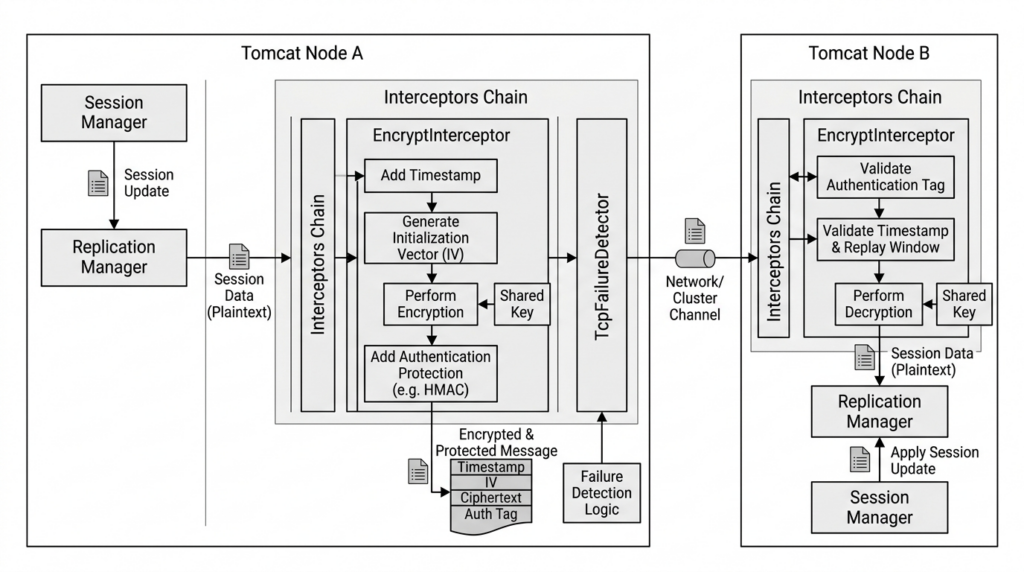
Tomcat’s clustering implementation uses Apache Tribes channels to move messages among members. Interceptors process those messages as they travel through the channel stack. EncryptInterceptor adds encryption to channel messages carrying session data between nodes. (Apache Tomcat)
A simplified outbound path looks like this:
Application session change
        |
        v
Tomcat clustering logic
        |
        v
Channel interceptor chain
        |
        v
EncryptInterceptor
        |
        v
Transport to another cluster node
The receiver performs the inverse operation:
Cluster transport receives data
        |
        v
EncryptInterceptor decrypts and validates
        |
        v
Remaining interceptor chain
        |
        v
Session replication logic
        |
        v
Local session state updated
The ordering of the interceptor is not cosmetic. Apache’s configuration reference states that EncryptInterceptor must be the final interceptor, ignoring TcpFailureDetector, for a given channel. When TcpFailureDetector is present, EncryptInterceptor must appear before it in the configured interceptor chain. The special ordering compensates for an asymmetry in how the failure detector sends validation traffic and how that traffic passes through the receiving chain. Incorrect ordering can corrupt messages. (Apache Tomcat)
A hardened configuration should make the algorithm explicit rather than relying on an inherited default:
<Channel className="org.apache.catalina.tribes.group.GroupChannel">

    <!-- Other channel components and interceptors -->

    <Interceptor
        className="org.apache.catalina.tribes.group.interceptors.EncryptInterceptor"
        encryptionAlgorithm="AES/GCM/NoPadding"
        encryptionKey="REPLACE_AT_DEPLOYMENT_WITH_HEX_ENCODED_SECRET"
        replayWindowTime="10000"
        replayWindowMessageCount="8192" />

    <Interceptor
        className="org.apache.catalina.tribes.group.interceptors.TcpFailureDetector" />

</Channel>
The key value above is deliberately not usable. Production deployments should inject it through their established secret-management and configuration-rendering process. It should not be committed to source control or copied into a public container image.
Tomcat accepts the key as hexadecimal bytes. For AES, the implementation supports appropriate key sizes such as 16, 24, or 32 bytes. The configuration reference gives the corresponding representation examples: 16 bytes require 32 hexadecimal characters, while 32 bytes require 64 hexadecimal characters. (GitHub)
A 32-byte test key can be generated locally with:
openssl rand -hex 32
The command only creates key material. It does not solve storage, distribution, rotation, access control, or audit requirements.
What the Current Implementation Does With Timestamps
The replay logic introduced for the maintained Tomcat branches places a timestamp inside the encrypted content. On the sending side, the implementation obtains the channel message timestamp, creates one if necessary, prepends an eight-byte timestamp to the original message, and encrypts the combined value. On receipt, Tomcat decrypts the data, extracts the trusted timestamp, checks the incoming message against its replay state, strips the timestamp, and forwards the remaining plaintext only if the checks pass. (GitHub)
The replay manager applies several checks:
- It rejects timestamps older than the configured replay window.
- It rejects timestamps too far in the future.
- It rejects timestamps at or before the oldest state already evicted from the replay cache.
- It derives a message identifier from the initialization vector region.
- It rejects identifiers that are already present.
- It maintains both a time-based window and a maximum retained-message count. (GitHub)
The default values in the relevant source are 10,000 milliseconds for the time window and 8,192 retained message identifiers. Those values are operational parameters, not universal recommendations. A cluster generating more than 8,192 relevant messages within the configured time window may begin evicting replay state based on count before the time window expires. The implementation compensates by tracking the timestamp of removed entries and rejecting messages at or before that boundary, but administrators still need to test legitimate throughput and clock behavior. (GitHub)
Clock synchronization is therefore part of availability as well as security. If nodes drift too far apart, valid messages can fall outside the allowed window and be rejected. Making the window extremely large to hide clock problems increases how long replay state must remain meaningful and can increase memory or state-management pressure. The correct response is to operate reliable time synchronization, measure actual drift, and size the window from observed cluster behavior.
Encryption Is Not the Same as Authentication
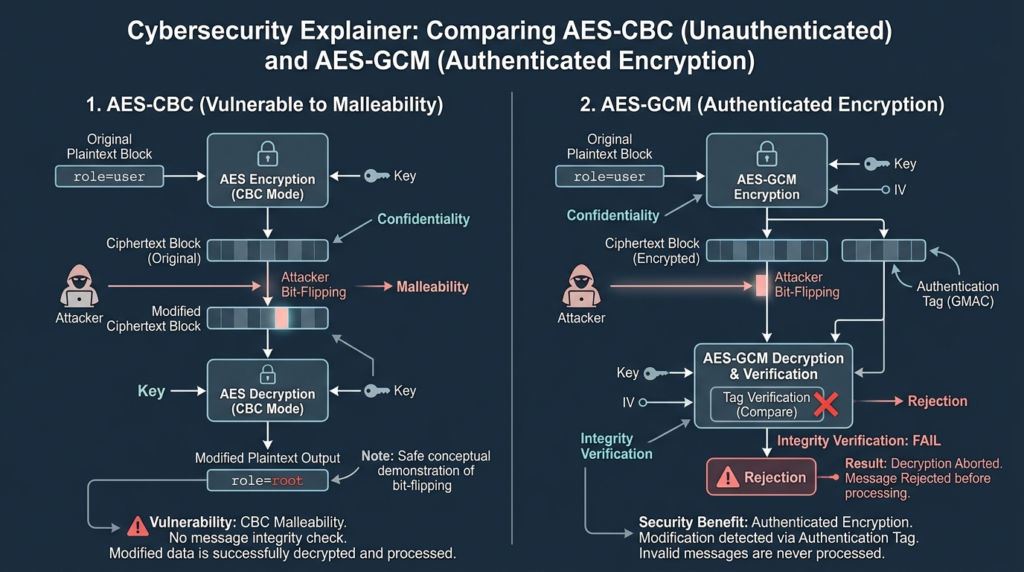
AES is a block cipher. A transformation such as AES/CBC/PKCS5Padding combines AES with a block mode and padding scheme. CBC hides plaintext when used with a secret key and an unpredictable initialization vector, but CBC by itself does not authenticate the ciphertext.
That distinction is visible in the algebra of CBC decryption. For block number (i):
P[i] = D_K(C[i]) XOR C[i-1]
An attacker who modifies a bit in C[i-1] causes the corresponding bit to change in P[i]. The attacker does not need to know the key to create that relationship. The preceding plaintext block is also disrupted, and application structure may prevent a useful modification, but the receiver lacks a cryptographic proof that the ciphertext is unchanged unless a separate, correctly designed message authentication mechanism is applied.
This property is called malleability. It does not mean that every CBC ciphertext can be turned into any arbitrary useful message. It means the encryption mode alone does not reliably detect unauthorized modification.
GCM provides a different security interface. NIST defines Galois/Counter Mode as authenticated encryption with associated data. Java’s cryptographic APIs treat GCM as an AEAD mode: encryption produces an authentication tag, and decryption verifies that tag before accepting the plaintext. A modified ciphertext or tag should cause authentication failure rather than silently yielding attacker-influenced plaintext. (Centro de recursos de seguridad informática del NIST)
| Property | CBC without a separate MAC | CFB without a separate MAC | OFB without a separate MAC | GCM |
|---|---|---|---|---|
| Encrypts plaintext | Sí | Sí | Sí | Sí |
| Provides built-in message authentication | No | No | No | Sí |
| Detects arbitrary ciphertext modification cryptographically | No | No | No | Yes, through the authentication tag |
| Suitable for a design that assumes non-malleable messages | No | No | No | Yes, when used correctly |
| Requires unique or correctly generated IVs | Sí | Sí | Sí | Yes, with especially strict key and IV uniqueness requirements |
| Apache recommendation for EncryptInterceptor | Do not prefer | Do not prefer | Do not prefer | Use GCM |
GCM is not automatically safe under every implementation error. Reusing the same key and IV combination can undermine its security and permit forgery attacks. Oracle’s Cipher documentation specifically warns that GCM IVs must be unique for a given key, and NIST’s guidance similarly treats correct nonce construction as essential. Tomcat’s implementation generates IV material internally, but operators still need to avoid unsafe custom providers, key reuse across unrelated environments, and configuration changes that were never tested with their Java runtime. (Publicaciones del NIST)
The security decision is not “CBC is always broken and GCM is magic.” CBC can be used safely in protocols that apply a sound encrypt-then-MAC construction with independent keys and correct verification behavior. The relevant point is narrower: Tomcat’s documented replay design expects a non-malleable protected message, and Apache explicitly recommends GCM for EncryptInterceptor.
Why Malleability Weakens Replay Protection
A basic replay defense remembers an identifier for each accepted message. If the exact same message appears again, the receiver rejects it. That works against byte-for-byte retransmission.
A malleable encryption scheme complicates the assumption. An adversary may transform an observed ciphertext into a different ciphertext. The new byte sequence no longer matches the stored identifier. If the transformation also influences fields used to determine freshness or parsing, a replay detector designed around immutable ciphertext loses the property it expected.
Tomcat’s revised documentation does not publish a weaponized construction for CVE-2026-59084, and defenders should not infer one. The safe conclusion is the one Apache documents: replay protection is only effective when the encryption algorithm is not malleable. (GitHub)
This boundary also explains why a remote version check cannot prove impact. A useful attack would require more than knowing that Tomcat is installed:
- Clustering must be enabled.
EncryptInterceptormust process the relevant messages.- A malleable algorithm must be selected.
- The attacker must be able to affect cluster traffic.
- The resulting modified or replayed message must remain processable.
- The replicated state must produce a security-relevant effect.
Each step requires evidence. Skipping those steps turns a configuration-sensitive exposure into an unsupported claim.
A Sequence of EncryptInterceptor Security Changes
CVE-2026-59084 is clearer when viewed as the latest entry in a series of EncryptInterceptor issues. The sequence shows that secure deployment depends on documentation, algorithm choice, error handling, replay state, interceptor ordering, and network architecture.
| CVE | Issue | Por qué es importante | Operational response |
|---|---|---|---|
| CVE-2022-29885 | Documentation incorrectly implied that EncryptInterceptor made clustering safe over an untrusted network | Encryption does not eliminate denial-of-service and every other risk of an exposed cluster channel | Keep the cluster network private even when encryption is enabled |
| CVE-2026-29146 | CBC was used by default and was vulnerable to a padding-oracle attack | Error behavior around unauthenticated CBC can reveal information about decrypted padding | Upgrade beyond the affected releases and prefer GCM |
| CVE-2026-34486 | An error in the previous fix allowed EncryptInterceptor to be bypassed | A security patch can create a narrow regression requiring another upgrade | Avoid stopping on the first fixed release in a fast patch sequence |
| CVE-2026-55955 | The implementation did not provide the replay protection claimed by the documentation | Operators could believe old messages would be rejected when the implementation did not enforce that guarantee | Upgrade to the later replay-protected implementation |
| CVE-2026-59084 | Secure configuration requirements were still not documented clearly | Replay protection remained unsafe when a malleable mode was selected | Upgrade, explicitly use GCM, and validate the complete configuration |
Apache disclosed CVE-2022-29885 after determining that the documentation overstated the protection available on untrusted networks. The advisory said the interceptor could provide confidentiality and integrity but did not protect against all risks, particularly denial of service. (Apache Tomcat)
CVE-2026-29146 was rated Important. Apache said that EncryptInterceptor used CBC by default and was vulnerable to a padding-oracle attack. The affected ranges extended through Tomcat 10.1.52 and Tomcat 9.0.115, with corresponding Tomcat 11 versions also affected. (Apache Tomcat)
CVE-2026-34486 then affected the specific releases carrying the first fix: Tomcat 10.1.53, Tomcat 9.0.116, and Tomcat 11.0.20. Apache described it as an error in the fix that allowed the interceptor to be bypassed. Those releases were superseded by 10.1.54, 9.0.117, and 11.0.21. (Apache Tomcat)
CVE-2026-55955 followed in June. Apache stated that, contrary to the documentation, EncryptInterceptor was not protected against replay attacks. The maintained branches received replay-protection fixes in 11.0.23, 10.1.56, and 9.0.119. (Apache Tomcat)
CVE-2026-59084 then clarified that the replay feature itself depends on a non-malleable algorithm. The safest maintenance decision is not to hop through each historical minimum. Move directly to a current supported release, review the algorithm explicitly, and regression-test the cluster as a whole.
Affected Versions and Upgrade Targets
The official affected ranges are broad because EncryptInterceptor has existed across multiple Tomcat generations.
| Rama | Versiones afectadas | Minimum recommended version | Support implication |
|---|---|---|---|
| Tomcat 11 | 11.0.0-M1 through 11.0.23 | 11.0.24 or later | Upgrade within the maintained branch |
| Tomcat 10.1 | 10.1.0-M1 through 10.1.56 | 10.1.57 or later | Upgrade within the maintained branch |
| Tomcat 9 | 9.0.13 through 9.0.119 | 9.0.120 or later | Upgrade and track the announced 2027 branch end date |
| Tomcat 8.5 | 8.5.38 through 8.5.100 | Migrate to Tomcat 9 or later | Branch reached end of life on March 31, 2024 |
| Tomcat 7 | 7.0.100 through 7.0.109 | Migrate to a supported branch | No supported community fix |
| Other unsupported versions | May also be affected | Migrate | Do not infer safety from absence in the tested range |
NVD lists the affected ranges and explicitly notes that other end-of-support versions may also be affected. Apache no longer checks security reports against Tomcat 8.5 after its March 31, 2024 end-of-life date and directs users to Tomcat 9 or later. Tomcat 7 is also end of life. (NVD)
An upgrade to the fixed version is necessary, but it should not be described as sufficient without configuration review.
A binary upgrade does not reliably:
- Remove an explicit legacy CBC setting.
- Replace an old pre-shared key.
- Repair interceptor ordering in a custom configuration.
- Restrict cluster ports at the network layer.
- Synchronize clocks.
- Remove an obsolete container image from every replica.
- Update configuration maintained by an external vendor.
- Prove that session replication still works after the change.
A Critical Detail About Implicit Defaults
Administrators should explicitly configure AES/GCM/NoPadding rather than assuming the runtime default.
The reason is not theoretical. The official 10.1.57 configuration reference still describes AES/CBC/PKCS5Padding as the backward-compatible default while recommending GCM. The tagged source for Tomcat 10.1.57, 9.0.120, and 11.0.24 also defines CBC as the default. Meanwhile, the follow-up CVE documentation commit describes GCM as the default and records a breaking change toward GCM in the changelog context. (Apache Tomcat)
The practical conclusion is straightforward:
encryptionAlgorithm="AES/GCM/NoPadding"
Do not base the security decision on an omitted attribute, a cached documentation page, or an assumption that a package upgrade silently changed the effective mode.
This is also why teams should preserve the exact runtime version, effective configuration, container digest, and deployment template in their evidence. “Tomcat 10.1.57” is not a complete description of the cryptographic state.
Determining Whether Your Environment Is Exposed
A useful assessment separates package exposure from reachable risk.
Scenario One, No Tomcat Cluster
If the instance has no active <Cluster> configuration and no vendor-specific embedded use of Tribes clustering, the documented EncryptInterceptor path is absent.
The software should still be upgraded if it falls within an affected range, particularly because the same releases contain fixes for other Tomcat vulnerabilities. But a report should not claim that session-replication messages can be manipulated when the deployment does not replicate sessions.
Scenario Two, Cluster Without EncryptInterceptor
A cluster may use Tribes without EncryptInterceptor. In that case, CVE-2026-59084’s specific algorithm and replay assumption does not apply because the affected interceptor is not present.
The cluster traffic may have a more basic confidentiality and integrity problem, however. An unencrypted cluster channel should be isolated from untrusted networks and reviewed under its own threat model.
Scenario Three, EncryptInterceptor With Explicit GCM
An affected Tomcat version using explicit AES/GCM/NoPadding, a protected key, synchronized clocks, correct ordering, and a private cluster network is in a much stronger position. The documentation CVE still justifies upgrading, and the earlier replay implementation issues must be considered, but the specific malleability concern is reduced because the selected mode authenticates the ciphertext.
Scenario Four, EncryptInterceptor With CBC, CFB, or OFB
This is the configuration most directly implicated by the clarification. Encryption may hide session data from passive observation, but it does not provide the non-malleability assumed by the replay design.
Priority rises when an attacker can influence the cluster network. Examples include:
- A compromised application host on the same subnet.
- An overly broad Kubernetes network policy.
- A flat virtual network shared by unrelated workloads.
- A cloud security group that permits cluster ports from large address ranges.
- A container or sidecar with unnecessary access to node-to-node traffic.
- A leaked cluster key combined with network reachability.
- A network appliance or host capable of capturing and reinjecting packets.
These are threat conditions to investigate, not claims that every such environment is exploitable.
Scenario Five, End-of-Life Tomcat
Tomcat 8.5 and 7 deployments have a broader maintenance problem. The absence of a new upstream package for CVE-2026-59084 is not evidence that the branch is safe. It means the community branch is no longer receiving normal security verification and releases.
Migration should be treated as a security project, not a request for an isolated backport.
Practical Risk Matrix
| Local condition | Likely priority | Reason |
|---|---|---|
| Affected package, clustering confirmed absent | Routine but required maintenance | Version is affected, but the specific component path is not active |
| Cluster enabled, no EncryptInterceptor | High architectural review priority | CVE-specific path is absent, but cluster traffic may lack protection |
| EncryptInterceptor with explicit GCM on a private node-only network | Moderate upgrade priority | Stronger mode is present, but old replay implementations and documentation still justify patching |
| EncryptInterceptor with CBC on a tightly isolated network | Alta | Malleable mode conflicts with documented replay assumptions |
| CBC or another malleable mode with broad east-west reachability | Urgent | An untrusted or compromised peer may be able to affect cluster traffic |
| Cluster key exposed in source control, images, logs, or tickets | Urgent incident response | Confidentiality and authenticity assumptions may be compromised |
| Tomcat 8.5 or 7 in production | Urgent migration planning | Unsupported branch creates continuing patch uncertainty |
| Mixed versions, algorithms, or keys across nodes | Urgent availability and security remediation | Replication may fail, bypass protection, or behave inconsistently |
Safe Local Inventory
Start with the runtime, not only the package database.
On Linux or macOS:
"${CATALINA_HOME}/bin/version.sh"
On Windows:
"%CATALINA_HOME%\bin\version.bat"
Capture the full output in the change record. A container image label or software bill of materials may not match the process that is currently running.
Search the active configuration:
set -euo pipefail

BASE="${CATALINA_BASE:?CATALINA_BASE must be set}"

grep -RIn \
  --include='*.xml' \
  --include='*.properties' \
  --include='*.yaml' \
  --include='*.yml' \
  --include='*.conf' \
  -E '(<Cluster|EncryptInterceptor|encryptionAlgorithm|replayWindowTime|replayWindowMessageCount)' \
  "$BASE/conf"
Then expand the search to the configuration sources used by the deployment:
grep -RIn \
  --exclude-dir='.git' \
  -E '(EncryptInterceptor|AES/CBC/PKCS5Padding|AES/GCM/NoPadding)' \
  ./deployment ./helm ./ansible ./terraform ./container 2>/dev/null
The directories are examples. Replace them with local, authorized paths. Do not point these commands at third-party systems.
Search results need interpretation. A commented example does not prove the interceptor is active. An absent string in server.xml does not prove it is unused if a vendor package generates configuration at startup or embeds Tomcat programmatically.
A Local Configuration Audit Script
The following script reads a local XML file and reports relevant attributes without printing the encryption key. It does not connect to a Tomcat server or test a remote target.
#!/usr/bin/env python3

from __future__ import annotations

import argparse
import pathlib
import sys
import xml.etree.ElementTree as ET


ENCRYPT_CLASS = (
    "org.apache.catalina.tribes.group.interceptors.EncryptInterceptor"
)
FAILURE_CLASS = (
    "org.apache.catalina.tribes.group.interceptors.TcpFailureDetector"
)


def inspect_server_xml(path: pathlib.Path) -> int:
    try:
        tree = ET.parse(path)
    except FileNotFoundError:
        print(f"error: file not found: {path}", file=sys.stderr)
        return 2
    except ET.ParseError as exc:
        print(f"error: invalid XML: {exc}", file=sys.stderr)
        return 2

    findings = 0

    for channel in tree.getroot().iter():
        children = list(channel)

        encrypt_positions = [
            index
            for index, child in enumerate(children)
            if child.attrib.get("className") == ENCRYPT_CLASS
        ]
        failure_positions = [
            index
            for index, child in enumerate(children)
            if child.attrib.get("className") == FAILURE_CLASS
        ]

        for position in encrypt_positions:
            findings += 1
            item = children[position]

            algorithm = item.attrib.get(
                "encryptionAlgorithm",
                "<implicit default, review required>",
            )
            has_key = bool(item.attrib.get("encryptionKey", "").strip())
            replay_time = item.attrib.get(
                "replayWindowTime",
                "<runtime default>",
            )
            replay_count = item.attrib.get(
                "replayWindowMessageCount",
                "<runtime default>",
            )

            print(f"EncryptInterceptor position: {position}")
            print(f"  algorithm: {algorithm}")
            print(f"  key configured: {'yes' if has_key else 'no'}")
            print(f"  replayWindowTime: {replay_time}")
            print(f"  replayWindowMessageCount: {replay_count}")

            if algorithm != "AES/GCM/NoPadding":
                print("  warning: explicitly configure AES/GCM/NoPadding")

            later_failures = [
                failure
                for failure in failure_positions
                if failure > position
            ]

            if failure_positions and not later_failures:
                print(
                    "  warning: review ordering with TcpFailureDetector"
                )

            print()

    if findings == 0:
        print("No EncryptInterceptor element found in this XML file.")

    return 0


def main() -> int:
    parser = argparse.ArgumentParser(
        description="Inspect a local Tomcat server.xml safely."
    )
    parser.add_argument(
        "server_xml",
        type=pathlib.Path,
        help="Path to an authorized local server.xml file",
    )
    args = parser.parse_args()
    return inspect_server_xml(args.server_xml)


if __name__ == "__main__":
    raise SystemExit(main())
Run it against a local configuration copy:
python3 audit_encrypt_interceptor.py \
  "${CATALINA_BASE}/conf/server.xml"
The script intentionally does not display the key. It also cannot determine whether property substitution, templating, programmatic configuration, or a vendor wrapper changes the final runtime value. Treat it as one evidence source, not an oracle.
Validate Clock Synchronization
Tomcat’s replay checks compare message timestamps with the local clock. Check each node.
With systemd:
timedatectl show \
  -p NTPSynchronized \
  -p TimeUSec \
  -p Timezone
With chrony:
chronyc tracking
chronyc sources -v
Record:
- Whether synchronization is active.
- Current offset.
- Maximum observed offset during normal operation.
- Time-source identity.
- Behavior after suspend, snapshot restore, or virtual-machine migration.
- Whether containers inherit correct host time.
A single synchronized result during a maintenance window does not prove long-term stability. Use monitoring data where available.
Validate the Network Boundary
EncryptInterceptor should not be treated as permission to expose the cluster channel to arbitrary networks. Apache had already corrected that misconception in CVE-2022-29885. Encryption does not prevent connection floods, malformed-message resource consumption, membership abuse outside the interceptor’s protection, or every implementation defect. (Apache Tomcat)
Revisión:
- Host firewall rules.
- Cloud security groups.
- Kubernetes
NetworkPolicyresources. - Service meshes and sidecars.
- Load balancers accidentally attached to cluster ports.
- VPN routes.
- Peering connections.
- Management and backup networks.
- Disaster-recovery environments.
- Temporary troubleshooting rules.
- Rules permitting entire RFC 1918 ranges instead of exact node identities.
The preferred policy is allowlisting among the cluster nodes or their tightly controlled security identities. A broad “internal network” is not equivalent to a trusted network.
Safe Educational PoC for Malleability
The following demonstration is deliberately local and non-weaponized. It does not start Tomcat, reproduce the Tribes wire format, communicate over a network, target a real system, or contain a production key. It demonstrates only the cryptographic property behind the configuration warning.
The test creates three fixed 16-byte plaintext blocks. It modifies bytes in a CBC ciphertext so that the second decrypted block changes from role=user a role=root. The first plaintext block becomes corrupted, which is expected in a CBC bit-flipping demonstration. The same test then changes a GCM ciphertext and shows that authenticated decryption rejects it.
import java.nio.charset.StandardCharsets;
import java.security.SecureRandom;
import java.util.Arrays;

import javax.crypto.AEADBadTagException;
import javax.crypto.Cipher;
import javax.crypto.spec.GCMParameterSpec;
import javax.crypto.spec.IvParameterSpec;
import javax.crypto.spec.SecretKeySpec;

public final class AeadBoundaryDemo {

    private static final SecureRandom RANDOM = new SecureRandom();

    private AeadBoundaryDemo() {
    }

    public static void main(String[] args) throws Exception {
        byte[] keyBytes = new byte[16];
        RANDOM.nextBytes(keyBytes);
        SecretKeySpec key = new SecretKeySpec(keyBytes, "AES");

        byte[] plaintext = (
            "metadata-block01" +
            "role=user;id=42!" +
            "payload-safe-lab"
        ).getBytes(StandardCharsets.US_ASCII);

        demonstrateCbcMalleability(key, plaintext);
        demonstrateGcmAuthentication(key, plaintext);
    }

    private static void demonstrateCbcMalleability(
            SecretKeySpec key,
            byte[] plaintext) throws Exception {

        byte[] iv = new byte[16];
        RANDOM.nextBytes(iv);

        Cipher encryptor = Cipher.getInstance("AES/CBC/PKCS5Padding");
        encryptor.init(
            Cipher.ENCRYPT_MODE,
            key,
            new IvParameterSpec(iv)
        );

        byte[] ciphertext = encryptor.doFinal(plaintext);
        byte[] modified = ciphertext.clone();

        byte[] original = "user".getBytes(StandardCharsets.US_ASCII);
        byte[] desired = "root".getBytes(StandardCharsets.US_ASCII);

        // The target text is in plaintext block 1 at byte offsets 5 to 8.
        // Modifying the same offsets in ciphertext block 0 changes those
        // bytes after CBC decryption.
        for (int i = 0; i < original.length; i++) {
            modified[5 + i] ^= (byte) (original[i] ^ desired[i]);
        }

        Cipher decryptor = Cipher.getInstance("AES/CBC/PKCS5Padding");
        decryptor.init(
            Cipher.DECRYPT_MODE,
            key,
            new IvParameterSpec(iv)
        );

        byte[] result = decryptor.doFinal(modified);
        byte[] secondBlock = Arrays.copyOfRange(result, 16, 32);

        System.out.println(
            "CBC accepted modified ciphertext."
        );
        System.out.println(
            "CBC second plaintext block: " +
            new String(secondBlock, StandardCharsets.US_ASCII)
        );
    }

    private static void demonstrateGcmAuthentication(
            SecretKeySpec key,
            byte[] plaintext) throws Exception {

        byte[] iv = new byte[12];
        RANDOM.nextBytes(iv);

        Cipher encryptor = Cipher.getInstance("AES/GCM/NoPadding");
        encryptor.init(
            Cipher.ENCRYPT_MODE,
            key,
            new GCMParameterSpec(128, iv)
        );

        byte[] ciphertext = encryptor.doFinal(plaintext);
        byte[] modified = ciphertext.clone();
        modified[5] ^= 0x01;

        Cipher decryptor = Cipher.getInstance("AES/GCM/NoPadding");
        decryptor.init(
            Cipher.DECRYPT_MODE,
            key,
            new GCMParameterSpec(128, iv)
        );

        try {
            decryptor.doFinal(modified);
            System.out.println(
                "Unexpected result: modified GCM data was accepted."
            );
        } catch (AEADBadTagException expected) {
            System.out.println(
                "GCM rejected modified ciphertext."
            );
        }
    }
}
Compile and run it in an isolated local directory:
javac AeadBoundaryDemo.java
java AeadBoundaryDemo
Expected behavior:
CBC accepted modified ciphertext.
CBC second plaintext block: role=root;id=42!
GCM rejected modified ciphertext.
This output does not prove a working Tomcat exploit. Real Tribes messages have their own structure, validation behavior, parser expectations, and state. The example demonstrates only why “the message is encrypted” is not enough when another security feature assumes that the encrypted representation cannot be modified without detection.
Safe Upgrade Planning
The upgrade must preserve both security and cluster availability. A node using GCM cannot exchange encrypted replication messages successfully with a node expecting CBC. Likewise, nodes with different keys cannot decrypt each other’s traffic.
Treat these values as cluster-wide protocol parameters:
- Tomcat branch and patch level.
- Encryption algorithm.
- Encryption key.
- JCA provider, when customized.
- Replay-window settings.
- Interceptor ordering.
- Cluster membership and transport settings.
Phase One, Establish the Current State
Before making changes:
- Inventory every active and standby node.
- Record the runtime version from the process.
- Export a sanitized copy of the effective configuration.
- Determine whether the algorithm is explicit or implicit.
- Confirm the key source without copying the secret into the ticket.
- Review cluster firewall rules.
- Measure clock offset.
- Confirm normal session-replication behavior.
- Identify applications that rely on replicated sessions.
- Document the rollback point.
Do not rotate a key before determining whether suspicious activity needs to be investigated. A key change may be necessary, but preserving evidence first can matter during incident response.
Phase Two, Build a Fixed Configuration
The target configuration should use:
encryptionAlgorithm="AES/GCM/NoPadding"
It should also use:
- A fresh, randomly generated cluster-specific key.
- Correct interceptor ordering.
- A measured replay window.
- A message-count limit suitable for observed traffic.
- Private network paths.
- Firewall allowlists.
- Reliable time synchronization.
- Supported Tomcat releases.
Test the exact Java runtime and cryptographic provider used in production. A configuration that works under one provider should not be assumed to behave identically under a custom or compliance-specific provider.
Phase Three, Choose an Upgrade Strategy
| Estrategia | Ventajas | Main risks | Mejor ajuste |
|---|---|---|---|
| Coordinated restart | Simple protocol consistency; all nodes switch together | Maintenance window and possible session interruption | Small clusters with an acceptable outage window |
| Blue-green cluster | Clean separation of old and new algorithms and keys; easy rollback | Requires temporary parallel capacity and careful traffic migration | Security-sensitive or high-availability environments |
| Rolling upgrade | May reduce visible downtime | Mixed versions, algorithms, or keys can break replication; temporary CBC use can preserve exposure | Only when compatibility is proven and the transition is tightly controlled |
Coordinated Restart
A coordinated restart is technically straightforward:
- Drain or stop incoming traffic.
- Stop all cluster nodes.
- Upgrade every node.
- Deploy the same explicit GCM configuration.
- Deploy the same new cluster key through the secret-management system.
- Start nodes in a controlled sequence.
- Validate membership and replication.
- Restore traffic.
- Perform failover tests.
The main cost is a maintenance window or loss of in-memory sessions. Applications using an external session store may have different continuity characteristics, but that must be confirmed rather than assumed.
Blue-Green Migration
A blue-green migration is usually the cleanest option when changing both the cryptographic protocol and the key.
The old cluster remains isolated with its existing parameters. A new cluster is built with:
- A supported Tomcat version.
- Explicit GCM.
- A new key.
- Correct replay controls.
- Restricted network rules.
- Validated application artifacts.
Do not make the old CBC cluster and new GCM cluster exchange encrypted replication traffic. Treat them as separate clusters.
Traffic can then move gradually:
- Send test traffic to the new cluster.
- Validate login, session updates, logout, and failover.
- Shift a small percentage of production traffic.
- Monitor errors and session continuity.
- Increase traffic in controlled steps.
- Stop new sessions on the old cluster.
- Drain remaining sessions according to the application plan.
- Retire old nodes, keys, images, and firewall rules.
Blue-green deployment also creates a clear rollback path. If the new cluster fails validation, traffic can return to the unchanged old cluster while the defect is corrected. The old cluster should remain isolated and temporary because retaining an insecure configuration indefinitely converts rollback capacity into permanent exposure.
Rolling Upgrade
A rolling upgrade is harder than replacing a stateless HTTP tier. Session replication requires nodes to understand each other’s encrypted messages.
A common but dangerous transition is:
- Upgrade one node.
- Leave CBC configured so it can communicate with old nodes.
- Continue until every node is upgraded.
- Change all nodes to GCM later.
That approach may be operationally necessary in some environments, but it leaves the malleable-mode exposure active during the transition. It also creates a second coordinated change when the algorithm and key are switched.
Use it only when:
- Mixed-version compatibility has been tested.
- The exact temporary risk is documented and accepted.
- The cluster network is tightly restricted.
- The transition window is short.
- All nodes are continuously inventoried.
- A synchronized GCM cutover is scheduled immediately afterward.
- Rollback behavior is understood.
Do not convert a two-hour transition into a six-month “temporary” CBC configuration.
Key Rotation Without Breaking the Cluster
Every communicating node needs the same active key. Updating one node at a time to a new key will normally cause decryption failures between old-key and new-key members.
Safe patterns include:
- A coordinated full-cluster key change.
- A blue-green replacement using a new cluster identity and key.
- An application-specific dual-cluster migration with no encrypted replication between old and new groups.
Evítalo:
- Publishing both old and new keys in configuration files.
- Keeping a historical key in source control “for rollback.”
- Passing secrets in shell commands that enter history.
- Writing key values to diagnostic logs.
- Exposing key-bearing configuration through unauthenticated management endpoints.
- Reusing the same key across development, staging, production, and disaster recovery.
Use a separate key for each security boundary. Compromise of a development environment should not provide cryptographic access to production cluster traffic.
Post-Upgrade Validation
A successful service start is not enough.
Confirm the Runtime Version
Run the version command on every node. Compare:
- Version string.
- Installation path.
- Java runtime.
- Container digest.
- Deployment identifier.
- Startup time.
A load balancer may continue sending traffic to an old node that was missed by the deployment system.
Confirm the Effective Algorithm
Verify that every node explicitly uses:
AES/GCM/NoPadding
Do not record the key value. Record only:
- Secret identifier.
- Secret version.
- Deployment timestamp.
- Access policy.
- Whether every node references the same intended secret.
Test Session Replication
Use non-production test identities and harmless state. A useful test sequence is:
- Authenticate to node A.
- Set a benign session value.
- Confirm replication to node B through approved observability.
- Remove node A from service.
- Send the next request to node B.
- Confirm the correct identity and session value.
- Update the value on node B.
- Restore node A if the architecture supports it.
- Confirm convergence without duplicate or stale state.
- Log out and verify that invalidation propagates.
Do not use real administrative accounts or customer records for the test.
Test Tamper Rejection in a Lab
A full protocol test should remain in an isolated lab and should not be based on weaponized third-party tooling. The objective is to confirm that altered encrypted messages are rejected and do not reach session-handling logic.
Useful evidence includes:
- A decryption or authentication failure.
- No corresponding session-state change.
- No cluster instability.
- No application-side effect.
- A timestamped capture from the isolated environment.
- The exact version and sanitized configuration.
Monitor Relevant Events
Tomcat’s implementation records failures when decryption fails and when replay checks reject a message. The source uses separate error paths for decryption failure and replay rejection. (GitHub)
Monitor for:
- Decryption failures.
- Authentication-tag failures.
- Replay rejections.
- Messages outside the permitted time window.
- Cluster membership churn.
- Session-replication exceptions.
- Nodes repeatedly joining and leaving.
- Sudden increases in channel traffic.
- Configuration warnings recommending GCM.
- Clock synchronization alerts.
- Firewall denies on cluster ports.
One error is not proof of an attack. It may result from a stale node, mismatched key, rolling deployment, packet corruption, or clock drift. Correlate the event with deployment history, network telemetry, host activity, and application behavior.
Evidence-Driven Verification
A useful finding should distinguish five levels of evidence:
| Evidence level | What it proves |
|---|---|
| Affected Tomcat version | The package falls within the published range |
| Cluster configuration present | The relevant Tomcat subsystem is enabled |
| EncryptInterceptor active | The affected component processes cluster messages |
| Malleable algorithm configured | The documented unsafe assumption exists |
| Untrusted traffic influence demonstrated in an authorized lab | The threat condition is reachable |
| Security-relevant state change confirmed | A concrete impact exists in that environment |
Security automation can help collect versions, configurations, network paths, logs, and retest evidence, but the workflow should preserve these distinctions. A platform such as Penligente can be used in an authorized validation process to organize asset discovery, configuration evidence, controlled verification, and post-upgrade retesting. The result should still cite Apache’s advisory as the source of vulnerability facts and should not label a version match as exploitation proof.
The related Tomcat RewriteValve analysis for CVE-2026-59083 applies the same evidence principle to another configuration-dependent issue fixed in the same Tomcat release set: software version, component enablement, reachable behavior, and security impact are separate facts that require separate proof.
Common Assessment Mistakes
Calling CVE-2026-59084 an RCE
Apache does not describe this issue as remote code execution. A report should not add RCE, authentication bypass, account takeover, or data exfiltration labels without demonstrating an independent chain in an authorized environment.
The direct issue is insufficient documentation of secure EncryptInterceptor configuration.
Treating Every Internet-Facing Tomcat Server as Exposed
The affected component protects internal cluster messages. An HTTP port exposed to the Internet does not prove that an attacker can reach the Tribes channel, that clustering is enabled, or that a malleable mode is configured.
Internet exposure can still matter indirectly if the application host is compromised through another vulnerability, but that is a different attack chain.
Ignoring the Issue Because Apache Rated It Low
Project severity is a starting point. A deployment using CBC across a flat network that contains untrusted workloads may deserve urgent treatment even though the generic advisory is Low.
Treating the CISA-ADP 9.1 as Universal Criticality
The NVD page displays a contributed score and explicitly says NVD has not yet provided its own assessment. The score does not establish active exploitation, component enablement, or local reachability. (NVD)
Assuming the Upgrade Rewrites the Configuration
Tomcat does not know whether an operator intentionally selected a legacy algorithm for compatibility. Existing configuration files and deployment templates can preserve that choice.
Always inspect the effective algorithm after upgrading.
Patching One Node
A cluster is only as consistent as its least controlled member. One old node can retain:
- An affected runtime.
- A legacy algorithm.
- An old key.
- An overly broad firewall rule.
- Broken replay behavior.
- An obsolete image.
Verify every active, standby, disaster-recovery, and autoscaling node.
Relying on Encryption Over an Open Network
EncryptInterceptor is defense in depth for cluster messages. It is not a replacement for segmentation, allowlisting, resource controls, host hardening, and membership security.
CVE-2022-29885 already corrected documentation that overstated its ability to make clustering safe on an untrusted network. (Apache Tomcat)
Increasing the Replay Window to Hide Clock Drift
A large replay window treats the symptom rather than the cause. Repair time synchronization, then choose a window based on measured latency and operational behavior.
Logging or Reporting the Key
An audit does not need the secret itself. Record the key identifier, version, access policy, and rotation date. Redact values from screenshots, commands, support bundles, and reports.
Changing the Algorithm Directly in Production
A mode change can break replication. Test the exact configuration in an isolated cluster and select a coordinated, blue-green, or explicitly risk-managed rolling strategy.
Incident Response When the Configuration Was High Risk
A vulnerable configuration does not prove compromise. It does justify a focused investigation when the cluster network was reachable from untrusted systems or the key may have leaked.
Preserve the State
Collect:
- Runtime versions.
- Sanitized configuration.
- Deployment manifests.
- Secret identifiers and access logs.
- Cluster membership history.
- Firewall and security-group history.
- Relevant network flow logs.
- Tomcat cluster logs.
- Time-synchronization records.
- Container and host process history.
- Session-related application anomalies.
Do not place key material in the investigation package.
Look for Correlated Signals
Potentially relevant signals include:
- Decryption failures before a deployment.
- Replay rejections not explained by testing.
- Unknown cluster peers.
- Unexpected east-west traffic.
- Repeated membership probes.
- Session values changing without corresponding application actions.
- Users appearing authenticated on an unexpected node.
- Failover behavior inconsistent with the application’s design.
- Access to the secret by an unusual identity.
- Old cluster images starting after retirement.
None of these is independently conclusive.
Contain the Network
Restrict the cluster channel to verified nodes. If the environment is flat, use temporary host-level rules while permanent segmentation is prepared.
Do not expose an isolated old cluster to the new cluster merely to simplify migration.
Rotate the Key
If key compromise is plausible, deploy a new key using a synchronized or blue-green process. Key rotation should occur alongside:
- Upgrade to a supported Tomcat version.
- Explicit GCM.
- Removal of old nodes.
- Revocation of unnecessary secret access.
- Deletion of leaked copies where feasible.
- Review of build logs and image layers.
- Validation that the old key no longer works anywhere.
Validate Application State
The most valuable question is not whether an unusual packet existed. It is whether replicated state produced an unauthorized effect.
Revisión:
- Authentication state.
- Role or privilege state.
- Tenant identifiers.
- Shopping-cart or workflow state.
- CSRF-related values.
- Logout and invalidation events.
- Administrative session activity.
- Application-specific serialized session objects.
Avoid assuming that all session data is equally sensitive. Determine what the application actually stores and how it validates that state.
Hardening Checklist
Versión
- Run Tomcat 11.0.24, 10.1.57, 9.0.120, or a later supported release.
- Remove old images and packages from active deployment paths.
- Migrate Tomcat 8.5 and 7 rather than waiting for upstream fixes.
- Track Tomcat 9’s announced end-of-support date.
Algorithm
- Explicitly set
AES/GCM/NoPadding. - Do not depend on an implicit default.
- Do not use CBC, CFB, or OFB merely for backward compatibility.
- Validate the selected JCA provider.
Key
- Generate the key with a cryptographically secure random source.
- Use a separate key for each cluster and environment.
- Store it in an approved secret manager.
- Restrict read access.
- Do not commit it to source control.
- Rotate it after suspected disclosure.
- Remove retired key versions.
Replay Protection
- Run a release containing the replay implementation fixes.
- Keep clocks synchronized.
- Measure normal message rates.
- Review
replayWindowTime. - Review
replayWindowMessageCount. - Monitor replay rejection events.
- Do not use a huge time window as a substitute for reliable time.
Red
- Keep cluster traffic on a private segment.
- Allow only expected nodes.
- Review cloud, Kubernetes, host, VPN, and disaster-recovery paths.
- Remove temporary broad rules.
- Monitor connection attempts.
- Do not expose the channel through a public load balancer.
Operations
- Keep all nodes on consistent versions and settings.
- Test session replication and failover.
- Use blue-green migration when changing several protocol parameters.
- Preserve sanitized evidence.
- Include cluster configuration in future patch reviews.
- Revalidate after autoscaling, image rebuilds, and disaster-recovery tests.
Frequently Asked Questions
Is CVE-2026-59084 a remote code execution vulnerability?
- Apache does not describe it as RCE.
- The direct issue is insufficient documentation of the requirements for securely configuring
EncryptInterceptor. - A meaningful security scenario requires clustering, the affected interceptor, an unsafe algorithm choice, and an attacker able to influence cluster traffic.
- Any claim of code execution would require a separate, demonstrated application or deserialization path.
- Do not assign RCE impact from the CVE number alone.
Am I affected if I do not use Tomcat clustering?
- The documented vulnerable configuration concerns
EncryptInterceptorin the Tomcat Tribes cluster channel. - If clustering and the interceptor are genuinely absent, that specific path is not active.
- Confirm generated, embedded, and vendor-managed configuration before closing the finding.
- Upgrade affected Tomcat packages because the same release may contain other security fixes.
- Record “component not enabled” separately from “software version affected.”
Is upgrading to Tomcat 11.0.24, 10.1.57, or 9.0.120 enough?
- The upgrade addresses the officially published CVE version range.
- It does not guarantee that an existing configuration stops using CBC.
- It does not rotate the cluster key.
- It does not fix broad network access.
- It does not synchronize clocks.
- Explicitly configure GCM and validate every node after the upgrade.
Why is GCM preferred over CBC for EncryptInterceptor?
- GCM is an authenticated-encryption mode.
- It verifies an authentication tag before accepting modified data.
- CBC without a separate MAC is malleable.
- Tomcat’s revised guidance states that replay protection is effective only with a non-malleable algorithm.
- GCM still requires correct key and IV handling.
- Utilice
AES/GCM/NoPaddingexplicitly rather than relying on defaults.
Can I perform a rolling upgrade safely?
- A rolling upgrade is possible only when mixed-version behavior has been tested.
- Nodes must use compatible algorithms and keys while they communicate.
- Switching one node to GCM while peers expect CBC will break encrypted replication.
- Retaining CBC during the transition preserves the relevant risk.
- Keep any transition short, isolated, monitored, and formally accepted.
- Blue-green or coordinated upgrades are usually easier to reason about.
What should Tomcat 8.5 and Tomcat 7 users do?
- Tomcat 8.5 and 7 are end-of-life branches.
- Apache does not provide maintained fixed releases for this CVE on those branches.
- Migrate to a supported branch.
- Test Java requirements, Jakarta namespace changes, application dependencies, connectors, clustering, and deployment descriptors.
- Do not interpret the absence of a new legacy package as evidence of safety.
- Treat compensating controls as temporary migration support.
How can a security team prove remediation?
- Capture the runtime version from every node.
- Show that
EncryptInterceptorestá configurado conAES/GCM/NoPadding. - Record the secret identifier without exposing its value.
- Confirm correct interceptor ordering.
- Verify clock synchronization.
- Verify that only approved nodes can reach cluster ports.
- Perform harmless session replication and failover tests.
- Confirm that altered GCM messages are rejected in an isolated lab.
- Preserve logs and configuration hashes as evidence.
Closing Assessment
CVE-2026-59084 corrects a dangerous assumption rather than introducing a dramatic new exploit label. Encrypting cluster traffic is not enough when replay protection depends on the encrypted message being resistant to undetected modification.
The correct response is to upgrade to a supported release, explicitly configure AES/GCM/NoPadding, protect and rotate the cluster key, isolate node-to-node traffic, synchronize clocks, and test replication after the change. Version evidence identifies where to investigate. Configuration evidence establishes whether the insecure assumption exists. Only controlled validation can establish the actual impact in a specific environment.

 Spanish
  English
  German
  French
  Portuguese
  Japanese
  Korean
  Hindi
Hindi  Arabic
  Turkish
  Hebrew